
Reference Material Producers
7 Essential Roles in Ensuring Reliable Testing and Calibration
Reference Material Producers (RMPs) play a critical role in modern laboratories, scientific research, industrial testing, and quality assurance systems. In a world where accuracy, traceability, and reliability are essential, reference materials provide the foundation for trustworthy measurements and analytical results. Industries such as pharmaceuticals, food safety, environmental monitoring, manufacturing, and clinical diagnostics rely heavily on high-quality reference materials produced by specialized organizations. These materials ensure that instruments, laboratories, and testing procedures produce consistent and accurate results across different locations and over time.
Understanding Reference Material Producers
Reference Material Producers are organizations that develop, manufacture, and distribute reference materials used for calibration, validation, and quality control in laboratories and testing facilities. A reference material is a substance or artifact with known properties that is sufficiently homogeneous and stable with respect to specified properties. These materials are used to verify the accuracy of measurement methods and ensure that laboratory results are reliable and comparable.
Reference materials may include chemical compounds, biological samples, alloys, gases, environmental samples, pharmaceutical standards, and many other types of materials. These substances are carefully prepared and certified with precise values for specific characteristics, such as concentration, purity, or physical properties.
RMPs operate under strict international guidelines to ensure that their materials meet the highest standards of quality and traceability. Their work supports scientific accuracy, regulatory compliance, and global trade by enabling consistent measurement systems across industries.
Importance of Reference Materials in Testing and Calibration
Reference materials serve as benchmarks for analytical measurements. Laboratories use them to calibrate instruments, validate analytical methods, and monitor ongoing performance. Without reference materials, it would be difficult to ensure that results produced by one laboratory match those produced by another.
For example, in environmental testing, laboratories analyze water samples to detect contaminants. By comparing their analytical results with certified reference materials, laboratories can confirm that their testing methods are producing accurate measurements. Similarly, pharmaceutical laboratories use reference materials to verify the purity and concentration of drug substances.
Reference materials also help organizations comply with regulatory requirements. Many international standards and accreditation bodies require laboratories to use certified reference materials for method validation and quality control.
Types of Reference Materials
Reference materials are classified into several categories depending on their level of certification and intended use. The most widely recognized types include certified reference materials (CRMs), standard reference materials (SRMs), and in-house reference materials.
Certified Reference Materials are produced under rigorous quality systems and are accompanied by certificates that specify the value of the property, the associated uncertainty, and the traceability to recognized measurement standards. These materials are widely used in accredited laboratories and regulated industries.
Standard Reference Materials are typically produced by national measurement institutes and are used for calibration and validation purposes. They provide highly reliable measurement values that laboratories can use as reference points.
In-house reference materials are developed internally by laboratories for routine quality control. Although they may not carry formal certification, they still play an important role in maintaining measurement consistency within an organization.
Production Process of Reference Materials
The production of reference materials is a complex and highly controlled process that requires expertise in chemistry, materials science, metrology, and quality management. The process begins with the selection of appropriate raw materials that possess the desired characteristics and purity levels.
Once suitable materials are selected, they undergo preparation and processing to achieve the required homogeneity and stability. Homogeneity ensures that every sample unit contains the same composition, while stability ensures that the material maintains its properties over time.
Extensive testing and characterization are then conducted to determine the exact values of the properties being certified. This often involves multiple laboratories and advanced analytical techniques to ensure accuracy and reliability.
After characterization, the material is packaged and accompanied by detailed documentation, including instructions for use, storage conditions, and measurement uncertainties. This documentation ensures that laboratories can use the material correctly and obtain consistent results.
Quality Standards for Reference Material Producers
Reference Material Producers must operate under internationally recognized quality management systems to ensure the reliability of their products. One of the most important standards governing RMPs is ISO 17034, which specifies general requirements for the competence of reference material producers.
This standard outlines requirements for quality management, production planning, material characterization, homogeneity testing, stability assessment, and traceability of measurements. Organizations seeking recognition as competent reference material producers must demonstrate compliance with these requirements through accreditation.
Another important standard used by laboratories working with reference materials is ISO/IEC 17025, which establishes requirements for the competence of testing and calibration laboratories. Laboratories accredited to this standard often rely on certified reference materials produced by accredited RMPs to maintain measurement accuracy.
Together, these standards form the backbone of international measurement systems and ensure consistency across laboratories worldwide.
Role of Accreditation in Reference Material Production
Accreditation provides formal recognition that a Reference Material Producer operates according to internationally accepted standards. Accreditation bodies assess the producer’s competence, quality systems, and technical capabilities before granting accreditation.
Accredited RMPs must demonstrate their ability to produce reference materials that are homogeneous, stable, and traceable to recognized measurement standards. They must also maintain robust quality management systems and participate in interlaboratory comparisons to verify the reliability of their measurement methods.
Accreditation enhances trust in reference materials and ensures that laboratories using them can rely on the accuracy of their results. It also facilitates international acceptance of testing results, which is essential for global trade and regulatory compliance.
Applications of Reference Materials Across Industries
Reference materials are used in a wide range of industries where accurate measurement is critical. In the pharmaceutical industry, they are used to verify the purity and potency of active pharmaceutical ingredients and finished drug products. Regulatory agencies require pharmaceutical manufacturers to use certified reference materials to ensure product safety and efficacy.
In the food and agriculture sector, reference materials are used to detect contaminants, verify nutritional content, and monitor pesticide residues. These materials help ensure food safety and protect public health.
Environmental laboratories rely on reference materials to measure pollutants in air, water, and soil. Accurate environmental testing helps governments and organizations monitor pollution levels and enforce environmental regulations.
In clinical laboratories, reference materials are used to calibrate diagnostic instruments and validate medical tests. Accurate diagnostic results are essential for patient care and treatment decisions.
Manufacturing industries also use reference materials for quality control and materials testing. For example, metallurgical laboratories use metal alloy reference materials to verify the composition of industrial products.
Challenges Faced by Reference Material Producers
Despite their critical role, Reference Material Producers face several challenges in maintaining high levels of accuracy and reliability. One major challenge is ensuring the long-term stability of reference materials, especially those containing biological or chemical components that may degrade over time.
Another challenge is maintaining traceability to international measurement standards. This requires collaboration with national measurement institutes and participation in global measurement networks.
Producing highly homogeneous materials can also be technically demanding, particularly for complex matrices such as soil, food, or biological samples. Producers must employ advanced manufacturing and testing techniques to achieve the required levels of uniformity.
Furthermore, the demand for new reference materials continues to grow as industries adopt more advanced analytical technologies. Producers must constantly develop new materials to support emerging scientific and industrial needs.
The Future of Reference Material Production
As science and technology continue to evolve, the importance of reference materials will only increase. Advances in analytical instrumentation, biotechnology, nanotechnology, and environmental science are creating new requirements for highly specialized reference materials.
Digital technologies are also transforming the way reference materials are documented and distributed. Modern databases and digital certificates allow laboratories to access detailed information about reference materials quickly and efficiently.
International collaboration among accreditation bodies, laboratories, and reference material producers is strengthening global measurement systems. This cooperation ensures that measurement results remain consistent and comparable across borders.
In the future, reference material producers will play an even more important role in supporting scientific innovation, regulatory compliance, and industrial quality assurance.
Conclusion
Reference Material Producers are fundamental contributors to the reliability of scientific measurements and laboratory testing worldwide. By developing and supplying high-quality reference materials, they enable laboratories to calibrate instruments, validate analytical methods, and maintain consistent measurement standards.
Through adherence to international standards such as ISO 17034 and collaboration with accredited laboratories operating under ISO/IEC 17025, reference material producers help ensure global confidence in measurement results.
From pharmaceuticals and environmental monitoring to food safety and industrial manufacturing, reference materials support countless applications that affect public health, safety, and economic development. As industries continue to demand greater precision and reliability in measurement systems, the work of reference material producers will remain essential to maintaining the integrity and trustworthiness of scientific data across the world.
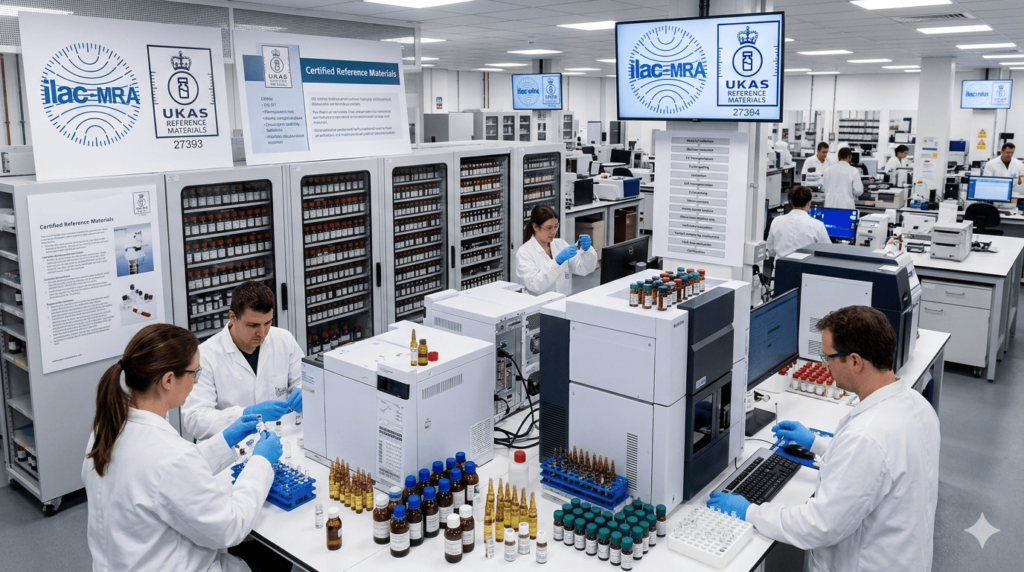
ISO 17034:latest Is Essentially Utilized For Capability Of Reference Material Makers.
ISO 17034:latest Is Planned For The Utilization By Reference Material Makers In The Advancement And Execution Of Their Administration Framework For Quality, Managerial And Specialized Activities.
ISO 17034:latest Covers The Development Of Certified And Non-certified Reference Materials.
WYAB License Expects That The Reference Material Maker Should Adjust To The Latest Version Of The Following Standards:
• ISO 17034:latest – General Necessities For The Capability Of Reference Material Makers.
• The WYAB Accreditation Scheme Manual
ISO 17034: Latest Standard for the Competence of Reference Material Producers
In modern scientific and industrial environments, accurate measurements and reliable analytical results are essential for quality assurance, safety, regulatory compliance, and global trade. Laboratories, testing organizations, and research institutions rely heavily on reference materials to validate analytical methods, calibrate instruments, and maintain consistency in measurement systems. The organizations responsible for developing and supplying these materials are known as Reference Material Producers (RMPs). To ensure their competence and the reliability of the materials they produce, international standards have been established. One of the most important standards governing this area is ISO 17034.
The latest version of ISO 17034 is essentially utilized to demonstrate the competence of reference material producers and to ensure that the reference materials they provide are reliable, traceable, and suitable for their intended purpose. The standard outlines a comprehensive framework for quality management, technical competence, and production processes involved in the development of both certified and non-certified reference materials.
Organizations seeking recognition or accreditation for producing reference materials must comply with ISO 17034 and related accreditation requirements. Accreditation bodies, such as the World Yoga Accreditation Board, often require adherence to ISO 17034 along with their own accreditation schemes to ensure that producers maintain internationally accepted standards of quality and technical competence.
Understanding Reference Material Producers
Reference Material Producers are specialized organizations responsible for the development, characterization, and distribution of reference materials used in testing, calibration, and analytical measurements. Reference materials are substances or artifacts with well-established property values that laboratories use to verify the accuracy and reliability of their measurement procedures.
These materials may include chemicals, biological samples, environmental samples, alloys, pharmaceutical standards, gases, food products, or industrial materials. Laboratories use them for instrument calibration, method validation, proficiency testing, and quality control.
Because reference materials serve as measurement benchmarks, their accuracy and reliability are critical. Any inconsistency or error in these materials can lead to inaccurate test results, which may have serious consequences in sectors such as healthcare, environmental monitoring, pharmaceuticals, and manufacturing.
This is why international standards such as ISO 17034 have been developed to regulate the competence of organizations producing reference materials.
Purpose and Scope of ISO 17034
ISO 17034 is designed to establish general requirements for the competence of reference material producers. The standard ensures that organizations involved in the production of reference materials operate under a robust management system and maintain the technical expertise necessary to produce reliable materials.
The standard applies to producers of both certified reference materials (CRMs) and non-certified reference materials. It defines the processes required to ensure the homogeneity, stability, traceability, and accurate characterization of reference materials.
The main objective of ISO 17034 is to ensure that reference materials produced by accredited organizations are suitable for their intended use and that laboratories using these materials can rely on their accuracy.
ISO 17034 covers all aspects of reference material production, including planning, material selection, preparation, testing, characterization, packaging, labeling, documentation, and distribution. It also establishes requirements for management systems, personnel competence, equipment calibration, measurement traceability, and quality assurance procedures.
By implementing ISO 17034, reference material producers can demonstrate their capability to supply reliable reference materials that meet the needs of laboratories and regulatory authorities.
Relationship Between ISO 17034 and Laboratory Standards
ISO 17034 works closely with ISO/IEC 17025, which specifies the competence requirements for testing and calibration laboratories. Laboratories accredited to ISO/IEC 17025 often rely on reference materials produced under ISO 17034 to ensure accurate measurement results.
While ISO/IEC 17025 focuses on laboratories performing testing and calibration, ISO 17034 focuses on organizations producing the materials used by those laboratories. Together, these standards create a comprehensive framework that ensures the reliability and traceability of measurement systems.
In many cases, reference material producers collaborate with ISO/IEC 17025 accredited laboratories to perform characterization studies, homogeneity testing, and stability assessments. This collaboration helps ensure that the values assigned to reference materials are accurate and scientifically valid.
Development of Certified and Non-Certified Reference Materials
ISO 17034 covers the development of both certified reference materials and non-certified reference materials. These two categories serve different purposes but both require careful production and quality control.
Certified reference materials are reference materials accompanied by a certificate that provides the value of a specified property, its associated uncertainty, and a statement of traceability to recognized measurement standards. These materials are produced using rigorous testing, statistical analysis, and validation procedures.
Certified reference materials are widely used in accredited laboratories, regulatory testing environments, and industries where high levels of measurement accuracy are required.
Non-certified reference materials, on the other hand, are materials that may not have formally certified property values but are still used for quality control, method development, or routine laboratory operations. Although they may not undergo the same level of certification as CRMs, they must still meet quality and stability requirements.
ISO 17034 provides guidelines for producing both types of materials and ensures that producers maintain consistent production processes regardless of the type of reference material being developed.
Management System Requirements Under ISO 17034
A key component of ISO 17034 is the establishment of a comprehensive management system that ensures consistent quality in reference material production. This management system must address both administrative and technical aspects of the organization’s operations.
The management system includes policies, procedures, and documentation that govern the production, testing, and distribution of reference materials. It ensures that activities are carried out in a controlled and systematic manner.
Organizations implementing ISO 17034 must establish clear organizational structures, define roles and responsibilities, and ensure that personnel involved in reference material production are competent and adequately trained.
The management system must also include document control procedures, internal audits, corrective actions, risk management, and continuous improvement processes. These elements help maintain high levels of quality and reliability in reference material production.
Technical Requirements for Reference Material Production
In addition to management system requirements, ISO 17034 includes extensive technical requirements related to the production of reference materials. These requirements ensure that materials are scientifically valid and suitable for use in analytical measurements.
One of the most important technical requirements is material characterization. Characterization involves determining the property values of a reference material using validated measurement methods. Multiple independent measurement techniques may be used to ensure accuracy.
Another important requirement is homogeneity testing. Homogeneity ensures that all units of a reference material batch contain the same composition or property values. If a material is not homogeneous, laboratories using it may obtain inconsistent results.
Stability testing is also critical. Reference materials must maintain their properties over time and under specified storage conditions. Producers must conduct stability studies to determine the shelf life of the materials and establish appropriate storage recommendations.
Measurement traceability is another essential requirement. The property values assigned to reference materials must be traceable to recognized measurement standards, often through national measurement institutes.
WYAB Accreditation Requirements
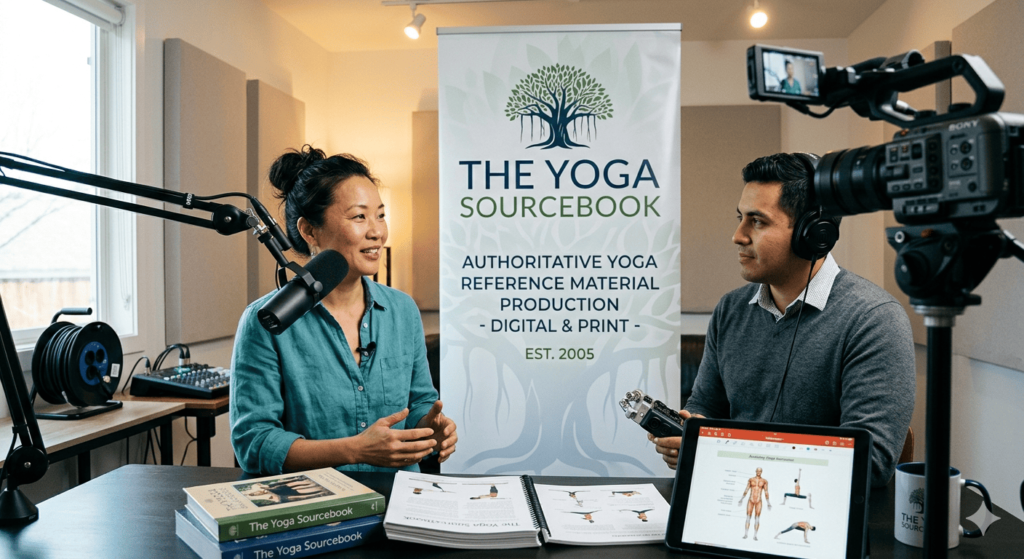
Accreditation bodies play an important role in verifying that reference material producers comply with international standards. One such body is the World Yoga Accreditation Board, which provides accreditation services for various certification, training, and quality assurance programs.
WYAB accreditation requires reference material producers to comply with the latest version of ISO 17034. This ensures that producers follow internationally accepted practices for developing and supplying reference materials.
In addition to ISO 17034, organizations seeking accreditation must comply with the WYAB Accreditation Scheme Manual. This manual outlines specific requirements, procedures, and guidelines established by WYAB to ensure consistent accreditation practices.
The accreditation process typically involves document review, technical assessment, and on-site evaluation. Assessors examine the organization’s management system, production procedures, technical capabilities, and quality assurance processes to verify compliance with the required standards.
Once accreditation is granted, organizations must maintain ongoing compliance through regular audits, surveillance assessments, and continuous improvement initiatives.
Benefits of ISO 17034 Accreditation
Achieving accreditation under ISO 17034 offers numerous benefits for reference material producers and the laboratories that rely on their materials.
One of the primary benefits is increased credibility. Accreditation demonstrates that a reference material producer operates according to internationally recognized standards and possesses the technical competence required to produce reliable materials.
Accreditation also enhances global recognition. Laboratories and organizations worldwide are more likely to trust and use reference materials produced by accredited organizations.
Another important benefit is improved quality management. Implementing ISO 17034 encourages organizations to establish systematic processes, maintain accurate documentation, and continuously improve their operations.
Accredited reference material producers also gain better access to international markets. Many regulatory agencies and accreditation bodies require laboratories to use reference materials produced under recognized standards.
Applications of Reference Materials
Reference materials produced under ISO 17034 are used in a wide range of industries and scientific disciplines.
In the pharmaceutical industry, reference materials are used to verify the purity and potency of drug substances. Pharmaceutical manufacturers rely on these materials to ensure compliance with regulatory requirements and maintain product quality.
Environmental laboratories use reference materials to measure pollutants in air, water, and soil. Accurate environmental testing helps protect ecosystems and public health.
Food safety laboratories use reference materials to detect contaminants such as pesticides, heavy metals, and pathogens in food products. These materials ensure that food testing results are reliable and consistent.
Clinical laboratories use reference materials to calibrate diagnostic instruments and validate medical testing procedures. Accurate diagnostic results are essential for patient care and treatment decisions.
Manufacturing industries use reference materials to verify the composition and properties of industrial materials such as metals, plastics, and chemicals.
Challenges in Reference Material Production
Producing high-quality reference materials presents several technical and operational challenges. One major challenge is ensuring long-term stability, particularly for biological or chemical materials that may degrade over time.
Another challenge is maintaining measurement traceability to international standards. Producers must collaborate with national measurement institutes and accredited laboratories to ensure that property values are accurately assigned.
Achieving high levels of homogeneity can also be difficult, especially for complex materials such as soil, food samples, or biological specimens.
Additionally, reference material producers must continuously develop new materials to meet the evolving needs of modern analytical technologies.
Future Developments in Reference Material Production
The field of reference material production continues to evolve as scientific technologies advance. Emerging areas such as biotechnology, nanotechnology, and advanced materials research require new types of reference materials with highly specialized properties.
Digital technologies are also transforming reference material management. Electronic certificates, digital databases, and online distribution systems are improving access to reference material information.
International collaboration among laboratories, accreditation bodies, and reference material producers is strengthening global measurement systems and ensuring consistency across borders.
These developments will further enhance the role of reference material producers in supporting scientific innovation and industrial quality assurance.
Conclusion
The latest version of ISO 17034 serves as the primary international standard for evaluating the competence of reference material producers. It provides comprehensive guidelines for management systems, technical competence, and production processes involved in the development of certified and non-certified reference materials.
Organizations seeking accreditation must demonstrate compliance with ISO 17034 and the requirements of accreditation bodies such as the World Yoga Accreditation Board. This includes adherence to the WYAB Accreditation Scheme Manual and successful completion of accreditation assessments.
By implementing ISO 17034, reference material producers can ensure the reliability, traceability, and quality of the materials they provide. These materials support accurate measurements across industries including pharmaceuticals, environmental monitoring, food safety, clinical diagnostics, and manufacturing.
As global industries continue to demand higher levels of accuracy and reliability in measurement systems, the importance of ISO 17034 and competent reference material producers will continue to grow. Their work forms the foundation of trustworthy scientific data and reliable laboratory testing worldwide.
Table of Contents
Branches
WYAB Accreditation
WYAB Head Office
WYAB World Yoga Accreditation Board
WYAB House
C/O Mr.Garry 54, Glengarnock Avenue,
E-14 3BP Isle Of Dogs, London UK
Tel .: +44-8369083940
email: info@worldyoga.us
Website: https://worldyoga.us/
MUMBAI Head Office
World Yoga Accreditation Board (WYAB)
WYAB House
B-401, New Om Kaveri Chs. Ltd., Nagindas pada,
Next To Shiv Sena Office, Nallasopara (E)
Tel .: +91-7499991895
email: info@worldyoga.us
Website: https://worldyoga.us/
DELHI-NCR Regd. Office
World Yoga Accreditation Board (WYAB)
WYAB House
Asaoti, Dist Palwal
Faridabad Delhi NCR, Haryana
Tel .: +91-7979801035
Fax: +91-250 2341170
Website: https://worldyoga.us/