WORDING OF CERTIFICATES – ISO 17020 Inspection Bodies
In the world of conformity assessment, the credibility of inspection bodies relies heavily on the clarity, consistency, and accuracy of the certificates they issue. Under the framework of ISO/IEC 17020:2012, inspection bodies are required to follow strict guidelines regarding how inspection reports and certificates are structured and worded. These certificates serve as formal evidence that a product, process, system, or installation has been assessed against defined criteria. Therefore, the wording used in such certificates is not just a matter of documentation—it is a critical component of trust, compliance, and international recognition.
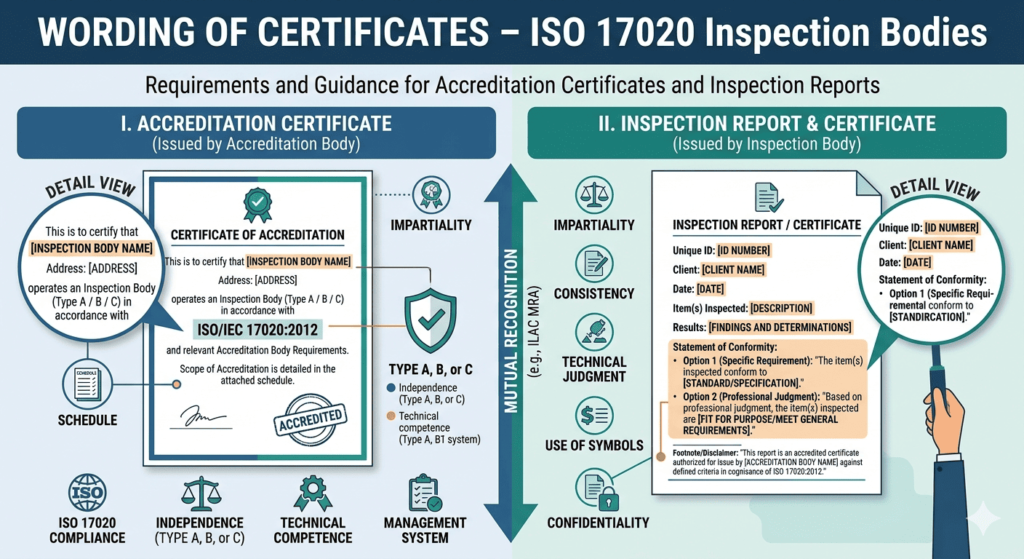
A standard reference wording is often recommended to maintain uniformity and avoid ambiguity. A typical statement might read: “This is a licensed certification approved for issue by Authorization Administration for Certifying Bodies LLC, which has assessed the organization against defined criteria and in accordance with ISO/IEC 17020:2012 – Conformity Assessment — Requirements for the operation of various types of bodies performing inspection.” This type of wording clearly communicates three essential elements: the authority issuing the certificate, the fact that an assessment has been conducted, and the standard against which the assessment has been performed. Such transparency ensures that all stakeholders, including regulators, clients, and international partners, can easily understand the scope and legitimacy of the certification.
To fully appreciate the importance of certificate wording, it is helpful to understand the terminology defined in ISO 17000:2004. Terms such as “conformity assessment” and “conformity assessment body” provide a standardized language that ensures consistency across industries and countries. Conformity assessment refers to the demonstration that specified requirements are fulfilled, while a conformity assessment body is an organization that performs such evaluations. By aligning certificate wording with these definitions, inspection bodies ensure that their documentation is universally understood and accepted.
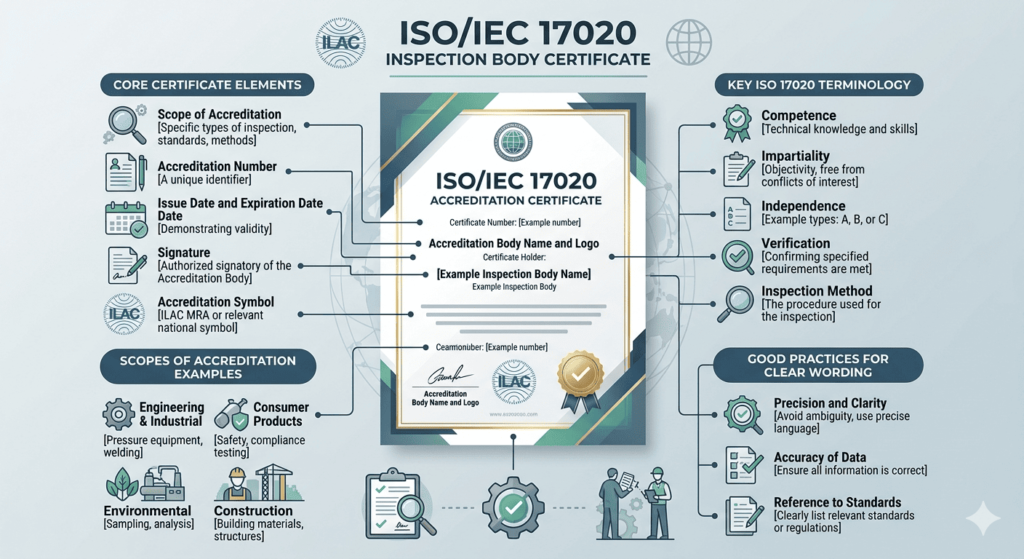
An ISO 17020 certificate must include specific information to meet compliance requirements and ensure traceability. At a minimum, the certificate should clearly state the client’s name and address, ensuring that the certified entity is accurately identified. It must also specify the assessment standards or criteria used during the inspection, which could include international standards, national regulations, or client-specific requirements. Including the initial assessment date provides a timeline for when the inspection was conducted, while the date of certificate issuance marks the official recognition of compliance.
If the certification is subject to periodic surveillance, a re-affirmation or surveillance date should also be included to demonstrate ongoing compliance. Additionally, if the certification has a defined validity period, the expiry date must be clearly stated to prevent misuse of outdated certificates.
Another critical element is the identification of the inspection body itself. The certificate must include the full name and address of the issuing body, ensuring accountability and traceability. Logos of both the inspection body and the accreditation body, if applicable, may also be included, but their use must comply with strict guidelines to avoid misrepresentation. Any limitations or conditions related to the certification must be explicitly mentioned. For example, the certificate may state that its validity is subject to satisfactory surveillance audits or compliance with certain operational conditions. These disclaimers are essential for preventing misunderstandings and protecting both the inspection body and the client.
Clause 7.4 of ISO/IEC 17020:2012 outlines additional requirements for inspection reports and certificates. These include the need for a unique identification number for each certificate, a clear description of the item or process inspected, and the results of the inspection. Where applicable, a statement of conformity must be included, indicating whether the inspected entity meets the specified requirements. This statement must be clear and unambiguous, avoiding vague language that could lead to different interpretations. It should also be based on objective evidence gathered during the inspection process. The certificate must be authorized by qualified personnel, typically through a signature or digital approval, to ensure its authenticity.
The structure of an ISO 17020 certificate generally follows a logical format that enhances readability and professionalism. The header section typically includes the title of the certificate, logos, and accreditation references. The main body contains detailed information about the client, the scope of inspection, the standards applied, and the results. The footer section includes authorization details, validity dates, and any conditions or disclaimers. This structured approach not only ensures compliance with ISO requirements but also makes the certificate easy to understand for all stakeholders.
Proper wording of certificates is essential for several reasons. From a legal perspective, certificates may be used as evidence in contracts, regulatory submissions, or dispute resolution. Clear and precise wording ensures that the certificate can withstand legal scrutiny. From an operational standpoint, standardized wording promotes consistency across different certificates issued by the same inspection body. This consistency enhances the organization’s professionalism and credibility. From a global perspective, uniform wording facilitates international acceptance of certificates, reducing the need for repeated inspections and supporting global trade.
However, incorrect or ambiguous wording can lead to significant risks. Misinterpretation of the certificate’s scope may result in improper use or reliance on the certification. In some cases, it could lead to legal disputes or regulatory non-compliance. For inspection bodies, such issues can damage reputation and even result in suspension or withdrawal of accreditation. Therefore, it is essential to implement strict controls over certificate preparation and issuance. This includes using standardized templates, verifying all information for accuracy, and ensuring that certificates are approved by authorized personnel before release.
Accreditation bodies play a vital role in maintaining the integrity of certificate wording. They review certificate formats, verify compliance with ISO standards, and ensure that logos and accreditation marks are used correctly. Inspection bodies must adhere to the guidelines provided by their accreditation bodies to maintain their accredited status. Regular audits and reviews help ensure that certificate wording remains consistent and compliant with evolving standards and regulatory requirements.
In today’s digital age, many inspection bodies are transitioning to electronic certificates. While the format may change, the requirements for wording remain the same. Digital certificates must include all mandatory information and maintain the same level of clarity and accuracy as printed versions. Additional features such as digital signatures, QR codes, and online verification systems can enhance security and authenticity, but they do not replace the need for proper wording.
In conclusion, the wording of certificates under ISO/IEC 17020:2012 is a fundamental aspect of the inspection process. It ensures that inspection results are communicated clearly, accurately, and consistently, supporting trust and confidence among stakeholders. By including all required information, following standardized phrasing, and adhering to accreditation guidelines, inspection bodies can produce certificates that are legally valid, internationally recognized, and resistant to misuse. As industries continue to evolve and global trade expands, the importance of precise and standardized certificate wording will only become more critical, reinforcing the role of inspection bodies as trusted providers of conformity assessment services.
Presentation
To guarantee propriety of declaration enrollment the accompanying phrasing on authentications should be utilized, ordinarily as a reference.
“This is a licensed authentication approved for issue by Authorization Administration for Confirming Bodies LLC who have surveyed XXXX against characterized models and in cognisance of ISO 17020:2012 Similarity appraisal — Necessities for the activity of different kinds of bodies performing assessment’.
Notes: (I) Congruity Evaluation and Similarity Appraisal Body are just terms characterized inside segments 2.1 and 2.4 of ISO 17000:2004 ‘Congruity Evaluation – Jargon and general standards’.
Endorsement Data
Declarations or examination reports ought to, as a base incorporate the accompanying data:
• Client name
• Client address
• Appraisal standard(s)
• Starting appraisal date
• Re-affirmation date (assuming intermittent observation is required)
• Date of authentication
• Expiry date of authentication (on the off chance that the confirmed status is time restricted)
• Name and address of declaration granting body (review body)
• Any vital admonitions in regards to limits on legitimacy (for example liable to agreeable execution and observation visits, and so forth)
• Logo of granting body (assessment body)
• Logo of authorization body, if material
• Required data as characterized in segment 7.4 ‘Review reports and examination endorsements’ of ISO 17020:2012 norm.
Introduction
The credibility of any inspection body depends significantly on the accuracy, consistency, and integrity of its certification documents. Under ISO/IEC 17020:2012, inspection bodies are required to maintain strict control over how certificates and inspection reports are worded, issued, and presented. These certificates are not merely formal documents—they represent verified assurance that a product, process, installation, or service complies with defined requirements.
The wording of certificates plays a critical role in ensuring transparency, avoiding misinterpretation, and maintaining international acceptance. Improper or ambiguous wording can lead to confusion, legal complications, or even rejection of certification in global markets. Therefore, inspection bodies must follow standardized phrasing aligned with ISO requirements and accreditation body expectations.
Standard Certificate Wording (Reference Format)
To ensure uniformity and propriety of certificate issuance, the following standard wording is generally recommended:
“This is a licensed certification approved for issue by Authorization Administration for Certifying Bodies LLC, which has assessed XXXX against defined criteria and in accordance with ISO/IEC 17020:2012 – Conformity Assessment — Requirements for the operation of various types of bodies performing inspection.”
This wording establishes three essential elements:
- Recognition of the issuing authority
- Confirmation of assessment against defined criteria
- Explicit reference to the applicable international standard
Such clarity ensures that stakeholders—including regulators, clients, and international partners—fully understand the scope and legitimacy of the certification.
Understanding Key Terminology
To correctly interpret certificate wording, it is important to understand terminology defined in ISO 17000:2004.
- Conformity Assessment: Demonstration that specified requirements relating to a product, process, system, or body are fulfilled.
- Conformity Assessment Body: An organization that performs conformity assessment services, such as inspection, testing, or certification.
These definitions ensure global consistency in how inspection results and certifications are interpreted.
Importance of Proper Certificate Wording
Accurate wording is not just a compliance requirement—it is fundamental to the value of certification. Proper wording ensures:
1. Legal Validity
Certificates may be used in contracts, regulatory approvals, or dispute resolution. Clear wording ensures legal enforceability.
2. International Acceptance
Organizations operating across borders rely on standardized language to ensure recognition by foreign authorities.
3. Transparency
Clients must clearly understand what has been inspected, under which criteria, and with what limitations.
4. Protection Against Misuse
Explicit wording prevents misrepresentation of certification scope or unauthorized use of certificates.
Mandatory Information on ISO 17020 Certificates
Inspection certificates or reports must include specific details as per Clause 7.4 of ISO/IEC 17020:2012. Each element contributes to traceability, authenticity, and reliability.
1. Client Name
The certificate must clearly identify the organization or individual receiving the inspection service. This ensures accountability and proper ownership of the document.
- Full legal name should be used
- Abbreviations should be avoided unless officially registered
2. Client Address
The address provides geographical identification and helps differentiate between entities with similar names.
- Must include complete postal details
- Should match official records or contracts
3. Assessment Standard(s)
The certificate must specify the exact standards or criteria used during inspection. This may include:
- National standards
- International standards (e.g., ISO)
- Client-specific technical specifications
This ensures clarity on what compliance means in the given context.
4. Initial Assessment Date
This indicates when the inspection or evaluation was first conducted.
- Provides historical reference
- Helps establish the timeline of compliance
5. Re-Affirmation / Surveillance Date
If periodic surveillance is required, the certificate must indicate the date of re-assessment.
- Ensures ongoing compliance
- Demonstrates that certification is not a one-time activity
6. Date of Certificate Issue
This is the official date on which the certificate is granted.
- Marks the start of validity
- Important for audit trails and documentation
7. Expiry Date of Certificate
If certification is time-bound, the expiry date must be clearly mentioned.
- Prevents misuse of outdated certificates
- Encourages timely renewal and reassessment
8. Name and Address of Inspection Body
The issuing body must be clearly identified.
- Includes full legal name and address
- Ensures traceability and accountability
9. Limitations and Conditions
Certificates must include any necessary disclaimers or conditions, such as:
- Validity subject to surveillance audits
- Limitations in scope
- Environmental or operational constraints
This protects both the inspection body and the client from misinterpretation.
10. Logo of Inspection Body
The inspection body’s logo serves as a visual identifier and branding element.
- Must be used consistently
- Should comply with internal branding guidelines
11. Logo of Accreditation Body
If the inspection body is accredited, the accreditation body’s logo may be used.
- Must follow strict usage rules
- Should not be misleading or imply broader scope than granted
12. Additional Required Information (Clause 7.4)
Clause 7.4 of ISO/IEC 17020:2012 specifies additional requirements for reports and certificates, including:
- Unique identification number
- Description of inspected item
- Results of inspection
- Statement of conformity (if applicable)
- Signature or authorization of responsible personnel
Structure of an ISO 17020 Certificate
A well-structured certificate typically includes:
Header Section
- Logo(s)
- Certificate title
- Accreditation reference
Body Section
- Client details
- Scope of inspection
- Standards applied
- Results and conclusions
Footer Section
- Signature and authorization
- Validity dates
- Conditions and disclaimers
This structured approach ensures readability and professionalism.
Statement of Conformity
One of the most critical components is the statement of conformity. This statement must:
- Clearly indicate whether requirements are met
- Avoid ambiguity
- Be based on objective evidence
Examples include:
- “Complies with specified requirements”
- “Meets the criteria defined in…”
The decision rule used for conformity must also be transparent.
Control of Certificate Issuance
Inspection bodies must implement strict controls over certificate issuance, including:
- Authorization procedures
- Verification of data accuracy
- Approval by qualified personnel
This ensures that only valid and verified certificates are released.
Risks of Incorrect Wording
Improper wording can lead to several risks:
- Misinterpretation of scope
- Legal disputes
- Loss of accreditation
- Damage to reputation
Therefore, standardization is essential.
Role of Accreditation Bodies
Accreditation bodies ensure that inspection bodies comply with ISO standards. They review:
- Certificate formats
- Wording consistency
- Use of logos and marks
Non-compliance may result in corrective actions or suspension.
Best Practices for Certificate Wording
Use Clear Language
Avoid technical jargon unless necessary. Use simple, precise wording.
Maintain Consistency
Use standardized templates for all certificates.
Ensure Accuracy
Double-check all details before issuance.
Follow Accreditation Guidelines
Adhere to logo usage and wording rules.
Regular Updates
Revise templates to align with updated standards or regulatory requirements.
Digital Certificates and Modern Considerations
With the rise of digital transformation, inspection bodies are increasingly issuing electronic certificates. Key considerations include:
- Secure digital signatures
- QR codes for verification
- Online validation systems
Despite the format change, wording requirements remain the same.
Global Recognition and Trade
ISO 17020 certificates facilitate international trade by:
- Providing assurance of quality and safety
- Reducing the need for repeated inspections
- Enhancing trust between trading partners
Consistent wording ensures that certificates are accepted worldwide.
Conclusion
The wording of certificates under ISO/IEC 17020:2012 is a critical component of the inspection process. It ensures clarity, credibility, and global acceptance of inspection results. By adhering to standardized phrasing, including all mandatory information, and maintaining strict control over issuance, inspection bodies can uphold the highest standards of professionalism and trust.
Table of Contents
Branches
WYAB Accreditation
WYAB Head Office
WYAB World Yoga Accreditation Board
WYAB House
C/O Mr.Garry 54, Glengarnock Avenue,
E-14 3BP Isle Of Dogs, London UK
Tel .: +44-8369083940
email: info@worldyoga.us
Website: https://worldyoga.us/
MUMBAI Head Office
World Yoga Accreditation Board (WYAB)
WYAB House
B-401, New Om Kaveri Chs. Ltd., Nagindas pada,
Next To Shiv Sena Office, Nallasopara (E)
Tel .: +91-7499991895
email: info@worldyoga.us
Website: https://worldyoga.us/
DELHI-NCR Regd. Office
World Yoga Accreditation Board (WYAB)
WYAB House
Asaoti, Dist Palwal
Faridabad Delhi NCR, Haryana
Tel .: +91-7979801035
Fax: +91-250 2341170
Website: https://worldyoga.us/