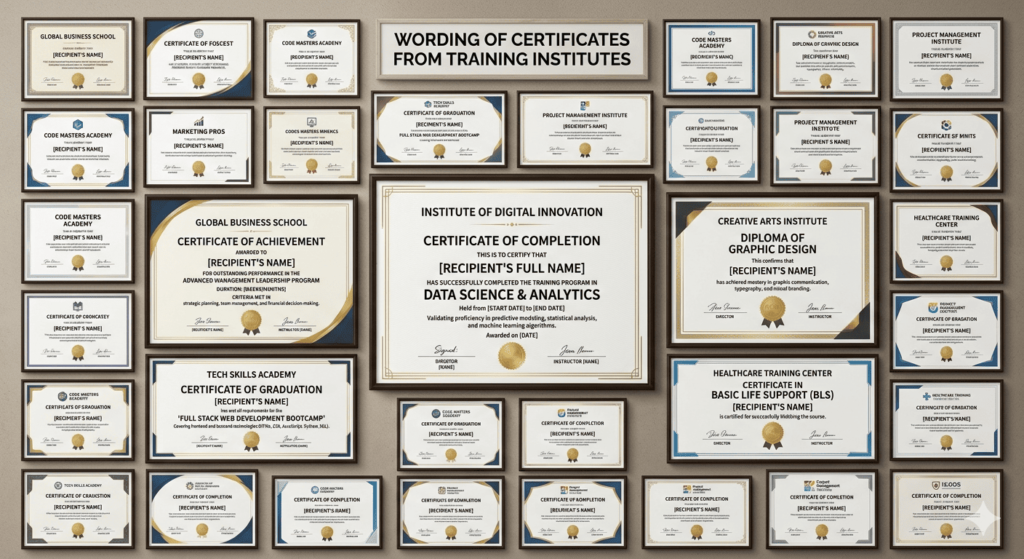
Wording of Certificates Training Institutes
In the modern education and training landscape, certificates are more than just proof of completion—they are formal representations of quality, credibility, and compliance. For training institutes, especially those aligned with accreditation frameworks such as the World Yoga Accreditation Board, the wording of certificates plays a crucial role in ensuring transparency, authenticity, and global acceptance. A well-structured certificate not only reflects the achievement of the learner but also demonstrates that the training provider adheres to recognized standards and evaluation processes. Therefore, using appropriate and standardized wording is essential for maintaining trust among students, employers, and regulatory authorities.
The phrasing of endorsements on certificates must be clear, formal, and aligned with accreditation requirements. Typically, a standardized statement is included to indicate that the certificate has been issued under an authorized framework. For example, a certificate may include wording such as: “This is a licensed certificate approved for issue by Authorization Administration for Certifying Bodies LLC, who have assessed the training institute against defined criteria and in accordance with WYAB TC:2023 ‘Certification of Instructional Courses’.
This certificate is valid only when verified through the Global Register of Quality Assessed Organizations.” Such phrasing ensures that the certificate is not perceived as self-issued but rather as part of a structured and evaluated system. It also clarifies that the accreditation body has assessed the institute, not the individual learner directly, which is an important distinction in maintaining accuracy and avoiding misrepresentation.
Another critical aspect of certificate wording is the inclusion of authentication data. Every certificate issued by a training institute should contain essential information that allows for identification, traceability, and verification. This includes the full name of the student, the complete title of the instructional course, the date of issue, and details of the assessment period. In cases where certifications require renewal, re-certification dates and expiry dates should also be clearly mentioned.
Additionally, the certificate must include the name and address of the issuing training institute, ensuring that recipients and third parties can easily identify the source of the certification. Including statements regarding the conditions of validity—such as requirements for refresher courses or periodic reassessment—further enhances the credibility and transparency of the document.
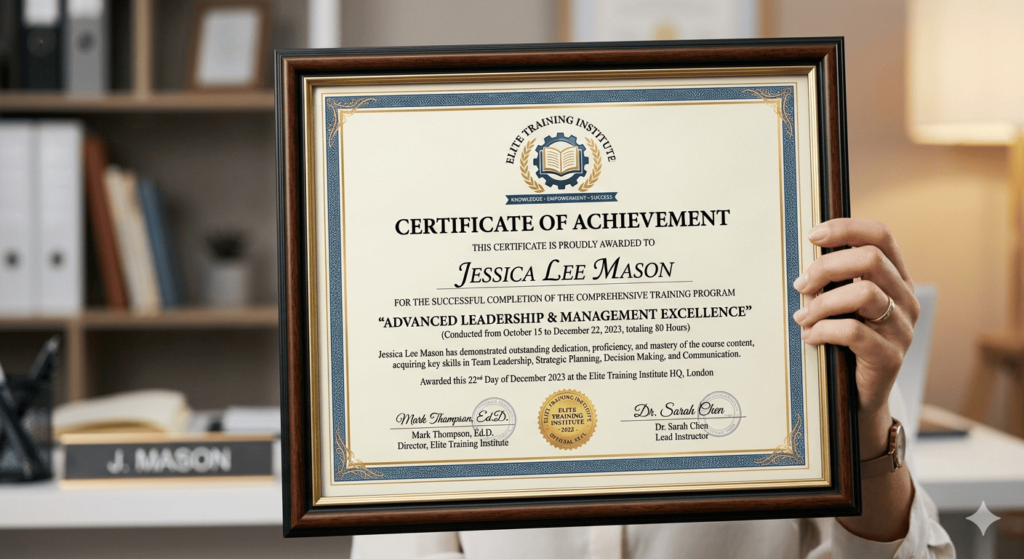
The presentation of certificates is equally important in reinforcing their value. A professionally designed certificate should have a clear structure, with all relevant information organized logically and presented in a readable format. The title of the certificate, such as “Certificate of Completion” or “Certificate of Achievement,” should be prominently displayed, followed by the candidate’s name and course details. The endorsement statement should be included in a visible but balanced manner, ensuring it is easy to read without overshadowing other key elements. Signatures of authorized personnel, along with official seals or stamps, add an additional layer of authenticity. While design elements such as fonts, borders, and colors can enhance visual appeal, they should not compromise clarity or professionalism.
One of the most sensitive elements in certificate wording is the use of accreditation marks or license imprints. For institutes accredited by the World Yoga Accreditation Board, the WYAB license mark may be displayed on the certificate, but its usage is governed by strict guidelines. The mark should appear in a non-dominant position, ensuring that it does not give the impression that the certificate has been issued directly by the accreditation body. Instead, it should clearly indicate that the training institute operates under an accredited framework.
Misuse of accreditation logos—such as placing them prominently or using them in a misleading manner—can result in serious consequences, including suspension or withdrawal of accreditation. Therefore, training institutes must carefully follow the latest guidelines for logo placement and usage.
Avoiding misrepresentation is a key responsibility for training providers when drafting certificate wording. Certificates must accurately reflect the relationship between the training institute and the accreditation body, without exaggerating or distorting the scope of accreditation. For instance, stating or implying that the accreditation body directly certifies individual learners is incorrect and misleading. Instead, the wording should emphasize that the institute has been assessed and approved to deliver certified courses. Similarly, outdated standards or incorrect references should be avoided, as they can undermine the validity of the certificate. Regular review and updating of certificate templates are necessary to ensure ongoing compliance with current accreditation requirements.
In today’s digital era, many training institutes are transitioning to electronic certificates, which offer convenience, security, and ease of verification. Despite the change in format, the principles of proper wording remain the same. Digital certificates should include all required authentication data and endorsement statements, along with additional security features such as unique identification numbers, QR codes, or digital signatures. These features enable instant verification and reduce the risk of fraud. Linking certificates to an online verification system or global register further enhances their reliability and acceptance, particularly in international contexts.
Ultimately, the wording of certificates for training institutes is not just a procedural requirement—it is a reflection of quality, integrity, and professionalism. By adopting standardized phrasing, including comprehensive authentication data, and adhering to accreditation guidelines, institutes can ensure that their certificates carry genuine value. Accreditation bodies like the World Yoga Accreditation Board provide the framework necessary to maintain consistency and trust across the training sector. When certificates are properly worded and presented, they become powerful tools that validate learning, support career advancement, and uphold the reputation of both the learner and the institution.
PHRASING OF ENDORSEMENTS
Certification of Instructional classes
PRESENTATION
To guarantee the fittingness of declaration enlistment, the accompanying phrasing on testaments should be utilized, commonly as a reference.
“This is a licensed testament approved for issue by Authorization Administration for Affirming Bodies LLC, who have evaluated XXXX against characterized models and in cognisance of WYAB TC:2023 ‘Certification of Instructional classes’. This endorsement is just legitimate when affirmed by the register recorded in the Global Register of Value Surveyed Associations.”
AUTHENTICATION DATA
Endorsements or examination reports ought to, as a base, incorporate the accompanying data:
• Understudy name
• Instructional classes name in full
• Date of endorsement
• Beginning appraisal date
• Re-certificate date (if appropriate)
• The expiry date of the authentication (if relevant)
• Name and address of authentication granting body (preparing organization)
• Admonitions with respect to limits on legitimacy (for example dependent upon a good intermittent boost course and re-assessment, and so on.)
• Logo of granting body (preparing foundation)
• The license sign of WYAB (see underneath)
LICENSE IMPRINT
The WYAB license imprint might be displayed on the endorsement in a way that is the least predominant imprint on the testament and in a style with the end goal that it won’t cause any sensible spectator to construe or in any case accept that the endorsement is given straight by WYAB. If it’s not too much trouble, see (most recent adaptation) for additional prerequisites.
Phrasing of Endorsements, Certification of Instructional Classes & Presentation Guidelines
In today’s highly competitive education and training ecosystem, certificates are more than just formal documents—they are symbols of credibility, competence, and compliance. For training institutes operating under accreditation frameworks such as the World Yoga Accreditation Board (WYAB), the wording and structure of certificates must be precise, standardized, and aligned with defined guidelines.
Proper certificate wording ensures authenticity, enhances trust among stakeholders, and prevents misuse or misinterpretation. This comprehensive guide outlines the correct phrasing, essential authentication data, presentation requirements, and usage of accreditation marks for training institutes offering certified instructional courses.
1. Importance of Standardized Certificate Wording
Certificates issued by training institutes serve multiple purposes:
- Recognition of learner achievement
- Proof of competency and skills acquired
- Compliance with accreditation requirements
- Professional validation for employment or advancement
However, without standardized wording, certificates can create confusion regarding their legitimacy. Accreditation bodies like WYAB establish structured phrings to ensure:
- Uniformity across certified institutions
- Transparency in evaluation processes
- Clear distinction between the training provider and the accrediting authority
- Prevention of misleading claims
Proper wording reinforces that the training institute has been evaluated against specific criteria and that the certification aligns with recognized standards.
2. Standard Phrasing of Endorsements
To maintain consistency and credibility, training institutes must use the following standardized endorsement statement on certificates:
“This is a licensed certificate approved for issue by Authorization Administration for Certifying Bodies LLC, who have assessed [Training Institute Name] against defined criteria and in accordance with WYAB TC:2023 ‘Certification of Instructional Courses’. This certificate is only valid when confirmed by the register listed in the Global Register of Quality Assessed Organizations.”
Key Elements Explained
- “Licensed certificate approved for issue”
Indicates that the certificate is not self-issued but authorized under a recognized framework. - “Authorization Administration for Certifying Bodies LLC”
Refers to the governing authority responsible for evaluating certification bodies. - “Assessed against defined criteria”
Confirms that the institute has undergone evaluation based on structured benchmarks. - “WYAB TC:2023 Certification of Instructional Courses”
Specifies the exact accreditation standard applied. - “Valid when confirmed by the register”
Ensures that certificates can be verified through an official registry.
This phrasing eliminates ambiguity and ensures that recipients, employers, and regulatory bodies clearly understand the legitimacy and scope of the certification.
3. Certification of Instructional Courses
Certification of instructional courses refers to the formal recognition that a training program meets predefined standards in terms of:
- Curriculum design
- Delivery methodology
- Trainer competence
- Assessment mechanisms
- Quality assurance systems
Under WYAB TC:2023, training institutes must demonstrate:
3.1 Structured Curriculum Framework
Courses should have clearly defined learning objectives, modules, and outcomes aligned with industry or academic standards.
3.2 Qualified Trainers
Instructors must possess relevant qualifications, experience, and teaching capabilities.
3.3 Assessment Integrity
Evaluation processes must be fair, consistent, and measurable.
3.4 Continuous Improvement
Institutes should regularly update course content and teaching methodologies.
3.5 Learner Support Systems
Adequate support mechanisms such as mentoring, feedback, and resources must be in place.
Certification wording must reflect that all these aspects have been assessed and approved under the accreditation system.
4. Presentation Requirements for Certificates
The presentation of a certificate is as important as its content. A professionally designed certificate enhances credibility and reflects the institute’s quality standards.
4.1 Layout and Structure
A standard certificate should include:
- Title (e.g., “Certificate of Completion” or “Certificate of Achievement”)
- Candidate’s full name
- Course title
- Accreditation statement
- Dates (issue, assessment, expiry)
- Signatures of authorized personnel
- Logos and accreditation marks
4.2 Typography and Design
- Use clear and professional fonts
- Maintain readability and visual hierarchy
- Avoid excessive decorative elements that may distract from essential information
4.3 Language Clarity
- Use formal and unambiguous language
- Avoid exaggerated claims or misleading statements
- Ensure consistency with accreditation wording
5. Authentication Data Requirements
To ensure traceability and authenticity, every certificate must include the following minimum data:
5.1 Candidate Information
- Full name of the student (as per official records)
5.2 Course Details
- Full name of the instructional course
- Course code (if applicable)
5.3 Dates
- Date of certificate issuance
- Initial assessment date
- Re-certification date (if applicable)
- Expiry date (if applicable)
5.4 Issuing Body Information
- Name of the training institute
- Full address of the institute
5.5 Validity Conditions
- Statements regarding limitations or conditions of validity
(e.g., subject to refresher training or periodic reassessment)
5.6 Logos and Marks
- Training institute logo
- Accreditation mark (WYAB license mark)
Including these elements ensures that certificates can be verified and trusted by employers, regulatory authorities, and other stakeholders.
6. Role of Accreditation Bodies
Accreditation bodies like World Yoga Accreditation Board play a crucial role in maintaining the integrity of certification systems.
Their responsibilities include:
- Defining accreditation standards
- Assessing training institutes
- Monitoring compliance
- Maintaining public registers of certified organizations
- Ensuring transparency and accountability
By adhering to WYAB guidelines, training institutes demonstrate their commitment to quality and global best practices.
7. Use of WYAB License Imprint
The WYAB license imprint is a critical component of certified training institute certificates. However, its use is strictly regulated.
7.1 Placement Guidelines
- The WYAB mark must be displayed in a non-dominant position
- It should not overshadow the training institute’s logo
- It must be clearly distinguishable from the institute’s branding
7.2 Purpose
The imprint indicates that the institute operates under WYAB accreditation but does not imply that WYAB directly issued the certificate.
7.3 Restrictions
- Must not be used in a misleading manner
- Must comply with the latest WYAB branding guidelines
- Should not suggest endorsement beyond accreditation
Failure to follow these guidelines may result in suspension or withdrawal of accreditation.
8. Avoiding Misrepresentation
Misrepresentation in certificate wording is a serious issue that can damage institutional credibility and lead to legal consequences.
Common Mistakes to Avoid:
- Claiming direct certification by the accreditation body
- Omitting verification requirements
- Using incorrect or outdated standards
- Misplacing accreditation logos
- Providing incomplete authentication data
Training institutes must ensure that all certificates are accurate, transparent, and compliant with accreditation requirements.
9. Verification and Global Register
A key aspect of modern certification systems is verifiability. Certificates should be linked to a global or centralized register where stakeholders can confirm their authenticity.
Benefits of Verification Systems:
- Prevents fraud and forgery
- Enhances employer confidence
- Supports digital credentialing
- Enables easy validation across borders
The endorsement statement should clearly mention that the certificate is valid only when verified through the official register.
10. Digital Certificates and Modern Practices
With the rise of digital transformation, many training institutes now issue electronic certificates.
Key Considerations:
- Use secure digital signatures
- Provide unique identification numbers
- Enable online verification
- Ensure compatibility with digital credential platforms
Even in digital formats, the wording and structure must remain consistent with accreditation requirements.
11. Best Practices for Training Institutes
To maintain high standards in certificate issuance, training institutes should adopt the following best practices:
11.1 Standardization
Develop a uniform certificate template aligned with accreditation guidelines.
11.2 Quality Control
Implement internal checks before issuing certificates.
11.3 Staff Training
Ensure administrative staff understand certification requirements.
11.4 Record Management
Maintain accurate records of issued certificates.
11.5 Continuous Compliance
Regularly review and update certificate formats based on latest accreditation standards.
12. Legal and Ethical Considerations
Certificates are legal documents and must be treated with responsibility.
Legal Aspects:
- Compliance with accreditation agreements
- Protection against fraudulent use
- Adherence to intellectual property rights (logos, marks)
Ethical Aspects:
- Honest representation of learner achievements
- Transparency in evaluation processes
- Accountability in certification practices
13. Conclusion
The wording of certificates for training institutes is a critical aspect of accreditation compliance and institutional credibility. By following standardized phrasing, including essential authentication data, and adhering to presentation guidelines, institutes can ensure that their certificates are trusted, verifiable, and globally recognized.
Accreditation bodies like the World Yoga Accreditation Board provide the framework necessary to maintain consistency and quality across training providers. Proper use of endorsement statements, authentication data, and license imprints ensures that certificates accurately reflect the value of the training delivered.
Table of Contents
Branches
WYAB Accreditation
WYAB Head Office
WYAB World Yoga Accreditation Board
WYAB House
C/O Mr.Garry 54, Glengarnock Avenue,
E-14 3BP Isle Of Dogs, London UK
Tel .: +44-8369083940
email: info@worldyoga.us
Website: https://worldyoga.us/
MUMBAI Head Office
World Yoga Accreditation Board (WYAB)
WYAB House
B-401, New Om Kaveri Chs. Ltd., Nagindas pada,
Next To Shiv Sena Office, Nallasopara (E)
Tel .: +91-7499991895
email: info@worldyoga.us
Website: https://worldyoga.us/
DELHI-NCR Regd. Office
World Yoga Accreditation Board (WYAB)
WYAB House
Asaoti, Dist Palwal
Faridabad Delhi NCR, Haryana
Tel .: +91-7979801035
Fax: +91-250 2341170
Website: https://worldyoga.us/