ACCREDITATION OF PERSONNEL CERTIFICATION SCHEMES
Accreditation of personnel certification schemes is a vital mechanism for ensuring that individuals certified in a particular profession or discipline meet globally recognized standards of competence, ethics, and performance. In an increasingly competitive and quality-driven world, organizations, employers, and regulatory bodies seek assurance that certified professionals possess not only theoretical knowledge but also practical skills and ongoing professional capability. This is where internationally accepted frameworks such as ISO/IEC 17024 play a crucial role. This standard provides a structured and reliable foundation for organizations that certify individuals, ensuring that their processes are fair, consistent, and transparent.
The accreditation process for personnel certification schemes is typically conducted in a systematic and multi-stage manner to ensure that certification bodies operate at the highest level of quality and integrity. The journey begins with the application stage, where the organization seeking accreditation submits detailed information about its structure, certification scope, and operational processes. This initial step is critical, as it sets the foundation for the evaluation process. Once the application is reviewed and found suitable, the accreditation body issues a fee invoice, and upon payment, the applicant proceeds to the next stage of documentation submission. At this point, the organization must provide comprehensive details about its personnel certification management system, including policies, procedures, assessment methods, and quality assurance mechanisms.
The core of the accreditation process lies in the evaluation of the organization against the requirements of ISO/IEC 17024. This involves a thorough review of documentation as well as practical assessments to verify that the certification body operates with impartiality, competence, and consistency. The accreditation body examines critical elements such as examiner qualifications, assessment procedures, certification decision processes, and systems for handling complaints and appeals. This stage ensures that the certification body is capable of delivering reliable and credible certification outcomes.
Following a successful evaluation, the organization may be granted a temporary or provisional accreditation status. This allows the certification body to begin its operations under controlled conditions while demonstrating the effectiveness of its systems in real-world scenarios. During this phase, the organization must adhere strictly to the requirements set by the accreditation body and maintain accurate records of its certification activities. A formal agreement is then established between the accreditation body and the certification organization, outlining responsibilities, conditions, and the scope of accreditation.
An important aspect of personnel certification accreditation is the requirement for registering all certified individuals in a centralized system. For instance, organizations accredited by bodies such as the World Yoga Accreditation Board (WYAB) must ensure that certificate holders are recorded in an official database. This process enhances transparency, enables easy verification of credentials, and reduces the risk of fraudulent certifications. Certification bodies are typically provided with access to dedicated online platforms where they can manage candidate data, upload certification details, and maintain records efficiently.
The accreditation process is further divided into structured stages, including application, document assessment, temporary authorization, and full authorization. During the document assessment stage, the accreditation body evaluates the organization’s compliance with ISO 17024 requirements and assesses the capability of any associated training providers or partners. Temporary authorization allows the organization to initiate certification services, while full authorization is granted only after verifying that all systems are fully implemented and functioning effectively. This verification may include on-site audits, remote assessments, or witnessing certification activities to ensure compliance in practice.
One of the distinguishing features of personnel certification schemes under ISO/IEC 17024 is the emphasis on continuous competence rather than one-time qualification. Unlike training certifications, which simply confirm course completion, personnel certification requires ongoing monitoring, periodic reassessment, and continuing professional development (CPD). This ensures that certified individuals remain up to date with industry standards and maintain their professional competence over time. As a result, such certifications carry greater value and credibility in the global marketplace.
The benefits of accreditation extend to all stakeholders involved. For certification bodies, accreditation enhances credibility, builds trust, and opens opportunities for international recognition. For individuals, it provides a competitive advantage in the job market and assures employers of their competence. Employers, in turn, benefit from reduced hiring risks and improved workforce quality. Accreditation also supports regulatory compliance and contributes to the overall improvement of industry standards.
However, achieving accreditation is not without challenges. Organizations must invest time and resources in developing compliant systems, training personnel, and maintaining impartiality in their operations. Documentation must be thorough and aligned with ISO 17024 requirements, and internal audits must be conducted regularly to ensure continuous improvement. Despite these challenges, organizations that successfully achieve accreditation gain a significant advantage in terms of reputation and operational excellence.
Another critical component of the accreditation framework is ongoing surveillance and monitoring. Accreditation bodies conduct periodic audits and reviews to ensure that certification bodies continue to comply with established standards. This may involve reviewing certification records, analyzing feedback from certified individuals, and assessing how complaints and appeals are managed. Continuous monitoring ensures that the integrity of the certification process is maintained over time and that any deviations are promptly addressed.
In conclusion, accreditation of personnel certification schemes is a comprehensive and structured process that ensures the reliability, consistency, and global acceptance of certified professionals. By adhering to standards such as ISO/IEC 17024, certification bodies can establish robust systems that validate not just knowledge but actual competence. The multi-stage accreditation process, combined with continuous monitoring and mandatory registration of certified individuals, creates a strong foundation for trust and transparency. As industries continue to evolve and demand higher levels of professionalism, accredited personnel certification schemes will remain essential in shaping a skilled, competent, and globally recognized workforce.
1 License of staff certificate plans is accomplished in stages. These are:
• Application, see structure .
• Survey application and in the event that proper issue receipt.
• Settlement of receipt by candidate.
• Archive accommodation of associations staff the executives framework and center quality confirmation parts.
• Evaluation of association as per ISO 17024.
• Temporary license choice
• Contract and arrangement and marks.
• Posting in WYAB
• Client account made at www.irgao.com for understudy/authentication posting.
• Execution check of the board framework – actual visit or far off appraisal counting examining of staff input
2 A prerequisite of license all declaration beneficiaries are enlisted with WYAB. This is finished by direct information passage of understudy subtleties by the staff certificate body at https://worldyoga.us/
3 Note: ISO 17024 is fundamentally expected for custom tailored faculty conspires that require persistent checking or CPD, instead of simply the fundamental arrangement of preparing. Preparing certification at a supplier or individual course level is accessible through a different certification conspire.
4 License of faculty certificate body is accomplished in the accompanying stages:
Stage 1 Application
Introductory enrollment following Application installment.
Stage 2 Report appraisal
Evaluation of ISO 17024 administration framework documentation.
Recording capability of suppliers.
Stage 3 Temporary Authorization
Enlistment of work force affirmation administrations.
Grant of staff confirmation body status.
“Middle Authorization” if vital.
Stage 4 Full Authorization
Confirmation of accreditation administrations and the board framework execution.
Note: Confirmation might involve (I) seeing execution to candidate’s detriment, (ii) audit of criticism structures from registrants or (iii) other observation action.
5 Enlistment of authentication holders will be made with WYAB (by means of https://worldyoga.us/) toward the finish of the primary day of issue of authentications.
6 The staff certificate body will be licensed in cognisance of ISO 17024.
Accreditation of personnel certification schemes plays a critical role in ensuring competence, credibility, and global acceptance of certified professionals across industries. In today’s competitive and quality-driven environment, organizations increasingly rely on structured certification frameworks to validate the knowledge, skills, and abilities of individuals. One of the most recognized international benchmarks for personnel certification bodies is ISO/IEC 17024, which sets out requirements for organizations certifying individuals against specific criteria.
This comprehensive framework ensures that certification bodies operate in a consistent, reliable, and impartial manner, thereby enhancing trust among employers, regulators, and the public. The accreditation process for personnel certification schemes is methodical and conducted in multiple stages to guarantee that the certification body meets all necessary technical, administrative, and quality requirements.
Understanding Personnel Certification Accreditation
Personnel certification accreditation refers to the formal recognition granted to an organization that demonstrates competence in certifying individuals according to defined standards. This recognition is typically awarded by an accreditation body such as the World Yoga Accreditation Board (WYAB), which evaluates whether the certification body complies with applicable international standards and maintains a robust management system.
Accreditation ensures:
- Fair and impartial assessment of candidates
- Consistency in certification decisions
- Transparency in processes
- Ongoing monitoring and improvement
Unlike simple training certifications, personnel certification schemes focus on verifying competence rather than just course completion. This distinction is crucial, especially in sectors where professional performance directly impacts safety, quality, and compliance.
Stages of Accreditation for Personnel Certification Schemes

Accreditation is not a one-step process; it is carried out in a structured sequence of stages designed to thoroughly evaluate the applicant organization.
1. Application Submission
The process begins with the submission of an application form by the certification body seeking accreditation. This application provides detailed information about the organization, its scope of certification, and the schemes it intends to operate.
The application stage includes:
- Completion of prescribed forms
- Submission of organizational details
- Declaration of intended certification scope
Once submitted, the accreditation body reviews the application for completeness and relevance.
2. Application Review and Invoice Issuance
After receiving the application, the accreditation body conducts a preliminary review. If the application meets the initial requirements, an invoice is issued to the applicant organization.
This stage ensures:
- Validity of application data
- Alignment with accreditation scope
- Readiness for further evaluation
3. Payment of Fees
The applicant organization must settle the invoice to proceed further. Payment confirms the organization’s commitment to the accreditation process and allows the accreditation body to allocate resources for evaluation.
4. Documentation Submission
At this stage, the applicant submits detailed documentation related to its personnel management system and quality assurance mechanisms.
Key documents include:
- Quality manual
- Procedures for certification
- Competence criteria for candidates
- Assessment methodologies
- Internal audit and review processes
These documents are critical for evaluating compliance with ISO/IEC 17024.
5. Assessment Against ISO 17024
The accreditation body conducts a thorough evaluation of the organization based on ISO 17024 requirements. This includes both document review and practical assessment.
Key focus areas:
- Impartiality and independence
- Competence of assessors
- Examination processes
- Certification decision-making
- Complaint and appeal handling
This stage ensures that the certification body operates with integrity and technical competence.
6. Temporary Accreditation Decision
If the organization meets the essential requirements, a temporary accreditation (or provisional approval) may be granted. This allows the organization to begin operating under controlled conditions.
Temporary accreditation:
- Enables initial certification activities
- Allows real-world validation of systems
- Acts as a transitional phase before full accreditation
7. Agreement and Contract Signing
Following the temporary approval, a formal agreement is signed between the accreditation body and the certification organization. This agreement outlines roles, responsibilities, and conditions of accreditation.
8. Listing in Accreditation Registry
Once approved, the certification body is officially listed in the accreditation body’s registry, such as the directory maintained by the World Yoga Accreditation Board (WYAB).
This listing:
- Enhances visibility and credibility
- Confirms recognized status
- Allows stakeholders to verify accreditation
9. Creation of Client Account
The certification body is provided with access to an online platform (e.g., www.irgao.com) for managing candidate and certification data.
This platform enables:
- Registration of certified individuals
- Tracking of certification records
- Transparency in credential management
10. System Implementation Verification
The final step in this phase involves verifying the actual implementation of the management system. This may include:
- On-site audits
- Remote assessments
- Review of candidate feedback
This ensures that documented procedures are effectively implemented in practice.
Mandatory Registration of Certificate Holders
A key requirement of accreditation is that all certified individuals must be registered with the accreditation body. This is typically done through direct data entry by the certification body into an official portal.
For example, under the World Yoga Accreditation Board (WYAB), certification bodies are required to register candidates through their designated platform.
Benefits of registration include:
- Centralized database of certified professionals
- Improved traceability and verification
- Prevention of fraudulent certifications
Role of ISO 17024 in Personnel Certification
ISO/IEC 17024 is specifically designed for personnel certification schemes that require continuous monitoring and professional development.
It emphasizes:
- Competence-based assessment
- Ongoing surveillance (CPD – Continuing Professional Development)
- Periodic re-certification
Unlike training certifications, ISO 17024 focuses on sustained competence rather than one-time learning outcomes.
Accreditation Process for Personnel Certification Bodies
The accreditation of a personnel certification body follows a structured four-stage model:
Stage 1: Application
This initial stage involves:
- Submission of application
- Payment of registration fees
- Initial onboarding
It marks the formal beginning of the accreditation journey.
Stage 2: Document Assessment
In this stage, the accreditation body evaluates:
- ISO 17024 management system documentation
- Certification schemes and criteria
- Competence frameworks
Additionally, the capability of training providers or partners is also assessed.
Stage 3: Temporary Authorization
During this phase:
- The organization is granted provisional recognition
- Certification services can begin
- Monitoring mechanisms are established
In some cases, an “interim authorization” may be issued to allow limited operations.
Stage 4: Full Authorization
Full accreditation is granted after successful verification of:
- Certification processes
- System implementation
- Compliance with ISO 17024
Verification methods may include:
- Witnessing certification activities
- Reviewing candidate feedback
- Conducting surveillance audits
This stage confirms that the organization meets all accreditation requirements.
Registration of Certification Holders
Certification bodies must ensure that all certificate holders are registered with the accreditation authority immediately after certification issuance.
This process:
- Begins on the first day of certificate issuance
- Requires accurate and complete data entry
- Ensures global recognition of credentials
Importance of Accreditation in Personnel Certification
Accreditation provides numerous benefits to all stakeholders:
For Certification Bodies
- Enhanced credibility and trust
- International recognition
- Improved operational efficiency
For Certified Individuals
- Global acceptance of credentials
- Increased employability
- Assurance of competence
For Employers
- վստահ भरोसा in certified professionals
- Reduced hiring risks
- Improved workforce quality
Continuous Monitoring and Surveillance
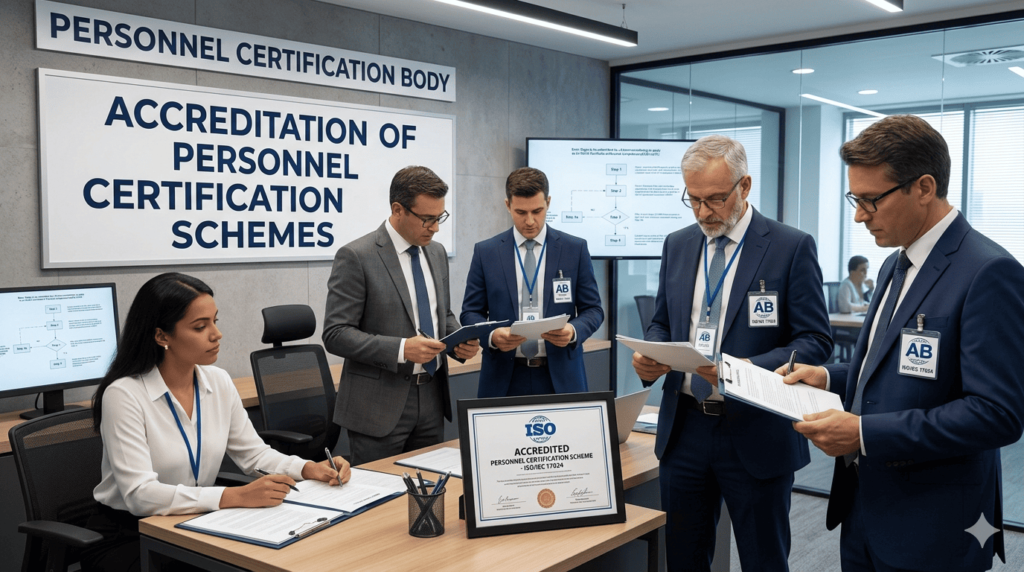
Accreditation is not a one-time activity. Certification bodies are subject to ongoing monitoring to ensure continued compliance.
Surveillance activities include:
- Periodic audits
- Review of certification decisions
- Monitoring of complaints and appeals
This ensures continuous improvement and adherence to standards.
Distinction Between Training Certification and Personnel Certification
It is important to distinguish between:
- Training certification (course completion)
- Personnel certification (competence validation)
Personnel certification under ISO/IEC 17024 requires:
- Practical assessment
- Ongoing evaluation
- Professional development
This makes it more robust and reliable.
Challenges in Accreditation
Organizations may face several challenges during accreditation:
- Developing compliant documentation
- Ensuring impartiality
- Maintaining consistency in assessments
- Managing data and records
However, these challenges can be addressed through proper planning and expert guidance.
Best Practices for Successful Accreditation
To achieve accreditation successfully, organizations should:
- Align processes with ISO 17024 requirements
- Train staff and assessors thoroughly
- Implement strong quality management systems
- Conduct internal audits regularly
These practices enhance readiness and improve success rates.
Conclusion
Accreditation of personnel certification schemes is a vital process that ensures the credibility, consistency, and global recognition of certified professionals. By adhering to internationally recognized standards like ISO/IEC 17024, certification bodies can establish robust systems that validate competence rather than just knowledge.
Table of Contents
Branches
WYAB Accreditation
WYAB Head Office
WYAB World Yoga Accreditation Board
WYAB House
C/O Mr.Garry 54, Glengarnock Avenue,
E-14 3BP Isle Of Dogs, London UK
Tel .: +44-8369083940
email: info@worldyoga.us
Website: https://worldyoga.us/
MUMBAI Head Office
World Yoga Accreditation Board (WYAB)
WYAB House
B-401, New Om Kaveri Chs. Ltd., Nagindas pada,
Next To Shiv Sena Office, Nallasopara (E)
Tel .: +91-7499991895
email: info@worldyoga.us
Website: https://worldyoga.us/
DELHI-NCR Regd. Office
World Yoga Accreditation Board (WYAB)
WYAB House
Asaoti, Dist Palwal
Faridabad Delhi NCR, Haryana
Tel .: +91-7979801035
Fax: +91-250 2341170
Website: https://worldyoga.us/