
Proficiency Testing Providers
In today’s quality-driven and compliance-focused world, laboratories are expected to deliver highly accurate, consistent, and reliable results. Whether operating in healthcare, pharmaceuticals, food testing, environmental monitoring, or industrial sectors, the credibility of a laboratory depends heavily on its ability to demonstrate technical competence. One of the most effective ways to validate this competence is through proficiency testing, conducted by specialized proficiency testing providers.
These providers play a crucial role in evaluating laboratory performance through structured inter-laboratory comparisons, helping organizations identify gaps, improve processes, and maintain international standards. At the center of this system lies the globally recognized standard ISO/IEC 17043, developed under the framework of the International Organization for Standardization, which defines the requirements for the competence of proficiency testing providers and ensures the integrity of proficiency testing schemes.
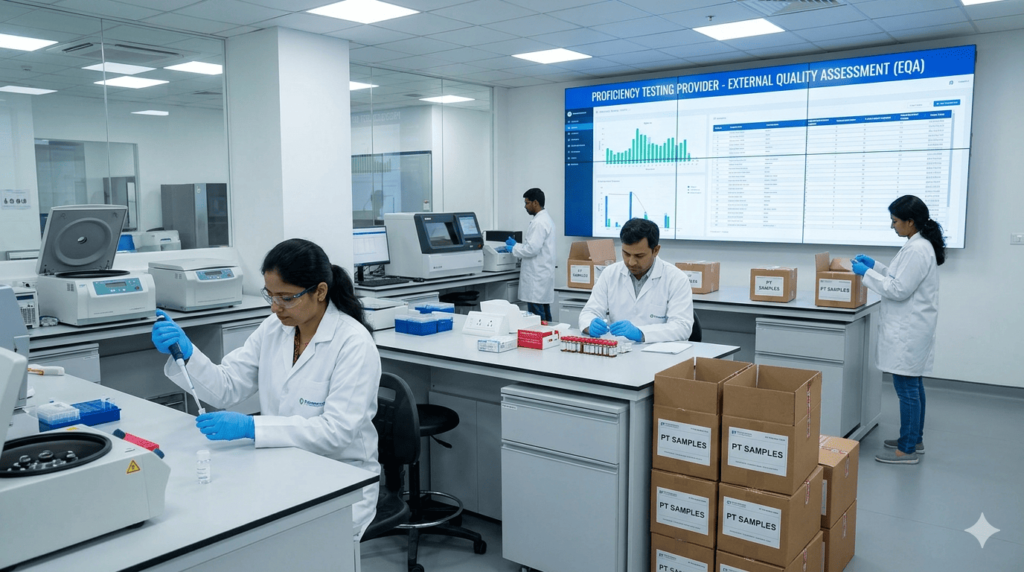
Proficiency testing is essentially a comparative evaluation process in which multiple laboratories analyze the same sample under predetermined conditions, and their results are compared against each other or against an assigned reference value. This process allows laboratories to assess their performance objectively and identify any deviations from expected results. Proficiency testing providers are responsible for organizing these schemes, ensuring that samples are properly prepared, distributed, and evaluated. Their role extends beyond simple coordination; they must ensure that the entire process is scientifically valid, statistically sound, and conducted with complete impartiality. By participating in proficiency testing programs, laboratories gain valuable insights into their technical capabilities and can take corrective actions where necessary, ultimately improving the quality of their testing services.
The importance of proficiency testing providers becomes even more evident when considering the stringent requirements of international accreditation standards. Laboratories seeking accreditation under standards such as ISO/IEC 17025 are often required to participate in proficiency testing programs as part of their quality assurance framework. This makes proficiency testing not just a best practice, but a critical requirement for demonstrating competence and achieving accreditation.
The ISO/IEC 17043 standard ensures that proficiency testing providers themselves are competent and capable of delivering reliable and unbiased assessments. It covers both management and technical requirements, including quality management systems, personnel competence, equipment calibration, sample handling, and statistical analysis. By complying with this standard, proficiency testing providers can ensure that their programs are credible and widely accepted across industries.
One of the key strengths of proficiency testing lies in its ability to identify hidden issues within laboratory operations. Even well-established laboratories can experience variations in results due to factors such as equipment calibration errors, environmental conditions, or human mistakes. Proficiency testing acts as an external check that highlights these issues before they lead to significant problems. For example, if a laboratory consistently produces results that deviate from the consensus value, it may indicate a systematic error that needs immediate attention. This proactive approach helps laboratories maintain high levels of accuracy and reliability, which are essential for building trust with clients, regulators, and stakeholders.
Proficiency testing providers also contribute significantly to the standardization of testing methods across laboratories. By using uniform samples and evaluation criteria, they help ensure that different laboratories produce comparable results, regardless of their location or operational setup. This is particularly important in global industries where consistency and interoperability are critical. For instance, in the pharmaceutical sector, consistent testing results are essential for ensuring the safety and efficacy of products. Similarly, in environmental monitoring, accurate and comparable data is crucial for assessing pollution levels and implementing regulatory measures. Proficiency testing providers help achieve this level of standardization by following strict protocols and guidelines, ensuring that all participants are evaluated on a level playing field.
Another important aspect of proficiency testing is the statistical analysis of results. Proficiency testing providers use advanced statistical methods to evaluate laboratory performance, often employing metrics such as z-scores to determine how far a laboratory’s result deviates from the assigned value. These statistical tools provide an objective and quantitative measure of performance, allowing laboratories to understand their strengths and weaknesses more clearly. The use of robust statistical techniques also ensures that the evaluation process is fair and unbiased, minimizing the impact of outliers or random variations. This scientific rigor is one of the reasons why proficiency testing is widely trusted as a reliable method for performance assessment.
In addition to technical evaluation, proficiency testing providers emphasize confidentiality and impartiality. Laboratories participating in proficiency testing programs are typically assigned unique identification codes, ensuring that their results remain anonymous. This encourages honest participation and prevents any potential bias in the evaluation process. Maintaining confidentiality is essential for building trust between proficiency testing providers and participating laboratories, as it assures organizations that their performance data will not be misused or disclosed without consent.
Organizations such as WYAB (Worldwide Accreditation Board) further reinforce the importance of proficiency testing by requiring providers to comply with the latest version of ISO/IEC 17043 and demonstrate technical competence in their respective fields. WYAB confirmation ensures that proficiency testing providers operate in accordance with internationally recognized standards and follow well-defined certification schemes. This additional layer of oversight enhances the credibility of proficiency testing programs and provides assurance to laboratories that they are participating in high-quality and reliable assessments.
As industries continue to evolve and technological advancements reshape the landscape of laboratory testing, proficiency testing providers are also adapting to new challenges and opportunities. Digital platforms are increasingly being used for data submission and reporting, making the process more efficient and accessible. Automation and data analytics are improving the accuracy and speed of result evaluation, while customized proficiency testing schemes are being developed to meet the specific needs of different industries. These innovations are helping proficiency testing providers deliver more value to laboratories and support continuous improvement in quality assurance practices.
In conclusion, proficiency testing providers play a vital role in ensuring the accuracy, reliability, and credibility of laboratory results. By organizing structured inter-laboratory comparisons and adhering to the stringent requirements of ISO/IEC 17043, they provide laboratories with the tools and insights needed to maintain high standards of performance. Proficiency testing is not just a regulatory requirement; it is a powerful mechanism for continuous improvement, helping laboratories identify weaknesses, enhance their capabilities, and build confidence among stakeholders. In an increasingly competitive and quality-conscious world, the role of proficiency testing providers will continue to grow, driving excellence and innovation in laboratory practices across the globe.
Proficiency Testing Providers ISO/IEC 17043 Standard Is Primarily Utilized For Proficiency Testing. ISO/IEC 17043 Is Utilized For Inter-laboratory Comparison Of Deciding The Presentation Of Individual Laboratories For Specific Tests. The Essential Goal Of Proficiency Testing Is To Give The Laboratories With A Data And Support To Exhibit And Work On The Quality Of Their Insightful Estimation.
WYAB Confirmation Expects That The Proficiency Testing Suppliers To The Most Recent Version Of The Following Standards:
• ISO/IEC 17043:latest – Rules For The Necessities For The Skill Of Suppliers Of Proficiency Testing Plans.
• Shown Specialized Ability Well Defined For The Field Where Testing Is Performed.
• The WYAB Certification Scheme Manual.
ISO/IEC 17043 Standard and Its Role in Quality Assurance
Proficiency Testing (PT) has become a cornerstone of modern quality assurance systems across laboratories, inspection bodies, and certification agencies worldwide. In an increasingly competitive and compliance-driven environment, organizations must demonstrate not only technical competence but also consistent reliability in their results. This is where proficiency testing providers play a vital role. They act as independent facilitators who assess laboratory performance through inter-laboratory comparisons, ensuring that results are accurate, reproducible, and aligned with international standards.
At the heart of proficiency testing lies the globally recognized standard International Organization for Standardization framework known as ISO/IEC 17043. This standard defines the requirements for the competence of proficiency testing providers and establishes guidelines for the development, implementation, and management of PT schemes. It ensures that laboratories are evaluated fairly, transparently, and consistently across industries.
Understanding Proficiency Testing
Proficiency testing is a method used to evaluate the performance of laboratories by comparing their test results against predefined criteria or against results from other laboratories. In simple terms, multiple laboratories receive identical samples and are asked to perform specific tests. The results are then collected, analyzed, and compared to assess accuracy and consistency.
This process helps laboratories identify:
- Measurement deviations
- Technical errors
- Calibration issues
- Staff competency gaps
- Equipment inconsistencies
Proficiency testing is not merely an assessment tool—it is a continuous improvement mechanism that enables laboratories to enhance their technical capabilities and maintain compliance with international standards.
Role of Proficiency Testing Providers
Proficiency testing providers are organizations responsible for designing, organizing, and evaluating PT schemes. Their role is critical in ensuring that laboratories receive unbiased and technically valid assessments of their performance.
Key responsibilities include:
1. Scheme Design
Providers develop PT programs tailored to specific industries such as pharmaceuticals, food testing, environmental analysis, construction materials, and calibration laboratories.
2. Sample Preparation
They prepare homogeneous and stable test samples that ensure consistency across all participating laboratories.
3. Distribution
Samples are distributed to laboratories under controlled conditions to prevent contamination or degradation.
4. Data Collection and Analysis
Results submitted by participants are statistically analyzed to determine performance levels.
5. Reporting
Detailed performance reports are provided to laboratories, highlighting deviations, trends, and corrective action recommendations.
6. Confidentiality
Maintaining participant anonymity and data confidentiality is essential to ensure fairness and trust in the system.
Importance of ISO/IEC 17043 Standard
The ISO/IEC 17043 standard is specifically designed to ensure the competence of proficiency testing providers. It provides a structured framework that guarantees the quality, reliability, and integrity of PT programs.
Key Objectives of ISO/IEC 17043:
- Establish internationally accepted criteria for PT providers
- Ensure technical competence and impartiality
- Promote consistency in PT scheme implementation
- Enhance confidence in laboratory testing results
- Support accreditation bodies in evaluating PT providers
Core Requirements of ISO/IEC 17043
The standard outlines several critical requirements that PT providers must meet:
1. Management System Requirements
PT providers must establish a robust management system that includes:
- Quality policies and objectives
- Document control procedures
- Internal audits and management reviews
- Corrective and preventive actions
This ensures continuous monitoring and improvement of PT services.
2. Technical Competence
Providers must demonstrate strong technical expertise in the fields they operate. This includes:
- Qualified personnel with relevant experience
- Access to appropriate testing methods
- Proper calibration and maintenance of equipment
- Scientific validation of test procedures
3. Statistical Design and Data Analysis
A key component of proficiency testing is statistical evaluation. Providers must:
- Use appropriate statistical models
- Define performance criteria (e.g., z-scores)
- Ensure accuracy in result interpretation
- Maintain transparency in calculations
4. Sample Handling and Homogeneity
The reliability of PT results depends on sample quality. Providers must ensure:
- Homogeneous sample distribution
- Stability during transportation
- Proper storage conditions
- Traceability of sample preparation
5. Confidentiality and Impartiality
Maintaining participant confidentiality is essential. Providers must:
- Assign anonymous identification codes
- Protect sensitive data
- Avoid conflicts of interest
- Ensure unbiased reporting
WYAB Confirmation and Its Requirements
WYAB (Worldwide Accreditation Board or similar accreditation authority) plays a significant role in ensuring that proficiency testing providers meet global standards. WYAB confirmation requires PT providers to comply with the latest version of ISO/IEC 17043 and additional internal guidelines.
Key WYAB Requirements:
1. Compliance with ISO/IEC 17043
PT providers must fully adhere to the latest version of the standard, ensuring:
- Technical accuracy
- Transparent operations
- Reliable reporting systems
2. Demonstrated Technical Expertise
Providers must show proven competence in their specific testing domains. This includes:
- Subject-matter expertise
- Industry experience
- Validated methodologies
3. WYAB Certification Scheme Manual
Providers must follow the specific operational and procedural guidelines outlined in the WYAB certification scheme manual. This ensures consistency across all accredited providers.
Benefits of Proficiency Testing for Laboratories
Participating in PT schemes offers numerous advantages:
1. Performance Validation
Laboratories can objectively evaluate their testing capabilities.
2. Accreditation Support
PT participation is often a requirement for accreditation under standards like ISO/IEC 17025.
3. Risk Reduction
Early identification of errors reduces the risk of incorrect results.
4. Continuous Improvement
Feedback reports help laboratories implement corrective actions.
5. Enhanced Credibility
Demonstrates reliability to clients, regulators, and stakeholders.
Types of Proficiency Testing Schemes
Proficiency testing providers offer various types of schemes depending on industry needs:
1. Quantitative Testing
Measures numerical values such as concentration, weight, or temperature.
2. Qualitative Testing
Evaluates presence/absence or identification of substances.
3. Calibration Testing
Assesses accuracy of measurement instruments.
4. Inter-Laboratory Comparisons (ILC)
Compares results across multiple laboratories.
Industries That Rely on Proficiency Testing
Proficiency testing is widely used across multiple sectors:
- Healthcare & Medical Laboratories
- Food & Beverage Testing
- Environmental Monitoring
- Pharmaceutical Industry
- Construction & Materials Testing
- Oil & Gas Sector
- Forensic Laboratories
Each of these industries requires high levels of accuracy and reliability, making PT an essential component of quality assurance.
Challenges Faced by Proficiency Testing Providers
Despite its importance, PT providers face several challenges:
1. Sample Stability Issues
Ensuring samples remain unchanged during transportation can be difficult.
2. Participant Variability
Differences in equipment and methods can affect results.
3. Statistical Complexity
Accurate data analysis requires advanced statistical expertise.
4. Global Standardization
Maintaining consistency across international participants is challenging.
Future Trends in Proficiency Testing
The field of proficiency testing is evolving rapidly with technological advancements:
1. Digital Platforms
Online portals for result submission and reporting are becoming standard.
2. Automated Data Analysis
AI and machine learning are being used for faster and more accurate evaluations.
3. Remote Auditing
Virtual assessments are gaining popularity post-pandemic.
4. Customized PT Programs
Tailored schemes for niche industries are increasing in demand.
Importance of Inter-Laboratory Comparison

Inter-laboratory comparison is a critical component of proficiency testing. It allows laboratories to benchmark their performance against peers and identify areas for improvement.
Benefits include:
- Improved measurement accuracy
- Standardization of testing methods
- Increased confidence in results
- Enhanced global recognition
Selecting the Right Proficiency Testing Provider
Choosing a competent PT provider is crucial for meaningful results. Laboratories should consider:
- Accreditation status
- Compliance with ISO/IEC 17043
- Industry expertise
- Frequency of PT programs
- Quality of reporting
- Customer support
Conclusion
Proficiency testing providers play an indispensable role in maintaining the integrity and reliability of laboratory testing worldwide. By adhering to the ISO/IEC 17043 standard, these providers ensure that laboratories are evaluated against internationally recognized benchmarks.
WYAB confirmation further strengthens this framework by enforcing strict compliance with technical and operational requirements. Together, they create a robust ecosystem that promotes accuracy, transparency, and continuous improvement.
Table of Contents
Branches
WYAB Accreditation
WYAB Head Office
WYAB World Yoga Accreditation Board
WYAB House
C/O Mr.Garry 54, Glengarnock Avenue,
E-14 3BP Isle Of Dogs, London UK
Tel .: +44-8369083940
email: info@worldyoga.us
Website: https://worldyoga.us/
MUMBAI Head Office
World Yoga Accreditation Board (WYAB)
WYAB House
B-401, New Om Kaveri Chs. Ltd., Nagindas pada,
Next To Shiv Sena Office, Nallasopara (E)
Tel .: +91-7499991895
email: info@worldyoga.us
Website: https://worldyoga.us/
DELHI-NCR Regd. Office
World Yoga Accreditation Board (WYAB)
WYAB House
Asaoti, Dist Palwal
Faridabad Delhi NCR, Haryana
Tel .: +91-7979801035
Fax: +91-250 2341170
Website: https://worldyoga.us/