
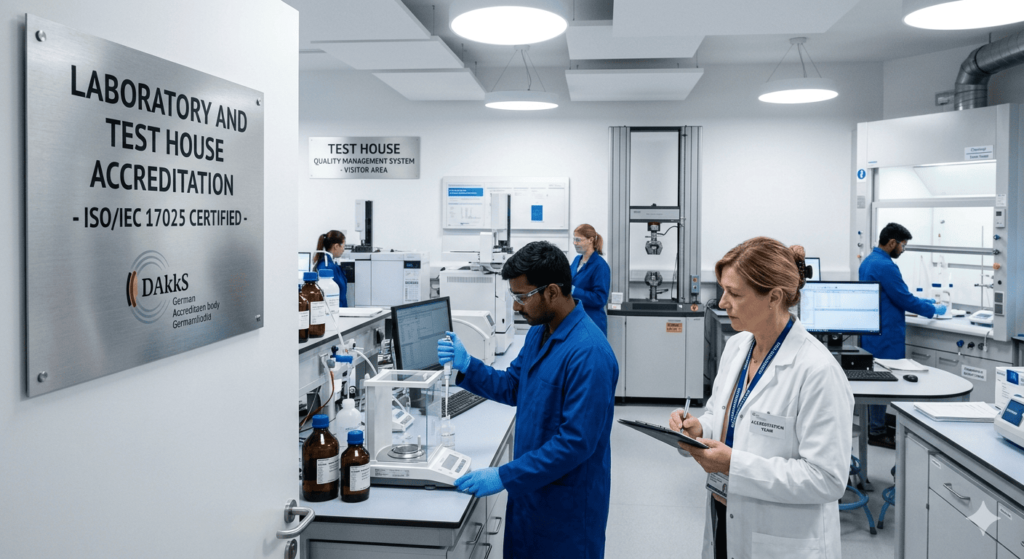
Laboratory and Test House Accreditation
Laboratory and Test House Accreditation is a critical component in ensuring the reliability, accuracy, and global acceptance of testing, calibration, and clinical research activities. In today’s highly regulated and quality-driven environment, laboratories are expected to demonstrate not only technical capability but also compliance with internationally recognized standards such as ISO/IEC 17025 and ISO 15189. Accreditation serves as formal recognition that a laboratory is competent to carry out specific tasks and produce valid results, which is essential for industries ranging from manufacturing and pharmaceuticals to healthcare and environmental monitoring.
At its core, laboratory accreditation is about building trust. When a laboratory achieves accreditation, it assures clients, regulatory bodies, and stakeholders that its processes, equipment, and personnel meet stringent quality requirements. This trust is further strengthened through the implementation of a robust Quality Management System aligned with ISO 9001:2015, which emphasizes continuous improvement, risk management, and customer satisfaction. By integrating quality principles into everyday operations, laboratories can maintain consistency in results and enhance operational efficiency.
A key aspect of accreditation is the focus on technical competence. Laboratories must ensure that their staff are properly trained and qualified, testing methods are validated, and equipment is regularly calibrated and maintained. Traceability of measurements to international standards is also essential, ensuring that results are comparable across different laboratories and regions. Participation in proficiency testing programs further demonstrates a laboratory’s ability to produce accurate and reliable results consistently. These practices not only improve internal performance but also enhance the laboratory’s reputation in the global market.
The accreditation process typically begins with a formal application, where the laboratory defines its scope of activities and submits detailed documentation, including quality manuals, procedures, and organizational structures. The accrediting body then reviews the application and may request additional information to ensure completeness and compliance. Once the documentation is deemed satisfactory, the laboratory undergoes a comprehensive assessment, which may include both desk reviews and on-site evaluations. During these assessments, auditors examine the laboratory’s operations, observe testing procedures, and verify the competence of personnel.
One of the distinguishing features of modern accreditation systems is their emphasis on transparency, fairness, and technical rigor. Accrediting bodies operate in accordance with standards like ISO/IEC 17011:2017, which ensures that the accreditation process itself is reliable and internationally recognized. This alignment allows accredited laboratories to gain global acceptance, facilitating international trade and collaboration. For example, test reports and calibration certificates issued by accredited laboratories are often accepted across borders without the need for additional verification, saving time and resources for businesses.
Environmental responsibility and workplace safety are also integral to laboratory accreditation. Laboratories are encouraged to adopt sustainable practices, such as reducing waste, optimizing energy consumption, and using environmentally friendly materials. At the same time, they must ensure a safe working environment for employees and visitors by implementing appropriate safety protocols and risk management measures. These considerations reflect a broader commitment to corporate social responsibility and ethical practices.
Another important element of accreditation is ongoing surveillance and continuous improvement. Accreditation is not a one-time achievement but a continuous process that requires laboratories to maintain compliance with standards and adapt to changes in technology, regulations, and market demands. Regular audits and assessments help identify areas for improvement and ensure that laboratories continue to meet the required standards. Laboratories are also expected to inform the accrediting body of any significant changes in their operations, such as expansion of scope or increased workload, to ensure that their accreditation remains valid and relevant.
Despite the challenges associated with accreditation, such as the need for detailed documentation, staff training, and financial investment, the benefits far outweigh the costs. Accredited laboratories gain a competitive edge in the market, as clients and regulatory authorities prefer working with recognized and reliable organizations. Accreditation also enhances customer confidence, reduces the risk of errors, and improves overall operational efficiency. For clinical laboratories, in particular, accreditation ensures the accuracy of diagnostic results, which directly impacts patient care and safety.
In conclusion, Laboratory and Test House Accreditation is an essential framework for ensuring quality, competence, and credibility in testing and research activities. By adhering to international standards like ISO/IEC 17025, ISO 15189, and ISO/IEC 17011:2017, laboratories can achieve global recognition and build lasting trust with stakeholders. As industries continue to evolve and demand higher levels of accuracy and accountability, accreditation will remain a cornerstone of quality assurance and a key driver of excellence in laboratory operations.
Laboratory and Test House Accreditation Guide and Outline Strategy for Test and Calibration or Clinical Research Centre Authorization
WYAB certification includes an independent review of documented plans to ensure that laboratory management operates in accordance with defined training and competence standards.
The WYAB approach is designed to ensure that its licensing activities are conducted in an open, transparent, fair, and technically competent manner. The system is intended to be dependable, repeatable, responsive, and authoritative for ease of use by stakeholders.
To ensure that the needs and prerequisites of laboratory partners are met, WYAB operates within a documented quality management framework. The organization supports the establishment of quality objectives and the implementation of effective quality practices. This ensures that all competent personnel are fully aware of quality arrangements, customer confidence is maintained, and that staff welfare, safety, and regulatory support are prioritized. Visitors to facilities are treated with due respect, and appropriate consideration is given to their wellbeing while on site.
WYAB promotes the maintenance of technical competence and emphasizes best professional practices. It also supports environmental responsibility by encouraging the use of recyclable and renewable materials and by minimizing waste generation and energy consumption.
WYAB recognizes the importance of relevant guidelines for all stakeholders within its scope of operations and therefore aligns its activities with ISO/IEC 17011:2017.
The WYAB fee structure is based on reasonable moderation for research facilities. Fees are calculated to recover the costs of accreditation activities, taking into account factors such as the turnover of the research facility or, in the case of non-commercial or government laboratories, the number of tests performed.
Charges depend on the initial accreditation and ongoing surveillance activities. Guide 52 provides a detailed explanation of the fee structure.
Accreditation Process
- Applicants shall submit a formal application for accreditation. Test laboratories or clinical research facilities are required to use the prescribed application format.
- Upon review of the application and preliminary correspondence, and if suitability is confirmed, an invoice for the application fee will be issued as specified.
- The applicant test, calibration, or clinical research center is required to comply with ISO/IEC 17025 or ISO 15189, as applicable, and to maintain a Quality Management System aligned with ISO 9001:2015.
- WYAB will review the application, may request additional information, and, if the application and preliminary assessment confirm suitability, an invoice for the assessment fee will be issued.
- Complete documentation, including manuals, systems, and organizational structures, shall be submitted as required by WYAB.
- WYAB will issue key documents to the applicant for agreement upon successful evaluation. These include:
- Agreement
- Memorandum of Understanding
- Licence imprints and logos
- Agreements
- Set of principles
- Worldwide affiliations
- Authority
- Rules for use of imprints
Accreditation and Surveillance Process (Continued)
- 1. The candidate shall submit to WYAB all documentation related to the activities of the test and calibration or clinical research center.
- 2. WYAB will review and assess the submitted documentation. If necessary, WYAB may require the candidate to make revisions and submit responses before proceeding to the next stage.
- 3. Upon a positive licensing decision, WYAB will issue an agreement. Test agreements may also be issued prior to application upon request.
- 4. WYAB will grant a temporary license once the documented management system is found to be satisfactory. The candidate will be listed on the WYAB website as a “Temporary Body.”
- 5. The candidate shall conduct test or calibration activities. Copies of verified or electronic records related to these activities shall be submitted to WYAB as required, consistent with previously reviewed reports.
- 6. Where necessary, WYAB will conduct on-site observations of the candidate’s testing or calibration activities. The candidate shall bear the cost of assessor day rates, in addition to travel and related expenses.
- 7. Following a successful on-site assessment, the candidate’s license will be upgraded to Full Accreditation. The candidate will be listed on the WYAB website, including any applicable conditions.
- 8. The candidate may continue testing and calibration or clinical research activities without the need to submit further desk-based documentation unless specifically requested.
- 9. WYAB will monitor the scope and level of testing, calibration, or clinical laboratory activities and conduct certification audits as appropriate.
- 10. WYAB will arrange for the listing of the accredited test and calibration or clinical laboratory in the Global Register.
NOTE
It is essential that the candidate’s clients clearly understand the relationship between WYAB and public regulatory authorities. Candidates must not imply or suggest that WYAB activities are carried out on behalf of, or with the endorsement of, public authorities. For this reason, the Terms and Conditions are critically important. WYAB guidance documents are publicly available, and candidates are encouraged to provide these to their clients prior to commencing work.
WYAB assessment activities are proportionate to the level of risk involved. Increased laboratory activity or higher operational complexity may require greater levels of assessment and surveillance. Research centers are therefore required to inform WYAB of changes in workload, income, or testing activity to ensure that appropriate certification and surveillance arrangements are maintained.
Where WYAB appoints an Assessor for a specific geographical region or country, the term “WYAB” used in this guide shall be understood to refer to the appointed Assessor.
Complete Guide & Strategic Framework for Test, Calibration, and Clinical Research Centre Authorization

Laboratory and Test House Accreditation plays a vital role in ensuring the credibility, accuracy, and global acceptance of testing, calibration, and clinical research activities. In an increasingly competitive and regulated environment, laboratories must demonstrate not only technical competence but also adherence to internationally recognized standards such as ISO/IEC 17025, ISO 15189, and ISO 9001:2015.
This comprehensive guide outlines the strategic framework, accreditation process, operational philosophy, and compliance expectations associated with WYAB certification, providing laboratories and clinical research centers with a structured pathway toward authorization and excellence.
1. Introduction to Laboratory Accreditation
Laboratory accreditation is a formal recognition that a laboratory is competent to carry out specific tests, calibrations, or clinical procedures. It ensures that results generated by the laboratory are reliable, reproducible, and accepted across industries and international markets.
Accreditation is not merely a certificate—it is a systematic approach to quality assurance, risk management, and continuous improvement. For test houses and research facilities, accreditation enhances credibility, improves operational efficiency, and builds trust among stakeholders, including regulators, customers, and global partners.
2. WYAB Certification Philosophy and Framework
WYAB certification is grounded in an independent, objective, and technically robust evaluation system. The certification process involves a comprehensive review of documented systems, ensuring that laboratories operate in alignment with defined training, competency, and quality standards.
Key Principles of WYAB Approach
- Transparency: All processes are conducted openly with clear documentation.
- Fairness: Equal treatment of all applicants regardless of size or location.
- Technical Competence: Focus on skills, training, and infrastructure.
- Repeatability: Ensuring consistent outcomes across assessments.
- Responsiveness: Adaptability to changing industry needs.
- Authority: Recognition as a credible certification body.
The WYAB framework aligns with ISO/IEC 17011:2017, which governs accreditation bodies globally and ensures international credibility.
3. Quality Management System (QMS) Integration
A strong Quality Management System (QMS) is the backbone of laboratory accreditation. WYAB mandates that laboratories implement a documented QMS aligned with ISO 9001:2015 principles.
Core Components of QMS
- Quality policy and objectives
- Document control and record management
- Internal audits and corrective actions
- Risk-based thinking
- Customer satisfaction monitoring
- Continuous improvement mechanisms
This structured approach ensures:
- Staff awareness of quality responsibilities
- Consistent delivery of accurate results
- Enhanced customer confidence
- Compliance with regulatory requirements
4. Technical Competence and Professional Practices
Technical competence is a central pillar of accreditation. WYAB emphasizes:
- Qualified and trained personnel
- Validated methods and procedures
- Calibration of equipment
- Traceability of measurements
- Participation in proficiency testing
Laboratories must demonstrate compliance with ISO/IEC 17025 or ISO 15189 depending on their scope.
Best Practices Promoted by WYAB
- Continuous training and skill development
- Ethical conduct and professional integrity
- Documentation of procedures
- Regular performance evaluation
5. Environmental and Social Responsibility
Modern accreditation systems extend beyond technical competence to include environmental sustainability and social responsibility.
WYAB encourages laboratories to:
- Use recyclable and renewable materials
- Minimize waste generation
- Optimize energy consumption
- Maintain safe and healthy work environments
This approach aligns laboratories with global sustainability goals and enhances corporate responsibility.
6. Fee Structure and Cost Considerations
The WYAB fee structure is designed to be fair, transparent, and proportionate to the size and activity level of the laboratory.
Key Factors Influencing Fees
- Type of laboratory (commercial, government, research)
- Number and complexity of tests
- Annual turnover or activity level
- Scope of accreditation
- Initial vs. surveillance assessments
Fees are structured to recover operational costs while ensuring accessibility for research facilities. Detailed fee guidelines are provided under WYAB Guide 52.
7. Accreditation Process: Step-by-Step Guide
The accreditation process is systematic and involves multiple stages to ensure thorough evaluation.
Step 1: Application Submission
Applicants must submit a formal application using the prescribed format, including:
- Scope of testing or calibration
- Organizational structure
- Quality manuals
- Technical procedures
Step 2: Application Review
WYAB reviews the application and may request additional information. If the application is deemed suitable, an invoice for the application fee is issued.
Step 3: Compliance with Standards
Applicants must demonstrate compliance with:
- ISO/IEC 17025 (Testing/Calibration Labs)
- ISO 15189 (Clinical Labs)
- ISO 9001:2015 (QMS)
Step 4: Documentation Submission
Applicants submit complete documentation, including:
- Quality manuals
- Standard operating procedures
- Organizational hierarchy
- Training records
Step 5: Assessment Fee and Evaluation
Upon successful document review, WYAB issues an assessment fee invoice and proceeds with detailed evaluation.
8. Legal and Formal Documentation
Upon successful evaluation, WYAB provides key legal and operational documents:
- Agreement
- Memorandum of Understanding (MoU)
- Licence imprints and logos
- Rules for logo usage
- Code of conduct and principles
- Authority and affiliation documentation
These documents define the rights, responsibilities, and operational boundaries of accredited laboratories.
9. Accreditation and Surveillance Process
Stage 1: Documentation Review
The applicant submits all relevant documents, which are thoroughly assessed. Corrections or improvements may be required.
Stage 2: Agreement Issuance
Upon a positive review, WYAB issues formal agreements. In some cases, provisional agreements may be issued earlier.
Stage 3: Temporary License
A temporary license is granted once the management system is deemed satisfactory. The laboratory is listed as a “Temporary Body.”
Stage 4: Operational Demonstration
The laboratory begins conducting tests or calibration activities and submits records for verification.
Stage 5: On-Site Assessment
WYAB conducts physical assessments, observing:
- Testing procedures
- Equipment usage
- Staff competence
- Record accuracy
Costs for assessors, travel, and logistics are borne by the applicant.
Stage 6: Full Accreditation
Upon successful on-site assessment:
- Full accreditation is granted
- The laboratory is officially listed
- Conditions, if any, are specified
Stage 7: Ongoing Operations
The accredited laboratory can operate without continuous documentation submission unless requested.
Stage 8: Surveillance and Monitoring
WYAB conducts periodic audits to ensure:
- Continued compliance
- Scope consistency
- Quality maintenance
Stage 9: Global Recognition
Accredited laboratories are listed in international directories, enhancing visibility and credibility.
10. Risk-Based Assessment Approach
WYAB follows a risk-based approach to accreditation:
- Higher complexity = more detailed assessment
- Increased activity = more frequent surveillance
- Expanded scope = additional evaluation
Laboratories must inform WYAB of changes in:
- Workload
- Revenue
- Testing scope
This ensures appropriate certification and monitoring.
11. Relationship with Regulatory Authorities
A critical aspect of accreditation is the clear distinction between certification bodies and government regulators.
Important Guidelines
- WYAB is an independent body
- Accreditation does not imply government endorsement
- Clients must not misrepresent accreditation status
Transparency in communication is essential to maintain credibility and avoid legal complications.
12. Role of Assessors and Regional Representation
WYAB may appoint assessors in different regions or countries. These assessors act as representatives and carry out:
- Documentation reviews
- On-site audits
- Technical evaluations
In such cases, “WYAB” refers to the appointed assessor within that jurisdiction.
13. Benefits of Laboratory Accreditation
Accreditation offers numerous advantages:
1. Enhanced Credibility
Recognition as a competent and reliable laboratory.
2. Global Acceptance
Test results are accepted internationally.
3. Improved Quality
Structured systems lead to consistent outcomes.
4. Regulatory Compliance
Alignment with international standards simplifies compliance.
5. Competitive Advantage
Accredited laboratories gain preference in tenders and contracts.
6. Customer Confidence
Clients trust validated and certified processes.
14. Challenges in Accreditation
Despite its benefits, laboratories may face challenges:
- High initial investment
- Documentation complexity
- Staff training requirements
- Continuous compliance obligations
However, these challenges are outweighed by long-term gains.
15. Strategic Implementation Plan
For successful accreditation, laboratories should adopt a strategic approach:
Phase 1: Preparation
- Conduct gap analysis
- Define scope
- Train staff
Phase 2: System Development
- Implement QMS
- Develop documentation
- Establish procedures
Phase 3: Internal Audit
- Evaluate system effectiveness
- Identify non-conformities
Phase 4: Application
- Submit formal application
- Prepare for assessment
Phase 5: Continuous Improvement
- Monitor performance
- Update systems regularly
16. Future Trends in Laboratory Accreditation
The future of accreditation is evolving with technological advancements:
- Digital documentation systems
- Remote audits and assessments
- AI-driven quality monitoring
- Integration with global databases
Laboratories must adapt to these changes to remain competitive.
17. Conclusion
Laboratory and Test House Accreditation is an essential component of modern quality assurance systems. It provides a structured pathway for laboratories to demonstrate competence, reliability, and compliance with international standards.
The WYAB certification framework offers a comprehensive, transparent, and technically sound approach to accreditation, ensuring that laboratories operate at the highest levels of quality and professionalism. By aligning with standards such as ISO/IEC 17025, ISO 15189, and ISO/IEC 17011:2017, laboratories can achieve global recognition and long-term success.
Table of Contents
Branches
WYAB Accreditation
WYAB Head Office
WYAB World Yoga Accreditation Board
WYAB House
C/O Mr.Garry 54, Glengarnock Avenue,
E-14 3BP Isle Of Dogs, London UK
Tel .: +44-8369083940
email: info@worldyoga.us
Website: https://worldyoga.us/
MUMBAI Head Office
World Yoga Accreditation Board (WYAB)
WYAB House
B-401, New Om Kaveri Chs. Ltd., Nagindas pada,
Next To Shiv Sena Office, Nallasopara (E)
Tel .: +91-7499991895
email: info@worldyoga.us
Website: https://worldyoga.us/
DELHI-NCR Regd. Office
World Yoga Accreditation Board (WYAB)
WYAB House
Asaoti, Dist Palwal
Faridabad Delhi NCR, Haryana
Tel .: +91-7979801035
Fax: +91-250 2341170
Website: https://worldyoga.us/