
Accreditation For Engineering
Accreditation For Engineering is a formal recognition granted to institutions, programs, or professionals that meet specific standards of quality, competence, and safety. It plays a pivotal role in ensuring that engineering education, practice, and services align with internationally or nationally recognized benchmarks. With the rapid advancement of technology and the growing complexity of infrastructure, industries, and manufacturing processes, accreditation has become an essential component in maintaining excellence, accountability, and public trust in engineering practices.
What is Accreditation in Engineering?
Accreditation is a systematic process of evaluation where an authoritative body assesses engineering programs, institutions, or professionals against established standards. It verifies that the entity under review meets or exceeds minimum criteria for quality, performance, and reliability. In engineering, accreditation is not merely a ceremonial recognition; it reflects a commitment to continual improvement, adherence to ethical standards, and the ability to produce competent engineers who can meet industry demands.
For educational institutions, accreditation typically focuses on curriculum, faculty qualifications, facilities, and research output. For professional engineers or firms, it may involve assessing compliance with safety protocols, technological competence, and adherence to industry standards.
Who Requires Engineering Accreditation?
Accreditation in engineering is required by multiple stakeholders across the educational and industrial spectrum:
- Educational Institutions: Universities, colleges, and technical institutes offering engineering programs seek accreditation to validate the quality of their courses. This accreditation helps graduates gain recognition for their degrees nationally and internationally.
- Professional Engineers: Practicing engineers often require certification or accreditation to demonstrate competence and credibility. Professional societies or regulatory boards may mandate it for licensure, especially in fields like civil, mechanical, electrical, and chemical engineering.
- Engineering Firms and Consultancies: Companies providing engineering design, construction, and consultancy services benefit from accreditation as it assures clients of technical proficiency, safety, and compliance with industry standards.
- Government and Regulatory Agencies: Accreditation is often a prerequisite for engineering firms bidding on public contracts, participating in infrastructure projects, or offering specialized services like environmental engineering or energy systems.
- Industrial and Research Laboratories: Labs engaged in testing, research, and product development need accreditation to ensure that their processes, instrumentation, and reporting meet recognized standards, which is crucial for credibility and legal compliance.
When is Engineering Accreditation Required?
The timing of accreditation depends on the nature of the entity and the context of its work:
- Academic Programs: Institutions usually pursue accreditation when launching new programs or periodically to maintain their recognized status. Continuous review cycles, often every 3–5 years, are common.
- Professional Certification: Engineers may need accreditation at the start of their careers to obtain licensure or when advancing to specialized roles requiring validation of skills.
- Engineering Firms: Accreditation is essential before engaging in large-scale projects, international collaborations, or industries governed by strict safety and quality standards.
- Laboratories: Accreditation is required before performing tests for certification, safety compliance, or research validation, ensuring reliability and acceptance of results.
Where is Engineering Accreditation Applicable?
Engineering accreditation has wide-ranging applicability across industries, sectors, and regions:
- Education: Accreditation impacts undergraduate and postgraduate engineering programs worldwide. Accrediting bodies ensure that students receive standardized, high-quality education that prepares them for professional challenges.
- Construction and Infrastructure: Civil and structural engineering firms rely on accreditation to participate in large projects such as bridges, highways, dams, and smart city development.
- Manufacturing and Industrial Engineering: Accreditation ensures that engineers involved in production, automation, and industrial design adhere to safety and quality standards.
- Energy and Environmental Engineering: Accreditation is crucial for professionals working in renewable energy, power plants, water treatment, and environmental sustainability projects.
- Research and Innovation: Laboratories and innovation centers rely on accredited engineers to conduct experiments, design prototypes, and validate new technologies.
How is Engineering Accreditation Achieved?
The process of accreditation involves several steps to ensure transparency, quality, and compliance:
- Application: Institutions, firms, or professionals submit applications to recognized accreditation bodies, providing details of programs, staff, processes, and facilities.
- Documentation Review: The accrediting authority examines records, course materials, technical reports, policies, and procedures to verify compliance with established standards.
- On-Site Evaluation: Evaluators or auditors visit the institution or facility to inspect labs, classrooms, machinery, project execution, and faculty performance. Interviews with stakeholders, including students, staff, and clients, are common.
- Assessment and Reporting: The accreditation team assesses findings against benchmarks, highlighting strengths, weaknesses, and areas for improvement.
- Decision and Certification: Upon meeting the required standards, the entity is granted accreditation for a defined period. Conditional accreditation may be offered with recommendations for improvement.
- Continuous Monitoring: Accredited entities must maintain quality standards and undergo periodic reviews to retain their status, promoting a culture of continuous improvement.
Case Study: Accreditation Impact in Civil Engineering
A prominent engineering college in India sought accreditation for its civil engineering program. Prior to accreditation, graduates faced difficulty securing positions in multinational companies due to perceived gaps in curriculum and practical exposure. After undergoing accreditation by the National Board of Accreditation (NBA), the institution revamped its curriculum, updated laboratories, and trained faculty in the latest industry practices.
Within three years, graduates from the accredited program achieved higher placement rates, and the college secured partnerships with leading construction firms. This case demonstrates how accreditation not only validates educational quality but also enhances employability and industry relevance.
White Paper Perspective: Global Importance of Engineering Accreditation
Globally, engineering accreditation aligns with frameworks such as ABET (USA), EUR-ACE (Europe), and Washington Accord (international). These systems facilitate mobility for engineers across borders, ensuring that qualifications are recognized internationally.
Accreditation also serves as a benchmark for sustainable engineering practices, ethical standards, and innovation. In an era of climate change, automation, and advanced materials, accredited engineers are better prepared to implement safe, efficient, and environmentally responsible solutions.
Industrial Application of Engineering Accreditation
In practical industrial settings, accreditation guarantees that engineering processes, designs, and services are reliable and safe. For instance:
- Automotive Engineering: Accredited engineers design safer vehicles, ensuring compliance with crash safety and emission standards.
- Chemical Engineering: Accreditation ensures safe handling of chemicals, process optimization, and adherence to environmental regulations.
- Electrical Engineering: Accredited professionals maintain electrical grids, power plants, and renewable energy projects within safety and performance standards.
- Software and Systems Engineering: Accreditation ensures that engineers develop robust, secure, and compliant software for industrial automation, infrastructure management, and data systems.
By establishing trust between clients, regulators, and the public, accreditation becomes a non-negotiable factor for credibility, risk mitigation, and competitiveness in engineering.
Conclusion
Accreditation in engineering is more than a formal certification; it is a strategic tool for quality assurance, professional growth, and industrial credibility. It provides a structured mechanism to assess and enhance the skills of engineers, the robustness of educational programs, and the competence of engineering firms.
In a world where technological innovation, infrastructure development, and environmental responsibility are paramount, accredited engineers and institutions stand out as reliable, competent, and forward-thinking. For aspiring engineers, professionals, and organizations, pursuing accreditation is not just a regulatory requirement—it is an investment in excellence, sustainability, and global recognition.
What is Required Accreditation For Engineering
Accreditation for engineering is a structured recognition process that validates the quality, competence, and reliability of educational programs, professional engineers, and engineering organizations. It ensures that engineering work—from academic instruction to industrial applications—meets established standards of excellence, safety, and effectiveness. In today’s fast-evolving technological landscape, understanding what is required for engineering accreditation is critical for institutions, professionals, and companies seeking credibility, competitiveness, and regulatory compliance.
Understanding Engineering Accreditation
Engineering accreditation is granted by authorized bodies to recognize that a program, institution, or professional adheres to defined quality and competency standards. It is a formal assurance that the entity under review possesses the knowledge, resources, and practices necessary to produce competent engineers or deliver engineering services that meet industry requirements.
Accreditation encompasses multiple dimensions:
- Educational Quality: Ensuring that engineering programs deliver a curriculum aligned with current technological trends, industry needs, and research developments.
- Professional Competence: Validating that practicing engineers have the technical knowledge, ethical grounding, and practical skills to perform safely and efficiently.
- Organizational Reliability: Assessing engineering firms or laboratories for compliance with regulatory standards, safety norms, and quality management systems.
Requirements for Accreditation
Achieving accreditation in engineering requires meeting a set of specific requirements determined by recognized accreditation bodies. These requirements vary depending on whether the focus is on educational programs, professional certification, or organizational approval.
1. Educational Institutions and Programs
For colleges and universities offering engineering degrees, the accreditation requirements typically include:
- Curriculum Standards: The program must cover core engineering principles, advanced technologies, and practical training components. Subjects must meet the competencies expected by the industry and professional boards.
- Qualified Faculty: Instructors must hold appropriate academic qualifications and practical experience. Continuing professional development of faculty is often required.
- Facilities and Laboratories: Adequate laboratories, workshops, equipment, and software tools must be available for students to gain hands-on experience.
- Student Assessment and Outcomes: Mechanisms must exist to evaluate student learning, technical skills, and problem-solving abilities. Programs must demonstrate successful graduate outcomes, such as employability and project competencies.
- Continuous Improvement: Institutions must have policies for regular review and improvement of teaching methods, infrastructure, and course content.
National and international accrediting bodies, such as the National Board of Accreditation (NBA) in India, ABET in the USA, and EUR-ACE in Europe, outline specific criteria for program accreditation. Compliance with these standards is essential for global recognition.
2. Professional Engineers
Individual engineers seeking professional recognition must meet requirements such as:
- Educational Qualifications: A recognized engineering degree from an accredited program.
- Practical Experience: Demonstrable work experience in the engineering field under supervision, often spanning 2–5 years.
- Ethical Standards: Commitment to professional ethics, safety protocols, and public responsibility.
- Examinations and Licensing: Passing examinations administered by professional boards or regulatory authorities to verify technical competence and legal eligibility.
- Continued Professional Development: Engineers are often required to update skills through training programs, workshops, and certifications to maintain accreditation.
3. Engineering Firms and Laboratories
Organizations offering engineering services or research must meet additional requirements to achieve accreditation:
- Quality Management Systems: Implementation of standardized procedures such as ISO 9001 for quality management or ISO/IEC 17025 for testing laboratories.
- Technical Competence: Employing qualified engineers with proven expertise to execute projects, tests, and designs accurately.
- Safety and Compliance: Adhering to safety standards, environmental regulations, and legal requirements relevant to engineering activities.
- Documentation and Reporting: Maintaining accurate records of designs, experiments, project outcomes, and corrective measures.
- Periodic Audits: Organizations must undergo regular inspections and audits to verify ongoing compliance with accreditation standards.
4. Regulatory and Legal Requirements
In many countries, certain engineering disciplines require mandatory accreditation to operate legally. For instance:
- Civil engineers designing public infrastructure often must be licensed and operate under accredited firms.
- Electrical and mechanical engineers working in high-risk environments, such as power plants or chemical plants, require certification to ensure safety.
- Environmental engineers handling waste management or pollution control must meet governmental and international standards to protect public health.
Failure to meet these requirements can result in legal restrictions, loss of project eligibility, or diminished industry credibility.
Benefits of Meeting Accreditation Requirements
Adhering to the requirements for engineering accreditation delivers multiple advantages:
- Global Recognition: Accredited programs and professionals are recognized internationally, enabling mobility and collaborative opportunities.
- Enhanced Employability: Graduates from accredited programs are preferred by employers, and professional engineers gain credibility in their field.
- Quality Assurance: Accreditation ensures that educational programs and organizations maintain high standards of performance and safety.
- Continuous Improvement: Structured evaluation encourages institutions and firms to regularly update curricula, methodologies, and technologies.
- Client and Public Confidence: Accreditation signals reliability, competence, and adherence to ethical and safety standards, building trust among clients and stakeholders.
Conclusion
What is required for engineering accreditation is a combination of education, competence, ethical standards, quality management, and adherence to regulatory norms. Whether for institutions, individual engineers, or organizations, accreditation serves as a benchmark for excellence, ensuring that engineering practices remain safe, effective, and aligned with global standards.
By fulfilling these requirements, engineering entities not only gain formal recognition but also enhance their capability to innovate, deliver high-quality solutions, and contribute positively to society and industry. Accreditation in engineering is, therefore, both a mark of quality and a strategic advantage in a competitive, technologically advanced world.
Who is Required Accreditation For Engineering
Accreditation in engineering is a formal recognition of quality, competence, and compliance with established standards. It is not merely a ceremonial title; it is essential for ensuring safety, reliability, and professionalism in engineering education, practice, and services. Understanding who is required to seek engineering accreditation is crucial for individuals, institutions, and organizations that aim to maintain credibility, comply with regulations, and gain competitive advantages in the industry.
1. Educational Institutions
Colleges, universities, and technical institutes offering engineering programs are among the primary entities required to obtain accreditation. Accreditation validates that their academic programs meet industry standards, produce competent graduates, and foster innovation.
- Engineering Programs: Undergraduate and postgraduate programs in civil, mechanical, electrical, chemical, and computer engineering must meet the standards set by recognized accreditation bodies such as the National Board of Accreditation (NBA) in India, ABET in the USA, or EUR-ACE in Europe.
- Faculty and Infrastructure: Accreditation ensures that institutions employ qualified faculty, maintain modern laboratories, and offer updated curricula that align with global engineering standards.
- Student Outcomes: Accredited institutions are required to demonstrate that students acquire the necessary technical skills, problem-solving abilities, and practical experience needed for professional practice.
Educational accreditation benefits students, enabling them to pursue higher studies, international careers, and professional licensure with confidence.
2. Professional Engineers
Individual engineers are also required to seek accreditation or certification in many countries, particularly if they wish to practice legally or advance professionally. This requirement ensures that engineers possess the necessary knowledge, skills, and ethical standards to work safely and efficiently.
- Licensure and Registration: Civil, mechanical, electrical, and other engineering professionals often need accreditation from government or professional bodies to obtain licenses for practice.
- Specialized Fields: Engineers working in high-risk industries, such as nuclear, chemical, structural, or environmental engineering, are required to hold specialized accreditations to demonstrate competency and compliance with safety norms.
- Continued Professional Development: Accredited engineers are often required to participate in training, workshops, and certifications to maintain their professional status and stay updated with evolving technologies.
Professional accreditation builds trust with employers, clients, and regulatory authorities, positioning engineers as reliable experts in their field.
3. Engineering Firms and Organizations
Companies and consultancies offering engineering services are required to obtain organizational accreditation to validate their technical competence and adherence to quality standards.
- Quality Assurance: Accreditation ensures that engineering firms follow robust quality management systems, such as ISO 9001, and comply with safety and regulatory standards.
- Eligibility for Projects: Many government contracts, international tenders, and private sector projects require firms to be accredited to demonstrate credibility and technical capability.
- Industrial Compliance: Engineering firms involved in construction, energy, manufacturing, or environmental projects must meet national and international accreditation requirements to ensure legal compliance and operational safety.
Accreditation enables firms to attract clients, secure projects, and maintain a reputation for professionalism and technical excellence.
4. Research and Testing Laboratories
Laboratories engaged in engineering research, material testing, and product validation are also required to seek accreditation to guarantee accuracy, reliability, and standard compliance.
- Laboratory Accreditation: Accreditation according to standards such as ISO/IEC 17025 ensures that testing methods, equipment, and personnel meet recognized benchmarks.
- Industrial Collaboration: Accredited labs are preferred by industries for research, development, and quality control purposes, enhancing collaboration opportunities and credibility.
- Legal and Safety Compliance: Accredited labs ensure that test results are reliable for regulatory approval, safety certifications, and industrial applications.
Conclusion
In summary, who is required to obtain accreditation for engineering includes:
- Educational institutions offering engineering programs.
- Individual professional engineers seeking licensure or certification.
- Engineering firms and consultancies delivering technical services.
- Research and testing laboratories involved in industrial and scientific validation.
Accreditation ensures that these entities operate with competence, maintain safety, adhere to legal and ethical standards, and contribute to industry innovation. By meeting accreditation requirements, professionals and organizations reinforce their credibility, enhance career opportunities, and ensure that engineering solutions are reliable, sustainable, and globally recognized.
When is Required Accreditation For Engineering
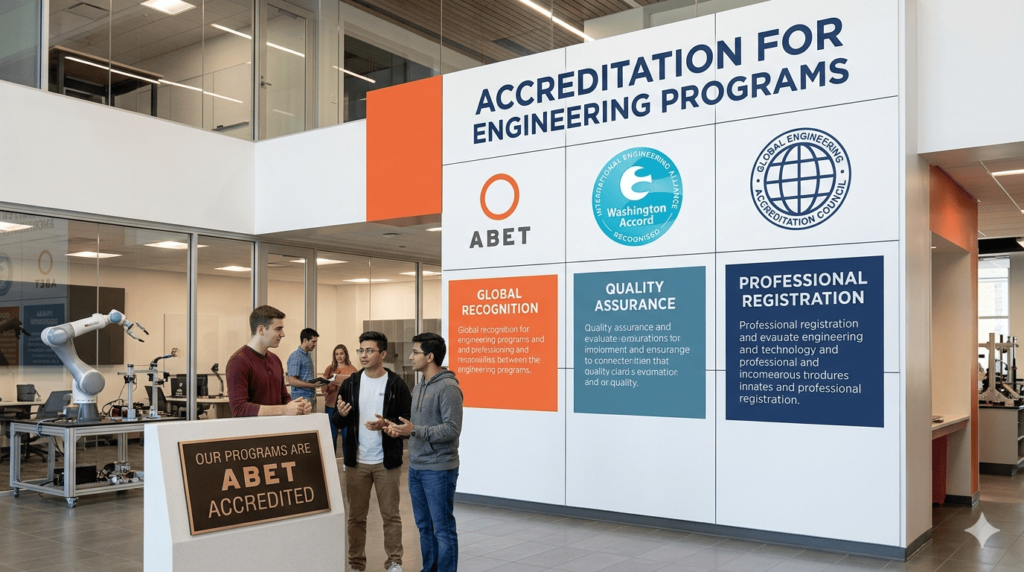
Engineering accreditation is a crucial process that validates the quality, competence, and credibility of engineering programs, professionals, and organizations. Knowing when accreditation is required helps educational institutions, engineers, and companies align with industry standards, meet regulatory requirements, and gain professional recognition. Timing plays a critical role because accreditation impacts education, professional practice, project eligibility, and legal compliance.
1. At the Launch of Academic Programs
One of the earliest points when accreditation is required is when a new engineering program is launched in a college or university. Accreditation ensures that the curriculum, teaching staff, laboratories, and learning outcomes meet industry standards from the outset.
- Curriculum Validation: Accreditation confirms that courses cover essential engineering concepts, practical training, and emerging technologies relevant to the industry.
- Faculty Assessment: Institutions must demonstrate that faculty members are qualified, experienced, and capable of delivering high-quality education.
- Infrastructure Readiness: Laboratories, workshops, and software tools must meet required standards to provide students with hands-on learning opportunities.
Starting with accreditation helps institutions attract students, establish credibility, and align with national and international educational standards.
2. During Professional Licensure or Certification
For individual engineers, accreditation is required when seeking professional licensure, registration, or certification.
- Entry into the Profession: Many countries require engineers to hold a degree from an accredited program before they can register as professional engineers.
- Specialization Requirements: Engineers pursuing careers in specialized fields, such as structural, chemical, electrical, or environmental engineering, must obtain accreditation or certification to demonstrate competence in those areas.
- Career Advancement: Accreditation is often required when engineers seek promotions, leadership roles, or eligibility for international assignments.
Obtaining accreditation at the right stage ensures that engineers can legally practice, access professional opportunities, and gain recognition from employers and clients.
3. Before Undertaking Major Projects
Engineering firms and consultancies are required to be accredited before participating in significant infrastructure, industrial, or governmental projects.
- Eligibility for Contracts: Many public and private sector tenders mandate that participating firms hold accreditation to prove their technical competence and reliability.
- Safety and Compliance: Accreditation ensures firms meet safety standards, environmental regulations, and quality benchmarks required for complex projects.
- Global Collaboration: International projects often require firms to be accredited by recognized global bodies to maintain credibility and legal compliance.
Without timely accreditation, firms may be disqualified from competitive bids or face legal and reputational risks.
4. For Research and Testing Activities
Accreditation is also required when laboratories and research centers conduct engineering tests, material validation, or product development.
- Regulatory Acceptance: Many regulatory authorities only recognize test results from accredited labs, making accreditation mandatory for product approvals, certifications, or industrial validation.
- Industrial Collaboration: Accredited labs are preferred by industries for R&D projects, ensuring that research and testing are accurate, reliable, and standardized.
- Periodic Reassessment: Accreditation is typically required not only at the start but also during periodic reviews to ensure ongoing compliance with technical and safety standards.
5. During Continuous Improvement Cycles
Accreditation is required at specific intervals for periodic review to maintain the validity of the recognition.
- Educational Programs: Accreditation bodies often require programs to undergo review every 3–5 years to confirm that curricula, faculty, and infrastructure remain up-to-date.
- Professional Engineers: Continued professional development and renewal of certifications may be required to maintain accreditation.
- Organizations and Labs: Regular audits ensure that firms and laboratories continue to meet quality, safety, and regulatory standards.
This cyclical approach ensures that accredited entities consistently uphold high standards and adapt to evolving industry requirements.
Conclusion
In essence, engineering accreditation is required at multiple critical points:
- When launching new educational programs.
- During professional licensure or certification for individual engineers.
- Before taking on major industrial or governmental projects.
- When conducting research, testing, or material validation in laboratories.
- At periodic intervals for maintaining and renewing accreditation.
Timing is crucial because accreditation affects legal compliance, professional recognition, project eligibility, and overall credibility. By securing accreditation at the appropriate stage, educational institutions, engineers, and organizations ensure that they meet industry standards, maintain public trust, and remain competitive in a rapidly evolving engineering landscape.
Where is Required Accreditation For Engineering
Engineering accreditation is a critical process that ensures educational programs, professionals, and organizations meet established standards of quality, competence, and safety. Understanding where accreditation is required helps students, engineers, institutions, and companies determine the sectors, regions, and industries where accreditation is essential for recognition, compliance, and professional credibility.
1. In Educational Institutions Worldwide
Accreditation is required in engineering colleges, universities, and technical institutes globally. Institutions offering undergraduate, postgraduate, or doctoral programs in engineering must seek accreditation to ensure that their programs meet industry standards and international benchmarks.
- Global Relevance: Accreditation by bodies such as ABET (USA), EUR-ACE (Europe), or NBA (India) ensures that engineering programs are recognized internationally. Graduates from accredited programs can pursue higher studies or professional opportunities abroad.
- Regional Importance: Accreditation is mandatory in many countries for programs to receive funding, recognition, or inclusion in national education frameworks. For example, in India, engineering programs must be accredited by the NBA to qualify for certain governmental grants and professional recognition.
By securing accreditation, educational institutions demonstrate the credibility of their programs, attract students, and enhance employment prospects for graduates.
2. In Professional Practice
Accreditation is required where engineers practice professionally, particularly in fields involving public safety, infrastructure, or high-risk industries.
- Civil and Structural Engineering: Engineers involved in designing bridges, highways, dams, or buildings must be licensed and accredited to ensure safety and compliance with regulations.
- Mechanical, Electrical, and Industrial Engineering: Professionals working in power plants, manufacturing industries, or industrial automation require accreditation to meet safety and operational standards.
- Specialized Fields: Areas such as environmental engineering, chemical engineering, or aerospace demand accreditation for engineers to legally practice and maintain professional credibility.
Without accreditation, engineers may face restrictions on employment, project participation, or legal liability.
3. In Engineering Firms and Organizations
Accreditation is required within organizations providing engineering services, particularly when engaging in large-scale, critical, or regulated projects.
- Government and Public Projects: Firms bidding on infrastructure or public sector projects often need accreditation to prove technical capability and compliance with legal standards.
- Private and Industrial Sectors: Accredited engineering firms are preferred by clients seeking reliability, safety, and quality assurance. Accreditation assures stakeholders that the organization can deliver competent solutions.
- International Operations: Companies seeking global collaborations or working on cross-border projects are required to maintain accreditation recognized internationally, ensuring compliance with global engineering standards.
This ensures that engineering organizations can operate in regulated industries, win contracts, and maintain credibility with clients and authorities.
4. In Research and Testing Laboratories
Engineering laboratories and testing facilities also require accreditation to guarantee accuracy, reliability, and recognition.
- Testing and Calibration Labs: Facilities conducting material testing, product validation, or engineering research must be accredited to comply with standards such as ISO/IEC 17025.
- Industrial Collaboration: Accredited labs are preferred partners for industrial R&D, quality assurance, and product development.
- Regulatory Compliance: Accreditation ensures that test results are legally recognized and acceptable for product certification, safety approvals, and compliance audits.
Accreditation in these contexts ensures trust in the data, experiments, and engineering solutions generated by laboratories.
5. Across All Regions and Industries
Accreditation is required across regions and industries wherever engineering education, practice, or services impact public safety, technology implementation, or industrial standards. From urban infrastructure to energy systems, manufacturing, environmental management, and information technology, accredited engineers and organizations are crucial to delivering safe, effective, and globally recognized engineering solutions.
Conclusion
In summary, engineering accreditation is required in the following areas:
- Educational institutions offering engineering programs worldwide.
- Professional engineers practicing in fields where safety, efficiency, and competence are critical.
- Engineering firms and consultancies delivering services in regulated or high-stakes industries.
- Research and testing laboratories performing validation, testing, or R&D in engineering disciplines.
- Across regions and industries where compliance, safety, and quality standards are essential.
By obtaining accreditation in these areas, educational institutions, engineers, and organizations ensure legal compliance, industry recognition, and public trust. Accreditation provides assurance that engineering work, whether in education, professional practice, or industrial application, meets the highest standards of quality, safety, and competence.
How is Required Accreditation For Engineering
Engineering accreditation is a structured process that ensures programs, professionals, and organizations meet recognized standards of quality, competence, and safety. Understanding how accreditation is obtained is essential for educational institutions, engineers, and firms aiming to demonstrate credibility, comply with regulations, and maintain professional excellence. The process involves multiple steps, from application and documentation to evaluation and continuous improvement.
1. Identifying the Relevant Accrediting Body
The first step in obtaining accreditation is determining the appropriate accreditation authority. This varies depending on whether the focus is educational, professional, or organizational:
- Educational Programs: Institutions must apply to recognized bodies like the National Board of Accreditation (NBA) in India, ABET in the USA, or EUR-ACE in Europe. These bodies set the standards for curriculum, faculty, infrastructure, and student outcomes.
- Professional Engineers: Individual engineers may seek accreditation or licensure from professional councils or boards that govern their specific field of engineering.
- Engineering Firms and Laboratories: Companies and research labs must approach relevant authorities, such as ISO certification bodies or national quality boards, to validate organizational and technical competence.
Choosing the correct accrediting body ensures that the recognition is valid, respected, and legally recognized.
2. Preparing Documentation and Evidence
Once the accrediting body is identified, the next step is document preparation. Accreditation relies heavily on verified evidence demonstrating compliance with required standards:
- For Educational Institutions: Documentation includes curriculum details, faculty qualifications, laboratory facilities, student assessment procedures, placement statistics, and continuous improvement plans.
- For Professional Engineers: Required documents may include educational certificates, work experience records, project portfolios, ethical declarations, and proof of professional development.
- For Organizations and Labs: Companies must provide process manuals, quality management procedures, equipment calibration records, safety protocols, and project execution evidence.
Well-organized documentation simplifies the accreditation process and demonstrates a commitment to transparency and quality.
3. Application Submission
After documentation is prepared, the next step is formally submitting an application to the accrediting body. This usually involves:
- Completing application forms with organizational, educational, or professional details.
- Paying applicable fees for evaluation and accreditation services.
- Agreeing to audits, inspections, or site visits as part of the evaluation process.
Accurate and complete applications help reduce delays and improve the chances of successful accreditation.
4. Evaluation and Site Assessment
Accrediting bodies typically conduct a thorough evaluation that may include:
- Document Review: Assessing submitted materials to ensure all standards and requirements are met.
- On-Site Visits: Inspectors visit campuses, laboratories, or organizational facilities to verify infrastructure, faculty, processes, and practices.
- Stakeholder Interviews: Meetings with students, faculty, engineers, or employees to understand operations, teaching methods, or project execution.
The evaluation identifies strengths, weaknesses, and areas that require improvement before accreditation can be granted.
5. Decision and Accreditation Granting
Based on the evaluation, the accrediting body issues a decision:
- Full Accreditation: Granted when all standards are met.
- Conditional Accreditation: Granted with recommendations for improvement within a specified timeframe.
- Denial: Issued if the entity fails to meet essential criteria, with guidance on corrective actions.
Accreditation typically has a validity period (e.g., 3–5 years), after which re-evaluation is required.
6. Continuous Monitoring and Renewal
Accreditation is not a one-time event; maintaining it requires continuous monitoring and renewal:
- Periodic Reporting: Institutions, professionals, and organizations must submit progress reports, updates, or improvements.
- Re-assessment: Accrediting bodies perform periodic audits to ensure ongoing compliance.
- Continuous Improvement: Entities are encouraged to update curricula, adopt new technologies, and enhance processes to maintain high standards.
This cyclical process ensures that accredited entities remain competent, reliable, and aligned with evolving industry requirements.
Conclusion
The process of obtaining engineering accreditation involves clear, structured steps: identifying the accrediting body, preparing documentation, submitting applications, undergoing evaluation, receiving accreditation, and maintaining continuous compliance. By following these steps, educational institutions, engineers, and organizations demonstrate their commitment to quality, safety, and professional excellence.
Accreditation not only validates technical competence but also strengthens credibility, increases opportunities for collaboration, and ensures that engineering education and services meet the highest global standards.
Case Study on Accreditation For Engineering
Accreditation in engineering plays a crucial role in validating quality, competence, and credibility for educational programs, professionals, and organizations. To understand its practical impact, this case study examines how accreditation transformed an engineering college and its graduates, highlighting the benefits, challenges, and lessons learned.
Background
XYZ Engineering College, located in a growing urban area in India, offered undergraduate programs in civil, mechanical, electrical, and computer engineering. While the college had a strong student base and dedicated faculty, it faced challenges:
- Graduates were struggling to secure positions in top engineering firms due to perceived gaps in curriculum relevance and practical exposure.
- The college’s research labs were underutilized, lacking modern equipment and industry-standard facilities.
- Industry partnerships were limited, reducing opportunities for internships and collaborative projects.
The management decided to pursue accreditation from the National Board of Accreditation (NBA) to enhance the quality of education, improve student employability, and align with national and international standards.
Accreditation Process
The college followed a structured approach to achieve accreditation:
- Preparation and Documentation:
- The college mapped its curriculum against NBA standards, identifying areas that needed updates.
- Faculty qualifications were reviewed, and professional development programs were introduced.
- Laboratories were upgraded with modern equipment, and software tools were installed for practical training.
- Student assessment systems were improved, introducing project-based learning, internships, and skill evaluation.
- Application and Self-Assessment Report:
- A detailed self-assessment report (SAR) was submitted to the NBA, showcasing compliance with accreditation criteria.
- The SAR included curriculum details, faculty profiles, laboratory infrastructure, student achievements, and research outputs.
- Evaluation and Site Visit:
- NBA evaluators conducted on-site inspections of classrooms, laboratories, and faculty performance.
- Interviews were conducted with students, alumni, and staff to assess learning outcomes and industry readiness.
- Recommendations and Improvements:
- Evaluators suggested minor curriculum enhancements, additional industry collaborations, and documentation improvements.
- The college implemented these recommendations promptly to meet full accreditation standards.
Results and Impact
The accreditation process had a significant impact on the college and its stakeholders:
- Enhanced Academic Quality: Curriculum improvements and modernized labs ensured that students received up-to-date technical knowledge and hands-on experience.
- Increased Employability: Graduates from accredited programs gained recognition among top engineering firms, leading to higher placement rates and better internship opportunities.
- Industry Collaboration: Accreditation enabled the college to establish partnerships with local and multinational companies for research, internships, and industrial projects.
- Faculty Development: Faculty members participated in continuous professional development programs, improving teaching quality and research output.
- Global Recognition: NBA accreditation, aligned with international frameworks like Washington Accord, enabled graduates to pursue higher studies and professional opportunities abroad.
Lessons Learned
This case study highlights several key lessons for institutions seeking engineering accreditation:
- Preparation is Key: Thorough documentation and readiness to meet standards are critical for a successful accreditation process.
- Continuous Improvement: Accreditation is not a one-time event; maintaining and updating curriculum, facilities, and teaching methods is essential.
- Stakeholder Engagement: Engaging students, faculty, and industry partners ensures practical learning and meets industry expectations.
- Long-Term Benefits: Accreditation enhances credibility, employability, and institutional reputation, making it a strategic investment rather than a regulatory requirement.
Conclusion
The case of XYZ Engineering College demonstrates how accreditation can transform an institution, benefiting students, faculty, and the broader industry. By meeting national and international standards, accredited programs ensure high-quality education, skilled professionals, and enhanced industry trust.
Accreditation is more than a certificate; it is a commitment to excellence, continuous improvement, and global competitiveness in the field of engineering. For educational institutions and professionals alike, accreditation is a gateway to credibility, opportunity, and sustainable growth.
White paper on Accreditation For Engineering
Executive Summary
Engineering accreditation is a critical framework that ensures the quality, competence, and reliability of engineering education, professionals, and organizations. In a rapidly evolving technological landscape, accreditation serves as a benchmark for standards, safety, and professional credibility. This white paper explores the importance of accreditation, its global context, benefits, challenges, and strategies for implementation in the engineering sector.
Introduction
Engineering impacts virtually every aspect of modern life, from infrastructure and transportation to energy, manufacturing, and technology. As the demand for skilled engineers increases, ensuring quality in education and professional practice becomes essential. Accreditation provides a structured approach to assess and validate educational programs, professional competencies, and organizational processes.
Accreditation bodies such as ABET (USA), EUR-ACE (Europe), and the National Board of Accreditation (NBA) in India establish standards for curriculum, faculty, infrastructure, and professional practice. Compliance with these standards ensures that engineers are equipped with the necessary knowledge, skills, and ethical grounding.
Importance of Engineering Accreditation
- Quality Assurance: Accreditation guarantees that educational programs, professional engineers, and organizations meet internationally recognized standards of quality and competence.
- Industry Recognition: Accredited programs and professionals are recognized globally, enhancing career mobility and employability.
- Safety and Compliance: Accreditation ensures adherence to safety norms, environmental regulations, and technical standards, which is critical in high-risk industries.
- Innovation and Research: Accredited institutions and labs are better positioned to engage in advanced research, collaborate with industry, and develop innovative solutions.
- Public Trust: Accreditation assures the public and stakeholders that engineering services, infrastructure, and technologies meet rigorous standards of safety and reliability.
Accreditation Requirements
Accreditation in engineering typically involves meeting standards in the following areas:
- Educational Programs: Curriculum design, faculty qualifications, laboratory facilities, student outcomes, and continuous improvement mechanisms.
- Professional Engineers: Licensure, demonstrated work experience, ethical standards, and ongoing professional development.
- Organizations and Laboratories: Quality management systems, technical competence, safety protocols, documentation, and periodic audits.
These requirements are designed to ensure that engineers and organizations maintain high standards of performance and accountability.
Global Context and Best Practices
International frameworks such as the Washington Accord facilitate mutual recognition of accredited engineering programs across countries. This global perspective allows graduates from accredited programs to pursue higher education and professional opportunities worldwide.
Best practices in engineering accreditation include:
- Periodic review and continuous improvement of curriculum and training programs.
- Adoption of modern technology and simulation tools in labs and workshops.
- Collaboration with industry to align academic programs with real-world requirements.
- Regular professional development for faculty and engineers to stay updated with emerging technologies.
Challenges in Implementation
Despite its benefits, achieving and maintaining accreditation can be challenging:
- Resource Constraints: Upgrading labs, faculty training, and infrastructure can be costly for institutions.
- Compliance Complexity: Meeting multiple national and international standards simultaneously can be challenging.
- Continuous Monitoring: Accreditation requires ongoing efforts, including documentation, audits, and updates, which may strain organizational resources.
Addressing these challenges requires strategic planning, stakeholder engagement, and a commitment to continuous improvement.
Conclusion
Engineering accreditation is not merely a regulatory requirement—it is a strategic tool for ensuring quality, credibility, and professional excellence. Accredited programs, professionals, and organizations are better equipped to meet industry demands, maintain safety and compliance, and foster innovation.
For educational institutions, accreditation enhances reputation, employability, and international recognition. For engineers and organizations, it strengthens credibility, opens global opportunities, and ensures adherence to best practices.
In an era of rapid technological change, engineering accreditation serves as a critical mechanism to uphold standards, build trust, and drive sustainable growth in education, industry, and society.
Industrial Application of Accreditation For Engineering
Engineering accreditation plays a crucial role not only in education and professional certification but also in real-world industrial applications. Accredited programs, professionals, and organizations provide industries with a reliable benchmark of quality, competence, and safety. In today’s highly competitive and technologically advanced industrial landscape, accreditation ensures that engineering solutions are efficient, safe, and globally recognized.
1. Manufacturing and Production Industries
In manufacturing, engineering accreditation ensures that processes, products, and systems meet rigorous quality and safety standards.
- Process Optimization: Accredited engineers design and implement manufacturing processes that reduce waste, improve efficiency, and maintain consistent quality.
- Equipment and Safety Standards: Accreditation ensures engineers understand equipment specifications, safety protocols, and compliance requirements.
- Product Certification: Products developed under the supervision of accredited engineers are more likely to meet domestic and international quality standards, improving market acceptance.
For example, an automotive manufacturing plant employing accredited mechanical and industrial engineers can consistently produce vehicles that meet safety and performance benchmarks, while minimizing production errors.
2. Construction and Infrastructure Development
Civil and structural engineering projects are highly dependent on accredited programs and professionals:
- Project Safety and Reliability: Accreditation ensures that engineers possess the knowledge and skills to design buildings, bridges, highways, and dams that meet safety and structural standards.
- Regulatory Compliance: Accredited engineers and firms comply with local building codes, environmental regulations, and international construction standards.
- Risk Mitigation: Accreditation helps reduce construction errors, delays, and potential hazards, safeguarding both investment and public welfare.
Accreditation in construction ensures that infrastructure projects are safe, sustainable, and aligned with modern engineering practices, enhancing public trust and long-term value.
3. Energy and Power Sector
The energy industry relies heavily on accredited engineers and organizations to ensure efficiency, sustainability, and safety:
- Renewable Energy Projects: Accreditation validates that engineers designing solar, wind, or hydroelectric systems follow global best practices.
- Power Plant Operations: Accredited electrical and mechanical engineers maintain reliable operations, optimize energy output, and adhere to strict safety regulations.
- Environmental Compliance: Accreditation ensures engineers minimize environmental impacts and meet legal requirements, including emission and waste management standards.
Industries in the energy sector benefit from accreditation by reducing operational risks, improving energy efficiency, and maintaining compliance with international standards.
4. Chemical, Pharmaceutical, and Industrial Labs
Accredited engineers and laboratories are essential for industries that require precise research, testing, and product development:
- Quality Control: Accreditation ensures that engineers and lab technicians follow standardized testing procedures, resulting in consistent, reliable outputs.
- Process Safety: Engineers in chemical and pharmaceutical industries utilize accredited protocols to prevent accidents, ensure safety, and comply with regulatory norms.
- Research and Innovation: Accredited labs and professionals contribute to innovative product development while meeting industrial and legal standards.
Accreditation provides industries with confidence in testing results, process reliability, and compliance with health and safety requirements.
5. Global Industrial Competitiveness
Industries that employ accredited engineers and practices enjoy a competitive advantage:
- International Recognition: Accreditation ensures compliance with global standards, facilitating export opportunities and international collaborations.
- Client Confidence: Clients prefer firms with accredited engineers because it guarantees reliability, safety, and high-quality project delivery.
- Sustainability and Innovation: Accredited engineers implement sustainable practices, efficient systems, and innovative solutions that drive industrial growth.
Conclusion
The industrial application of accreditation in engineering spans manufacturing, construction, energy, chemical, pharmaceutical, and research sectors. Accreditation ensures that engineers and organizations adhere to high standards of quality, safety, and efficiency.
By employing accredited professionals and maintaining accredited systems, industries achieve:
- Enhanced operational efficiency
- Reduced risk and errors
- Compliance with local and international standards
- Improved product and project quality
- Greater market trust and competitiveness
Accreditation is therefore not only a tool for educational recognition or professional validation but also a strategic asset for industries. It ensures that engineering solutions are reliable, innovative, and globally accepted, enabling industries to grow sustainably and maintain excellence in an increasingly competitive world.
Table of Contents