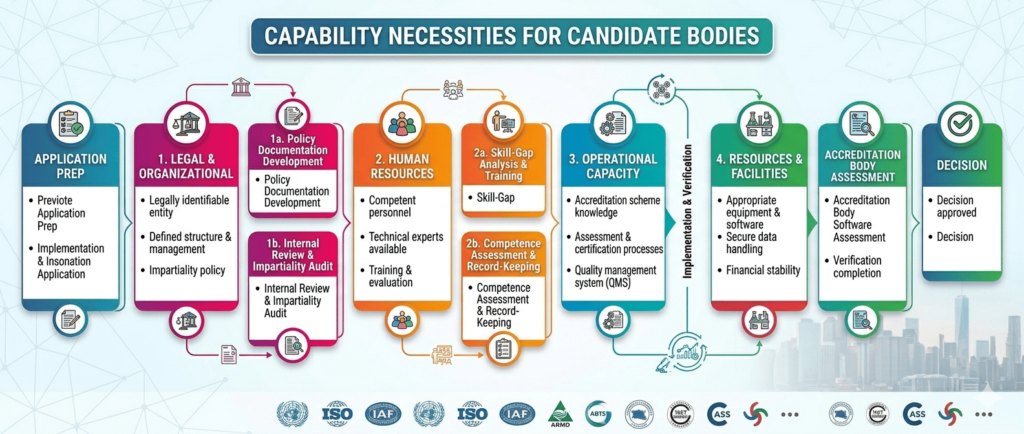
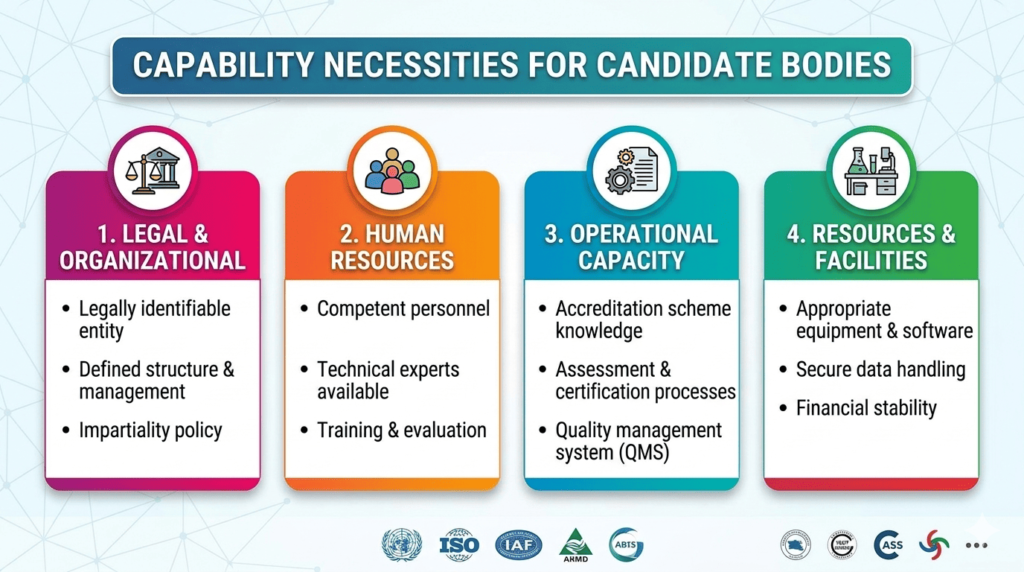
Capability Necessities For Candidate Bodies
The capability requirements for candidate certification bodies are essential to ensure credibility, consistency, and trust in the certification process. Organizations seeking accreditation must demonstrate not only compliance with international standards but also the competence, experience, and integrity required to operate as an impartial certification body. One of the primary benchmarks for such organizations is adherence to ISO/IEC 17021, which defines the requirements for bodies providing audit and certification of management systems.
The overall prerequisite for application is that a candidate body must meet the requirements of ISO/IEC 17021. While many organizations are able to demonstrate technical compliance with the clauses of the standard, there is often a gap when it comes to the effective implementation of their management systems. Accreditation bodies focus not only on documented procedures but also on how well these procedures are executed in practice. Therefore, candidate bodies must ensure that their systems are functional, effective, and consistently followed across all operations.
A key aspect of capability is competence within the certification profession. Certification is fundamentally different from consultancy, even though both fields may require similar technical knowledge. Consultancy typically involves advising organizations on how to achieve compliance, whereas certification requires independent verification of that compliance. Because of this distinction, not all consultancy experience is directly applicable to certification activities. Certification bodies must maintain impartiality and avoid conflicts of interest, which requires a different mindset, structure, and level of responsibility.
To ensure that candidate bodies meet the expected standards, specific capability requirements are defined. One of the primary requirements is the demonstration of individual competence. Personnel within the organization must show appropriate qualifications, professional experience, and technical expertise. This includes knowledge of management systems, auditing techniques, and industry-specific requirements. Individuals must also possess key attributes such as integrity, objectivity, analytical thinking, and effective communication skills.
The evaluation of competence is often carried out using frameworks such as Table 1 of ISO/IEC 17021-2. This framework outlines the necessary knowledge, skills, and personal behaviors required for certification personnel. Although the assessment may involve some level of subjectivity, it provides a structured approach to ensure that personnel meet the required standards.
Another critical requirement is the demonstration of sufficient professional experience. Candidate certification bodies are expected to show an aggregate of 110 months of professional experience within the certification field at a senior level. This experience should involve responsibilities such as auditing, certification decision-making, and management system evaluation. It is important to note that no single individual can contribute more than 45 percent of the total required experience. This ensures that the organization has a well-balanced team and does not rely excessively on one person.
Documentation is another crucial element in the assessment of candidate bodies. All documentation submitted must be of a professional standard and should represent the original work of the organization. Plagiarism is strictly prohibited, and documents should not contain references to other organizations. Proper document control practices must be implemented, including version control, document identification, and status tracking. Electronic records should clearly reflect the document name, version number, and approval status.
Candidate bodies must focus on three main areas of documentation. The first is the management system documentation, which includes policies, procedures, and manuals that demonstrate compliance with ISO/IEC 17021. The second is records that show the implementation of the management system, such as audit reports, internal audits, and management reviews. The third is evidence of staff competence, including CVs, training records, and qualification certificates.
Accuracy and completeness of information are critical, particularly in CVs and application forms. All details provided must be verifiable and up to date. Any discrepancies or incomplete information can raise concerns during the assessment process and may delay or negatively impact the application.
Impartiality is a fundamental principle that candidate certification bodies must uphold. Organizations must ensure that their certification activities are free from any conflicts of interest. This includes maintaining a clear separation between consultancy and certification functions, even if they exist under the same ownership. Mechanisms such as impartiality committees and conflict-of-interest policies should be established to manage and mitigate risks.
In addition to competence and impartiality, candidate bodies must demonstrate effective organizational structure and governance. Roles and responsibilities should be clearly defined, and there should be a transparent decision-making process for certification activities. The certification decision must be independent and based solely on objective evidence gathered during audits.
The effectiveness of the management system is also a key consideration. Candidate bodies must show that they conduct regular internal audits, identify non-conformities, and implement corrective actions. Continuous improvement should be an integral part of their operations, ensuring that processes are regularly reviewed and enhanced.
In conclusion, capability requirements for candidate bodies are designed to ensure that only competent and reliable organizations are granted accreditation. Compliance with ISO/IEC 17021 provides the foundation, but true capability lies in the effective implementation of systems, the competence of personnel, and the commitment to impartiality and continuous improvement. By meeting these requirements, candidate certification bodies can establish credibility, gain trust, and contribute to the overall quality and reliability of certification processes worldwide.
Capability Necessities For Candidate Bodies the overall prerequisite for applications is that a candidate body will meet the necessities of ISO 17021. It is frequently conceivable to exhibit the specialized prerequisites of the standard being met yet a deficit can exist with execution of a body’s administration framework. There is a need to guarantee that bodies show suitable abilities furthermore, ability inside the confirmation calling.
Numerous consultancies have seen the business chances of offering confirmation administrations. Applicable abilities and skills are normal to both consultancy and certificate however not all viewpoints from consultancy are fitting to confirmation, as well as the other way around. Furthermore, the abilities and information sets are unique, albeit some similitude every so often.
It is consequently important to set out certain prerequisites for candidate affirmation bodies. These are as per the following:
• Candidates should show individual experience, capability, ability and expertise.
• Properties, information and abilities will be abstractly evaluated through utilization of Table 1 of ISO 17021-2 (See Table 1 to this report).
• At date of use, certificate bodies ought to exhibit an aggregate 110 months proficient experience inside the confirmation calling at a senior level. This will be evaluated from data gave in the important application structure (ordinarily ASL(F)2). If all else fails about what is viewed as expert experience, if it’s not too much trouble, reach us ahead of making an application.
• Nobody individual might offer over 45% of the experience prerequisite
• Documentation should be at an expert degree of value and be the candidate certificate body’s own work. The following are report contemplations considered critical to WYAB:
o Literary theft should be stayed away from.
o Reports containing the names of different associations.
o Report control: Electronic records ought to reflect archive name and number as well as record status or variant.
• Documentation should be at an expert degree of value and be the candidate certificate body’s own work. The following are report contemplations considered critical to WYAB:
• Candidates ought to remember that main three things are required.
o Documentation exhibiting the board framework structure in consistence with ISO 17021.
o Records exhibiting execution of the administration framework.
o Ability of staff. In this regard coming up next are significant:
• Characteristics of people concerning ISO 17021 and Table 1 of this archive.
• Exactness of CVs and finished application structures.
• Fulfillment of CVs and application structures.
In the rapidly evolving landscape of certification, accreditation, and conformity assessment, the competence of candidate bodies plays a decisive role in maintaining trust, transparency, and international acceptance. Candidate certification bodies seeking accreditation must not only demonstrate compliance with international standards but also establish robust systems, qualified personnel, and ethical practices. Among the most critical benchmarks for such organizations is adherence to ISO/IEC 17021, which outlines the requirements for bodies providing audit and certification of management systems.
This comprehensive framework ensures that certification bodies operate with integrity, impartiality, and technical competence. However, meeting the technical clauses of ISO standards alone is not sufficient. Candidate bodies must also demonstrate effective implementation of management systems, consistent operational performance, and the ability to deliver reliable certification outcomes.
Understanding the Core Requirement: ISO 17021 Compliance
The primary prerequisite for any candidate certification body is compliance with ISO/IEC 17021. This standard defines requirements for competence, consistency, and impartiality in the auditing and certification of management systems such as quality, environmental, and occupational health and safety systems.
While many organizations can demonstrate documented compliance, the real challenge lies in implementation. A gap often exists between documented procedures and actual practices. Accreditation bodies such as WYAB closely evaluate whether systems are effectively executed, monitored, and improved.
Candidate bodies must ensure:
- Full alignment of their management system with ISO 17021 requirements
- Demonstrable implementation through records and audit evidence
- Continuous improvement mechanisms
The Importance of Competence in Certification
Competence is the backbone of any credible certification body. It encompasses not only technical knowledge but also practical experience, ethical judgment, and decision-making capabilities.
Certification differs significantly from consultancy. While both domains share certain knowledge areas, their objectives and responsibilities are fundamentally different:
Consultancy vs Certification
- Consultancy focuses on advising organizations on how to meet standards
- Certification involves independently verifying compliance without bias
A certification body must remain impartial and avoid conflicts of interest. Therefore, individuals transitioning from consultancy to certification must adapt to stricter ethical and operational requirements.
Defining Capability Requirements
To ensure consistency and credibility, specific capability requirements are established for candidate certification bodies. These requirements focus on individual competence, organizational experience, documentation quality, and system implementation.
1. Individual Competence and Expertise
Candidate bodies must demonstrate that their personnel possess:
- Relevant academic qualifications
- Professional certifications
- Industry-specific knowledge
- Practical auditing experience
Individuals should exhibit:
- Analytical thinking
- Decision-making ability
- Ethical integrity
- Communication skills
Competence is not limited to theoretical knowledge. It must be supported by real-world experience in auditing, certification decision-making, and management system evaluation.
2. Evaluation Through ISO 17021-2 Table 1
Capabilities, knowledge, and attributes are assessed using Table 1 of ISO/IEC 17021-2. This table provides a structured framework to evaluate auditors and certification personnel based on:
- Personal behavior (ethics, integrity, professionalism)
- Knowledge of management systems
- Auditing principles and practices
- Sector-specific expertise
This evaluation is often subjective but follows a standardized methodology to ensure fairness and consistency.
3. Professional Experience Requirement
One of the most critical criteria is the requirement for aggregate professional experience.
Candidate certification bodies must demonstrate:
- A total of 110 months of professional experience in the certification field
- Experience must be at a senior level, involving decision-making responsibilities
- Experience must be relevant to auditing, certification, or conformity assessment
Key Conditions:
- No single individual can contribute more than 45% of the total required experience
- Experience must be verifiable through documented evidence
- Experience should reflect diversity in sectors and certification activities
This requirement ensures that the organization does not rely heavily on a single expert but instead has a balanced and competent team.
4. Documentation Quality and Ownership
Documentation is a critical component of the accreditation process. It reflects the professionalism, maturity, and operational readiness of the certification body.
Essential Documentation Principles:
a) Original Work
All submitted documents must be:
- Created by the candidate body
- Free from plagiarism
- Tailored to the organization’s processes
Copy-paste documentation or templates without customization is strictly discouraged.
b) Professional Quality
Documents should demonstrate:
- Clear structure and formatting
- Logical flow of information
- Accuracy and completeness
c) Document Control
Proper document control is mandatory:
- Each document must have a unique identification number
- Version control must be maintained
- Status (draft, approved, obsolete) must be clearly defined
Electronic records should reflect:
- Document name
- Version number
- Approval status
5. Avoiding Plagiarism and Misrepresentation
Plagiarism is a serious concern in accreditation. Candidate bodies must ensure:
- No unauthorized copying of documents
- No inclusion of other organizations’ names or references
- No misrepresentation of experience or competence
Failure to comply with these requirements can lead to rejection or suspension of the application.
6. Key Documentation Requirements
Candidates must focus on three primary areas of submission:
a) Management System Documentation
This includes:
- Quality manual
- Procedures and policies
- Process maps
These documents must demonstrate compliance with ISO 17021 and show how the system operates in practice.
b) Implementation Records
Documentation alone is insufficient. Candidate bodies must provide records showing actual implementation, such as:
- Audit reports
- Certification decisions
- Internal audit records
- Management review outputs
These records prove that the management system is functional and effective.
c) Personnel Competence Evidence
Staff competence must be demonstrated through:
- Detailed CVs
- Training records
- Qualification certificates
- Audit logs
Important Aspects:
- CVs must be accurate and complete
- Application forms must be fully filled
- Experience claims must be verifiable
7. Attributes of Certification Personnel
Personnel involved in certification must possess specific attributes aligned with ISO standards:
Personal Attributes:
- Integrity and honesty
- Objectivity
- Professional skepticism
- Confidentiality
Technical Attributes:
- Knowledge of standards
- Understanding of auditing techniques
- Risk assessment capability
Behavioral Attributes:
- Communication skills
- Team collaboration
- Problem-solving ability
8. Impartiality and Ethical Considerations
Maintaining impartiality is a fundamental requirement for certification bodies. Organizations must:
- Avoid conflicts of interest
- Ensure separation between consultancy and certification activities
- Establish impartiality committees
Even if consultancy and certification exist under separate legal entities, common ownership can pose risks. Candidate bodies must demonstrate how they manage and mitigate such risks.
9. Organizational Structure and Governance
A well-defined organizational structure is essential. Candidate bodies must establish:
- Clear roles and responsibilities
- Defined reporting lines
- Independent certification decision processes
Governance mechanisms should ensure:
- Accountability
- Transparency
- Consistency in decision-making
10. Management System Effectiveness
Beyond documentation, the effectiveness of the management system is evaluated based on:
- Internal audits
- Corrective actions
- Continuous improvement initiatives
Candidate bodies must demonstrate that:
- Non-conformities are identified and addressed
- Processes are regularly reviewed
- Improvements are implemented systematically
11. Application and Assessment Process
During the application process, candidate bodies submit detailed information, typically through structured forms such as ASL(F)2. This includes:
- Organizational details
- Personnel competence
- Experience records
- Documentation
Assessment involves:
- Document review
- Office assessment
- Witness audits
12. Common Challenges Faced by Candidate Bodies
Some common issues include:
- Over-reliance on templates
- Lack of implementation evidence
- Insufficient experience distribution
- Poor documentation control
- Incomplete CVs
Addressing these challenges is critical for successful accreditation.
13. Best Practices for Meeting Capability Requirements
To enhance readiness, candidate bodies should:
- Invest in staff training and development
- Conduct internal audits regularly
- Maintain updated documentation
- Ensure transparency in operations
- Build a diverse and experienced team
14. Continuous Improvement and Future Readiness
Accreditation is not a one-time process. Certification bodies must continuously improve by:
- Updating processes based on feedback
- Adapting to new standards and regulations
- Enhancing auditor competence
This ensures long-term sustainability and credibility in the certification market.
Conclusion
Capability requirements for candidate bodies are designed to ensure that only competent, reliable, and ethical organizations are granted accreditation. Compliance with ISO/IEC 17021 is the foundation, but true success lies in effective implementation, skilled personnel, and a commitment to impartiality.
By focusing on competence, experience, documentation quality, and system effectiveness, candidate certification bodies can not only meet accreditation requirements but also build a strong reputation in the global conformity assessment ecosystem.
Table of Contents
Branches
WYAB Accreditation
WYAB Head Office
WYAB World Yoga Accreditation Board
WYAB House
C/O Mr.Garry 54, Glengarnock Avenue,
E-14 3BP Isle Of Dogs, London UK
Tel .: +44-8369083940
email: info@worldyoga.us
Website: https://worldyoga.us/
MUMBAI Head Office
World Yoga Accreditation Board (WYAB)
WYAB House
B-401, New Om Kaveri Chs. Ltd., Nagindas pada,
Next To Shiv Sena Office, Nallasopara (E)
Tel .: +91-7499991895
email: info@worldyoga.us
Website: https://worldyoga.us/
DELHI-NCR Regd. Office
World Yoga Accreditation Board (WYAB)
WYAB House
Asaoti, Dist Palwal
Faridabad Delhi NCR, Haryana
Tel .: +91-7979801035
Fax: +91-250 2341170
Website: https://worldyoga.us/