
National Safe School Accreditation
The National Safe School Accreditation (NSSA), also known as School Safety Ratings, is an advanced and structured framework designed to ensure that educational institutions maintain the highest standards of safety, security, and well-being for students, staff, and visitors. In today’s dynamic and often unpredictable environment, schools are no longer just centers of academic learning; they are responsible for providing a secure and supportive atmosphere where students can thrive without fear or risk.
NSSA plays a crucial role in helping schools achieve this objective by offering a systematic, evidence-based approach to evaluating and improving school safety systems. It emphasizes the importance of continuous monitoring, assessment, and enhancement of safety measures, ensuring that institutions are always prepared to handle both routine and emergency situations effectively.
At the core of NSSA lies the concept of School Self-Evaluation (SSE), which empowers institutions to internally assess their safety practices against defined standards and benchmarks. This process encourages schools to take ownership of their safety systems, identify gaps, and implement corrective actions proactively. SSE is not merely a checklist exercise; it is a reflective and analytical process that promotes accountability and fosters a culture of safety within the institution.
Complementing SSE is the External Assessor Review (EAR), where independent experts evaluate the school’s safety systems, validate the evidence provided, and offer unbiased recommendations for improvement. This combination of internal evaluation and external validation ensures transparency, credibility, and reliability in the accreditation process, making NSSA a trusted standard for school safety.
One of the distinguishing features of NSSA is its reliance on evidence-based assessment. Schools are required to demonstrate their safety performance through documented policies, training records, incident reports, maintenance logs, and other verifiable data. This approach ensures that safety measures are not just theoretical but are actively implemented and monitored. By focusing on measurable outcomes and real-world performance, NSSA helps institutions move beyond compliance and towards excellence in safety management. It also enables schools to make informed, data-driven decisions that enhance their overall safety framework.
The NSSA framework evaluates school safety across sixteen critical dimensions, each addressing a specific aspect of safety and security. These include school administration and management, policies and procedures, human resources, staff and student training and awareness, safety and maintenance, physical infrastructure, access control, visitor management, surveillance systems, communication mechanisms, external and internal safety, recreational areas, specialized facilities such as cafeterias and laboratories, transportation systems, and key performance indicators. By covering such a wide range of factors, NSSA ensures a holistic evaluation of the school’s safety ecosystem. Each dimension is carefully assessed to determine how effectively the institution is managing risks and implementing safety measures, leading to a comprehensive understanding of its strengths and areas for improvement.
Another significant aspect of NSSA is its focus on continuous improvement. Safety is not a one-time achievement but an ongoing process that requires constant attention and adaptation. NSSA encourages schools to regularly review their safety practices, update their policies, and implement new strategies to address emerging risks. This iterative approach ensures that safety systems remain relevant and effective in the face of changing circumstances. It also promotes a proactive mindset, where schools anticipate potential hazards and take preventive measures rather than reacting to incidents after they occur.
The NSSA School Safety Ratings system is a professional and paid assessment service that provides institutions with detailed insights into their safety performance. Through this evaluation, schools receive a clear understanding of how well their safety systems are functioning and where improvements are needed. The ratings not only serve as a benchmark for internal development but also enhance the institution’s reputation by demonstrating its commitment to safety and excellence. For parents and stakeholders, NSSA accreditation acts as a mark of trust, assuring them that the school prioritizes the well-being of its students.
Implementing NSSA offers numerous benefits to educational institutions. It helps create a safer and more secure learning environment, reduces risks and liabilities, improves operational efficiency, and strengthens stakeholder confidence. Moreover, it fosters a culture of awareness and responsibility among students and staff, ensuring that everyone plays a role in maintaining safety. By integrating safety into daily operations, schools can enhance both their educational outcomes and their overall institutional performance.
However, adopting NSSA is not without challenges. Schools may face constraints such as limited resources, lack of awareness, or resistance to change. Addressing these challenges requires strong leadership, effective planning, and a commitment to continuous learning and improvement. With the right approach, institutions can overcome these barriers and successfully implement the NSSA framework.
In conclusion, the National Safe School Accreditation (NSSA) is a comprehensive and forward-thinking initiative that redefines how schools approach safety and security. By combining structured evaluation, evidence-based assessment, and continuous improvement, NSSA provides a robust framework for creating safe and resilient educational environments. It goes beyond compliance to build a culture of safety, where every stakeholder is engaged and accountable. As schools continue to face new challenges and risks, frameworks like NSSA will play an increasingly important role in ensuring that educational institutions remain safe, secure, and conducive to learning.
National Safe School Accreditation the NSSA | School Safety Ratings expects to advance orderly and proof-based School Self-Evaluation (SSE) in accordance with school-based security. The board framework, commended by External Assessor Review (EAR), works with persistent improvement as well as upgrades its responsibility for school safety and security.
The NSSA | School Safety Ratings endeavors to help schools explore their student safety needs deliberately and assess the adequacy of significant assignments. This leads to continuous refinement of school safety designs for the enhancement of student safety.
The NSSA | School Safety Ratings is a paid help to survey how well your educational institution’s school safety and security systems, drives, and activities are performing, in view of related proof and information.
The NSSA | School Safety Ratings comprises sixteen angles, which are portrayed below.
The evaluations are resolved in view of development for these angles:
• School Administration and the Board
• Arrangements
• Human Resources
• Staff and Student Preparing and Mindfulness
• Safety, Cleanliness and Upkeep
• Actual Climate
• Building Access
• Guests and Staff Entrance Management
• Checking Observation
• Communications
• General Outside
• General Inside
• Playground / Diversion Regions
• Cafeteria / Recreation Center / Specific Regions
• School Transport and Stopping
• Key Execution Markers
A Comprehensive Framework for School Safety and Security
In today’s rapidly evolving educational environment, ensuring the safety and security of students, staff, and school infrastructure has become a fundamental responsibility of every educational institution. The National Safe School Accreditation (NSSA), also known as School Safety Ratings, is a structured and evidence-based framework designed to evaluate, improve, and sustain safety standards within schools. It provides a systematic approach to identifying risks, implementing effective control measures, and fostering a culture of continuous safety improvement. With increasing concerns around physical safety, health risks, and emergency preparedness, NSSA serves as a vital tool for institutions striving to create a secure and resilient learning environment.
The NSSA framework is built on the principle that school safety is not a one-time activity but an ongoing and dynamic process. Risks within educational settings can evolve due to changes in infrastructure, student population, technology, and external threats. Therefore, a continuous and adaptive approach is essential. NSSA addresses this need by promoting regular assessments, updates, and improvements in safety practices. It encourages schools to move beyond reactive measures and adopt a proactive strategy that anticipates potential risks and mitigates them before they escalate into serious issues.
A key strength of NSSA lies in its integration of School Self-Evaluation (SSE) and External Assessor Review (EAR). School Self-Evaluation empowers institutions to internally assess their safety systems against established standards, helping them identify strengths, weaknesses, and areas for improvement. This process builds a sense of ownership and accountability within the school, ensuring that safety is embedded into daily operations and decision-making. On the other hand, External Assessor Review brings an added layer of objectivity and expertise. Independent evaluators verify the findings of the self-assessment, review evidence, and provide unbiased recommendations, ensuring that the evaluation process is both credible and transparent.
This dual-layered mechanism significantly enhances the reliability and effectiveness of the NSSA framework. It ensures that schools are not only self-aware but also aligned with external benchmarks and best practices. The combination of internal reflection and external validation creates a balanced approach that drives meaningful improvements in safety systems. Moreover, NSSA emphasizes evidence-based assessment, requiring schools to support their claims with documented proof such as policies, training records, incident reports, and maintenance logs. This ensures that safety measures are not just theoretical but are actively implemented and monitored.
Ultimately, NSSA contributes to building a strong culture of safety within educational institutions. It encourages collaboration among administrators, teachers, students, and parents, making safety a shared responsibility. By adopting NSSA, schools demonstrate their commitment to protecting their community and maintaining high standards of operational excellence. In an era where safety challenges are becoming increasingly complex, the NSSA framework provides a comprehensive and reliable pathway for schools to ensure a secure, prepared, and future-ready environment for all.
Understanding the Purpose of NSSA
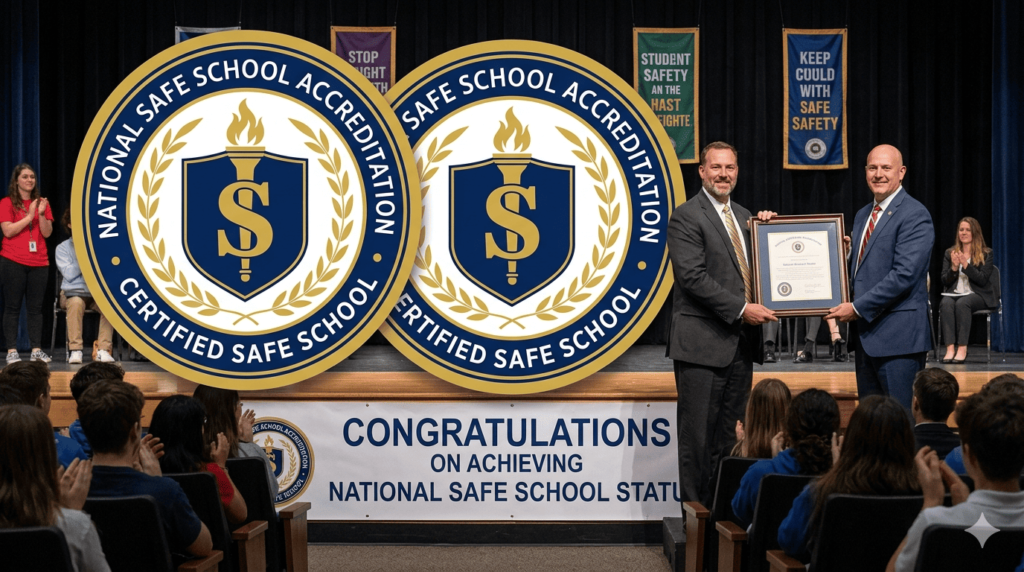
The NSSA aims to help educational institutions:
- Establish a robust school safety management system
- Conduct systematic self-assessment
- Identify gaps and risks proactively
- Implement corrective and preventive actions
- Enhance student well-being and protection
- Promote continuous improvement in safety standards
Unlike traditional compliance-based approaches, NSSA focuses on performance evaluation backed by data and evidence, ensuring that safety measures are not just documented but effectively implemented.
The Role of School Self-Evaluation (SSE)
School Self-Evaluation is the backbone of NSSA. It empowers institutions to internally review their safety systems against predefined criteria.
Key Benefits of SSE:
- Encourages ownership and responsibility
- Promotes internal accountability
- Helps identify strengths and weaknesses
- Supports data-driven decision-making
Through SSE, schools regularly monitor their safety practices, ensuring that they remain aligned with evolving risks and regulatory expectations.
External Assessor Review (EAR)
To ensure credibility and objectivity, NSSA incorporates External Assessor Review. Independent experts evaluate the school’s safety systems, verify evidence, and provide unbiased feedback.
Importance of EAR:
- Ensures transparency
- Validates self-assessment findings
- Provides expert recommendations
- Enhances trust among stakeholders
The combination of SSE and EAR creates a balanced system where internal insights meet external validation, leading to more effective safety outcomes.
Evidence-Based Assessment Approach
One of the defining features of NSSA is its reliance on evidence and data. Schools are required to demonstrate their safety performance through:
- Documented policies and procedures
- Training records
- Incident reports
- Maintenance logs
- Surveillance data
- Emergency response records
This ensures that the accreditation is not based on assumptions but on verifiable proof of implementation and effectiveness.
Continuous Improvement in School Safety
NSSA promotes a cycle of continuous improvement, where schools:
- Assess current safety practices
- Identify gaps and risks
- Implement corrective measures
- Monitor effectiveness
- Reassess and refine strategies
This iterative approach ensures that safety systems evolve with changing threats and operational challenges.
NSSA as a Paid Assessment Service
The NSSA School Safety Ratings is a professional assessment service that evaluates how effectively a school’s safety systems are functioning. It provides:
- Detailed performance insights
- Benchmarking against standards
- Actionable recommendations
- Recognition of safety excellence
For institutions, this investment translates into enhanced credibility, improved safety culture, and increased trust among parents and stakeholders.
Sixteen Key Assessment Angles of NSSA
The NSSA framework evaluates school safety across sixteen critical dimensions, each addressing a specific aspect of safety and security.
1. School Administration and Management
Effective leadership is essential for implementing and sustaining safety systems. This includes:
- Commitment to safety policies
- Allocation of resources
- Decision-making processes
- Safety governance structure
Strong administration ensures that safety is prioritized at every level.
2. Policies and Procedures
Well-defined policies provide the foundation for consistent safety practices.
Key elements include:
- Emergency response plans
- Child protection policies
- Health and hygiene guidelines
- Risk management procedures
Policies must be clear, accessible, and regularly updated.
3. Human Resources
Staff play a crucial role in maintaining safety.
Assessment includes:
- Recruitment background checks
- Role clarity
- Staff responsibilities
- Performance monitoring
Ensuring that the right people are in place enhances overall safety effectiveness.
4. Staff and Student Training & Awareness
Awareness and preparedness are vital.
This includes:
- Safety drills
- First aid training
- Fire safety education
- Emergency response training
Regular training ensures that everyone knows how to act during emergencies.
5. Safety, Cleanliness, and Maintenance
A well-maintained environment reduces risks significantly.
Focus areas:
- Sanitation standards
- Waste management
- Equipment maintenance
- Hazard identification
Clean and safe premises contribute to both health and safety.
6. Physical Environment
The design and condition of school infrastructure impact safety.
Assessment includes:
- Structural integrity
- Ventilation and lighting
- Safe layout
- Accessibility
A well-planned environment minimizes potential hazards.
7. Building Access Control
Controlling entry and exit points is critical.
Key measures:
- Secure gates
- ID verification
- Restricted access zones
- Entry logs
Proper access control prevents unauthorized entry.
8. Visitor and Staff Entry Management
Managing visitors is essential for security.
This involves:
- Visitor registration systems
- Identification badges
- Escort policies
- Monitoring movements
It ensures that all individuals on campus are accounted for.
9. Surveillance and Monitoring
Continuous monitoring enhances security.
Tools include:
- CCTV systems
- Security personnel
- Alarm systems
- Monitoring protocols
Effective surveillance helps detect and respond to threats promptly.
10. Communication Systems
Clear communication is vital during emergencies.
This includes:
- Public address systems
- Emergency contact protocols
- Internal communication channels
- Parent notification systems
Efficient communication ensures quick response and coordination.
11. General External Safety
This covers the safety of the school’s external environment.
Focus areas:
- Boundary walls
- Lighting outside premises
- Traffic control
- Neighborhood risks
A secure external environment reduces external threats.
12. General Internal Safety
Internal safety measures focus on daily operations.
Includes:
- Classroom safety
- Corridor management
- Equipment safety
- Hazard-free spaces
Ensuring internal safety protects students during routine activities.
13. Playground and Recreation Areas
Recreational spaces must be safe and well-managed.
Assessment includes:
- Equipment safety
- Surface conditions
- Supervision
- Injury prevention measures
Safe play areas are essential for student well-being.
14. Cafeteria and Specialized Areas
Areas like cafeterias and labs require special attention.
Key considerations:
- Food safety standards
- Hygiene practices
- Equipment safety
- Chemical handling (labs)
These areas must comply with strict safety protocols.
15. School Transport and Parking
Transportation safety is critical for students.
Includes:
- Vehicle safety checks
- Driver qualifications
- Route planning
- Parking management
Safe transport systems ensure student safety beyond the campus.
16. Key Performance Indicators (KPIs)
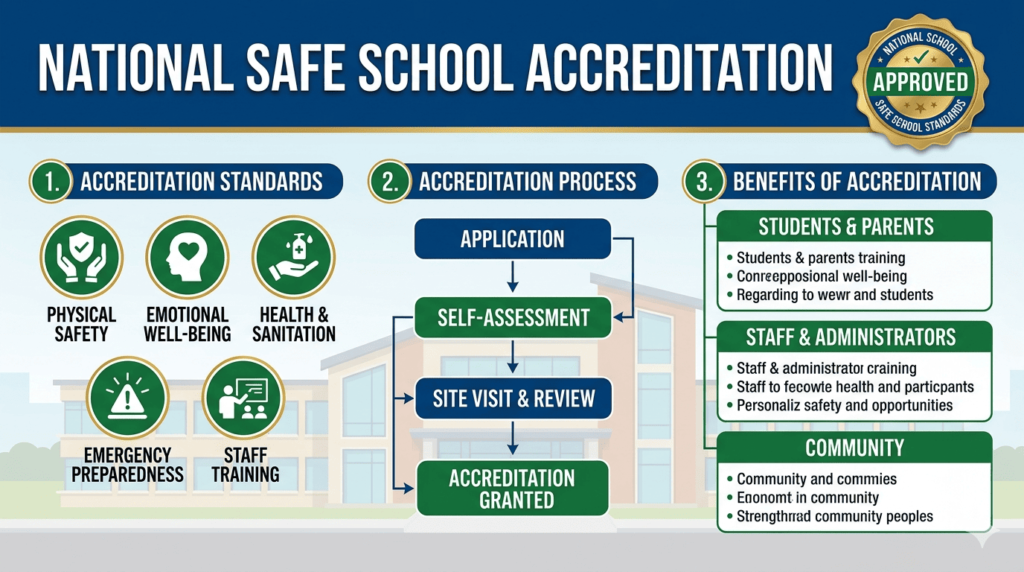
KPIs measure the effectiveness of safety systems.
Examples:
- Incident rates
- Response times
- Training completion rates
- Compliance levels
KPIs provide measurable insights into safety performance.
Benefits of NSSA Accreditation
Implementing NSSA offers numerous advantages:
1. Enhanced Student Safety
Creates a secure environment for learning and development.
2. Improved Institutional Reputation
Builds trust among parents, students, and stakeholders.
3. Regulatory Compliance
Ensures adherence to safety standards and guidelines.
4. Risk Reduction
Identifies and mitigates potential hazards proactively.
5. Continuous Improvement
Encourages ongoing enhancement of safety systems.
6. Data-Driven Decision Making
Supports strategic planning with measurable insights.
Building a Culture of Safety
NSSA goes beyond systems and procedures—it fosters a culture of safety. This involves:
- Encouraging reporting of risks
- Promoting safety awareness
- Engaging students and staff
- Recognizing safe practices
A strong safety culture ensures that everyone takes responsibility for maintaining a secure environment.
Challenges in Implementing NSSA
While NSSA offers a comprehensive framework, schools may face challenges such as:
- Resource limitations
- Resistance to change
- Lack of awareness
- Training gaps
However, with proper planning and commitment, these challenges can be effectively addressed.
The Future of School Safety
As risks evolve, school safety frameworks like NSSA will continue to adapt. Emerging trends include:
- Integration of technology (AI surveillance, smart systems)
- Data analytics for risk prediction
- Enhanced cybersecurity measures
- Focus on mental health and well-being
NSSA is well-positioned to evolve alongside these trends, ensuring that schools remain prepared for future challenges.
Conclusion
The National Safe School Accreditation (NSSA) is a comprehensive, structured, and evidence-based approach to ensuring safety and security in educational institutions. By combining School Self-Evaluation (SSE) with External Assessor Review (EAR), it creates a balanced system that promotes accountability, transparency, and continuous improvement.
Through its sixteen assessment angles, NSSA covers every critical aspect of school safety—from administration and infrastructure to training and performance measurement. It empowers schools to proactively identify risks, implement effective controls, and maintain a safe learning environment.
In an era where safety concerns are increasingly complex, NSSA provides a reliable framework for schools to not only meet expectations but exceed them. By adopting NSSA, institutions demonstrate their commitment to protecting students, enhancing operational excellence, and building trust with all stakeholders.
Table of Contents
WYAB World Yoga Accreditation Board
WYAB House
C/O Mr.Garry 54, Glengarnock Avenue,
E-14 3BP Isle Of Dogs, London UK
Tel .: +44-8369083940
email: info@worldyoga.us
Website: https://worldyoga.us/
MUMBAI Head Office
World Yoga Accreditation Board (WYAB)
WYAB House
B-401, New Om Kaveri Chs. Ltd., Nagindas pada,
Next To Shiv Sena Office, Nallasopara (E)
Tel .: +91-7499991895
email: info@worldyoga.us
Website: https://worldyoga.us/
DELHI-NCR Regd. Office
World Yoga Accreditation Board (WYAB)
WYAB House
Asaoti, Dist Palwal
Faridabad Delhi NCR, Haryana
Tel .: +91-7979801035
Fax: +91-250 2341170
Website: https://worldyoga.us/