Wording of Certificates
The wording of certificates plays a crucial role in establishing credibility, trust, and global recognition for certification bodies, training institutions, and accreditation organizations such as WorldYoga or similar frameworks.
In this detailed guide, we will explore the importance, structure, essential components, compliance requirements, and best practices for drafting certificate wording, especially in the context of certification bodies, accreditation boards, and training institutions.
1. Importance of Certificate Wording
The wording of a certificate determines its authenticity, clarity, and acceptance. Poorly worded certificates may lead to:
- Misinterpretation of qualifications
- Rejection by employers or institutions
- Legal disputes or credibility issues
- Loss of trust in the certifying body
On the other hand, well-structured certificate wording ensures:
- Clear communication of achievement or compliance
- Professional and international recognition
- Alignment with accreditation standards
- Legal validity and traceability
For organizations like WorldYoga or accreditation bodies, consistent wording is essential to maintain uniformity across all issued certificates.
2. Types of Certificates
Different types of certificates require slightly different wording structures. These include:
a. Certification Certificates
Issued to individuals or organizations confirming compliance with a standard (e.g., ISO, Yoga Teacher Certification).
b. Accreditation Certificates
Issued to bodies that are authorized to certify others.
c. Training Completion Certificates
Issued after successful completion of a course or program.
d. Participation Certificates
Issued for attending events, workshops, or seminars.
Each type must reflect its purpose clearly in the wording.
3. Standard Structure of Certificate Wording
A professionally drafted certificate generally follows a structured format:
1. Title/Header
The title should clearly indicate the nature of the certificate.
Examples:
- Certificate of Completion
- Certificate of Accreditation
- Certificate of Registration
- Certificate of Achievement
2. Issuing Authority
This section identifies the organization issuing the certificate.
Example:
“This is to certify that [Organization Name]…”
It must include:
- Official name of the issuing body
- Logo (if applicable)
- Accreditation reference (if any)
3. Statement of Certification
This is the most important part and must clearly define what is being certified.
Example:
“…has been assessed and found to be in compliance with the requirements of…”
This section should include:
- Standard name (e.g., ISO 9001, Yoga Certification Standard)
- Scope of certification
- Type of compliance
4. Name of the Recipient
Clearly mention:
- Individual’s full name OR
- Organization name
Example:
“…awarded to [Full Name / Company Name]…”
Accuracy is critical to avoid disputes.
5. Scope and Details
Defines what exactly is covered under certification.
Example:
“For providing yoga training services in accordance with prescribed guidelines.”
This may include:
- Services/products
- Location (if applicable)
- Level or grade
6. Certificate Number
Each certificate must have a unique identification number for traceability.
Example:
“Certificate No: WY/2026/001234”
7. Issue Date and Validity
Clearly mention:
- Date of issue
- Expiry date (if applicable)
Example:
“Date of Issue: 01 January 2026
Valid Until: 31 December 2028”
8. Signature and Authorization
Must include:
- Name of authorized signatory
- Designation
- Signature
- Seal or stamp
9. Accreditation Statement (if applicable)
If the issuing body is accredited, a statement must be included.
Example:
“Issued under the authority of an internationally recognized accreditation framework.”
4. Sample Certificate Wording
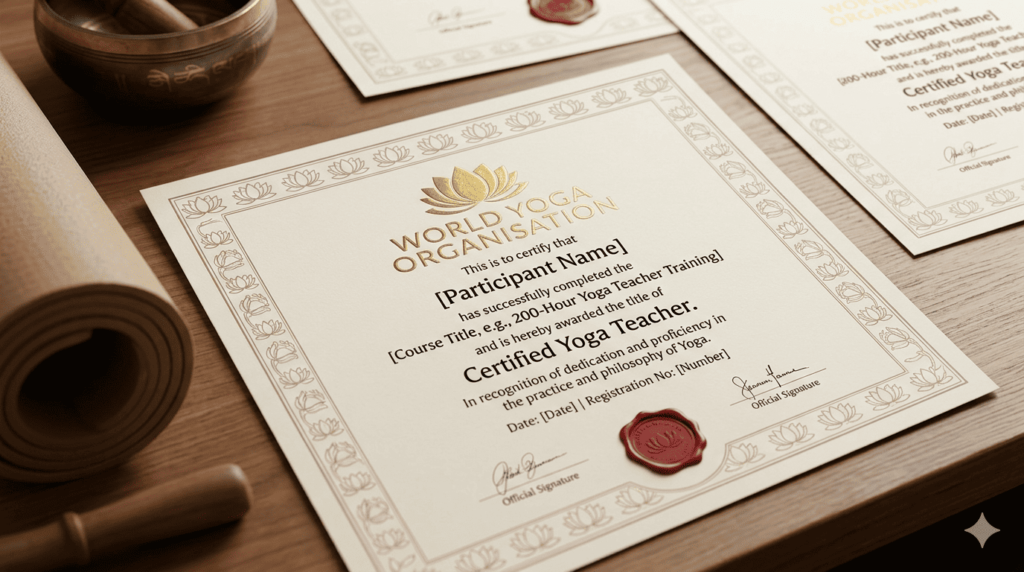
Here is a professional sample:
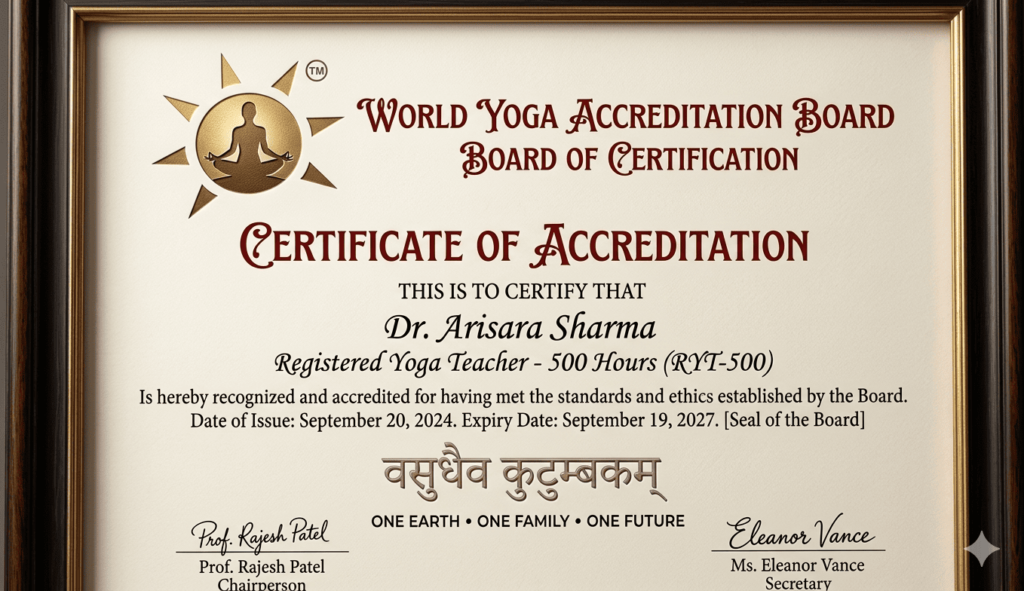
Certificate of Accreditation
“This is to certify that
[Organization Name]
has been assessed and accredited by WorldYoga Certification Board
for compliance with the requirements of
Yoga Training and Certification Standards
Scope of Accreditation:
Provision of Yoga Education, Training, and Certification Services
Certificate Number: WYAB-ACC-2026-001
Date of Issue: 01 January 2026
Valid Until: 31 December 2028
This certificate remains valid subject to continued compliance with the applicable standards and successful surveillance audits.
Authorized Signatory
[Name]
[Designation]”
5. Key Principles for Effective Certificate Wording
a. Clarity
Avoid ambiguous language. The wording should be easily understandable.
b. Accuracy
All names, dates, and references must be correct.
c. Consistency
Use standardized templates across all certificates.
d. Formal Tone
Maintain a professional and authoritative tone.
e. Compliance
Align with international standards and guidelines.
6. Compliance with International Standards
Certificate wording must often align with globally recognized standards such as:
- ISO/IEC 17021 (Certification Bodies)
- ISO/IEC 17024 (Personnel Certification)
- ISO/IEC 17065 (Product Certification)
These standards require:
- Transparency in certification scope
- Clear identification of certified entity
- Traceability via certificate number
- Defined validity period
Failure to comply may lead to rejection in international markets.
7. Common Mistakes to Avoid
1. Vague Language
Avoid phrases like “successfully completed” without specifying what.
2. Missing Scope
Certificates without scope lack clarity and credibility.
3. Incorrect Names
Spelling errors can invalidate certificates.
4. No Validity Period
Certificates without expiry may be questioned.
5. Lack of Unique Identification
Without a certificate number, verification becomes difficult.
8. Digital Certificates and Modern Trends
With the rise of digital transformation, certificate wording must also adapt to electronic formats.
Key additions include:
- QR Code for verification
- Digital signature
- Online verification link
- Blockchain-based authentication (emerging trend)
Example addition:
“This certificate can be verified online using the QR code or verification portal.”
9. Legal Considerations
Certificates are legal documents in many contexts. Therefore:
- Avoid misleading claims
- Ensure compliance with applicable laws
- Maintain records for verification
- Include disclaimers where necessary
Example:
“This certificate does not guarantee product performance but confirms compliance at the time of assessment.”
10. Branding and Presentation
While wording is critical, presentation also matters.
Include:
- Professional layout
- Clear typography
- Official logos
- Security features (hologram, watermark)
However, branding should never overshadow clarity of wording.
11. Customization vs Standardization
Organizations often face a choice between customizing certificates and maintaining standard formats.
Best Practice:
- Use a standardized core structure
- Allow limited customization (e.g., scope, name, level)
This ensures consistency while accommodating different programs.
12. Role of Accreditation Bodies
Accreditation bodies play a key role in defining certificate wording guidelines. They ensure:
- Uniformity across certification bodies
- Compliance with international norms
- Credibility of issued certificates
Organizations like WorldYoga must ensure that all affiliated bodies follow approved wording formats.
13. Verification and Traceability
Modern certificate wording should include verification mechanisms.
Example:
“This certificate is subject to verification through the official registry.”
Benefits:
- Prevents fraud
- Enhances trust
- Enables global recognition
14. Future of Certificate Wording
The future is moving toward:
- Smart certificates with embedded data
- AI-based verification systems
- Blockchain-secured credentials
- Global digital credential frameworks
Despite technological changes, the core principles of clear and accurate wording will remain essential.
Conclusion
The wording of certificates is a foundational element in the certification and accreditation ecosystem. It defines the credibility, clarity, and acceptance of the certificate across industries and borders. Whether for yoga certification, quality management, or professional training, precise and standardized wording ensures that certificates serve their true purpose—validating competence and compliance.
Organizations like WorldYoga and other accreditation bodies must prioritize structured templates, compliance with international standards, and modern verification techniques to maintain trust and global recognition.
INTRODUCTION
The wording of certificates plays a critical role in ensuring the credibility, transparency, and global acceptance of certification systems. Certificates are not merely formal documents; they serve as official proof that an organization has been independently assessed and found compliant with specific standards. Therefore, the language used in certificates must be clear, standardized, and aligned with internationally recognized frameworks such as ISO 17021:2015 and ISO 17000:2004.
To guarantee propriety of certificate issuance and maintain consistency across certification bodies, a standard wording structure is typically followed. This ensures that all stakeholders—including regulators, customers, and international partners—can trust the authenticity and meaning of the certificate.
The following is the recommended standard wording that should appear on certificates, serving as a reference template. Wherever “XXXX” is mentioned, it should be replaced with the official name of the certification body as listed in the accreditation register.
Standard Certificate Wording:
“This is a licensed testament approved for issue by Certification Administration for Confirming Bodies LLC who have surveyed XXXX against characterized models and in cognisance of ISO 17021:2015 ‘Similarity Evaluation – Prerequisites for bodies giving review and accreditation of the executives frameworks’. This testament is just substantial when affirmed by the register recorded in the Global Register of Value Surveyed Associations: https://worldyoga.us/”
Notes:
(i) “Conformity Assessment” and “Conformity Assessment Body” are terms defined within ISO 17000:2004, which provides standardized terminology and principles for assessment activities.
This wording establishes the legitimacy of the certificate by clearly identifying:
- The issuing authority
- The assessment framework used
- The applicable international standard
- The validation mechanism through a global register
Such structured wording eliminates ambiguity and reinforces confidence in the certification process.
IMPORTANCE OF STANDARDIZED CERTIFICATE WORDING
Standardization in certificate wording is essential for maintaining uniformity across industries and geographical boundaries. Certification bodies operate globally, and organizations often rely on certifications to enter international markets. Therefore, any inconsistency in wording can lead to confusion, misinterpretation, or even rejection of the certificate.
Using harmonized wording ensures that certificates are:
Globally Recognized
When certificates follow internationally accepted phrasing aligned with standards like ISO 17021:2015, they are more easily recognized by regulators and clients worldwide.
Legally Defensible
Clear and precise wording reduces the risk of disputes. It defines the scope, limitations, and authority of the certification, making it legally robust.
Transparent and Trustworthy
Stakeholders can clearly understand what has been certified, under what conditions, and by whom.
Consistent Across Sectors
Whether it is manufacturing, healthcare, education, or IT, standardized wording ensures uniform interpretation.
CERTIFICATE INFORMATION REQUIREMENTS
A certificate must contain essential information to ensure completeness and validity. These elements provide a comprehensive overview of the certified organization and the scope of certification.
1. Client Name
The certificate must clearly state the legal name of the organization being certified. This ensures there is no ambiguity regarding the entity that has been assessed. The name should match official records such as registration documents.
2. Client Address
The full address of the certified organization must be included. This is particularly important for organizations operating from multiple locations. If certification applies to multiple sites, either all addresses should be listed or a reference to an annex should be provided.
3. Scope of Client Activities
The scope defines what exactly has been certified. It should be specific, clear, and aligned with the organization’s actual operations. For example:
- Manufacturing of automotive components
- Provision of IT consulting services
- Design and development of medical devices
A well-defined scope prevents misuse or misinterpretation of the certificate.
4. Applicable Management System Standard
The certificate must specify the standard against which the organization has been assessed, such as:
- ISO 9001:2015 (Quality Management Systems)
- ISO 14001:2015 (Environmental Management Systems)
- ISO 45001:2018 (Occupational Health & Safety)
This ensures clarity regarding the type of certification granted.
5. Initial Certification Date
This is the date when the certification was first granted following a successful audit and decision process. It reflects the beginning of the certification cycle.
6. Re-certification Date
Certificates are typically valid for a fixed cycle (usually three years). The re-certification date indicates when the next full audit is required to renew the certification.
7. Issue Date
The issue date represents when the current version of the certificate was released. This may differ from the initial certification date if updates or revisions have been made.
8. Expiry Date
The expiry date defines the validity period of the certificate. After this date, the certificate is no longer valid unless renewed.
9. Certification Body Details
The name and address of the certification body issuing the certificate must be clearly stated. This ensures traceability and accountability. The certification body must be recognized and operate in accordance with standards like ISO 17021:2015.
10. Limitations and Conditions
Certificates must include statements regarding limitations on validity. These typically include:
- Certification is subject to ongoing surveillance audits
- Continued compliance with the standard is required
- Any major nonconformity may lead to suspension or withdrawal
Such disclaimers protect the integrity of the certification system.
11. Accreditation Body Logo
If the certification body is accredited, the logo of the accreditation body should be displayed. This signifies that the certification body itself has been independently evaluated.
12. Accreditation Mark Usage Rules
The use of accreditation marks must comply with strict guidelines. Misuse can lead to suspension of accreditation. The logo should not imply that the accreditation body directly certifies the organization.
13. Industrial Classification Codes (NACE/Other Codes)
Where applicable, the certificate should include classification codes such as NACE (Statistical Classification of Economic Activities). These codes help define the industry sector and scope of activities.
STRUCTURE AND FORMAT OF CERTIFICATES
Beyond wording, the structure and layout of certificates also contribute to their effectiveness. A well-structured certificate typically includes:
- Header with certification body details
- Title indicating certification type
- Main body with standardized wording
- Scope and client information
- Dates and validity details
- Logos and accreditation marks
- Signature of authorized personnel
The layout should be professional, easy to read, and resistant to forgery.
ROLE OF CERTIFICATION BODIES
Certification bodies are responsible for ensuring that certificates are issued in accordance with international standards. Their responsibilities include:
- Conducting impartial audits
- Making certification decisions based on evidence
- Maintaining records of certified clients
- Ensuring correct use of certificate wording
- Monitoring ongoing compliance through surveillance audits
They must operate with integrity, impartiality, and competence to maintain trust in the certification process.
COMMON ERRORS IN CERTIFICATE WORDING
Despite guidelines, errors in certificate wording can occur. Some common issues include:
Ambiguous Scope
Vague descriptions can lead to misuse of certification claims.
Incorrect Standard Reference
Using outdated or incorrect standard versions reduces credibility.
Missing Dates
Incomplete date information creates confusion about validity.
Improper Logo Usage
Misuse of accreditation logos can lead to non-compliance.
Lack of Conditions Statement
Failure to include limitations may mislead stakeholders.
Avoiding these errors is essential for maintaining the integrity of the certification system.
DIGITAL CERTIFICATES AND VERIFICATION
With the increasing adoption of digital systems, many certification bodies now issue electronic certificates. These often include:
- QR codes for verification
- Online validation portals
- Digital signatures
- Secure databases
The inclusion of a verification link (such as the Global Register mentioned earlier) ensures that stakeholders can confirm the authenticity of the certificate in real time.
LEGAL AND ETHICAL CONSIDERATIONS
Certificates carry legal and ethical implications. Misrepresentation of certification status can lead to:
- Legal penalties
- Loss of accreditation
- Reputational damage
- Contract termination
Therefore, both certification bodies and certified organizations must ensure accurate representation of certification status at all times.
GLOBAL RECOGNITION AND MUTUAL ACCEPTANCE
Standardized certificate wording supports mutual recognition agreements (MRAs) between accreditation bodies. This enables certificates issued in one country to be accepted in another, facilitating international trade and cooperation.
Organizations benefit from:
- Reduced duplication of audits
- Easier market access
- Increased customer confidence
CONCLUSION
The wording of certificates is a fundamental aspect of the certification process. It ensures clarity, consistency, and credibility across industries and regions. By adhering to internationally recognized standards such as ISO 17021:2015 and ISO 17000:2004, certification bodies can issue certificates that are globally accepted and trusted.
A well-worded certificate not only reflects compliance but also demonstrates professionalism, transparency, and commitment to quality. It serves as a powerful tool for organizations to showcase their adherence to standards and build confidence among stakeholders.
Table of Contents
Branches
WYAB Accreditation
WYAB Head Office
WYAB World Yoga Accreditation Board
WYAB House
C/O Mr.Garry 54, Glengarnock Avenue,
E-14 3BP Isle Of Dogs, London UK
Tel .: +44-8369083940
email: info@worldyoga.us
Website: https://worldyoga.us/
MUMBAI Head Office
World Yoga Accreditation Board (WYAB)
WYAB House
B-401, New Om Kaveri Chs. Ltd., Nagindas pada,
Next To Shiv Sena Office, Nallasopara (E)
Tel .: +91-7499991895
email: info@worldyoga.us
Website: https://worldyoga.us/
DELHI-NCR Regd. Office
World Yoga Accreditation Board (WYAB)
WYAB House
Asaoti, Dist Palwal
Faridabad Delhi NCR, Haryana
Tel .: +91-7979801035
Fax: +91-250 2341170
Website: https://worldyoga.us/