Arm Balance: Both Legs to the Side
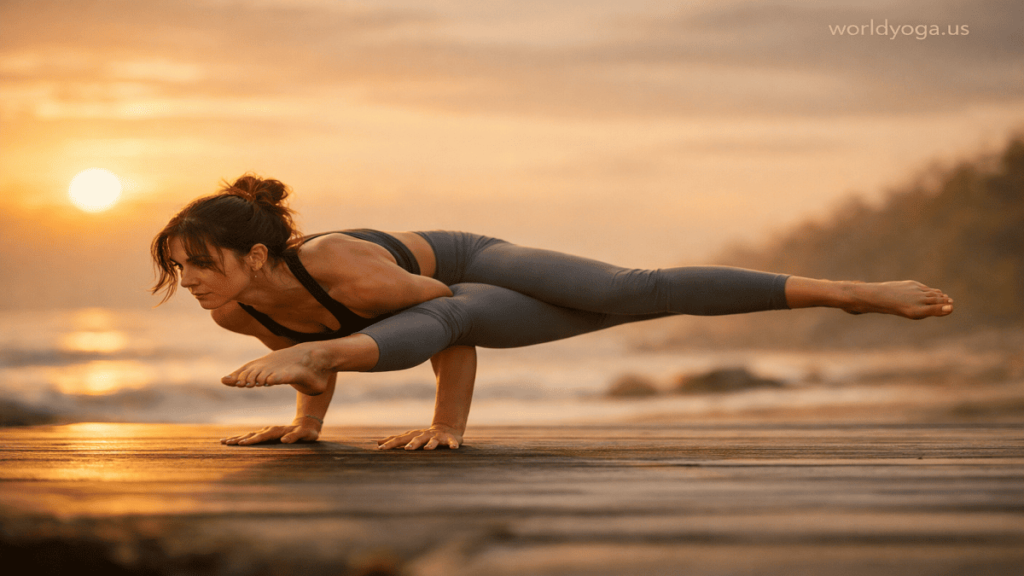
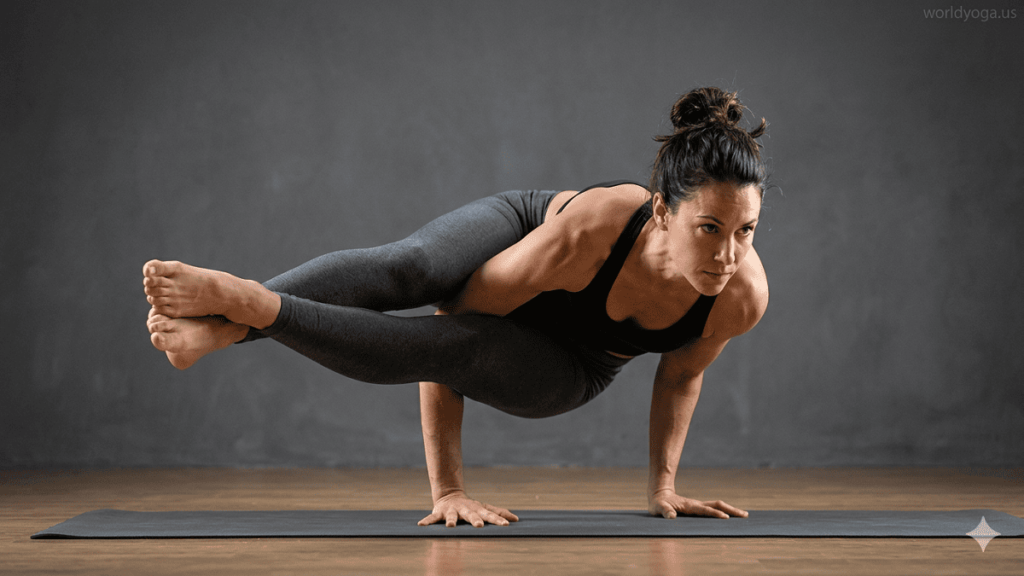
Arm Balance: Both Legs to the Side refers to an advanced category of yoga arm balances where the practitioner supports the entire body weight on the hands while both legs extend laterally to one side of the body. This classification includes highly technical poses such as Vishama Dwi Pada Koundinyasana, where asymmetry, spinal rotation, and lateral leg extension create complex biomechanical demands.
Biomechanical Overview
In this arm balance variation, the body operates under a significant rotational torque system. Unlike symmetrical arm balances such as Bakasana, where load is evenly distributed, this category shifts mass to one side, requiring precise control of the center of mass over a narrow base of support (the hands). The lateral extension of both legs increases the lever arm length, intensifying the demand on the core and shoulder stabilizers.
Key Movement Characteristics
- Both legs extend horizontally to one side, creating a strong lateral vector force
- The torso typically rotates in the opposite direction to counterbalance leg weight
- Hands act as the sole base of support with dynamic micro-adjustments through fingers and palms
- The pelvis remains lifted and controlled through coordinated core engagement
Muscular Demands
This arm balance category heavily recruits:
- Core stabilizers: obliques, transverse abdominis, rectus abdominis
- Shoulder complex: serratus anterior, deltoids, rotator cuff
- Arms: triceps brachii and forearm flexors for load-bearing stability
- Hip stabilizers: glutes and adductors to maintain leg extension and alignment
Technical Challenges
Practitioners commonly face:
- Difficulty maintaining forward weight shift
- Collapsing through one shoulder due to uneven loading
- Loss of pelvic control during leg extension
- Insufficient core engagement leading to rotational collapse
Preparatory Foundations
Effective progression typically includes:
- Twisting poses (Parivrtta Anjaneyasana, Parivrtta Trikonasana)
- Side-arm balances like Parsva Bakasana
- Core compression drills and plank variations
- Arm balances emphasizing single-leg extension before bilateral lateral extension
Training Insight
Mastery of “Both Legs to the Side” arm balances requires integration of strength, mobility, and neuromuscular coordination, rather than isolated muscular power. The practitioner must learn to control torque while maintaining scapular stability and precise weight distribution.
Conclusion
This category represents one of the most advanced expressions of arm balance yoga, combining asymmetry, rotation, and full-body integration. It serves as a benchmark for evaluating high-level core strength, shoulder resilience, and proprioceptive control in modern yoga practice.
#Arm Balance: Both Legs to the Side in Delhi
What alignment principles are essential for safely achieving balance in Parsva Bakasana?
1. Strong, Controlled Spinal Rotation (Twist from the Thoracic Spine)
The twist should originate primarily from the thoracic spine, not the lumbar region. This protects the lower back from excessive shear stress. The ribcage rotates around a stable pelvis, allowing the torso to wrap securely onto the upper arm. Maintaining length in the spine before deepening the twist ensures structural integrity.
2. Compact Elbow–Knee Connection
A key alignment principle is creating a firm contact point between the outer thigh and upper arm (triceps area). This connection acts as a shelf for the body. The elbows should stay bent and close together, forming a stable base. If the elbows splay outward, the structure collapses and balance is lost.
3. Forward Center of Mass Shift
Balance is achieved only when the center of mass moves forward of the wrists. Many practitioners fail by staying too upright. The chest must actively move forward, even if it feels like a fall is imminent. Proper engagement of the core prevents actual collapse while enabling lift.
4. Scapular Protraction and Shoulder Stability
The shoulders must remain protracted (rounded slightly forward) using the serratus anterior. This prevents the chest from sinking and stabilizes the shoulder girdle. Collapsed or retracted shoulders reduce structural support and increase wrist and shoulder strain.
5. Even Weight Distribution Through Both Hands
Although one leg rests on an arm, both hands must press actively into the ground. Uneven loading leads to instability and overuse injuries. Micro-adjustments through the fingertips help fine-tune balance and maintain symmetry in force distribution.
6. Core Engagement and Anti-Rotation Control
The obliques and transverse abdominis must actively resist unwanted rotation. This is crucial because the posture naturally encourages twisting collapse. A strong core stabilizes the pelvis and prevents the lower body from swinging off-axis.
7. Hip Elevation and Compact Body Shape
The hips must lift high to reduce leverage load on the arms. A compact body shape—knees tucked and spine engaged—reduces torque and improves control. Excessive extension of the legs without stability leads to imbalance.
Conclusion
In Parsva Bakasana, safe balance is achieved through a combination of thoracic rotation, structural elbow-knee connection, forward weight shift, scapular stability, and strong anti-rotational core control. When these principles are integrated, the posture becomes both stable and efficient, minimizing strain while maximizing control and lift.
#Arm Balance: Both Legs to the Side in Banglore
Which muscle groups provide the primary support and stability in this lateral arm balance?
1. Core Stabilizers (Primary Control System)
The obliques (internal and external) are the most important muscles in this pose. They control spinal rotation and prevent the torso from collapsing sideways. The transverse abdominis acts as a deep stabilizing corset, maintaining intra-abdominal pressure and spinal support. The rectus abdominis assists in forward compression, helping lift the hips and bring the body into a compact balance.
2. Shoulder Girdle Stabilizers (Structural Foundation)
The serratus anterior is essential for scapular protraction, which keeps the chest lifted and prevents shoulder collapse. The middle and lower trapezius stabilize the scapula and maintain proper shoulder positioning. The rotator cuff muscles (supraspinatus, infraspinatus, teres minor, subscapularis) stabilize the humeral head within the shoulder socket, ensuring joint safety under load.
3. Arm Support Muscles (Load Bearing)
The triceps brachii plays a key role in maintaining elbow extension and preventing collapse under body weight. The forearm flexors and extensors stabilize the wrists and regulate pressure distribution through the palms and fingers. These muscles allow fine adjustments that are critical for balance corrections during the pose.
4. Hip and Leg Engagement (Counterbalance System)
The hip flexors (iliopsoas) and adductors help maintain the compact leg position resting on the upper arm. The gluteus maximus assists in lifting and stabilizing the pelvis, especially during the initial lift-off phase. Hamstrings also contribute to controlling leg positioning and preventing excessive extension that could destabilize the balance.
5. Spinal Stabilizers (Postural Integrity)
The erector spinae support spinal alignment and resist collapse under forward weight shift. They work in coordination with the core muscles to maintain a controlled curve rather than excessive flexion or extension.
Integrated Function
Unlike symmetrical arm balances such as Bakasana, Parsva Bakasana demands anti-rotational strength, meaning the left and right sides of the body perform different stabilization roles simultaneously. The core prevents twisting collapse, the shoulders manage vertical load, and the arms maintain structural support, while the hips and legs regulate counterbalance.
Conclusion
Primary stability in Parsva Bakasana is generated by the obliques, transverse abdominis, serratus anterior, triceps, and forearm muscles, with essential support from the hips and spinal stabilizers. The coordinated interaction of these muscle groups enables controlled balance in this complex lateral arm balance posture.
#Arm Balance: Both Legs to the Side in India
What preparatory poses help develop the required spinal twist and core engagement?
1. Revolved Standing Twists (Spinal Rotation Foundation)
Poses like Parivrtta Anjaneyasana are essential for building controlled spinal rotation. This posture teaches practitioners to initiate the twist from the thoracic spine while keeping the hips stable. It also strengthens the coordination between breath and rotation, which is crucial for safe twisting under load.
Similarly, Parivrtta Trikonasana develops longer-range rotational control. It improves hamstring flexibility while reinforcing axial length in the spine. This helps prevent collapse into the lower back when transitioning into arm balances.
2. Deep Hip and Core Integration Poses
Chair twist variations (Parivrtta Utkatasana) are highly effective for combining lower-body compression with spinal rotation. These poses mimic the core engagement pattern required in Parsva Bakasana by forcing the practitioner to maintain balance while twisting under load.
Low lunge twists with elbow-to-knee connections also train the same kinetic chain used in arm balances, reinforcing the relationship between hip flexion and thoracic rotation.
3. Arm Balance Foundations for Load Adaptation
Before attempting full Parsva Bakasana, practitioners should develop strength in symmetrical arm balances like Bakasana. This builds wrist endurance, scapular stability, and forward weight-shift confidence.
Once stable in crow pose, transitioning into side-loaded variations helps introduce asymmetry while maintaining structural control.
4. Direct Preparatory Arm Balance Progressions
One of the most effective specific preparatory poses is Parsva Bakasana itself in supported or partial form (feet lightly touching ground). This allows the practitioner to learn elbow–knee connection, weight shifting, and scapular protraction without full lift-off.
Additionally, one-legged variations such as Eka Pada Koundinyasana drills help bridge the gap between twisting and full arm balance execution.
5. Core Compression and Anti-Rotation Drills
Plank variations with knee-to-elbow crosses, side planks (Vasisthasana), and slow controlled leg tucks strengthen the obliques and transverse abdominis, which are essential for resisting rotational collapse. These drills directly simulate the anti-rotation demands of Parsva Bakasana.
Conclusion
Effective preparation for Parsva Bakasana requires a structured progression:
- Standing revolved poses for spinal mobility
- Core compression drills for stability
- Crow pose for foundational arm strength
- Partial side crow for integration
Together, these preparatory practices build the spinal rotation, core engagement, and neuromuscular control necessary for safe and stable execution of this advanced twisting arm balance.
#Arm Balance: Both Legs to the Side in Mharashtra
How should body weight be distributed between the arms to maintain control and prevent collapse?
1. Primary Load vs. Stabilizing Support
One arm typically bears a slightly greater share of the load because the torso and legs rest partially on that side. However, the opposite arm must remain actively engaged rather than passive. The goal is not to “rest” on one arm but to create a shared support system, where both arms contribute to vertical lift and lateral stability.
2. Equal Pressure Through Both Palms
Even though the weight is uneven, pressure should be distributed across both hands through active pressing into the floor. The practitioner should spread the fingers wide and engage the fingertips to regulate subtle shifts. This prevents overloading one wrist and helps maintain structural balance in real time.
3. Elbow Alignment and Structural Integrity
Both elbows should remain bent and drawn inward toward the midline, forming a compact shelf for the body. If one elbow collapses outward or bears excessive load, the shoulder line destabilizes and the pose can fail. Keeping elbows aligned ensures that force travels efficiently through the forearm into the shoulder girdle.
4. Shoulder Engagement and Scapular Balance
The serratus anterior must be equally active on both sides to maintain scapular protraction. If one shoulder collapses, weight shifts unevenly and increases the risk of wrist or shoulder injury. Balanced scapular engagement allows both arms to function as a unified support platform rather than independent structures.
5. Micro-Adjustments Through Fingertips
Small shifts in balance are controlled through fine motor engagement in the hands. Pressing more through the index finger and thumb side can help correct forward drift, while engaging the outer hand edge can counter lateral tipping. These adjustments are continuous and subtle, not static.
6. Core Support to Reduce Arm Overload
Proper weight distribution is not achieved by the arms alone. The obliques and transverse abdominis must actively lift and stabilize the torso so that the arms are not overburdened. When the core is fully engaged, less weight drops into the shoulders, making distribution more even and sustainable.
7. Comparison to Symmetrical Arm Balances
In symmetrical poses like Bakasana, weight is naturally centered between both arms. In Parsva Bakasana, however, the practitioner must consciously create that balance despite lateral loading, making proprioception and control significantly more important.
Conclusion
To maintain control and prevent collapse in Parsva Bakasana, weight must be actively shared between both arms, with one arm supporting slightly more load while the other provides continuous stabilizing pressure. Combined with strong scapular engagement and core lift, this balanced distribution ensures stability, safety, and efficient alignment in the posture.
#Arm Balance: Both Legs to the Side in Chennai
What are the most common technical errors in this pose, and how can practitioners correct them effectively?
1. Insufficient Forward Weight Shift
Error:
Many practitioners stay too upright, keeping the center of mass behind the wrists. This prevents lift and causes the body to feel “stuck” or heavy.
Correction:
Actively shift the chest forward so the shoulders move slightly ahead of the wrists. Engage the core to prevent collapse while allowing controlled forward lean. Practicing transitions from Bakasana helps build confidence in forward loading.
2. Collapsing or Retracting Shoulders
Error:
The chest sinks and scapulae retract, weakening the structural support of the upper body.
Correction:
Engage the serratus anterior to protract the shoulders (push the floor away). Think of “rounding the upper back” to create a stable shelf. This keeps the shoulder girdle active and prevents joint compression.
3. Poor Elbow–Knee Connection
Error:
The thigh slips off the upper arm, or elbows flare outward, breaking the structural base.
Correction:
Firmly press the outer thigh onto the triceps and keep elbows bent and hugged toward the midline. This creates a compact “locking point” that supports the body’s weight.
4. Uneven Weight Distribution Between Hands
Error:
Too much load shifts into one wrist, usually the side supporting the torso.
Correction:
Press evenly through both palms and actively use fingertips for micro-adjustments. Maintain awareness of both hands working equally, even if the load feels asymmetrical.
5. Over-Rotation or Under-Rotation of the Torso
Error:
Insufficient twist prevents proper alignment, while excessive twisting collapses spinal integrity.
Correction:
Initiate rotation from the thoracic spine, not the lumbar region. Use preparatory poses like Parivrtta Anjaneyasana to train controlled spinal rotation.
6. Lack of Core Compression
Error:
The hips drop and the body becomes heavy due to weak oblique engagement.
Correction:
Actively engage the obliques and transverse abdominis to lift the hips and maintain compact body shape. Think of drawing knees toward the chest to reduce leverage load.
7. Wrist Overload and Instability
Error:
Collapsed wrist alignment causes pain or instability.
Correction:
Spread fingers wide, press through knuckles, and distribute pressure across the entire hand. Strengthen wrists through progressive loading drills.
Conclusion
Most errors in Parsva Bakasana stem from failure to integrate forward shift, scapular stability, elbow–knee connection, and core compression. Correcting these elements transforms the pose from unstable effort into controlled balance, allowing safer and more efficient execution.
#Arm Balance: Both Legs to the Side in Surat
Case Study of Arm Balance: Both Legs to the Side
1. Subject Profile and Initial Assessment
The subject is an intermediate-level yoga practitioner with 2.5 years of consistent practice. Baseline strengths included good general flexibility and familiarity with foundational arm balances such as Bakasana. However, limitations were observed in three key areas:
- Insufficient thoracic rotation control
- Weak anti-rotational core stability
- Uneven weight distribution between upper limbs during load-bearing tasks
Initial attempts at lateral arm balances showed premature collapse on the dominant arm and inability to maintain hip elevation.
2. Movement Analysis Framework
The “both legs to the side” category is characterized by:
- High rotational torque due to lateral leg extension
- A narrow base of support (hands only)
- Asymmetrical loading of the upper limbs
- High demand for anti-rotation core control
These factors create a complex kinetic chain where failure in any segment (core, shoulder, or wrist) leads to immediate instability.
3. Intervention Strategy (8–10 Week Model)
Phase 1: Foundational Control (Weeks 1–3)
- Revolved lunges and standing twists for thoracic mobility
- Core compression drills (plank knee-to-elbow variations)
- Wrist conditioning and scapular activation work
Phase 2: Structural Integration (Weeks 4–6)
- Side crow progressions (Parsva Bakasana)
- Controlled weight-shift drills from kneeling to partial lift
- Introduction of asymmetrical load awareness training
Phase 3: Expression Phase (Weeks 7–10)
- Partial and full lateral arm balance holds
- Dynamic entries from twisted lunge positions
- Focus on breath control and micro-adjustments in balance
4. Key Adaptations Observed
A. Improved Core Anti-Rotation Control
Significant increase in oblique engagement reduced torso collapse and stabilized pelvic alignment during lateral extension.
B. Enhanced Shoulder Stability
Scapular protraction and serratus anterior activation improved load transfer efficiency through both arms.
C. Better Load Distribution Awareness
The subject learned to actively distribute pressure across both palms rather than collapsing into the dominant side.
D. Increased Neuromuscular Coordination
Fine motor adjustments through fingers improved balance recovery during instability phases.
5. Common Failure Points Identified
- Delayed forward weight shift leading to loss of lift
- Over-rotation in the lumbar spine instead of thoracic spine
- Weak elbow–knee connection causing structural collapse
- Underactive non-dominant arm failing to stabilize effectively
6. Corrective Strategies Applied
- Emphasis on thoracic rotation drills over lumbar twisting
- Use of isometric holds in side crow variations
- Progressive load exposure to reduce fear-based hesitation
- Cueing: “press the floor away evenly through both hands”
7. Outcome Summary
After structured progression, the subject achieved:
- Stable lateral arm balance holds of 6–12 seconds
- Significantly reduced wrist discomfort
- Improved symmetry in upper-body engagement despite asymmetrical leg positioning
- Enhanced confidence in transitioning between twisting and balancing phases
Conclusion
The “Both Legs to the Side” arm balance category represents a high-level integration of rotation, compression, and unilateral load control. Progression requires systematic development of thoracic mobility, core anti-rotation strength, and scapular stability. When properly trained, practitioners demonstrate measurable improvements in balance control, joint resilience, and neuromuscular efficiency across asymmetrical movement patterns.
#Arm Balance: Both Legs to the Side in Ahemadabad
White Paper of Arm Balance: Both Legs to the Side
Abstract
This white paper analyzes the advanced yoga movement category known as Arm Balance: Both Legs to the Side, with key reference to Vishama Dwi Pada Koundinyasana. This category represents a high-load, asymmetrical arm support system characterized by lateral leg extension, rotational torque, and unilateral weight-bearing demands. The document outlines biomechanical principles, neuromuscular requirements, injury risk factors, and structured progression models relevant to practitioners, movement scientists, and performance trainers.
1. Introduction
Arm balances with both legs extended to one side represent one of the most mechanically complex locomotor patterns in yoga. Unlike symmetrical arm balances such as Bakasana, these postures introduce significant rotational instability and uneven force distribution, requiring advanced control of the shoulder girdle and core stabilizers.
The system is defined by three core features:
- Asymmetrical lateral leg extension
- High torsional load on the spine and shoulders
- Narrow base of support (hands only)
2. Biomechanical Model
2.1 Center of Mass and Base of Support
Stability depends on maintaining the center of mass (COM) directly over or slightly forward of the wrists. Lateral leg extension shifts COM outside the midline, requiring compensatory core activation.
2.2 Torque and Rotational Forces
The extended legs generate a long lever arm, producing rotational torque. This must be counteracted by oblique-driven anti-rotation strength and scapular stabilization.
2.3 Load Transfer System
Force is transferred through:
- Hands → wrists → elbows → shoulders → core
Efficient transfer reduces localized joint stress and improves balance efficiency.
3. Musculoskeletal Demands
Primary muscle systems include:
- Core stabilizers: transverse abdominis, internal/external obliques, rectus abdominis
- Shoulder complex: serratus anterior, deltoids, rotator cuff
- Upper limb support: triceps brachii, forearm flexors/extensors
- Hip stabilizers: adductors, gluteus maximus, iliopsoas
- Spinal control: erector spinae (controlled activation only)
These systems function in integrated co-contraction patterns rather than isolated activation.
4. Neuromuscular Requirements
Performance depends on:
- High proprioceptive sensitivity
- Rapid micro-adjustment capability in hands and shoulders
- Coordinated left-right asymmetrical motor control
- Anti-rotation reflex suppression under load
5. Risk Profile and Injury Mechanisms
Primary injury risks include:
- Wrist overload from uneven pressure distribution
- Shoulder impingement due to collapsed scapular control
- Lumbar strain from incorrect twisting mechanics
- Elbow stress from poor structural alignment
Failure typically results from inadequate scapular protraction or premature weight shift.
6. Progressive Training Framework
Phase 1: Mobility Development
- Thoracic rotation drills
- Revolved lunges and standing twists
Phase 2: Foundational Strength
- Core compression training
- Crow pose development (Bakasana)
Phase 3: Asymmetrical Integration
- Side crow variations (Parsva Bakasana)
- One-leg arm balance transitions
Phase 4: Full Expression
- Controlled entry and static holds
- Dynamic stabilization training under fatigue
7. Performance Optimization Principles
- Maintain forward center of mass shift
- Ensure equal hand engagement despite asymmetry
- Prioritize thoracic over lumbar rotation
- Maintain continuous scapular protraction
- Use core compression to reduce arm loading
8. Conclusion
The “Both Legs to the Side” arm balance system represents a peak expression of asymmetrical human movement capacity. It integrates rotational biomechanics, unilateral load-bearing, and neuromuscular precision. Mastery requires progressive conditioning of core anti-rotation strength, shoulder stability, and proprioceptive control. When properly trained, this movement category enhances overall athletic performance, joint resilience, and advanced motor coordination efficiency.
#Arm Balance: Both Legs to the Side in Hyderabad
Industry Application of Arm Balance: Both Legs to the Side
1. Sports Performance and Athletic Conditioning
In elite sports training, this movement pattern is used to develop anti-rotational core strength, shoulder stability, and unilateral load control. These attributes are essential in disciplines such as gymnastics, rock climbing, martial arts, swimming, and track athletics.
Unlike symmetrical arm balances such as Bakasana, which build general upper-body strength, lateral arm balances simulate real-world athletic demands where forces are rarely balanced. Athletes benefit from improved:
- Force transfer efficiency across kinetic chains
- Reactive stability under asymmetric load
- Core-driven injury resistance during dynamic movement
2. Physiotherapy and Rehabilitation Applications
In clinical rehabilitation, modified versions of these arm balances are used to restore closed-chain upper limb function and improve neuromuscular control.
Key applications include:
- Shoulder stability rehabilitation (post-injury or post-surgery)
- Wrist and elbow load adaptation training
- Core re-education for postural dysfunction
Therapists often utilize simplified progressions such as supported side crow (Parsva Bakasana) to safely reintroduce load-bearing capacity while monitoring alignment and joint response.
3. Fitness and Functional Training Industry
In modern fitness systems, especially calisthenics and functional movement training, this category is treated as an advanced skill progression model.
It is commonly broken into:
- Core anti-rotation drills
- Wrist conditioning protocols
- Scapular stability training
- Progressive arm balance sequencing
This allows coaches to integrate yoga-based biomechanics into strength and conditioning programs, improving total-body coordination and joint resilience.
4. Biomechanics and Sports Science Research
In academic and applied research, these arm balances are used as models of asymmetrical kinetic chain loading. They help scientists study:
- Torque management under unilateral load
- Center of mass displacement control
- Scapulohumeral rhythm under instability
- Neuromuscular coordination in complex motor tasks
Insights from these studies inform robotics, prosthetics design, and athletic performance modeling.
5. Mind–Body Wellness and Corporate Training
In wellness and corporate programs, these postures are often used in modified or preparatory forms to develop:
- Focus under instability
- Stress resilience through controlled physical challenge
- Mind–body awareness and concentration
They are not typically taught in full expression but are used to build mental discipline and body awareness through progressive training.
6. Conclusion
The “Both Legs to the Side” arm balance category is no longer limited to traditional yoga practice. It functions as a multi-industry movement model for training strength, coordination, and stability under asymmetrical load. Its applications span from elite athletic conditioning to clinical rehabilitation and advanced biomechanical research, making it a valuable framework for modern human movement science.
#Arm Balance: Both Legs to the Side in Mumbai
Ask FAQs
What is Arm Balance: Both Legs to the Side?
It is an advanced category of yoga arm balances where the practitioner supports the body on the hands while both legs extend to one side of the body. A key example is Vishama Dwi Pada Koundinyasana, which involves asymmetrical loading, spinal rotation, and strong core engagement.
Who should practice this type of arm balance?
This category is suitable only for advanced practitioners who already have strong foundations in arm balances, core strength, and spinal mobility. Prior experience with poses like Bakasana and twisting balances is essential before attempting full variations.
What are the main benefits of these arm balances?
They improve upper-body strength, core stability, spinal rotation control, and neuromuscular coordination. These poses also enhance balance, proprioception, and the ability to manage uneven or asymmetrical loads, which is useful in both athletic and functional movement contexts.
What are the most common mistakes practitioners make?
Common mistakes include insufficient forward weight shift, collapsing shoulders, uneven pressure between the hands, and weak core engagement. Many practitioners also over-rotate from the lower back instead of the thoracic spine, leading to instability or discomfort.
How can beginners safely progress toward these poses?
Progression should be gradual, starting with mobility work (twisting poses), then building strength through arm balances like Parsva Bakasana. Core drills, wrist conditioning, and controlled weight-shift exercises should be practiced consistently before attempting full lateral arm balances.
Table of Contents
Disclaimer: This content is for educational purposes only and is not a substitute for professional yoga instruction or medical advice. Advanced arm balances such as Arm Balance: Both Legs to the Side should be practiced under the guidance of a qualified instructor. Stop immediately if you feel pain or discomfort.