Author name: Mukesh Singh

Staff Pose. An advanced yoga practitioner performing an inverted forearm-supported backbend with both legs extended vertically in a calm indoor studio.
UPWARD BOW POSE, Elevated Both Legs Inverted Staff Pose

Elevated Both Legs Inverted Staff Pose

Elevated Both Legs Inverted Staff Pose is an advanced inversion and backbend that demands exceptional strength, stability, and full-body coordination. This powerful posture combines deep spinal extension with forearm-supported inversion and bilateral leg elevation, creating a high-level challenge for shoulder endurance, core control, and spinal integrity. Practicing this pose develops superior neuromuscular awareness, improves thoracic spine mobility, strengthens the posterior chain, and enhances pelvic stability under asymmetrical load conditions.

Eka Pada Urdhva Dhanurasana. A yoga practitioner performing One-Legged Wheel Pose in a calm indoor studio with one leg extended upward and hands and feet grounded on a mat.
UPWARD BOW POSE, Eka Pada Urdhva Dhanurasana

Eka Pada Urdhva Dhanurasana

Eka Pada Urdhva Dhanurasana (One-Legged Wheel Pose) is an advanced yoga backbend that demands exceptional strength, flexibility, and neuromuscular control. This powerful posture integrates deep spinal extension with unilateral balance, making it a benchmark for advanced yoga practitioners. It enhances shoulder stability, core anti-rotation strength, hip mobility, and overall body coordination. Practicing this pose requires careful progression from foundational backbends to full Wheel Pose before introducing asymmetry.

Person performing Upward Bow Pose (Wheel Pose) in a deep backbend with hands and feet grounded, forming a full arch in a yoga studio setting.
UPWARD BOW POSE

UPWARD BOW POSE

Upward Bow Pose (Chakrasana) is a powerful advanced backbending yoga posture that builds full-body strength, spinal flexibility, and mobility. This pose deeply engages the arms, shoulders, back, core, and legs while opening the chest and improving posture. It is widely used in advanced yoga practice and functional movement training to enhance flexibility, energy, and body control. Practicing with proper alignment and preparation ensures safe execution and maximizes its physical and postural benefits.

Athlete performing a heel-elevated chair squat in high stance, balancing on forefoot with arms extended forward in a controlled fitness training position.
CHAIR SQUAT: HIGH STANCE HEELS UP—ARMS IN FRONT & BEHIND

CHAIR SQUAT: HIGH STANCE HEELS UP—ARMS IN FRONT & BEHIND

Chair Squat High Stance Heels Up is an advanced functional training exercise designed to build lower-body strength, ankle stability, core control, and full-body coordination. Performed on the balls of the feet, this variation increases balance demand while engaging the quadriceps, calves, glutes, and core muscles. Adding arm positions in front and behind enhances postural stability and neuromuscular coordination. It is widely used in fitness, sports training, and rehabilitation programs to improve functional movement efficiency and overall body control.

Advanced yogi performing Revolved Tip Toe Pose variation, balancing on the tip of one foot with a deep spinal twist and arms extended for stability in a yoga studio setting.
CHAIR SQUAT: HIGH STANCE, Revolved Tip Toe Pose

Revolved Tip Toe Pose

Revolved Tip Toe Pose (Parivrtta Padangusthasana) is an advanced balancing yoga posture that combines deep spinal rotation with single-leg stability. This pose develops core strength, ankle stability, and full-body coordination while enhancing focus and body awareness. Practicing it safely with proper alignment helps improve balance control, spinal mobility, and neuromuscular integration.

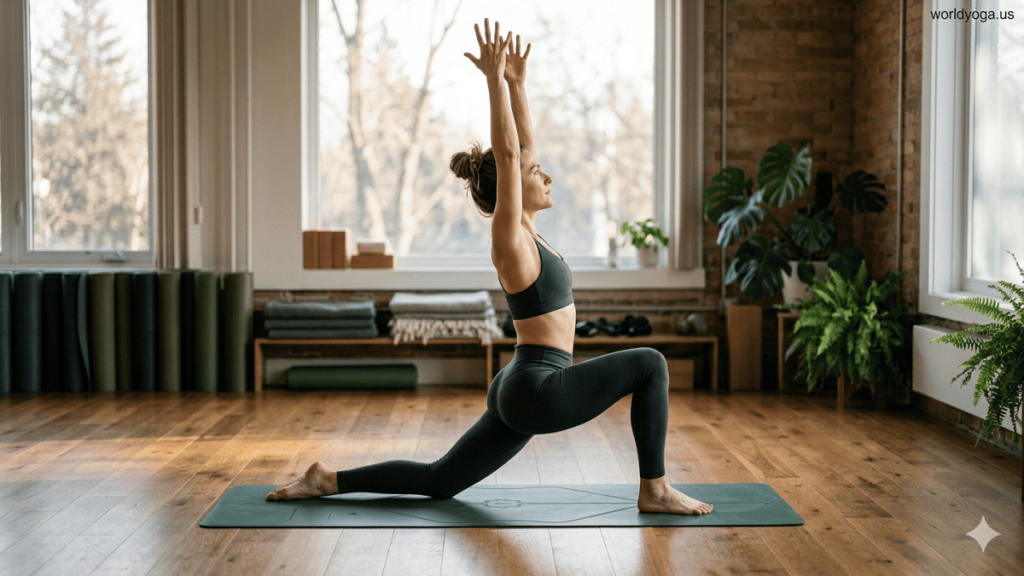
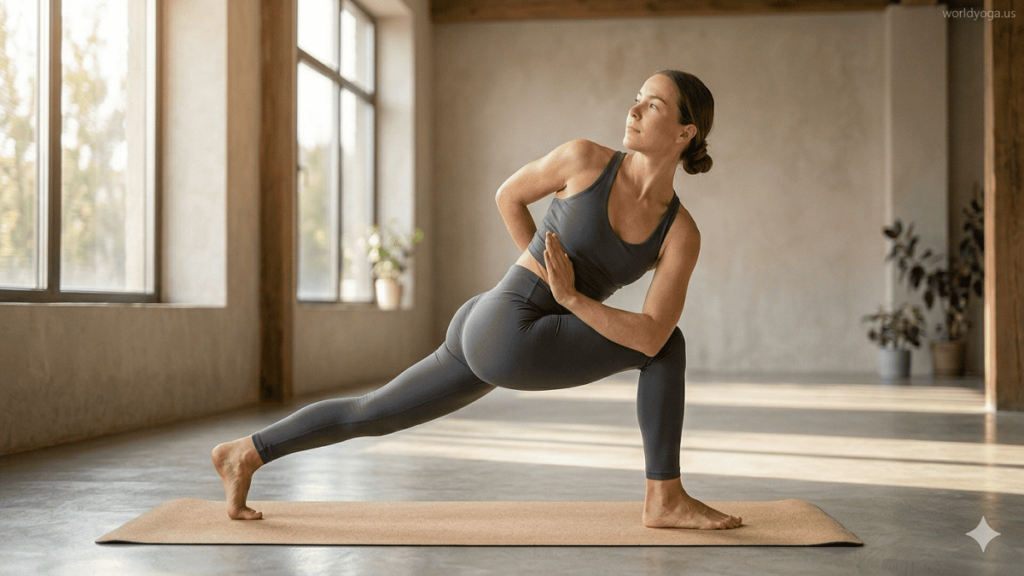
A yoga practitioner performing Parivritta Prapadasana in a deep lunge with a controlled spinal twist and hands in prayer position.
CHAIR SQUAT: HIGH STANCE, Parivritta Prapadasana

Parivritta Prapadasana

Parivritta Prapadasana is a dynamic standing yoga posture that combines a deep lunge with a controlled spinal twist. The pose requires coordination between lower-body stability, core engagement, and upper-body rotation, making it an effective full-body movement. Typically practiced as a variation of Revolved Lunge, it helps improve spinal mobility, strengthen the legs and core, and enhance balance and coordination.

A person performing a Chair Squat: High Stance with a partial squat position, maintaining an upright torso and proper knee alignment near a chair.
CHAIR SQUAT: HIGH STANCE

CHAIR SQUAT: HIGH STANCE

Chair Squat: High Stance is a beginner-friendly variation of the Squat that focuses on controlled movement, proper alignment, and reduced joint stress. This guide explores 5 powerful benefits of the exercise, including improved lower-body strength, better balance, and enhanced functional mobility, making it ideal for fitness, rehabilitation, and daily movement training.

A yoga practitioner performing Chamatkarasana (Wild Thing Pose) with one hand grounded, hips lifted, and chest open in a graceful backbend.
WILD THING POSE, Chamatkarasana

Chamatkarasana

Chamatkarasana, also known as Wild Thing Pose, is a dynamic yoga posture that builds strength, flexibility, and balance. Commonly practiced as a transition from Side Plank, it enhances spinal mobility, opens the chest, and improves shoulder stability. This guide explores 7 powerful benefits of Chamatkarasana along with key insights for safe and effective practice.

Person performing Wild Thing Pose (Camatkarasana) in a deep backbend with one hand grounded and chest open, captured in a realistic yoga photography-style scene with natural lighting and a calm environment. Watermark “worldyoga.us” appears in the top right corner.
WILD THING POSE

WILD THING POSE

Wild Thing Pose (Camatkarasana) is a dynamic yoga backbend that combines strength, flexibility, and balance through a controlled transition from Downward-Facing Dog into an expansive chest-opening position. This guide explores 7 powerful alignment principles that help practitioners improve shoulder stability, spinal extension, and core engagement while maintaining safety and control. It emphasizes proper weight distribution, mindful breath coordination, and progressive mobility to avoid strain in the wrists, shoulders, and lower back.

An advanced yoga practitioner performing a kneeling deep backbend in a studio, hands reaching toward heels with controlled spinal alignment and open chest.
KNEES ON THE FLOOR: BACKBEND—HANDS TO THE HEELS AND TO THE FLOOR

KNEES ON THE FLOOR: BACKBEND—HANDS TO THE HEELS AND TO THE FLOOR

The Knees-on-the-Floor Backbend (Hands to Heels and Floor Variation) is an advanced progression of Ustrasana (Camel Pose) that focuses on deep spinal extension, hip flexor opening, and controlled chest expansion. It is not a standalone classical yoga pose but a biomechanically advanced variation used in modern yoga, mobility training, and therapeutic movement systems.

Scroll to Top