Parivritta Pada Garudasana in Vishama Hamsasana
Overview
Parivritta Pada Garudasana in Vishama Hamsasana is an advanced hybrid yoga arm balance combining three complex movement principles: a twisted lower-body configuration, Eagle-leg binding, and an asymmetrical forearm-supported balance. It merges elements of Garudasana with Hamsasana, while introducing a “vishama” (uneven/asymmetrical) loading pattern.
Unlike symmetrical arm balances, this variation intentionally creates imbalance to train advanced neuromuscular control, rotational stability, and compensatory strength.
Meaning of the Name
- Parivritta: Revolved or twisted
- Pada: Foot or leg positioning
- Garudasana: Eagle Pose leg wrap structure
- Vishama: Uneven or asymmetrical
- Hamsasana: Swan Pose arm balance base
Together, the name describes a twisted Eagle-leg arm balance performed in an uneven Swan Pose foundation.
Structural Concept
This posture is built on three simultaneous systems:
1. Upper Body (Support System)
- Forearms or hands bear body weight
- One side may carry more load than the other (asymmetry)
- Scapular stabilization is critical
2. Core (Control System)
- Deep abdominal compression stabilizes lift
- Obliques manage rotational force
- Spine resists collapse under uneven loading
3. Lower Body (Binding System)
- Legs are tightly crossed in Eagle configuration
- Based on mechanics of Garudasana
- One side may be more engaged than the other due to vishama (asymmetry)
How It Is Practiced (Conceptual Flow)
- Begin in a forearm-supported Hamsasana base
- Shift into an uneven weight distribution (vishama loading)
- Lift the body using core compression
- Wrap legs into Eagle configuration
- Introduce controlled spinal twist (parivritta)
- Stabilize through breath and micro-adjustments
Key Characteristics
- Asymmetrical balance challenge
- High core and shoulder activation
- Rotational instability under load
- Strong dependence on proprioception
- Advanced coordination between limbs and spine
Strength Requirements
- Forearm and wrist endurance for uneven loading
- Shoulder stability under asymmetrical stress
- Deep core compression strength
- Oblique strength for controlled twisting
- Hip adduction strength for leg binding
Flexibility Requirements
- Functional hip internal rotation
- Controlled thoracic spine mobility
- Shoulder range under load-bearing conditions
- Active rather than passive flexibility
Key Benefits
- Develops advanced unilateral strength control
- Improves correction of body imbalances
- Enhances core stability under rotational stress
- Strengthens neuromuscular coordination
- Builds resilience in unstable balance conditions
Common Mistakes
- Collapsing into the overloaded side
- Over-twisting without core control
- Losing Eagle-leg compression
- Uneven weight collapse in shoulders
- Holding breath during imbalance
Safety Note
This posture is extremely advanced and should only be attempted after mastery of:
- Basic arm balances
- Forearm stability work
- Standard Eagle Pose (Garudasana)
- Controlled core compression training
Further Reading
- https://www.yogajournal.com/poses/crow-pose/
- https://www.ekhartyoga.com/blog/eagle-pose-garudasana
- https://www.yogapedia.com/definition/5070/hamsasana
#Parivritta Pada Garudasana in Vishama Hamsasana in Maharshtra
What is Parivritta Pada Garudasana in Vishama Hamsasana?
Parivritta Pada Garudasana in Vishama Hamsasana is an advanced, non-traditional yoga arm balance that combines a forearm-supported balance, a twisted body position, and the Eagle-leg binding pattern from Garudasana. It is performed on an uneven (asymmetrical) base, making it significantly more complex than standard arm balances.
It also incorporates principles of Hamsasana, where the body is lifted and supported through the forearms or hands while maintaining strong core engagement.
Meaning of the Name
- Parivritta: Twisted or rotated
- Pada: Feet or leg positioning
- Garudasana: Eagle Pose leg wrap structure
- Vishama: Uneven or asymmetrical support
- Hamsasana: Swan Pose arm balance foundation
Together, the name describes a twisted Eagle-leg arm balance performed on an uneven Swan Pose base.
Core Concept
This posture is defined by three simultaneous challenges:
1. Arm Balance Foundation
The body is supported on the forearms or hands, requiring strong upper-body stability and wrist endurance.
2. Asymmetrical Load (Vishama)
Unlike standard arm balances, weight is distributed unevenly, increasing the demand for balance correction and muscular compensation.
3. Twisted Lower Body (Parivritta + Garuda Legs)
The legs are wrapped in an Eagle configuration while the torso is gently rotated, creating rotational instability that must be controlled.
Key Characteristics
- Forearm or hand-based arm balance structure
- Uneven weight distribution across the upper body
- Tight Eagle-leg binding from Garudasana
- Controlled spinal twist
- High reliance on core compression and balance awareness
Why It Is Considered Advanced
This variation is advanced because it combines:
- Strength (arms, shoulders, core)
- Flexibility (hips and spine)
- Coordination (multi-limb synchronization)
- Stability under asymmetry
The “vishama” element removes symmetry, making balance corrections more difficult and requiring higher neuromuscular control.
Primary Benefits
- Builds deep core and oblique strength
- Improves shoulder and wrist stability under uneven load
- Enhances spinal rotation control
- Develops advanced balance and proprioception
- Strengthens hip control and leg binding coordination
Who It Is For
This posture is intended for:
- Advanced yoga practitioners
- Individuals with strong arm balance experience
- Practitioners comfortable with Eagle Pose and forearm balances
It is not suitable for beginners.
Safety Consideration
Because of its complexity and asymmetry, improper practice may lead to wrist, shoulder, or lower back strain. Proper progression and supervision are strongly recommended.
Further Reading
- https://www.yogajournal.com/poses/crow-pose/
- https://www.ekhartyoga.com/blog/eagle-pose-garudasana
- https://www.yogapedia.com/definition/5070/hamsasana
#Parivritta Pada Garudasana in Vishama Hamsasana in Ahemadabad
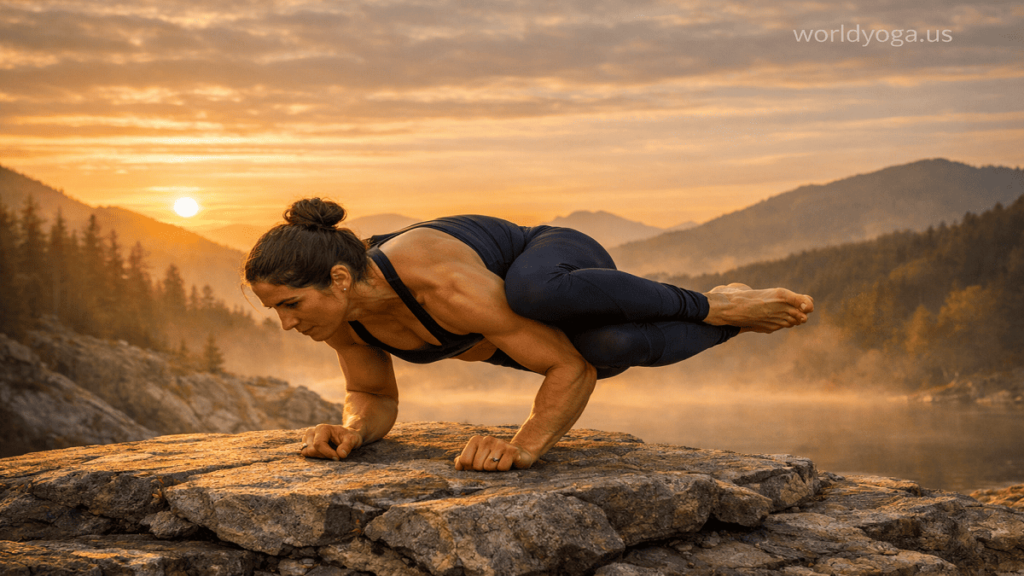
How is this twisted variation of the pose performed?
1. Preparation Phase
Before attempting the pose, prepare the body:
- Warm up wrists with circular loading and plank holds
- Activate core with knee-to-chest compression drills
- Practice Eagle leg wrapping on the floor
- Train forearm strength with static holds
- Open thoracic spine with gentle twists
This ensures stability under asymmetrical load.
2. Entering the Hamsasana Base
- Start in a low squat or kneeling position
- Place forearms (or hands) on the mat
- Spread fingers or root forearms firmly
- Lean forward gradually into Hamsasana
- Engage core and begin lifting the hips
At this stage, maintain controlled shoulder engagement.
3. Establishing Vishama (Asymmetrical Load)
- Shift weight slightly more onto one side
- Do not distribute weight evenly between both arms
- Maintain controlled imbalance without collapsing
- Keep shoulders active and lifted
This uneven loading is what defines the “vishama” structure.
4. Forming Garuda Legs
- Cross one thigh over the other tightly
- Wrap legs into Eagle Pose configuration from Garudasana
- Squeeze inner thighs to maintain compression
- Keep pelvis lifted and stable
The tighter the bind, the more stable the lower body becomes.
5. Adding the Parivritta (Twist)
- Initiate a gentle rotation from the core (not the arms)
- Turn the lower torso slightly toward one side
- Keep shoulders as stable and square as possible
- Avoid collapsing into the twist
- Maintain even breath and controlled movement
The twist should be subtle, not forceful.
6. Stabilization Phase
- Press firmly through forearms or palms
- Engage deep abdominal muscles
- Maintain Eagle leg compression
- Adjust balance using micro-movements in fingers or forearms
- Keep gaze steady to stabilize orientation
7. Exit the Pose
- First release the twist gently
- Return weight to center evenly
- Untangle Eagle legs slowly
- Lower feet back to the mat with control
- Rest in Child’s Pose
Common Execution Errors
- Over-rotating the spine and losing balance
- Collapsing onto the overloaded arm
- Loose Eagle-leg binding
- Lifting too quickly without core control
- Holding breath during imbalance
Key Principle to Remember
This posture is not about depth of twist or height of lift. It is about:
- Controlled asymmetry (vishama)
- Core-driven stability
- Tight leg binding
- Calm, steady balance under instability
Further Reading
- https://www.yogajournal.com/poses/crow-pose/
- https://www.ekhartyoga.com/blog/eagle-pose-garudasana
- https://www.yogapedia.com/definition/5070/hamsasana
#Parivritta Pada Garudasana in Vishama Hamsasana in Hyderabad
What strength and mobility are required for this pose?
1. Upper Body Strength Requirements
The upper body is the primary support system.
Key requirements:
- Wrist and forearm strength: to tolerate uneven loading (vishama stress)
- Shoulder stability: strong scapular protraction and depression control
- Triceps endurance: sustained isometric support in bent-arm position
- Upper back activation: prevents collapse into the chest
Why it matters:
Because weight is asymmetrical, one arm often bears more load, increasing stabilization demand significantly.
2. Core Strength and Rotational Control
Core strength is the central driver of stability.
Key requirements:
- Deep abdominal compression (transverse abdominis) for lift
- Oblique strength for controlled twisting (parivritta action)
- Spinal stabilization under rotation and imbalance
- Pelvic control to prevent shifting collapse
Why it matters:
The core must simultaneously manage lift + twist + imbalance correction, making it the most critical system in this pose.
3. Lower Body Strength (Garuda Structure)
The leg position from Garudasana requires:
- Strong hip adduction (inner thigh engagement)
- Controlled internal rotation strength
- Balanced activation between both legs
- Continuous compression to maintain structural integrity
Why it matters:
Loose leg binding increases instability and disrupts balance alignment.
4. Mobility Requirements
Unlike pure flexibility poses, this requires active mobility under load.
A. Hip Mobility
- Internal rotation range for leg crossing
- Adductor flexibility with active engagement
- Ability to maintain compression without strain
B. Thoracic Spine Mobility
- Controlled rotational mobility for parivritta twist
- Ability to rotate without collapsing the core
- Segmental spinal control under load
C. Shoulder Mobility (Under Load)
- Safe range of forward flexion and protraction
- Stability in end-range weight-bearing positions
- Control without joint compression
5. Balance and Neuromuscular Control
This pose is highly dependent on coordination rather than pure flexibility or strength.
Key requirements:
- Fine proprioceptive adjustments in hands/forearms
- Rapid balance correction responses
- Coordination between upper and lower body systems
- Ability to maintain breath control during instability
6. Summary of Required Capabilities
To perform safely and effectively, a practitioner must have:
- Strong wrists, forearms, and shoulder stabilizers
- Deep core compression and oblique control
- Hip strength with controlled internal rotation
- Functional thoracic spinal mobility
- High-level balance and proprioception
- Ability to coordinate asymmetrical load under twist
Further Reading
- https://www.yogajournal.com/poses/crow-pose/
- https://www.ekhartyoga.com/blog/eagle-pose-garudasana
- https://www.verywellfit.com/how-to-do-crow-pose-bakasana-3567072
#Parivritta Pada Garudasana in Vishama Hamsasana in Banglore
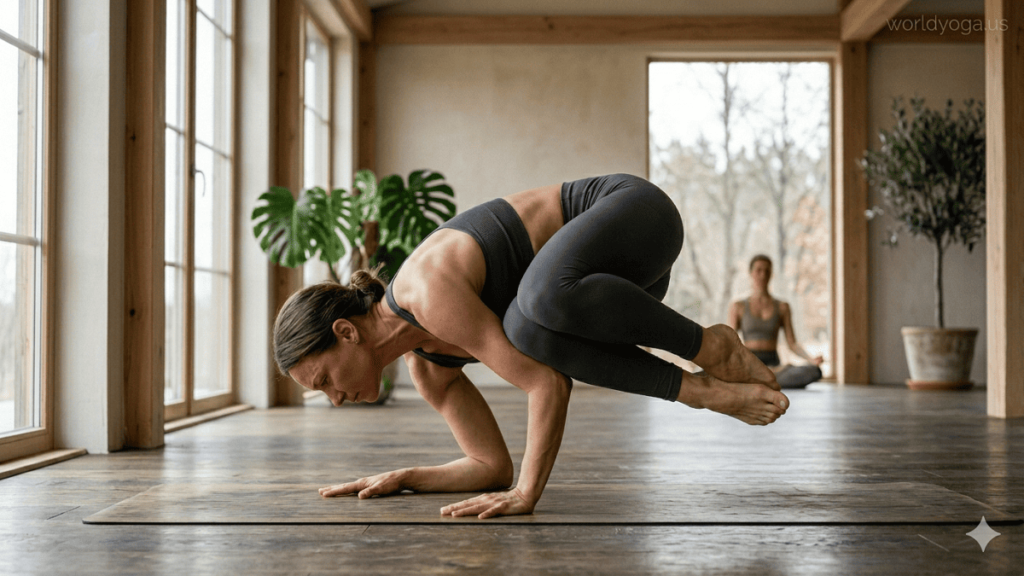
What are the key benefits of this advanced arm balance?
1. Develops Advanced Core Strength and Compression Control
This posture heavily engages the deep abdominal system.
Benefits:
- Strengthens transverse abdominis for spinal stability
- Improves oblique activation through controlled twisting
- Enhances ability to maintain compression under imbalance
- Builds endurance in sustained isometric core engagement
The combination of twist + asymmetry makes the core work significantly harder than in standard arm balances.
2. Improves Shoulder Stability Under Uneven Load
Because the pose is “vishama” (asymmetrical), one side often bears more weight.
Benefits:
- Strengthens scapular stabilization muscles
- Improves wrist endurance under uneven pressure
- Enhances shoulder joint control and alignment awareness
- Builds resilience in forearm-supported balance positions
This improves performance in all advanced arm balances.
3. Enhances Spinal Mobility and Controlled Rotation
The “parivritta” element introduces structured spinal twisting.
Benefits:
- Improves thoracic spine rotation mobility
- Develops control over rotational movement under load
- Reduces stiffness in mid-back through active movement
- Strengthens coordination between spine and core
Unlike passive stretching, this builds functional rotational strength.
4. Strengthens Hip Control and Lower Body Stability
The Eagle-leg structure from Garudasana provides lower-body compression.
Benefits:
- Improves hip adduction strength
- Enhances internal rotation control
- Builds symmetry awareness between left and right sides
- Strengthens stabilizing muscles around pelvis
This creates a compact, stable lower-body foundation.
5. Improves Balance, Proprioception, and Coordination
The asymmetry and twist significantly challenge the nervous system.
Benefits:
- Enhances body awareness in unstable positions
- Improves micro-adjustments for balance correction
- Strengthens neuromuscular coordination across limbs
- Increases reaction speed to instability
This makes it highly effective for advanced movement training.
6. Builds Mental Focus and Breath Control
The complexity of the posture requires calm attention.
Benefits:
- Improves concentration under physical stress
- Enhances breath regulation during effort
- Builds emotional control in unstable positions
- Encourages mindfulness and present-moment awareness
7. Prepares for Advanced Movement Systems
This posture acts as a progression tool for:
- Complex arm balance transitions
- Asymmetrical strength training patterns
- Advanced Vinyasa flow sequences
- Rotational movement systems in yoga and fitness
Further Reading
- https://www.yogajournal.com/poses/crow-pose/
- https://www.ekhartyoga.com/blog/eagle-pose-garudasana
- https://www.verywellfit.com/how-to-do-crow-pose-bakasana-3567072
#Parivritta Pada Garudasana in Vishama Hamsasana in Kolkata
Case Study of Parivritta Pada Garudasana in Vishama Hamsasana
1. Introduction
This case study examines the learning progression, biomechanical challenges, and performance outcomes of Parivritta Pada Garudasana in Vishama Hamsasana, an advanced asymmetrical arm balance combining forearm-supported loading (Hamsasana), Eagle-leg binding (Garudasana), and controlled spinal rotation under uneven (vishama) load conditions.
The objective was to evaluate how an experienced yoga practitioner adapts to combined instability, rotational torque, and unilateral loading.
2. Subject Profile
- Age: 30 years
- Experience: 4+ years advanced yoga practice
- Arm balance experience: Crow Pose, forearm balances, basic inversions
- Baseline limitations: Asymmetry in shoulder strength, moderate wrist fatigue under load, inconsistent core control during rotation
3. Initial Assessment
At baseline, the practitioner demonstrated:
- Stable forearm support in symmetrical positions
- Weakness under uneven weight distribution
- Limited control of spinal rotation while maintaining balance
- Inconsistent leg compression in Eagle binding from Garudasana
- Early fatigue in scapular stabilizers during holds
Primary limitation identified: loss of stability during combined twist + asymmetry conditions
4. Training Protocol (6 Weeks)
Phase 1: Foundational Conditioning (Weeks 1–2)
- Forearm plank holds with uneven weight shifting
- Static Garudasana leg practice on the floor
- Core compression drills (knee-to-chest holds)
- Shoulder stability and scapular control training
Phase 2: Integration Phase (Weeks 3–4)
- Assisted entry into Hamsasana
- Partial asymmetrical weight shifting (vishama loading drills)
- Controlled micro-rotation exercises (no full lift)
- Breath synchronization under load
Phase 3: Full Expression Phase (Weeks 5–6)
- Independent arm balance attempts
- Full Eagle-leg binding integration
- Gradual increase in rotational amplitude (parivritta phase)
- Refinement of entry, hold, and exit mechanics
5. Observations and Progress
By week 6, the following improvements were recorded:
- Increased forearm balance endurance (from ~10s to ~28s)
- Improved shoulder stability under uneven load
- Better synchronization between core compression and rotation
- More consistent leg binding integrity during instability
- Improved breath control during peak effort
However, mild instability persisted on the weaker side during asymmetrical loading.
6. Key Findings
6.1 Asymmetry Training Improves Stability Awareness
The vishama (uneven) structure forced corrective neuromuscular adaptation, improving balance intelligence over time.
6.2 Core Control is the Primary Limiting Factor
Loss of core compression directly resulted in collapse during rotational phases.
6.3 Leg Binding Enhances Structural Efficiency
The Eagle-leg configuration from Garudasana improved lower-body compactness and reduced instability when actively engaged.
6.4 Rotation Must Be Incremental
Excessive twisting caused immediate loss of balance, reinforcing the need for controlled progression.
7. Conclusion
The case study demonstrates that Parivritta Pada Garudasana in Vishama Hamsasana is primarily a neuromuscular coordination and asymmetry adaptation task, rather than a pure strength-based movement. Success depends on gradual integration of core compression, shoulder stability, and controlled rotational mechanics under uneven load.
Progressive training significantly improves balance control, rotational stability, and full-body coordination.
8. Further Reading
- https://www.yogajournal.com/poses/crow-pose/
- https://www.ekhartyoga.com/blog/eagle-pose-garudasana
- https://www.verywellfit.com/how-to-do-crow-pose-bakasana-3567072
#Parivritta Pada Garudasana in Vishama Hamsasana in Chennai
White paper of Parivritta Pada Garudasana in Vishama Hamsasana
1. Abstract
This white paper analyzes Parivritta Pada Garudasana in Vishama Hamsasana, an advanced asymmetrical yoga arm balance integrating forearm-supported load bearing (Hamsasana), Eagle-leg binding (Garudasana), and controlled spinal rotation under uneven (vishama) conditions. The posture is evaluated as a high-complexity neuromuscular system requiring coordinated strength, stability, and proprioception across multiple planes of movement.
2. Introduction
Arm balances are closed-chain kinetic systems requiring integrated upper-body strength and core control. This variation increases complexity through:
- Asymmetrical load distribution (vishama structure)
- Rotational instability (parivritta component)
- Lower-body compression (Garuda leg bind)
- Forearm-supported balance (Hamsasana base)
The result is a multi-variable stability challenge emphasizing coordination over maximal force output.
3. Biomechanical Structure
The posture operates across three functional subsystems:
3.1 Upper Limb Load System
- Forearms or hands provide primary support
- Uneven weight distribution increases stabilization demand
- Scapular protraction and depression maintain joint integrity
3.2 Core Compression & Rotation System
- Abdominals generate vertical lift (compression force)
- Obliques manage rotational torque (parivritta action)
- Spine maintains controlled flexion under asymmetry
3.3 Lower Limb Binding System
- Legs are tightly crossed in Eagle configuration from Garudasana
- Hip adduction creates compact structural stability
- Asymmetry amplifies neuromuscular demand
4. Neuromuscular Demands
This posture requires simultaneous activation of:
- Isometric upper-body endurance (forearms, shoulders, triceps)
- Deep core stabilization under rotation
- Hip adduction and internal rotation control
- Proprioceptive fine-tuning for asymmetrical balance correction
- Cross-limb coordination between upper and lower body systems
The dominant factor is inter-system coordination efficiency, not isolated strength.
5. Performance Variables
Key measurable indicators include:
- Core Compression Efficiency (CCE)
- Scapular Stability Index (SSI)
- Rotational Control Accuracy (RCA)
- Asymmetrical Load Tolerance (ALT)
- Balance Recovery Response Time (BRRT)
High performance correlates strongly with CCE and SSI under uneven loading conditions.
6. Training Progression Model
Phase 1: Foundational Conditioning
- Forearm planks and shoulder stability drills
- Static Eagle-leg practice (Garudasana)
- Core compression training
Phase 2: Integration Phase
- Assisted forearm balance entry (Hamsasana)
- Controlled asymmetrical weight shifting (vishama drills)
- Micro-rotation introduction
Phase 3: Full Expression Phase
- Independent execution
- Incremental rotation control
- Refinement of stability under fatigue
7. Risk Assessment
Primary Risks:
- Wrist overload due to uneven loading
- Shoulder collapse under asymmetry
- Loss of balance during rotational transition
- Over-rotation of thoracic spine
Mitigation Strategies:
- Progressive load adaptation
- Scapular stabilization conditioning
- Controlled rotation limits
- Structured sequencing and progression
8. Discussion
Parivritta Pada Garudasana in Vishama Hamsasana is best understood as a multi-dimensional motor control system rather than a strength-based posture. It integrates sagittal compression, transverse rotation, and asymmetrical stabilization into a single movement pattern.
Performance depends primarily on neuromuscular efficiency, proprioceptive accuracy, and inter-limb coordination.
9. Conclusion
This posture represents a high-level integrative movement model combining upper-body load bearing, lower-body binding, rotational control, and asymmetrical stability. When trained progressively, it enhances full-body coordination, balance intelligence, and functional strength under complex conditions.
10. Further Reading
- https://www.yogajournal.com/poses/crow-pose/
- https://www.ekhartyoga.com/blog/eagle-pose-garudasana
- https://www.verywellfit.com/how-to-do-crow-pose-bakasana-3567072
#Parivritta Pada Garudasana in Vishama Hamsasana in Pune
Industry Application of Parivritta Pada Garudasana in Vishama Hamsasana
1. Overview
Parivritta Pada Garudasana in Vishama Hamsasana is an advanced asymmetrical yoga arm balance that integrates forearm-supported load-bearing (Hamsasana), Eagle-leg binding (Garudasana), and controlled spinal rotation under uneven (vishama) conditions. While it originates in advanced yoga practice, its underlying biomechanics make it relevant across multiple performance, health, and research industries.
2. Fitness and Functional Training Industry
In strength and conditioning environments, this posture is treated as a high-level bodyweight coordination drill.
Applications:
- Advanced calisthenics progression for upper-body endurance
- Core training under rotational and asymmetrical load
- Shoulder stability and scapular control development
- Integration into functional movement circuits
Value:
Builds multi-planar strength and stability, combining compression, rotation, and imbalance control.
3. Yoga Education and Teacher Training
In advanced yoga systems, this posture is used for peak performance sequencing and pedagogy.
Applications:
- Advanced arm balance curriculum development
- Demonstration of asymmetrical stability concepts
- Teaching rotational control under load
- Peak pose structuring in Vinyasa flows
Value:
Serves as a capstone-level integration posture for experienced practitioners.
4. Sports Performance and Athletic Conditioning
The movement pattern supports athletes who require stability under dynamic, uneven force.
Applications:
- Gymnastics: balance and aerial control training
- Martial arts: core stability during rotational impact
- Climbing: shoulder endurance and grip integration
- Dance/acrobatics: spatial awareness and control
Value:
Enhances rotational stability and neuromuscular coordination under load.
5. Rehabilitation and Clinical Movement Therapy (Modified Use)
In adapted and simplified forms, it has applications in rehabilitation settings.
Applications:
- Shoulder stabilization retraining protocols
- Controlled wrist loading progressions
- Core activation in closed-chain environments
- Neuromuscular re-education for asymmetry correction
Value:
Supports functional recovery and motor control retraining when carefully modified.
6. Biomechanics and Movement Science Research
This posture is valuable as a complex human movement model.
Applications:
- Study of asymmetrical load distribution (vishama mechanics)
- Analysis of scapular stability under rotational force
- Research on closed-chain rotational control
- Wearable sensor data for balance correction patterns
Value:
Provides a high-complexity system for studying integrated human movement.
7. Wellness, Corporate Health, and Mind-Body Training
In wellness industries, it is used for cognitive and physical integration training.
Applications:
- Stress regulation through breath control under instability
- Focus and attention training in challenging physical states
- Executive performance yoga programs
- Mindfulness under physical stress training
Value:
Combines mental resilience, breath control, and physical coordination.
8. Key Cross-Industry Value Proposition
Across industries, this posture delivers:
- High neuromuscular complexity
- Asymmetrical strength development
- Rotational stability training
- Minimal equipment requirement
- Strong transfer to real-world movement control
9. Limitations
- Very high technical difficulty limits general use
- Requires advanced wrist and shoulder conditioning
- Not suitable without progressive training
- Risk of injury if performed without guidance
10. Conclusion
Parivritta Pada Garudasana in Vishama Hamsasana functions as a multi-domain movement intelligence tool, applicable in fitness, yoga education, sports performance, rehabilitation, and biomechanics research. Its primary value lies in developing integrated strength, asymmetrical control, and rotational stability under complex conditions.
Further Reading
- https://www.yogajournal.com/poses/crow-pose/
- https://www.ekhartyoga.com/blog/eagle-pose-garudasana
- https://www.verywellfit.com/how-to-do-crow-pose-bakasana-3567072
#Parivritta Pada Garudasana in Vishama Hamsasana in Mumbai
Ask FAQs
What is Parivritta Pada Garudasana in Vishama Hamsasana?
It is an advanced asymmetrical yoga arm balance that combines a forearm-supported base (Hamsasana), Eagle-leg binding (Garudasana), and a controlled spinal twist performed on an uneven (vishama) weight distribution.
Is this pose suitable for beginners?
No. It is an advanced posture intended only for experienced practitioners who already have strong arm balances, core control, and familiarity with Eagle Pose leg binding. Beginners should focus on foundational strength and balance poses first.
What are the main benefits of this pose?
Key benefits include improved core strength, shoulder and wrist stability, spinal rotation control, enhanced balance, better hip coordination, and increased neuromuscular awareness under asymmetrical load conditions.
What are the most common mistakes?
Common mistakes include collapsing into one side due to uneven load, over-twisting the spine, weak core engagement, loose Eagle-leg binding, and holding the breath during balance transitions.
How should someone safely prepare for this pose?
Preparation should include forearm strength training, core compression drills, practice of Garudasana, basic arm balances like Crow Pose, and gradual introduction to forearm-supported balances such as Hamsasana, ideally under expert guidance.
Table of Contents
Disclaimer
This content is for educational and informational purposes only and does not constitute medical, fitness, or professional yoga instruction. Parivritta Pada Garudasana in Vishama Hamsasana is an advanced posture that carries a risk of injury if performed incorrectly. Practice only under the supervision of a qualified instructor and consult a healthcare professional before attempting advanced physical movements, especially if you have any injuries or medical conditions.