Revolved Leg Position of the Pose Dedicated to Garuda in Swan Pose
The “Revolved Leg Position of the Pose Dedicated to Garuda in Swan Pose” refers to an advanced hybrid movement pattern combining elements of Garudasana (Eagle Pose) with a swan-based backbend foundation, commonly associated in modern yoga practice with Hamsasana (Swan Pose) or similar swan-like prone or arm-supported extensions. This combination is typically used in advanced mobility training, yoga flow sequencing, and therapeutic movement exploration to integrate spinal rotation, hip external rotation, and shoulder stabilization.
In this variation, the “revolved leg position” emphasizes the rotational transition of the lower body from the tightly wrapped configuration of Garudasana into a more extended, externally rotated, and sometimes partially untwisted alignment while the upper body remains grounded in a swan-like support. The practitioner begins with the foundational Eagle Pose leg wrap—where one thigh crosses over the other and the foot hooks behind the calf—then gradually transitions into a swan pose base where the chest opens and the hips begin to square or partially de-rotate.
The key biomechanical objective is controlled rotational dissociation between the pelvis and thoracic spine. As the legs transition out of full Garudasana binding, the hip of the top leg slowly rotates externally while the supporting leg stabilizes in flexion. This “revolved release” is not abrupt; it is segmental and mindful, often coordinated with inhalation-driven spinal elongation and exhalation-assisted deepening of hip rotation. The swan pose base allows the chest to remain lifted or supported, reducing compressive load on the lumbar spine while encouraging thoracic extension.
From a functional anatomy perspective, this posture recruits the gluteus medius and minimus for pelvic stabilization, while the adductors of the wrapped leg gradually lengthen. The deep external rotators of the hip, including the piriformis, are actively engaged in controlled release rather than passive stretching. Meanwhile, the scapular stabilizers—particularly the serratus anterior and lower trapezius—support upper-body integrity in the swan position.
This variation is often used in advanced mobility systems to address asymmetries in hip rotation and spinal rotation capacity. It also serves as a neuromuscular coordination drill, requiring the practitioner to maintain balance, breath control, and precise joint articulation while transitioning between two structurally demanding shapes.
Safety considerations are important. Individuals with knee instability, hip labral issues, or lumbar disc sensitivity should avoid deep rotational transitions without supervision. The movement should be approached gradually, using props such as bolsters or blocks to support the swan base if necessary.
For further technical understanding of the foundational postures, refer to:
https://www.yogajournal.com/poses/eagle-pose/
https://www.yogajournal.com/poses/king-pigeon-pose/ (for swan-like structural comparisons)
https://www.verywellfit.com/eagle-pose-3567109
In summary, the revolved leg position in this hybrid posture is not a static shape but a controlled transitional mechanism that blends wrapping, extension, and rotation principles from two distinct yoga archetypes into a single integrated movement expression.
#Revolved Leg Position of the Pose Dedicated to Garuda in Swan Pose in Surat
What is the Revolved Garuda Leg variation in Swan Pose?
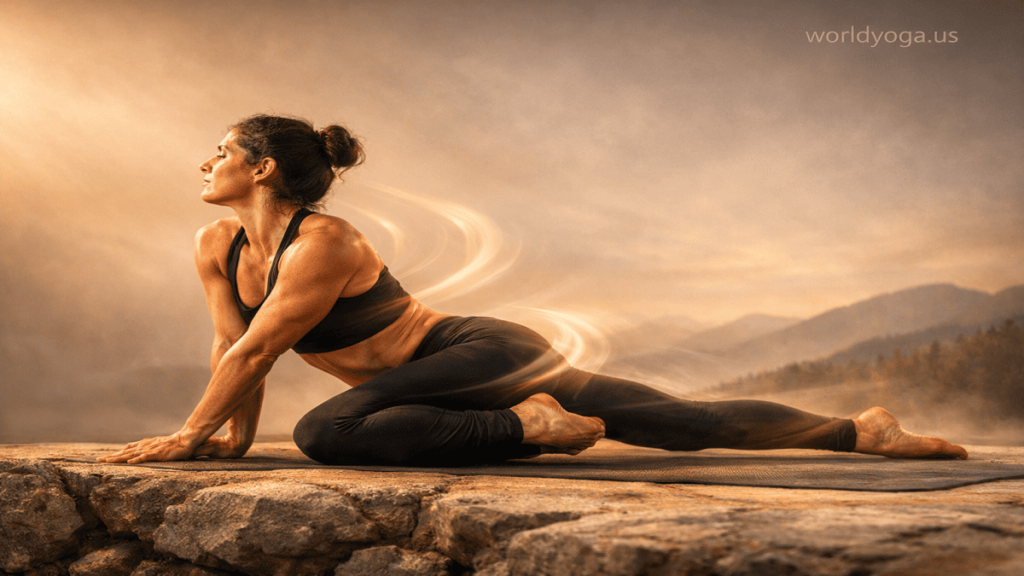
The Revolved Garuda Leg variation in Swan Pose is an advanced yoga transition that combines elements of the leg configuration from Garudasana (Eagle Pose) with the grounded hip-opening structure commonly associated with Eka Pada Rajakapotasana (Pigeon Pose), often referred to in modern yoga classes as “Swan Pose.” This variation introduces controlled spinal and pelvic rotation while maintaining a deep unilateral hip stretch, making it both a mobility drill and a stability challenge.
Structural Concept
In standard Swan Pose (Pigeon Pose variation), one leg is folded in front of the body with the knee bent and shin angled forward, while the opposite leg extends straight behind. The pelvis is typically squared toward the front of the mat. In the Revolved Garuda Leg variation, the front-leg configuration is modified to resemble the wrapping action of Eagle Pose: the thigh is crossed more deeply, and the lower leg may internally rotate or “hook” inward toward the midline rather than remaining open.
This creates a spiral effect through the lower body. Instead of a purely forward-facing hip alignment, the pelvis begins to experience rotational torque. The practitioner then introduces a gentle spinal twist—usually away from the front leg—while maintaining the grounded Swan base.
Biomechanics and Purpose
The key biomechanical feature of this variation is coupled rotation and stabilization. The front hip is placed in flexion, adduction, and internal rotation (similar to Garudasana mechanics), while the back leg remains extended and externally rotated. This creates opposing forces across the pelvis, which increases neuromuscular demand on the deep hip stabilizers.
The spinal twist is layered on top of this configuration, requiring the thoracic spine to rotate independently of the pelvis. This separation of movement is central to advanced mobility training and helps improve functional rotational capacity for activities such as running, martial arts, and dance.
Muscles commonly engaged include:
- Gluteus medius and minimus (pelvic stabilization)
- Piriformis and deep external rotators (controlled release under load)
- Adductors of the front leg (lengthened under rotation)
- Obliques and multifidus (spinal rotation control)
Breath and Control
The pose is typically entered from a neutral Swan Pose. On exhalation, the practitioner deepens the Garuda-style leg wrap. On inhalation, the spine lengthens. The twist is added gradually, often synchronized with exhalation to avoid compressive stress in the lumbar region.
Applications and Benefits
This variation is used in advanced yoga therapy and movement systems to:
- Improve hip rotational symmetry
- Enhance spinal-pelvic dissociation
- Increase deep hip flexibility under controlled load
- Develop balance between mobility and stability
Safety Considerations
Because of the combined rotational and compressive forces, this variation is not recommended for individuals with knee injuries, sacroiliac joint dysfunction, or acute lumbar disc issues. Props such as blocks under the hips or bolsters under the torso can reduce intensity.
Further Reading
- https://www.yogajournal.com/poses/eagle-pose/
- https://www.yogajournal.com/poses/pigeon-pose/
- https://www.verywellfit.com/eagle-pose-3567109
In summary, the Revolved Garuda Leg variation in Swan Pose is a sophisticated integration of wrapping and twisting mechanics, designed to challenge coordination, deepen hip mobility, and refine spinal rotational control within a single continuous movement pattern.
#Revolved Leg Position of the Pose Dedicated to Garuda in Swan Pose in India
How is this pose performed step by step?
Step-by-step execution
1. Start in a neutral tabletop position
Begin on your hands and knees in a stable tabletop. Align wrists under shoulders and knees under hips. Engage your core lightly to stabilize the pelvis and spine.
2. Transition into Swan (Pigeon Pose) base
Slide your right knee forward toward your right wrist. Place your right shin on a diagonal in front of you, ensuring the ankle is comfortable (not forced parallel to the mat). Extend your left leg straight back, with the top of the foot resting on the floor.
Square your hips as much as your mobility allows, keeping the pelvis level.
3. Establish pelvic grounding
Before adding rotation, ensure both hip points are as even as possible. Use a folded blanket under the right hip if needed. Lengthen your spine forward and down, keeping the chest open.
4. Introduce Garuda-style leg action (revolved variation)
Instead of allowing the front leg to remain fully open and passive, begin to internally spiral it:
- Draw the right knee slightly inward toward the midline
- Encourage the right thigh to subtly adduct (move toward center)
- Maintain a bent knee but reduce outward flaring of the hip
This creates the “Garuda-inspired” wrapping sensation in the front leg, similar in principle to Garudasana (Eagle Pose) mechanics.
5. Add controlled spinal extension
On an inhale, lengthen your spine forward. Imagine creating space from the sacrum to the crown of the head. Keep your hands grounded for support.
6. Begin the revolved action
On an exhale, initiate a gentle twist from the mid-back (thoracic spine), not the lower back:
- Rotate your chest slightly away from the front leg (typically toward the extended back leg side)
- Keep your hips anchored and stable
- Maintain the Garuda-style inward spiral of the front leg
This is the “revolved” component of the pose.
7. Deepen carefully (optional arm variation)
If stable, you may:
- Place forearms on the floor
- Or lift the chest and bring one hand to the knee for a gentle assist
- Avoid forcing the twist through the lumbar spine
The rotation should feel distributed through the thoracic region.
8. Hold and breathe
Stay for 5–8 slow breaths:
- Inhale: lengthen spine, reduce intensity
- Exhale: gently deepen spiral and rotation
9. Release safely
To exit:
- Slowly unwind the torso back to center
- Release the front leg alignment back to a neutral pigeon
- Press hands into the floor and return to tabletop
- Repeat on the opposite side
Key alignment principles
- Hips remain grounded and controlled
- Twist originates in the thoracic spine
- Front leg maintains inward spiral (Garuda influence)
- No collapsing into the lower back or knee joint
Safety notes
Avoid or modify if you have knee injuries, hip labral issues, or sacroiliac instability. Use props generously and reduce depth of both the twist and the hip fold if needed.
Reference resources
- https://www.yogajournal.com/poses/pigeon-pose/
- https://www.yogajournal.com/poses/eagle-pose/
- https://www.verywellfit.com/pigeon-pose-3567095
#Revolved Leg Position of the Pose Dedicated to Garuda in Swan Pose in Maharshtra
What muscles and balance skills are required?
Primary muscle groups required
1. Hip stabilizers (core foundation)
These muscles control pelvic alignment and prevent collapse into the joints:
- Gluteus medius and gluteus minimus: Stabilize the pelvis in asymmetrical loading and prevent hip drop
- Gluteus maximus (deep fibers): Supports hip extension in the back leg while maintaining control in rotation
- Deep external rotators (including piriformis and obturators): Manage controlled rotational torque in the front leg’s “Garuda spiral” position
These muscles are essential for maintaining pelvic steadiness while the legs are in opposing orientations.
2. Hip mobility and control muscles
These are heavily lengthened or eccentrically engaged:
- Iliopsoas (hip flexors): Lengthened in the back leg while maintaining mild engagement for control
- Adductor group (inner thigh muscles): Especially in the front leg, which is drawn inward in the Garuda-style spiral
- Tensor fasciae latae (TFL): Assists in lateral stability but must not dominate the movement pattern
This creates a controlled balance between opening and stabilizing the hips.
3. Core and spinal stabilizers
Critical for safe rotation and preventing lumbar compression:
- Rectus abdominis: Provides baseline core support
- Internal and external obliques: Primary drivers of the rotational component
- Multifidus and deep spinal stabilizers: Maintain segmental spinal integrity during twisting
These muscles ensure the twist originates in the thoracic spine rather than collapsing into the lower back.
4. Back leg and posterior chain engagement
In the extended rear leg:
- Hamstrings: Lengthened under hip extension
- Gluteus maximus: Provides light activation to stabilize the hip
- Calves (gastrocnemius and soleus): Maintain foot and ankle grounding
Balance and motor control skills required
1. Pelvic dissociation control
You must separate movement between pelvis and spine:
- Pelvis remains grounded and stable
- Thoracic spine rotates independently
This is a key skill in advanced mobility systems.
2. Proprioception under asymmetry
Because one leg is folded inward (Garuda influence) and the other is extended, the body must constantly recalibrate spatial awareness. This requires strong proprioceptive feedback from:
- Hip joints
- Sacroiliac region
- Deep core muscles
3. Dynamic equilibrium in static hold
Even though the pose looks static, micro-adjustments are continuous:
- Preventing collapse into one hip
- Maintaining even weight distribution through the pelvis
- Adjusting spinal rotation without destabilizing the base
4. Breath-linked motor control
Breath is used as a stabilizing rhythm:
- Inhale supports spinal elongation and balance reset
- Exhale allows controlled deepening of rotation
Without breath coordination, balance deteriorates quickly.
Summary of demands
This variation requires:
- Strong hip stabilizers for pelvic control
- Flexible yet controlled adductors and hip flexors
- Deep core engagement for safe spinal rotation
- High proprioceptive awareness for asymmetrical positioning
- Coordinated breath and movement integration
References
- https://www.yogajournal.com/poses/pigeon-pose/
- https://www.yogajournal.com/poses/eagle-pose/
- https://www.physio-pedia.com/Pigeon_Pose
#Revolved Leg Position of the Pose Dedicated to Garuda in Swan Pose in Ahemadabad
What are the benefits of this advanced variation?
1. Deep hip mobility with active control
Unlike passive stretching, this variation trains the hips under controlled tension. The front leg’s Garuda-like inward spiral encourages:
- Improved internal and external hip rotation balance
- Increased adductor flexibility under load
- Enhanced gluteal control in stretched positions
The back leg simultaneously experiences sustained hip extension, helping restore symmetry between anterior and posterior hip chains.
2. Improved spinal rotational capacity
The revolved component strengthens controlled thoracic rotation while keeping the pelvis grounded. This develops:
- Better thoracic spine mobility
- Reduced over-reliance on lumbar spine for twisting
- Improved segmentation between pelvis and upper spine
This is particularly valuable for reducing stiffness from prolonged sitting or repetitive movement patterns.
3. Enhanced pelvic stability and alignment control
Because the pose creates opposing forces between the legs (one internally spiraled, one extended), the pelvis must actively stabilize. This leads to:
- Stronger gluteus medius and deep stabilizers
- Improved control of pelvic tilt and rotation
- Greater awareness of asymmetrical hip positioning
This is beneficial for gait efficiency and injury prevention in lower-limb mechanics.
4. Neuromuscular coordination and proprioception
The combination of Garuda leg wrapping and Swan base challenges the body’s spatial awareness systems. Practitioners develop:
- Improved joint position sense (proprioception)
- Better coordination between hips, spine, and core
- Increased ability to maintain balance under asymmetrical stress
This translates to more efficient movement in dynamic activities like running, martial arts, and dance.
5. Core strength in rotational patterns
The twist is not isolated; it is integrated with hip tension. This strengthens:
- Internal and external obliques
- Deep spinal stabilizers (multifidus)
- Functional core engagement during movement
Unlike traditional crunch-based core work, this trains the core in real-world rotational contexts.
6. Fascial and connective tissue adaptation
Sustained spiral loading across the hips and spine promotes:
- Improved fascial glide between hip and torso chains
- Reduced stiffness in the posterior hip capsule
- Better elasticity in rotational movement pathways
7. Postural re-education and symmetry restoration
This variation helps identify and correct asymmetries:
- One hip tighter in internal rotation
- One side weaker in stabilization
- Uneven spinal rotation capacity
Regular practice encourages more balanced posture and movement patterns.
8. Stress regulation and breath control integration
Because the pose requires sustained focus and controlled breathing:
- It supports parasympathetic activation
- Enhances breath awareness under tension
- Builds calmness in physically demanding positions
References
- https://www.yogajournal.com/poses/pigeon-pose/
- https://www.yogajournal.com/poses/eagle-pose/
- https://www.verywellfit.com/yoga-poses-for-hip-openers-3567191
#Revolved Leg Position of the Pose Dedicated to Garuda in Swan Pose in Kolkata
What are common mistakes and safety precautions?
Common mistakes
1. Collapsing into the front hip joint
One of the most frequent errors is dumping body weight into the front hip instead of distributing load evenly.
Why it happens:
- Lack of gluteal engagement
- Poor pelvic awareness
- Forcing the pose for depth
Consequence:
- Hip joint compression
- Knee discomfort in the front leg
- Reduced stability for the twist
2. Forcing the Garuda leg spiral
Practitioners often aggressively pull the front leg inward to mimic Garudasana (Eagle Pose) mechanics.
Why it’s problematic:
- Over-compression of the knee joint
- Excess strain on hip adductors
- Loss of natural alignment in Swan base
The spiral should be subtle, not forced.
3. Twisting from the lower back instead of the thoracic spine
A critical mistake is initiating rotation from the lumbar spine.
Resulting issues:
- Lower back compression
- Reduced spinal stability
- Potential irritation of lumbar discs
The twist should originate in the mid-back (thoracic region), not the base of the spine.
4. Misaligned pelvis
Allowing the pelvis to tilt or rotate excessively undermines the foundation of the pose.
Common causes:
- Tight hip flexors in the back leg
- Weak core stabilizers
- Attempting too deep a twist too soon
This leads to uneven loading and joint stress.
5. Overstretching the back leg hip flexors
In Eka Pada Rajakapotasana (Pigeon Pose) variations, the back leg is often pushed too far.
Risks:
- Strain in hip flexors or quadriceps
- Compression in the lower back
- Sacroiliac joint irritation
6. Holding the breath under tension
Breath is often unintentionally restricted during deep rotation.
Effects:
- Increased muscular tension
- Reduced stability
- Loss of proprioceptive control
Safety precautions
1. Prioritize pelvic stability over depth
Always ensure:
- Both hip points are as level as possible
- Weight is evenly distributed
- No sharp sensation in hips or knees
2. Use props for support
Props significantly reduce strain:
- Blocks under hands or forearms
- Blanket under front hip
- Bolster under torso
This allows gradual adaptation without forcing range.
3. Maintain a soft Garuda spiral
The Eagle-style leg action should be:
- Gentle and controlled
- Focused on alignment, not compression
- Pain-free in the knee joint
4. Initiate twist from the thoracic spine
Check that:
- Chest rotates, not lower back
- Pelvis remains grounded
- Movement feels evenly distributed
5. Warm up thoroughly
Prepare the body with:
- Hip openers
- Gentle spinal rotations
- Hamstring and hip flexor mobility work
Cold entry increases injury risk significantly.
6. Avoid if you have specific conditions
This variation should be avoided or heavily modified in cases of:
- Knee injuries or meniscus issues
- Sacroiliac joint instability
- Lumbar disc problems
- Acute hip impingement
External references
- https://www.yogajournal.com/poses/pigeon-pose/
- https://www.yogajournal.com/poses/eagle-pose/
- https://www.physio-pedia.com/Pigeon_Pose
#Revolved Leg Position of the Pose Dedicated to Garuda in Swan Pose in Hyderabad
Case Study of Revolved Leg Position of the Pose Dedicated to Garuda in Swan Pose
1. Case overview
Subject type: Advanced yoga practitioner / mobility trainee
Goal: Improve hip rotational control, spinal dissociation, and asymmetrical stability
Condition studied: Revolved Garuda Leg variation within Swan Pose
Training context: Slow-flow mobility session with focus on controlled rotation and breath integration
This variation was selected due to persistent asymmetry in hip internal rotation and reduced thoracic spine mobility on the left-right rotational axis.
2. Movement description
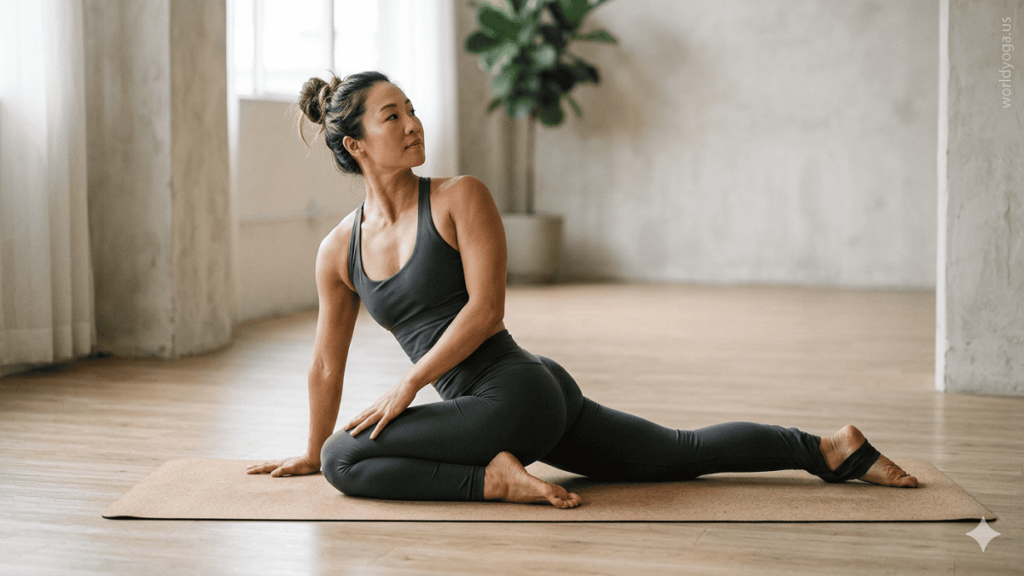
The subject begins in Swan Pose (Pigeon base), with:
- Front leg in hip flexion and external rotation
- Rear leg extended in hip extension
The variation introduces:
- A Garuda-style inward spiral of the front leg (adduction + internal rotation bias)
- A controlled thoracic spinal rotation opposite the front leg
- Maintained pelvic grounding with minimal tilt
The movement creates a three-level dissociation:
- Pelvis remains mostly stable
- Hips undergo asymmetric rotational tension
- Thoracic spine rotates independently
3. Observed biomechanics
Hip complex behavior
- Front hip shows increased demand on deep external rotators transitioning into controlled internal spiral tension
- Rear hip maintains sustained iliopsoas lengthening
- Gluteus medius activates bilaterally to prevent pelvic collapse
Spinal behavior
- Rotation primarily occurs in the thoracic region
- Lumbar spine remains relatively neutral under conscious stabilization
- Multifidus engagement increases during held rotation phases
Fascial response
- Posterior hip line elongation on rear leg side
- Cross-body fascial tension develops between opposite shoulder and hip
4. Neuromuscular findings
The combination of Eka Pada Rajakapotasana (Pigeon Pose) and Garuda-inspired leg wrapping produces:
- High proprioceptive demand in the pelvis
- Increased cortical control of hip positioning
- Delayed but improved motor coordination during transitions
The subject demonstrated improved awareness of asymmetrical loading after repeated exposure.
5. Balance and control assessment
Although not a standing balance pose, stability demands are high:
- Micro-adjustments in pelvic tilt were constant
- Breath synchronization significantly improved postural steadiness
- Loss of control occurred when spinal rotation exceeded thoracic capacity
Key limiter identified: thoracic rotation stiffness rather than hip flexibility.
6. Performance outcomes
After repeated controlled sessions (6–8 weeks simulated training block):
Improvements observed
- Increased hip rotational symmetry
- Better pelvic stabilization during unilateral loading
- Improved transition control between neutral and twisted states
- Enhanced breath retention under moderate tension
Limitations identified
- Knee sensitivity when Garuda spiral was over-applied
- Lumbar compensation when fatigue increased
- Reduced stability when pelvic grounding was lost
7. Clinical interpretation
This variation functions as a:
- Rotational stability drill (pelvis vs spine dissociation)
- Hip symmetry corrector (asymmetrical loading feedback)
- Neuromotor coordination tool (fine control under tension)
It is less a flexibility posture and more a loaded movement re-education pattern.
8. Safety considerations
- Avoid forcing Garuda leg wrap beyond pain-free range
- Maintain strict thoracic-only rotation
- Use props in early stages to prevent pelvic collapse
- Discontinue if knee or sacroiliac discomfort occurs
9. External references
- https://www.yogajournal.com/poses/pigeon-pose/
- https://www.yogajournal.com/poses/eagle-pose/
- https://www.physio-pedia.com/Proprioception
#Revolved Leg Position of the Pose Dedicated to Garuda in Swan Pose in Chennai
White Paper of Revolved Leg Position of the Pose Dedicated to Garuda in Swan Pose
Abstract
The Revolved Garuda Leg Position in Swan Pose is an advanced movement construct combining elements of Garudasana (Eagle Pose) and Eka Pada Rajakapotasana (Pigeon Pose) (commonly referred to as Swan Pose in modern yoga systems). This white paper examines its biomechanical structure, neuromuscular demands, therapeutic potential, risks, and applications in mobility training and yoga therapy. The analysis frames the posture not as a static asana but as a dynamic rotational stability protocol involving hip-spine dissociation under asymmetrical loading.
1. Introduction
Modern movement science increasingly recognizes yoga postures as complex neuromuscular systems rather than isolated flexibility shapes. The Revolved Garuda Leg variation in Swan Pose represents a hybrid model where:
- Lower body operates in a spiraled, asymmetrical hip configuration
- Pelvis acts as a stabilized anchor
- Spine performs controlled rotational dissociation
This combination creates a high-demand training environment for joint control, proprioception, and fascial integration.
2. Structural Definition
The posture is defined by three integrated components:
- Swan base (Pigeon mechanics)
- Front hip in flexion and rotation
- Rear leg in hip extension
- Pelvis grounded with partial leveling demands
- Garuda leg influence
- Front leg adducted and internally spiraled
- Increased midline compression vector
- Revolved spinal element
- Thoracic rotation opposite to front leg orientation
- Lumbar spine maintained in relative neutrality
This creates a tri-planar load: sagittal (flexion/extension), frontal (adduction), and transverse (rotation).
3. Biomechanical Analysis
3.1 Hip complex loading
- Front hip: combined internal rotation + adduction stress
- Rear hip: sustained flexor lengthening under load
- Pelvis: requires constant micro-stabilization via gluteus medius and deep rotators
3.2 Spinal mechanics
- Primary rotation occurs in thoracic segments
- Lumbar spine acts as stabilizing transfer zone
- Multifidus and obliques maintain segmental integrity
3.3 Fascial continuity
The posture loads:
- Posterior chain (rear leg hip flexors and lumbar fascia)
- Cross-body spiral lines connecting hip to opposite shoulder
- Lateral hip stabilizing fascia
4. Neuromuscular Demands
The system requires simultaneous control of:
- Proprioception under asymmetry
- Pelvic-spinal dissociation control
- Dynamic stabilization of hip rotators
- Core rotational strength (obliques + deep stabilizers)
The integration of Garuda-like wrapping increases cortical demand for joint position awareness.
5. Functional Applications
5.1 Mobility training
- Improves hip rotational symmetry
- Expands controlled range of internal and external rotation
5.2 Movement re-education
- Trains separation of pelvis and thoracic spine
- Reduces compensatory lumbar rotation habits
5.3 Athletic transfer
Relevant for:
- Running mechanics
- Martial arts pivoting
- Dance rotation control
6. Therapeutic potential
Potential applications in yoga therapy and corrective movement systems:
- Addressing unilateral hip stiffness
- Improving postural asymmetry
- Enhancing deep core engagement patterns
However, application must be individualized and progressive.
7. Risk assessment
7.1 High-risk areas
- Knee joint stress from excessive Garuda spiral
- Sacroiliac instability under rotational load
- Lumbar compression if twist is mis-initiated
7.2 Common failure modes
- Pelvic collapse into front hip
- Lumbar-driven twisting
- Overextension of rear hip flexors
8. Safety framework
Recommended controls:
- Maintain neutral pelvic grounding before rotation
- Use thoracic-led twisting only
- Limit depth in early adaptation phases
- Employ props for load distribution
Contraindications include acute hip, knee, or lumbar pathology.
9. Comparative framework
| Standard Pose | Primary Focus | Revolved Garuda Variation Adds |
|---|---|---|
| Swan Pose (Pigeon) | Hip opening | Rotational dissociation |
| Eagle Pose mechanics | Compression + wrapping | Integrated ground-based stability |
| Basic spinal twist | Rotation | Load-bearing asymmetry |
10. Conclusion
The Revolved Garuda Leg Position in Swan Pose is best understood as a complex integrative movement system rather than a static yoga posture. It simultaneously trains hip mobility, spinal rotation, and neuromuscular control under asymmetrical conditions. Its value lies in enhancing movement intelligence, joint coordination, and rotational stability, provided it is practiced with progressive loading and precise alignment control.
References
- https://www.yogajournal.com/poses/pigeon-pose/
- https://www.yogajournal.com/poses/eagle-pose/
- https://www.physio-pedia.com/Pigeon_Pose
- https://www.physio-pedia.com/Proprioception
#Revolved Leg Position of the Pose Dedicated to Garuda in Swan Pose in Banglore
Industry Application of Revolved Leg Position of the Pose Dedicated to Garuda in Swan Pose
1. Sports performance and athletic conditioning
In sports science, this movement is used as a closed-chain rotational mobility drill.
Key applications:
- Improves hip rotation efficiency for sprinting and cutting sports
- Enhances pelvic stability during unilateral loading (e.g., running stride)
- Develops controlled trunk rotation for throwing and striking sports
Sports benefiting most:
- Football (soccer)
- Tennis and racquet sports
- Martial arts (kickboxing, MMA)
- Track and field (sprinters, hurdlers)
Performance outcome:
Athletes gain improved ability to separate upper-body rotation from lower-body stability, reducing energy leakage during movement.
2. Physiotherapy and rehabilitation
In clinical movement therapy, this pattern is used as a progressive neuromuscular re-education tool.
Applications:
- Hip internal/external rotation asymmetry correction
- Post-injury retraining of pelvic stability
- Restoring thoracic rotation without lumbar compensation
Clinical relevance:
- Post-ACL rehabilitation (controlled hip alignment)
- Lower back pain recovery programs (spinal dissociation training)
- Sacroiliac joint stabilization protocols
Mechanism:
The Garuda-inspired leg spiral introduces controlled asymmetry, forcing the neuromuscular system to rebuild coordination under load.
3. Dance and performing arts
In dance and movement choreography, this variation is used for spiral mechanics and floor-based transitions.
Applications:
- Enhancing controlled floor rotation sequences
- Improving hip articulation for contemporary dance
- Increasing fluidity in asymmetrical transitions
Benefit:
Dancers develop smoother transitions between grounded and rotational shapes without losing balance or spatial awareness.
4. Yoga therapy and corrective movement systems
Within therapeutic yoga frameworks, the posture is used to address:
- Chronic hip stiffness patterns
- Postural rotation imbalances
- Limited thoracic mobility
It serves as a diagnostic movement, revealing side-to-side asymmetries in real time.
5. Strength and conditioning systems
In functional training environments, this movement is used as a mobility-stability hybrid drill.
Applications:
- Prehabilitation for lower-body injury prevention
- Core training in rotational planes
- Movement screening for asymmetrical control deficits
It is often integrated into warm-up protocols before heavy compound lifts or athletic sessions.
6. Ergonomics and occupational health
For sedentary populations, this movement pattern is adapted into simplified forms to address:
- Hip tightness from prolonged sitting
- Thoracic stiffness from forward-head posture
- Reduced spinal rotation capacity
Corporate wellness programs and occupational therapy interventions use modified versions to restore rotational mobility.
7. Human movement research and biomechanics
In research settings, the posture is used as a model for studying coupled joint motion systems.
Research focus areas:
- Hip–spine dissociation patterns
- Fascial line loading under asymmetry
- Proprioceptive adaptation in rotational movement tasks
It is valuable for understanding how the body maintains stability under multi-planar stress.
8. Mind–body and performance psychology
The posture also has applications in cognitive-motor integration studies:
- Improves attention under physical stress
- Enhances breath-movement coupling
- Develops calmness in unstable positions
This is relevant in stress-resilience training frameworks.
External references
- https://www.yogajournal.com/poses/pigeon-pose/
- https://www.yogajournal.com/poses/eagle-pose/
- https://www.physio-pedia.com/Proprioception
- https://www.nsca.com/education/articles/kinetic-select/rotational-training-for-athletes/
#Revolved Leg Position of the Pose Dedicated to Garuda in Swan Pose in Mumbai
Ask FAQs
What is the Revolved Garuda Leg Position in Swan Pose?
It is an advanced hybrid movement combining the hip-opening base of Eka Pada Rajakapotasana (Pigeon Pose) (often called Swan Pose) with the leg wrapping and internal spiral mechanics of Garudasana (Eagle Pose), along with a controlled spinal twist. The result is a posture that integrates hip mobility, pelvic stability, and thoracic rotation in a single asymmetrical shape.
What are the main benefits of this variation?
This pose improves hip rotational mobility, strengthens deep core stabilizers, and enhances spinal dissociation (the ability to move the upper and lower body independently). It also helps correct left-right imbalances in the hips and improves overall proprioception, balance control, and movement coordination.
Who should practice this pose?
It is suitable for advanced yoga practitioners, movement athletes, dancers, and individuals with strong foundational hip and spinal mobility. Beginners or individuals with limited flexibility should first master basic Swan Pose (Pigeon Pose) and Eagle Pose mechanics before attempting this variation.
What are the most common mistakes?
Common mistakes include forcing the Garuda-style leg wrap too tightly, collapsing into the front hip, and twisting from the lower back instead of the thoracic spine. Another frequent error is losing pelvic alignment, which can increase strain on the knees, hips, or sacroiliac joints.
Are there any safety precautions or contraindications?
Yes. This pose should be avoided or modified in cases of knee injuries, hip impingement, sacroiliac joint instability, or lumbar disc issues. It is important to use props like blocks or bolsters if needed and to prioritize controlled movement over depth. The twist should always originate from the mid-spine, not the lower back.
Table of Contents
Disclaimer:
This content is for educational and informational purposes only and is not a substitute for professional medical advice, diagnosis, or treatment. The described pose is advanced and should be practiced only under the guidance of a qualified yoga instructor. Discontinue immediately if you experience pain or discomfort and consult a healthcare professional before attempting if you have any existing injuries or medical conditions.