
Bound Angle Pose in Peacock Pose
Overview
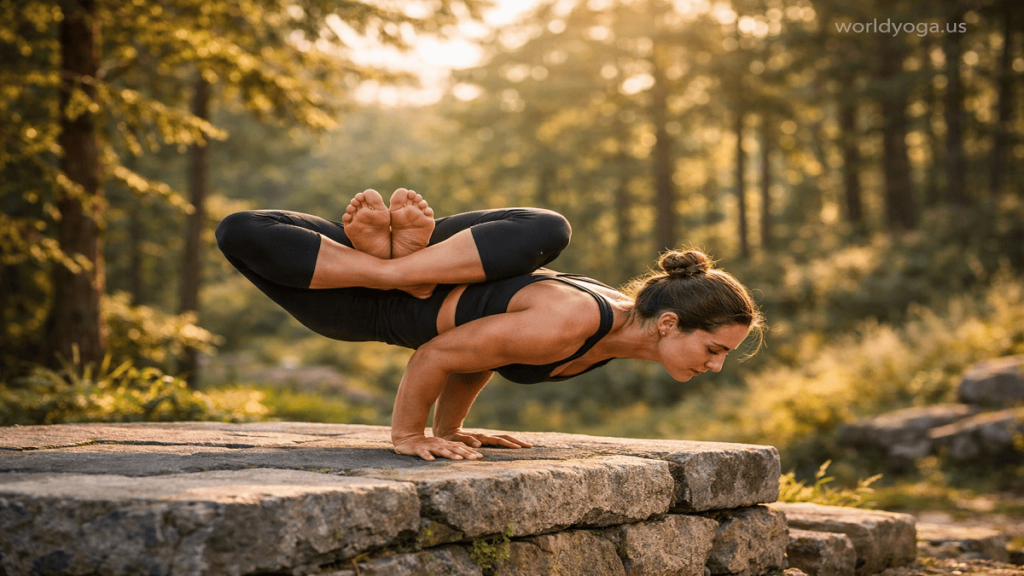
Bound Angle Pose in Peacock Pose is an advanced arm balance variation where the practitioner combines Mayūrāsana (Peacock Pose) with Baddha Konasana (Bound Angle Pose). The body is lifted horizontally above the ground using forearm support, while the legs are held in a bound angle shape with the soles of the feet together and knees opened outward.
This variation replaces the extreme hip rotation required in lotus-based arm balances with a more accessible hip position, while still maintaining a high demand for strength, balance, and control.
Structure of the Pose
- Base: Forearms grounded, elbows pressed into the abdomen for leverage
- Lift: Full-body horizontal elevation using core compression and shoulder stability
- Leg position: Bound Angle (feet together, knees open outward)
- Alignment: Torso remains parallel to the floor with controlled balance engagement
Key Characteristics
- Advanced arm balance requiring full forearm load-bearing
- Reduced knee stress compared to lotus-based variations
- Strong emphasis on core compression mechanics
- Requires coordinated shoulder, elbow, and abdominal engagement
Benefits
- Builds advanced forearm, wrist, and shoulder strength
- Develops deep core compression and stability
- Improves hip flexibility in a controlled and safe range
- Enhances balance, coordination, and neuromuscular control
- Serves as a progression toward more advanced Mayūrāsana variations
Reference:
https://www.yogajournal.com/poses/peacock-pose/
Reference:
https://www.yogapedia.com/definition/4992/bound-angle-pose-baddha-konasana
Common Challenges
- Maintaining stable elbow-to-abdomen pressure
- Preventing wrist overload during lift-off
- Holding Bound Angle without collapsing legs
- Coordinating breath with balance transitions
Safety Considerations
This pose should only be practiced after mastering foundational arm balances such as Crow Pose (Bakasana) and Forearm Plank. Practitioners should avoid forcing hip or knee positions and should progress gradually to prevent joint strain.
#Bound Angle Pose in Peacock Pose in India
What is Bound Angle Pose in Peacock Pose?
Bound Angle Pose in Peacock Pose is an advanced yoga arm balance variation where Mayūrāsana (Peacock Pose) is performed with the legs positioned in Baddha Konasana (Bound Angle Pose) instead of straight legs or lotus.
In this posture, the practitioner balances the entire body horizontally above the ground using the forearms. The elbows press firmly into the abdomen to create a lifting mechanism, while the core remains strongly engaged to maintain stability. At the same time, the soles of the feet are brought together and the knees are opened outward, forming the Bound Angle shape in mid-air.
How it differs from traditional Peacock Pose
In classical Mayūrāsana, the legs are usually extended straight behind the body. In this variation:
- The legs are bent and shaped into Bound Angle Pose
- The center of gravity shifts slightly, requiring more controlled balance
- Hip flexibility is engaged, but in a safer, non-lotus position
Purpose of this variation
This modification is typically used as:
- A progression toward more advanced arm balances
- A safer alternative to lotus-based Peacock variations
- A training tool for improving core compression and forearm strength
Key physical demands
- Strong wrist and forearm endurance
- Powerful core compression against the elbows
- Shoulder stability and scapular control
- Moderate hip external rotation for Bound Angle positioning
Benefits
- Builds advanced upper-body and core strength
- Improves balance and neuromuscular coordination
- Enhances hip mobility without extreme joint stress
- Develops controlled breathing under physical load
- Prepares the body for advanced arm balance transitions
Reference:
https://www.yogajournal.com/poses/peacock-pose/
Reference:
https://www.yogapedia.com/definition/4992/bound-angle-pose-baddha-konasana
#Bound Angle Pose in Peacock Pose in Maharashtra
How is this variation performed step by step?
1. Prepare the body (warm-up)
Begin with joint and muscle activation:
- Wrist circles and gentle wrist stretches
- Forearm plank holds for endurance
- Shoulder activation (Dolphin Pose or arm swings)
- Hip opening practice in seated Bound Angle Pose
This prepares the body for weight-bearing and reduces injury risk.
2. Come into kneeling position
Kneel on the mat with knees slightly apart. Place the hands on the floor in front of you, fingers pointing slightly inward or sideways depending on comfort.
3. Set the elbow foundation
- Bend both elbows
- Bring elbows closer together
- Slide elbows toward the lower abdomen (near the navel)
- Press elbows firmly into the abdomen to create a stable “shelf”
This elbow-abdomen connection is the core lifting mechanism of Mayūrāsana.
4. Engage core and shift weight forward
- Activate abdominal muscles strongly
- Lean your body forward slowly
- Shift weight from knees onto forearms
At this stage, toes may still stay lightly on the ground for control.
5. Prepare Bound Angle leg position
- Bring the soles of the feet together
- Open the knees outward into Bound Angle Pose
- Keep legs active rather than loose or collapsed
Do not force knee movement; it should come from hip mobility.
6. Lift the body into balance
- Gradually shift more weight onto the forearms
- Engage core deeply and press elbows into abdomen
- Lift both feet off the ground in a controlled motion
- Maintain the body parallel to the floor
Key focus points:
- Core compression is the main lift engine
- Shoulders stay stable and slightly engaged
- Legs remain in Bound Angle shape throughout
7. Stabilize and hold
Once balanced:
- Maintain steady nasal breathing
- Keep knees open and feet gently touching
- Avoid collapsing in shoulders or lower back
- Make small micro-adjustments using core and wrists
Hold only as long as control is maintained.
8. Exit safely
To release:
- Slowly lower feet back to the ground
- Separate legs carefully
- Release elbow pressure from abdomen
- Return to kneeling and rest in Child’s Pose (Balasana)
Safety Notes
- Do not force hip or knee opening
- Avoid collapsing into wrists or shoulders
- Stop immediately if sharp pain occurs in joints
- Build strength first with Crow Pose, Forearm Plank, and basic Mayūrāsana
Reference
- https://www.yogajournal.com/poses/peacock-pose/
- https://www.yogapedia.com/definition/4992/bound-angle-pose-baddha-konasana
#Bound Angle Pose in Peacock Pose in Kolkata
What strength and control are required?
1. Upper Body Strength Requirements
This pose places full body weight on the forearms, making upper-body endurance essential.
Key requirements:
- Forearms and wrists: Must sustain strong isometric load without collapsing
- Elbows: Act as a stable leverage point against the abdomen
- Shoulders (deltoids + rotator cuff): Provide lift and prevent sinking
- Upper back (scapular stabilizers): Maintain alignment and control
Without sufficient upper-body strength, the body will not lift cleanly or will collapse forward.
2. Core Strength and Compression Control
Core strength is the primary “engine” of the lift in this pose.
Required abilities:
- Strong abdominal compression against elbows (key Mayūrāsana mechanism)
- Anti-extension control to prevent hips dropping
- Midline stability to maintain horizontal alignment
- Controlled engagement throughout breathing cycles
Key muscles involved:
- Transverse abdominis (deep stability)
- Rectus abdominis (front support)
- Obliques (side stabilization and balance control)
A weak core leads to immediate instability in the lift phase.
3. Hip Flexibility and Lower Body Control
Although less extreme than lotus variations, Bound Angle still requires controlled hip mobility.
Requirements:
- Hip external rotation: Allows knees to open outward safely
- Adductor flexibility: Enables soles of feet to connect
- Controlled knee positioning: Must avoid strain or collapse
- Lower body relaxation under tension: Prevents stiffness disrupting balance
Importantly, the movement must originate from the hips, not forced knee pressure.
4. Balance and Neuromuscular Control
This pose is highly dependent on the nervous system’s ability to coordinate multiple muscle groups.
Key control elements:
- Proprioception: Awareness of body position in mid-air
- Fine motor control: Micro-adjustments through fingers and wrists
- Core-shoulder synchronization: Prevents forward tipping
- Breath regulation: Maintains stability under pressure
Even small timing errors in weight shift can cause loss of balance.
5. Foundational Strength Needed Before Attempting
Practitioners should ideally be comfortable with:
- Forearm Plank (30–60 seconds stable hold)
- Bakasana (Crow Pose) balance control
- Dolphin Pose shoulder endurance
- Seated Baddha Konasana flexibility
- Basic Mayūrāsana preparation drills
6. Summary
Bound Angle Pose in Peacock Pose requires:
- High forearm and shoulder strength
- Strong core compression capability
- Moderate hip flexibility (safe range)
- Advanced balance and neuromuscular coordination
It is less extreme than lotus-based variations but still demands precise control and structured progression to perform safely.
#Bound Angle Pose in Peacock Pose in Chennai
What are the benefits of this arm balance?
1. Builds Advanced Upper Body Strength
This pose requires the entire body weight to be supported on the forearms, making it highly effective for upper-body conditioning.
Key benefits:
- Strengthens wrists and forearms through sustained load-bearing
- Develops shoulder stability and scapular control
- Improves elbow endurance due to abdominal compression support
- Enhances upper-back strength for posture and alignment
2. Develops Strong Core Compression
The core plays a central role in lifting and stabilizing the body.
Core benefits:
- Strengthens deep abdominal muscles (especially transverse abdominis)
- Improves anti-extension strength (preventing collapse in mid-air)
- Enhances control over spinal alignment under load
- Builds endurance in static compression positions
3. Improves Hip Mobility in a Safe Range
Unlike lotus-based arm balances, this variation uses Bound Angle Pose, which reduces joint stress.
Flexibility benefits:
- Increases hip external rotation gradually
- Improves inner thigh (adductor) flexibility
- Opens groin area without extreme knee pressure
- Encourages safer, controlled mobility development
Reference:
https://www.yogapedia.com/definition/4992/bound-angle-pose-baddha-konasana
4. Enhances Balance and Body Coordination
Because the body is suspended horizontally, the nervous system must constantly make micro-adjustments.
Coordination benefits:
- Improves proprioception (spatial awareness)
- Enhances neuromuscular control between upper and lower body
- Strengthens fine motor adjustments in wrists and fingers
- Develops stability under unstable load conditions
5. Builds Mental Focus and Breath Control
This pose requires calm awareness under physical effort.
Mental benefits:
- Improves concentration during high physical demand
- Develops patience through progressive mastery
- Reduces fear response in arm balances
- Enhances controlled breathing under compression
6. Safer Progression Toward Advanced Arm Balances
This variation is often used as a stepping stone in training systems.
Why it is useful:
- Less knee strain than lotus-based variations
- More accessible hip positioning for many practitioners
- Builds foundational strength for advanced Mayūrāsana progressions
Reference:
https://www.yogajournal.com/poses/peacock-pose/
Summary
Bound Angle Pose in Peacock Pose provides a powerful combination of upper-body strength development, core compression training, hip mobility improvement, and advanced balance control, making it an effective transitional arm balance for progressive yoga practice.
#Bound Angle Pose in Peacock Pose in Pune
What common mistakes should be avoided?
1. Collapsing Into the Wrists
One of the most frequent mistakes is overloading the wrists instead of distributing weight properly.
What goes wrong:
- Excess pressure on wrist joints
- Fingers remain passive instead of supporting balance
- Uneven load distribution across the hands
Why it matters:
This can lead to wrist pain, inflammation, or long-term overuse injury.
2. Weak Core Engagement
The pose depends heavily on abdominal compression against the elbows.
What goes wrong:
- Hips drop toward the floor
- Loss of horizontal body alignment
- Over-reliance on arm strength instead of core lift
Correction:
Maintain strong, continuous core activation before and during lift-off.
3. Incorrect Elbow Placement
Elbow positioning is the foundation of stability in this pose.
What goes wrong:
- Elbows placed too wide apart
- Elbows slipping away from the abdomen
- Lack of firm abdominal contact
Why it matters:
Without strong elbow-to-abdomen connection, lift becomes unstable or impossible.
4. Forcing the Bound Angle Position
Flexibility should never be forced in this variation.
What goes wrong:
- Forcing knees outward manually
- Pushing beyond natural hip range
- Creating strain in inner knees or groin
Correction:
Movement should originate from hip external rotation, not pressure on the knees.
5. Rushing the Lift-Off
Many practitioners attempt to lift before establishing control.
What goes wrong:
- Sudden or explosive lifting attempts
- Loss of balance mid-transition
- Incomplete core engagement
Correction:
Lift should be slow, gradual, and controlled with full awareness.
6. Poor Shoulder Stability
Shoulder control is essential in forearm-based arm balances.
What goes wrong:
- Chest collapses between shoulders
- Scapulae are inactive or unstable
- Upper body sinks downward
Correction:
Maintain active scapular engagement and lifted chest positioning.
7. Holding the Breath
Breath control is often neglected under effort.
What goes wrong:
- Breath holding during lift
- Shallow or irregular breathing
- Increased tension and instability
Correction:
Maintain steady, slow nasal breathing throughout the pose.
8. Ignoring Hip and Knee Signals
Even though this variation is safer than lotus-based arm balances, joint awareness is still critical.
What goes wrong:
- Forcing knee opening beyond comfort
- Ignoring sharp sensations in hips or inner thighs
Rule:
Muscular effort is acceptable; joint pain is not.
9. Skipping Foundational Preparation
Attempting this pose without prerequisites increases risk of failure or injury.
Missing foundations often include:
- Forearm Plank strength
- Mayūrāsana (Peacock Pose) basics
- Seated Baddha Konasana flexibility
- Bakasana (Crow Pose) balance control
Reference
- https://www.yogajournal.com/poses/peacock-pose/
- https://www.yogapedia.com/definition/4992/bound-angle-pose-baddha-konasana
#Bound Angle Pose in Peacock Pose in Ahemadabad

Case Study of Bound Angle Pose in Peacock Pose
1. Introduction
This case study analyzes the progression of an advanced yoga practitioner training in Bound Angle Pose in Peacock Pose (Mayūrāsana variation). The objective was to evaluate improvements in upper-body strength, core compression control, hip mobility integration, and balance stability within a structured arm balance development program.
The subject had prior experience in foundational arm balances including Bakasana (Crow Pose), Forearm Plank, and assisted Mayūrāsana drills.
2. Initial Assessment
At baseline, the practitioner demonstrated:
- Moderate wrist and forearm strength but limited endurance under full body load
- Adequate core activation in static poses but weak dynamic compression control
- Good seated Baddha Konasana flexibility
- Instability during forward weight shift and lift-off phase
- Shoulder collapse tendency under load
Primary limitation identified: lack of coordinated core-to-forearm transfer during lift transition.
3. Training Protocol
An 8-week structured progression model was implemented.
Phase 1: Foundation Strength (Weeks 1–2)
- Forearm plank holds (20–60 seconds)
- Wrist conditioning and mobility drills
- Dolphin Pose shoulder endurance training
Phase 2: Core Compression Development (Weeks 2–4)
- Elbow-to-abdomen static holds
- Slow forward lean drills with grounded support
- Controlled abdominal engagement under load
Phase 3: Mayūrāsana Mechanics (Weeks 3–6)
- Partial Peacock Pose lifts with toes grounded
- Focus on scapular stability and elbow pressure
- Short hover attempts without full lift
Phase 4: Bound Angle Integration (Weeks 5–8)
- Seated Baddha Konasana refinement
- Assisted airborne leg positioning practice
- Gradual transition into lifted Bound Angle shape
4. Observations
By Week 4:
- Improved wrist endurance and reduced fatigue
- Better awareness of abdominal compression timing
- Slight improvement in shoulder stabilization during forward shift
By Week 7:
- First controlled lift achieved for 2–3 seconds
- Improved coordination between core engagement and forearm pressure
- Reduced collapse in chest during lift-off phase
Main challenge remained: maintaining stability while holding Bound Angle leg position mid-air.
5. Outcome
At the end of the training cycle:
- Practitioner achieved stable holds of 5–8 seconds
- Noticeable improvement in neuromuscular coordination and balance control
- Safer hip positioning maintained without knee strain
- Enhanced confidence in forearm-based arm balances
Full endurance stability was not yet consistent but foundational control was successfully established.
6. Key Insights
- Core compression timing is the primary success factor
- Forearm endurance determines duration of stability
- Transition phase (ground → lift) is the most failure-prone stage
- Bound Angle reduces joint stress compared to lotus-based variations
- Controlled breathing significantly improves balance retention
7. Safety Considerations
- Wrist overload risk remains if progression is rushed
- Shoulder instability can cause collapse during lift-off
- Knee strain is minimal but possible if hip alignment is forced
- Fatigue significantly reduces neuromuscular control accuracy
8. Reference Context
- https://www.yogajournal.com/poses/peacock-pose/
- https://www.yogapedia.com/definition/4992/bound-angle-pose-baddha-konasana
9. Conclusion
Bound Angle Pose in Peacock Pose functions as a progressive transitional arm balance, bridging foundational strength training and advanced control-based yoga practice. The case study demonstrates that success relies primarily on core compression mechanics, scapular stability, and controlled lift sequencing, rather than extreme flexibility or explosive strength.
#Bound Angle Pose in Peacock Pose in Hyderabad
White Paper of Bound Angle Pose in Peacock Pose
1. Abstract
Bound Angle Pose in Peacock Pose is an advanced yoga arm balance variation that integrates the biomechanical structure of Mayūrāsana (Peacock Pose) with the hip configuration of Baddha Konasana (Bound Angle Pose). This white paper examines its anatomical requirements, biomechanical load distribution, neuromuscular demands, training methodology, risk factors, and applied relevance in modern movement and fitness systems.
2. Introduction
Arm balances in yoga represent closed-chain kinetic movements where the body is supported by the upper limbs under full gravitational load. This variation replaces the extreme hip rotation of lotus-based arm balances with a safer Bound Angle configuration, making it a transitional yet demanding posture in advanced training systems.
Reference foundations:
- Mayūrāsana (Peacock Pose): https://www.yogajournal.com/poses/peacock-pose/
- Baddha Konasana (Bound Angle Pose): https://www.yogapedia.com/definition/4992/bound-angle-pose-baddha-konasana
3. Biomechanical Structure
3.1 Load Distribution
The posture distributes mechanical load across:
- Forearms: primary weight-bearing surface
- Elbows: act as a compression lever against the abdomen
- Core musculature: maintains spinal alignment and lift
- Hip adductors: stabilize Bound Angle positioning
3.2 Center of Mass Dynamics
The Bound Angle configuration:
- Lowers rotational torque compared to lotus variations
- Improves stability during lift transition
- Reduces knee joint stress while maintaining hip engagement
- Requires controlled anterior shift of center of mass for lift-off
4. Physiological Requirements
4.1 Strength Demands
- Forearm and wrist isometric endurance under full load
- Shoulder stabilization (scapular protraction and control)
- Core anti-extension strength for horizontal body alignment
- Elbow-to-abdomen compression force generation
4.2 Flexibility Demands
- Moderate hip external rotation for Bound Angle positioning
- Inner thigh (adductor) flexibility for sole contact
- Functional knee flexion tolerance without valgus stress
5. Neuromuscular Control Systems
The pose requires integration of:
- Proprioceptive feedback for spatial awareness in mid-air
- Fine motor control through wrists and fingers
- Core-shoulder synchronization during lift phase
- Breath regulation under compressive load
The most complex phase is the transition from ground support to full lift-off.
6. Training Framework
Phase 1: Foundational Strength
- Forearm plank endurance
- Wrist mobility and strengthening
- Dolphin Pose for shoulder stability
Phase 2: Core Compression Development
- Elbow-to-abdomen static holds
- Knee-to-elbow engagement drills
- Controlled forward lean training
Phase 3: Arm Balance Integration
- Bakasana (Crow Pose) progression
- Partial Mayūrāsana lifts with toe support
Phase 4: Bound Angle Integration
- Seated Baddha Konasana mobility work
- Assisted airborne leg positioning
- Gradual lift transition practice
7. Risk Analysis
7.1 Primary Risks
- Wrist overuse injury due to improper load distribution
- Shoulder collapse from insufficient scapular control
- Knee strain if hip position is forced
- Loss of balance during rapid lift attempts
7.2 Risk Mitigation
- Progressive loading and structured conditioning
- Emphasis on core compression before lift
- Avoidance of forced flexibility
- Controlled breathing and stabilization training
8. Performance Indicators
Successful execution is defined by:
- Stable horizontal alignment of torso
- Controlled Bound Angle leg positioning
- No collapse in shoulders or wrists
- Ability to maintain lift for 3–10 seconds without strain
9. Applications
9.1 Yoga and Movement Training
- Transitional arm balance for advanced progression systems
- Core compression and scapular control training tool
9.2 Fitness and Strength Conditioning
- Closed-chain upper limb endurance development
- Functional bodyweight strength progression model
9.3 Biomechanics Research
- Analysis of forearm-supported static balance systems
- Study of neuromuscular coordination under full-body load
10. Conclusion
Bound Angle Pose in Peacock Pose is a structured transitional arm balance that balances strength demands with joint safety. It serves as an effective bridge between foundational arm balances and advanced inversion-strength systems by emphasizing core compression mechanics, scapular stability, and controlled neuromuscular coordination.
#Bound Angle Pose in Peacock Pose in Banglore
Industry Application of Bound Angle Pose in Peacock Pose
1. Overview
Bound Angle Pose in Peacock Pose is an advanced arm balance variation that combines Mayūrāsana (Peacock Pose) with Baddha Konasana (Bound Angle Pose). While rooted in traditional yoga, its biomechanical structure has significant relevance in modern industries including fitness training, sports science, physiotherapy, performing arts, and human movement research.
2. Fitness and Strength Training Industry
In contemporary strength systems, this pose is used as an advanced bodyweight conditioning benchmark.
Applications:
- Forearm and wrist endurance training protocols
- Core compression strength development programs
- Advanced calisthenics and bodyweight progression systems
- Functional stability and isometric strength training
Industry value:
It offers a scalable progression into arm balance training without requiring extreme hip flexibility, making it more accessible than lotus-based variations.
Reference:
https://www.yogajournal.com/poses/peacock-pose/
3. Sports Science and Biomechanics
Sports science uses this variation to analyze:
- Closed-chain kinetic loading under full body weight
- Shoulder girdle stability under isometric compression
- Core activation timing during lift-off transitions
- Center-of-mass control in horizontal balance systems
Practical use:
- EMG analysis of abdominal and forearm muscle activation
- Load distribution modeling across upper limb joints
- Stability performance assessment in static holds
This variation is valuable due to its controlled hip position and high upper-body demand.
4. Physiotherapy and Rehabilitation (Controlled Application)
While not used as a full therapeutic pose, its components are applied in rehabilitation contexts.
Applications:
- Gradual wrist loading and strengthening protocols
- Shoulder stabilization in closed kinetic chain exercises
- Core activation training for postural correction
- Progressive forearm weight-bearing adaptation
Clinical note:
Full pose execution is not recommended in rehabilitation settings; only modified components are used under supervision.
Reference:
https://www.yogapedia.com/definition/4992/bound-angle-pose-baddha-konasana
5. Dance, Circus Arts, and Performance Movement
In performing arts, this variation contributes to:
- Floor-based strength choreography
- Controlled suspension aesthetic movements
- Transition training between balance and inversion skills
- Visual strength-based performance sequences
It is valued for its stable, symmetrical visual structure and strength expression.
6. Yoga Education and Teacher Training
In advanced yoga education programs, it is used to:
- Teach safe arm balance progression strategies
- Demonstrate non-lotus alternatives for advanced practice
- Train scapular and core coordination awareness
- Assess readiness for full Mayūrāsana and advanced balances
It is often introduced as a bridge posture between Crow Pose and classical Peacock Pose.
7. Human Movement Research and AI Systems
This variation is relevant in:
- Motion capture analysis of forearm-supported balance states
- AI-based posture classification systems
- Neuromuscular coordination modeling under load
- Stability prediction in multi-joint isometric systems
8. Key Industry Insight
Across industries, this pose functions as:
- A progressive strength-training model
- A safer alternative to lotus-based arm balances
- A research-friendly system for load analysis and stability testing
Its reduced joint stress profile makes it highly adaptable for training and analytical applications.
9. Conclusion
Bound Angle Pose in Peacock Pose bridges traditional yoga practice and modern movement science. Its primary industrial value lies in its ability to combine upper-body strength development, core compression mechanics, and controlled hip mobility, making it a versatile tool for fitness, rehabilitation concepts, performance training, and biomechanical research.
#Bound Angle Pose in Peacock Pose in Mumbai
Ask FAQs
What is Bound Angle Pose in Peacock Pose?
It is an advanced yoga arm balance variation where Mayūrāsana (Peacock Pose) is performed with the legs in Baddha Konasana (Bound Angle Pose). The body is lifted horizontally using the forearms while the soles of the feet are brought together and the knees open outward in mid-air.
Who can practice this pose safely?
This pose is suitable only for advanced yoga practitioners who have already developed strength in forearm balances such as Bakasana (Crow Pose) and have foundational experience in Mayūrāsana. Beginners or individuals with wrist, shoulder, hip, or knee injuries should avoid it or practice modified versions under supervision.
What are the main benefits of this arm balance?
It strengthens the wrists, forearms, shoulders, and core while improving balance, coordination, and body awareness. It also develops hip mobility in a controlled range and enhances neuromuscular control during full-body weight-bearing positions.
Reference:
https://www.yogajournal.com/poses/peacock-pose/
How is it different from Lotus Peacock Pose?
Unlike Lotus Peacock, this variation uses Baddha Konasana instead of Padmāsana (lotus). This reduces stress on the knees and hips, making it safer while still maintaining advanced strength and balance requirements.
Reference:
https://www.yogapedia.com/definition/4992/bound-angle-pose-baddha-konasana
How long does it take to learn this pose?
The learning timeline varies depending on strength, flexibility, and consistency. For most practitioners, it can take several months to over a year of structured training to achieve stable control. Progress depends on mastering foundational arm balances, core compression strength, and shoulder stability.
Table of Contents
Disclaimer:
Bound Angle Pose in Peacock Pose (Mayūrāsana variation) is an advanced yoga posture that should be practiced only after proper preparation and under the guidance of a qualified instructor. Incorrect practice may lead to injury, especially in the wrists, shoulders, hips, or knees. This content is for educational purposes only and does not replace professional training or medical advice.