Arm Balance: Peacock and Swan
Arm balances are advanced yoga practices that develop strength, control, and coordination. Among them, the combination of peacock and swan variations represents a progression from foundational arm support to more refined balance and body alignment.
1. Peacock Pose (Mayurasana)
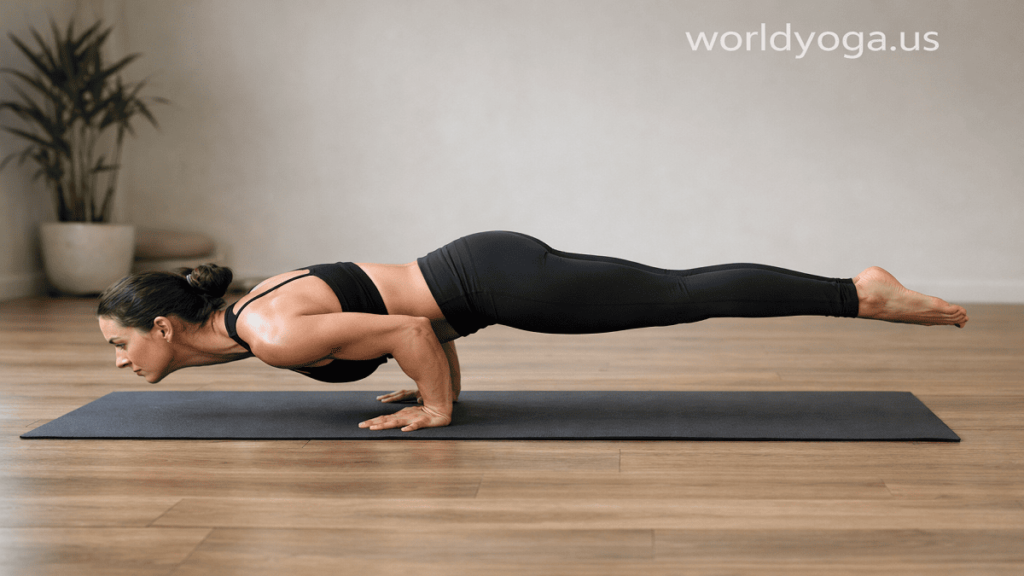
Peacock Pose, traditionally known as Mayurasana, is a classical Hatha Yoga posture where the body is balanced horizontally on the hands, with elbows pressing into the abdomen.
Key Characteristics
- Hands placed on the floor with fingers pointing backward
- Elbows positioned into the abdominal region
- Body lifted parallel to the ground
- Legs extended straight behind
Benefits
- Strengthens wrists, forearms, and shoulders
- Enhances core stability and spinal control
- Improves balance and coordination
- Traditionally associated with digestive stimulation
2. Swan Pose (Arm Balance Variation)
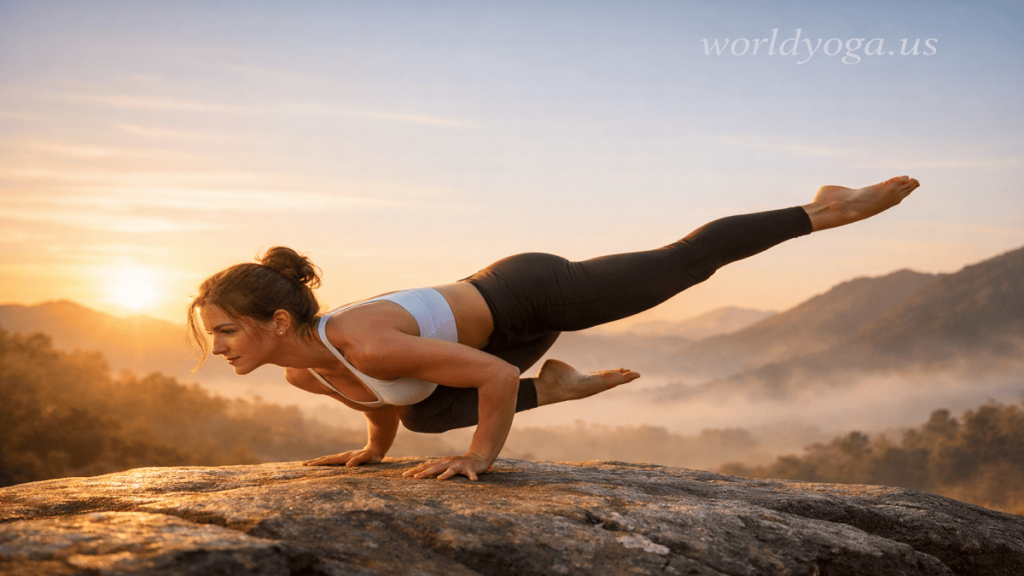
Swan Pose (arm balance variation) is a less standardized but conceptually related arm balance that emphasizes grace, extension, and controlled weight distribution. It is often interpreted as a variation or progression involving lifted legs and refined posture control.
Key Characteristics
- Strong arm support with lifted body
- Greater emphasis on elegance and extension
- Requires advanced balance and coordination
- May involve variations in leg positioning
Benefits
- Develops refined balance and control
- Improves shoulder stability and endurance
- Enhances flexibility and movement fluidity
- Builds advanced neuromuscular coordination
3. Comparative Analysis
| Aspect | Peacock Pose | Swan Pose (arm balance variation) |
|---|---|---|
| Structure | Horizontal, compact | More extended and expressive |
| Difficulty | Advanced | Advanced to highly advanced |
| Focus | Strength and compression | Balance, control, and extension |
| Stability | More grounded | More dynamic and refined |
4. Training Progression
To move from Peacock Pose to swan-style balances:
- Build strong wrist and shoulder stability
- Develop core engagement and spinal alignment
- Practice controlled weight shifting
- Gradually introduce variations in leg positioning
5. Safety Considerations
- Avoid if you have wrist or shoulder injuries
- Do not force balance without proper strength
- Maintain steady breathing during holds
- Practice under guidance for advanced variations
Conclusion
Peacock Pose and Swan Pose (arm balance variation) represent two advanced expressions of arm balancing in yoga. While Peacock Pose emphasizes strength and stability, swan variations focus more on fluidity and refined control. Together, they illustrate the progression from foundational arm balance mechanics to advanced movement mastery.
#Arm Balance: Peacock and Swan in India
What are Peacock and Swan arm balance poses?
Peacock Pose (Mayurasana)
Peacock Pose, traditionally known as Mayurasana, is a classical Hatha Yoga posture in which the body is held horizontally, supported by the hands and forearms.
In this pose, the practitioner places the hands on the ground (often with fingers pointing backward), bends the elbows, and presses them into the abdomen. The body is then lifted so it becomes parallel to the floor, with the legs extended straight behind. The posture relies heavily on wrist strength, shoulder stability, and core engagement to maintain balance.
It is known for building upper-body strength and improving coordination, and in traditional yoga it is associated with stimulating the abdominal organs.
Swan Pose (Arm Balance Variation)
Swan Pose (arm balance variation) is a more modern or interpretative arm balance that emphasizes elegance, extension, and refined control rather than compact strength alone.
In swan-style balances, the practitioner lifts the body using the arms but often incorporates more expressive leg positioning, spinal extension, or graceful alignment. Unlike Peacock Pose, which is compact and grounded, Swan variations may appear more elongated and fluid, requiring a higher level of balance and coordination.
This pose is less standardized in traditional texts and is often taught in contemporary yoga, movement arts, or advanced flow practices.
Key Difference
- Peacock Pose focuses on strength, compression, and stability
- Swan Pose (arm balance variation) emphasizes balance, extension, and fluid control
Summary
Both Peacock Pose and Swan Pose (arm balance variation) are advanced arm balances that challenge the practitioner’s strength and coordination. Peacock Pose represents a classical, strength-driven posture, while Swan variations reflect a more expressive and dynamic evolution of arm balancing in modern yoga practice.
#Arm Balance: Peacock and Swan in Maharashtra
How are these poses performed step by step?
1. Peacock Pose (Mayurasana) – Step by Step
Step 1: Preparation
Start by kneeling on the floor. Warm up the wrists, shoulders, and core with preparatory poses like Plank and Chaturanga Dandasana.
Step 2: Hand Placement
Place your palms on the floor with fingers pointing backward toward your body. Keep the hands close together and firmly grounded.
Step 3: Elbow Positioning
Bend your elbows and bring them into the abdomen, ideally near the navel. Keep elbows close together to create a stable base.
Step 4: Lean Forward
Shift your body weight forward slowly. Lower your chest slightly while keeping the core engaged.
Step 5: Lift the Legs
Gradually lift one leg and then the other off the ground. Extend both legs straight behind you.
Step 6: Full Balance
Hold the body parallel to the ground. Maintain strong engagement in the arms, shoulders, and core. Keep the gaze slightly forward for balance.
Step 7: Exit
Lower the legs gently back to the floor and return to a resting position.
2. Swan Pose (arm balance variation) – Step by Step
Step 1: Starting Position
Begin in a low squat or a preparatory arm-balance position. Warm up wrists and hips thoroughly.
Step 2: Hand Placement
Place your hands firmly on the floor, shoulder-width apart. Spread the fingers for better weight distribution.
Step 3: Arm Engagement
Bend the elbows slightly and engage the shoulders. Keep the arms strong and stable.
Step 4: Lift the Body
Shift your weight forward onto your hands and begin lifting your body off the ground. Engage the core to stabilize.
Step 5: Leg Positioning
Extend one or both legs in a graceful, elongated position (depending on the variation). The body may be slightly lifted or angled rather than fully horizontal.
Step 6: Balance and Hold
Maintain a controlled, steady position with smooth breathing. Focus on balance, extension, and fluid alignment.
Step 7: Exit
Slowly lower your body back down with control and return to a neutral position.
Safety Notes
- Avoid practicing these poses without proper strength and preparation
- Do not force balance; progress gradually
- Keep breathing steady and controlled
- Practice under guidance if you are new to arm balances
Summary
Peacock Pose is performed through a compact, strength-based lift with elbows supporting the abdomen, while Swan Pose (arm balance variation) involves a more fluid, extended balance with emphasis on control and elegance. Both require disciplined practice and proper technique for safe execution.
#Arm Balance: Peacock and Swan in Pune
What are the key differences between them?
1. Body Structure and Alignment
- Peacock Pose: The body is held straight and horizontal, parallel to the ground, with legs extended backward in a rigid line.
- Swan Pose (arm balance variation): The body is often more curved or extended, with a graceful, elongated shape rather than a strict horizontal alignment.
2. Center of Gravity
- Peacock Pose: The center of gravity is compact and centrally controlled, supported by elbows pressing into the abdomen.
- Swan Pose: The center of gravity is more dynamic and variable, depending on leg positioning and extension, making balance more complex.
3. Arm and Elbow Position
- Peacock Pose: Elbows are firmly placed into the abdomen, acting as a primary support system.
- Swan Pose: Elbows are less compressed into the torso, with more reliance on shoulder strength and arm stability.
4. Strength vs. Fluidity
- Peacock Pose: Emphasizes raw strength, compression, and stability.
- Swan Pose: Emphasizes fluidity, grace, and controlled movement, requiring refined coordination.
5. Difficulty and Control
- Peacock Pose: Advanced but more structurally predictable once strength is developed.
- Swan Pose: Often more technically challenging, as it requires precise balance adjustments and body awareness.
6. Leg Positioning
- Peacock Pose: Legs are straight and together, providing counterbalance.
- Swan Pose: Legs may be extended, lifted, or artistically positioned, increasing complexity.
7. Traditional vs. Modern Practice
- Peacock Pose: A classical Hatha Yoga posture with established technique and purpose.
- Swan Pose: A modern or interpretative variation, commonly seen in contemporary yoga and movement arts.
Summary
The main difference between Peacock Pose and Swan Pose (arm balance variation) lies in their approach:
- Peacock Pose focuses on strength, compression, and stability
- Swan Pose focuses on balance, extension, and fluid control
Together, they represent two complementary aspects of advanced arm balancing—one rooted in classical strength and the other in expressive movement and refinement.
#Arm Balance: Peacock and Swan in Hyderabad
What strength and control are required?
1. Upper-Body Strength
Wrists and Forearms:
Both poses require strong wrists to تحمل full body weight. In Peacock Pose, the load is more direct and compressive, while in swan variations it is more dynamic and distributed.
Shoulders and Upper Back:
- In Peacock Pose, the shoulders stabilize the body in a fixed horizontal position.
- In Swan Pose, the shoulders must adapt to subtle shifts, requiring greater dynamic control and endurance.
2. Core Strength and Stability
A powerful core is essential in both poses:
- Peacock Pose: Requires strong abdominal compression to keep the body rigid and parallel to the floor.
- Swan Pose: Requires adaptive core control to maintain balance during extended or asymmetrical leg positions.
The core acts as the central stabilizer, preventing collapse and maintaining alignment.
3. Arm and Elbow Control
- Peacock Pose: Relies on firm elbow placement into the abdomen, requiring controlled pressure and stability.
- Swan Pose: Requires more freedom in the arms, demanding fine motor control and precise weight distribution through the hands and shoulders.
4. Balance and Proprioception
Balance is critical in both poses but differs in nature:
- Peacock Pose: Balance is more static and controlled, with predictable alignment.
- Swan Pose: Balance is dynamic and constantly adjusting, requiring heightened body awareness.
Proprioception (awareness of body position in space) is essential for maintaining stability.
5. Spinal and Postural Control
- Peacock Pose: Requires a straight, rigid spine with minimal movement.
- Swan Pose: Often involves controlled spinal extension or variation, requiring flexibility combined with strength.
6. Coordination and Movement Control
- Peacock Pose: Emphasizes controlled entry and steady holding.
- Swan Pose: Involves more fluid transitions and coordinated limb movement, increasing the demand for neuromuscular precision.
7. Endurance and Breath Control
Both poses require sustained muscular engagement:
- Maintaining steady breathing prevents unnecessary tension
- Endurance is needed to hold the posture without losing alignment
Summary
To perform Peacock Pose and Swan Pose (arm balance variation) effectively, a practitioner needs:
- Strong wrists, forearms, shoulders, and upper back
- Deep core stability and spinal control
- Precise balance and proprioception
- Coordinated arm and body control
- Muscular endurance and steady breathing
Overall, Peacock Pose emphasizes static strength and compression, while Swan Pose requires dynamic control and fluid balance, making both complementary challenges in advanced arm balance practice.
#Arm Balance: Peacock and Swan in Ahemdabad
What common mistakes should be avoided?
1. Poor Wrist Alignment
A frequent mistake is placing excessive or uneven pressure on the wrists. Collapsing into the wrists instead of distributing weight through the entire hand can lead to strain or injury. Proper grounding through the palms and fingers is essential for stability.
2. Weak Core Engagement
Lack of core activation is a major issue in both poses.
- In Peacock Pose, it causes the body to sag and lose its horizontal line.
- In Swan Pose (arm balance variation), it leads to instability during extended or asymmetrical positioning.
A strong, engaged core is necessary to maintain balance and alignment.
3. Incorrect Elbow Placement (Peacock Pose)
In Peacock Pose, placing the elbows too wide or too far from the abdomen reduces support and balance. The elbows should be close together and firmly positioned into the abdominal area.
4. Rushing the Lift-Off
Trying to lift the body too quickly often results in loss of control or falling forward. Both poses require a gradual transfer of weight from the lower body to the arms. Controlled movement is key.
5. Collapsing the Shoulders
Failing to properly engage the shoulders can lead to joint strain.
- In Peacock Pose, this reduces stability.
- In Swan Pose, it disrupts fluid movement and balance.
Strong shoulder engagement and scapular control are essential.
6. Overextending or Misplacing the Legs (Swan Pose)
In Swan Pose (arm balance variation), improper leg positioning can shift the center of gravity too far, making the pose unstable. The legs should be extended with control, not thrown into position.
7. Holding the Breath
Many practitioners hold their breath during effort, which creates tension and reduces endurance. Steady, controlled breathing helps maintain focus and stability in both poses.
8. Skipping Preparatory Training
Attempting these advanced poses without mastering foundational strength and balance is a common mistake. Lack of preparation increases the risk of injury and makes the poses significantly harder to perform.
Summary
The most common mistakes in Peacock Pose and Swan Pose (arm balance variation) include:
- Poor wrist alignment and weight distribution
- Weak core engagement
- Incorrect elbow or shoulder positioning
- Rushing into the pose
- Improper leg control (especially in Swan variations)
- Holding the breath and skipping preparation
Avoiding these errors ensures safer practice, better balance, and more effective progression in advanced arm balancing.
#Arm Balance: Peacock and Swan in Kolkata
Case study of Arm Balance: Peacock and Swan
1. Background
This case study evaluates the progression of an experienced yoga practitioner developing proficiency in two advanced arm balances: Peacock Pose (Mayurasana) and Swan Pose (arm balance variation). The objective was to analyze improvements in strength, balance, and neuromuscular control over a structured training period.
The subject was a 30-year-old practitioner with 5+ years of yoga experience, including intermediate arm balances but limited exposure to advanced variations requiring sustained horizontal support and dynamic balance.
2. Initial Assessment
At baseline, the practitioner demonstrated:
- Moderate wrist and shoulder strength
- Adequate core engagement but limited endurance
- Difficulty maintaining balance in horizontal arm support
- Limited experience with dynamic balance transitions
The practitioner could perform preparatory poses but struggled with full execution of Peacock Pose and had no prior experience with swan-style balances.
3. Training Intervention
A structured 10-week program was implemented:
Weeks 1–3: Foundational Conditioning
- Wrist strengthening and mobility exercises
- Core stabilization (Plank, forearm holds)
- Shoulder stability drills
Weeks 4–6: Peacock Pose Development
- Gradual progression into Peacock Pose
- Focus on elbow placement and abdominal support
- Controlled lift-off and short-duration holds
Weeks 7–8: Strength Consolidation
- Increased hold time in Peacock Pose
- Introduction of controlled balance drills
- Improved breathing coordination
Weeks 9–10: Swan Pose Integration
- Introduction to Swan Pose (arm balance variation)
- Practice of dynamic balance with extended leg positioning
- Emphasis on fluid transitions and control
4. Observations
- Early stages showed instability due to weak wrist endurance and poor weight distribution
- By week 5, the practitioner achieved a stable 5-second hold in Peacock Pose
- Transition to swan variations initially caused imbalance due to shifting center of gravity
- Improvements in proprioception and core control were evident by week 8
By week 10, the practitioner could hold Peacock Pose for 10 seconds and perform a basic swan variation with controlled entry and exit.
5. Outcomes
The training resulted in measurable improvements:
- Increased upper-body strength and endurance
- Enhanced core stability and spinal control
- Improved balance and neuromuscular coordination
- Greater confidence in dynamic arm-balance transitions
No injuries were reported due to gradual progression and proper technique.
6. Comparative Findings
- Peacock Pose was mastered earlier due to its structured and stable alignment
- Swan Pose (arm balance variation) required more time due to its dynamic and less predictable balance demands
- Swan variations placed greater emphasis on coordination rather than pure strength
7. Conclusion
This case study demonstrates that mastery of Peacock Pose provides a strong foundation for progressing into more complex arm balances like Swan Pose (arm balance variation). While Peacock Pose develops structural strength and stability, Swan Pose refines dynamic control and movement precision.
A progressive, well-structured training approach is essential for safely achieving both poses and minimizing injury risk.
References
#Arm Balance: Peacock and Swan in Banglore
White Paper of Arm Balance: Peacock and Swan
1. Executive Summary
This white paper examines two advanced arm-balancing postures: Peacock Pose (Mayurasana) and Swan Pose (arm balance variation). These poses represent distinct yet complementary approaches to upper-body weight-bearing in yoga. Peacock Pose emphasizes structural strength and compression-based stability, while Swan variations highlight dynamic balance, extension, and refined motor control. Together, they provide a comprehensive framework for understanding advanced human movement integration.
2. Introduction
Arm balances in yoga serve as key indicators of functional strength, coordination, and neuromuscular efficiency. Peacock Pose is a classical posture rooted in Hatha Yoga traditions, whereas Swan Pose (arm balance variation) reflects a modern evolution emphasizing fluidity and expressive movement. Studying both provides insight into static versus dynamic balance systems.
3. Biomechanical Analysis
3.1 Peacock Pose
- Load Distribution: Concentrated through wrists and forearms
- Elbow Position: Pressed into the abdomen, creating a lever mechanism
- Body Alignment: Horizontal and rigid
- Stability Type: Static and compression-based
3.2 Swan Pose (Arm Balance Variation)
- Load Distribution: Distributed dynamically across hands and shoulders
- Elbow Role: Less compressed, allowing greater movement freedom
- Body Alignment: Extended or curved, often asymmetrical
- Stability Type: Dynamic and balance-driven
4. Physiological Demands
Both poses require high levels of physical capability:
- Upper-Body Strength: Essential for weight-bearing support
- Core Stability: Maintains alignment and balance
- Proprioception: Critical for spatial awareness and control
- Endurance: Sustains isometric contraction and balance
However, Swan variations demand greater neuromuscular adaptability due to shifting body positions.
5. Risk Assessment
Potential risks include:
- Wrist strain from excessive load
- Shoulder instability due to poor alignment
- Loss of balance leading to forward falls
- Overuse injuries from repetitive strain
Risk levels increase significantly without proper conditioning and supervision.
6. Training Methodology
A progressive framework is recommended:
- Foundation Phase:
- Wrist conditioning and mobility
- Core strengthening (Plank, Chaturanga)
- Static Balance Phase:
- Mastery of Peacock Pose
- Controlled weight transfer drills
- Dynamic Integration Phase:
- Introduction to Swan Pose (arm balance variation)
- Practice of extended and asymmetrical balance
- Advanced Coordination Phase:
- Fluid transitions between variations
- Breath-controlled movement sequences
7. Traditional and Modern Perspectives
- Peacock Pose: Traditionally associated with digestive stimulation and internal energy regulation (agni and prana).
- Swan Pose: Represents modern interpretations focusing on movement aesthetics and functional control.
8. Applications
- Advanced yoga training and certification
- Functional fitness and bodyweight conditioning
- Sports performance and balance training
- Performing arts and movement disciplines
9. Comparative Insights
| Parameter | Peacock Pose | Swan Pose (arm balance variation) |
|---|---|---|
| Stability | Static | Dynamic |
| Structure | Compact and rigid | Extended and fluid |
| Focus | Strength and compression | Balance and coordination |
| Difficulty | Advanced | Advanced to highly advanced |
10. Conclusion
Peacock Pose and Swan Pose (arm balance variation) together represent a complete spectrum of advanced arm-balancing capabilities. While Peacock Pose develops foundational strength and structural stability, Swan Pose refines dynamic control and expressive movement.
A structured, progressive approach is essential for safe and effective mastery. These poses serve not only as physical challenges but also as models for studying integrated human movement and performance.
References
#Arm Balance: Peacock and Swan in Chennai
Industry Application of Arm Balance: Peacock and Swan
1. Fitness and Functional Training Industry
In modern fitness systems, these poses are used as advanced performance benchmarks. Trainers incorporate their principles to:
- Develop upper-body and core strength
- Improve joint stability, especially in wrists and shoulders
- Enhance bodyweight control and endurance
Peacock Pose is often used for building foundational strength, while Swan Pose (arm balance variation) is applied to refine balance and coordination.
2. Sports Performance and Athletic Conditioning
Athletes benefit from the movement mechanics of these poses in areas such as:
- Core-to-limb force transfer
- Shoulder stability under load
- Dynamic balance and proprioception
Disciplines like gymnastics, martial arts, and calisthenics use similar principles to improve performance and reduce injury risk.
3. Rehabilitation and Physiotherapy (Modified Application)
Although the full poses are too advanced for most patients, their foundational elements are adapted in rehabilitation programs:
- Wrist and forearm strengthening exercises
- Scapular stabilization and shoulder control
- Core activation and posture correction
Therapists often use simplified versions inspired by Peacock Pose to rebuild strength safely.
4. Performing Arts and Movement Disciplines
In dance, circus arts, and physical theatre, these arm balances contribute to:
- Controlled body suspension techniques
- Balance in asymmetrical and extended positions
- Fluid transitions between movements
Swan Pose (arm balance variation) is particularly relevant for expressive and aesthetic movement training.
5. Yoga Education and Certification
Advanced yoga training programs use these poses to:
- Teach progression from basic to advanced arm balances
- Demonstrate biomechanical principles of load-bearing
- Develop awareness of alignment and joint safety
They are often included as advanced-level study material in teacher training curricula.
6. Biomechanics and Research
Researchers study these postures to understand:
- Load distribution in upper-body weight-bearing
- Joint stress patterns in wrists and shoulders
- Interaction between static and dynamic balance systems
Insights gained contribute to improved training methods and injury prevention strategies.
7. Wellness and Mind-Body Industry
Within the wellness sector, these poses are associated with:
- Discipline and advanced physical control
- Mindfulness through focused effort
- Integration of strength, flexibility, and balance
They are often highlighted in advanced workshops and performance-based yoga programs.
#Arm Balance: Peacock and Swan in Mumbai
Ask FAQs
What are Peacock and Swan arm balance poses?
Peacock Pose is a classical yoga posture where the body is balanced horizontally on the hands with elbows pressing into the abdomen. Swan Pose (arm balance variation) is a modern variation that emphasizes fluid, extended body positioning and dynamic balance.
Which pose is more difficult, Peacock or Swan?
Both are advanced, but Swan Pose (arm balance variation) is generally more challenging due to its dynamic nature and shifting center of gravity, while Peacock Pose is more structured and strength-based.
What are the main benefits of these arm balances?
These poses improve upper-body strength, core stability, balance, coordination, and body awareness. Peacock Pose focuses more on strength, while Swan Pose (arm balance variation) enhances control and fluid movement.
Are these poses suitable for beginners?
No, both poses are intended for advanced practitioners. Beginners should first build strength and stability through foundational exercises before attempting Peacock Pose or Swan Pose (arm balance variation).
What precautions should be taken before practicing?
Ensure proper warm-up of wrists, shoulders, and core. Avoid these poses if you have injuries in the wrists or shoulders. Practicing under the guidance of a qualified instructor is strongly recommended for safety and proper technique.
Table of Contents
Disclaimer
Peacock Pose and Swan Pose (arm balance variation) are advanced yoga postures that require significant strength, balance, and proper technique. Practice only under qualified guidance and avoid attempting if you have wrist, shoulder, or joint injuries. This content is for educational purposes only and does not replace professional medical or fitness advice.