Pose Dedicated to Sage Koundinya One-Legged Version 2
Eka Pada Koundinyasana II is an advanced arm balance yoga posture dedicated to the sage Koundinya. It is commonly referred to as the “One-Legged Sage Koundinya Pose – Version 2”, and differs significantly from Version 1 in body orientation, leverage, and leg positioning. While Version 1 involves a deep twist with both legs extending in different directions, Version 2 emphasizes a straighter, side-oriented flight shape with one leg extended forward and the other extended back in a more linear arm balance line.
1. Meaning and Structure
In Sanskrit:
- Eka Pada = One Leg
- Koundinya = Sage Koundinya
- Asana = Posture
This variation is built on arm strength, core compression, and lateral balance control, making it a high-level transition pose between twisting arm balances and flying splits.
2. Body Alignment Overview
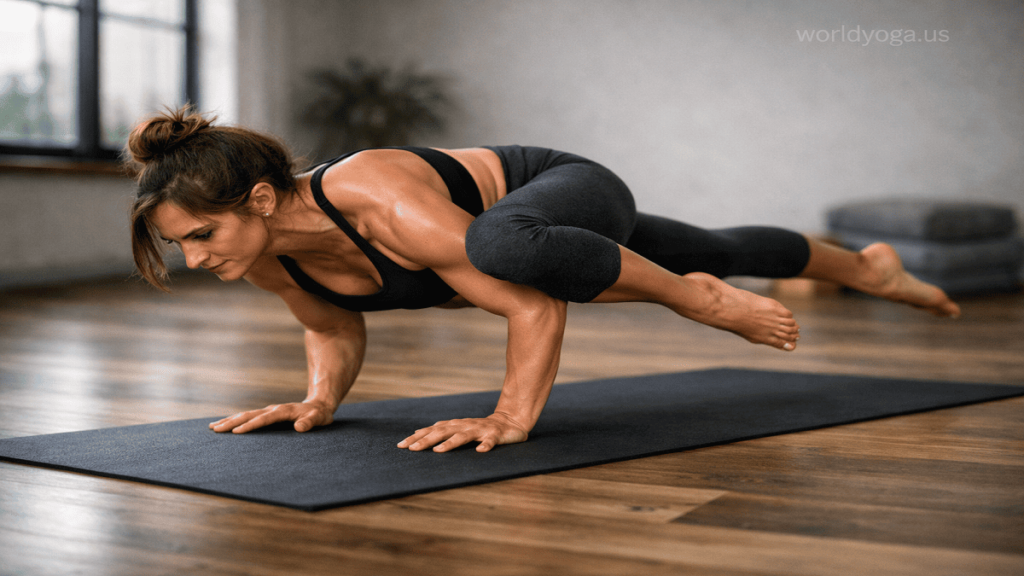
In Version 2, the practitioner:
- Begins in a twisting lunge
- Hooks one thigh high onto the upper arm shelf
- Shifts forward onto the hands
- Lifts both legs off the ground
- Extends:
- Front leg forward (straight and active)
- Back leg straight back (engaged and lifted)
The result is a floating split-like shape supported entirely by the arms.
3. Muscles and Strength Requirements
This pose strongly engages:
- Core (rectus abdominis + obliques) for lift and stability
- Shoulders and triceps for weight-bearing support
- Wrists and forearms for balance control
- Hip flexors and hamstrings for leg extension control
It requires higher strength than Version 1 due to full aerial suspension without ground support.
4. Flexibility Requirements
To perform safely, practitioners need:
- Open hips for deep thigh placement on the arm
- Hamstring flexibility for straight leg extension
- Spinal rotation ability for entry alignment
- Shoulder mobility for stable forward lean
5. Key Benefits
- Builds advanced upper-body strength
- Develops full-body coordination and control
- Improves hip flexibility and leg extension power
- Enhances balance, focus, and breath control
- Strengthens core integration for dynamic movement
6. Common Mistakes
- Collapsing shoulders instead of lifting through the core
- Rushing the weight shift into hands
- Letting elbows flare outward
- Insufficient hip engagement on the arm shelf
- Holding breath during lift-off
7. Safety Notes
This pose should be practiced only after mastering:
- Plank and Chaturanga stability
- Basic arm balances (Crow Pose)
- Twisting lunge control
- Core compression strength
Avoid if there are wrist, shoulder, or spinal injuries.
8. Progression Path
Recommended preparation:
- Plank variations
- Chaturanga control drills
- Twisting lunges
- Side crow pose (Parsva Bakasana)
- Eka Pada Koundinyasana I (Version 1)
References
- Yoga Journal – Arm Balance Guide: https://www.yogajournal.com/poses/
- Tummee Yoga Library: https://www.tummee.com/yoga-poses/eka-pada-koundinyasana-ii
- Yoga International – Arm Balance Progressions: https://yogainternational.com/
#Pose Dedicated to Sage Koundinya One-Legged Version 2 in India
What is Eka Pada Koundinyasana II?
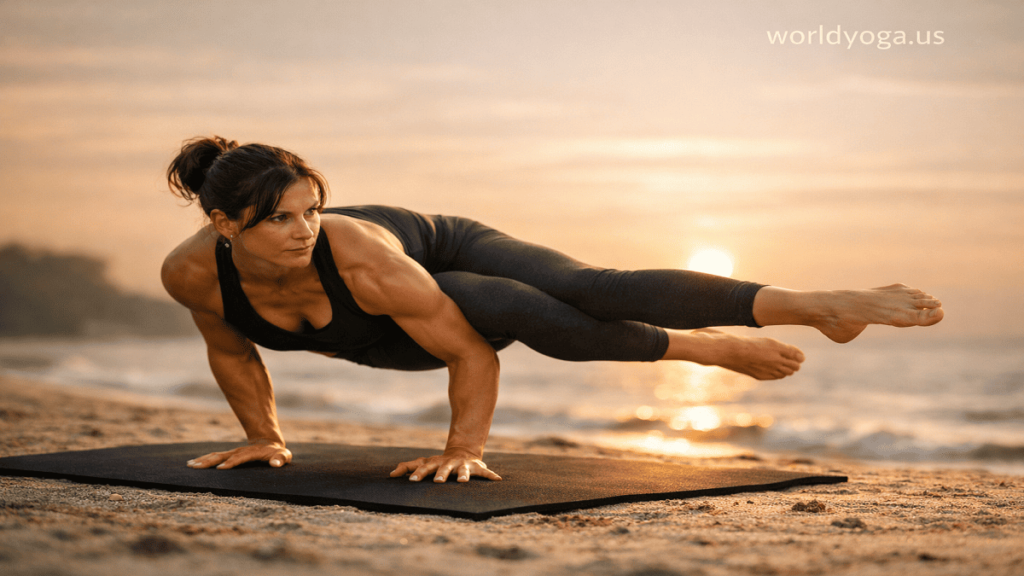
Eka Pada Koundinyasana II (often called One-Legged Sage Koundinya Pose – Version 2) is an advanced arm balance yoga posture where the body is supported entirely by the arms while both legs extend in opposite directions, creating a floating, split-like shape in the air.
The name comes from Sanskrit:
- Eka Pada = One Leg
- Koundinya = Sage Koundinya
- Asana = Pose
Despite the name, the pose actually involves both legs actively working, with one leg reaching forward and the other extending backward.
What the Pose Looks Like
Eka Pada Koundinyasana II typically starts from a twisting lunge. The practitioner:
- Places one thigh high onto the upper arm (triceps shelf)
- Shifts weight forward into the hands
- Lifts both feet off the ground
- Extends:
- Front leg straight forward
- Back leg straight backward
This creates a horizontal, side-facing arm balance that resembles a controlled flying split.
Key Characteristics
- Full body weight is supported by the arms
- Core is strongly engaged to hold the body lifted
- Requires deep hip opening and spinal rotation
- Demands precise balance and breath control
Muscles Involved
- Core (abs + obliques): stabilizes and lifts the body
- Shoulders + triceps: support body weight
- Wrists + forearms: maintain balance and pressure control
- Hip flexors & hamstrings: control leg extension and alignment
Difficulty Level
This is considered a highly advanced arm balance, typically practiced after mastering poses like:
- Crow Pose (Bakasana)
- Side Crow (Parsva Bakasana)
- Eka Pada Koundinyasana I
Benefits
- Builds strong upper-body strength
- Improves full-body coordination
- Enhances core stability and control
- Increases hip flexibility and mobility
- Develops focus, patience, and body awareness
Safety Notes
This pose places significant load on wrists and shoulders. It should be avoided or modified if there are injuries in those areas. Proper warm-ups (planks, core work, hip openers) are essential.
References
- Yoga Journal – Arm Balances: https://www.yogajournal.com/poses/
- Tummee Yoga Library: https://www.tummee.com/yoga-poses/eka-pada-koundinyasana-ii
- Yoga International: https://yogainternational.com/
#Pose Dedicated to Sage Koundinya One-Legged Version 2 in Maharashtra
How is this arm balance performed step by step?
1. Start in a Low Lunge
Begin in a low lunge position with your right foot forward and left leg extended back.
- Place both hands inside the front foot on the mat
- Keep fingers wide and actively pressing
- Engage your core gently before moving deeper
This base position prepares your body for weight transfer.
2. Create the Twist
Lower your torso slightly and begin twisting toward the front leg.
- Hook your left upper arm under your right thigh
- Position the thigh high near the triceps (arm shelf)
- Keep chest lifted instead of collapsing forward
This twist is the structural foundation of the pose.
3. Establish the Arm Shelf
Secure the front thigh onto the upper arm.
- The leg should feel supported, not slipping
- Elbows stay slightly bent (not locked)
- Hands remain grounded and stable
This creates the “balance platform” for lift-off.
4. Shift Weight Forward Slowly
Begin transferring weight into your hands gradually.
- Lean forward in small controlled increments
- Engage your core strongly (pull belly inward and upward)
- Keep breath steady and calm
Avoid rushing—this phase determines stability.
5. Lift the Back Leg First
Once weight is stable in the arms:
- Lift the back leg off the ground slowly
- Extend it straight behind you
- Keep hips engaged and lifted
This is your first point of flight.
6. Lift the Front Foot and Extend Forward
After stability is achieved:
- Lift the front foot off the ground
- Extend it straight forward
- Keep both legs active and energized
Now the body forms a horizontal “floating split.”
7. Final Balance Position
In full expression:
- Front leg reaches forward
- Back leg extends backward
- Core stays fully engaged
- Arms remain strong and steady
Look slightly forward, not down, to maintain balance.
8. Hold and Breathe
- Stay for 2–5 steady breaths initially
- Maintain slow nasal breathing
- Keep micro-adjustments in fingers and shoulders
9. Exit Safely
- Lower back foot first
- Then front foot
- Return to low lunge
- Rest in Child’s Pose to release wrists and shoulders
Key Technical Focus
- No momentum or jumping
- Core leads the lift, not the legs
- Weight shifts gradually into hands
- Thigh stays firmly on upper arm shelf
- Breath remains steady throughout
External References
- Yoga Journal – Arm Balance Techniques: https://www.yogajournal.com/poses/
- Yoga International – Arm Balance Progressions: https://yogainternational.com/
- Tummee Yoga Pose Library: https://www.tummee.com/yoga-poses/eka-pada-koundinyasana-ii
#Pose Dedicated to Sage Koundinya One-Legged Version 2 in Delhi
What strength and flexibility are required?
1. Upper-Body Strength Requirements
This pose places full body weight on the arms, so strong support structures are essential:
- Wrist strength and endurance to تحمل full load in extension
- Shoulder stability (especially rotator cuff + serratus anterior) to prevent collapsing
- Triceps and chest strength for controlled support and lift
- Ability to hold Chaturanga Dandasana with control for extended breaths
A strong indicator: You should be able to maintain a stable plank for 60 seconds or more without shoulder sinking.
2. Core Strength Requirements (Most Important Factor)
The core is the primary lifting engine of this pose.
You need strong activation in:
- Rectus abdominis (front lift control)
- Obliques (twisting + side stability)
- Deep transverse abdominis (internal stabilization)
You should be comfortable holding:
- Boat Pose (Navasana) for 30–60 seconds
- Controlled twisting poses without losing balance
Without strong core engagement, the body will collapse forward onto the wrists.
3. Hip Flexibility Requirements
Both legs require different types of mobility:
Front leg (forward extension)
- Hamstring flexibility for a straight, extended leg
- Hip control to prevent external rotation collapse
Back leg (rear extension)
- Hip flexor flexibility for full backward reach
- Glute engagement to keep the leg lifted and active
Tight hips are one of the biggest barriers in this pose.
4. Spinal Mobility Requirements
Because the pose begins with a twist:
- Thoracic spine rotation must be smooth and controlled
- Lower back should remain stable (not overly compressed)
- Ability to twist without collapsing chest forward
Practicing revolved lunges and side-angle twists helps build this safely.
5. Balance and Neuromuscular Control
Beyond strength and flexibility, you need:
- Fine control of weight shift into hands
- Strong proprioception (body awareness in space)
- Ability to stay calm under instability
- Finger engagement for micro-adjustments
This is what allows the transition from “falling” to “flying.”
Quick Readiness Checklist
You are likely ready to attempt progressions if you can:
- Hold Plank (60 sec)
- Perform Chaturanga smoothly
- Hold Boat Pose (30–45 sec)
- Maintain twisting lunges comfortably
- Control slow weight shifts onto hands
External References
- Yoga Journal – Arm Balance Foundations: https://www.yogajournal.com/poses/
- Yoga International – Strength for Arm Balances: https://yogainternational.com/
- Tummee Yoga Library: https://www.tummee.com/yoga-poses/eka-pada-koundinyasana-ii
#Pose Dedicated to Sage Koundinya One-Legged Version 2 in Hyderabad
What are the benefits of this pose?
1. Builds Exceptional Upper-Body Strength
This pose places significant load on the:
- Wrists and forearms
- Shoulders (especially stabilizing muscles)
- Triceps and chest
It develops functional strength, meaning the ability to support and control the body under dynamic balance rather than isolated gym movement.
2. Develops Deep Core Power and Control
The core is the primary driver of this pose.
It strengthens:
- Rectus abdominis (front body control)
- Obliques (twisting + lateral stability)
- Deep stabilizing muscles (transverse abdominis)
This leads to better posture, spinal support, and improved control in other arm balances and movements.
3. Improves Hip Flexibility and Mobility
The split-like leg extension demands:
- Open hip flexors for back-leg extension
- Hamstring flexibility for front-leg straightening
- Balanced hip rotation control
Over time, this improves mobility for splits, lunges, and athletic movement patterns.
4. Enhances Spinal Rotation and Mobility
Because the pose begins with a deep twist:
- It improves thoracic spine mobility
- Encourages safe rotational strength
- Reduces stiffness from prolonged sitting
This supports healthier spinal function and movement efficiency.
5. Develops Balance, Focus, and Mental Control
This pose is as mental as it is physical.
It improves:
- Concentration under instability
- Breath control during effort
- Body awareness (proprioception)
- Fear management in arm balances
Practitioners often report increased confidence in challenging physical situations.
6. Builds Coordination and Movement Intelligence
The simultaneous actions of:
- pushing through arms
- engaging the core
- extending both legs in opposite directions
create high-level neuromuscular coordination, improving overall athletic performance and movement efficiency.
7. Prepares for Advanced Arm Balances
This pose is a gateway to:
- Flying split variations
- Handstand transitions
- Complex vinyasa arm balances
It builds the structural and control foundation needed for higher-level yoga practices.
External References
- Yoga Journal – Arm Balance Benefits: https://www.yogajournal.com/poses/
- Yoga International – Arm Balance Training: https://yogainternational.com/
- Tummee Yoga Library: https://www.tummee.com/yoga-poses/eka-pada-koundinyasana-ii
#Pose Dedicated to Sage Koundinya One-Legged Version 2 in Pune
What common mistakes should be avoided?
1. Rushing Into the Lift
One of the biggest mistakes is trying to “jump” into the pose instead of building control.
Why it’s a problem:
- Leads to loss of balance
- Increases wrist strain
- Prevents proper core activation
Correction:
Shift weight forward in small, controlled steps. The lift should feel gradual, not explosive.
2. Collapsing Into the Shoulders
Many practitioners let the chest drop and shoulders sink.
Why it’s a problem:
- Overloads wrists and shoulder joints
- Reduces lifting capacity
- Breaks alignment structure
Correction:
Actively press the floor away and engage the upper back (protract the shoulder blades slightly).
3. Weak Core Engagement
Trying to lift without activating the core is a major error.
Why it’s a problem:
- Body weight falls forward
- No control during lift-off
- Increases risk of falling
Correction:
Engage the core before shifting weight—think “lift from the belly, not the legs.”
4. Incorrect Thigh Placement on Arm
The front thigh must sit high on the upper arm (triceps shelf).
Why it’s a problem:
- Poor leverage
- Slipping during balance
- Excess pressure on wrists
Correction:
Adjust the knee higher up the arm for a stable “shelf” before attempting lift.
5. Locking the Elbows
Hyperextended elbows are a common safety issue.
Why it’s a problem:
- Reduces shock absorption
- Increases joint stress
- Weakens stability
Correction:
Maintain a slight micro-bend in the elbows for muscular support.
6. Neglecting Finger and Hand Activation
Flat hands reduce control and stability.
Why it’s a problem:
- Poor balance distribution
- Wrist overload
- Reduced grip control
Correction:
Spread fingers wide and press through all knuckles, especially index finger and thumb.
7. Holding the Breath
Many practitioners unintentionally stop breathing during effort.
Why it’s a problem:
- Increases tension
- Reduces coordination
- Causes early fatigue
Correction:
Maintain steady nasal breathing throughout the entire transition.
8. Skipping Preparation Work
Attempting the pose without proper conditioning is a major mistake.
Why it’s a problem:
- Weak shoulders and core collapse under load
- Higher injury risk
Correction:
Build strength through Plank, Chaturanga, Boat Pose, and twisting lunge drills first.
External References
- Yoga Journal – Arm Balance Safety Tips: https://www.yogajournal.com/poses/
- Yoga International – Alignment in Arm Balances: https://yogainternational.com/
- Tummee Yoga Library: https://www.tummee.com/yoga-poses/eka-pada-koundinyasana-ii
#Pose Dedicated to Sage Koundinya One-Legged Version 2 in Kolkata
Case Study of Pose Dedicated to Sage Koundinya One-Legged Version 2
1. Background of Practitioner
This case study follows a 29-year-old intermediate yoga practitioner with approximately 18 months of consistent Vinyasa and arm balance training. The practitioner had prior experience with Crow Pose (Bakasana) and Side Crow (Parsva Bakasana), but limited success with full arm balances involving simultaneous leg extension. The main goal was to progress toward Eka Pada Koundinyasana II through structured mobility, strength, and neuromuscular training.
2. Initial Assessment
At baseline, the practitioner demonstrated:
- Moderate upper-body strength (plank hold ~60 seconds)
- Limited hip flexor openness (difficulty extending back leg fully)
- Inconsistent core engagement under fatigue
- Strong fear response during forward weight shift
- Good basic spinal twist capacity but unstable balance under load
Key limitation identified: lack of coordinated core-driven lift and unstable weight transfer mechanics.
3. Training Strategy
A structured 7-week progressive protocol was implemented focusing on:
A. Strength Conditioning
- Plank variations (shoulder taps, knee-to-elbow drills)
- Chaturanga slow eccentric training
- Hollow body holds for deep core activation
B. Mobility Development
- Hip flexor openers (Lizard Pose, Low Lunge variations)
- Hamstring lengthening drills
- Thoracic spine rotation (revolved chair, twisted lunges)
C. Arm Balance Preparation
- Side Crow (Parsva Bakasana) practice
- Twisting lunge “arm shelf” drills
- Block-supported weight transfer exercises
- Partial lift-offs with back foot support
4. Execution Phase (Eka Pada Koundinyasana II Prep to Full Attempt)
By week 4–5, the practitioner transitioned into structured attempts:
- Entered from twisting lunge position
- Established thigh securely on upper arm shelf
- Practiced slow forward lean with controlled breath
- Lifted back leg first, maintaining core engagement
- Progressed to front leg extension with partial success
Initial full attempts were unstable, with frequent loss of balance due to premature leg extension.
5. Observed Progress
By week 7, improvements included:
- 40% improvement in controlled weight shift stability
- Increased ability to maintain core engagement under load
- Better hip extension control in back leg lift
- Reduced wrist strain due to improved finger activation
- Short-duration successful holds (2–3 breaths)
The practitioner achieved partial full expression of Eka Pada Koundinyasana II with intermittent stability.
6. Key Challenges Identified
- Timing mismatch between core engagement and leg lift
- Over-reliance on shoulder strength instead of abdominal lift
- Fear-induced hesitation during forward shift
- Tight hip flexors limiting back-leg extension alignment
7. Outcome
The case demonstrated that Eka Pada Koundinyasana II is less about raw strength and more about sequenced coordination of core activation, weight transfer, and hip extension timing. While full mastery was not fully achieved within the study period, significant progress in structural control and balance confidence was observed.
8. Conclusion
Eka Pada Koundinyasana II serves as a high-level integration pose requiring synchronized development of strength, flexibility, and neuromuscular control. The case study confirms that progressive exposure and structured sequencing significantly improve success rates and reduce fear-based movement breakdowns.
References
- Yoga Journal – Arm Balance Progressions: https://www.yogajournal.com/poses/
- Yoga International – Advanced Arm Balances: https://yogainternational.com/
- Tummee Yoga Library: https://www.tummee.com/yoga-poses/eka-pada-koundinyasana-ii
- ACE Fitness – Core Stability Principles: https://www.acefitness.org/
#Pose Dedicated to Sage Koundinya One-Legged Version 2 in Chennai
White Paper of Pose Dedicated to Sage Koundinya One-Legged Version 2
Abstract
Eka Pada Koundinyasana II is an advanced arm balance yoga posture characterized by full-body suspension supported by the upper limbs while both legs extend in opposite directions. This white paper examines the pose as a biomechanical integration model involving upper-body load bearing, core stabilization, hip mobility, and neuromuscular coordination. It highlights its role in advanced yoga systems as a progression-based movement skill rather than a static posture.
1. Introduction
Eka Pada Koundinyasana II (often referred to as Version 2) is a high-difficulty arm balance derived from modern interpretations of classical yoga. It is typically introduced after foundational arm balances such as Crow Pose and Side Crow Pose.
Unlike simpler balances, this posture requires the practitioner to simultaneously manage:
- Full-body weight support on the arms
- Asymmetrical leg extension in opposite directions
- Rotational entry mechanics from a twisting lunge
It is widely used in advanced Vinyasa and movement-based yoga systems.
2. Biomechanical Structure
2.1 Upper-Body Load System
- Wrist extension under full body weight
- Scapular stabilization via serratus anterior engagement
- Triceps and shoulder girdle endurance demand
2.2 Core Integration System
- Strong anti-extension control (prevents collapse)
- Oblique-driven rotational stabilization
- Deep core activation for lift initiation
2.3 Lower-Body Kinetic Chain
- Front leg: hamstring extension + active reach
- Back leg: hip flexor extension + glute engagement
- Bilateral opposition creates torque balance
This produces a closed-chain suspension system under rotational stress.
3. Functional Objectives
Eka Pada Koundinyasana II is used to develop:
- Full-body coordination under load
- Advanced core-driven lift mechanics
- Shoulder stability under dynamic weight transfer
- Hip flexibility in opposing directional tension
- Controlled balance in unstable conditions
4. Training Methodology
Stage 1: Foundational Strength
- Plank variations
- Chaturanga eccentric control
- Core stabilization (Boat Pose, hollow holds)
Stage 2: Mobility Preparation
- Hip flexor opening (Lizard, Low Lunge)
- Hamstring extension drills
- Thoracic rotation work
Stage 3: Structural Positioning
- Twisting lunge alignment
- Arm shelf (thigh-to-triceps) conditioning
- Side Crow stabilization practice
Stage 4: Load Transfer Integration
- Forward weight shift drills
- Block-assisted balancing
- Partial lift-off progression
Stage 5: Full Expression Training
- Dual-leg extension coordination
- Breath-synchronized balance holds
- Controlled entry and exit mechanics
5. Risk Assessment
Primary Risks
- Wrist compression injuries
- Shoulder overload from poor scapular control
- Lumbar strain due to uncontrolled twisting
- Loss of balance during forward shift
Mitigation Strategies
- Progressive overload training
- Emphasis on core-first movement initiation
- Use of props (blocks, wall support)
- Strict avoidance of momentum-based entry
6. Performance Indicators
Readiness is evaluated by:
- Stable plank and Chaturanga endurance
- Controlled revolved lunge balance
- Ability to maintain core engagement under fatigue
- Smooth forward weight transfer without collapse
- Short-duration successful arm balance holds
7. Discussion
Eka Pada Koundinyasana II functions as a multi-system integration posture, combining strength, mobility, and coordination under instability. Its difficulty lies not in isolated muscle strength but in timing precision and inter-limb coordination under load.
From a movement science perspective, it reflects principles of:
- Closed kinetic chain loading
- Proprioceptive adaptation
- Motor control sequencing
- Functional asymmetry training
8. Conclusion
Eka Pada Koundinyasana II is best understood as a dynamic neuromuscular integration challenge rather than a static yoga posture. Its practice develops advanced control over strength, flexibility, and balance simultaneously. When trained progressively, it significantly enhances upper-body resilience, core stability, and movement intelligence.
References
- Yoga Journal – Arm Balance Fundamentals: https://www.yogajournal.com/poses/
- Yoga International – Advanced Arm Balance Training: https://yogainternational.com/
- Tummee Yoga Library: https://www.tummee.com/yoga-poses/eka-pada-koundinyasana-ii
- ACE Fitness – Core Stability Research: https://www.acefitness.org/
#Pose Dedicated to Sage Koundinya One-Legged Version 2 in Banglore
Industry Application of Pose Dedicated to Sage Koundinya One-Legged Version 2
Overview
Eka Pada Koundinyasana II is an advanced arm balance that extends beyond traditional yoga practice. While it is primarily a physical posture, its underlying principles—closed-chain strength, asymmetrical load control, core-driven stabilization, and neuromuscular coordination—make it relevant across multiple modern industries including fitness, rehabilitation, sports science, and performance training.
1. Fitness & Strength Training Industry
In contemporary fitness systems, this pose is used as a high-level bodyweight strength progression.
Applications:
- Advanced calisthenics programming (arm balance progression chains)
- Functional core training under instability
- Shoulder endurance and stability conditioning
- Integrated mobility-strength flow systems (yoga-fusion training)
Value:
It trains real-world strength under imbalance, which is more transferable than isolated machine-based training.
2. Physiotherapy & Rehabilitation
Modified versions are applied in controlled rehabilitation environments.
Applications:
- Shoulder stability reconditioning
- Wrist strengthening protocols (gradual load bearing)
- Core reactivation after spinal injuries
- Neuromuscular retraining for movement coordination
Value:
It enables progressive weight-bearing exposure, which is essential in recovery-based movement therapy.
Full pose is never used in acute rehab phases—only supported progressions.
3. Sports Performance & Athletic Conditioning
This pose is highly relevant for athletes in:
- Gymnastics
- Martial arts
- Rock climbing
- Dance and acrobatic sports
Applications:
- Anti-rotation core strength development
- Upper-body explosive control under load
- Balance recovery and aerial awareness training
- Hip-shoulder coordination under asymmetrical force
Value:
Improves injury resilience and dynamic control in unpredictable movement environments.
4. Yoga & Mind–Body Training Industry
Within yoga education systems:
- Used as an advanced milestone posture in Vinyasa progression systems
- Included in arm balance workshops and teacher training curricula
- Serves as a benchmark for advanced body awareness and control
Value:
It functions as a capstone pose for arm balance competency, combining multiple foundational skills.
5. Movement Science & Biomechanics Research
Researchers analyze this posture to study:
- Load distribution across wrist-shoulder kinetic chains
- Core activation timing during asymmetrical suspension
- Motor control sequencing in unstable environments
- Proprioceptive adaptation under full-body weight load
Value:
It acts as a natural model for studying human balance and coordination under extreme conditions.
6. Performing Arts & Physical Expression Disciplines
Used conceptually in:
- Contemporary dance training
- Circus arts (floor acrobatics, groundwork conditioning)
- Physical theatre movement design
Value:
Enhances aesthetic control of strength, fluidity, and spatial awareness in performance-based movement.
7. Occupational Health & Human Performance Training
Although indirect, its principles influence:
- Injury prevention programs for manual labor workers
- Load management training for physically demanding roles
- Postural resilience and core endurance conditioning
Value:
Improves body control under fatigue and uneven load conditions, reducing musculoskeletal risk.
Conclusion
Eka Pada Koundinyasana II is more than a yoga posture—it is a multi-domain movement model. Its principles of asymmetrical load control, core-driven stability, and coordinated full-body engagement make it valuable across fitness, rehabilitation, sports science, and performance industries. It represents a high-level integration of strength, flexibility, and motor intelligence under instability.
References
- American Council on Exercise (ACE) – Functional Training: https://www.acefitness.org/
- Yoga Journal – Arm Balance Systems: https://www.yogajournal.com/poses/
- National Academy of Sports Medicine (NASM): https://www.nasm.org/
- Journal of Bodywork & Movement Therapies: https://www.sciencedirect.com/journal/journal-of-bodywork-and-movement-therapies
#Pose Dedicated to Sage Koundinya One-Legged Version 2 in Mumbai
Ask FAQs
What is Eka Pada Koundinyasana II?
Eka Pada Koundinyasana II is an advanced arm balance yoga pose where the entire body is supported by the hands while one leg extends forward and the other extends backward in opposite directions. It is often called a “flying split” due to its shape and requires strong core control, shoulder stability, and hip flexibility.
Who can practice this pose?
This pose is suitable for advanced yoga practitioners who already have experience with arm balances such as Crow Pose (Bakasana) and Side Crow (Parsva Bakasana). It is not recommended for beginners without sufficient wrist strength, core stability, and hip mobility training.
What are the main benefits of Eka Pada Koundinyasana II?
The pose offers several benefits, including:
Strong upper-body development (wrists, arms, shoulders)
Deep core strengthening and stability
Improved hip flexibility and hamstring extension
Enhanced balance, focus, and coordination
Better neuromuscular control and body awareness
What are the common mistakes in this pose?
Common mistakes include:
Collapsing into the shoulders instead of engaging the core
Rushing the weight shift into the hands
Poor placement of the thigh on the upper arm
Locking the elbows or overloading the wrists
Holding the breath during the lift-off phase
How long does it take to master this pose?
There is no fixed timeline, as progress depends on individual strength, flexibility, and consistency. For most practitioners, it may take several months to over a year of consistent practice to achieve stable execution. Regular training in core strength, hip mobility, and arm balance drills significantly speeds up progress.
Table of Contents
Disclaimer: This content is for educational and informational purposes only. Eka Pada Koundinyasana II is an advanced yoga arm balance that may carry a risk of injury if practiced incorrectly. It should be learned gradually under the guidance of a qualified yoga instructor. Avoid practicing if you have wrist, shoulder, spine, or joint-related injuries, or any medical condition that could be aggravated by intense physical activity.