
Arm Balance: Shoulder Pressure Pose & Firefly Pose
Arm balances such as Bhujapidasana (Shoulder Pressure Pose) and Tittibhasana (Firefly Pose) are advanced yoga postures that combine upper-body strength, deep core engagement, and hip flexibility. Both poses train the body to support its full weight on the hands while maintaining stability through controlled compression and balance.
1. Bhujapidasana (Shoulder Pressure Pose)
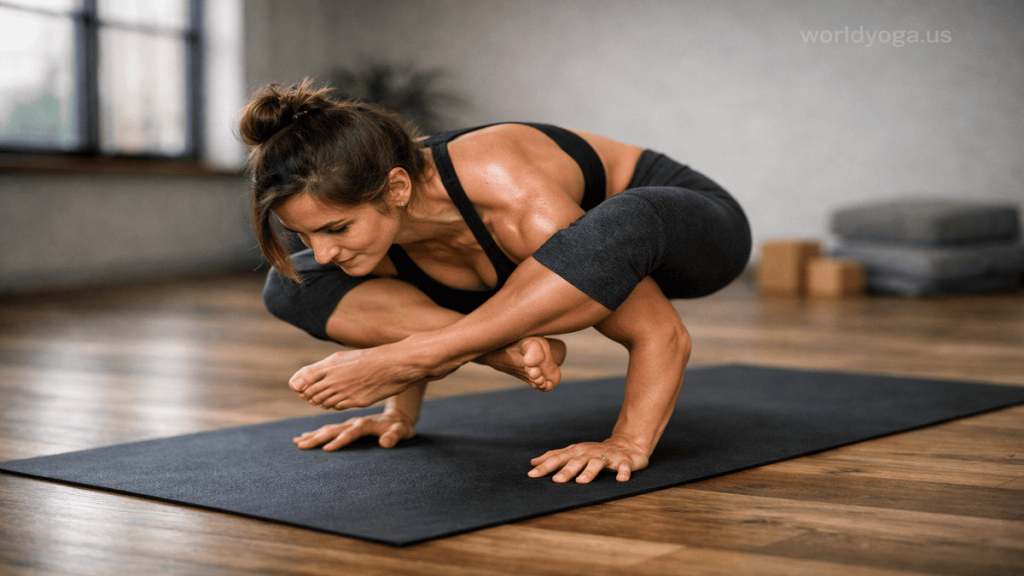
Bhujapidasana involves balancing the body by placing the legs over the upper arms and lifting the feet off the ground while the hands remain firmly planted. The knees rest high on the triceps, and the ankles often cross in front of the body.
Key Actions
- Deep squat entry with feet close together
- Arms threaded between legs and pressed against the inner thighs
- Hands placed flat on the floor, shoulder-width apart
- Gradual lifting of feet off the ground using core strength
Muscles Engaged
- Core (especially lower abs)
- Inner thighs and hip adductors
- Shoulders, wrists, and triceps
Benefits
- Builds strong wrist and shoulder endurance
- Improves hip flexibility and compression strength
- Enhances core stability and balance control
- Prepares for deeper arm balances like Firefly Pose
2. Tittibhasana (Firefly Pose)
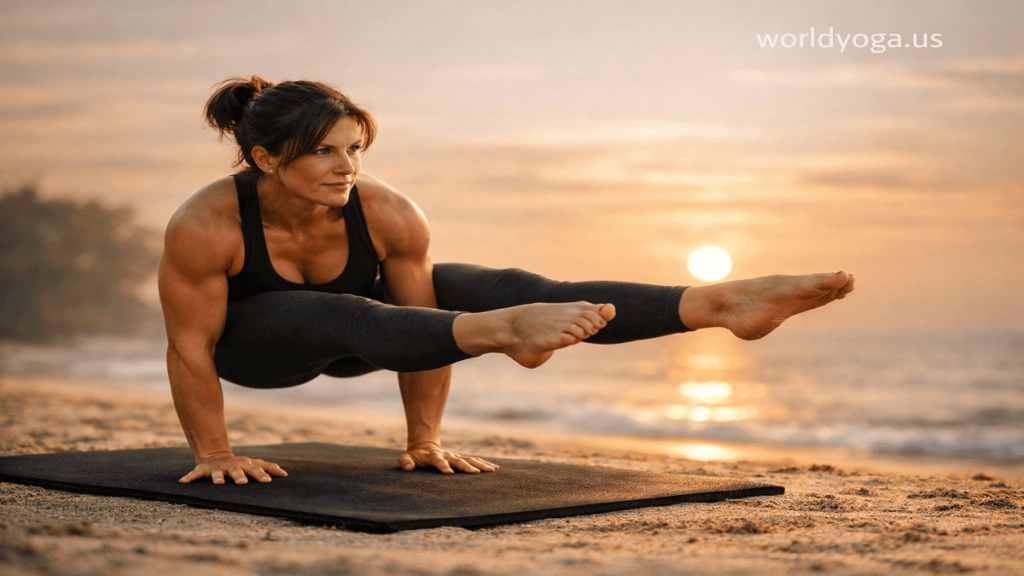
Tittibhasana is a straight-leg arm balance where the body is lifted off the ground with legs extended forward, parallel to the floor, supported by the arms from underneath.
Key Actions
- Forward fold with feet wide apart
- Shoulders placed behind the knees
- Hands firmly grounded on the floor
- Legs slowly straighten and lift into the air
- Core engages strongly to maintain lift
Muscles Engaged
- Core (deep abdominal engagement)
- Hamstrings and hip flexors
- Forearms, wrists, and shoulders
Benefits
- Develops explosive core and arm strength
- Improves hamstring flexibility
- Enhances balance, focus, and body coordination
- Builds confidence in advanced arm balances
3. Key Differences
| Feature | Bhujapidasana | Tittibhasana |
|---|---|---|
| Leg Position | Bent, crossed over arms | Straight and extended forward |
| Difficulty | Intermediate–Advanced | Advanced |
| Focus | Compression + balance | Lift + extension |
| Entry Style | Deep squat | Forward fold |
4. Common Mistakes
- Collapsing weight into shoulders
- Lack of core engagement
- Rushing lift-off without control
- Poor wrist alignment or flat hands
- Not warming up hips and hamstrings
5. Safety Notes
These poses should be practiced with:
- Strong wrist and shoulder conditioning
- Proper hip and hamstring warm-ups
- Controlled progression from simpler arm balances like Crow Pose
Avoid practice if there are wrist, shoulder, or lower back injuries.
6. References
- Yoga Journal – Arm Balance Guide: https://www.yogajournal.com/poses/
- Yoga International – Firefly Pose Tutorial: https://yogainternational.com/
- Tummee Yoga Library: https://www.tummee.com/yoga-poses/
#Arm Balance: Shoulder Pressure Pose & Firefly Pose in India
What are Shoulder Pressure Pose and Firefly Pose?
1. Shoulder Pressure Pose (Bhujapidasana)
Bhujapidasana, commonly called Shoulder Pressure Pose, is an intermediate-to-advanced arm balance where the body is lifted off the ground by pressing the legs tightly against the upper arms while balancing on the hands.
The name comes from Sanskrit:
- Bhujā = arm / shoulder
- Pīda = pressure
- Āsana = pose
How it looks/works
The practitioner squats deeply, threads the arms between the legs, and places the thighs high on the upper arms (near the shoulders). The hands press into the ground, and the feet lift off as the core engages strongly.
Key idea
It is a compression-based arm balance—the legs “squeeze” the arms, creating stability while the hands support the body.
2. Firefly Pose (Tittibhasana)
Tittibhasana, known as Firefly Pose, is an advanced arm balance where the body is lifted with straight legs extended forward parallel to the floor, resembling a glowing firefly in flight.
The name comes from Sanskrit:
- Tittibha = firefly
- Āsana = pose
How it looks/works
The practitioner folds forward, places the shoulders behind the knees, plants the hands on the ground, and then slowly lifts the body while straightening the legs forward.
Key idea
It is a lift-and-extend arm balance, relying heavily on core strength and hamstring flexibility.
Key Difference Between Them
- Bhujapidasana (Shoulder Pressure Pose): legs are bent and squeeze the arms for support
- Tittibhasana (Firefly Pose): legs are straight and extend forward in the air
In Simple Terms
- Shoulder Pressure Pose = compressed arm balance (knees bent, squeezing arms)
- Firefly Pose = extended arm balance (straight legs flying forward)
Benefits of Both
- Builds strong wrists, arms, and shoulders
- Strengthens deep core muscles
- Improves balance and coordination
- Enhances hip and hamstring flexibility
- Develops focus and body control
External References
- Yoga Journal – Arm Balance Guide: https://www.yogajournal.com/poses/
- Yoga International – Firefly Pose: https://yogainternational.com/
- Tummee Yoga Library: https://www.tummee.com/yoga-poses/
#Arm Balance: Shoulder Pressure Pose & Firefly Pose in Maharashtra
How is each pose performed step by step?
1. Start in a Deep Squat
- Stand with feet slightly wider than hips
- Lower into a deep squat (heels may lift if needed)
- Keep spine long and chest open
2. Thread the Arms Inside the Legs
- Slide both arms between the inner thighs
- Place shoulders behind the knees
- Bring upper arms as high up the thighs as possible
3. Secure the Shoulder Pressure
- Gently squeeze thighs inward onto the upper arms
- Keep elbows slightly bent (not locked)
- Hands placed on the floor shoulder-width apart
4. Engage Core and Lean Forward
- Shift weight slightly forward
- Engage abdominal muscles strongly
- Lift chest away from thighs
5. Lift the Feet Off the Ground
- Press palms firmly into the mat
- Slowly lift both feet off the floor
- Keep ankles crossed or legs together for stability
6. Hold the Balance
- Keep breathing steady
- Maintain compression of thighs onto arms
- Look slightly forward, not down
7. Exit Safely
- Slowly lower feet back to the mat
- Release arms from between legs
- Return to standing or forward fold
Key Focus
- Strong leg squeeze on arms
- Core engagement (not arm strength alone)
- Controlled forward shift
Step-by-Step: Tittibhasana (Firefly Pose)
Tittibhasana is a straight-leg arm balance requiring strong core lift and hamstring flexibility.
1. Begin in a Forward Fold
- Stand with feet slightly wider than hips
- Fold forward deeply
- Bend knees if hamstrings are tight
2. Position the Shoulders Behind the Knees
- Slide shoulders behind knees
- Place upper arms under the thighs
- Bring weight onto the arms
3. Place Hands on the Floor
- Hands shoulder-width apart
- Fingers spread wide for stability
- Press firmly into the mat
4. Lift the Hips Slightly
- Engage core strongly
- Begin shifting weight into hands
- Lift hips away from the floor
5. Straighten the Legs Forward
- One leg at a time or both together
- Extend legs forward parallel to the ground
- Keep toes active and engaged
6. Fully Lift into Balance
- Press through palms
- Lift entire body off the ground
- Maintain straight arms and strong core
7. Hold the Pose
- Keep breathing steady
- Look forward slightly
- Maintain leg extension and chest lift
8. Exit Safely
- Slowly bend knees
- Lower feet to the floor
- Return to standing or forward fold
Key Focus
- Strong core lift (most important)
- Hamstring flexibility for straight legs
- Wrist and shoulder stability
- Controlled leg extension, not momentum
External References
- Yoga Journal – Arm Balance Guide: https://www.yogajournal.com/poses/
- Yoga International – Firefly Pose Tutorial: https://yogainternational.com/
- Tummee Yoga Library: https://www.tummee.com/yoga-poses/
#Arm Balance: Shoulder Pressure Pose & Firefly Pose in Haryana
What strength and flexibility are required for these arm balances?
1. Bhujapidasana (Shoulder Pressure Pose)
Strength Requirements
Upper Body
- Strong wrists and forearms for full body weight support
- Stable shoulders (serratus anterior + rotator cuff) for balance
- Engaged triceps and chest for controlled lift
Core
- Strong lower abdominal compression strength
- Ability to maintain tight inward engagement while balancing
- Core must support lifting without collapsing forward
You should be able to hold a stable plank for 45–60 seconds comfortably.
Flexibility Requirements
Hips & Inner Thighs
- Moderate hip opening for deep squat position
- Good adductor (inner thigh) flexibility for squeezing arms
- Comfortable deep flexion without strain
Spine
- Neutral spinal mobility (no extreme flexibility needed)
- Ability to fold forward without rounding excessively
Key Requirement Pattern
Bhujapidasana = Compression + Stability
- Less about flexibility
- More about squeezing strength and balance control
2. Tittibhasana (Firefly Pose)
Strength Requirements
Upper Body
- Strong shoulders and triceps for full lift-off
- Powerful wrist stability under load
- Ability to support body weight with straight arms
Core
- High-level core lifting strength (anti-gravity control)
- Deep engagement to hold legs extended in air
- Strong coordination between core and hip flexors
You should be able to hold Boat Pose (Navasana) for 30–60 seconds easily.
Flexibility Requirements
Hamstrings (Very Important)
- High flexibility for straight-leg extension
- Ability to maintain length while lifting
Hips
- Moderate-to-high hip flexion range
- Comfortable forward folding without rounding collapse
Lower Back
- Controlled spinal flexibility to avoid strain during lift
Key Requirement Pattern
Tittibhasana = Lift + Extension
- More flexibility than Bhujapidasana
- Requires strong hamstrings + core coordination
3. Key Differences in Requirements
| Aspect | Bhujapidasana | Tittibhasana |
|---|---|---|
| Main Demand | Compression strength | Lift strength |
| Core Role | Squeezing & stability | Elevation & extension |
| Flexibility Need | Moderate hips | High hamstring flexibility |
| Difficulty Driver | Arm-leg pressure balance | Full body lift control |
4. Shared Requirements (Both Poses)
Both poses require:
- Strong wrists and forearms
- Stable shoulder girdle
- Deep core activation
- Fear control during forward weight shift
- Good balance and body awareness
5. Readiness Indicators
You are closer to these poses if you can:
- Hold Plank (60 sec)
- Perform Chaturanga smoothly
- Hold Boat Pose (30–60 sec)
- Sit in deep squat comfortably
- Practice Crow Pose without collapse
External References
- Yoga Journal – Arm Balance Foundations: https://www.yogajournal.com/poses/
- Yoga International – Arm Balance Training: https://yogainternational.com/
- Tummee Yoga Library: https://www.tummee.com/yoga-poses/
#Arm Balance: Shoulder Pressure Pose & Firefly Pose in Delhi
What are the key benefits of practicing these poses?
1. Bhujapidasana (Shoulder Pressure Pose) – Benefits
1. Builds Strong Compression Strength
This pose teaches the body to generate power through squeezing and inward engagement rather than brute force.
- Strengthens inner thighs and hip adductors
- Improves core compression control
- Develops stability in tight, compact positions
2. Strengthens Upper Body Stability
- Improves wrist endurance under body weight
- Strengthens shoulders and triceps
- Builds balance in closed-chain arm support
3. Enhances Hip Mobility and Control
- Opens hips for deep squat positioning
- Improves coordination between legs and arms
- Develops control in folded, compressed shapes
4. Improves Balance and Focus
- Requires precise body positioning
- Enhances mental concentration under load
- Builds confidence in arm-supported balance
2. Tittibhasana (Firefly Pose) – Benefits
1. Develops Powerful Core Lift Strength
This pose trains the body to lift and sustain itself in the air using core power.
- Strengthens deep abdominal muscles
- Improves anti-gravity control
- Builds endurance in core stabilization
2. Builds Strong Arm and Shoulder Endurance
- Strengthens wrists and forearms under full extension
- Improves shoulder stability in straight-arm support
- Enhances pushing strength in upper body
3. Improves Hamstring and Hip Flexibility
- Deepens hamstring length for straight-leg extension
- Increases hip flexion range of motion
- Supports better forward folding ability
4. Enhances Coordination and Body Awareness
- Requires synchronized lifting and leg extension
- Improves neuromuscular control
- Develops spatial awareness in balance
3. Shared Benefits of Both Poses
1. Full-Body Strength Integration
Both poses connect:
- Arms + core + hips + legs working together
- Functional strength instead of isolated muscle use
2. Advanced Core Stability
- Improves deep abdominal control
- Supports spine under load
- Enhances posture and movement efficiency
3. Mental Focus and Fear Management
- Builds confidence in unstable positions
- Reduces fear of falling in arm balances
- Improves breath control under effort
4. Better Balance and Coordination
- Develops fine motor control
- Enhances proprioception (body awareness)
- Improves transition control in yoga flows
5. Practical Real-World Carryover
These poses improve:
- Athletic performance (gymnastics, climbing, martial arts)
- Injury resistance in wrists and shoulders
- Core strength for daily movement stability
- Body control in dynamic environments
External References
- Yoga Journal – Arm Balance Benefits: https://www.yogajournal.com/poses/
- Yoga International – Advanced Arm Balances: https://yogainternational.com/
- Tummee Yoga Library: https://www.tummee.com/yoga-poses/
#Arm Balance: Shoulder Pressure Pose & Firefly Pose in Kolkata
What common mistakes should be avoided in both poses?
1. Common Mistakes in Bhujapidasana
1. Collapsing the Chest Forward
One of the most frequent errors is letting the chest drop toward the floor.
Why it’s a problem:
- Puts excess pressure on wrists
- Reduces balance control
- Breaks core engagement
Correction:
Keep the chest lifted and actively engage the upper back to create space.
2. Weak Leg Compression on Arms
Failing to squeeze the thighs firmly onto the upper arms.
Why it’s a problem:
- Loss of stability
- Increased reliance on arm strength alone
- Difficulty lifting feet
Correction:
Actively press inner thighs inward to “lock” the arms in place.
3. Relying Only on Arm Strength
Trying to lift without core engagement.
Why it’s a problem:
- Arms fatigue quickly
- Balance becomes unstable
- No upward lift support
Correction:
Initiate lift from the core, not the arms.
4. Incorrect Hand Placement
Hands too narrow or too wide.
Why it’s a problem:
- Poor weight distribution
- Wrist strain
- Loss of balance alignment
Correction:
Keep hands shoulder-width apart with strong finger engagement.
2. Common Mistakes in Tittibhasana
1. Insufficient Core Engagement
Trying to lift legs without activating the core.
Why it’s a problem:
- Legs drop immediately
- No controlled lift
- Overloads wrists and shoulders
Correction:
Engage deep abdominals before lifting feet.
2. Bent or Passive Arms
Not fully straightening or stabilizing arms.
Why it’s a problem:
- Reduces structural support
- Increases instability
- Causes collapse under weight
Correction:
Keep arms active, strong, and stable without locking joints.
3. Tight Hamstrings Blocking Extension
Forcing straight legs without preparation.
Why it’s a problem:
- Rounds the back
- Limits lift capacity
- Causes strain in lower back
Correction:
Warm up hamstrings before attempting full extension.
4. Rushing Into the Lift
Jumping instead of controlled elevation.
Why it’s a problem:
- Loss of balance
- No proper alignment setup
- Increased fall risk
Correction:
Shift weight forward gradually in stages.
3. Shared Mistakes (Both Poses)
1. Holding the Breath
- Increases tension
- Reduces coordination
- Causes early fatigue
Fix: Maintain steady nasal breathing throughout.
2. Weak Wrist Engagement
- Collapsing into palms
- Uneven pressure distribution
Fix: Spread fingers wide and press through all knuckles.
3. Skipping Warm-Up
- Tight hips and shoulders restrict movement
- Increases injury risk
Fix: Always prepare with planks, hip openers, and core work.
4. Fear-Based Movement
- Hesitating during weight shift
- Breaking alignment mid-transition
Fix: Build gradual exposure with supported variations.
5. Key Takeaway
- Bhujapidasana mistakes = poor compression + collapsed chest
- Tittibhasana mistakes = weak core lift + rushed extension
Both poses require slow control, strong core activation, and precise alignment—not momentum or force.
External References
- Yoga Journal – Arm Balance Safety: https://www.yogajournal.com/poses/
- Yoga International – Arm Balance Alignment: https://yogainternational.com/
- Tummee Yoga Library: https://www.tummee.com/yoga-poses/
#Arm Balance: Shoulder Pressure Pose & Firefly Pose in Banglore
Case Study of Arm Balance: Shoulder Pressure Pose & Firefly Pose
1. Background of Practitioner
This case study follows a 30-year-old intermediate yoga practitioner with 2 years of consistent Vinyasa practice. The practitioner had foundational strength in Plank and Chaturanga but struggled with sustained arm balances, especially due to limited hamstring flexibility and inconsistent core engagement. The goal was to develop control in Bhujapidasana and Tittibhasana over an 8-week structured progression.
2. Initial Assessment
Strength Profile
- Moderate upper-body strength (Plank: ~60 seconds)
- Weak endurance in wrist loading positions
- Core engagement inconsistent during transitions
Mobility Profile
- Limited hamstring flexibility
- Moderate hip opening capacity
- Tightness in inner thighs affecting compression poses
Motor Control
- Difficulty coordinating breath with movement
- Fear response during forward weight shift
- Reliance on momentum instead of control
3. Training Methodology
The intervention followed a progressive 4-phase model:
Phase 1: Foundational Conditioning
- Plank holds and shoulder taps
- Chaturanga slow lowering drills
- Boat Pose (Navasana) for core activation
Phase 2: Mobility Development
- Deep squat holds (Malasana)
- Hip openers (Lizard Pose, Bound Angle Pose)
- Hamstring stretching (forward folds, half splits)
Phase 3: Bhujapidasana Preparation
- Arm threading drills in squat
- Thigh-to-arm compression practice
- Block-assisted lift-offs
- Controlled forward lean with feet grounded
Phase 4: Tittibhasana Progression
- Shoulder-behind-knee positioning drills
- Partial leg extension holds
- Assisted lifts with bent knees
- Full extension attempts with breath control
4. Observations During Practice
Bhujapidasana Phase
- Early difficulty maintaining chest lift
- Gradual improvement in inner thigh compression
- Increased wrist tolerance after 3–4 weeks
- First successful lift achieved at week 5 (2–3 breath hold)
Tittibhasana Phase
- Hamstring tightness initially limited full extension
- Core fatigue occurred during lift attempts
- Improved stability after integrating Boat Pose training
- Partial successful holds achieved by week 7–8
5. Key Challenges Identified
- Insufficient core-to-limb coordination
- Over-reliance on arm strength instead of compression mechanics
- Hamstring restriction limiting Firefly extension
- Fear response during forward shifting phase
- Breath-holding during peak effort
6. Outcomes
Bhujapidasana
- Achieved stable lift with controlled compression
- Improved shoulder stability and wrist endurance
- Enhanced confidence in compact arm balances
Tittibhasana
- Achieved partial full extension holds
- Improved leg straightening control
- Better integration of core lift mechanics
7. Key Learnings
- Bhujapidasana depends primarily on compression strength and structural alignment
- Tittibhasana requires core lift strength combined with hamstring flexibility
- Both poses demand timing, breath control, and gradual weight transfer
- Progress is significantly improved through progressive exposure rather than forceful attempts
8. Conclusion
The case study demonstrates that both Bhujapidasana and Tittibhasana are not purely strength-based poses but integrated neuromuscular coordination challenges. Structured progression focusing on core activation, mobility development, and controlled weight transfer leads to measurable improvement within 6–8 weeks of consistent practice.
References
- Yoga Journal – Arm Balance Progressions: https://www.yogajournal.com/poses/
- Yoga International – Advanced Arm Balances: https://yogainternational.com/
- Tummee Yoga Library: https://www.tummee.com/yoga-poses/
#Arm Balance: Shoulder Pressure Pose & Firefly Pose in Chennai
White Paper of Arm Balance: Shoulder Pressure Pose & Firefly Pose
Abstract
This white paper examines two advanced arm balances in modern yoga practice—Bhujapidasana (Shoulder Pressure Pose) and Tittibhasana (Firefly Pose)—as integrated movement systems combining strength, flexibility, and neuromuscular coordination. Both poses represent distinct biomechanical models: Bhujapidasana emphasizes compression-based stability, while Tittibhasana focuses on extension-based lift mechanics. Together, they form a complementary framework for upper-body loading, core activation, and advanced balance training.
1. Introduction
Arm balances are complex closed-chain kinetic movements where the body is supported entirely by the upper limbs. Bhujapidasana and Tittibhasana are widely used in advanced yoga systems as progression markers for strength, mobility, and control.
- Bhujapidasana: compact, compressed arm balance
- Tittibhasana: extended, floating arm balance
These poses are frequently integrated into Vinyasa, Ashtanga, and modern movement-based yoga methodologies.
2. Biomechanical Structure
2.1 Bhujapidasana (Compression Model)
Key mechanics:
- Thighs press into upper arms (adduction force)
- Core generates inward compression
- Hands stabilize body via ground reaction force
- Elbows act as structural supports
Primary system: Compression + stabilization under load
2.2 Tittibhasana (Extension Model)
Key mechanics:
- Legs extend forward parallel to ground
- Core lifts body against gravity
- Shoulders and triceps support full suspension
- Hamstrings control leg extension alignment
Primary system: Lift + extension under tension
3. Functional Objectives
Both poses develop:
- Upper-body load-bearing capacity
- Core stabilization and anti-gravity strength
- Hip mobility and flexibility integration
- Neuromuscular coordination under instability
- Proprioceptive awareness and balance control
4. Training Methodology
Phase 1: Foundational Strength
- Plank variations
- Chaturanga control drills
- Core activation (Boat Pose, hollow holds)
Phase 2: Mobility Preparation
- Deep squat (Malasana)
- Hip openers (Lizard Pose, Bound Angle Pose)
- Hamstring flexibility training
Phase 3: Bhujapidasana Development
- Arm threading drills
- Inner thigh compression practice
- Block-assisted lift-offs
- Controlled forward lean transitions
Phase 4: Tittibhasana Development
- Shoulder-behind-knee positioning
- Gradual leg extension drills
- Assisted lifts with bent knees
- Full extension integration training
5. Risk Assessment
Primary Risks
- Wrist overload due to poor alignment
- Shoulder collapse under body weight
- Hamstring strain in Firefly extension
- Loss of balance during forward weight shift
Mitigation Strategies
- Progressive loading and staged training
- Strong emphasis on core-first movement
- Proper warm-up of wrists, hips, and hamstrings
- Use of props for controlled progression
6. Performance Indicators
Bhujapidasana Readiness
- Stable deep squat hold
- Controlled thigh-to-arm compression
- Ability to lift feet for 2–3 breaths
Tittibhasana Readiness
- Comfortable forward fold with shoulder placement
- Strong Boat Pose endurance
- Partial leg extension with controlled lift
7. Discussion
Bhujapidasana and Tittibhasana represent two complementary paradigms in arm balance training:
- Bhujapidasana develops structural compression strength and stability control
- Tittibhasana develops dynamic lift strength and extension control
Together, they create a complete neuromuscular training system, improving strength, flexibility, and motor coordination under unstable load conditions.
From a movement science perspective, these poses reflect:
- Closed kinetic chain loading
- Anti-gravity core activation
- Proprioceptive adaptation
- Asymmetrical force distribution
8. Conclusion
Bhujapidasana and Tittibhasana are advanced arm balances that extend beyond traditional yoga practice into functional movement training. Their combined practice develops full-spectrum upper-body strength, deep core control, and dynamic flexibility, making them essential components in advanced yoga progression systems.
References
- Yoga Journal – Arm Balance Foundations: https://www.yogajournal.com/poses/
- Yoga International – Advanced Arm Balances: https://yogainternational.com/
- Tummee Yoga Library: https://www.tummee.com/yoga-poses/
- ACE Fitness – Core Stability Research: https://www.acefitness.org/
#Arm Balance: Shoulder Pressure Pose & Firefly Pose in Hyderabad
Industry Application of Arm Balance: Shoulder Pressure Pose & Firefly Pose
Overview
Bhujapidasana and Tittibhasana are advanced yoga arm balances that extend beyond traditional practice into multiple modern industries. Their core value lies in training closed-chain strength, core-driven stability, mobility under load, and neuromuscular coordination. These qualities are widely applicable in fitness, rehabilitation, sports performance, movement science, and physical arts.
1. Fitness & Strength Training Industry
Applications
- Advanced calisthenics progression systems
- Bodyweight strength training programs
- Core stability and anti-gravity training modules
- Mobility-strength integration flows (yoga-fusion fitness)
Use Case
- Bhujapidasana is used for compression strength training
- Tittibhasana is used for dynamic lift and extension strength
Industry Value
These poses help develop functional strength without equipment, improving control in unstable body positions.
2. Physiotherapy & Rehabilitation
Applications
- Gradual wrist loading rehabilitation protocols
- Shoulder stabilization retraining
- Core reactivation after injury
- Controlled hip mobility restoration
Use Case
- Bhujapidasana assists in compression control and joint stability
- Tittibhasana supports progressive core activation and coordination
Industry Value
They provide structured progressions for safe reintroduction of weight-bearing movement (in modified form only).
3. Sports Performance & Athletic Training
Applications
- Gymnastics strength conditioning
- Martial arts balance and control training
- Dance and acrobatic movement preparation
- Climbing and grappling core endurance work
Use Case
- Bhujapidasana enhances compact strength and stability under pressure
- Tittibhasana improves explosive core lift and body extension control
Industry Value
They enhance injury resilience, balance recovery, and body control under dynamic stress.
4. Yoga Education & Teacher Training
Applications
- Advanced arm balance curriculum modules
- Vinyasa progression sequencing
- Technique refinement workshops
- Movement literacy development
Use Case
- Used as milestone poses for arm balance certification levels
Industry Value
They serve as benchmark poses for advanced yoga competency and sequencing skill development.
5. Movement Science & Biomechanics Research
Applications
- Study of closed kinetic chain loading
- Core activation timing analysis
- Shoulder and wrist load distribution studies
- Motor control and balance research
Use Case
- Bhujapidasana models compression-based force distribution
- Tittibhasana models suspended extension mechanics
Industry Value
They act as controlled human models for studying balance under full-body load conditions.
6. Performing Arts & Physical Expression
Applications
- Contemporary dance conditioning
- Circus and aerial groundwork training
- Physical theatre movement design
- Acrobatics floor skill development
Use Case
- Bhujapidasana supports grounded compression strength aesthetics
- Tittibhasana enhances floating extension visual dynamics
Industry Value
They improve strength expression, spatial awareness, and controlled movement aesthetics.
7. Occupational & Functional Training
Applications
- Load-bearing resilience training for physical workers
- Postural endurance development
- Fatigue resistance conditioning
- Injury prevention programs (indirect influence)
Use Case
- Improves core stability under uneven physical load
Industry Value
Enhances real-world movement efficiency and musculoskeletal durability.
Conclusion
Bhujapidasana and Tittibhasana are not limited to yoga practice—they function as multi-industry movement frameworks. Their principles of compression, lift, balance, and coordination are widely applicable in fitness training, rehabilitation, sports performance, biomechanics research, and performing arts.
Together, they represent a complete system of advanced human movement integration under instability and load.
References
- American Council on Exercise (ACE): https://www.acefitness.org/
- Yoga Journal – Arm Balance Guide: https://www.yogajournal.com/poses/
- National Academy of Sports Medicine (NASM): https://www.nasm.org/
- Journal of Bodywork & Movement Therapies: https://www.sciencedirect.com/journal/journal-of-bodywork-and-movement-therapies
#Arm Balance: Shoulder Pressure Pose & Firefly Pose in Mumbai
Ask FAQs
What is the main difference between Bhujapidasana and Tittibhasana?
Bhujapidasana is a compression-based arm balance where the legs bend and squeeze the upper arms for stability. Tittibhasana is an extension-based arm balance where the legs stay straight and extend forward while the body lifts off the ground.
Which pose is easier for beginners to progress toward?
Bhujapidasana is generally considered more accessible because it relies more on compression and balance in a compact shape, while Tittibhasana requires higher hamstring flexibility and core lifting strength for full leg extension.
What are the key benefits of these arm balances?
Both poses improve:
Core strength and stability
Wrist, arm, and shoulder endurance
Hip mobility and flexibility
Balance, focus, and body awareness
They also enhance overall neuromuscular coordination and control.
What should I avoid when practicing these poses?
Common mistakes include:
Rushing into the lift without control
Collapsing shoulders instead of engaging them
Weak core activation
Improper hand placement or wrist collapse
Holding the breath during effort
How long does it take to master these poses?
There is no fixed timeline. With consistent practice, most practitioners may take several months to over a year depending on strength, flexibility, and prior experience with arm balances. Regular progression work is essential.
Table of Contents
Disclaimer: This content is for educational and informational purposes only. Bhujapidasana (Shoulder Pressure Pose) and Tittibhasana (Firefly Pose) are advanced yoga arm balances that may carry a risk of injury if practiced incorrectly. They should be learned gradually under the supervision of a qualified yoga instructor. Individuals with wrist, shoulder, spine, hip, or hamstring injuries—or any medical conditions—should avoid or modify these poses as appropriate.