Arm Balance: One Leg Straight, One Knee Bent
Overview
The arm balance variation “One Leg Straight, One Knee Bent” is a transitional and preparatory arm balance shape commonly used in yoga and movement training systems. It is not a single fixed classical pose like Crow (Bakasana), but rather a functional arm balance variation seen in poses such as Eka Pada Bakasana (One-Legged Crow), Firefly progressions, and advanced vinyasa transitions. It involves supporting the body on the hands while one leg remains extended straight and the other is bent, creating asymmetrical loading for improved balance control.
Structure and Body Position
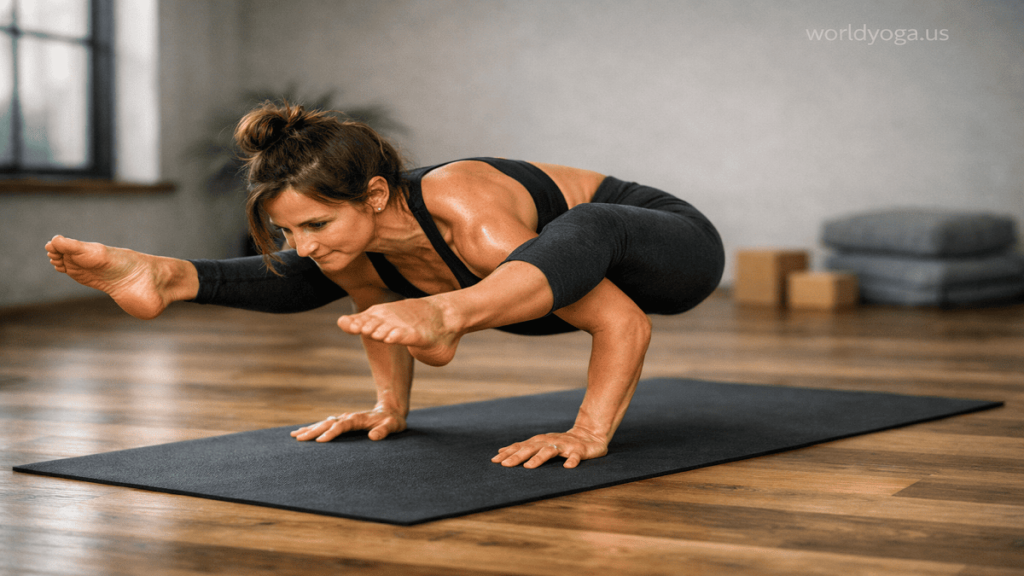
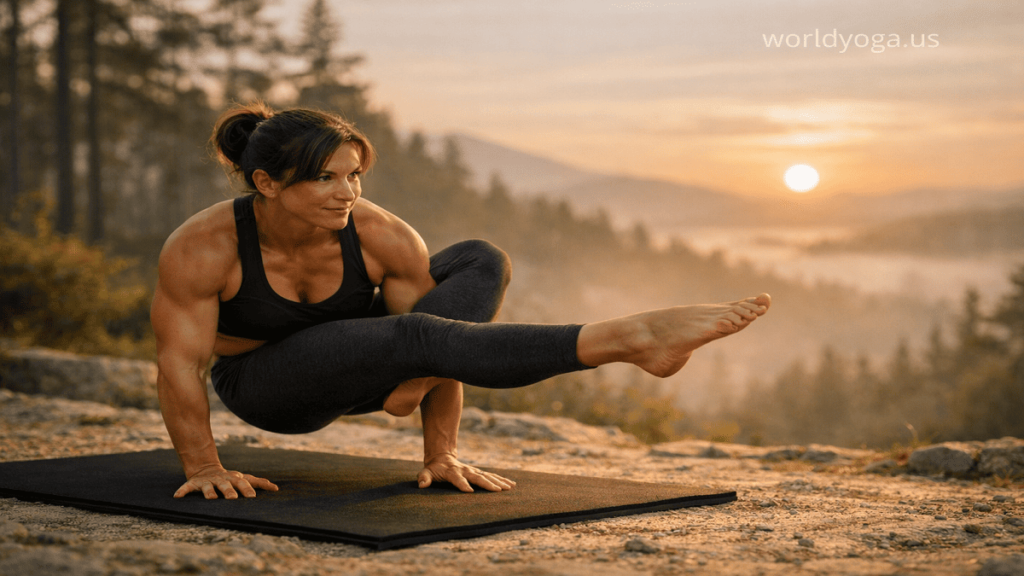
In this variation, the practitioner places the hands firmly on the ground, shoulder-width apart, with fingers actively spread for stability. The knees are drawn toward the upper arms or triceps, depending on the variation. One leg is extended straight backward or upward, while the opposite leg remains bent and supported on the arm.
This asymmetrical position shifts the center of gravity, requiring continuous micro-adjustments through the wrists, shoulders, and core.
Key Muscular Engagement
This arm balance variation activates multiple muscle groups:
- Core muscles (rectus abdominis and obliques): stabilize the torso and prevent collapse
- Shoulders and triceps: support body weight and maintain lift
- Wrist stabilizers: manage compression and balance
- Hip flexors and hamstrings: control leg extension and bending coordination
The uneven leg position increases rotational demand on the torso, making core engagement more dynamic compared to symmetrical arm balances.
Benefits
Practicing this variation offers several physical and technical benefits:
- Builds foundational strength for advanced arm balances
- Improves unilateral body control and coordination
- Enhances shoulder stability under uneven load
- Develops core anti-rotation strength
- Increases focus and proprioceptive awareness
It is especially useful as a stepping stone toward Firefly Pose, Eka Pada Bakasana, and flying transitions in vinyasa flows.
Common Challenges
Practitioners often face:
- Difficulty maintaining balance due to uneven weight distribution
- Over-reliance on arm strength instead of core engagement
- Collapsing shoulder or unstable wrist alignment
- Tight hips limiting smooth leg separation
Safety Tips
- Warm up wrists, shoulders, and hips thoroughly
- Engage core before lifting feet
- Avoid locking elbows
- Use controlled breathing to stabilize balance
- Practice near a wall or with a spotter if needed
Progression Use
This variation is widely used in yoga sequencing as a bridge movement between basic arm balances (Crow Pose) and advanced poses (Firefly Pose, Eka Pada Koundinyasana). It trains the nervous system to handle asymmetrical balance loads efficiently.
External References
- https://www.yogajournal.com/poses/
- https://www.ekhartyoga.com/resources/yoga-poses
- https://www.yogapedia.com/
#Arm Balance: One Leg Straight, One Knee Bent in India
What is the One Leg Straight, One Knee Bent arm balance?
The “One Leg Straight, One Knee Bent” arm balance is a non-classical yoga arm balance variation used in modern yoga and movement training to build toward advanced poses like Crow (Bakasana), Firefly (Tittibhasana), and Eka Pada arm balances.
It describes a body position rather than a single named pose: the practitioner balances on the hands while one leg is extended straight and the other leg remains bent, creating an asymmetrical shape.
What it looks like
- Hands are firmly grounded on the floor, shoulder-width apart
- One knee is placed or engaged on an upper arm (depending on variation)
- One leg stays straight and extended (backward, upward, or forward depending on the transition)
- The other leg stays bent and compact, helping control balance and weight shift
- Core is strongly engaged to prevent tipping or collapsing
What it is used for
This variation is mainly used as a training and transition shape, not a final classical posture. It appears in:
- Arm balance progressions in Vinyasa yoga
- Preparations for Firefly Pose (Tittibhasana)
- Preparations for Eka Pada Bakasana (One-Legged Crow)
- Strength drills in calisthenics-based yoga flows
Why it is important
This arm balance is valuable because it trains:
- Asymmetrical balance control (uneven weight distribution)
- Core anti-rotation strength (preventing twisting collapse)
- Shoulder stability under shifting load
- Coordination between both legs performing different actions
It teaches the body how to manage instability—an essential skill for advanced arm balances.
Key idea
Unlike symmetrical arm balances where both legs do the same thing, this variation forces the body to split roles between the legs, making it more challenging for coordination and control.
Simple summary
It is an arm balance drill position where:
one leg is straight, the other is bent, while balancing on the hands to develop strength, control, and progression toward advanced yoga arm balances.
External references
- https://www.yogajournal.com/poses/
- https://www.ekhartyoga.com/resources/yoga-poses
- https://www.yogapedia.com/
#Arm Balance: One Leg Straight, One Knee Bent in Maharashtra
How is this Firefly variation performed step by step?
1. Warm up the body
Begin with wrist circles, shoulder activation, and hip openers. Add poses like Forward Fold, Lizard Pose, and Plank to prepare hamstrings, hips, and core.
2. Start in a forward fold
Stand with feet slightly wider than hip-width apart. Slowly fold forward from the hips, keeping the spine long at first.
3. Thread the arms behind the legs
Slide your arms deeply behind your thighs so the legs rest high on the upper arms near the shoulders. This creates the foundation for the arm balance.
4. Place hands firmly on the floor
Bring your palms down behind your heels (or slightly beside them depending on flexibility). Spread fingers wide and press evenly into the ground for stability.
5. Shift weight forward
Engage your core and slowly transfer body weight into your hands. Begin bending the elbows slightly while lifting the hips.
6. Lift one foot first
Once balanced, lift one foot off the ground. This is usually the bent leg side first, helping reduce load and improve stability.
7. Extend the other leg straight
Keep the second leg fully extended and active, pointing forward or slightly upward depending on your balance. This creates the “one straight, one bent” shape.
8. Stabilize the position
Hold the balance by:
- Engaging the core strongly
- Keeping shoulders active (not collapsing)
- Pressing thighs into upper arms for support
- Breathing slowly and steadily
9. Switch sides or exit safely
To come out, gently lower both feet back to the ground with control. Rest in a forward fold before repeating on the other side.
Key focus points
- Core engagement is more important than arm strength
- The bent leg helps reduce load and improve control
- The straight leg should stay active, not loose
- Weight must stay slightly forward over the hands
Common beginner tip
If lifting both feet feels difficult, practice one-leg lifts first before attempting full balance.
External references
- https://www.yogajournal.com/poses/firefly-pose/
- https://www.ekhartyoga.com/resources/yoga-poses/tittibhasana-firefly-pose
- https://www.yogapedia.com/definition/6361/firefly-pose
#Arm Balance: One Leg Straight, One Knee Bent in Pune
What strength and mobility are required?
1. Upper-body strength (arms, wrists, shoulders)
A strong upper body is essential because the entire body weight is supported through the hands.
- Wrists: Must tolerate deep extension and sustained load without collapsing
- Forearms: Provide grip-like stability and micro-adjustments for balance
- Shoulders (deltoids + scapular stabilizers): Keep the torso lifted and prevent sinking
- Triceps: Help maintain elbow control and support body elevation
Without sufficient upper-body strength, the practitioner tends to collapse forward or lose balance quickly.
2. Core strength (primary stabilizer)
The core is the main driver of lift and control in this variation.
- Rectus abdominis: Helps lift the legs off the ground
- Obliques: Control twisting caused by uneven leg positioning
- Transverse abdominis: Provides deep stabilization of the spine
Because one leg is straight and the other bent, the body naturally wants to rotate. Strong core engagement prevents this collapse and maintains alignment.
3. Hip mobility (asymmetrical control requirement)
Hip mobility is especially important due to the uneven leg position.
- Hip flexors: Allow one leg to lift efficiently without strain
- Hip extensors: Support controlled extension of the straight leg
- Adductors (inner thighs): Help keep legs stable against the arms
Limited hip mobility often causes the straight leg to bend or drop, making the pose unstable.
4. Hamstring flexibility
The straight leg requires active hamstring length to fully extend.
- Tight hamstrings reduce leg extension and shift weight backward
- This makes balancing harder because the center of gravity moves behind the hands
Regular forward folds and active leg stretches help improve this requirement.
5. Shoulder and chest mobility
Good upper-body mobility supports safe alignment.
- Chest opening: prevents rounding and collapsing
- Shoulder flexibility: allows proper stacking over wrists
- Scapular mobility: supports balance adjustments during micro-shifts
Without this, the pose becomes compressed and unstable.
6. Balance and neuromuscular control
This variation heavily relies on coordination rather than strength alone.
- Fine control of weight shift between hands
- Awareness of center of gravity
- Ability to adjust mid-air instability instantly
This is what transforms raw strength into controlled arm balance skill.
Summary
To perform this Firefly variation, you need:
- Strong wrists, shoulders, and core
- Flexible hamstrings and hips
- Good shoulder mobility
- High balance awareness and coordination
It is essentially a strength–flexibility–control integration drill, not just a pose.
External references
- https://www.yogajournal.com/poses/firefly-pose/
- https://www.ekhartyoga.com/resources/yoga-poses/tittibhasana-firefly-pose
- https://www.yogapedia.com/definition/6361/firefly-pose
#Arm Balance: One Leg Straight, One Knee Bent in Delhi
What are the benefits of this pose?
1. Builds upper-body strength
Because the entire body weight is supported on the hands, this variation significantly strengthens:
- Wrists and forearms (load tolerance and stability)
- Shoulders (especially stabilizing muscles around the scapula)
- Triceps and chest (support and lift control)
Over time, it improves endurance for all arm balances and weight-bearing movements.
2. Develops core stability and control
The uneven leg position forces the core to work harder than in symmetrical poses.
- Strengthens deep abdominal muscles
- Improves anti-rotation control (preventing twisting)
- Enhances spinal stability under load
This translates into better posture and improved control in dynamic movements.
3. Improves balance and body coordination
Since one leg is straight and the other is bent, the body must constantly adjust to stay centered.
- Enhances proprioception (body awareness in space)
- Improves fine motor control in the hands and shoulders
- Develops ability to manage shifting weight distribution
This is especially useful for advanced yoga transitions and athletic movements.
4. Increases hip and hamstring mobility
This variation gently stretches and activates the lower body in different ways:
- Straight leg improves hamstring length and control
- Bent leg supports hip flexion and mobility
- Inner thighs (adductors) are engaged for stabilization
Over time, this helps prepare the body for full Firefly Pose.
5. Prepares for advanced arm balances
This pose acts as a training bridge toward more complex movements like:
- Firefly Pose (Tittibhasana)
- One-Legged Crow (Eka Pada Bakasana)
- Arm balance transitions in vinyasa flows
It teaches controlled lifting and asymmetrical weight management.
6. Enhances mental focus and confidence
Balancing in an unstable position requires:
- Concentration
- Calm breathing under effort
- Confidence in controlled movement
Practicing regularly helps reduce fear of falling and improves mental resilience in challenging postures.
7. Improves wrist resilience and joint awareness
Controlled loading strengthens small stabilizing muscles in the wrists and elbows, improving:
- Joint endurance
- Stability during hand support
- Injury awareness when practiced safely
Summary
This Firefly variation provides:
- Stronger arms, shoulders, and core
- Better balance and coordination
- Improved hip and hamstring mobility
- Mental focus and control
- Progression toward advanced arm balances
External references
- https://www.yogajournal.com/poses/firefly-pose/
- https://www.ekhartyoga.com/resources/yoga-poses/tittibhasana-firefly-pose
- https://www.yogapedia.com/definition/6361/firefly-pose
#Arm Balance: One Leg Straight, One Knee Bent in Banglore
What common mistakes should be avoided?
1. Skipping proper warm-up
One of the biggest mistakes is attempting the pose with cold wrists, tight hips, or stiff hamstrings.
- Leads to wrist strain and poor balance
- Reduces hip mobility needed for leg positioning
- Increases risk of losing control during lift
A proper warm-up is non-negotiable for safe practice.
2. Using momentum instead of control
Many practitioners try to “jump” into the balance rather than lifting with core engagement.
- Creates instability in mid-air
- Reduces ability to control alignment
- Often results in falling forward or backward
The lift should be slow, controlled, and driven by the core.
3. Collapsing the shoulders
Letting the shoulders drop is a common alignment error.
- Reduces structural support
- Puts excessive pressure on wrists
- Makes balancing unstable
Shoulders should stay active, slightly lifted, and stable.
4. Weak or delayed core engagement
In this variation, the core must activate before the feet leave the ground.
- Without core support, legs feel “heavy”
- Body tends to twist due to asymmetry
- Balance becomes inconsistent
Engaging the core early is essential for lift success.
5. Incorrect leg positioning
Misplacing the bent and straight legs affects balance quality.
- Straight leg becomes passive instead of active
- Bent leg collapses instead of supporting structure
- Legs lose alignment with center of gravity
Both legs must remain engaged, not relaxed.
6. Locking the elbows
Some practitioners fully lock the elbows, thinking it increases stability.
- Reduces shock absorption
- Increases wrist strain
- Limits micro-adjustments needed for balance
A slight micro-bend keeps the arms active and safe.
7. Poor weight distribution
Shifting weight too far back or too far forward causes instability.
- Too far back → feet won’t lift
- Too far forward → face plants or loss of control
Balance must stay slightly forward over the hands.
8. Holding the breath
Breath-holding is a common reflex under effort.
- Increases tension in the body
- Reduces coordination and focus
- Makes balance harder to maintain
Steady, controlled breathing improves stability significantly.
Summary
To practice safely, avoid:
- Skipping warm-up
- Using momentum instead of strength
- Collapsed shoulders
- Weak core engagement
- Poor leg alignment
- Locked elbows
- Incorrect weight shift
- Breath-holding
External references
- https://www.yogajournal.com/poses/firefly-pose/
- https://www.ekhartyoga.com/resources/yoga-poses/tittibhasana-firefly-pose
- https://www.yogapedia.com/definition/6361/firefly-pose
#Arm Balance: One Leg Straight, One Knee Bent in Kolkata
Case Study of Arm Balance: One Leg Straight, One Knee Bent
1. Introduction
The “One Leg Straight, One Knee Bent” arm balance is an asymmetrical transitional movement pattern commonly used in yoga-based strength training systems. It appears in progressions toward Firefly Pose (Tittibhasana), One-Legged Crow (Eka Pada Bakasana), and dynamic vinyasa arm balance flows. This case study examines how a practitioner develops control, strength, and coordination through this variation.
2. Subject Profile (Typical Practitioner)
The subject is an intermediate-level yoga practitioner with:
- 12–18 months of consistent yoga practice
- Basic competency in Crow Pose (Bakasana)
- Moderate hamstring flexibility
- Developing but inconsistent core strength
- No significant wrist or shoulder injuries
Primary goal: improve asymmetrical arm balance control and transition toward advanced arm balances.
3. Initial Assessment
At the beginning of training, the practitioner shows:
- Difficulty stabilizing uneven leg positions
- Over-reliance on arm strength rather than core engagement
- Early fatigue in wrists and shoulders
- Loss of balance during weight shift phase
- Limited awareness of center of gravity in asymmetrical shapes
Key limitation identified: lack of coordinated core activation during asymmetrical load transfer.
4. Training Intervention
A. Strength Conditioning
- Plank holds (30–60 seconds) for core endurance
- Chaturanga Dandasana repetitions for shoulder strength
- Crow Pose holds for baseline arm balance stability
B. Mobility Work
- Forward folds for hamstrings
- Hip flexor stretches (Low Lunge variations)
- Inner thigh activation drills
C. Skill Progressions
- One-leg lift drills in Crow Pose
- Supported arm balances using blocks
- Slow weight-shift transitions from standing fold
- Bent-knee holds before straight-leg extension
5. Biomechanical Observations
The variation creates an uneven torque system:
- Straight leg increases lever length and instability
- Bent leg reduces load on one side but shifts center of mass
- Core must counteract rotational forces continuously
Failure points typically occur during:
- Initial lift-off phase
- Transition from both feet grounded to partial lift
- Straight leg extension phase
6. Progress Timeline
Weeks 1–3
- Improved wrist awareness
- Partial lifts achieved with support
- Frequent loss of balance during leg separation
Weeks 4–6
- Stable one-foot lift achieved
- Better core engagement timing
- Reduced reliance on momentum
Weeks 7–10
- Consistent asymmetrical holds (2–4 breaths)
- Improved straight-leg extension control
- Enhanced shoulder stability
7. Outcomes
After structured progression, the practitioner demonstrates:
- Improved asymmetrical balance control
- Stronger core anti-rotation capacity
- Increased hamstring and hip mobility integration
- Better transition ability into Firefly-related poses
- Enhanced mental focus under instability
8. Key Challenges Identified
- Difficulty maintaining alignment during transitions
- Uneven weight distribution between hands
- Delayed core engagement timing
- Fear of forward tipping during lift
9. Conclusion
The One Leg Straight, One Knee Bent arm balance functions as a neuromuscular integration drill rather than a final posture. It teaches practitioners how to manage uneven loading, control rotation, and stabilize the body in transitional arm balance environments. Mastery of this variation significantly improves readiness for advanced poses like Firefly Pose.
External References
- https://www.yogajournal.com/poses/
- https://www.ekhartyoga.com/resources/yoga-poses
- https://www.yogapedia.com/
#Arm Balance: One Leg Straight, One Knee Bent in Chennai
White Paper of Arm Balance: One Leg Straight, One Knee Bent
1. Executive Summary
The “One Leg Straight, One Knee Bent” arm balance is an asymmetrical transitional movement pattern used in advanced yoga and movement training systems. It is not a standalone classical posture, but a structured progression drill that bridges foundational arm balances (Crow Pose) and advanced shapes (Firefly Pose and One-Legged Crow variations).
This white paper analyzes its biomechanical structure, strength and mobility demands, risk profile, and training applications in functional movement development.
2. Introduction
Arm balances in yoga are typically categorized as closed-chain kinetic movements where the hands act as the base of support. The asymmetrical variation—one leg extended and one knee bent—introduces uneven load distribution, making it significantly more complex than symmetrical balances.
It is widely used in modern Vinyasa sequencing, calisthenics-based yoga, and athletic mobility training to develop controlled instability tolerance.
3. Biomechanical Framework
This variation operates through a three-system interaction model:
- Upper Limb Support System: wrists, elbows, and shoulders bear axial load
- Core Stabilization System: abdominal and spinal muscles prevent rotational collapse
- Lower Limb Asymmetry System: one leg acts as an extended lever while the other acts as a compact stabilizer
Key biomechanical principle:
The body must maintain the center of mass over a constantly shifting base of support while resisting rotational torque generated by uneven leg positioning.
4. Strength Requirements
4.1 Upper-Body Strength
- Wrist extension tolerance under full bodyweight
- Shoulder girdle stability (scapular protraction control)
- Triceps endurance for sustained support
4.2 Core Strength
- Anti-rotation control (obliques and transverse abdominis)
- Pelvic stabilization under asymmetrical load
- Dynamic compression strength during lift-off phase
5. Mobility Requirements
5.1 Hip Mobility
- Hip flexion for knee placement and lift initiation
- Adductor engagement for midline stability
5.2 Hamstring Flexibility
- Straight leg extension without spinal collapse
- Controlled eccentric lengthening under load
5.3 Shoulder Mobility
- Controlled overhead protraction
- Stable scapular elevation during weight transfer
6. Neuromuscular Control Requirements
This variation heavily depends on motor coordination rather than pure strength:
- Proprioceptive awareness during unstable transitions
- Timing synchronization between core activation and lift-off
- Micro-adjustment capability in wrists and fingers
- Balance correction under rotational stress
7. Risk Analysis
Primary risks include:
- Wrist overload due to uneven weight distribution
- Shoulder collapse under rotational torque
- Hamstring strain from forced straight-leg extension
- Loss of balance during asymmetrical transition phase
Risk mitigation:
- Progressive loading sequences
- Supported variations (blocks or partial lifts)
- Controlled exit training
- Gradual flexibility development
8. Training Applications
This variation is used in:
- Yoga progression systems: Firefly and Crow transitions
- Functional fitness training: unilateral stability development
- Calisthenics conditioning: advanced bodyweight control drills
- Sports training: core anti-rotation and balance refinement
It is particularly valuable as a bridge movement between strength and mobility systems.
9. Performance Benefits
Regular practice leads to:
- Improved asymmetrical core strength
- Enhanced shoulder and wrist endurance
- Better hamstring integration under load
- Increased coordination in unstable positions
- Stronger mind-body control during transitions
10. Conclusion
The One Leg Straight, One Knee Bent arm balance is a high-value transitional movement pattern that trains asymmetrical load control, neuromuscular coordination, and integrated strength-mobility performance. It functions as a foundational bridge toward advanced arm balances and represents a key progression tool in modern yoga-based movement systems.
External References
- https://www.yogajournal.com/poses/
- https://www.ekhartyoga.com/resources/yoga-poses
- https://www.yogapedia.com/
#Arm Balance: One Leg Straight, One Knee Bent in Hyderabad
Industry Application of Arm Balance: One Leg Straight, One Knee Bent
1. Overview
The “One Leg Straight, One Knee Bent” arm balance is an asymmetrical bodyweight training pattern used in yoga, calisthenics, and functional movement systems. While not a classical named pose, it plays a significant role as a progression drill toward advanced arm balances such as Firefly Pose (Tittibhasana) and One-Legged Crow (Eka Pada Bakasana).
Its primary value lies in training uneven load distribution, core anti-rotation strength, and neuromuscular control under instability, making it relevant across multiple industries beyond yoga.
2. Fitness and Functional Training Industry
In modern fitness programming, this variation is used as a advanced bodyweight control exercise.
Applications include:
- Progressive calisthenics training systems
- Core stability and anti-rotation workouts
- Advanced yoga-fitness hybrid classes
- Movement-based strength conditioning programs
Personal trainers use it to assess:
- Unilateral control strength
- Core stability under asymmetrical load
- Wrist and shoulder endurance under bodyweight pressure
It is especially useful in functional fitness models that prioritize movement efficiency over isolated muscle training.
3. Sports Performance Training
This arm balance variation is highly relevant in athletic development due to its demand for dynamic stability.
Used in training for:
- Gymnastics and acrobatics (body control in airborne transitions)
- Rock climbing (core tension and shoulder stability)
- Martial arts (balance under destabilization)
- Dance and aerial performance (controlled asymmetry)
Key athletic benefits:
- Improves proprioception (spatial awareness)
- Enhances anti-rotation core strength
- Builds shoulder resilience under shifting load
4. Physiotherapy and Rehabilitation (Controlled Use)
In rehabilitation environments, modified versions of this movement are used carefully to rebuild functional strength.
Applications include:
- Gradual wrist loading rehabilitation
- Shoulder stabilization post-injury
- Core reactivation in functional movement therapy
Important note: full expression is not used in early rehab phases. Instead, therapists use supported or partial-load variations to safely reintroduce weight-bearing capacity.
5. Yoga Therapy and Mind-Body Training
In therapeutic yoga systems, this variation is used to develop:
- Balance confidence under asymmetrical stress
- Controlled breath under physical instability
- Mental focus during challenging transitions
It is often included in programs targeting:
- Stress resilience training
- Fear reduction in inversion and arm balances
- Cognitive focus through movement complexity
6. Sports Science and Biomechanics Research
Researchers analyze this movement to study:
- Asymmetrical torque distribution in human joints
- Center of mass control during unstable support
- Integration of flexibility and strength in real-time movement
It is often compared with:
- Gymnastic lever progressions
- Dynamic plank variations
- Unilateral kinetic chain studies
7. Fitness Technology and AI Movement Analysis
In digital fitness ecosystems, this movement pattern informs:
- Balance detection algorithms in yoga apps
- Wearable sensor analysis of wrist load
- AI-based posture correction systems
- Motion tracking for injury prevention models
It helps refine data-driven movement feedback systems in modern fitness platforms.
8. Conclusion
The One Leg Straight, One Knee Bent arm balance is more than a yoga progression—it is a multidisciplinary movement tool. Its applications span fitness training, elite sports conditioning, rehabilitation, and biomechanics research.
Its value lies in teaching the body how to manage asymmetrical force, unstable balance, and coordinated strength, making it a foundational drill in modern movement science.
External References
- https://www.yogajournal.com/poses/
- https://www.ekhartyoga.com/resources/yoga-poses
- https://www.yogapedia.com/
#Arm Balance: One Leg Straight, One Knee Bent in Mumbai
Ask FAQs
What is the One Leg Straight, One Knee Bent arm balance?
It is an asymmetrical arm balance variation used in yoga and movement training where the body is supported on the hands while one leg is extended straight and the other is bent. It is mainly a progression drill, not a classical named yoga pose.
Is this arm balance suitable for beginners?
No, it is generally not suitable for beginners. It requires prior experience with basic arm balances like Crow Pose and a good foundation of wrist strength, core stability, and hip mobility.
What are the main benefits of practicing this variation?
This movement helps build:
Core anti-rotation strength
Shoulder and wrist stability
Balance and body coordination
Hip mobility and hamstring control
It also prepares the body for advanced poses like Firefly Pose.
What are the most common mistakes to avoid?
Common mistakes include:
Using momentum instead of control
Collapsing the shoulders
Weak core engagement during lift
Poor alignment of the straight leg
Holding the breath while balancing
How can I safely progress toward this arm balance?
You can safely progress by:
Building strength with Plank and Chaturanga
Practicing Crow Pose first
Improving hamstring and hip flexibility
Using supported variations (blocks or partial lifts)
Practicing slow, controlled weight shifts
Table of Contents
Disclaimer
This arm balance variation is an advanced movement requiring proper strength, flexibility, and control. Do not attempt it without adequate preparation or if you have wrist, shoulder, hip, or lower back injuries. Practice under the guidance of a qualified yoga instructor, and progress gradually to avoid strain or injury.