Dragonfly Pose 1
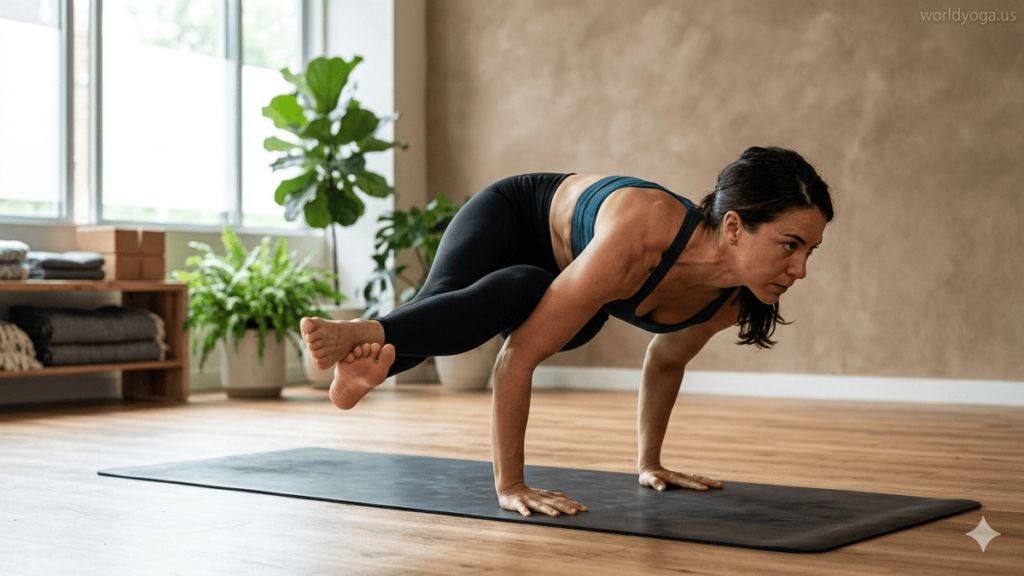
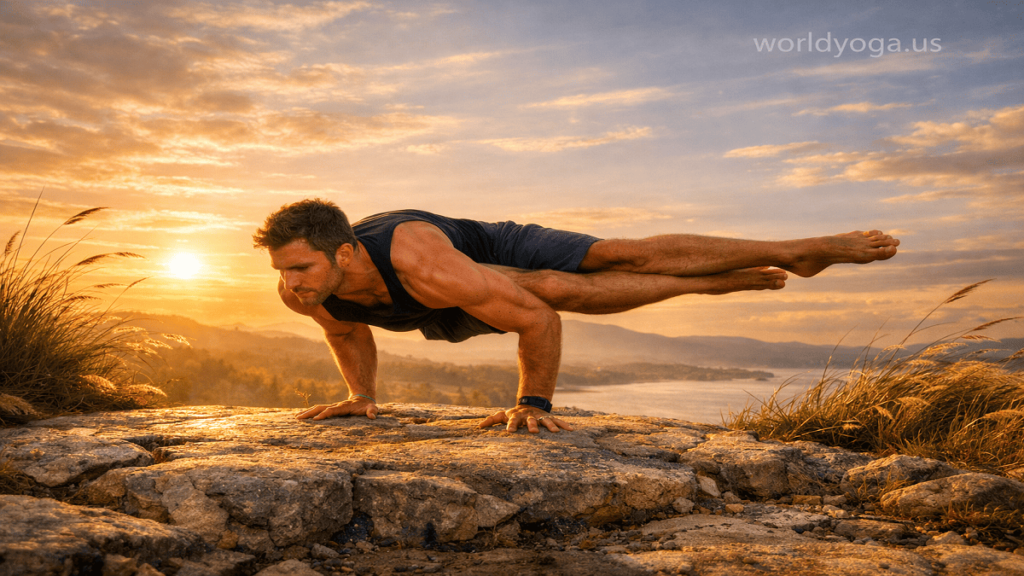
Dragonfly Pose, also known in Sanskrit as Maksikanagasana, is an advanced yoga arm balance that combines core strength, hamstring flexibility, hip opening, and upper-body stability. The name “Dragonfly” comes from the body’s resemblance to a dragonfly’s wings when the legs are extended sideways while balancing on the arms.
What is Dragonfly Pose?
Dragonfly Pose is a side arm balance where the practitioner places both legs on one side of the body while supporting the weight on the hands. The torso twists slightly as the legs extend outward, creating a strong lateral line of balance.
It is often practiced in advanced Vinyasa and Ashtanga-inspired sequences as a progression toward deeper arm balances and twisting strength poses.
Key Characteristics
- Arm-supported balance posture
- Both legs extended to one side
- Requires strong core engagement and twist control
- Combines flexibility (hamstrings + hips) with strength (arms + shoulders)
Basic Purpose of Dragonfly Pose
Dragonfly Pose is designed to develop integrated strength and mobility rather than isolated muscle control. It trains the body to manage complex movement patterns involving rotation, balance, and compression.
Primary Focus Areas
- Core stability and oblique strength
- Wrist and shoulder endurance
- Hamstring flexibility
- Hip opening and rotation control
- Balance and spatial awareness
Difficulty Level
Dragonfly Pose is considered:
- Advanced level arm balance
- Requires prior experience with Crow Pose (Bakasana) and side arm balances
- Strong hip flexibility is essential for safe practice
In Summary
Dragonfly Pose (Maksikanagasana) is a challenging yoga arm balance that demands strength, flexibility, and precise control. It is a powerful posture for developing advanced body awareness, especially in lateral balance and twisting movement patterns.
Further Reading
- https://www.yogajournal.com/poses/
- https://www.yogaalliance.org/
- https://www.tummee.com/yoga-poses/maksikanagasana
- https://www.artofliving.org/yoga
#Dragonfly Pose 1 in Maharashtra
How is this arm balance performed step by step?
1. Warm Up the Body
Start with a thorough warm-up focusing on:
- Wrists and shoulders (circles, plank holds)
- Hips (pigeon pose, lizard pose)
- Hamstrings (forward folds)
- Core activation (boat pose or plank variations)
This prepares the body for weight-bearing and twisting.
2. Begin in a Squatting Position
Start in a low squat (Malasana) with feet slightly apart. Keep the spine tall and hands in prayer or resting on the mat.
3. Place Hands on the Mat
Lower your hands to the ground shoulder-width apart. Spread your fingers wide and press evenly through the palms to create a strong base.
4. Shift Weight Forward
Lean forward gradually, shifting your weight onto your hands. Engage your core to avoid collapsing into the shoulders.
5. Hook One Leg onto the Upper Arm
Lift one leg and place the knee or thigh onto the upper arm (triceps area). This creates a stable “shelf” for support.
6. Twist and Position the Second Leg
Rotate your torso slightly in the direction of the hooked leg. Begin extending the second leg out to the side, preparing for lift.
7. Lift the Body Off the Ground
Press firmly into the hands and slowly lift your hips off the mat. Both legs move to one side of the body, creating a lateral balance position.
8. Extend and Straighten the Legs
Once stable, extend both legs outward to the side as much as flexibility allows. Keep the core fully engaged to maintain lift and alignment.
9. Hold the Pose
Maintain:
- Strong core engagement
- Steady breathing
- Active pressing through palms
- Focused gaze (drishti)
Hold for a few breaths initially, then release slowly.
10. Exit Safely
Lower the body gently back into a squat. Release the leg from the arm and reset before switching sides.
Key Tips
- Do not rush the leg hook or lift
- Keep elbows slightly bent (not locked)
- Engage obliques for side stability
- Use a yoga block under hands if needed
- Practice near a wall for confidence support
Conclusion
Dragonfly Pose is a complex balance of strength, flexibility, and rotation control. It requires patience and progressive training rather than force, making gradual preparation essential for safe practice.
Further Reading
- https://www.yogajournal.com/poses/
- https://www.yogaalliance.org/
- https://www.verywellfit.com/yoga-arm-balances-3566915
- https://www.tummee.com/yoga-poses/maksikanagasana
#Dragonfly Pose 1 in Chennai
What strength and flexibility are required?
1. Upper Body Strength Requirements
Strong and stable arms are essential because the entire body weight is supported on the hands.
- Wrists: Must handle sustained load in deep extension without pain
- Forearms: Provide grip stability and endurance for balancing
- Shoulders (deltoids & rotator cuff): Stabilize the forward lean and prevent collapse
- Chest and upper back: Support scapular control and posture alignment
Without adequate upper-body strength, the pose becomes unstable and places excess strain on joints.
2. Core Strength and Oblique Activation
Core strength is critical for controlling the sideways lift.
- Obliques (side abdominal muscles): Primary stabilizers in lateral balance
- Rectus abdominis: Assists in lifting the body off the ground
- Transverse abdominis: Maintains deep internal stability
- Lower back muscles: Help prevent twisting collapse
F=maF = maF=ma
This highlights that greater muscular force is needed to counteract body weight during lift and hold phases.
3. Hip Flexibility Requirements
Dragonfly Pose demands deep hip opening and rotation control.
- External hip rotation: Allows leg placement on the arm shelf
- Hip abduction: Enables both legs to extend sideways
- Hip flexor flexibility: Prevents strain during lift-off and extension
Tight hips are one of the main limiting factors in this pose.
4. Hamstring Flexibility
Hamstrings play a major role in leg extension.
- Required for straightening legs sideways
- Helps maintain clean alignment in extended position
- Reduces strain during balance hold
Limited hamstring flexibility often restricts full expression of the pose.
5. Spinal Rotation and Mobility
Since Dragonfly is a twisted side balance:
- Spinal rotation (thoracic spine): Needed for torso alignment
- Core twist control: Prevents collapsing into the lower back
- Pelvic stability: Maintains balance during asymmetric load
6. Balance and Neuromuscular Control
Beyond physical strength, Dragonfly Pose requires:
- Proprioception: Awareness of body position in space
- Coordination: Smooth integration of twist, lift, and extension
- Focus (drishti): Mental stability to maintain balance under load
Minimum Preparation Benchmarks
Before attempting Dragonfly Pose, practitioners should ideally be able to:
- Hold Crow Pose (Bakasana) for 20–30 seconds
- Perform deep hip openers comfortably (pigeon, lizard pose)
- Maintain side plank stability for 20–40 seconds
- Execute controlled forward folds without strain
Conclusion
Dragonfly Pose requires a complex integration of strength, flexibility, and control, especially in the hips and core. Success depends on gradual preparation, not force, making balanced development across all muscle groups essential.
Further Reading
- https://www.yogajournal.com/poses/
- https://www.yogaalliance.org/
- https://www.verywellfit.com/yoga-arm-balances-3566915
- https://www.tummee.com/yoga-poses/maksikanagasana
#Dragonfly Pose 1 in Kolkata
What are the benefits of this pose?
1. Builds Upper Body Strength
This pose places significant load on the arms and shoulders.
- Strengthens wrists, forearms, and grip endurance
- Develops shoulder stability and control
- Improves chest and upper back engagement
Regular practice enhances overall upper-body resilience for other arm balances.
2. Strengthens Core and Obliques
The sideways balance makes core engagement essential.
- Strong activation of oblique (side abdominal) muscles
- Improves overall abdominal strength and stability
- Enhances control of twisting and lateral movement
A strong core helps prevent collapse during the side lift.
3. Improves Hip Flexibility and Mobility
Dragonfly Pose deeply opens the hips.
- Increases external hip rotation
- Improves lateral hip mobility and control
- Releases stiffness in hip joints
This is especially beneficial for people with tight hips from sitting or inactivity.
4. Enhances Hamstring Flexibility
- Improves ability to extend legs sideways
- Reduces tightness in posterior leg muscles
- Supports smoother transitions in advanced poses
Flexible hamstrings make the pose more accessible and stable.
5. Develops Balance and Coordination
Because the body is lifted and twisted sideways:
- Improves proprioception (body awareness in space)
- Enhances neuromuscular coordination
- Builds stability in asymmetrical movement patterns
This translates into better control in both yoga and athletic movements.
6. Strengthens Spinal Rotation and Control
- Improves thoracic spine mobility
- Enhances controlled twisting strength
- Builds stability in rotated positions
This supports healthy spinal movement and posture alignment.
7. Builds Mental Focus and Confidence
- Requires strong concentration (drishti)
- Develops patience and calm under physical challenge
- Reduces fear of imbalance through gradual practice
Mental discipline is a key part of mastering this pose.
Conclusion
Dragonfly Pose offers a powerful combination of strength, flexibility, balance, and mental focus training. It is especially valuable for advanced practitioners seeking integrated body control and improved lateral movement ability.
Further Reading
- https://www.yogajournal.com/poses/
- https://www.yogaalliance.org/
- https://www.verywellfit.com/yoga-arm-balances-3566915
- https://www.tummee.com/yoga-poses/maksikanagasana
#Dragonfly Pose 1 in Ahemadabad
What common mistakes should be avoided?
1. Forcing the Leg onto the Arm Too Early
One of the most common mistakes is trying to hook the leg before the hips are ready.
- Causes strain in hips, groin, or knee
- Leads to poor alignment and instability
Fix:
Work first on hip openers like pigeon pose and lizard pose before attempting the full hook.
2. Collapsing into the Shoulders
Letting the chest sink toward the floor reduces stability.
- Compresses neck and upper spine
- Weakens arm support structure
Fix:
Actively push the floor away and keep shoulders lifted and engaged.
3. Lack of Core Engagement
Relying only on arm strength is a major error.
- Leads to loss of balance
- Increases pressure on wrists and shoulders
- Reduces control in sideways lift
Fix:
Engage obliques and lower abdomen before lifting—think “lift from the core, not the arms.”
4. Poor Wrist Alignment
Incorrect hand placement is very common in this pose.
- Causes wrist pain or overloading
- Reduces balance stability
Fix:
Spread fingers wide, press evenly through palms, and avoid collapsing into the heel of the hand.
5. Rushing the Transition into Balance
Trying to lift too quickly often causes tipping or falling.
- Breaks alignment
- Reduces control over twist and lift
Fix:
Shift weight forward gradually and lift in stages, not all at once.
6. Neglecting the Twist Control
Dragonfly requires controlled spinal rotation, not just leg placement.
- Leads to uneven weight distribution
- Causes lower back strain
Fix:
Engage obliques and rotate slowly from the torso, not just the hips.
7. Locked or Overbent Elbows
Both extremes reduce stability.
- Locked elbows stress joints
- Overbent elbows reduce support strength
Fix:
Maintain a soft micro-bend in the elbows for controlled stability.
8. Holding the Breath
Many practitioners unconsciously stop breathing during effort.
- Increases tension and fatigue
- Reduces focus and balance control
Fix:
Maintain steady, even breathing throughout the pose.
Conclusion
Avoiding these common mistakes in Dragonfly Pose ensures safer practice, better balance, and faster progression. The key is controlled movement, proper preparation, and integrated core engagement rather than force or speed.
Further Reading
- https://www.yogajournal.com/poses/
- https://www.yogaalliance.org/
- https://www.verywellfit.com/yoga-arm-balances-3566915
- https://www.tummee.com/yoga-poses/maksikanagasana
#Dragonfly Pose 1 in Hyderabad
Case Study of Dragonfly Pose 1
1. Introduction
Dragonfly Pose, or Maksikanagasana, is an advanced yoga arm balance that integrates lateral balance, spinal rotation, hip flexibility, and upper-body strength. This case study examines the progression of a practitioner over a structured training period aimed at achieving controlled entry and partial hold of the pose. The objective was to analyze improvements in mobility, strength, balance, and neuromuscular coordination.
2. Participant Profile
- Age: 27 years
- Experience: 2.5 years of regular yoga practice (Vinyasa-based)
- Initial capability: Comfortable with Crow Pose (Bakasana), moderate hip flexibility, limited side arm balance experience
- Primary limitations: Tight hips, weak oblique engagement, and instability during weight shift into arms
3. Methodology
The training program was conducted over 8 weeks, focusing on progressive skill development rather than immediate full pose execution.
Phase 1: Foundation Building (Weeks 1–2)
- Wrist strengthening drills and plank variations
- Core activation (boat pose, hollow holds)
- Hip openers (pigeon pose, lizard pose)
- Side plank holds for oblique activation
Phase 2: Mobility + Strength Integration (Weeks 3–5)
- Deep hip rotation exercises
- Seated spinal twists
- Assisted leg placement drills onto upper arm
- Crow pose refinement for arm balance control
Phase 3: Balance Training (Weeks 6–8)
- Partial lift attempts in side arm balance position
- Controlled weight transfer into hands
- Assisted Dragonfly Pose holds (using blocks for support)
- Short duration balance attempts (3–10 seconds)
4. Observations
Weeks 1–2:
- Limited hip external rotation
- Difficulty maintaining wrist stability under load
- Core engagement inconsistent during transitions
Weeks 3–5:
- Improved hip mobility and twist control
- Better shoulder stability in crow pose variations
- Increased awareness of oblique activation
Weeks 6–8:
- Successful partial lift into Dragonfly Pose position
- Short static holds achieved with assistance
- Noticeable improvement in lateral balance control
5. Results
By the end of the program, the participant demonstrated:
- Improved hip flexibility and external rotation range
- Stronger oblique and core engagement during lateral movement
- Increased upper-body strength and wrist endurance
- Ability to perform assisted Dragonfly Pose holds with partial lift-off
Full independent hold remained challenging due to residual hip tightness and balance instability.
6. Discussion
This case highlights that Dragonfly Pose is a multi-system movement requiring integrated development rather than isolated strength. The most significant limiting factors were hip mobility and timing of core engagement during lateral lift.
Progress was most evident during Phase 3, where combining strength, mobility, and balance training allowed partial expression of the pose. This confirms that systematic progression is essential for safe and effective learning.
7. Conclusion
Dragonfly Pose requires structured preparation involving flexibility, strength, and neuromuscular coordination. With consistent training, practitioners can progress from assisted variations to controlled full expression over time. The pose serves as a benchmark for advanced lateral arm balance control in yoga practice.
Further Reading
- https://www.yogajournal.com/poses/
- https://www.yogaalliance.org/
- https://www.verywellfit.com/yoga-arm-balances-3566915
- https://www.tummee.com/yoga-poses/maksikanagasana
- https://www.ncbi.nlm.nih.gov/pmc/
#Dragonfly Pose 1 in Banglore
White Paper of Dragonfly Pose 1
1. Executive Summary
Dragonfly Pose (Maksikanagasana) is an advanced yoga arm balance that integrates lateral stability, core rotation control, hip flexibility, and upper-body load-bearing strength. It is widely used in modern yoga and movement training systems as a benchmark posture for evaluating integrated strength and neuromuscular coordination. This paper examines its biomechanics, physiological demands, training methodology, benefits, risks, and applied use cases across fitness, rehabilitation, and performance domains.
2. Introduction
Dragonfly Pose is a side-oriented arm balance in which both legs extend to one side of the body while the practitioner supports their weight on the hands. Unlike linear arm balances, it introduces a lateral load shift combined with spinal rotation, making it significantly more complex.
The pose is primarily used in advanced Vinyasa and movement-based yoga systems to develop asymmetrical strength and control under load.
3. Biomechanical Analysis
Dragonfly Pose involves multi-plane movement requiring synchronized muscular engagement.
Key biomechanical components:
- Upper limbs act as the primary weight-bearing structure
- Core muscles stabilize lateral collapse and rotation
- Hip joints perform external rotation and abduction
- Spine maintains controlled rotational alignment
F=maF = maF=ma
This reflects the increased force required to counteract body mass during lateral lift and sustained balance.
Primary structural demands include:
- Scapular stabilization and shoulder protraction
- Wrist extension load tolerance
- Oblique-driven rotational control
- Pelvic stability under asymmetric loading
4. Physiological and Neuromuscular Demands
Dragonfly Pose places high demand on multiple systems:
- Muscular system: deltoids, triceps, forearms, obliques, hip abductors, and deep core stabilizers
- Nervous system: high proprioceptive demand for spatial awareness and balance correction
- Cardiorespiratory system: moderate isometric exertion under sustained hold
The pose requires coordinated activation across upper and lower kinetic chains.
5. Training Progression Framework
A structured progression model is essential for safe execution:
Phase 1: Foundational Strength (2–4 weeks)
- Plank and side plank conditioning
- Wrist strengthening drills
- Core stabilization exercises
Phase 2: Mobility Development (3–5 weeks)
- Hip opening (pigeon, lizard pose)
- Spinal rotation exercises
- Hamstring flexibility training
Phase 3: Integration Phase (4–6 weeks)
- Crow pose progression
- Assisted side arm balance drills
- Controlled leg placement on upper arm
Phase 4: Full Expression
- Lift-off attempts
- Static holds (5–20 seconds)
- Controlled transitions in and out of pose
6. Benefits and Applications
Physical Benefits:
- Improves upper-body strength and endurance
- Enhances hip mobility and rotational flexibility
- Strengthens core and oblique muscle groups
Neuromuscular Benefits:
- Enhances balance under lateral load
- Improves proprioception and motor coordination
Applications:
- Functional fitness and calisthenics training
- Advanced yoga sequencing systems
- Athletic conditioning for multidirectional sports
- Movement therapy and motor control development
7. Risks and Limitations
- Wrist strain from excessive load bearing
- Shoulder compression due to improper alignment
- Hip or groin strain from insufficient mobility
- Loss of balance leading to falls
Proper progression, warm-up, and supervised practice are strongly recommended.
8. Discussion
Dragonfly Pose represents a multi-planar movement challenge, combining strength, flexibility, and rotational control. Unlike linear arm balances, it emphasizes lateral stability and asymmetric load management, making it highly effective for advanced movement training.
Its primary value lies in developing integrated body control under complex force directions, rather than isolated muscle strength.
9. Conclusion
Dragonfly Pose (Maksikanagasana) is a high-level functional yoga posture that develops strength, flexibility, coordination, and neuromuscular precision. When practiced progressively, it serves as a key milestone in advanced arm balance training and integrated movement systems.
Further Reading
- https://www.yogajournal.com/poses/
- https://www.yogaalliance.org/
- https://www.verywellfit.com/yoga-arm-balances-3566915
- https://www.tummee.com/yoga-poses/maksikanagasana
- https://www.ncbi.nlm.nih.gov/pmc/
#Dragonfly Pose 1 in Pune
Industry Application of Dragonfly Pose 1
1. Fitness and Strength Training Industry
In modern fitness systems, Dragonfly Pose is used as a functional bodyweight training progression.
Applications:
- Builds asymmetrical upper-body strength (arms, shoulders, wrists)
- Enhances oblique and core rotational power
- Develops advanced calisthenics control and stability
- Prepares athletes for movements like L-sit transitions and side lever progressions
It is often included in hybrid yoga-strength programs to improve movement efficiency and joint resilience.
2. Sports Performance and Athletic Conditioning
Dragonfly Pose is valuable in sports training due to its emphasis on lateral balance and rotational control.
Applications:
- Improves change-of-direction stability in sports like football and basketball
- Enhances core rotation strength for tennis, cricket, and baseball
- Develops single-side load control, reducing injury risk during dynamic movement
- Improves proprioception under unstable conditions
It is commonly used in off-season mobility and conditioning programs.
3. Physiotherapy and Rehabilitation
In rehabilitation contexts, modified versions are used for motor control and functional recovery training.
Applications:
- Restoring wrist and shoulder load tolerance after injury
- Improving hip mobility and pelvic alignment control
- Rebuilding core activation patterns in asymmetrical movement
- Supporting neurological rehabilitation for balance retraining
These applications are always performed in assisted or regression-based formats under supervision.
4. Yoga Therapy and Wellness Industry
Within yoga therapy, Dragonfly Pose is used for advanced neuromuscular coordination development.
Applications:
- Enhances body awareness in lateral movement patterns
- Builds confidence in advanced balance postures
- Supports postural correction and spinal mobility programs
- Improves mind-body integration through controlled effort and focus
5. Dance and Performing Arts
Dragonfly Pose is widely relevant in contemporary movement and performance arts.
Applications:
- Improves floor-based transitions and side balances
- Enhances hip articulation and rotational control
- Develops strength for lifts, freezes, and acrobatic sequences
- Supports fluidity in modern and contemporary choreography
6. Military, Tactical, and Functional Training
In high-performance physical training environments, Dragonfly variations are used for:
- Building joint stability under load and fatigue
- Enhancing ground movement strength and control
- Improving multi-directional agility and balance recovery
- Supporting injury prevention in dynamic environments
7. Corporate Wellness and Mind-Body Programs
Simplified versions are integrated into workplace wellness systems to:
- Improve postural health and spinal alignment
- Reduce stiffness from prolonged sitting
- Enhance focus through balance-based movement drills
- Support stress reduction via controlled breathing and movement awareness
Conclusion
Dragonfly Pose has evolved into a multi-industry functional movement pattern. Its combination of strength, flexibility, and rotational balance makes it valuable in fitness, sports, rehabilitation, performing arts, and wellness systems. It serves as a bridge between traditional yoga practice and modern applied movement science.
Further Reading
- https://www.yogajournal.com/poses/
- https://www.yogaalliance.org/
- https://www.verywellfit.com/yoga-arm-balances-3566915
- https://www.ncbi.nlm.nih.gov/pmc/
- https://www.tummee.com/yoga-poses/maksikanagasana
#Dragonfly Pose 1 in Mumbai
What is Dragonfly Pose in yoga?
Dragonfly Pose, or Maksikanagasana, is an advanced arm balance where the body is supported on the hands while both legs extend to one side. It combines strength, flexibility, and twisting control, making it a high-level balancing posture in modern yoga practice.
Is Dragonfly Pose suitable for beginners?
No, Dragonfly Pose is considered advanced. Beginners should first develop strength and flexibility through poses like Crow Pose (Bakasana), Side Plank, and hip openers before attempting it.
What are the main benefits of Dragonfly Pose?
This pose helps improve:
Upper body strength (wrists, arms, shoulders)
Core and oblique muscle strength
Hip flexibility and mobility
Balance and coordination
Focus and mental control
What are common challenges in this pose?
Practitioners often face:
Tight hips limiting leg extension
Weak wrist or shoulder strength
Difficulty maintaining lateral balance
Poor core engagement during lift-off
Loss of stability while twisting
Can Dragonfly Pose cause injuries?
Yes, if performed incorrectly or without preparation. Common risks include wrist strain, shoulder stress, or hip discomfort. With proper warm-up, gradual progression, and correct alignment, the pose can be practiced safely and effectively.
Table of Contents
Disclaimer: This content is for educational and informational purposes only and is not a substitute for professional medical or yoga guidance. Dragonfly Pose (Maksikanagasana) is an advanced posture and should be practiced only after proper preparation and under the supervision of a qualified instructor. Avoid this pose if you have wrist, shoulder, hip, or back injuries.