
Eka Pada Bakasana 1
Eka Pada Bakasana I (One-Legged Crane Pose I) is an advanced arm balance in Yoga that builds upon the foundational strength and technique of Bakasana. This pose challenges practitioners to develop a refined sense of balance, core engagement, and upper-body stability while integrating flexibility and focus.
In Eka Pada Bakasana I, the practitioner begins in a low squat, similar to the setup for Crow Pose. From here, the hands are placed firmly on the ground, shoulder-width apart, with fingers spread to create a stable base. As the body shifts forward, one knee rests on the corresponding upper arm (triceps), while the other leg extends straight back, parallel to the floor. The gaze (drishti) is directed slightly forward to maintain balance, and the core muscles are actively engaged to stabilize the posture.
This pose primarily strengthens the wrists, arms, shoulders, and abdominal muscles. At the same time, it enhances hip mobility and promotes neuromuscular coordination. The asymmetrical nature of the posture requires heightened concentration, making it beneficial not only physically but also mentally, as it cultivates focus and mindfulness—key elements emphasized in traditional yogic philosophy.
Practicing Eka Pada Bakasana I also contributes to improved proprioception, or body awareness in space. As the practitioner balances on the hands while extending one leg, the body must continuously adjust to maintain equilibrium. This dynamic engagement helps refine motor control and deepens the practitioner’s connection between mind and body.
However, due to its complexity, Eka Pada Bakasana I is generally recommended for intermediate to advanced practitioners. Beginners should first develop proficiency in preparatory poses such as Crow Pose and plank variations. Additionally, proper warm-up of the wrists, shoulders, and hips is essential to reduce the risk of injury. Individuals with wrist, shoulder, or lower back issues should approach this pose cautiously or under the guidance of a certified yoga instructor.
For detailed guidance and visual demonstrations, you may refer to reputable resources such as:
- Yoga Journal: https://www.yogajournal.com
- DoYogaWithMe: https://www.doyogawithme.com
- Gaia: https://www.gaia.com
In conclusion, Eka Pada Bakasana I is a powerful posture that integrates strength, balance, and mental clarity. With consistent practice and mindful progression, it can significantly enhance both physical capability and inner awareness, embodying the holistic benefits of yoga practice.
#Eka Pada Bakasana 1 in India
What is Eka Pada Bakasana I?
Eka Pada Bakasana I (One-Legged Crane Pose I) is an advanced arm-balancing posture in Yoga that evolves from the foundational Bakasana. The name comes from Sanskrit: “eka” (one), “pada” (leg), “baka” (crane), and “asana” (pose), describing a variation of Crane Pose performed with one leg extended.
In this posture, the practitioner balances the body weight on the hands while one knee rests on the upper arm and the opposite leg extends straight back. It requires a combination of upper-body strength, core stability, balance, and concentration. The pose is typically entered from a low squat, where the hands are planted firmly on the floor, shoulder-width apart. As the body leans forward, the elbows bend slightly (like a shelf), supporting the bent leg, while the extended leg lifts and reaches backward, creating a dynamic, asymmetrical shape.
Eka Pada Bakasana I primarily strengthens the wrists, forearms, shoulders, and abdominal muscles. It also improves balance and coordination, as the practitioner must continuously engage stabilizing muscles to maintain the posture. The extended leg adds an additional challenge, requiring greater control and awareness compared to the standard Crow Pose.
Beyond physical benefits, this pose enhances mental focus and discipline. Because balance is delicate, even small distractions can cause a loss of stability. As a result, practitioners develop heightened concentration and mindfulness—key principles in yoga practice.
Due to its intensity, Eka Pada Bakasana I is generally suited for intermediate to advanced practitioners. Beginners are encouraged to first build strength and confidence through preparatory poses such as Crow Pose, plank variations, and core-strengthening exercises. Proper warm-up, especially for the wrists and shoulders, is essential to prevent strain or injury.
In summary, Eka Pada Bakasana I is a challenging yet rewarding yoga posture that integrates strength, balance, and mental clarity. It represents a natural progression in arm-balance practice and offers both physical and cognitive benefits when practiced with proper technique and awareness.
#Eka Pada Bakasana 1 in Maharashtra
How is this arm balance performed step by step?
Step-by-Step Instructions
1. Begin in a Squat (Malasana Setup)
Start in a low squat with your feet slightly apart. Keep your heels grounded if possible. This position prepares your hips and establishes your center of gravity.
2. Place the Hands Firmly
Lean forward and place your palms flat on the floor, shoulder-width apart. Spread your fingers wide to create a strong base, similar to Bakasana.
3. Position the Supporting Leg
Bend one knee and place it high onto the corresponding upper arm (triceps), ideally close to the armpit. This placement increases stability and leverage.
4. Shift Weight Forward
Slowly lean your body weight forward into your hands. Bend your elbows slightly to create a “shelf” for the resting leg. Keep your gaze forward (not down) to help maintain balance.
5. Lift the First Foot
Engage your core and gently lift the foot of the bent leg off the ground. At this stage, you are briefly balancing like in Crow Pose.
6. Extend the Opposite Leg Back
Once stable, extend the other leg straight back behind you. Keep it active, engaged, and parallel to the floor. Avoid letting it drop, as this can destabilize the pose.
7. Engage Core and Stabilize
Tighten your abdominal muscles and inner thighs. Press firmly through your hands and maintain steady breathing. Keep shoulders protracted (slightly rounded forward) for support.
8. Hold the Pose
Maintain the position for a few breaths, focusing on steady balance and controlled breathing. Even a few seconds is effective for building strength and confidence.
9. Exit with Control
Gently bend the extended leg, lower your foot back to the floor, and return to the squat position. Avoid dropping out abruptly to protect your wrists and shoulders.
Key Alignment Tips
- Keep your elbows hugging inward, not splaying out.
- Look slightly forward to maintain balance.
- Engage the core continuously—this is crucial.
- Distribute weight evenly across your palms and fingers.
Safety Considerations
This pose places significant pressure on the wrists and shoulders. Warm up properly and avoid attempting it if you have injuries in these areas. Practicing foundational poses like Yoga arm balances will help build the required strength.
#Eka Pada Bakasana 1 in Surat
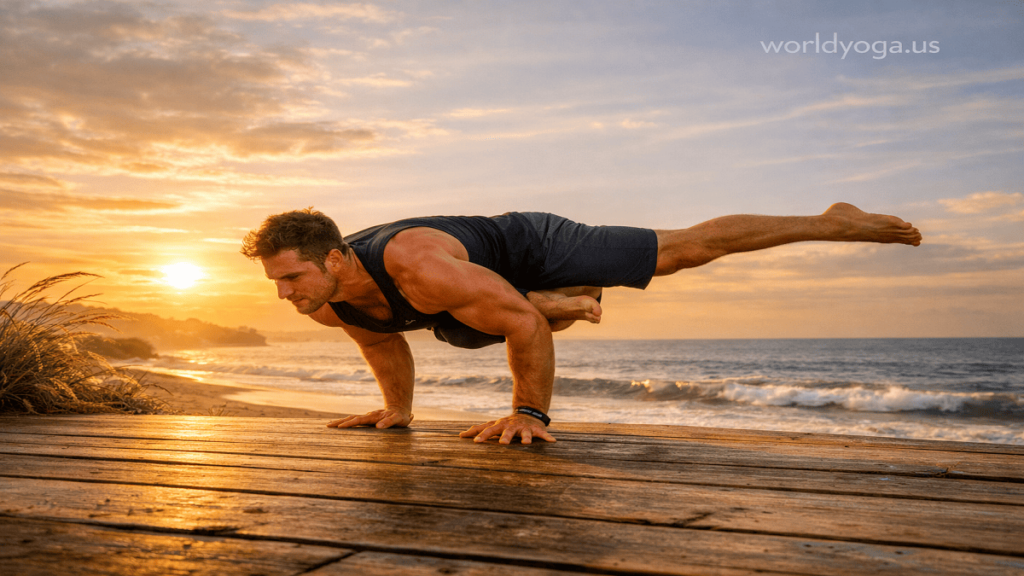
What strength and balance are required?
1. Upper Body Strength
The foundation of this arm balance lies in strong wrists, forearms, and shoulders. The wrists must تحمل (bear) the body’s weight in a flexed position, requiring both strength and mobility. The shoulders—particularly the deltoids and stabilizing muscles around the scapula—must actively support and stabilize the torso. Proper scapular protraction (rounding forward) is essential to prevent collapsing into the joints.
2. Core Stability
Core engagement is critical. The abdominal muscles (especially the transverse abdominis and obliques) act as a central stabilizing force, keeping the body compact and controlled. In Eka Pada Bakasana I, the extended leg creates an imbalance that the core must counteract. Without strong core activation, the hips will drop and the pose becomes unstable.
3. Arm and Triceps Control
The triceps play a crucial role by forming a supportive “shelf” for the bent leg. They must maintain a steady bend (not too deep or too straight) to balance strength and flexibility. This controlled arm positioning helps distribute weight efficiently and prevents overloading the wrists.
4. Hip Flexibility and Engagement
While strength is key, hip mobility is equally important. The bent leg must lift high onto the upper arm, which requires open hips. Meanwhile, the extended leg must remain active and lifted, engaging the glutes and hamstrings to maintain alignment and counterbalance.
5. Balance and Proprioception
Balance in this pose is dynamic rather than static. The body constantly makes micro-adjustments through the hands and fingers to stay stable. This involves proprioception—your awareness of body position in space. Even slight shifts in weight distribution can determine whether you hold the pose or fall forward.
6. Mental Focus and Coordination
Physical strength alone is not enough. Eka Pada Bakasana I requires concentration and coordination. The asymmetrical nature of the pose challenges your ability to remain calm and focused while managing multiple points of engagement simultaneously—a key aspect of Yoga.
Summary
To perform Eka Pada Bakasana I effectively, you need:
- Strong wrists, arms, and shoulders
- Deep core engagement
- Controlled triceps support
- Hip flexibility and active leg engagement
- Refined balance and body awareness
Developing these elements progressively ensures not only success in the pose but also reduces the risk of injury while enhancing overall functional strength and stability.
#Eka Pada Bakasana 1 in Chennai
What are the benefits of this pose?
1. Builds Upper Body Strength
This pose significantly strengthens the wrists, forearms, shoulders, and upper back. Supporting the body weight on the hands develops joint stability and muscular endurance. Over time, it enhances pushing strength and prepares the body for more advanced arm balances and inversions.
2. Enhances Core Stability
Eka Pada Bakasana I requires deep engagement of the abdominal muscles to maintain balance, especially with one leg extended. This strengthens the core, including the obliques and transverse abdominis, which are essential for spinal support and functional movement.
3. Improves Balance and Coordination
Unlike symmetrical poses such as Bakasana, this variation introduces asymmetry, making balance more complex. Practicing it refines proprioception (body awareness) and coordination, as the body must constantly adjust to stay stable.
4. Develops Mental Focus and Concentration
Arm balances demand full attention. Even minor distractions can disrupt stability. This pose trains the mind to stay present, improving concentration, discipline, and mindfulness—core principles of yoga practice.
5. Increases Body Awareness
Holding this posture requires precise control over multiple muscle groups simultaneously. This enhances neuromuscular coordination and deepens the connection between mind and body, allowing for more efficient and controlled movement patterns.
6. Strengthens Wrist and Joint Stability
Weight-bearing on the hands helps condition the wrists and improves joint resilience when practiced correctly. This can be beneficial for overall upper-body functionality, provided proper alignment and gradual progression are followed.
7. Engages and Tones the Lower Body
Although primarily an arm balance, the extended leg remains fully active. The glutes, hamstrings, and inner thighs are engaged to maintain alignment, contributing to lower-body strength and muscle tone.
8. Builds Confidence and Control
Mastering Eka Pada Bakasana I can be psychologically empowering. Successfully balancing in such a demanding pose builds confidence, patience, and a sense of achievement, which often carries over into other areas of practice and daily life.
Summary
The benefits of Eka Pada Bakasana I include:
- Increased upper-body and core strength
- Improved balance and coordination
- Enhanced focus and mental clarity
- Greater body awareness and control
- Stronger, more stable joints
#Eka Pada Bakasana 1 in Ahemadabad
What common mistakes should be avoided?
1. Placing the Knee Too Low on the Arm
One of the most frequent mistakes is positioning the bent knee too low on the triceps. This reduces leverage and makes lifting the body much harder.
Correction: Aim to place the knee as high as possible, نزدیک the armpit, similar to proper alignment in Bakasana.
2. Not Leaning Forward Enough
Many practitioners hesitate to shift their weight forward, fearing a fall. This keeps too much weight in the feet, preventing lift-off.
Correction: Gradually lean forward until your elbows stack over your wrists and your center of gravity moves into your hands. Using a cushion in front can help build confidence.
3. Collapsing into the Shoulders
Allowing the shoulders to sink downward puts excessive pressure on the joints and reduces stability.
Correction: Actively push the floor away and protract the shoulders (round them slightly forward) to create a strong, supported structure.
4. Lack of Core Engagement
Without proper core activation, the hips sag and the extended leg drops, making balance nearly impossible.
Correction: Engage your abdominal muscles continuously and keep the body compact and controlled.
5. Letting the Extended Leg Hang
A passive or low-hanging back leg disrupts balance and shifts weight backward.
Correction: Keep the extended leg active, lifted, and in line with the hips. Think of reaching strongly through the toes.
6. Looking Down Instead of Forward
Gazing straight down can tip your weight backward and destabilize the pose.
Correction: Keep your gaze (drishti) slightly forward on the floor to maintain balance and alignment.
7. Overloading the Wrists
Dumping all body weight into the heels of the hands can strain the wrists.
Correction: Distribute weight evenly across the entire palm and fingers, actively pressing through the fingertips for balance control.
8. Rushing Into the Pose
Attempting Eka Pada Bakasana I without sufficient preparation often leads to poor form and potential injury.
Correction: Build strength and familiarity through foundational poses like Crow Pose and core exercises before progressing.
Summary
Key mistakes to avoid include:
- Poor knee placement
- Insufficient forward lean
- Collapsing shoulders
- Weak core engagement
- Passive extended leg
- Incorrect gaze
- Uneven weight distribution
- Skipping progression
#Eka Pada Bakasana 1 in Kolkata
Case Study of Eka Pada Bakasana 1
Background:
A 32-year-old intermediate practitioner of Yoga sought to improve upper-body strength, balance, and confidence in arm balances. Although proficient in Bakasana, the practitioner struggled with asymmetrical poses, particularly maintaining stability when extending one leg.
Initial Assessment
The practitioner demonstrated:
- Adequate wrist mobility and shoulder strength
- Moderate core engagement
- Limited confidence in forward weight shifting
- Difficulty activating and lifting the extended leg
These limitations resulted in frequent loss of balance and inability to hold Eka Pada Bakasana I for more than 1–2 seconds.
Intervention Plan (6 Weeks)
1. Strength Development (Weeks 1–2):
Focus was placed on building foundational strength through plank variations, chaturanga holds, and core exercises (e.g., leg raises, hollow body holds). Wrist conditioning drills were also introduced to improve load tolerance.
2. Technique Refinement (Weeks 3–4):
The practitioner worked on entering the pose from Crow Pose. Emphasis was given to:
- Higher knee placement on the triceps
- Controlled forward lean
- Proper scapular engagement (protraction)
Props such as yoga blocks and cushions were used to reduce fear of falling.
3. Integration and Balance Training (Weeks 5–6):
Gradual extension of one leg was introduced. The practitioner practiced lifting the extended leg incrementally while maintaining core stability. Short hold durations were repeated multiple times to build endurance and neuromuscular control.
Outcomes
By the end of six weeks, the practitioner achieved:
- A stable hold of Eka Pada Bakasana I for 8–10 seconds
- Improved core strength and shoulder stability
- Better weight distribution through the hands
- Increased confidence in arm balances
Additionally, the practitioner reported enhanced focus and body awareness during practice.
Key Learnings
- Progressive Training is Essential:
Jumping directly into advanced variations without mastering foundational poses limits success and increases injury risk. - Core Engagement Drives Stability:
The ability to control the extended leg depends largely on core strength rather than just arm power. - Mental Barriers Affect Performance:
Fear of falling prevented proper forward weight shift. Using props significantly improved confidence. - Consistency Yields Results:
Regular, structured practice (4–5 sessions per week) was critical in achieving measurable progress.
Conclusion
This case study highlights that mastering Eka Pada Bakasana I requires a combination of strength, technique, and psychological readiness. With systematic progression and mindful practice, practitioners can transition from basic arm balances like Crow Pose to more complex, asymmetrical variations. The pose not only enhances physical capabilities but also reinforces concentration and discipline, reflecting the holistic benefits of Yoga.
#Eka Pada Bakasana 1 in Pune
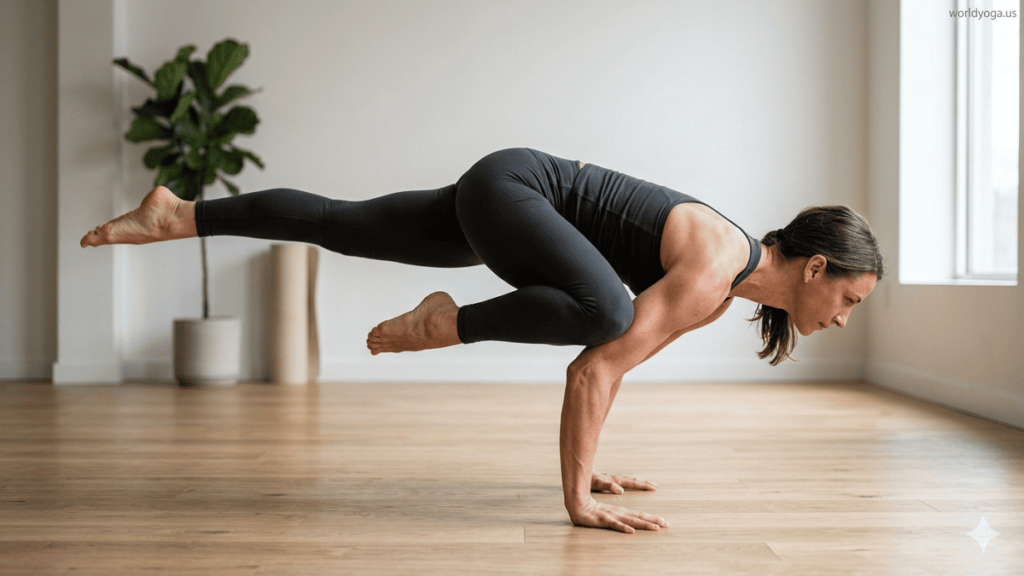
White Paper of Eka Pada Bakasana 1
Abstract
Eka Pada Bakasana I is an advanced arm-balancing posture within Yoga that integrates upper-body strength, core stability, and neuromuscular coordination. This white paper examines the biomechanics, physiological demands, benefits, risks, and training methodologies associated with the pose. The objective is to provide a structured, evidence-informed overview for practitioners, instructors, and movement specialists.
1. Introduction
Eka Pada Bakasana I is a progression from Bakasana, distinguished by its asymmetrical load distribution and extended-leg variation. Unlike symmetrical arm balances, this posture introduces rotational and lateral stability challenges, requiring advanced motor control and proprioceptive awareness.
2. Biomechanical Analysis
2.1 Load Distribution
The pose shifts the practitioner’s center of gravity anteriorly, requiring efficient weight transfer into the hands. The wrists act as primary load-bearing joints, while the shoulders stabilize through scapular protraction.
2.2 Muscle Activation
- Upper Body: Deltoids, triceps, and serratus anterior provide stabilization and lift.
- Core: Transverse abdominis and obliques maintain trunk integrity.
- Lower Body: Gluteus maximus and hamstrings engage to stabilize the extended leg.
2.3 Balance Mechanics
The asymmetrical structure demands continuous micro-adjustments through the fingers and palms, enhancing proprioceptive feedback and neuromuscular efficiency.
3. Physiological Benefits
- Strength Development: Enhances upper-body and core muscular endurance.
- Joint Stability: Conditions wrists and shoulders for load-bearing activities.
- Neuromuscular Coordination: Improves balance, timing, and body awareness.
- Cognitive Engagement: Encourages focus, concentration, and mindfulness.
4. Risk Assessment and Limitations
4.1 Injury Risks
- Wrist strain due to excessive loading
- Shoulder instability if scapular engagement is insufficient
- Risk of forward falls without proper control
4.2 Contraindications
Individuals with wrist injuries, shoulder dysfunction, or limited core strength should avoid or modify the pose. Supervised instruction is recommended for safe progression.
5. Training Methodology
5.1 Foundational Preparation
Practitioners should first develop proficiency in Crow Pose, plank variations, and core stabilization exercises.
5.2 Progressive Loading
Gradual introduction of asymmetry—lifting one leg while maintaining balance—facilitates adaptation without overload.
5.3 Technique Optimization
Key elements include:
- High knee placement on the triceps
- Forward weight shift
- Active core engagement
- Controlled leg extension
5.4 Frequency and Adaptation
Consistent practice (3–5 sessions per week) promotes neuromuscular adaptation and strength gains.
6. Discussion
Eka Pada Bakasana I represents a convergence of strength, balance, and cognitive control. Its asymmetrical design makes it particularly effective for developing unilateral stability and correcting muscular imbalances. However, its complexity necessitates a structured and progressive training approach.
7. Conclusion
Eka Pada Bakasana I is a high-skill posture that offers significant physical and mental benefits when practiced correctly. By integrating biomechanical efficiency, strength development, and mindful awareness, it exemplifies the advanced potential of Yoga. Future exploration may include electromyographic studies and injury-prevention frameworks to further validate its application in modern movement science.
#Eka Pada Bakasana 1 in Banglore
Industry Application of Eka Pada Bakasana 1
Overview
Eka Pada Bakasana I, an advanced arm balance in Yoga, has applications that extend beyond traditional yoga settings. Its emphasis on strength, balance, and neuromuscular control makes it relevant across multiple industries, including fitness, rehabilitation, sports performance, and wellness.
1. Fitness and Personal Training Industry
In modern fitness programming, Eka Pada Bakasana I is used as a high-level bodyweight exercise to develop upper-body strength and core stability. Trainers incorporate it into advanced calisthenics and functional training routines to:
- Improve relative strength (strength-to-bodyweight ratio)
- Enhance coordination and balance
- Introduce progressive overload without equipment
It is particularly valuable in boutique fitness studios and high-performance training environments where body control and movement efficiency are prioritized.
2. Rehabilitation and Physical Therapy
While not typically used in early-stage rehab, modified versions of this pose contribute to later-stage functional recovery. Physical therapists may adapt elements of Bakasana and its variations to:
- Rebuild wrist and shoulder stability
- Improve proprioception after injury
- Restore neuromuscular coordination
Careful supervision ensures safe application, especially for patients recovering from upper-limb injuries.
3. Sports Performance and Athletic Conditioning
Athletes in disciplines such as gymnastics, martial arts, and rock climbing benefit from the attributes developed through Eka Pada Bakasana I. The pose enhances:
- Core stabilization under asymmetrical load
- Upper-body endurance and control
- Balance during dynamic movements
These qualities translate directly into improved athletic performance, particularly in sports requiring bodyweight control and precision.
4. Corporate Wellness Programs
Organizations increasingly integrate Yoga into employee wellness initiatives. While Eka Pada Bakasana I is an advanced pose, it is often showcased as a progression goal to:
- Encourage long-term engagement in wellness programs
- Promote strength, focus, and stress management
- Inspire achievement and motivation among participants
It symbolizes growth and mastery, which aligns with professional development themes.
5. Yoga Education and Certification Programs
In teacher training programs, Eka Pada Bakasana I is used to teach biomechanics, alignment, and progression strategies. Instructors learn how to:
- Break down complex poses into accessible steps
- Identify and correct alignment errors
- Guide students safely toward advanced postures
This makes it a valuable educational tool within the yoga instruction industry.
6. Digital Fitness and Content Creation
With the rise of online platforms, advanced poses like Eka Pada Bakasana I are widely used in digital content (videos, tutorials, courses). They:
- Attract experienced practitioners seeking challenges
- Demonstrate expertise and credibility of instructors
- Enhance engagement in virtual fitness communities
Conclusion
Eka Pada Bakasana I has evolved from a traditional yoga posture into a versatile movement applied across multiple industries. Its ability to develop strength, balance, and focus makes it valuable in fitness training, rehabilitation, sports performance, and wellness programming. As interest in functional movement and holistic health continues to grow, the relevance of advanced poses within Yoga is expected to expand further.
#Eka Pada Bakasana 1 in Mumbai
Ask FAQs
What is Eka Pada Bakasana I?
Eka Pada Bakasana I is an advanced arm balance in Yoga where the body is supported on the hands, one leg rests on the upper arm, and the other leg extends straight back. It is a progression from Bakasana and requires strength, balance, and coordination.
Who can practice this pose?
This pose is best suited for intermediate to advanced practitioners. Beginners should first build strength and stability through foundational poses like Crow Pose, planks, and core exercises before attempting Eka Pada Bakasana I.
What are the main benefits of this pose?
Eka Pada Bakasana I helps develop upper-body strength, core stability, balance, and focus. It also improves body awareness and coordination, making it beneficial for both physical fitness and mental concentration.
What are common challenges in this pose?
Practitioners often struggle with shifting their weight forward, maintaining core engagement, and keeping the extended leg lifted. Fear of falling and weak wrist or shoulder strength can also make the pose difficult initially.
How can I practice this pose safely?
To practice safely:
Warm up wrists, shoulders, and hips
Use props like cushions to reduce fear of falling
Focus on proper alignment and gradual progression
Avoid the pose if you have wrist or shoulder injuries
Consistent practice within Yoga and guidance from a qualified instructor can help you perform the pose safely and effectively.
Table of Contents
Disclaimer:
The information provided about Eka Pada Bakasana I is for educational purposes only and does not substitute professional medical or fitness advice. Practice Yoga poses at your own risk, and consult a qualified instructor or healthcare professional before attempting advanced postures, especially if you have existing injuries or medical conditions.