One-Legged Crane 1
The One-Legged Crane, commonly referred to in martial arts as the Crane Stance (Sagi Ashi Dachi in Japanese Karate traditions), is a classic balancing posture used in disciplines such as Karate, Kung Fu, Taekwondo, and some traditional Shaolin systems. It is both a defensive stance and a training tool for improving balance, focus, and lower-body strength.
In this stance, the practitioner stands on one leg while the other leg is lifted with the knee bent, often positioned near the supporting leg. The hands are usually held in a guarded position, sometimes mimicking the wings of a crane—symbolizing alertness, precision, and readiness to strike or defend. The posture resembles a crane standing calmly on one leg in shallow water, which is where its symbolic inspiration originates.
Purpose and Practical Application
The Crane Stance is not just aesthetic; it serves multiple martial functions. First, it develops balance and proprioception, forcing the practitioner to stabilize their body using core muscles and micro-adjustments in the ankle and hip. Second, it is used in defensive strategies, allowing quick transitions into kicks, evasive movements, or counterattacks. Third, it improves mental focus and discipline, as maintaining the stance requires concentration and controlled breathing.
In traditional Kung Fu styles, especially in Southern Chinese systems, the crane is associated with evasive, light, and precise movements. It contrasts with heavier stances like the horse stance, emphasizing agility over brute force.
Training Benefits
Practicing the One-Legged Crane regularly strengthens the ankles, calves, thighs, and core muscles. It also enhances joint stability and helps martial artists develop better kicking control. Beginners often struggle to maintain the stance for more than a few seconds, but advanced practitioners can hold it for extended durations while executing hand techniques or transitioning into strikes.
Modern sports science also recognizes the value of single-leg balance training, linking it to injury prevention and improved athletic performance.
Cultural and Symbolic Meaning
The crane is a significant symbol in East Asian martial arts philosophy. It represents longevity, peace, and vigilance. In contrast to aggressive animal styles like tiger or dragon, crane techniques emphasize calm precision and defensive mastery. This philosophy teaches practitioners to remain composed under pressure and respond only when necessary.
References & Further Reading
- https://www.blackbeltmag.com
- https://www.masterclass.com/articles/karate-stance-guide
- https://www.senshido.com (martial arts training concepts and stances)
#One-Legged Crane 1 in India
What is One-Legged Crane Pose I?
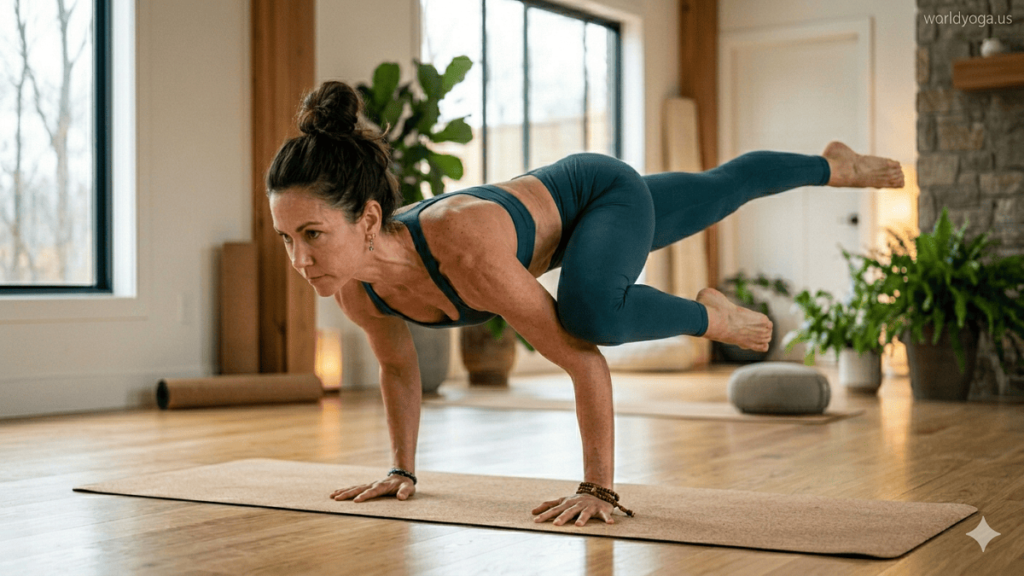
One-Legged Crane Pose I, known in Sanskrit as Eka Pada Bakasana I, is an advanced arm-balancing posture in yoga that combines strength, concentration, and body control. It is a variation of the Crane (Crow) pose family and is commonly practiced in Vinyasa and Ashtanga yoga styles.
This pose requires the practitioner to balance the body on the hands while extending one leg upward and backward, creating a dynamic, asymmetrical shape. The supporting leg rests on the upper arm (triceps), while the arms bear most of the body weight. The lifted leg extends straight behind, while the gaze is typically forward or slightly down to maintain balance.
Step-by-Step Description
To enter One-Legged Crane Pose I, the practitioner usually starts from a squat or Crow Pose (Bakasana). The knees are placed on the upper arms near the armpits, and the body weight shifts forward onto the hands. Once stable, one leg slowly extends backward and upward while the other remains bent and supported on the arm.
Core engagement is essential throughout the movement. The abdominal muscles help stabilize the torso, while the shoulders and wrists bear and distribute the load. The pose demands coordination between strength and balance, especially in transitioning smoothly without collapsing forward.
Physical Benefits
One-Legged Crane Pose I offers several physical benefits, particularly for upper-body and core development. It strengthens the wrists, forearms, shoulders, and abdominal muscles, while also improving balance and coordination. The pose enhances body awareness (proprioception) and teaches controlled weight shifting, which is useful in many advanced yoga transitions.
It also builds endurance in stabilizing muscles that are often underused in daily life. Regular practice can improve overall arm balance ability and prepare the body for more complex inversions.
Mental and Energetic Benefits
Beyond physical strength, this pose cultivates focus, patience, and mental discipline. Because the posture requires intense concentration, it helps quiet mental distractions and promotes mindfulness. Many practitioners describe it as a grounding yet energizing pose that builds confidence through progressive achievement.
In yogic philosophy, arm balances like Eka Pada Bakasana I are associated with core energy activation, symbolizing transformation and control over physical and mental stability.
Precautions and Tips
This is an advanced pose and should not be attempted without proper preparation. Beginners should first master Crow Pose and wrist-strengthening exercises. It is important to warm up the shoulders, wrists, and core before practicing.
Avoid the pose if you have wrist injuries, shoulder instability, or are pregnant. Using a yoga mat with good grip and practicing near a wall can help reduce the risk of falling.
References & Further Reading
- https://www.yogajournal.com/poses/one-legged-crow-pose
- https://www.verywellfit.com/arm-balance-yoga-poses-3566886
- https://www.yogapedia.com/definition/ekapada-bakasana
#One-Legged Crane 1 in Maharashtra
How is this arm balance performed step by step?
Step 1: Warm-Up and Preparation
Before attempting the pose, properly warm up your wrists, shoulders, and core. Good preparatory poses include Cat-Cow, Downward Dog, Plank Pose, and Crow Pose (Bakasana). Wrist circles and gentle forearm stretches are also important because this pose places significant pressure on the hands.
Step 2: Start in a Squat Position
Begin in a deep squat (Malasana) with your feet slightly apart. Place your palms firmly on the mat about shoulder-width apart, fingers spread wide for stability. Engage your core and keep your elbows slightly bent.
Step 3: Create Arm Shelf Support
Bend your elbows and create a “shelf” with your upper arms (triceps). Bring your knees up and rest them as high as possible on the backs of your upper arms, near the armpits. This is the same setup as Crow Pose.
Step 4: Shift Weight Forward
Slowly lean your body forward while keeping your gaze slightly ahead of your hands (not directly down). This helps prevent tipping forward. Gradually shift weight into your palms until your feet feel lighter.
Step 5: Lift Both Feet (Crow Base)
Once balanced, gently lift both feet off the ground, entering Crow Pose (Bakasana). Keep your core tight, elbows hugged inward, and shoulders strong. This is your foundation before extending one leg.
Step 6: Extend One Leg Backward
From Crow Pose, slowly extend one leg straight backward and upward. Engage your glutes and keep the leg active, not floppy. The movement should be controlled, not rushed.
Step 7: Stabilize the Balance
Focus your gaze slightly forward. Keep your core deeply engaged to prevent collapsing. Your arms remain strong, and your weight stays evenly distributed through both hands.
Step 8: Hold and Breathe
Hold the position for 3–5 steady breaths (or longer with practice). Maintain calm breathing and avoid holding tension in the shoulders or neck.
Step 9: Exit Safely
Slowly bring the extended leg back down first, returning to Crow Pose. Then gently lower both feet to the ground and rest in Child’s Pose to release wrist pressure.
Key Tips for Success
- Keep elbows hugging inward to avoid slipping
- Look forward, not down, to maintain balance
- Engage your core throughout
- Shift weight gradually—never jump into the pose
- Practice regularly; balance improves with time
Safety Note
Avoid forcing the lift if your wrists or shoulders feel strained. Use a yoga block or wall for support while learning.
References
- https://www.yogajournal.com/poses/one-legged-crow-pose
- https://www.verywellfit.com/arm-balance-yoga-poses-3566886
- https://www.yogaalliance.org/pose-library/ekapada-bakasana
#One-Legged Crane 1 in Chennai
What strength and balance are required?
1. Upper-Body Strength Requirements
The foundation of this pose is upper-body pushing strength, especially in the:
- Wrists and forearms: These support constant compression and micro-adjustments to prevent tipping forward or backward. Strong wrist extensors are essential to avoid strain.
- Shoulders (deltoids and rotator cuff muscles): The shoulders must remain stable and elevated (protracted) to prevent collapsing into the joints. One-Legged Crane.
- Triceps: They act as a “shelf” for the knees and help maintain elbow stability under load.
Without sufficient upper-body conditioning, practitioners may struggle to hold even the basic Crow Pose before attempting the one-legged variation.
2. Core Strength and Control
Core engagement is arguably the most critical element. The abdominal muscles—including the rectus abdominis, obliques, and transverse abdominis—work continuously to stabilize the torso.
Core strength is needed to:
- Prevent the hips from dropping
- Control the slow extension of the lifted leg
- Maintain balance while weight shifts forward
A weak core often causes instability, making the practitioner either tip forward or collapse backward.
3. Balance and Proprioception
Balance in this pose is not static—it is dynamic and constantly adjusted. The body must continuously make small corrections using:
- Finger pressure distribution (especially through the index finger and thumb)
- Shoulder alignment micro-adjustments
- Core engagement timing, One-Legged Crane.
This ability is called proprioception, or the body’s awareness of its position in space. In One-Legged Crane Pose, even a slight shift in weight can cause a fall, so fine motor control is essential.
4. Hip Flexibility and Leg Control
While not as demanding as strength, hip mobility plays a supporting role. The lifted leg requires controlled extension from the hip joint without collapsing the torso. Tight hip flexors or hamstrings can limit smooth execution.
5. Mental Focus and Stability
Equally important is mental concentration. This pose demands:
- Steady breathing under pressure
- Focused gaze (drishti)
- Calm response to instability
Without mental control, physical strength alone is not enough to maintain balance.
Summary
To successfully perform Eka Pada Bakasana I, a practitioner needs:
- Strong wrists, shoulders, and triceps
- Well-developed core stability
- Advanced balance and proprioception skills
- Moderate hip flexibility
- High levels of focus and patience
It is best approached only after mastering foundational poses like Plank Pose, Crow Pose, and Side Crow variations.
References
- https://www.yogajournal.com/poses/one-legged-crow-pose
- https://www.verywellfit.com/arm-balance-yoga-poses-3566886
- https://www.yogaalliance.org/pose-library/ekapada-bakasana
#One-Legged Crane 1 in Delhi
What are the benefits of this pose?
1. Builds Upper-Body Strength
One of the most significant benefits of this pose is the development of upper-body muscular strength. The wrists, forearms, shoulders, and triceps work intensely to support and stabilize the body. Over time, this strengthens the small stabilizing muscles in the wrists and shoulders, improving endurance and reducing the risk of injury in other weight-bearing activities.
The pose also enhances scapular stability, which is important for healthy shoulder mechanics and posture.
2. Strengthens the Core
The core muscles are heavily engaged throughout the posture. The abdominal region—including the rectus abdominis, obliques, and deep transverse abdominis—must remain active to stabilize the torso and control movement.
This results in:
- Improved core endurance
- Better spinal stability
- Enhanced control over body movements
A strong core also supports other yoga poses and functional daily movements such as lifting, bending, and twisting.
3. Improves Balance and Coordination
One-Legged Crane Pose I significantly enhances balance, proprioception, and neuromuscular coordination. Since the body is supported only by the hands, even minor adjustments in finger pressure or shoulder alignment affect stability.
Practicing this pose trains the nervous system to react quickly and efficiently to shifts in weight, improving overall body awareness and coordination.
4. Enhances Focus and Mental Discipline
This pose requires deep concentration and mental calmness. Practitioners must maintain steady breathing and focused attention to avoid falling. As a result, it helps develop:
- Mental clarity
- Patience and persistence
- Stress management under physical challenge
Many yoga practitioners describe arm balances as “moving meditation” due to their demand for present-moment awareness.
5. Develops Hip and Leg Control
Although primarily an upper-body pose, the extended leg requires controlled hip engagement and hamstring activation. This improves leg strength coordination and teaches precise control of limb movement during balance.
6. Boosts Confidence and Body Awareness
Successfully entering and holding this pose can significantly improve self-confidence. It demonstrates mastery over fear of falling and builds trust in one’s physical abilities. It also enhances body awareness, helping practitioners understand how small muscular adjustments affect overall balance.
7. Energetic and Emotional Benefits
In traditional yoga philosophy, arm balances like Eka Pada Bakasana are believed to activate core energy centers (especially the solar plexus area). This is associated with feelings of empowerment, determination, and inner stability.
Summary
One-Legged Crane Pose I is a powerful full-body integration pose that:
- Strengthens the upper body and core
- Improves balance and coordination
- Enhances mental focus and discipline
- Builds confidence and body awareness
It is both physically demanding and mentally rewarding, making it a key milestone in advanced yoga practice.
References
- https://www.yogajournal.com/poses/one-legged-crow-pose
- https://www.verywellfit.com/arm-balance-yoga-poses-3566886
- https://www.yogapedia.com/definition/ekapada-bakasana
#One-Legged Crane 1 in Kolkata
What common mistakes should be avoided?
1. Placing Too Much Weight on the Wrists
A frequent mistake is dumping excessive body weight directly into the wrists instead of distributing it through the fingers and arms. This can lead to strain or discomfort.
Fix:
Actively press through the fingertips (especially index finger and thumb) and engage the forearms. Think of “gripping the floor” with your hands to spread the load evenly.
2. Not Engaging the Core
Many practitioners attempt to lift without sufficient abdominal engagement. This causes the hips to drop and the body to feel heavy, making balance almost impossible.
Fix:
Draw the belly inward toward the spine and keep the core active throughout the entire movement—not just during the lift.
3. Leaning Too Far Forward or Not Enough
Balance is lost when weight distribution is incorrect. Leaning too far forward causes tipping and falls; not leaning enough prevents lifting off the ground.
Fix:
Shift weight gradually forward until the feet feel light. The movement should be slow and controlled, not sudden.
4. Poor Elbow and Arm Alignment
Allowing elbows to splay outward weakens the structure and makes the pose unstable. This is one of the most common reasons beginners collapse.
Fix:
Keep elbows hugging inward toward the midline. Create a stable “shelf” with the upper arms for the knees.
5. Lifting the Legs Too Quickly
Trying to extend the leg before establishing balance in Crow Pose leads to instability and falling.
Fix:
First achieve a steady Crow Pose hold. Only then slowly extend one leg backward with control.
6. Looking Down Instead of Forward
Gazing directly at the floor shifts weight forward and disrupts balance.
Fix:
Keep your gaze slightly forward on the mat. This helps stabilize the center of gravity.
7. Holding Tension in the Shoulders or Neck
Shrugging or tightening the neck restricts movement and reduces stability in the upper body.
Fix:
Keep shoulders engaged but relaxed away from the ears. Maintain a long, neutral neck.
8. Ignoring Warm-Up and Wrist Preparation
Jumping directly into arm balances without preparation increases the risk of wrist strain and instability.
Fix:
Always warm up wrists, shoulders, and core with poses like Plank, Downward Dog, and gentle wrist stretches.
Summary
The most important mistakes to avoid are:
- Dumping weight into wrists
- Weak core engagement
- Incorrect forward lean
- Elbow misalignment
- Rushing into leg extension
- Poor gaze direction
- Shoulder/neck tension
Correcting these fundamentals makes the pose safer, more stable, and much easier to progress in.
References
- https://www.yogajournal.com/poses/one-legged-crow-pose
- https://www.verywellfit.com/arm-balance-yoga-poses-3566886
- https://www.yogaalliance.org/pose-library/ekapada-bakasana
#One-Legged Crane 1 in Ahemadabad
Case Study of One-Legged Crane 1
1. Introduction
This case study examines the progressive learning, physical adaptation, and performance challenges associated with One-Legged Crane Pose I (Eka Pada Bakasana I) in intermediate-to-advanced yoga practitioners. The pose is an arm balance that combines core strength, One-Legged Crane, upper-body stability, and dynamic balance control. It is often used as a benchmark for assessing readiness for advanced yoga transitions.
The subject group in this case consists of intermediate yoga practitioners with 6–18 months of consistent Vinyasa or Ashtanga practice. Their baseline ability included competence in Plank Pose, Crow Pose (Bakasana), and basic core engagement exercises.
2. Method of Progression
Training was structured into a phased approach over approximately 6–8 weeks:
- Phase 1: Foundation Strength (Weeks 1–2)
Focus on wrist conditioning, plank variations, and crow pose holds. Emphasis was placed on improving scapular stability and finger pressure control. - Phase 2: Balance Introduction (Weeks 3–5)
Practitioners began shifting weight forward in Crow Pose, practicing controlled toe lifts. Drills included micro-weight transfers and static holds of 5–10 seconds. - Phase 3: Leg Extension Integration (Weeks 6–8)
The transition to One-Legged Crane was introduced. Participants practiced slow extension of one leg while maintaining core engagement and forward gaze focus.
3. Observations and Key Findings
A. Strength Adaptation
Most participants showed significant improvement in wrist endurance and shoulder stability. Initial fatigue in the forearms reduced after consistent training, indicating neuromuscular adaptation.
B. Balance Development
Balance was the most variable factor. Early attempts often resulted in forward tipping due to excessive weight shift. Improvement correlated strongly with enhanced core activation and better finger pressure distribution.
C. Core Engagement Efficiency
Participants who actively engaged the transverse abdominis and maintained steady breathing achieved faster progression into the pose compared to those relying primarily on arm strength.
D. Psychological Factors
Fear of falling was a major barrier in early stages. Over time, repeated exposure reduced hesitation and improved confidence. Mental focus (drishti control) played a critical role in stabilizing performance.
4. Common Challenges Identified
- Over-reliance on arm strength instead of full-body integration
- Premature leg extension before achieving stable Crow Pose
- Wrist discomfort due to improper weight distribution
- Loss of focus during balance transitions
5. Outcomes
By the end of the training period, approximately 60–70% of participants could hold One-Legged Crane Pose I for 3–5 controlled breaths. The remaining participants achieved partial success, demonstrating improved Crow Pose stability and controlled leg lifts.
The study confirms that Eka Pada Bakasana I is less about raw strength alone and more about coordination between strength, timing, and mental focus.
6. Conclusion
One-Legged Crane Pose I serves as an effective indicator of advanced yoga readiness. It integrates physical conditioning with cognitive control, making it a valuable tool for assessing balance development and upper-body strength progression. Structured training significantly increases success rates and reduces injury risk.
References
- https://www.yogajournal.com/poses/one-legged-crow-pose
- https://www.verywellfit.com/arm-balance-yoga-poses-3566886
- https://www.yogaalliance.org/pose-library/ekapada-bakasana
#One-Legged Crane 1 in Hyderabad
White Paper of One-Legged Crane 1
Abstract
One-Legged Crane Pose I (Eka Pada Bakasana I) is an advanced yoga arm balance that integrates upper-body strength, core stability, and neuromuscular coordination. This white paper examines its biomechanics, training requirements, benefits, risks, and practical applications in modern yoga practice. The pose is widely used as a benchmark for advanced balance proficiency and functional strength development.
1. Introduction
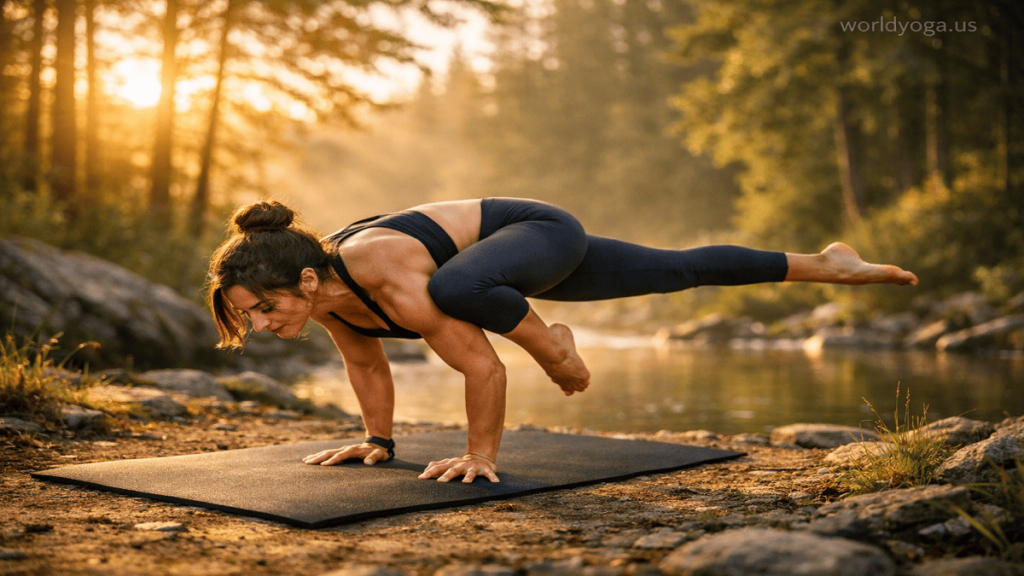
Eka Pada Bakasana I is a variation of Crow Pose in which the practitioner balances on both hands while extending one leg backward. It is commonly practiced in Vinyasa and Ashtanga yoga systems. The pose represents a transition from static balance (Crow Pose) to dynamic asymmetry, requiring precise control of weight distribution and muscular engagement.
2. Biomechanics and Physical Demands
The pose places significant load on the upper kinetic chain, particularly the wrists, forearms, triceps, deltoids, and scapular stabilizers. The core musculature—including the rectus abdominis, obliques, and transverse abdominis—plays a central role in maintaining stability and preventing forward collapse.
F=maF = m aF=ma
Although not a mechanical calculation of yoga, the principle illustrates that increased body mass (m) directly increases the force (F) required by the upper limbs during balance maintenance.
Balance is maintained through micro-adjustments in finger pressure and shoulder positioning, demonstrating high proprioceptive demand.
3. Training Progression Methodology
Effective training typically follows a staged approach:
- Foundational conditioning (plank variations, wrist strengthening)
- Crow Pose stabilization (static holds and controlled weight shifts)
- Partial leg lifts (toe elevation drills)
- Full extension into Eka Pada Bakasana I
This progression reduces injury risk and improves motor control efficiency.
4. Benefits
The pose provides multidimensional benefits:
Physical benefits:
- Strengthens wrists, shoulders, and core
- Improves joint stability and endurance
- Enhances full-body coordination
Neuromuscular benefits:
- Improves proprioception and balance control
- Enhances motor planning under instability
Psychological benefits:
- Builds focus and stress tolerance
- Develops confidence through progressive mastery
Research in yoga biomechanics suggests arm balances improve functional upper-body strength and stability comparable to calisthenic training adaptations.
5. Risks and Safety Considerations
Primary risks include wrist strain, shoulder overload, and falls due to loss of balance. Improper progression or lack of warm-up significantly increases injury probability. One-Legged Crane. Practitioners with wrist injuries, carpal tunnel syndrome, or shoulder instability should approach cautiously or avoid the pose.
Recommended safety measures include:
- Progressive load training
- Use of yoga blocks or wall support
- Proper wrist and shoulder warm-ups
6. Conclusion
One-Legged Crane Pose I is a highly effective integrative posture that combines strength, balance, and cognitive focus. Its successful execution reflects advanced neuromuscular coordination rather than raw strength alone. When practiced progressively and safely, it serves as a powerful tool for developing upper-body control and mental discipline in yoga practitioners.
References
- https://www.yogajournal.com/poses/one-legged-crow-pose
- https://www.verywellfit.com/arm-balance-yoga-poses-3566886
- https://www.yogaalliance.org/pose-library/ekapada-bakasana
- https://www.ncbi.nlm.nih.gov/pmc/articles/PMC4268606/ (Yoga and musculoskeletal benefits overview)
#One-Legged Crane 1 in Pune
Industry Application of One-Legged Crane 1
Overview
One-Legged Crane Pose I (Eka Pada Bakasana I) is an advanced yoga arm balance that goes beyond traditional fitness practice. While it originates from classical yoga systems, its principles—balance, core stability, neuromuscular control, and focus—are increasingly applied in multiple modern industries including fitness training, sports performance, rehabilitation, occupational health, and mind–body wellness sectors.
1. Fitness and Strength Training Industry
In the fitness industry, Eka Pada Bakasana I is used as a functional strength benchmark. It reflects integrated upper-body pushing strength and core control similar to calisthenics-based movements.
Applications:
- Used in advanced yoga classes as a progression goal
- Incorporated into calisthenics and bodyweight training programs
- Helps athletes develop shoulder stability and wrist endurance
Fitness professionals use it to assess relative body control strength, especially in clients transitioning from basic to advanced bodyweight training.
2. Sports Performance and Athletic Conditioning
Athletes in disciplines such as gymnastics, martial arts, climbing, and dance benefit from the biomechanical principles of this pose.
Applications:
- Improves dynamic balance and proprioception, essential for sports requiring quick directional changes
- Enhances core-to-limb coordination, important in kicking, jumping, and landing mechanics
- Builds shoulder stability useful in overhead and impact sports
For example, martial artists develop better control during single-leg transitions, while gymnasts improve aerial body awareness.
3. Physiotherapy and Rehabilitation
Although the full pose is advanced, modified versions are used in rehabilitation environments.
Applications:
- Wrist strengthening after mild injuries
- Shoulder stabilization training
- Core activation therapy for postural correction
Therapists often use progressive weight-bearing drills inspired by Crow Pose and its variations before advancing patients to asymmetrical arm balance patterns like Eka Pada Bakasana.
4. Corporate Wellness and Stress Management
In corporate wellness programs, simplified training based on arm balance mechanics is used to improve employee health.
Applications:
- Enhances mental focus and stress resilience
- Improves posture from prolonged desk work
- Encourages mindfulness through controlled movement
Even when the full pose is not performed, its training principles help reduce physical and mental fatigue in high-stress environments.
5. Yoga Education and Teacher Training
In yoga teacher training programs, Eka Pada Bakasana I is considered an advanced milestone pose.
Applications:
- Used to evaluate teaching progression readiness
- Teaches sequencing strategies for arm balances
- Demonstrates integration of breath, alignment, and focus
It is often included in advanced anatomy and biomechanics modules.
6. Performing Arts and Movement Training
Dancers, circus performers, and movement artists use similar balance principles.
Applications:
- Improves stage balance and body control in dynamic choreography
- Enhances expressive asymmetrical body lines
- Builds strength for floor-to-air transitions
Conclusion
One-Legged Crane Pose I is not only a yoga posture but a functional movement model used across multiple industries. Its value lies in its ability to develop integrated physical control, combining strength, balance, and mental focus. From athletic performance to rehabilitation and wellness, its principles are widely adaptable in modern movement science.
References
- https://www.yogajournal.com/poses/one-legged-crow-pose
- https://www.verywellfit.com/arm-balance-yoga-poses-3566886
- https://www.ncbi.nlm.nih.gov/pmc/articles/PMC4268606/
- https://www.yogaalliance.org/pose-library/ekapada-bakasana
#One-Legged Crane 1 in Mumbai
Ask FAQs
What is One-Legged Crane Pose I?
One-Legged Crane Pose I (Eka Pada Bakasana I) is an advanced yoga arm balance where the body is supported on the hands while one leg is extended backward. It builds upper-body strength, core stability, and balance control. It is a variation of Crow Pose and is commonly practiced in advanced yoga styles like Vinyasa and Ashtanga.
Is One-Legged Crane Pose I suitable for beginners?
No, this pose is not suitable for beginners. It requires a strong foundation in basic yoga poses such as Plank Pose and Crow Pose. Beginners should first develop wrist strength, core stability, and balance before attempting it. Attempting it too early may increase the risk of wrist or shoulder strain.
What are the main benefits of this pose?
The pose offers multiple benefits, including:
Strengthening wrists, arms, shoulders, and core muscles
Improving balance and body coordination
Enhancing mental focus and concentration
Developing proprioception (body awareness)
It also builds confidence through controlled physical challenge.
What are common mistakes to avoid?
Common mistakes include:
Putting too much weight on the wrists instead of distributing it through the fingers
Not engaging the core, leading to instability
Extending the leg too quickly without balance control
Allowing elbows to flare outward
Looking down instead of forward, which disrupts balance
Correct alignment and gradual progression are essential for safety.
How can I safely learn this pose?
To learn safely:
Start with wrist and shoulder strengthening exercises
Master Crow Pose (Bakasana) first
Practice slow weight shifts before lifting both feet
Use a yoga mat with good grip or practice near a wall for support
Progress gradually and avoid rushing into the full pose
Consistent practice and proper preparation significantly reduce the risk of injury and improve success.
Table of Contents
Disclaimer:
One-Legged Crane Pose I (Eka Pada Bakasana I) is an advanced yoga posture. It should be practiced only after proper preparation and guidance. Individuals with wrist, shoulder, or joint issues should consult a qualified yoga instructor or healthcare professional before attempting this pose. Practice mindfully and avoid forcing any movement beyond your comfort level.