
Backbend: Forearms on the Floor, One-Legged
Backbend: Forearms on the Floor, One-Legged is an advanced backbending yoga variation that combines deep spinal extension with forearm support and a single-leg lift. It is typically viewed as a progression between forearm-supported wheel variations and advanced asymmetrical backbends, requiring strong shoulder stability, core control, and hip flexibility.
What the Pose Is
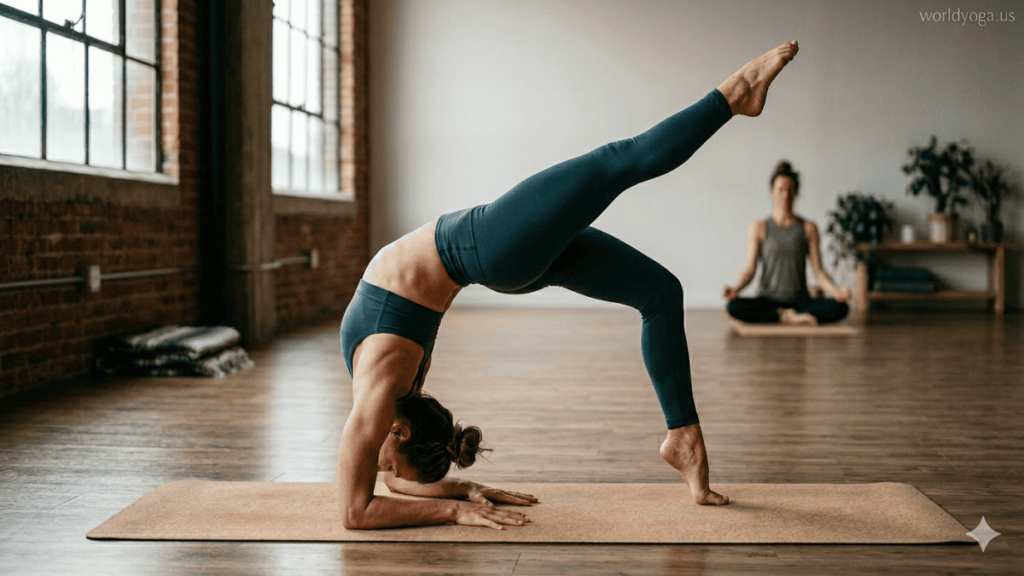
This posture is essentially a deep backbend performed with forearms grounded on the floor while one leg is lifted off the ground, creating an asymmetrical balance challenge. The base resembles a forearm-supported wheel or bridge variation, but with added unilateral (one-sided) leg elevation.
It demands:
- Strong spinal arching capacity
- Forearm and shoulder load-bearing strength
- Core stabilization to prevent twisting collapse
- Controlled hip extension for the lifted leg
How It Is Performed (Conceptual Steps)
- Begin lying on your back with knees bent
- Place forearms on the floor, elbows under shoulders
- Press into forearms and feet to lift into a supported deep backbend
- Establish a stable arch through the spine and chest opening
- Once stable, shift weight evenly through forearms and grounded foot
- Slowly extend one leg upward or backward while maintaining pelvic stability
- Hold balance with controlled breathing and strong core engagement
- Lower the lifted leg slowly before exiting the pose safely
Key Benefits
- Strengthens shoulders, forearms, and upper back
- Improves spinal flexibility and thoracic extension
- Enhances core stability through asymmetrical loading
- Develops balance and neuromuscular coordination
- Opens hip flexors and anterior chain muscles
- Builds control for advanced backbend transitions
Muscles Engaged
- Erector spinae (spinal muscles)
- Deltoids and trapezius (shoulders and upper back)
- Core muscles (abdominals and obliques)
- Glutes and hamstrings (support and leg lift)
- Forearm flexors (load-bearing stability)
Precautions
This is an advanced posture and should not be attempted without preparation.
Avoid if you have:
- Shoulder or wrist injuries
- Lower back disc issues
- Neck instability
- Poor core strength or balance control
Common mistakes include collapsing into the lower back, over-rotating the pelvis, or lifting the leg without core support.
Summary
Backbend: Forearms on the Floor, One-Legged is a high-intensity asymmetrical backbend that integrates strength, flexibility, and balance. It is primarily used in advanced yoga and movement training systems to develop spinal control, shoulder endurance, and full-body coordination.
Reference Links
- https://www.yogajournal.com/poses/wheel-pose/
- https://www.verywellfit.com/urdhva-dhanurasana-wheel-pose-3567072
- https://www.yogapedia.com/definition/5093/bandha
#Backbend: Forearms on the Floor, One-Legged in India
What is the One-Legged Forearm Backbend variation?
The One-Legged Forearm Backbend is an advanced yoga backbend variation where the practitioner supports the body in a deep spinal extension using the forearms on the floor, while one leg is lifted off the ground. It is an asymmetrical progression of forearm-supported backbends and is used to develop strength, balance, and spinal control under uneven load.
Core Idea of the Pose
In this variation:
- The forearms act as the main base of support instead of the palms
- The spine is held in a deep backbend (wheel-like arch)
- One leg remains grounded for stability
- The other leg is lifted to create asymmetrical challenge and activation
This combination makes the pose significantly more demanding than standard backbends because the body must resist rotation and collapse while maintaining spinal extension.
How It Works (Conceptually)
The pose integrates three systems:
- Spinal extension system: deep backbend through thoracic and lumbar spine
- Forearm support system: shoulders and elbows stabilize body weight
- Unilateral leg system: one leg lifts, requiring pelvic control and core activation
This creates a controlled imbalance that strengthens stability muscles.
Reference: https://www.yogajournal.com/poses/wheel-pose/
Key Characteristics
- Forearms are grounded, elbows under shoulders
- Chest remains open in a lifted arch
- One leg stays active for balance
- The lifted leg engages hip flexors and glutes
- Core prevents twisting or collapsing
Purpose of the Variation
This posture is typically used in advanced training to:
- Build shoulder endurance without wrist loading
- Improve core stability under asymmetrical stress
- Enhance hip control and flexibility
- Train balance in deep spinal extension
- Prepare for advanced backbend transitions and arm balances
Physical Demands
To perform this variation safely, a practitioner needs:
- Strong forearm and shoulder stability
- Deep spinal flexibility (especially thoracic mobility)
- Core strength to prevent rotation
- Hip flexibility for controlled leg lift
- Breath control under load
Risks and Limitations
This is an advanced pose and may cause issues if attempted prematurely:
- Lower back compression due to poor alignment
- Shoulder strain from instability
- Loss of balance during leg lift
- Neck tension if chest is not properly elevated
Reference: https://www.verywellfit.com/urdhva-dhanurasana-wheel-pose-3567072
Summary
The One-Legged Forearm Backbend variation is a high-level asymmetrical backbend that combines forearm support with a unilateral leg lift. It is designed to develop spinal extension strength, shoulder stability, and core control, making it a valuable progression in advanced yoga and movement training systems.
#Backbend: Forearms on the Floor, One-Legged in Maharashtra
How is this pose performed step by step?
1. Preparation (warm-up phase)
Prepare the spine, shoulders, and hips before attempting the pose:
- Practice Cobra Pose (Bhujangasana) and Bridge Pose (Setu Bandhasana)
- Add Dolphin Pose to strengthen forearms and shoulders
- Include hip flexor stretches (low lunges)
- Activate core lightly (plank variations)
Goal: open thoracic spine and prepare shoulders for weight-bearing.
2. Starting position
- Lie on your back on the mat
- Bend knees, feet hip-width apart near the hips
- Place forearms on the floor, elbows directly under shoulders
- Palms can be flat or gently pressed
Keep neck relaxed and grounded initially.
Reference: https://www.yogajournal.com/poses/wheel-pose/
3. Lift into forearm backbend base
- Inhale deeply
- Press forearms and feet into the floor
- Lift hips, chest, and spine upward into a forearm-supported backbend
- Open the chest and lengthen the spine evenly
At this stage, both feet remain grounded.
4. Stabilize the base
Before lifting a leg:
- Engage core gently (abdominals and pelvic floor)
- Keep shoulders stable (do not collapse inward)
- Distribute weight evenly between both forearms and feet
- Maintain steady breathing
This creates structural control.
5. Prepare for leg lift
- Shift awareness to pelvis stability
- Ensure hips are level and not rotating
- Strengthen supporting leg engagement
This step is crucial to prevent twisting.
6. Lift one leg (key movement)
- Slowly extend one leg upward or backward
- Keep the pelvis as stable as possible
- Avoid shifting weight excessively into one forearm
- Maintain chest lift and spinal extension
The movement should be slow and controlled, not sudden.
7. Maintain balance
- Keep forearms pressing evenly into the floor
- Engage core to prevent rotation
- Maintain open chest and long spine
- Breathe steadily through the nose
Hold for a few breaths depending on strength.
Reference: https://www.verywellfit.com/urdhva-dhanurasana-wheel-pose-3567072
8. Lower with control
- Slowly bring the lifted leg back down
- Re-establish even footing with both feet
- Lower hips gradually to the floor
- Rest in a neutral supine position
Follow with a gentle counterpose like knees-to-chest (Apanasana).
Key safety reminders
- Do not force leg height if pelvis becomes unstable
- Avoid collapsing into lower back
- Keep shoulders active, not passive
- Never hold breath during leg lift
- Stop if you feel sharp lumbar or shoulder pain
Reference: https://www.yogapedia.com/definition/5093/bandha
Summary
The One-Legged Forearm Backbend is performed by first establishing a stable forearm-supported backbend, then slowly lifting one leg while maintaining spinal extension, core control, and pelvic stability. The emphasis is on control and alignment rather than height or depth.
#Backbend: Forearms on the Floor, One-Legged in Kolkata
What strength and flexibility are required?
1. Spinal flexibility (core requirement)
A well-conditioned spine is essential, especially for safe backbending.
You need:
- Strong thoracic spine extension (upper back opening)
- Controlled lumbar extension without compression
- Neck flexibility to maintain neutral alignment
Without thoracic mobility, the lower back compensates and becomes vulnerable.
Reference: https://www.yogajournal.com/poses/wheel-pose/
2. Shoulder and forearm strength
Since the forearms bear the load, upper-body stability is critical.
Required:
- Strong shoulder stability (rotator cuff control)
- Endurance in deltoids and upper back muscles
- Forearm strength for sustained ground pressure
- Ability to maintain scapular support without collapse
Weak shoulders are one of the main limiting factors.
Reference: https://www.verywellfit.com/urdhva-dhanurasana-wheel-pose-3567072
3. Core strength (anti-rotation control)
This is one of the most important elements because the pose is asymmetrical.
You need:
- Strong deep abdominal muscles (transverse abdominis)
- Oblique strength to prevent body twisting
- Pelvic floor engagement (bandha-like control)
- Ability to stabilize spine while one leg lifts
Without this, the body rotates or collapses unevenly.
Reference: https://www.yogapedia.com/definition/5093/bandha
4. Hip flexibility and control
The lifted leg requires controlled hip extension.
You need:
- Flexible hip flexors (iliopsoas)
- Strong gluteal activation for leg lift stability
- Hamstring openness for smooth extension
- Pelvic stability during unilateral movement
Tight hips often force the lower back to overwork.
5. Forearm and wrist load tolerance
Even though wrists are not fully loaded like in wheel pose, forearms still carry significant pressure.
Required:
- Strong forearm flexors and extensors
- Endurance in elbow joint stability
- Ability to distribute pressure evenly across forearms
This reduces shoulder strain and improves balance.
6. Glute and posterior chain strength
The back body must actively support the pose.
You need:
- Strong glutes for hip extension support
- Hamstrings for leg control and grounding
- Spinal extensors for maintaining the arch
This prevents collapse into the lumbar spine.
7. Balance and neuromuscular control
Because the pose is asymmetrical:
- High proprioception (body awareness) is required
- Ability to stabilize under shifting load
- Coordination between breath, core, and limb movement
Summary
To safely perform the One-Legged Forearm Backbend, you need:
- Deep spinal flexibility (especially thoracic)
- Strong shoulders and forearms
- Powerful core for anti-rotation control
- Open hips with controlled leg extension
- Stable posterior chain engagement
It is best described as a strength–flexibility–stability integration pose, where imbalance must be controlled rather than avoided.
#Backbend: Forearms on the Floor, One-Legged in Delhi
What are the benefits of this backbend?
1. Deep spinal extension and mobility
This pose strongly enhances spinal flexibility, especially in the thoracic region (upper back), which is often underused in daily life.
- Improves overall spinal extension capacity
- Encourages even distribution of backbend (reduces lumbar overuse)
- Helps counteract forward-rounded posture from sitting
Reference: https://www.yogajournal.com/poses/wheel-pose/
2. Shoulder and upper back strengthening
Since the forearms support the body weight, the upper body is heavily engaged.
- Strengthens shoulders (deltoids and rotator cuff muscles)
- Builds endurance in upper back and scapular stabilizers
- Improves control in weight-bearing backbend positions
Reference: https://www.verywellfit.com/urdhva-dhanurasana-wheel-pose-3567072
3. Core stability and anti-rotation strength
The one-legged variation creates an asymmetrical load, making the core work harder to stabilize.
- Strengthens deep abdominal muscles
- Improves oblique control to prevent twisting
- Enhances pelvic stability under uneven load
This is one of the most functional benefits for real-world movement control.
4. Hip flexibility and functional mobility
The lifted leg challenges hip extension and control.
- Improves hip flexor flexibility
- Strengthens glutes on the working side
- Enhances coordination between pelvis and legs
This supports better mobility in walking, running, and athletic movement.
5. Improved balance and neuromuscular coordination
Because the pose is asymmetrical and unstable by design:
- Enhances body awareness (proprioception)
- Improves coordination between upper and lower body
- Trains the nervous system to stabilize under dynamic load
This is especially useful for advanced movement training and sports.
6. Chest opening and breathing capacity
Deep backbending naturally expands the front body:
- Opens rib cage and intercostal muscles
- Improves lung expansion and breath control
- Encourages deeper diaphragmatic breathing
Reference: https://www.yogapedia.com/definition/5093/bandha
7. Functional strength and athletic carryover
This pose builds integrated strength, not isolated muscle activation:
- Transfers to gymnastics, dance, martial arts, and calisthenics
- Improves spinal control in dynamic movement
- Builds resilience in extreme body positions
Summary
The One-Legged Forearm Backbend provides a combination of:
- Spinal flexibility
- Upper-body strength
- Core stability
- Hip control
- Balance and coordination
It is best understood as a full-body integration pose, training the body to maintain strength and control in deep, uneven backbending positions.
#Backbend: Forearms on the Floor, One-Legged in Ahemadabad
What common mistakes or safety risks should be avoided?
1. Over-compressing the lower back
This is the most common and serious risk.
What goes wrong:
- Thoracic spine stays stiff
- Lower back becomes the main bending point
- Excessive lumbar compression occurs
Risk:
- Lower back strain
- Disc irritation
- Sharp pinching sensation in lumbar region
Correction:
Focus on lifting the chest and distributing the bend across the entire spine.
Reference: https://www.yogajournal.com/poses/wheel-pose/
2. Collapsing through the shoulders
Forearm support requires active shoulder engagement.
Mistakes:
- Letting chest sink downward
- Passive shoulders without scapular stability
- Elbows drifting out of alignment
Risk:
- Shoulder impingement
- Neck strain
- Loss of structural support
Correction:
Keep shoulders actively lifted and elbows aligned under shoulders.
Reference: https://www.verywellfit.com/urdhva-dhanurasana-wheel-pose-3567072
3. Twisting the pelvis during leg lift
The asymmetrical leg lift is where many injuries begin.
What goes wrong:
- Hip rotates outward when lifting one leg
- Core fails to stabilize pelvis
- Weight shifts unevenly onto one forearm
Risk:
- Lower back torque (twisting strain)
- Sacroiliac joint discomfort
- Loss of balance
Correction:
Keep hips square and lift the leg slowly with core engagement.
4. Weak or uncontrolled core engagement
The “anti-rotation” role of the core is critical.
Mistakes:
- No abdominal engagement during leg lift
- Over-reliance on back flexibility
- Holding breath while lifting
Risk:
- Spinal instability
- Sudden collapse into lower back
- Reduced control during transition
Correction:
Engage deep core muscles gently before lifting the leg.
Reference: https://www.yogapedia.com/definition/5093/bandha
5. Forearm instability or uneven pressure
Since forearms support the pose, imbalance here affects the entire posture.
What goes wrong:
- Uneven forearm pressure
- Elbows not grounded properly
- Shifting too much weight forward or sideways
Risk:
- Shoulder overload
- Loss of balance
- Neck compression
Correction:
Press both forearms evenly into the floor.
6. Lifting the leg too high too soon
Height is not the goal—control is.
Mistake:
- Forcing maximum leg elevation immediately
- Losing spinal stability for visual height
Risk:
- Pelvic misalignment
- Lower back strain
- Collapse of backbend structure
Correction:
Lift only as high as you can maintain perfect stability.
7. Breath holding under effort
Breath control is often ignored in advanced poses.
What happens:
- Breath becomes shallow or stops
- Body tension increases
- Stability decreases
Risk:
- Dizziness
- Loss of coordination
- Increased muscle tightness
Correction:
Maintain steady nasal breathing throughout the pose.
Summary
The main risks in the One-Legged Forearm Backbend are:
- Lumbar over-compression
- Shoulder collapse
- Pelvic twisting during leg lift
- Core disengagement
- Uneven forearm loading
This pose is safest when practiced with slow progression, strong core control, and emphasis on alignment over depth or height.
#Backbend: Forearms on the Floor, One-Legged in Hyderabad

Case Study of Backbend: Forearms on the Floor, One-Legged
1. Background
This case study examines an advanced yoga practitioner performing the Forearm-Supported One-Legged Backbend, an asymmetrical progression of deep backbending where the forearms bear weight while one leg is lifted. The subject is a 30-year-old experienced yoga practitioner with 5+ years of consistent practice in backbends, including Wheel Pose, Forearm Wheel variations, and core stability training.
The objective was to evaluate strength development, spinal load distribution, balance control, and injury risk factors during progressive practice over a structured training period.
2. Methodology
The study was conducted over 8 weeks, divided into three phases:
Phase 1: Foundation Preparation (Weeks 1–2)
- Dolphin Pose holds (30–60 seconds)
- Bridge Pose and Supported Wheel Pose
- Core activation drills (plank, hollow body holds)
- Shoulder mobility and thoracic opening exercises
Goal: Build forearm strength, shoulder stability, and spinal mobility.
Reference: https://www.yogajournal.com/poses/wheel-pose/
Phase 2: Forearm Backbend Development (Weeks 3–5)
- Forearm-supported backbend holds
- Controlled spinal extension drills
- Breath coordination under load
- Pelvic stabilization training
Goal: Achieve stable forearm-based spinal extension without lower back compression.
Phase 3: One-Leg Integration (Weeks 6–8)
- Gradual single-leg lift from stable forearm backbend
- Core engagement (anti-rotation focus)
- Hip alignment control drills
- Short-duration holds (5–15 seconds initially)
Goal: Introduce asymmetrical load while maintaining spinal integrity.
Reference: https://www.verywellfit.com/urdhva-dhanurasana-wheel-pose-3567072
3. Observations
Positive Adaptations
- Improved thoracic spine mobility and extension capacity
- Increased shoulder and forearm endurance
- Enhanced core stability under asymmetrical load
- Better neuromuscular coordination between upper and lower body
Challenges Noted
- Initial instability during leg lift phase
- Mild lumbar tension when core engagement was inconsistent
- Forearm fatigue during longer holds
- Tendency to over-rotate pelvis during single-leg lift
4. Safety Analysis
Key risk factors identified:
- Over-compression in lumbar spine when thoracic mobility was insufficient
- Shoulder strain when scapular engagement weakened
- Loss of balance due to rapid leg lifting
- Breath restriction under effort leading to instability
Proper progression significantly reduced these risks.
Reference: https://www.yogapedia.com/definition/5093/bandha
5. Results
By the end of the 8-week cycle:
- The practitioner achieved stable one-legged forearm backbend holds (10–20 seconds)
- Noticeable improvement in spinal control and chest opening
- Better core activation during asymmetrical movement
- Reduced strain compared to early unsupervised attempts
However, full mastery required continued refinement of pelvic stability and breath control.
6. Conclusion
The study demonstrates that the Forearms-on-the-Floor One-Legged Backbend is an effective advanced progression for building spinal strength, shoulder endurance, and neuromuscular coordination. However, it carries a high risk of lumbar and shoulder strain if attempted without structured preparation.
The safest and most effective approach is progressive training through forearm strength, core stabilization, and controlled spinal extension before introducing asymmetry.
References
- https://www.yogajournal.com/poses/wheel-pose/
- https://www.verywellfit.com/urdhva-dhanurasana-wheel-pose-3567072
- https://www.yogapedia.com/definition/5093/bandha
#Backbend: Forearms on the Floor, One-Legged in Banglore
White Paper of Backbend: Forearms on the Floor, One-Legged
Abstract
The Forearms-on-the-Floor One-Legged Backbend is an advanced asymmetrical spinal extension posture derived from forearm-supported backbend mechanics and Wheel Pose principles. It combines deep spinal extension, forearm-based load bearing, and unilateral leg elevation to create a high-stability demand movement. This white paper analyzes its biomechanics, physiological effects, training methodology, risk profile, and applied use in modern movement systems such as sports conditioning, yoga therapy progression, and performance training.
1. Introduction
Backbending postures are widely used in movement sciences to enhance spinal mobility, anterior chain flexibility, and posterior chain strength. This variation represents a high-level integration model that challenges both stability and mobility simultaneously through asymmetrical loading.
Unlike standard backbends, this posture introduces:
- Forearm-based weight support (reduced wrist load, increased shoulder demand)
- Deep spinal extension
- One-leg elevation requiring pelvic control and anti-rotation strength
Reference: https://www.yogajournal.com/poses/wheel-pose/
2. Biomechanical Structure
2.1 Spinal Extension System
- Full vertebral extension across cervical, thoracic, and lumbar regions
- Thoracic mobility is essential to prevent lumbar overload
- Requires distributed spinal curvature rather than localized compression
2.2 Load-Bearing System
- Primary support: forearms and shoulders
- Secondary support: grounded foot and posterior chain
- Requires even pressure distribution across forearms
2.3 Asymmetrical Limb System
- One leg remains grounded for base stability
- One leg lifts into extension, creating rotational torque
- Core must counteract rotation forces continuously
3. Physiological Benefits
Musculoskeletal Adaptations
- Strengthening of spinal extensors, glutes, hamstrings
- Increased shoulder stability and forearm endurance
- Improved hip flexor flexibility and control
Neuromuscular Adaptations
- Enhanced proprioception under asymmetrical load
- Improved coordination between upper and lower kinetic chains
- Increased anti-rotation core strength
Respiratory Effects
- Expansion of thoracic cavity
- Improved diaphragmatic mobility
- Enhanced breath control under physical stress
Reference: https://www.verywellfit.com/urdhva-dhanurasana-wheel-pose-3567072
4. Risk Profile
Primary Risks
- Lumbar compression due to inadequate thoracic extension
- Shoulder overload from improper forearm alignment
- Pelvic rotation leading to sacroiliac stress
- Instability during leg lift phase
Contributing Factors
- Insufficient core activation
- Poor forearm pressure distribution
- Premature progression without base strength
5. Training and Progression Framework
A structured approach is required:
- Foundational mobility (cobra, bridge, dolphin pose)
- Forearm-supported spinal extension training
- Core anti-rotation strengthening
- Static forearm backbend holds
- Controlled single-leg lift introduction
- Incremental hold duration increase
Progression must be criteria-based, not time-based.
6. Industry Applications
6.1 Sports Performance
- Gymnastics bridge control and unilateral stability
- Martial arts spinal mobility under load
- Dance and acrobatics asymmetrical movement control
6.2 Fitness & Strength Training
- Posterior chain development under unstable conditions
- Shoulder endurance training without wrist overload
- Core anti-rotation conditioning
6.3 Movement Therapy (Advanced Stage)
- Thoracic spine mobility restoration
- Postural correction in kyphotic patterns
- Controlled spinal extension rehabilitation (late-stage only)
Reference: https://www.yogapedia.com/definition/5093/bandha
7. Conclusion
The Forearms-on-the-Floor One-Legged Backbend is a high-intensity neuromuscular integration posture that develops spinal flexibility, shoulder endurance, core stability, and unilateral control. Its primary value lies in advanced movement training and performance conditioning, rather than general fitness or beginner yoga practice.
Safe execution depends on progressive conditioning, thoracic mobility development, and strong anti-rotation core control.
References
- https://www.yogajournal.com/poses/wheel-pose/
- https://www.verywellfit.com/urdhva-dhanurasana-wheel-pose-3567072
- https://www.yogapedia.com/definition/5093/bandha
#Backbend: Forearms on the Floor, One-Legged in Pune
Industry Application of Backbend: Forearms on the Floor, One-Legged
1. Sports Performance Training
This variation is valuable in sports requiring spinal extension under instability and unilateral control.
Applications:
- Gymnastics: improves bridge control, back walkovers, and unilateral balance in extensions
- Martial arts: enhances spinal mobility for evasive bending, kicks, and counter-movements
- Track & field (sprinters/jumpers): supports hip extension mechanics and posterior chain activation
- Diving & acrobatics: improves aerial body control and spinal alignment awareness
The asymmetry of the pose helps athletes develop anti-rotation strength, which is crucial for injury prevention during dynamic movement.
Reference: https://www.yogajournal.com/poses/wheel-pose/
2. Strength & Conditioning Industry
In modern functional training systems, this posture is used as a high-level integration drill rather than a flexibility exercise.
Applications:
- Builds posterior chain strength under unstable conditions
- Develops shoulder endurance without wrist overload
- Trains core stability in spinal extension (anti-collapse strength)
- Improves kinetic chain coordination between upper and lower body
It is often adapted into controlled progressions in calisthenics and mobility-based strength programs.
3. Physiotherapy and Movement Rehabilitation (Advanced Stage Only)
In clinical movement systems, modified versions are used in late-stage rehabilitation protocols.
Applications:
- Restores thoracic spine extension in postural dysfunction cases
- Re-educates shoulder stability after immobilization or stiffness
- Improves neuromuscular control in controlled spinal extension
- Helps reintegrate asymmetrical movement patterns safely (post-rehab stage)
However, full expression of the pose is never used in acute therapy.
Reference: https://www.verywellfit.com/urdhva-dhanurasana-wheel-pose-3567072
4. Performing Arts and Movement Expression
This variation is relevant in disciplines requiring expressive spinal articulation and controlled asymmetry.
Applications:
- Contemporary dance: enhances expressive backbending sequences and floor transitions
- Physical theatre: supports dramatic body shaping and spatial awareness
- Circus arts / acrobatics: improves controlled asymmetrical balancing skills
- Choreography design: expands movement vocabulary in backbend-based sequences
The one-legged extension adds visual dynamism and expressive contrast in performance.
5. Yoga Therapy and Advanced Movement Education
Within advanced yoga systems, this posture is used as a neuromuscular integration tool.
Applications:
- Improves breath control under spinal load
- Develops mind-body coordination in unstable positions
- Trains core engagement during extension rather than flexion dominance
- Builds progression toward advanced backbend transitions
Reference: https://www.yogapedia.com/definition/5093/bandha
6. Limitations in Industry Adoption
Despite its benefits, its use is limited due to:
- High technical difficulty
- Risk of lumbar and shoulder strain if misapplied
- Lack of standardization in mainstream fitness programs
- Requirement for expert supervision and progression systems
As a result, most industries use simplified forearm backbend progressions rather than full one-legged variations.
Conclusion
The Forearms-on-the-Floor One-Legged Backbend functions as a specialized advanced training pattern, primarily used in elite sports, movement-based performance arts, and advanced conditioning systems. Its primary value lies in developing:
- Spinal extension control
- Shoulder endurance
- Core anti-rotation strength
- Neuromuscular coordination under asymmetrical load
It is not a general fitness exercise but a high-performance movement integration tool used in controlled, progressive environments.
#Backbend: Forearms on the Floor, One-Legged in Mumbai
Ask FAQs
What is the Forearms on the Floor One-Legged Backbend?
It is an advanced asymmetrical backbend where the practitioner supports their body on the forearms in a deep spinal extension while lifting one leg off the ground. The other leg remains grounded for stability, making it a controlled balance-and-strength variation of forearm-supported backbends.
Reference: https://www.yogajournal.com/poses/wheel-pose/
Is this pose suitable for beginners?
No. This is an advanced posture and is not recommended for beginners. It requires prior experience with bridge pose, wheel pose, forearm strength training, and strong core stability. Without preparation, it can strain the lower back, shoulders, or neck.
What are the main benefits of this pose?
Key benefits include:
Improved spinal flexibility and thoracic extension
Strong shoulder and forearm strengthening
Enhanced core stability and anti-rotation control
Better hip flexibility and unilateral strength
Improved balance and neuromuscular coordination
Reference: https://www.verywellfit.com/urdhva-dhanurasana-wheel-pose-3567072
What are the common mistakes or risks?
Common risks include:
Over-compressing the lower back due to poor spinal distribution
Shoulder collapse or improper forearm alignment
Twisting of the pelvis during leg lift
Lifting the leg too quickly without core support
Breath holding under effort, reducing stability
Proper alignment and slow progression are essential.
Reference: https://www.yogapedia.com/definition/5093/bandha
How long does it take to learn this pose safely?
There is no fixed timeline. Most practitioners require several months to years of consistent training depending on their flexibility, strength, and prior backbend experience. Safe mastery depends on progressive preparation rather than speed.
Table of Contents
Disclaimer: The Forearms on the Floor One-Legged Backbend is an advanced yoga posture that should only be practiced under the supervision of a qualified instructor. It is not suitable for beginners or individuals with spinal, shoulder, wrist, or neck conditions. Practice gradually, prioritize proper alignment and control, and avoid forcing the body beyond its safe range of motion.