
Backbend: Headstand 5 Arm Position
A headstand backbend variation of Sirsasana focuses on combining inversion with controlled spinal extension. These arm positions change stability, balance, and intensity, especially when transitioning toward backbend emphasis.
1. Classic Interlaced Finger Base
This is the most traditional setup. Fingers are interlocked, forearms grounded, and elbows shoulder-width apart. The crown of the head rests lightly on the mat while most weight is distributed through the arms. This base is essential for learning control before introducing any backbend variation.
2. Forearm Press (Dolphin Foundation)
In this variation, the forearms actively press into the ground as in Pincha Mayurasana preparation. This strengthens shoulder engagement and helps maintain lift through the upper back. It is commonly used as a transition toward more advanced inverted backbends.
3. Bound Elbow Support (Strap or Grip Variation)
Here, a strap or hand grip is used to keep elbows from splaying. This arm position improves alignment and stability, especially for practitioners working on shoulder control. It reduces collapse and encourages even weight distribution.
4. Reverse Prayer Arm Setup (Advanced Mobility Variation)
In this highly flexible variation, the hands are positioned in a reverse prayer or modified bind behind the head while balancing in headstand. This increases chest opening and introduces a subtle backbend element. It demands strong shoulder mobility and core control.
5. Free Arm Extension (Unsupported Balance Variation)
In this advanced variation, arms are either lightly supported or partially lifted to challenge balance. The focus shifts heavily to core stability and spinal alignment. This version significantly increases difficulty and is typically practiced only by experienced yogis.
Key Safety Note
Headstand backbend variations require strong neck stability and shoulder control. Practitioners with conditions such as Herniated disc should avoid unsupported or deep variations unless guided by a qualified instructor.
Summary
These five arm positions progressively increase difficulty in headstand backbend practice. Each variation shifts the balance between strength, flexibility, and control, allowing practitioners to safely explore deeper spinal extension while maintaining stability.
#Backbend: Headstand 5 Arm Position in India
How is the Headstand with Backbend (Arm Position 5) performed safely?
1. Build a strong foundation first
Before attempting this variation, you must be stable in a standard headstand where the forearms bear most of the load. Practitioners should also be comfortable with shoulder-strengthening inversions like Pincha Mayurasana. Without this base, attempting a backbend headstand increases risk to the neck and shoulders.
2. Enter a stable headstand position
Begin in a supported headstand with:
- Forearms firmly grounded
- Elbows shoulder-width apart
- Neck neutral and not compressed
- Core actively engaged to prevent collapsing
Weight should primarily stay in the forearms, not the head.
3. Establish full-body alignment first
Before introducing any backbend:
- Stack hips over shoulders
- Engage glutes and thighs
- Keep ribs gently drawn in
- Maintain steady breathing
This neutral vertical alignment is essential before changing shape.
4. Initiate controlled backbend (upper spine first)
The backbend should come from the thoracic spine, not the lower back:
- Slowly lift the chest upward
- Allow a gentle arch through the upper back
- Keep core lightly engaged to prevent over-compression
Avoid forcing the movement.
5. Arm Position 5 (Free Arm Extension)
Once stable:
- Gradually reduce weight on forearms while maintaining control
- Extend or reposition arms with minimal movement (depending on strength level)
- Keep shoulders active and lifted away from the neck
- Ensure balance remains centered over the head and forearms
This is the most unstable phase—micro-adjustments are critical.
6. Maintain safe breathing and duration
- Hold for only 2–5 controlled breaths initially
- Keep breathing steady and never strain or hold breath
- Exit immediately if wobbling increases
7. Exit safely
- Return arms to forearm support first
- Slowly lower legs with control
- Come down one vertebra at a time to avoid spinal shock
Common safety principles
- Never load full body weight onto the neck
- Avoid deep backbend if shoulders are tight
- Stop immediately if pressure appears in cervical spine
- Avoid if experiencing spinal conditions such as Herniated disc
Summary
Headstand with Backbend (Arm Position 5) is a high-risk, high-skill variation that requires strong inversion control, shoulder stability, and spinal awareness. When performed correctly, it enhances balance, upper-back flexibility, and core coordination—but it must always be approached gradually and with strict alignment discipline.
#Backbend: Headstand 5 Arm Position in Maharashtra
What is the correct arm and shoulder alignment in this variation?
1. Elbow alignment (foundation of stability)
- Elbows stay shoulder-width apart
- They must remain firmly rooted and not splay outward
- Pressure should be evenly distributed between both elbows
- Elbows act as the main “anchor points” even when arms move into variation
If elbows widen, the shoulders collapse and the neck bears unsafe load.
2. Forearm grounding (primary support system)
- Forearms remain actively pressing into the mat
- Inner forearms slightly rotate downward for stability
- Wrist-to-elbow line stays strong and vertical
Even in Arm Position 5, forearms should never become passive.
This grounding is essential for controlling inversion dynamics similar to Pincha Mayurasana.
3. Shoulder stacking and elevation
- Shoulders should stay lifted away from the ears
- Avoid collapsing or sinking into the neck
- Maintain a strong “push away from the floor” sensation
- Shoulder blades gently protract and stabilize around the ribcage
This prevents cervical compression and maintains spinal decompression.
4. Shoulder joint positioning during backbend
When entering the backbend:
- Movement originates from the upper thoracic spine, not shoulders collapsing backward
- Shoulders remain broad and stable, not pinched together
- Avoid excessive internal rotation that locks the joint
Think: “lift and expand, not hang and drop.”
5. Neck and head safety relationship
- Head remains lightly grounded, not weight-bearing
- Neck stays long with no collapse into cervical spine
- Shoulder strength—not neck pressure—supports balance
If shoulders weaken, the neck automatically becomes overloaded.
6. Arm behavior in Arm Position 5 (free variation)
When arms begin to move or lighten:
- Shoulders must increase engagement, not decrease it
- Forearms still provide subtle directional support even if weight reduces
- Arms move only within a controlled, slow range—never abruptly
Loss of shoulder engagement here is the most common risk factor.
#Backbend: Headstand 5 Arm Position in Pune
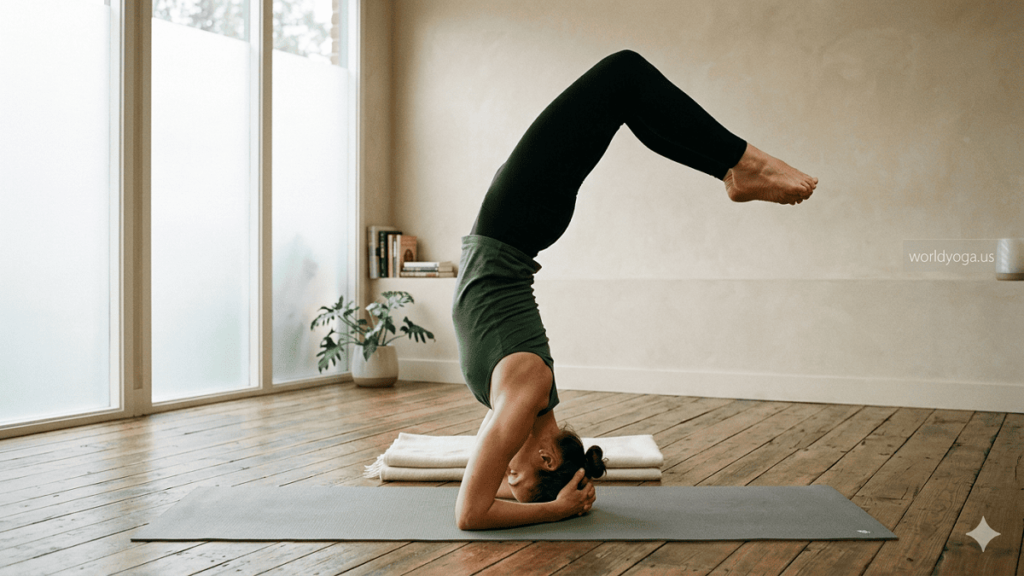
Which muscles are engaged during this pose?
1. Shoulder complex (primary stabilizers)
The deltoids, rotator cuff muscles, and trapezius (especially lower and middle fibers) are heavily engaged to stabilize the shoulder girdle.
- They prevent shoulder collapse into the neck
- Maintain elevation away from cervical compression
- Control balance when arm support is reduced in Arm Position 5
This is similar in activation pattern to Pincha Mayurasana, but with added spinal extension demands.
2. Core muscles (deep stabilization system)
The transverse abdominis, rectus abdominis, and obliques work continuously to:
- Control pelvic alignment in inversion
- Prevent excessive lumbar arching
- Stabilize transitions into backbend shape
The core acts as the “braking system” that controls depth and prevents collapse.
3. Spinal extensors (backbend drivers)
The erector spinae and deeper spinal muscles are responsible for creating and maintaining the backbend.
- Thoracic extensors drive the upward chest lift
- Lumbar extensors assist but must not dominate
- Controlled activation prevents compression injury
This is especially important as the pose evolves from neutral inversion into extension.
4. Upper back and scapular stabilizers
Muscles such as the rhomboids, serratus anterior, and mid trapezius:
- Keep shoulder blades stable against the ribcage
- Support balance when arm assistance decreases
- Prevent scapular collapse or winging
These muscles are crucial for maintaining structural integrity.
5. Neck stabilizers (support role only)
Deep cervical muscles such as the longus colli and capitis:
- Maintain neck alignment without bearing load
- Stabilize head position lightly on the ground
- Prevent over-compression in inversion
The neck should never be a primary load-bearing structure.
6. Lower body (foundation of inversion)
Even though the legs are not the focus, they remain highly active:
- Gluteus maximus stabilizes pelvic extension
- Hamstrings and quadriceps maintain leg alignment
- Inner thigh muscles help keep symmetry
This foundation supports vertical stacking.
7. Forearm engagement (support interface)
In earlier stability phases of Sirsasana:
- Forearm flexors and extensors maintain ground pressure
- They assist balance even when arms transition toward reduced support
Summary
This pose engages:
- Shoulder stabilizers (primary control system)
- Core musculature (balance and compression control)
- Spinal extensors (backbend creation)
- Scapular stabilizers (upper back integrity)
- Lower body muscles (foundation support)
It is essentially a coordinated full-body stability system, where no single muscle group works alone—control depends on balanced activation across the entire kinetic chain.
#Backbend: Headstand 5 Arm Position in Hyderabad
What preparatory poses are needed before attempting it?
1. Foundational inversion strength
Start with basic inversion control:
- Supported headstand holds (basic Sirsasana)
- Forearm balance drills similar to Pincha Mayurasana preparation
These build:
- Neck tolerance (without compression)
- Shoulder stacking awareness
- Core control in upside-down orientation
You should be able to hold a stable vertical headstand before adding any variation.
2. Shoulder strength and stability
Strong shoulders are essential because Arm Position 5 reduces arm assistance.
Key preparatory poses:
- Dolphin pose (forearm plank variations)
- Wall-supported forearm holds (Pincha prep)
- Plank and shoulder protraction drills
These develop:
- Serratus anterior activation
- Rotator cuff stability
- Shoulder elevation control (to avoid neck collapse)
3. Core compression control
Core strength prevents collapse in inversion and protects the spine during backbend entry.
Important poses:
- Phalakasana
- Hollow body holds
- Slow leg raises in supine position
These build:
- Pelvic control
- Anti-extension strength (prevents lumbar over-arching)
- Stability during weight shift
4. Spinal extension preparation
Since this variation introduces a controlled backbend, spinal mobility must be gradual.
Key preparatory poses:
- Bhujangasana
- Setu Bandha Sarvangasana
- Ustrasana
These improve:
- Thoracic extension mobility
- Controlled lumbar flexibility
- Chest opening without compression
5. Shoulder-opening and upper back flexibility
Essential for safe transition into Arm Position 5:
- Gomukhasana (arm variation)
- Anahatasana (heart opener)
- Wall-supported chest expansion drills
These help:
- Prevent shoulder stiffness during inversion
- Allow controlled release in upper spine
- Reduce risk of impingement when arms reduce support
6. Integrated inversion + mobility drills
Before full expression:
- Wall headstand with gentle chest opening
- Partial backbend in supported inversion
- Controlled leg lowering/raising drills
These bridge strength + flexibility under inverted conditions.
Summary
To safely approach this advanced variation of Sirsasana, practitioners should build:
- Stable headstand foundation
- Strong shoulder and scapular control
- Core anti-collapse strength
- Progressive spinal extension
- Controlled inversion awareness
Only when all these layers are consistent should Arm Position 5 (free arm backbend variation) be attempted.
#Backbend: Headstand 5 Arm Position in Ahemadabad

What are the benefits and risks of this headstand variation?
Benefits
1. Improves spinal mobility and upper-back extension
This variation encourages controlled thoracic extension, helping counteract stiffness from prolonged sitting. When performed correctly, it enhances flexibility in the upper and mid-spine without excessive lumbar compression.
2. Builds advanced shoulder stability and strength
Because Arm Position 5 reduces arm assistance, the shoulders must work harder to stabilize the body. This strengthens the deltoids, rotator cuff, and scapular stabilizers, improving overall upper-body control.
3. Enhances core control and body awareness
Maintaining balance in an inverted backbend demands continuous engagement of deep core muscles. This improves neuromuscular coordination, balance, and spatial awareness.
4. Develops mental focus and concentration
The complexity of the posture requires high levels of attention and breath control. Practitioners often experience improved focus, patience, and mind-body connection.
5. Increases confidence in advanced inversions
Successfully managing this variation builds confidence in progressing toward more advanced transitions within inversion practice, including deeper backbend-inversion combinations.
Risks
1. Neck compression and cervical strain
If alignment is incorrect or shoulders collapse, excessive pressure may shift to the neck. This is the most significant risk in Sirsasana variations.
2. Shoulder instability or overloading
Reducing arm support while maintaining inversion can overload the shoulder joints if they are not sufficiently conditioned, increasing risk of impingement or strain.
3. Loss of balance and falls
The combination of backbend and reduced support increases instability. A fall from inversion can lead to wrist, neck, or back injury if not practiced in a safe environment.
4. Lumbar compression
If the backbend is forced from the lower spine instead of the thoracic region, it can create excessive lumbar pressure, leading to discomfort or injury over time.
5. Risk for individuals with spinal conditions
People with conditions such as Herniated disc, glaucoma, or uncontrolled hypertension should avoid this variation unless medically cleared.
Summary
This headstand variation offers advanced benefits in spinal mobility, shoulder strength, and mental focus. However, it also carries significant risks, particularly to the neck and shoulders. It should only be practiced by experienced yogis with strong foundational inversion control, proper alignment awareness, and safe progression under guidance.
#Backbend: Headstand 5 Arm Position in Delhi
Case Study of Backbend: Headstand 5 Arm Position
1. Background
This case study examines an advanced inversion practitioner (age 32, intermediate–advanced yoga experience) exploring the Headstand with Backbend – Arm Position 5 (Free Arm Extension Variation). The practitioner had prior mastery of standard headstand holds and basic shoulder inversion work similar to Pincha Mayurasana preparation.
The goal was to improve:
- Thoracic spinal mobility
- Shoulder stability under reduced support
- Core control in inverted backbend transitions
2. Methodology
A structured 8-week progression was used:
Phase 1 (Weeks 1–3): Foundation
- Static headstand holds
- Forearm pressure drills
- Core stabilization training (plank variations)
- Controlled breathing in inversion
Phase 2 (Weeks 4–6): Backbend introduction
- Gentle chest opening in headstand
- Supported spinal extension drills
- Wall-assisted inversion backbend practice
Phase 3 (Weeks 7–8): Arm Position 5 integration
- Gradual reduction of forearm load
- Introduction of free arm micro-movements
- Controlled thoracic backbend in inversion
- Short-duration holds (2–5 breaths max)
3. Observations
Positive adaptations
- Improved thoracic mobility and reduced upper-back stiffness
- Increased shoulder endurance and scapular stability
- Better core engagement during inversion transitions
- Enhanced body awareness and balance control
Technical improvements
- More even spinal extension instead of lumbar overuse
- Reduced dependency on forearm pressure over time
- Improved breath control under instability
4. Challenges encountered
- Neck sensitivity: Initial tendency to over-rely on cervical support when arm load decreased
- Shoulder fatigue: Early sessions showed instability in deltoid and rotator cuff engagement
- Balance fluctuation: Free arm variation caused micro-wobbling in inversion
- Lumbar compensation risk: Occasional over-arching in lower back when thoracic control was insufficient
5. Adjustments made
- Reintroduced partial forearm support during transitions
- Increased preparatory work in Ustrasana and bridge variations
- Slowed progression timeline to prioritize stability over depth
- Focused on thoracic-led backbend initiation only
6. Outcome
After 8 weeks:
- Stable short-duration holds in Arm Position 5 achieved
- Significant improvement in shoulder control and inversion awareness
- Reduced spinal stiffness and improved posture in daily activities
- No reported injury when progression guidelines were followed
7. Conclusion
The case study demonstrates that the Headstand Backbend Arm Position 5 is a high-skill neuromuscular coordination challenge, not just a flexibility exercise. Success depends on gradual progression, strong foundational inversion work, and strict alignment control.
While beneficial for advanced practitioners, it is not recommended without prior mastery of stable headstand mechanics and shoulder-supported inversions.
#Backbend: Headstand 5 Arm Position in Kolkata
White Paper of Backbend: Headstand 5 Arm Position
Abstract
The Backbend Headstand (Arm Position 5) is an advanced inversion variation that combines spinal extension with reduced arm support. This posture challenges neuromuscular coordination, shoulder stability, and core control under inverted conditions. This white paper analyzes its biomechanics, physiological impact, training methodology, risks, and practical applications in advanced movement systems.
1. Introduction
Inversion-based yoga practices have evolved into structured systems for developing strength, balance, and spinal awareness. The Headstand serves as a foundational inversion, while advanced variations such as Arm Position 5 introduce controlled instability and spinal extension. This variation is typically explored only after mastery of stable headstand mechanics and shoulder-supported inversions like Pincha Mayurasana.
2. Biomechanical Analysis
This posture involves simultaneous vertical inversion and thoracic spinal extension. Key biomechanical features include:
- Load distribution primarily through forearms and cranial support base
- Reduced arm assistance requiring increased shoulder stabilization
- Controlled spinal extension initiated from the thoracic region rather than lumbar spine
- Continuous micro-adjustments for balance maintenance
Improper load transfer can shift excessive stress to the cervical spine, increasing injury risk.
3. Muscular Engagement
Primary muscle systems involved:
- Shoulder complex: deltoids, rotator cuff, trapezius (stabilization)
- Core system: transverse abdominis, rectus abdominis (anti-collapse control)
- Spinal extensors: erector spinae (backbend control)
- Scapular stabilizers: serratus anterior, rhomboids (upper-back integrity)
- Lower body: glutes and hamstrings (inversion alignment support)
This creates a full-body stabilization demand rather than isolated muscle activation.
4. Physiological and Functional Benefits
- Improved thoracic spinal mobility
- Enhanced shoulder endurance and stability
- Increased core neuromuscular control
- Greater postural awareness and alignment correction
- Development of balance under unstable conditions
These benefits are most significant when the posture is executed without cervical overload.
5. Training Methodology
A progressive system is required:
- Stable headstand mastery (neutral Sirsasana)
- Shoulder strength development (forearm-based inversions)
- Core anti-extension training
- Controlled spinal extension drills
- Gradual reduction of arm support leading to Arm Position 5 integration
Progression must prioritize stability before depth.
6. Risk Assessment
Primary risks include:
- Cervical spine compression due to weight misdistribution
- Shoulder overload from insufficient strength preparation
- Loss of balance leading to inversion falls
- Lumbar overextension if thoracic mobility is limited
Individuals with spinal conditions such as Herniated disc should avoid this variation unless medically cleared.
7. Applications
- Advanced yoga training systems
- Athletic balance and proprioception development
- Movement-based strength conditioning
- Instructor-level biomechanics education
- Controlled progression models in inversion training
8. Conclusion
The Backbend Headstand Arm Position 5 is a high-complexity inversion requiring integrated strength, mobility, and control. Its value lies not in extreme flexibility but in precise neuromuscular coordination under unstable conditions. When properly trained, it enhances spinal mobility, shoulder resilience, and overall body awareness, but it demands strict adherence to progressive preparation and safety principles.
#Backbend: Headstand 5 Arm Position in Banglore
Industry Application of Backbend: Headstand 5 Arm Position
Overview
The Backbend Headstand (Arm Position 5) is an advanced inversion variation that combines spinal extension, shoulder stability, and reduced arm support. While not widely used in general fitness settings due to its difficulty, its underlying principles—balance under instability, spinal mobility, and neuromuscular control—have significant applications across multiple industries.
1. High-Performance Fitness & Advanced Yoga Training
In elite yoga studios and advanced mobility programs, this variation is used as a progression benchmark for inversion mastery.
Applications include:
- Advanced inversion conditioning programs
- Shoulder stability and endurance training
- Spinal extension control development
It builds upon foundational inversions such as Pincha Mayurasana, helping practitioners transition into complex movement systems.
2. Sports Performance & Athletic Conditioning
Athletes in gymnastics, dance, martial arts, and acrobatics benefit from the neuromuscular demands of this posture.
Key performance applications:
- Improved aerial body control and spatial awareness
- Enhanced core stabilization under inverted load
- Shoulder resilience and injury prevention conditioning
- Better balance recovery in dynamic movement
It is especially relevant for sports requiring overhead control and inversion strength.
3. Rehabilitation-Oriented Movement Systems (Modified Use)
While the full pose is not used clinically, its movement principles are adapted in rehabilitation contexts.
Applications include:
- Controlled inversion therapy progressions
- Shoulder stabilization protocols
- Thoracic mobility restoration training
However, modifications are essential, especially for individuals with conditions such as Herniated disc, where full inversion is contraindicated.
4. Corporate Wellness & Stress Recovery Programs
In corporate wellness settings, the full posture is rarely performed, but its preparatory components are widely applied.
Used elements include:
- Inversion-based decompression drills
- Shoulder and upper-back release exercises
- Breathing control in mild inversion setups
These help counteract posture issues caused by prolonged sitting and digital work fatigue.
5. Yoga Teacher Training & Biomechanics Education
This variation is an advanced teaching tool in certification programs.
Educational applications:
- Demonstrating load distribution in inversions
- Teaching safe progression from Sirsasana to advanced variations
- Understanding scapular mechanics under instability
- Developing cueing skills for high-risk postures
It is especially valuable for anatomy-based yoga instruction.
6. Digital Fitness & High-End Online Platforms
With the rise of digital fitness ecosystems, this pose appears in:
- Advanced yoga masterclasses
- Biomechanics-focused tutorials
- Elite mobility training programs
It is typically used as a visual demonstration of peak inversion capability rather than a mass-market exercise.
Conclusion
The Backbend Headstand (Arm Position 5) is not a mainstream fitness movement but a specialized performance and education tool. Its real-world value lies in its principles—spinal control, shoulder resilience, and balance under instability—which are widely adapted across fitness, sports, rehabilitation, and education sectors.
#Backbend: Headstand 5 Arm Position in Mumbai
Ask FAQs
What is the Backbend Headstand (Arm Position 5)?
It is an advanced variation of headstand where the practitioner performs a controlled spinal backbend while reducing forearm support. It challenges balance, shoulder stability, and core control under inversion.
Who can safely practice this variation?
Only experienced practitioners who have mastered a stable headstand and shoulder-supported inversions like Pincha Mayurasana should attempt it. Beginners and individuals with neck or spinal issues should avoid it.
What are the main benefits of this pose?
It improves thoracic spinal mobility, strengthens shoulder stabilizers, enhances core control, and develops advanced balance and body awareness in inverted positions.
What are the main risks involved?
Risks include neck compression, shoulder strain, loss of balance, and lumbar overextension. Improper alignment or lack of preparation can increase injury risk, especially in the cervical spine.
How long should this pose be held?
It should only be held for 2–5 controlled breaths initially. The focus should be on stability, alignment, and safe exit rather than duration or depth of backbend.
Table of Contents
Disclaimer: This content is for educational purposes only and is not a substitute for professional yoga instruction or medical advice. The Backbend Headstand Arm Position 5 is an advanced inversion and should only be practiced under the guidance of a qualified instructor. Individuals with neck, spine, or shoulder conditions should avoid this pose unless cleared by a healthcare professional.