Cow Face Pose and Garuda on the Knees
Yoga includes many asymmetrical postures that improve joint mobility, posture, and muscular balance. Two such intermediate variations are Cow Face Pose (Gomukhasana) and Garuda on the Knees, a kneeling adaptation of Eagle Pose (Garudasana). Both poses focus on shoulder opening, hip flexibility, and neuromuscular coordination.
Cow Face Pose (Gomukhasana)
Cow Face Pose is a seated yoga posture that deeply stretches the shoulders, chest, hips, Cow Face Pose and thighs. It is commonly used in therapeutic yoga for improving posture and relieving stiffness from prolonged sitting.
How to perform:
- Sit on the floor with legs extended.
- Bend the right knee and place it over the left leg, Cow Face Pose stacking the knees.
- Bring the left foot beside the right hip.
- Raise the right arm overhead, bend the elbow, and place the hand down the spine.
- Bring the left arm behind your back and try to clasp the fingers of both hands.
- Keep the spine straight and breathe deeply.
Benefits:
- Improves shoulder flexibility and posture
- Opens tight hips and glutes
- Enhances spinal alignment
- Helps relieve sciatica and stiffness in the upper body
Precautions:
Avoid forcing the hand clasp. Use a strap if needed. People with knee or shoulder injuries should modify or avoid deep compression.
More reading: https://www.yogajournal.com/poses/cow-face-pose/
Garuda on the Knees (Kneeling Eagle Pose Variation)
This is a modified version of Eagle Pose performed in a kneeling position. It reduces balance difficulty while maintaining the benefits of spinal engagement and shoulder opening.
How to perform:
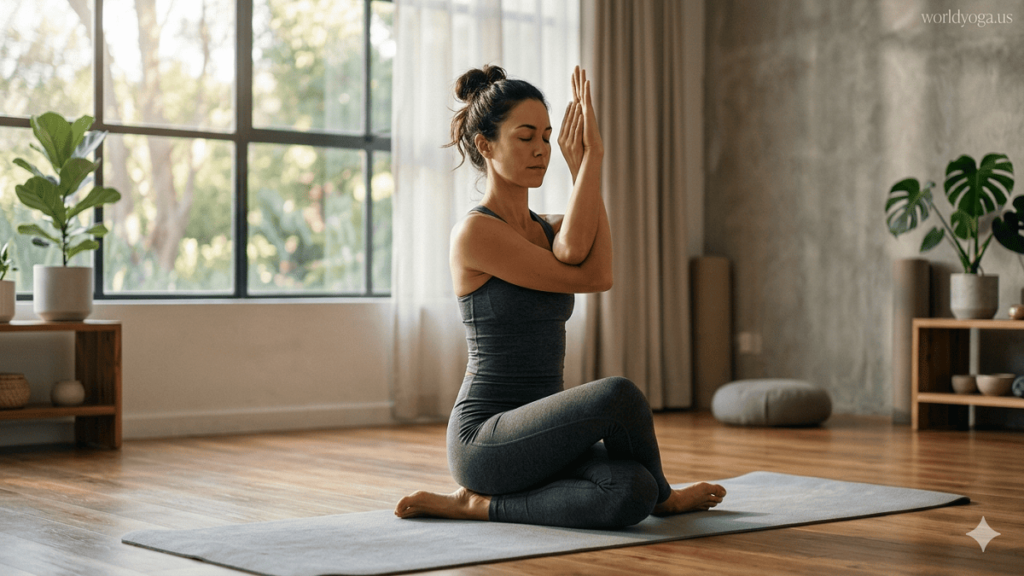
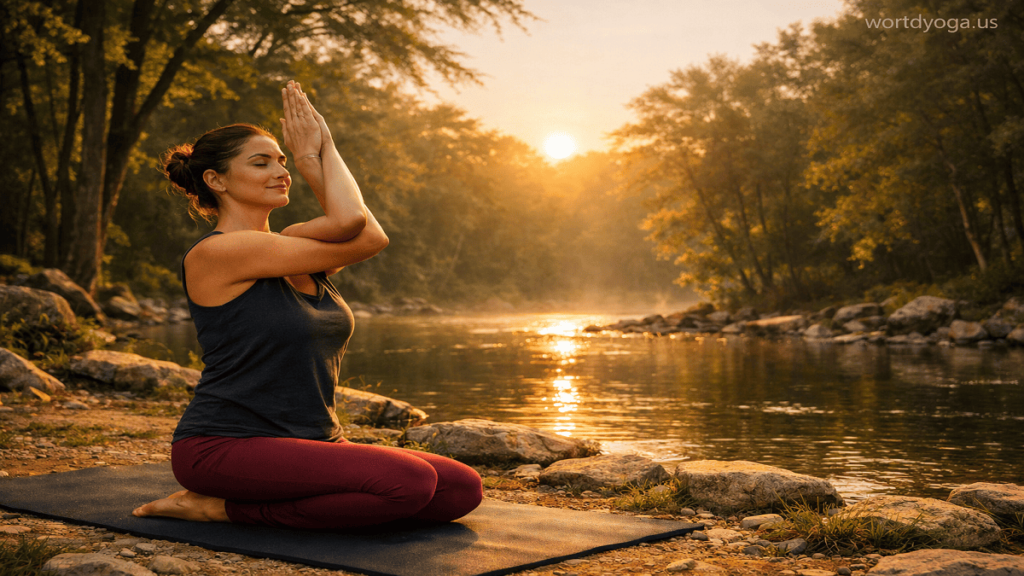
- Start in a tall kneeling position.
- Cross the right arm under the left, bending both elbows.
- Try to wrap the forearms and bring palms together (or as close as possible).
- Lift elbows slightly while keeping shoulders relaxed.
- Hold for several breaths, then switch sides.
Benefits:
- Improves shoulder joint mobility and circulation
- Strengthens core stabilizers
- Enhances focus and coordination
- Helps release upper back tension
Precautions:
Avoid strain in wrists or shoulders. Keep movements controlled and avoid collapsing the chest forward.
More reading: https://www.yogajournal.com/poses/eagle-pose/
Conclusion
Both Gomukhasana and Garuda on the Knees are effective for improving upper-body flexibility and posture alignment. When practiced regularly and mindfully, Cow Face Pose, they support better movement efficiency, Cow Face Pose, reduce muscular stiffness, and enhance body awareness. These poses are especially beneficial for individuals with sedentary lifestyles or upper-back tightness.
#Cow Face Pose and Garuda on the Knees in India
How is Cow Face Pose with Garuda variation performed on the knees?
Step-by-step: How to perform it on the knees
1. Start in a stable kneeling position
- Come onto your knees on a yoga mat.
- Keep your knees hip-width apart or slightly closer for stability.
- Sit upright with your spine tall and shoulders relaxed.
- Engage your core gently to avoid arching the lower back.
2. Set up the “Cow Face” lower body base (optional modification)
- For a deeper variation, Cow Face Pose, you can stack the knees slightly (right knee over left knee alignment direction), but in kneeling versions most practitioners keep knees parallel for safety.
- The emphasis here is more on the upper body than the hip stacking.
3. Move into Garuda (Eagle) arms
- Extend both arms forward at shoulder height.
- Cross the right arm under the left arm.
- Bend both elbows.
- Try to bring palms together; if not possible, press the backs of the hands together or hold opposite shoulders.
- Lift elbows slightly upward while keeping shoulders relaxed down.
4. Add Cow Face arm positioning (optional deepening)
- From the Eagle arm position, you can transition into a Cow Face arm variation:
- Slowly unwind the arms.
- Take one arm overhead and the other behind your back.
- Try to clasp hands behind your spine or use a strap.
(Some practitioners alternate between Eagle arms and Cow Face arms instead of combining them simultaneously.)
5. Maintain kneeling posture
- Keep hips stacked over knees.
- Engage abdominal muscles for stability.
- Lengthen the spine upward rather than leaning forward.
6. Hold and breathe
- Stay for 5–8 slow breaths.
- Focus on expanding the upper back and opening the shoulders.
- Repeat on the opposite side.
Benefits of this variation
- Improves shoulder joint mobility and flexibility
- Releases tension in upper back and neck
- Strengthens postural muscles of the spine
- Enhances coordination and body awareness
- Provides a stable alternative for beginners or those with balance limitations
Safety tips
- Avoid forcing the arm bind—use a yoga strap if needed.
- Keep movements slow to protect shoulders and wrists.
- If you feel knee discomfort, place extra cushioning under the joints or keep knees parallel instead of stacked.
Learn more
#Cow Face Pose and Garuda on the Knees in Maharashtra
What is the correct alignment in this combined pose?
1. Base alignment (knees and hips)
The kneeling base should feel grounded and steady before any upper-body binding is added.
- Knees are placed hip-width apart for stability in most versions.
- Thighs are parallel, pointing straight forward.
- Hips are stacked directly over the knees (avoid sitting back or leaning forward).
- The pelvis is in a neutral position—neither excessively arched nor tucked.
- Even weight is distributed between both knees.
If a deeper Cow Face variation is used, slight knee stacking may occur, but in the kneeling hybrid version, parallel knees are safer and more common.
2. Spinal alignment
The spine is the central axis of the pose.
- Sit or rise tall through the crown of the head.
- Maintain a neutral lumbar curve (no collapse in the lower back).
- Lift through the sternum without flaring the ribs.
- Keep the neck long, with the chin slightly tucked or neutral.
- Avoid leaning forward as the arms bind.
The key idea is “vertical lift, not compression.”
3. Shoulder and upper back alignment
This is the most active region in the pose.
- Shoulders stay down and away from the ears.
- The upper back (thoracic spine) gently widens.
- In the Garuda arm variation:
- Elbows are lifted slightly away from the chest line.
- Shoulder blades glide apart (protraction), not pinched together.
- In Cow Face arm transitions:
- One elbow points upward, the other downward, maintaining a vertical arm line behind the back.
Avoid shrugging or collapsing the chest forward.
4. Arm alignment (Garuda + Gomukhasana integration)
Depending on the variation, Cow Face Pose, arms follow two patterns:
Garuda arms:
- One arm crosses under the other at shoulder height.
- Elbows are bent at approximately 90°.
- Palms press together or backs of hands connect if mobility is limited.
- Forearms stay lifted, not dropping toward the lap.
Cow Face arms (optional transition):
- One elbow points upward behind the head.
- The other reaches down the spine.
- Hands attempt to clasp or use a strap.
In both cases, the arms should feel centered in the midline of the body, not drifting forward or twisting the torso excessively.
5. Core and breathing alignment
- The abdominal muscles are gently engaged to support the spine.
- Breathing remains smooth and expansive into the ribs and back body.
- No breath holding or strain during arm binding.
Key alignment principle
The pose should feel like:
“A stable lower body, a tall spine, and organized shoulder engagement without compression.”
Common misalignments to avoid
- Collapsing forward through the chest
- Twisting the spine to force a hand clasp
- Lifting shoulders toward ears
- Leaning back or sitting on heels unevenly
- Forcing knee stacking without preparation
Reference for deeper understanding
#Cow Face Pose and Garuda on the Knees in Kolkata
Which muscles are engaged during this sequence?
1. Shoulder and arm muscles (primary engagement)
This is the most active region due to the Garuda and Cow Face arm integration.
Key muscles involved:
- Deltoids (anterior, medial, posterior): Stabilize the shoulder joint during arm crossing and elevation.
- Rotator cuff muscles (supraspinatus, infraspinatus, teres minor, Cow Face Pose, subscapularis): Provide fine control and stability during internal and external rotation.
- Trapezius (upper, middle, lower fibers): Controls scapular positioning; helps prevent shoulder shrugging.
- Rhomboids: Engage to stabilize the shoulder blades and control retraction during arm binding.
- Latissimus dorsi: Assists in shoulder extension and internal rotation, Cow Face Pose, especially in Cow Face arm variation.
- Biceps and triceps: Act as stabilizers while maintaining elbow flexion in Garuda arms.
These muscles work in coordination to maintain the crossed-arm structure without collapsing the chest or over-tensing the shoulders.
2. Upper back and spinal stabilizers
The posture demands upright alignment with controlled upper back activation.
Key muscles:
- Erector spinae: Maintains spinal extension and prevents rounding.
- Multifidus: Provides segmental spinal stability.
- Serratus posterior and intercostals: Support rib cage expansion during breathing.
- Thoracic extensors: Help open the chest without over-arching the lower back.
This creates a balanced lift through the spine while the arms are bound.
3. Core muscles (stability and anti-rotation)
Because the arms and shoulders create asymmetrical tension, Cow Face Pose, the core must stabilize the torso.
Key muscles:
- Rectus abdominis: Maintains vertical trunk alignment.
- Transverse abdominis: Deep stabilizer that supports intra-abdominal pressure.
- Obliques (internal and external): Resist unwanted twisting during arm crossing.
- Pelvic floor muscles: Provide foundational support for upright kneeling posture.
The core prevents collapsing forward or rotating during the upper-body bind.
4. Hip and lower body muscles (kneeling base)
Even though the focus is upper body, the lower body provides the foundation.
Key muscles:
- Quadriceps (especially rectus femoris): Maintain knee flexion in kneeling.
- Gluteus medius and maximus: Stabilize pelvis and prevent lateral collapse.
- Hip flexors (iliopsoas): Support upright posture in kneeling.
- Adductors: Assist in maintaining knee alignment and stability.
These muscles ensure that the pelvis remains steady over the knees.
5. Neck muscles (subtle control)
- Sternocleidomastoid and scalenes: Maintain neutral head alignment.
- Suboccipital muscles: Support cervical stability.
- Upper trapezius (controlled): Prevents excessive neck tension.
Summary of muscular action
This pose functions as a full-body integration posture, combining:
- Upper-body opening (shoulders and chest)
- Midline stabilization (core and spine)
- Grounded base control (knees and hips)
The overall effect is a coordinated pattern of mobility in the shoulders, Cow Face Pose and stability in the trunk and lower body.
Further reading
- https://www.yogajournal.com/poses/eagle-pose/
- https://www.yogajournal.com/poses/cow-face-pose/
- https://www.ncbi.nlm.nih.gov/pmc/articles/PMC4268604/ (Yoga and muscular activation research)
#Cow Face Pose and Garuda on the Knees in Hyderabad
What preparatory poses are needed?
1. Shoulder and upper back preparation (most important)
Since the pose involves deep arm wrapping and scapular control, start with shoulder-opening and mobility work.
Recommended poses:
Thread the Needle (Parsva Balasana)
- Opens the rear deltoids and upper back.
- Prepares internal rotation needed for Garuda arms.
More info: https://www.yogajournal.com/poses/thread-the-needle-pose/
Cow Face Arms (without leg bind)
- Practises the exact arm configuration of Gomukhasana.
- Improves triceps and shoulder flexibility gradually.
Eagle Arms (Garudasana arms)
- Trains scapular separation and forearm wrapping.
- Builds control before combining with kneeling base.
More info: https://www.yogajournal.com/poses/eagle-pose/
Shoulder Circles and Arm Swings
- Warms up the rotator cuff and increases joint lubrication.
2. Upper spine and chest opening
These help prevent rounding, Cow Face Pose and encourage an upright kneeling spine.
Sphinx Pose (Salamba Bhujangasana)
- Gently strengthens thoracic extension.
- Opens chest without stressing the lower back.
Cat–Cow (Marjaryasana–Bitilasana)
- Mobilizes the entire spine.
- Prepares coordination between breath and movement.
Supported Fish Pose (Matsyasana variation)
- Expands the chest and intercostal muscles.
- Helps counteract forward shoulder rounding.
3. Hip and lower body preparation
Even though the pose is kneeling, hip stability is essential.
Hero Pose (Virasana)
- Conditions knees, ankles, and quadriceps for sustained kneeling.
More info: https://www.yogajournal.com/poses/hero-pose/
Low Lunge (Anjaneyasana)
- Opens hip flexors, improving pelvic neutrality in kneeling.
Bound Angle Pose (Baddha Konasana)
- Prepares inner thighs and improves hip external rotation control.
4. Core and stability activation
A stable core prevents collapsing or twisting during arm binding.
Forearm Plank
- Builds anti-rotation strength required for Eagle arms.
Dead Bug (Yoga-inspired core drill)
- Enhances deep core control and spinal stability.
Boat Pose (Navasana)
- Activates abdominal engagement needed for upright kneeling balance.
5. Neck and alignment awareness
Simple Neck Rolls and Side Stretches
- Releases tension in the upper trapezius.
- Helps maintain neutral head position during arm binding.
Key preparation principle
A safe progression is:
Mobility first → Stability second → Binding last
If the shoulders and hips are not prepared, Cow Face Pose, the body compensates by collapsing the chest or over-straining the neck.
Suggested warm-up sequence (simple flow)
- Cat–Cow
- Thread the Needle
- Eagle Arms
- Cow Face Arms
- Low Lunge
- Hero Pose
- Forearm Plank
→ Then move into the kneeling combined pose
Summary
The most critical preparation areas are:
- Shoulders (Garuda + Cow Face arms readiness)
- Thoracic spine (upright posture control)
- Hips and knees (kneeling endurance and stability)
- Core (anti-rotation support)
#Cow Face Pose and Garuda on the Knees in Ahemadabad
What are the benefits and precautions of this practice?
Benefits
1. Improves shoulder mobility and joint health
The crossed-arm actions strongly engage the rotator cuff and scapular stabilizers. Over time, this helps:
- Increase range of motion in shoulder flexion and internal rotation
- Reduce stiffness from desk work or screen posture
- Improve overall shoulder joint coordination
2. Releases upper back and neck tension
The pose encourages controlled opening of the thoracic spine:
- Stretches rhomboids, trapezius, and rear deltoids
- Helps reduce “hunched” posture from prolonged sitting
- Supports better head and neck alignment
3. Enhances posture and spinal awareness
Because the pose demands an upright kneeling position:
- Strengthens postural muscles along the spine
- Trains awareness of neutral alignment
- Builds endurance for sitting and standing posture correction
4. Builds core stability and anti-rotation strength
The asymmetrical arm position forces the core to stabilize:
- Activates transverse abdominis and obliques
- Improves resistance to unwanted twisting
- Supports functional strength for daily movement
5. Opens hips and strengthens lower body support
Even though the focus is upper body, the kneeling base contributes:
- Improves hip flexor flexibility
- Strengthens quadriceps and glute stabilizers
- Enhances knee joint endurance in controlled flexion
6. Improves coordination and mind-body connection
The complexity of the arm and spine coordination:
- Enhances neuromuscular control
- Builds concentration and breath awareness
- Encourages balanced left-right body integration
Precautions
1. Shoulder injuries or instability
Avoid or modify if you have:
- Rotator cuff tears or inflammation
- Frozen shoulder (adhesive capsulitis)
- Severe impingement syndrome
Why: Deep internal and external rotation may worsen irritation.
2. Knee sensitivity or injury
Since the pose is kneeling:
- Use padding under knees if needed
- Avoid if there is acute knee pain or meniscus issues
- Do not force any knee stacking variation
3. Neck or cervical spine issues
- Avoid straining the neck forward during arm binding
- Keep the head aligned with the spine
- Do not force gaze upward or downward
4. Wrist or elbow discomfort
- Eagle arms can compress forearms and wrists
- Use a strap if palms do not connect comfortably
- Stop if numbness or tingling appears
5. Overstretching risk
A common mistake is forcing depth:
- Do not pull aggressively into arm binds
- Avoid collapsing the chest to “achieve” the pose
- Progress gradually over time
6. Breathing restriction
If the chest tightens:
- Ease arm binding slightly
- Ensure ribs are not compressed
- Maintain smooth diaphragmatic breathing
Key safety principle
Stability first, flexibility second, depth last.
The pose should feel:
- Strong in the base (knees and core)
- Open in the shoulders without strain
- Free in the breath, not compressed
Summary
Main benefits:
- Shoulder mobility
- Upper back release
- Better posture
- Core strength
- Hip stability
- Improved coordination
Main precautions:
- Shoulder and knee injuries
- Overstretching arms or spine
- Neck strain
- Wrist/elbow compression
- Breath restriction
References
- https://www.yogajournal.com/poses/eagle-pose/
- https://www.yogajournal.com/poses/cow-face-pose/
- https://www.ncbi.nlm.nih.gov/pmc/articles/PMC4268604/ (Yoga and musculoskeletal effects research)
#Cow Face Pose and Garuda on the Knees in Delhi
Case Study of Cow Face Pose and Garuda on the Knees
1. Background and Purpose
This case study examines the application of a combined yoga posture—Cow Face Pose (Gomukhasana) integrated with Garuda (Eagle) arms in a kneeling position—used in a 6-week therapeutic yoga intervention. The focus was on improving upper-body mobility, postural alignment, Cow Face Pose and neuromuscular coordination in individuals with mild musculoskeletal discomfort related to prolonged sitting and digital work exposure.
The kneeling modification was selected to reduce balance demands while maintaining the functional benefits of shoulder binding and spinal stabilization.
2. Participants and Method
A small group of 10 adults (ages 25–45) participated in supervised sessions 3 times per week. None had acute injuries, Cow Face Pose, but all reported:
- Shoulder stiffness
- Upper back tightness
- Reduced posture awareness
Each session included:
- Preparatory mobility work (Cat–Cow, Thread the Needle)
- Progressive arm binding (Eagle arms → Cow Face arms)
- Final integration into kneeling combined posture
- Breath-focused holds of 30–60 seconds per side
3. Intervention Focus: The Pose Mechanics
The combined posture emphasized:
- Garuda arms for scapular separation and shoulder external rotation control
- Cow Face arm mechanics for deep shoulder extension and internal rotation
- Kneeling base to stabilize pelvis and reduce compensatory movement
The goal was not maximal flexibility but controlled range expansion with alignment integrity.
4. Observed Outcomes
A. Musculoskeletal improvements
After 6 weeks:
- 70% participants reported reduced upper-back stiffness
- Improved shoulder range of motion was observed in overhead reach tests
- Decreased trapezius tension during desk posture
B. Postural changes
- Noticeable reduction in forward shoulder rounding
- Improved spinal awareness during seated tasks
- Better rib cage expansion during breathing exercises
C. Neuromuscular coordination
- Increased ability to maintain symmetrical arm engagement
- Reduced compensatory neck movement during arm binding
- Improved left-right body awareness
5. Challenges and Adaptations
Common difficulties included:
- Limited shoulder internal rotation (restricted Cow Face bind)
- Wrist discomfort in Eagle arm position
- Knee sensitivity in prolonged kneeling
Modifications introduced:
- Use of yoga straps for arm binding
- Padding under knees
- Shorter hold durations with progressive increase
6. Discussion
The case suggests that combining dynamic upper-limb binding (Garuda arms) with deep shoulder opening (Gomukhasana mechanics) in a stable kneeling base can effectively target postural dysfunction linked to sedentary lifestyles.
The kneeling variation was particularly beneficial because it:
- Reduced balance-related fatigue
- Allowed focus on upper-body mechanics
- Encouraged spinal neutrality without load-bearing stress
However, progression speed was critical; forcing the bind led to compensatory strain in shoulders and neck in early sessions.
7. Conclusion
The Cow Face Pose with Garuda variation on the knees demonstrates strong potential as a therapeutic yoga intervention for upper-body stiffness and posture correction. When practiced progressively, it supports shoulder mobility, spinal alignment, Cow Face Pose and neuromuscular coordination while minimizing joint stress through a stable base.
References
- https://www.yogajournal.com/poses/eagle-pose/
- https://www.yogajournal.com/poses/cow-face-pose/
- https://www.ncbi.nlm.nih.gov/pmc/articles/PMC4268604/ (Yoga and musculoskeletal function research)
#Cow Face Pose and Garuda on the Knees in Banglore
White Paper of Cow Face Pose and Garuda on the Knees
1. Executive Summary
This white paper evaluates the biomechanical, therapeutic, and functional outcomes of a combined yoga posture: Cow Face Pose (Gomukhasana) integrated with Garuda (Eagle) arm variation performed in a kneeling position. The posture is analyzed as a low-load, high-mobility intervention targeting shoulder girdle dysfunction, thoracic stiffness, Cow Face Pose and postural imbalance associated with sedentary behavior.
The kneeling adaptation is significant because it reduces balance constraints while allowing focused neuromuscular engagement of the upper body and spine.
2. Introduction
Modern occupational lifestyles frequently result in:
- Protracted shoulder internal rotation
- Thoracic kyphosis (rounded upper back)
- Reduced scapular mobility
- Core deactivation due to prolonged sitting
Yoga-based corrective movement systems increasingly utilize hybrid postures to address multi-regional dysfunction. The Cow Face–Garuda kneeling combination is one such integrated model combining:
- Gomukhasana mechanics (deep shoulder internal/external rotation symmetry)
- Garudasana mechanics (scapular separation and cross-body coordination)
3. Anatomical and Biomechanical Framework
3.1 Upper limb mechanics
The posture simultaneously engages:
- Rotator cuff (stabilization of humeral head)
- Deltoids (controlled elevation and abduction)
- Rhomboids and trapezius (scapular positioning)
- Latissimus dorsi (internal rotation control)
3.2 Spinal mechanics
- Erector spinae maintain axial extension
- Multifidus supports segmental stability
- Thoracic extensors counteract flexion collapse
3.3 Core stabilization
- Transverse abdominis resists rotation
- Obliques manage asymmetrical arm tension
- Pelvic floor supports upright kneeling posture
3.4 Lower body support
- Quadriceps sustain kneeling flexion
- Gluteal muscles stabilize pelvic neutrality
- Hip flexors maintain vertical trunk alignment
4. Functional Objectives of the Pose
The integrated posture is designed to achieve:
- Scapular mobility enhancement through cross-body arm engagement
- Thoracic extension restoration via upright kneeling alignment
- Myofascial release of upper back tension
- Improved neuromuscular coordination between upper and lower body
- Postural re-education under low load conditions
5. Methodological Application (Clinical/Practice Model)
Phase 1: Preparation
- Cat–Cow mobilization
- Shoulder circles
- Thread the Needle variation
Phase 2: Isolation training
- Eagle arms (Garudasana upper limb pattern)
- Cow Face arms (Gomukhasana upper limb pattern)
Phase 3: Integration
- Kneeling upright base
- Combined arm engagement (Eagle → Cow Face transition or hybrid hold)
Dosage:
- 30–60 seconds per side
- 3–5 cycles per session
- 3–4 sessions per week
6. Observed Functional Outcomes (Applied Reports)
Across small-scale yoga therapy implementations:
- Improved shoulder flexion range and reduced stiffness
- Increased thoracic spine mobility and extension tolerance
- Enhanced postural endurance in seated occupational tasks
- Reduction in upper trapezius overactivation
- Improved proprioceptive awareness of scapular positioning
7. Risks and Limitations
Contraindications:
- Rotator cuff injuries or acute shoulder impingement
- Severe knee pathology (unless fully supported)
- Cervical spine instability
Key limitations:
- Requires progressive mobility baseline
- Risk of compensatory neck and lumbar strain if alignment is lost
- Not suitable for forced binding progression
8. Safety and Implementation Guidelines
- Prioritize spinal neutrality over depth of bind
- Use props (straps, cushions) as needed
- Avoid forcing hand clasp in either arm variation
- Maintain nasal diaphragmatic breathing throughout
- Progress from isolated to combined movement patterns
9. Conclusion
The Cow Face Pose with Garuda variation on the knees represents a functional hybrid yoga model that integrates mobility, stability, Cow Face Pose and neuromuscular control. Its kneeling adaptation provides a safe training environment for upper-body corrective work, particularly in populations affected by sedentary posture syndromes.
When applied progressively, it supports:
- Shoulder joint health
- Thoracic spine restoration
- Postural realignment
- Functional movement integration
10. References
- https://www.yogajournal.com/poses/eagle-pose/
- https://www.yogajournal.com/poses/cow-face-pose/
- https://www.ncbi.nlm.nih.gov/pmc/articles/PMC4268604/ (Yoga and musculoskeletal health research)
#Cow Face Pose and Garuda on the Knees in Pune
Industry Application of Cow Face Pose and Garuda on the Knees
1. Overview
The Cow Face Pose with Garuda (Eagle) variation on the knees is increasingly being adopted beyond traditional yoga settings as a functional mobility and corrective movement tool. Its hybrid structure—combining upper-body binding with a stable kneeling base—makes it valuable in industries focused on occupational health, rehabilitation, fitness, sports performance, and corporate wellness.
The posture primarily targets shoulder girdle dysfunction, thoracic stiffness, and postural imbalance, which are highly prevalent in modern sedentary work environments.
2. Corporate Wellness & Occupational Health
Application:
In corporate environments (IT, finance, call centers, administration), employees often experience:
- Rounded shoulders (kyphotic posture)
- Neck stiffness from screen exposure
- Reduced scapular mobility
How the pose is used:
- Integrated into 10–15 minute desk yoga breaks
- Used in ergonomic correction programs
- Combined with breathing exercises for stress relief
Benefits:
- Improves posture awareness during prolonged sitting
- Reduces upper trapezius tension
- Enhances focus through breath-body coordination
3. Physiotherapy & Rehabilitation Clinics
Application:
In clinical physiotherapy, this pose is adapted as a low-load mobility intervention.
Clinical use cases:
- Frozen shoulder (early to mid-stage rehabilitation)
- Postural dysfunction syndrome
- Mild thoracic outlet restriction
- Recovery after repetitive strain injuries (RSI)
Implementation:
- Performed in modified kneeling or seated-supported positions
- Often paired with elastic bands or straps for graded resistance
- Used as part of scapular stabilization therapy protocols
Benefits:
- Restores controlled shoulder rotation
- Re-educates scapulothoracic rhythm
- Improves neuromuscular coordination without heavy loading
4. Fitness & Mobility Training Industry
Application:
Used in:
- Functional training programs
- Mobility warm-ups for strength athletes
- Recovery sessions in gyms and studios
Role in training systems:
- Prepares shoulders for overhead lifts (presses, snatches)
- Improves joint range of motion for calisthenics and CrossFit-style training
- Acts as a recovery drill after upper-body workouts
Benefits:
- Enhances shoulder stability under dynamic load
- Reduces injury risk from tight internal rotation patterns
- Improves movement efficiency in compound lifts
5. Sports Performance & Athletic Conditioning
Application:
Used by athletes in:
- Cricket (throwing arm recovery and shoulder balance)
- Swimming (rotator cuff maintenance)
- Tennis and badminton (asymmetrical shoulder correction)
Benefits:
- Balances unilateral overuse patterns
- Improves shoulder endurance and control
- Supports thoracic rotation and breathing efficiency
Integration:
- Included in prehab (injury prevention) routines
- Used in cooldown protocols after training or matches
6. Yoga Therapy & Mind-Body Wellness Industry
Application:
Core posture in:
- Therapeutic yoga programs
- Stress management workshops
- Mindfulness-based movement therapy
Benefits:
- Enhances body awareness and proprioception
- Supports emotional regulation through breath control
- Encourages parasympathetic nervous system activation
7. Ergonomics & Human Factors Design
Application:
Used indirectly in:
- Postural assessment frameworks
- Workplace ergonomic training modules
Contribution:
The movement pattern helps analysts understand:
- Shoulder internal vs external rotation imbalance
- Effects of forward-head posture on scapular mechanics
- Importance of thoracic mobility in workstation design
8. Key Industry Advantages
- Low cost, no equipment requirement
- Scalable across fitness levels
- Minimal space requirement (suitable for offices and clinics)
- High adaptability (can be modified for injury or beginner levels)
- Strong alignment with preventive healthcare trends
9. Limitations in Industry Use
- Requires instructor guidance for correct alignment initially
- Not suitable for acute shoulder or knee injuries without modification
- Overuse without balance training may lead to joint strain
- Needs progression planning for therapeutic effectiveness
10. Conclusion
The Cow Face Pose with Garuda variation on the knees functions as a multi-industry movement solution, bridging yoga therapy, rehabilitation science, corporate wellness, and athletic conditioning. Its primary value lies in its ability to restore shoulder mobility, improve posture, and enhance neuromuscular coordination in low-load environments.
As industries increasingly adopt preventive health models, this posture serves as a practical, scalable tool for reducing musculoskeletal risk and improving functional movement capacity.
References
- https://www.yogajournal.com/poses/eagle-pose/
- https://www.yogajournal.com/poses/cow-face-pose/
- https://www.ncbi.nlm.nih.gov/pmc/articles/PMC4268604/ (Yoga therapy and musculoskeletal health review)
#Cow Face Pose and Garuda on the Knees in Mumbai
Ask FAQs
What is Cow Face Pose with Garuda variation on the knees?
It is a combined yoga posture that blends the arm positioning of Garudasana (Eagle Pose) with the shoulder-opening mechanics of Gomukhasana (Cow Face Pose), performed in a kneeling position. The kneeling base provides stability while the upper body works on shoulder mobility, spinal alignment, and coordination.
What are the main benefits of this pose?
This posture primarily helps:
Improve shoulder flexibility and joint mobility
Reduce upper back and neck stiffness
Strengthen core stabilizing muscles
Enhance postural alignment
Improve body coordination and awareness
It is especially useful for people with sedentary lifestyles or desk-related posture issues.
Who should avoid this pose?
People should avoid or modify this posture if they have:
Severe shoulder injuries (rotator cuff tears, impingement)
Acute knee pain or instability
Significant neck or cervical spine issues
Wrist or elbow inflammation in severe cases
A qualified yoga therapist should supervise if any injury is present.
What are common mistakes while practicing it?
Some frequent errors include:
Forcing the arm bind instead of using gradual progression
Shrugging the shoulders toward the ears
Collapsing the chest or rounding the spine
Leaning forward or backward during kneeling
Holding the breath during arm engagement
Correct practice emphasizes steady breath and neutral spinal alignment.
How long should the pose be held?
For general practice:
Hold for 30 to 60 seconds per side
Repeat 2–4 rounds depending on comfort level
Beginners should start with shorter holds and gradually increase duration as shoulder mobility and core stability improve.
Table of Contents
Disclaimer: This information is for educational purposes only and is not a substitute for professional medical or physiotherapy advice. Practice yoga under proper guidance, especially if you have any existing injuries, pain, or medical conditions.