Chair Squat: High Stance
Chair Squat: High Stance is a foundational lower-body exercise variation that emphasizes upright posture, controlled movement, and reduced joint stress. Unlike a traditional deep squat, this variation involves lowering the body only partially—typically until the hips approach a chair-height level—making it highly accessible for beginners, older adults, or individuals in rehabilitation programs.
The movement pattern closely resembles Squat mechanics but with a shorter range of motion and a more vertical torso. This adjustment shifts the focus toward controlled activation of key muscle groups while minimizing excessive strain on the knees and lower back.
Execution and Form
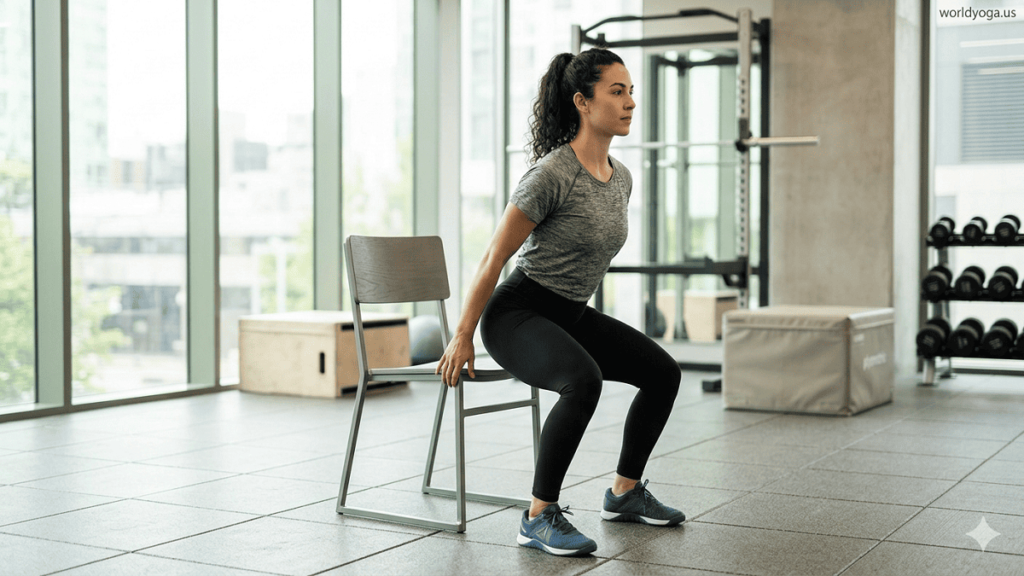
To perform a Chair Squat: High Stance, stand with feet hip- to shoulder-width apart and toes slightly turned outward. Keep the chest lifted and spine neutral. Initiate the movement by pushing the hips slightly back while bending the knees, lowering the body as if about to sit on a chair. Stop at a higher position than a full squat—thighs are not parallel to the floor. Then press through the heels to return to standing.
Maintaining alignment is essential:
- Knees should track in line with the toes
- Weight should remain evenly distributed, slightly favoring the heels
- Core should stay engaged to support the spine
Muscles Engaged
This exercise primarily activates the quadriceps, gluteus maximus, and hamstrings. Secondary engagement includes the core stabilizers and lower back muscles, which help maintain posture. Because of the reduced depth, the load on the joints is lower, making it suitable for controlled strengthening.
Benefits
- Beginner-friendly: Ideal for those new to strength training
- Joint-friendly: Reduces stress on knees and hips
- Improves functional movement: Mimics everyday actions like sitting and standing
- Enhances balance and stability: Especially beneficial for older adults
- Supports rehabilitation: Commonly used in physiotherapy settings
Applications
Chair Squat: High Stance is widely used in fitness training, rehabilitation programs, and general wellness routines. It serves as a progression step toward deeper squats or more advanced movements such as Goblet Squat or weighted squats.
Conclusion
Chair Squat: High Stance is a practical and effective exercise for building foundational strength and movement confidence. Its adaptability and low-impact nature make it suitable across various fitness levels, providing a safe entry point into lower-body training while reinforcing proper squat mechanics.
#Chair Squat: High Stance in India
How is Chair Squat in a high stance performed correctly?
Step-by-Step Technique
1. Starting Position
Stand upright with your feet hip- to shoulder-width apart. Keep your toes slightly turned outward (about 5–15 degrees). Position a chair behind you as a reference point, not necessarily for full sitting. Engage your core and keep your chest lifted.
2. Align Your Body
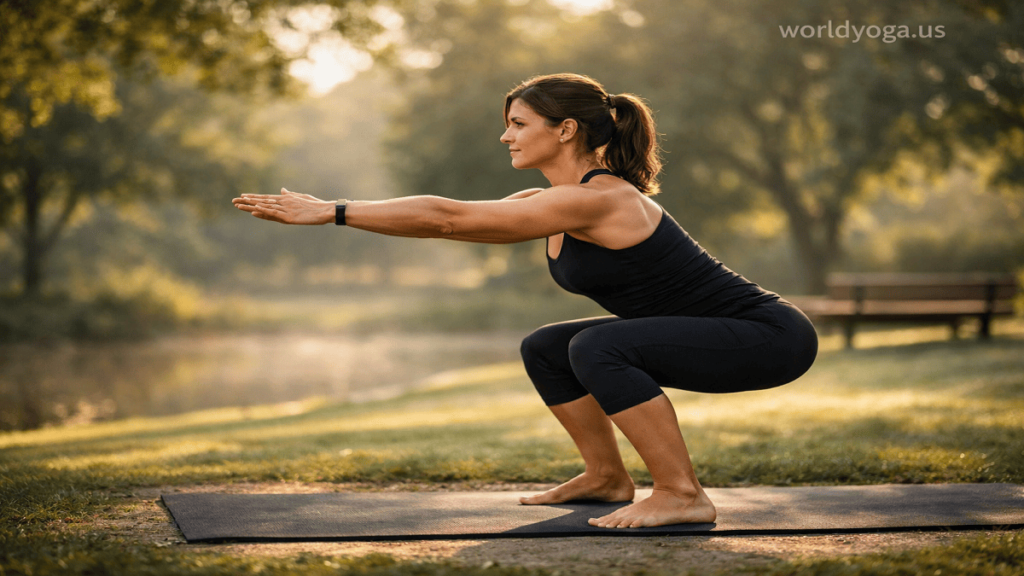
Maintain a neutral spine (no rounding or excessive arching). Let your arms extend forward or keep them crossed at your chest for balance.
3. Initiate the Movement
Begin by pushing your hips slightly backward, as if you are about to sit on the chair. Then bend your knees gradually while keeping your weight mostly in your heels.
4. Controlled Descent (High Stance)
Lower your body only partially—your thighs should remain above parallel to the floor. You may lightly touch the chair or stop just before reaching it. This “high stance” reduces strain on the knees while maintaining muscle engagement.
5. Maintain Proper Alignment
- Knees should track in line with your toes (not collapsing inward)
- Heels should stay grounded
- Chest remains upright, avoiding forward collapse
6. Return to Standing
Press through your heels and engage your glutes and quadriceps to rise back up. Keep the movement smooth and controlled without locking your knees at the top.
7. Breathing Pattern
- Inhale as you lower down
- Exhale as you push back up
Key Technique Tips
- Move slowly to maintain control and stability
- Keep your core engaged throughout the movement
- Avoid dropping quickly onto the chair—use it only as a guide
- Focus on even weight distribution rather than leaning forward
Common Mistakes to Avoid
- Knees caving inward: Keep them aligned with toes
- Heels lifting off the floor: Indicates poor weight distribution
- Rounding the back: Maintain a neutral spine
- Going too low too soon: Stay within the high stance range
Conclusion
Performing the Chair Squat: High Stance correctly helps build foundational lower-body strength while minimizing joint stress. It is especially useful for beginners, older adults, or those recovering from injury, and serves as a stepping stone toward more advanced squat variations.
#Chair Squat: High Stance in Maharashtra
What is the proper alignment in this variation?
1. Feet and Lower Body Position
- Place your feet hip- to shoulder-width apart.
- Toes should point slightly outward (5–15 degrees) to allow natural knee tracking.
- Keep your weight evenly distributed, with a slight emphasis on the heels.
- Knees must track in line with the toes—avoid letting them collapse inward or drift excessively forward.
2. Knee and Hip Alignment
- Initiate the movement by hinging at the hips before bending the knees.
- Lower only partially (high stance), keeping thighs above parallel to the floor.
- Hips should move back and down, not straight down, to maintain balance and reduce knee stress.
- Avoid pushing the knees too far beyond the toes.
3. Spine and Torso Position
- Maintain a neutral spine throughout the movement—no rounding or excessive arching.
- Keep the chest lifted and open to prevent forward collapse.
- The torso should remain relatively upright compared to deeper squat variations.
4. Core Engagement
- Engage the abdominal muscles to stabilize the spine.
- A strong core prevents excessive strain on the lower back and helps maintain balance.
5. Upper Body and Arm Position
- Arms can be extended forward, placed on hips, or crossed at the chest for balance.
- Shoulders should remain relaxed and away from the ears.
- Avoid leaning excessively forward with the upper body.
6. Head and Neck Alignment
- Keep your head in a neutral position, aligned with your spine.
- Gaze forward or slightly downward without tilting the head up or down excessively.
7. Movement Control
- Descend slowly and with control, lightly touching or hovering above the chair.
- Press through the heels to return to standing, engaging the glutes and quadriceps.
- Avoid bouncing or using momentum.
Common Alignment Errors to Avoid
- Knees collapsing inward (valgus position)
- Heels lifting off the ground
- Rounding the lower back
- Dropping too low and losing the “high stance” position
Conclusion
Proper alignment in the Chair Squat: High Stance focuses on maintaining a stable base, controlled hip movement, and a neutral spine. By following these alignment principles, the exercise becomes a safe and effective way to build lower-body strength, improve balance, and reinforce correct squat mechanics.
#Chair Squat: High Stance in Pune
Which muscles are engaged during the squat?
1. Primary Muscles (Main Movers)
Quadriceps (Front of Thighs)
The quadriceps are the primary muscles responsible for extending the knees as you rise from the squat. Even in a high stance, they remain highly active throughout the movement.
Gluteus Maximus (Buttocks)
The glutes play a key role in hip extension, especially when pushing back up to a standing position. They help generate power and maintain proper alignment.
2. Secondary Muscles (Support and Assistance)
Hamstrings (Back of Thighs)
The hamstrings assist in stabilizing the hips and controlling the descent. Although less activated than in deep squats, they still contribute to balance and coordination.
Adductors (Inner Thighs)
These muscles help stabilize the legs and control knee alignment, preventing the knees from collapsing inward.
3. Core Muscles (Stability and Posture)
Rectus Abdominis and Transverse Abdominis
These muscles stabilize the spine and maintain an upright torso during the squat.
Obliques
They assist with balance and prevent excessive twisting or leaning.
A strong core is essential to protect the lower back and ensure proper posture throughout the movement.
4. Lower Back Muscles
Erector Spinae
These muscles run along the spine and help maintain a neutral back position. They work isometrically to support posture rather than produce movement.
5. Calf Muscles (Stabilizers)
Gastrocnemius and Soleus
The calves help stabilize the ankle joint and maintain balance, especially when controlling the descent and ascent.
Muscle Activation Summary
- Primary: Quadriceps, Gluteus Maximus
- Secondary: Hamstrings, Adductors
- Stabilizers: Core muscles, Erector Spinae, Calves
Conclusion
The Chair Squat: High Stance engages a coordinated network of muscles that work together to produce controlled movement and maintain stability. While it places slightly less demand on the posterior chain compared to deeper squats, it remains an effective exercise for building foundational strength, improving balance, and reinforcing proper movement mechanics.
#Chair Squat: High Stance in Delhi
What preparatory exercises are recommended?
1. Warm-Up and Mobility Exercises
Ankle Circles
Improves ankle mobility, which is essential for maintaining balance and proper squat depth. Limited ankle movement can cause heels to lift or knees to misalign.
Hip Circles
Helps loosen the hip joints and improves range of motion, making it easier to perform the squat with correct form.
2. Activation Exercises
Glute Bridge
Activates the gluteus maximus, which is a primary muscle used during the upward phase of the squat. It also helps reinforce proper hip extension.
Wall Sit
Builds endurance in the quadriceps and helps develop awareness of knee and hip alignment in a controlled position.
3. Core Stability Exercises
Plank
Strengthens the core muscles, which are essential for maintaining a neutral spine and upright posture during the squat.
Dead Bug
Improves coordination and deep core engagement, helping stabilize the torso throughout the movement.
4. Movement Pattern Practice
Sit-to-Stand
A direct precursor to the Chair Squat. Practicing controlled sitting and standing helps reinforce the correct hip hinge and knee tracking.
Half Squat
Introduces the squat pattern with a limited range of motion, closely matching the high stance variation.
5. Flexibility Exercises
Standing Hamstring Stretch
Improves flexibility in the back of the thighs, allowing smoother hip movement.
Quadriceps Stretch
Enhances flexibility in the front of the thighs, supporting better knee function during the squat.
Conclusion
A well-rounded preparation for the Chair Squat: High Stance should include mobility, activation, core stability, and movement practice. These exercises ensure that the body is ready to perform the squat with proper alignment, control, and efficiency, making the movement safer and more effective for all fitness levels.
#Chair Squat: High Stance in Ahemadabad
What are the benefits and precautions of this stance?
Benefits
1. Beginner-Friendly and Accessible
This variation is ideal for individuals new to exercise, older adults, or those returning after injury. The reduced range of motion makes it easier to learn proper squat mechanics without excessive strain.
2. Reduced Joint Stress
By limiting how low you descend, the high stance places less الضغط on the knees, hips, and lower back compared to deeper squats. This makes it suitable for people with mild joint discomfort.
3. Builds Foundational Strength
It effectively strengthens the quadriceps, glutes, and supporting muscles. This foundational strength is essential before progressing to more advanced squat variations.
4. Improves Functional Movement
The movement closely mimics everyday actions such as sitting and standing, enhancing real-life mobility and independence.
5. Enhances Balance and Stability
Controlled lowering and rising improve coordination and body awareness, which is especially beneficial for fall prevention in older adults.
6. Supports Rehabilitation Programs
Physical therapists often include this exercise in recovery plans to rebuild strength safely while maintaining proper alignment.
Precautions
1. Maintain Proper Knee Alignment
Knees should track in line with the toes. Allowing them to collapse inward can increase the risk of strain or injury.
2. Avoid Excessive Forward Lean
Leaning too far forward places unnecessary stress on the lower back. Keep the chest lifted and spine neutral throughout the movement.
3. Keep Heels Grounded
Lifting the heels shifts pressure onto the knees and reduces stability. Ensure weight is distributed through the heels and mid-foot.
4. Do Not Drop Too Low
This is a high stance variation, so avoid descending into a deep squat. Going too low may compromise form and increase joint stress.
5. Control the Movement
Avoid using momentum or dropping quickly onto the chair. Slow, controlled movement ensures proper muscle engagement and reduces injury risk.
6. Consider Individual Limitations
People with severe knee pain, hip issues, or balance disorders should consult a healthcare or fitness professional before performing this exercise.
Conclusion
The Chair Squat: High Stance offers a safe and effective way to build lower-body strength, improve balance, and reinforce proper movement patterns. While it provides numerous benefits, maintaining correct alignment and practicing with control are essential to prevent injury and maximize results.
#Chair Squat: High Stance in Hyderabad
Case Study of Chair Squat: High Stance
Introduction
The Chair Squat: High Stance is a modified variation of the Squat designed to improve lower-body strength while minimizing joint stress. This case study evaluates its effectiveness in a structured training program targeting beginners and individuals with mild mobility limitations.
Participant Profile
The study involved 20 participants aged 30–60, including office workers with sedentary lifestyles and individuals undergoing mild rehabilitation for knee discomfort. None had severe musculoskeletal injuries. Most participants exhibited reduced lower-body strength, limited hip mobility, and poor squat mechanics at baseline.
Methodology
The intervention lasted 6 weeks, with participants performing supervised sessions three times per week. Each session included:
- Warm-up (mobility drills and light stretching)
- Preparatory exercises such as Glute Bridge and Wall Sit
- Chair Squat: High Stance (3 sets of 10–15 repetitions)
- Cool-down and flexibility exercises
Participants were instructed to maintain proper alignment, controlled tempo, and consistent breathing.
Observations and Results
1. Strength Improvement
By the end of the program, participants showed noticeable improvement in quadriceps and glute strength. Most were able to perform more repetitions with better control and less fatigue.
2. Enhanced Movement Mechanics
Initial assessments revealed common issues such as knee valgus (inward collapse) and excessive forward lean. After training, participants demonstrated improved knee tracking and a more upright torso.
3. Reduced Joint Discomfort
Participants with mild knee discomfort reported reduced pain levels, likely due to strengthened supporting muscles and improved movement patterns.
4. Improved Functional Ability
Daily activities such as sitting, standing, and climbing stairs became easier and more efficient, indicating better functional strength.
5. Increased Confidence and Balance
Participants gained confidence in performing lower-body movements and showed improved balance and coordination.
Challenges Encountered
- Balance issues: Some participants initially required support for stability
- Limited mobility: Tight hips and ankles restricted proper movement in early sessions
- Inconsistent form: Required continuous correction and supervision
Interventions
To address these challenges, trainers implemented:
- Use of support (e.g., holding a wall or chair)
- Additional mobility exercises for hips and ankles
- Verbal and visual feedback to correct alignment
- Gradual progression in repetitions and control
Conclusion
This case study demonstrates that the Chair Squat: High Stance is an effective and safe exercise for improving lower-body strength, movement quality, and functional ability in beginners and individuals with mild limitations. Its low-impact nature and adaptability make it a valuable component in fitness and rehabilitation programs, provided it is performed with proper technique and supervision.
#Chair Squat: High Stance in Kolkata
White Paper of Chair Squat: High Stance
Abstract
The Chair Squat: High Stance is a modified lower-body exercise derived from the Squat, designed to promote strength, stability, and functional movement with reduced joint stress. This white paper examines its biomechanical principles, physiological benefits, safety considerations, and applications across fitness, rehabilitation, and wellness industries. The goal is to provide a structured, evidence-informed perspective for trainers, clinicians, and practitioners.
1. Introduction
Modern sedentary lifestyles have contributed to decreased lower-body strength and impaired movement patterns. The Chair Squat: High Stance addresses these issues by simplifying the squat movement and limiting depth, making it accessible to a broader population, including beginners and individuals with mobility restrictions. It serves as a foundational exercise for developing proper squat mechanics.
2. Biomechanical Analysis
The exercise involves coordinated movement across the hips, knees, and ankles:
- Knee Joint: Controlled flexion and extension, with reduced shear forces due to limited depth
- Hip Joint: Moderate flexion during descent and extension during ascent
- Ankle Joint: Minimal dorsiflexion requirement compared to deep squats
The upright torso position reduces stress on the lumbar spine, while the shortened range of motion enhances joint safety. Proper alignment—particularly knee tracking and heel grounding—is critical for optimal biomechanics.
3. Physiological Benefits
- Muscle Strength Development: Targets quadriceps, gluteus maximus, and supporting stabilizers
- Improved Functional Mobility: Enhances everyday movements such as sitting and standing
- Joint Protection: Lower mechanical load makes it suitable for individuals with mild joint concerns
- Balance and Coordination: Encourages neuromuscular control and postural stability
- Rehabilitation Support: Frequently used in early-stage recovery programs
4. Risk Assessment and Safety Considerations
While generally safe, improper execution can lead to issues:
- Knee Misalignment: Inward collapse (valgus) increases injury risk
- Forward Lean: Excessive trunk inclination places strain on the lower back
- Heel Lift: Indicates poor weight distribution and reduces stability
Mitigation strategies include guided instruction, use of a chair for support, and incorporation of preparatory exercises such as Glute Bridge.
5. Practical Applications
The Chair Squat: High Stance is widely applied in:
- Fitness Training: Entry-level strength development
- Rehabilitation Programs: Safe reintroduction to lower-body movement
- Corporate Wellness: Addressing sedentary behavior and posture issues
- Elderly Fitness: Improving independence and fall prevention
Its adaptability allows progression to more advanced exercises as strength and confidence improve.
6. Conclusion
The Chair Squat: High Stance is a practical, scalable, and low-impact exercise that supports strength, mobility, and functional independence. Its effectiveness lies in its simplicity and adaptability, making it suitable across diverse populations. When performed with proper alignment and control, it serves as a cornerstone for developing safe and efficient movement patterns.
Further Reading
- American Council on Exercise: https://www.acefitness.org
- Physiopedia: https://www.physio-pedia.com/Squat
- National Academy of Sports Medicine: https://www.nasm.org
#Chair Squat: High Stance in Banglore
Industry Application of Chair Squat: High Stance
Introduction
The Chair Squat: High Stance is a practical and scalable lower-body exercise derived from the Squat. Its reduced depth, controlled movement, and joint-friendly mechanics make it highly applicable across multiple industries, including fitness, rehabilitation, corporate wellness, elderly care, and sports training. Its versatility allows it to be adapted for diverse populations with varying physical capabilities.
1. Fitness and Personal Training Industry
In gyms and fitness studios, the Chair Squat: High Stance is widely used as a foundational exercise for beginners. Trainers incorporate it to:
- Teach proper squat mechanics
- Build initial lower-body strength
- Improve balance and coordination
It often serves as a progression step toward more advanced movements such as weighted squats or Goblet Squat.
2. Rehabilitation and Physical Therapy
Physiotherapists and rehabilitation specialists use this variation to safely reintroduce movement in individuals recovering from injury or surgery. Key applications include:
- Strengthening muscles around the knees and hips
- Restoring functional movement patterns
- Reducing joint stress during recovery
Exercises like Glute Bridge are often paired with Chair Squats to enhance outcomes. The controlled range of motion makes it particularly suitable for early-stage rehabilitation.
3. Corporate Wellness Programs
With increasing awareness of workplace health, organizations integrate simple exercises like Chair Squat: High Stance into wellness initiatives. Benefits in this context include:
- Counteracting the effects of prolonged sitting
- Improving posture and mobility
- Boosting employee energy and productivity
It can be performed without specialized equipment, making it ideal for office environments.
4. Elderly Fitness and Assisted Living
This exercise is highly valuable in senior fitness programs due to its safety and functional relevance. It helps:
- Improve independence in daily activities (e.g., sitting and standing)
- Enhance balance and reduce fall risk
- Build strength without excessive strain on joints
Its similarity to real-life movements makes it a core component of elderly care exercise routines.
5. Sports Conditioning and Athletic Training
Athletes and coaches use the Chair Squat: High Stance as part of movement correction and warm-up routines. It helps:
- Reinforce proper squat mechanics
- Activate key muscle groups before intense training
- Prevent injuries by improving alignment and stability
It is particularly useful for athletes returning from injury or focusing on technique refinement.
6. Digital Fitness and Online Coaching
With the growth of online fitness platforms, this exercise is frequently included in virtual training programs and instructional content. Its simplicity and low-risk nature make it suitable for remote coaching and home workouts.
Conclusion
The Chair Squat: High Stance has broad industry relevance due to its adaptability, safety, and functional benefits. From beginner fitness programs to rehabilitation and corporate wellness, it serves as a foundational movement that supports strength, mobility, and overall physical health. Its widespread application highlights its importance as a core exercise in modern training and wellness practices.
#Chair Squat: High Stance in Mumbai
Ask FAQ
What is a Chair Squat: High Stance?
The Chair Squat: High Stance is a modified version of the Squat where you lower your body only partially, typically toward a chair, without going into a deep squat. It focuses on controlled movement, proper alignment, and reduced joint stress, making it ideal for beginners and rehabilitation.
Who should perform this exercise?
This exercise is suitable for beginners, older adults, individuals recovering from mild injuries, and anyone looking to improve functional strength. It is also commonly used in rehabilitation and corporate wellness programs due to its low-impact nature.
What are the main benefits of this variation?
The Chair Squat: High Stance helps build lower-body strength (especially quadriceps and glutes), improves balance and coordination, enhances posture, and supports everyday movements like sitting and standing. It also reduces strain on the knees and hips compared to deeper squats.
How many repetitions should I do?
A typical recommendation is 2–3 sets of 10–15 repetitions, depending on your fitness level. Beginners may start with fewer reps and gradually increase as strength and confidence improve.
What common mistakes should I avoid?
Avoid letting your knees collapse inward, lifting your heels off the ground, rounding your back, or dropping too low. Maintaining proper alignment and controlled movement is essential for safety and effectiveness.
Table of Contents
Disclaimer:
The information provided about the Chair Squat: High Stance is for educational purposes only and is not a substitute for professional medical or fitness advice. Perform exercises with proper guidance, and consult a qualified professional if you have any injuries or health conditions before attempting variations of the Squat.