
Revolved Tip Toe Pose
The Revolved Tip Toe Pose, commonly associated with advanced standing balance variations in yoga, is a challenging posture that integrates strength, flexibility, balance, and spinal rotation. In traditional yoga nomenclature, it is closely related to the family of twisting standing balances such as Parivrtta Padangusthasana, though variations may differ slightly across modern yoga schools. The pose is often practiced in dynamic vinyasa sequences or advanced hatha yoga sessions to cultivate deep core engagement and proprioceptive awareness.
Overview and Technique
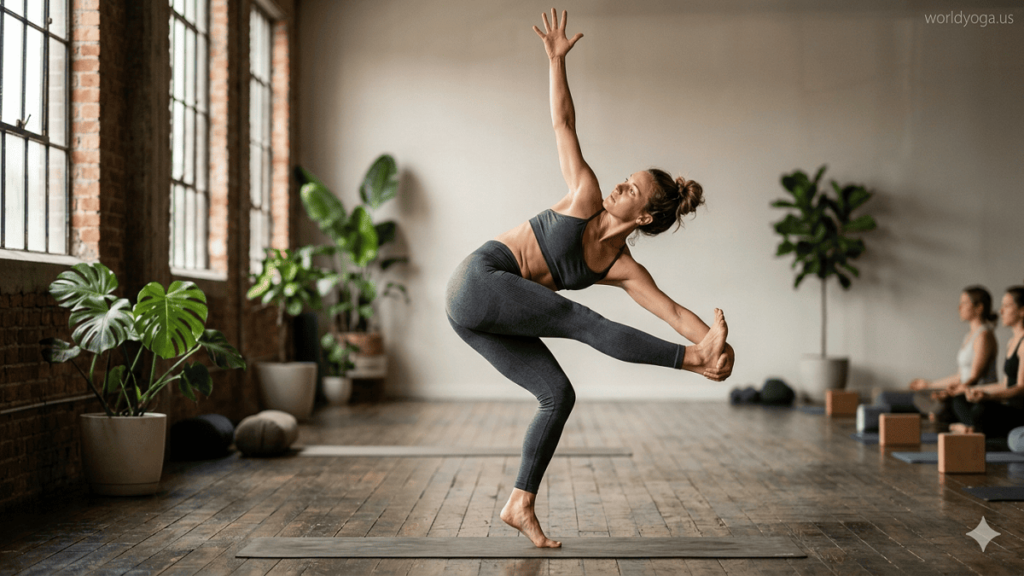
The posture typically begins from a standing position. The practitioner shifts weight onto one foot, rising onto the tip of that foot while lifting the opposite leg. The lifted leg is extended forward or slightly upward depending on flexibility level. Simultaneously, the torso rotates in the opposite direction of the lifted leg, creating a spinal twist while maintaining balance on the supporting foot’s toes.
Arms are commonly extended in a counterbalance position—either stretched wide or brought into a prayer position during the twist. The gaze (drishti) is directed over the shoulder to enhance rotational alignment and stability.
Benefits
The Revolved Tip Toe Pose provides a range of physical and neurological benefits:
- Balance and Proprioception – The narrow base of support significantly challenges the stabilizing muscles of the ankles, feet, and core.
- Spinal Mobility – The rotational aspect enhances thoracic spine flexibility and improves posture.
- Core Strengthening – The oblique muscles and transverse abdominis are actively engaged to maintain rotation and stability.
- Leg Strength and Endurance – The standing leg develops strength in the calves, quadriceps, and stabilizing ligaments.
- Digestive Stimulation – Twisting postures are traditionally believed to support abdominal organ compression and release, aiding digestion.
Precautions
Due to its difficulty, this pose is not recommended for beginners. Individuals with ankle instability, knee injuries, or spinal conditions such as herniated discs should avoid or modify the posture. Proper warm-up is essential, particularly for the hips, hamstrings, Revolved Tip Toe Pose and core muscles. Practicing near a wall for support is advisable for beginners.
Modifications
- Use a wall or chair for balance support.
- Keep the lifted foot lower instead of fully extended.
- Reduce the depth of the twist to avoid strain on the spine.
- Bend the standing knee slightly to improve stability.
Additional Resources
For further study and guided instruction, refer to credible yoga resources:
- Yoga Journal Pose Library: https://www.yogajournal.com/poses
- Yoga Basics Standing Balance Guide: https://www.yogabasics.com/
- DoYogaWithMe Instructional Platform: https://www.doyogawithme.com/
#Revolved Tip Toe Pose in India
How is Revolved Tip Toe Pose performed correctly?
Step-by-Step Execution
The correct performance of the pose begins in a stable standing position, usually in Mountain Pose (Tadasana). The practitioner first grounds one foot firmly into the mat while engaging the arch and distributing weight evenly across the heel and toes. This grounding action is essential because the entire pose depends on stability through a small base of support.
Once balanced, the opposite leg is slowly lifted forward. In the full expression of the pose, Revolved Tip Toe Pose the standing heel rises so the practitioner balances on the tip of the toes. This increases instability and demands heightened muscular engagement in the calves, ankles, Revolved Tip Toe Pose and core. The lifted leg may remain straight or slightly bent depending on flexibility and control.
Next, the torso begins a controlled spinal rotation. The twist originates from the mid-spine rather than the shoulders or neck alone. As the torso rotates, the practitioner aligns the chest with the direction of the twist while maintaining a long spine. The hips should remain as stable and square as possible, resisting the tendency to collapse or rotate excessively.
The arms are used for balance and extension. In many variations, one arm reaches forward while the other extends backward to enhance rotational counterbalance. Revolved Tip Toe Pose, In more advanced versions, the hands may come into prayer at the chest or extend outward in opposite directions.
The gaze plays an important stabilizing role. The practitioner focuses on a fixed point (drishti) over the shoulder or slightly ahead to maintain equilibrium. Breathing remains steady and controlled, typically slow inhalations to prepare and controlled exhalations during the twist.
Key Alignment Principles
Proper alignment is crucial. The standing ankle must remain active to prevent collapse inward or outward. The core must stay engaged throughout to protect the lower back and stabilize the spine during rotation. The lifted leg should not create tension in the hip joint; instead, Revolved Tip Toe Pose, it should move with controlled muscular activation.
Common Mistakes to Avoid
Many practitioners lose balance by locking the knee of the standing leg or by over-rotating the spine from the shoulders instead of the thoracic region. Another common error is holding the breath, Revolved Tip Toe Pose, which reduces stability and increases muscular tension.
Preparatory Work and Safety
Before attempting this pose, practitioners should build strength through standing balances such as Tree Pose and Half Moon Pose, along with foundational twists. Warm-up poses targeting the hamstrings, hips, and spine are essential.
Reliable guidance can be found at:
- Yoga Journal Pose Guide: https://www.yogajournal.com/poses
- Yoga International Practice Library: https://yogainternational.com/article/view/yoga-poses
- DoYogaWithMe Tutorials: https://www.doyogawithme.com/yoga-poses
#Revolved Tip Toe Pose in Maharashtra

What is the proper alignment in this balancing twist?
1. Foundation and Foot Alignment
Alignment begins at the base. The standing foot must be firmly rooted into the mat with even pressure distributed across the heel, ball of the big toe, and little toe mound. Even though the pose is performed on the tip of the standing foot in advanced variations, Revolved Tip Toe Pose, the principle of even grounding still applies through the forefoot. The ankle should remain active and stable, avoiding collapse inward (overpronation) or outward (supination). The knee of the standing leg should track directly over the second and third toes to maintain joint integrity.
2. Pelvic Positioning
The pelvis should remain as level and neutral as possible. One of the most common alignment errors is allowing the hip of the lifted leg to hike upward or rotate excessively. Instead, the pelvis should face forward with minimal tilting. Engaging the lower abdominals helps stabilize the pelvis and prevents unnecessary torque in the lumbar spine.
3. Spinal Alignment and Rotation
The spine should be elongated before any rotation is introduced. The crown of the head reaches upward, creating axial extension. The twist originates from the thoracic spine (mid-back), Revolved Tip Toe Pose not the neck or lower back. Shoulders remain relaxed and stacked rather than forcefully pulled back or shrugged.
During rotation, Revolved Tip Toe Pose, both sides of the waist should remain long. Collapsing one side shortens the spine and reduces stability. The head follows the spine naturally, with the gaze (drishti) turning last to maintain balance.
4. Leg Positioning
The standing leg remains strong, engaged, and slightly micro-bent if needed for stability. The lifted leg should be controlled rather than passive. Depending on flexibility, Revolved Tip Toe Pose. it may extend forward or remain slightly bent. The key alignment principle is that the lifted leg does not destabilize the pelvis or cause leaning backward.
5. Arm and Shoulder Alignment
The shoulders should stay level and relaxed. Arms act as counterweights rather than rigid levers. In many variations, one arm extends forward and the other backward, aligning with the twist. The shoulder blades should remain down and slightly drawn toward the spine to prevent rounding in the upper back.
6. Breath and Balance Integration
Proper alignment is reinforced through breath. Inhalation lengthens the spine, while exhalation deepens the twist without collapsing alignment. Breath should remain steady to support neuromuscular control.
Key Alignment Summary
- Stable, evenly grounded standing foot
- Knee aligned over toes
- Neutral, level pelvis
- Lengthened spine with thoracic rotation
- Engaged core for stability
- Relaxed shoulders with controlled arm extension
Further Study
- Yoga Journal Pose Alignment Guide: https://www.yogajournal.com/poses
- Yoga International Anatomy Resources: https://yogainternational.com/
- DoYogaWithMe Pose Tutorials: https://www.doyogawithme.com/yoga-poses
#Revolved Tip Toe Pose in Banglore
Which muscles are engaged during the pose?
Lower Body Engagement
The primary muscular effort begins in the standing leg. The quadriceps are heavily engaged to stabilize and support body weight, especially when balancing on the tip of the foot. The calf muscles, particularly the gastrocnemius and soleus, Revolved Tip Toe Pose, work continuously to maintain plantar flexion and micro-adjustments for balance. Intrinsic foot muscles also play a crucial role in stabilizing the arch and preventing collapse.
The gluteus medius and gluteus minimus are especially important, as they stabilize the pelvis in the frontal plane and prevent the hip from dropping on the lifted-leg side. The gluteus maximus assists in maintaining hip extension and overall lower-body strength. Hamstrings contribute isometric support in controlling knee alignment and maintaining stability.
The lifted leg engages the hip flexors, primarily the iliopsoas, rectus femoris, and sartorius, depending on the height and extension of the leg. These muscles help maintain controlled elevation without excessive strain in the hip joint.
Core and Abdominal Muscles
The core is the central stabilizing system in this pose. The transverse abdominis acts as a deep stabilizer, compressing the abdominal cavity and supporting spinal alignment. The rectus abdominis assists in maintaining trunk stability, while the internal and external obliques are highly active during the twisting motion.
The obliques are especially important, as they generate and control the rotational movement of the torso. Without adequate oblique engagement, Revolved Tip Toe Pose, the twist would collapse into the lower back or shoulders, increasing injury risk.
Spinal and Back Muscles
The erector spinae muscles support spinal extension and help maintain an elongated posture throughout the twist. The multifidus muscles provide segmental spinal stability, Revolved Tip Toe Pose, ensuring controlled rotation between vertebrae rather than excessive movement in a single region.
The latissimus dorsi also assists in upper-body stabilization, particularly when the arms are extended in opposite directions for balance.
Upper Body Engagement
The deltoids and trapezius muscles stabilize the shoulders, especially when the arms are extended or counterbalancing. The rhomboids help maintain scapular positioning, preventing rounding of the upper back during rotation. Forearm and hand muscles are engaged if the pose involves arm extension or binding variations.
Stabilizing Synergy
What makes this pose particularly demanding is not isolated muscle strength but coordinated activation across multiple systems. The nervous system continuously adjusts micro-engagements in the feet, core, and hips to maintain equilibrium during rotation.
Additional Reference Sources
- Yoga Journal Anatomy Guide: https://www.yogajournal.com/practice/yoga-sequences/yoga-anatomy/
- Yoga International Muscle Engagement Articles: https://yogainternational.com/
- ACE Fitness Muscle Anatomy Overview: https://www.acefitness.org/resources/everyone/exercise-library/
#Revolved Tip Toe Pose in Ahemadabad
What preparatory poses are recommended?
1. Standing Balance Foundations
Before introducing twisting elements, the body must develop steady single-leg stability.
- Tree Pose (Vrksasana) builds foundational balance, ankle strength, and hip stability while training focus and breath control.
- Eagle Pose (Garudasana) strengthens deep stabilizers of the hips, knees, and ankles while introducing mild compression and coordination challenges.
- Half Moon Pose (Ardha Chandrasana) develops lateral stability, strengthens the standing leg, and improves proprioception in a more dynamic balance setting.
These poses prepare the neuromuscular system to handle instability, especially when weight shifts onto the toes in advanced variations.
2. Spinal Rotation Preparations
Since the target pose involves controlled twisting, the thoracic spine must be mobile and the core must learn to stabilize during rotation.
- Revolved Chair Pose (Parivrtta Utkatasana) is one of the most direct preparatory postures. It strengthens the legs while introducing spinal twist under load.
- Seated Spinal Twist (Ardha Matsyendrasana) improves rotational range of motion in a controlled seated position.
- Revolved Lunge (Parivrtta Anjaneyasana) integrates twisting with lower-body engagement, closely simulating the demands of standing twist balance.
These poses teach the body to rotate from the mid-spine rather than collapsing into the lower back.
3. Core Activation and Stability Work
Strong core engagement is essential to prevent instability during balance and twist.
- Boat Pose (Navasana) builds deep abdominal strength, particularly the transverse abdominis and hip flexors.
- Forearm Plank (Phalakasana variation) reinforces full-core integration and shoulder stability.
- Side Plank (Vasisthasana) strengthens obliques, which are critical for controlled rotation.
These strengthen the body’s ability to maintain alignment while under asymmetrical load.
4. Hip and Hamstring Mobility
Tight hips and hamstrings can restrict balance and rotation.
- Low Lunge (Anjaneyasana) opens the hip flexors and prepares for lifted-leg movement.
- Standing Forward Fold (Uttanasana) lengthens hamstrings and calms the nervous system.
- Reclined Hand-to-Big-Toe Pose (Supta Padangusthasana) improves hamstring flexibility while maintaining spinal neutrality.
5. Ankle and Foot Preparation
Since the pose often shifts weight onto the forefoot or tiptoe, ankle conditioning is crucial.
- Heel Raises in Standing Position strengthen calves and improve ankle control.
- Garland Pose (Malasana) improves ankle mobility and foot grounding awareness.
- Toe Balance Drills train intrinsic foot muscles for stability under load.
Key Preparation Principle
Effective preparation is not about isolated flexibility but integrated readiness: stable feet, mobile spine, strong core, and responsive balance system working together.
Additional Learning Resources
- Yoga Journal Pose Library: https://www.yogajournal.com/poses
- Yoga International Practice Sequences: https://yogainternational.com/
- DoYogaWithMe Guided Classes: https://www.doyogawithme.com/yoga-poses
#Revolved Tip Toe Pose in Kolkata
What are the benefits and precautions of this pose?
Benefits of the Pose
1. Improved Balance and Proprioception
This pose challenges the body to stabilize on a very small base of support, especially when performed on the tip of one foot. As a result, it significantly enhances proprioception—the body’s awareness of position in space. The stabilizing muscles in the feet, ankles, and lower legs become highly active, improving overall balance control in both static and dynamic movement.
2. Core Strength and Stability
The twisting and balancing components require continuous engagement of the deep core muscles, including the transverse abdominis and obliques. These muscles stabilize the spine while controlling rotation. Over time, this improves core endurance, postural control, and functional strength that carries over into daily movement patterns.
3. Spinal Mobility and Rotation
The rotational aspect of the pose encourages controlled mobility in the thoracic spine. This helps maintain healthy spinal function, improves posture, and counteracts stiffness caused by prolonged sitting. Unlike passive stretching, this is an active twist, meaning strength and mobility are developed together.
4. Lower Body Strengthening
The standing leg bears full body weight while maintaining stability on a narrow base. This strengthens the quadriceps, calves, glutes, and intrinsic foot muscles. The hips also work to stabilize the pelvis, improving overall lower-body coordination and endurance.
5. Mental Focus and Concentration
Because balance is unstable, the mind must remain highly focused. The pose trains sustained attention, breath awareness, and mental calm under physical challenge, contributing to improved mindfulness and concentration.
Precautions and Contraindications
1. Balance and Fall Risk
This is an advanced balancing posture. Loss of stability can result in falls, especially if practiced without preparation. Practicing near a wall or support is strongly recommended for beginners.
2. Ankle, Knee, and Hip Sensitivity
The standing leg experiences high load and micro-adjustments. Individuals with ankle sprains, knee instability, or hip injuries should avoid or modify the pose. Improper alignment can place unnecessary stress on these joints.
3. Spinal Conditions
Since the pose involves rotation, individuals with herniated discs, sciatica, or acute lower back issues should be cautious. The twist should always originate from the thoracic spine rather than forcing movement from the lumbar region.
4. Over-rotation and Strain
A common mistake is forcing the twist beyond available mobility. This can strain the spine or shoulders. The rotation should always remain controlled and pain-free, with emphasis on lengthening before twisting.
5. Fatigue and Stability Loss
Practicing when fatigued increases the risk of poor alignment and instability. The pose requires full neuromuscular engagement and should not be attempted when balance or focus is compromised.
Additional Guidance Resources
- Yoga Journal Pose Reference: https://www.yogajournal.com/poses
- Yoga International Safety and Anatomy Guides: https://yogainternational.com/
- DoYogaWithMe Instructional Library: https://www.doyogawithme.com/yoga-poses
#Revolved Tip Toe Pose in Delhi
Case Study of Revolved Tip Toe Pose
Subject Profile
The practitioner in this case is a 34-year-old recreational yoga student with three years of consistent vinyasa yoga experience. The individual had strong general flexibility but reported difficulty with single-leg balance and limited thoracic spinal rotation. No prior musculoskeletal injuries were present, though mild ankle instability was noted during dynamic movement.
Initial Assessment
At baseline, the practitioner demonstrated:
- Moderate hamstring flexibility but limited active control in standing balances
- Reduced endurance in calf and foot stabilizers during prolonged standing poses
- Restricted thoracic rotation with compensatory lumbar movement during twists
- Difficulty maintaining steady gaze (drishti) in unstable positions
These findings indicated that while flexibility was adequate, neuromuscular control and stability were primary limiting factors.
Intervention Strategy
A structured eight-week progression was implemented focusing on three pillars: balance training, rotational mobility, and core integration.
Phase 1: Stability Development (Weeks 1–3)
Emphasis was placed on foundational poses such as Tree Pose, Warrior III, and heel raises. These improved ankle strength and proprioceptive awareness. Core engagement was introduced through Plank and Boat Pose variations.
Phase 2: Rotational Integration (Weeks 4–6)
Revolved Chair Pose and Revolved Low Lunge were incorporated to develop controlled spinal rotation under load. The practitioner was instructed to initiate twist from the thoracic spine while maintaining pelvic stability.
Phase 3: Advanced Balance Introduction (Weeks 7–8)
Half Moon Pose with bind variations and assisted tiptoe balancing drills were introduced. A wall was used for support during early attempts of the target pose to reduce fall risk and refine alignment.
Outcome and Observations
By the end of the intervention period, the practitioner demonstrated measurable improvement in balance duration (from 5–7 seconds to 20–25 seconds in controlled conditions). Thoracic rotation improved significantly, with reduced lumbar compensation during twisting movements.
Key qualitative improvements included:
- Increased confidence in unstable standing positions
- Improved breath control under physical challenge
- Enhanced awareness of foot grounding and pelvic alignment
- Reduced muscular tension during rotational transitions
The practitioner was able to achieve a modified version of the Revolved Tip Toe Pose independently, maintaining balance for short durations with controlled spinal alignment.
Discussion
This case highlights that successful execution of the Revolved Tip Toe Pose is not dependent solely on flexibility, but on integrated neuromuscular control. The combination of progressive overload in balance training and structured rotational preparation proved essential. The findings align with established yoga biomechanics principles emphasizing stability before mobility.
Conclusion
The progression toward mastering this pose demonstrates that advanced balancing twists require systematic development of ankle stability, core strength, and thoracic mobility. When approached methodically, the pose becomes an achievable expression of integrated strength and coordination rather than an isolated flexibility challenge.
References
- Yoga Journal Pose Library: https://www.yogajournal.com/poses
- Yoga International Anatomy and Practice Resources: https://yogainternational.com/
- DoYogaWithMe Guided Progressions: https://www.doyogawithme.com/yoga-poses
#Revolved Tip Toe Pose in Hyderabad
White Paper of Revolved Tip Toe Pose
Abstract
The Revolved Tip Toe Pose, commonly aligned with Parivrtta Padangusthasana, is an advanced yoga posture combining unilateral balance, axial spinal rotation, and integrated core stabilization. This white paper examines its biomechanical structure, physiological demands, progression methodology, risk profile, and applied benefits in movement training systems. The pose is analyzed as a neuromuscular coordination task rather than a purely flexibility-based posture.
1. Introduction
Balancing twists represent a high-level category of yoga postures that integrate multiple physical systems simultaneously. The Revolved Tip Toe Pose is particularly demanding due to its reduced base of support (forefoot or tiptoe balance) combined with rotational torque through the spine. This makes it a relevant model for studying functional stability, proprioception, and controlled mobility.
2. Biomechanical Framework
2.1 Base of Support and Load Distribution
The pose significantly reduces the base of support to the metatarsal heads or tip of the foot. This increases reliance on intrinsic foot muscles, ankle stabilizers, and lower-leg proprioceptors. Continuous micro-adjustments occur through the gastrocnemius, soleus, and tibialis anterior.
2.2 Kinetic Chain Engagement
Force transmission follows a closed kinetic chain from the foot upward through the knee, hip, and spine. The gluteus medius plays a critical stabilizing role in preventing pelvic drop, while quadriceps maintain knee extension control under load.
2.3 Rotational Mechanics
Spinal rotation is primarily generated in the thoracic region. The obliques control rotational torque while preventing lumbar over-rotation. The erector spinae maintain axial extension, ensuring the twist occurs without spinal collapse.
3. Neuromuscular Demand Profile
The pose requires simultaneous activation of:
- Deep core stabilizers (transverse abdominis, multifidus)
- Rotational muscles (internal and external obliques)
- Lower-limb stabilizers (calves, quadriceps, gluteus medius)
- Foot intrinsic muscles for balance refinement
This coordination creates a high proprioceptive load, making the posture a neuromotor integration exercise rather than a static hold.
4. Physiological and Functional Benefits
4.1 Balance and Proprioception Enhancement
Repeated practice improves vestibular integration and ankle joint responsiveness, translating into better balance control in daily locomotor tasks.
4.2 Spinal Mobility and Postural Efficiency
Active thoracic rotation improves segmental spinal mobility while reducing compensatory lumbar movement patterns associated with sedentary behavior.
4.3 Core Stability Development
The pose trains anti-rotation strength, improving functional core stability relevant to lifting, walking, and athletic movement patterns.
5. Risk Analysis
5.1 Mechanical Stress Factors
High compressive load on the forefoot and eccentric demand on stabilizing muscles increase risk of strain if alignment is compromised.
5.2 Common Fault Patterns
- Lumbar over-rotation instead of thoracic rotation
- Collapse of standing knee valgus
- Loss of pelvic neutrality
- Overextension of lifted leg causing hip strain
5.3 Contraindications
Individuals with ankle instability, acute spinal disorders, or balance impairments should avoid unsupervised practice.
6. Progression Model
A structured progression is recommended:
- Static balance foundations (e.g., Tree Pose)
- Controlled standing strength (e.g., Warrior III)
- Rotational stability training (e.g., Revolved Chair Pose)
- Assisted tiptoe balance drills
- Full pose integration with support transition
7. Applied Use Cases
The pose is increasingly used in:
- Functional movement training systems
- Athletic balance conditioning
- Rehabilitation-based proprioceptive re-education
- Advanced yoga sequencing frameworks
8. Conclusion
The Revolved Tip Toe Pose is best understood as an integrated neuromuscular coordination challenge rather than a flexibility-based posture. Its value lies in enhancing balance precision, spinal rotation control, and core stability under unstable conditions. When properly progressed, it contributes to improved functional movement efficiency and injury resilience.
References
- Yoga Journal Pose Library: https://www.yogajournal.com/poses
- Yoga International Anatomy Resources: https://yogainternational.com/
- DoYogaWithMe Educational Library: https://www.doyogawithme.com/yoga-poses
#Revolved Tip Toe Pose in Pune
Industry Application of Revolved Tip Toe Pose
1. Fitness and Strength & Conditioning Industry
In strength and conditioning contexts, this pose is used as a neuromuscular control drill rather than a flexibility exercise. Trainers incorporate it into programs to improve:
- Single-leg stability under rotational load
- Ankle and foot strength development
- Core anti-rotation capacity
- Dynamic balance for athletic performance
Athletes in sports such as basketball, tennis, and running benefit from improved proprioception and injury resistance, particularly in the lower limbs. The pose mimics real-world movement demands where rotation and balance occur simultaneously, such as cutting, landing, or directional changes.
2. Physiotherapy and Rehabilitation
In rehabilitation settings, modified versions of the pose are used for proprioceptive retraining and post-injury recovery, especially after ankle sprains or mild knee instability. Under clinical supervision, the posture helps restore:
- Joint position awareness
- Controlled weight-bearing confidence
- Gradual return to functional balance tasks
Therapists often introduce simplified versions before progressing to full expression. The rotational component is particularly useful for retraining thoracic mobility while avoiding excessive lumbar compensation patterns.
3. Yoga and Mind-Body Wellness Industry
Within modern yoga systems, the pose is integrated into advanced sequencing classes as a peak posture that synthesizes strength, balance, and focus. It is used to:
- Develop advanced body awareness
- Train breath control under instability
- Enhance mental concentration and stress regulation
It also serves as a benchmark posture indicating progression in intermediate-to-advanced yoga curricula. Studios often use it in vinyasa flow classes as part of peak pose methodology.
4. Sports Performance and Athletic Training
Sports performance coaches apply the principles of this pose in off-field training. The movement pattern supports:
- Rotational power control (without spinal overloading)
- Stability during airborne or single-leg landings
- Improved coordination between upper and lower body kinetic chains
This is particularly relevant in rotational sports such as golf, baseball, martial arts, and racket sports, where controlled spinal rotation is essential.
5. Ergonomics and Workplace Wellness
In corporate wellness programs, simplified variations are used to address issues related to sedentary behavior. Benefits include:
- Reduction of thoracic stiffness from prolonged sitting
- Improved postural awareness
- Activation of underused stabilizing muscles
Short balance-based movement breaks inspired by this pose help counteract postural fatigue and improve circulation.
6. Mindfulness and Cognitive Training Applications
Because the pose requires sustained focus under instability, it is also used in attention training protocols. The cognitive demands include:
- Sustained concentration (drishti control)
- Breath regulation under physical stress
- Stress response modulation
This makes it relevant in mindfulness-based movement systems and stress reduction programs.
7. Conclusion
The Revolved Tip Toe Pose demonstrates strong interdisciplinary value across fitness, rehabilitation, sports science, wellness, and cognitive training domains. Its functional importance lies not in aesthetic execution but in its ability to integrate balance, rotation, and core control under instability. When adapted appropriately, it serves as a practical tool for enhancing movement efficiency, injury resilience, and neuromuscular coordination across multiple professional industries.
References
- Yoga Journal Pose Library: https://www.yogajournal.com/poses
- Yoga International Practice and Anatomy: https://yogainternational.com/
- ACE Fitness Movement and Training Resources: https://www.acefitness.org/education-and-resources/
- DoYogaWithMe Guided Practice Library: https://www.doyogawithme.com/yoga-poses
#Revolved Tip Toe Pose in Mumbai
Ask FAQs
What is the Revolved Tip Toe Pose?
The Revolved Tip Toe Pose, associated with Parivrtta Padangusthasana, is an advanced yoga balancing posture that combines single-leg stability with spinal rotation. It is typically practiced in advanced yoga sequences to develop balance, core strength, and thoracic mobility simultaneously.
Is this pose suitable for beginners?
No, this pose is generally not recommended for beginners. It requires strong foundational skills in balance, core engagement, and spinal control. Beginners are advised to first master preparatory poses such as Tree Pose, Revolved Chair Pose, and basic standing balances before attempting it.
What are the main benefits of this pose?
The main benefits include improved balance, enhanced core strength, increased spinal mobility, and better body awareness. It also strengthens the ankles, calves, and hips while training the nervous system to maintain stability under rotational stress.
What are common mistakes to avoid?
Common mistakes include collapsing the standing knee inward, twisting from the lower back instead of the upper spine, and losing balance due to poor foot engagement. Another frequent error is holding the breath, which reduces stability and control during the pose.
Who should avoid or modify this pose?
Individuals with ankle instability, knee injuries, or spinal conditions such as herniated discs should avoid or modify this pose. Pregnant practitioners or those with significant balance disorders should also practice only under professional supervision or use supported variations.
Table of Contents
Disclaimer: This content is for educational purposes only and should not be considered medical or professional fitness advice. Practice yoga poses like the Revolved Tip Toe Pose only under proper guidance, and avoid them if you have injuries, medical conditions, or balance issues without consulting a qualified healthcare or yoga professional.