Chair Squat: High Stance Heels Up—Arms in Front & Behind
Chair Squat (high stance with heels elevated and alternating arm positions) is a functional lower-body strengthening exercise commonly used in fitness training, rehabilitation, and athletic conditioning. It is a variation of the standard squat that increases demand on balance, ankle stability, and core engagement by shifting the body’s center of gravity forward onto the forefoot.
Overview and Execution
In this variation, the practitioner begins in a high squat stance with feet hip- to shoulder-width apart. The heels are lifted off the ground so the body rests on the balls of the feet. The torso remains upright with the spine neutral and chest open.
The movement is performed by lowering the hips backward and downward as if sitting into an invisible chair, while maintaining heel elevation throughout the motion. The knees track forward in line with the toes without collapsing inward.
Arm positioning alternates to increase coordination demand:
- In one phase, arms extend forward at shoulder height to counterbalance the forward shift of weight.
- In another phase, arms move behind the body to challenge postural stability and scapular control.
This alternating arm action increases neuromuscular complexity and enhances full-body coordination.
Muscles Engaged
This exercise activates multiple muscle groups simultaneously:
- Quadriceps: Primary driver for knee extension and squat control
- Gluteus maximus and medius: Hip stabilization and extension control
- Calves (gastrocnemius and soleus): Essential for maintaining heel elevation
- Core muscles (transverse abdominis and obliques): Maintain trunk stability
- Erector spinae: Support spinal alignment
- Shoulders and upper back (deltoids, Chair Squat, trapezius, rhomboids): Active during arm movement variations
The elevated heel position increases emphasis on the quadriceps while reducing posterior chain dominance compared to flat-foot squats.
Benefits
- Improved lower-body strength and endurance
- Enhanced ankle stability and calf activation
- Better balance and proprioception due to reduced base of support
- Core strengthening through continuous stabilization demand
- Improved postural control from alternating arm coordination
This variation is particularly effective for athletes needing explosive lower-body control and individuals training functional movement patterns.
Precautions
- Avoid if there is ankle instability or Achilles tendon issues due to sustained heel elevation.
- Individuals with knee pain should ensure proper knee tracking and avoid excessive forward collapse.
- Maintain controlled movement; avoid bouncing or rapid shifts in arm position.
- Beginners should reduce depth or perform the exercise near a wall for support.
Progressions and Modifications
- Perform with heels slightly lower before progressing to full elevation
- Hold arms stationary before introducing alternation
- Use a wall for balance assistance
- Add resistance (light dumbbells) only after mastering form
Conclusion
Chair Squat with high stance, heel elevation, Chair Squat and alternating arm positions is a highly effective functional training movement that integrates lower-body strength, core stability, Chair Squat and balance control. Its combination of instability and coordination makes it valuable for athletic conditioning, rehabilitation progression, Chair Squat and general fitness development.
#Chair Squat: High Stance Heels Up—Arms in Front & Behind in India
How is Chair Squat High Stance with heels up performed correctly?
Step-by-Step Correct Execution
1. Starting Position
Begin standing tall with feet placed slightly wider than hip-width, or in a comfortable squat stance that allows knee alignment with toes. The spine should be neutral, chest lifted, and core gently engaged.
Slowly lift both heels off the ground so you are balanced on the balls of your feet. The weight should be evenly distributed across the forefoot, not rolling inward or outward. This elevated heel position is maintained throughout the entire exercise.
2. Arm Position Setup
Choose a starting arm position:
- Arms forward: Extend both arms straight in front at shoulder height to assist balance.
- Maintain relaxed shoulders without shrugging or locking elbows.
This forward reach helps counterbalance the forward shift created by heel elevation.
3. Descent Phase (Squat)
Begin lowering the body by pushing the hips slightly back and bending the knees. Imagine sitting into an invisible chair.
Key alignment points:
- Knees track in line with toes, not collapsing inward.
- Torso stays upright; avoid excessive forward leaning.
- Heels remain lifted at all times.
- Core stays engaged to stabilize the spine.
Lower until thighs are approximately parallel to the ground or to a comfortable depth without losing balance or heel elevation.
4. Arm Transition (Front to Behind Variation)
Once stable in the squat:
- Slowly transition arms from forward position to behind the body.
- Move with control, not momentum.
When arms move behind, the chest naturally opens slightly. This increases postural challenge and requires stronger scapular and core control.
5. Ascent Phase
Press through the balls of the feet to return to standing. Keep heels elevated throughout the entire upward movement.
- Engage quadriceps and glutes to lift the body.
- Maintain upright spine and steady breathing.
- Return arms to forward position or alternate based on training variation.
Key Alignment Principles
- Heels stay lifted continuously
- Knees track over second and third toes
- Spine remains neutral (no excessive rounding or arching)
- Core remains engaged throughout movement
- Weight stays centered over mid-foot to forefoot
- Movements are slow and controlled, not explosive
Common Mistakes to Avoid
- Dropping heels during the squat
- Letting knees collapse inward
- Leaning too far forward and losing spinal alignment
- Swinging arms instead of controlled transitions
- Going too deep before stability is developed
Safety and Control Tips
- Use a wall or chair for support if balance is challenging
- Reduce squat depth if heel elevation cannot be maintained
- Keep breathing steady (inhale down, exhale up)
- Focus on control rather than speed
Conclusion
Correct performance of Chair Squat (High Stance with Heels Up and Arm Variations) relies on maintaining continuous heel elevation, stable knee tracking, and strong core engagement while controlling both descent and ascent. When executed properly, Chair Squat, it becomes a highly effective movement for building functional leg strength, Chair Squat, balance, and coordination under instability.
#Chair Squat: High Stance Heels Up—Arms in Front & Behind in Maharashtra
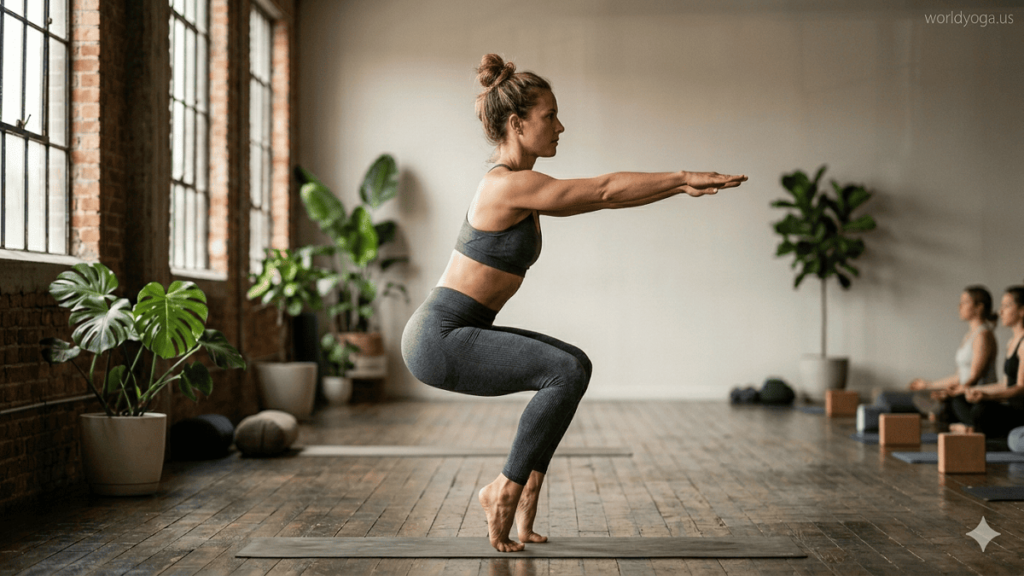
What is the proper alignment with arms in front and behind?
1. Foot and Lower-Limb Alignment
The foundation begins at the feet. Both heels remain elevated throughout the movement, placing weight on the balls of the feet. Pressure should be evenly distributed across the big toe mound, Chair Squat little toe mound, and central forefoot to prevent rolling inward or outward.
The knees must track directly over the second and third toes. They should neither collapse inward (valgus) nor push excessively outward. This alignment protects the knee joint and ensures proper engagement of the quadriceps and glutes.
2. Pelvic and Hip Position
The pelvis should remain neutral—neither excessively tucked nor arched. As the hips lower into the squat, they move slightly backward while staying aligned under the torso. The hips should not shift side-to-side or rotate unevenly.
Gluteal engagement helps stabilize the pelvis, especially during the transition between arm positions.
3. Spinal Alignment
The spine remains long and neutral throughout the movement. The chest stays open, Chair Squat and the ribcage is not flared forward. Avoid rounding the lower back or over-arching the lumbar spine.
A strong core engagement (especially transverse abdominis) helps maintain this neutral spinal position while the center of gravity shifts forward due to heel elevation.
4. Arm Position: Front Alignment
When arms are extended forward:
- Arms are straight at shoulder height
- Palms face inward or slightly downward
- Shoulders remain relaxed and away from ears
- The arms act as a counterbalance to the forward shift caused by heel lift
This position helps stabilize the torso during the descent and improves balance control.
5. Arm Position: Behind the Body Alignment
When arms move behind:
- Arms extend gently backward without forcing shoulder hyperextension
- Chest remains open but not over-arched
- Shoulder blades stay engaged and drawn slightly down and back
- Movement is controlled, not momentum-driven
This variation increases postural demand and requires stronger scapular stability and core control to prevent falling forward.
6. Head and Gaze (Drishti)
The head remains in line with the spine. The gaze is forward at a fixed point to maintain balance. Sudden head movement should be avoided, Chair Squat as it can disrupt equilibrium, especially with heels elevated.
7. Breathing and Integration
- Inhale: Prepare and lengthen spine
- Exhale: Lower into squat or transition arms
- Maintain steady breathing to support balance and control
Breath stability directly influences postural stability in this exercise.
Key Alignment Summary
- Heels continuously elevated
- Knees aligned over toes
- Neutral pelvis and spine
- Arms forward = counterbalance and stability
- Arms behind = scapular control and postural challenge
- Core engaged throughout movement
Conclusion
Proper alignment in this variation depends on maintaining a stable lower-body foundation while using arm positions as controlled counterbalances. Arms in front provide forward stability, while arms behind increase postural demand, but both must be performed without disrupting spinal neutrality or heel elevation.
#Chair Squat: High Stance Heels Up—Arms in Front & Behind in Pune
Which muscles are engaged during this variation?
Lower Body Muscles
The primary load is carried by the legs, especially due to heel elevation.
- Quadriceps (rectus femoris, vastus lateralis, medialis, intermedius):
These are the main drivers of knee extension and control during both descent and ascent. Because the heels are lifted, the quadriceps work more intensely than in a flat-foot squat. - Gluteus maximus:
Assists in hip extension during standing up from the squat and helps stabilize the pelvis in the lowered position. - Gluteus medius and minimus:
These muscles stabilize the hips and prevent lateral collapse of the pelvis or knee inward movement. - Calf muscles (gastrocnemius and soleus):
Highly engaged due to continuous heel elevation. They maintain plantar flexion and stabilize the ankle joint under load. - Intrinsic foot muscles:
Support balance on the forefoot and help control micro-adjustments in stability.
Core Muscles
The core is constantly active to maintain upright posture and balance.
- Transverse abdominis:
Acts as a deep stabilizer, maintaining intra-abdominal pressure and spinal control. - Rectus abdominis:
Helps maintain trunk alignment and prevents excessive lumbar arching. - Internal and external obliques:
Assist in stabilizing the torso, especially during arm transitions between front and back positions. - Erector spinae:
Maintains spinal extension and prevents forward collapse of the upper body.
Upper Body Muscles (Arms in Front Position)
When arms are extended forward:
- Anterior deltoids: maintain shoulder flexion
- Trapezius (middle fibers): stabilize scapula
- Serratus anterior: supports shoulder blade control
- Forearm muscles: maintain arm extension and wrist stability
This position increases anterior chain activation and helps counterbalance forward weight shift.
Upper Body Muscles (Arms Behind Position)
When arms move behind the body:
- Posterior deltoids: assist shoulder extension
- Rhomboids: retract and stabilize shoulder blades
- Latissimus dorsi: supports controlled arm extension
- Trapezius (lower fibers): maintains scapular depression and posture
This variation increases posterior chain engagement and demands stronger postural control.
Stabilization and Coordination Role
What makes this variation unique is not isolated muscle activation but continuous coordination between systems:
- Lower body maintains structural support
- Core prevents collapse and controls posture
- Upper body adjusts center of gravity through arm positioning
- Nervous system constantly refines balance through micro-adjustments
Conclusion
Chair Squat with high stance and heel elevation is a full-body integration exercise. It primarily targets the quadriceps and calves while heavily engaging the core and postural muscles of the back and shoulders. The alternating arm positions shift muscular emphasis between anterior and posterior chains, making it an effective movement for developing strength, balance, Chair Squat and coordination simultaneously.
#Chair Squat: High Stance Heels Up—Arms in Front & Behind in Ahemadabad
What preparatory exercises help build stability and strength?
1. Ankle and Calf Strength Preparation
Because the exercise is performed on the balls of the feet, Chair Squat the calves and ankles must be conditioned to handle continuous elevation.
- Standing Heel Raises (Slow Tempo):
Builds strength in the gastrocnemius and soleus while improving ankle control. - Single-Leg Calf Raises:
Enhances unilateral stability and reduces ankle wobble during dynamic movement. - Wall-Assisted Toe Holds:
Helps train endurance in forefoot balance without full squat depth.
These exercises improve stability in the elevated heel position and reduce risk of collapse during squats.
2. Lower-Body Strength Foundations
Strong quadriceps and glutes are essential for controlling squat depth and return phase.
- Bodyweight Squats (Flat Foot):
Builds foundational strength and movement patterning. - Wall Sit (Isometric Hold):
Develops endurance in the quadriceps under sustained load. - Split Squats or Lunges:
Improves unilateral leg strength and hip stability.
These movements create strength transfer into the high-stance squat variation.
3. Core Stability and Control
A stable core prevents forward collapse and supports posture during arm transitions.
- Plank Hold (Standard and Forearm):
Strengthens transverse abdominis and spinal stabilizers. - Dead Bug Exercise:
Trains core coordination with limb movement, similar to arm transitions in the squat. - Hollow Body Hold:
Improves deep abdominal engagement and trunk control.
These exercises ensure the torso remains stable while the arms move dynamically.
4. Balance and Proprioception Training
Since heel elevation reduces stability, Chair Squat, balance training is essential.
- Tandem Stance (Heel-to-Toe Standing):
Improves foot alignment and balance control. - Single-Leg Balance Holds:
Develops ankle and hip stabilizers. - Mini Squat Holds on Toes:
Prepares the body for unstable squat positions.
These drills enhance neuromuscular responsiveness and coordination.
5. Shoulder and Arm Coordination
Since arm position changes affect balance, Chair Squat upper-body control is important.
- Front Arm Raises (Light Resistance):
Builds anterior shoulder stability. - Reverse Arm Extensions:
Strengthens posterior chain muscles used when arms move behind. - Scapular Retraction Exercises:
Improves shoulder blade control and posture.
These exercises help maintain stability during arm transitions.
Progression Strategy
A safe progression pathway includes:
- Flat-foot squats
- Heel raises in standing position
- Wall-supported heel squats
- Static toe balance holds
- Full Chair Squat with arm variations
Conclusion
Effective preparation for Chair Squat (High Stance with Heels Up and Arm Variations) requires a combination of calf strengthening, lower-body endurance, core stability, balance training, and shoulder coordination. When these components are trained progressively, the body develops the strength and control needed to perform the movement safely and efficiently.
#Chair Squat: High Stance Heels Up—Arms in Front & Behind in Hyderabad
What are the benefits and precautions of this advanced squat variation?
Benefits of This Advanced Squat Variation
1. Enhanced Quadriceps Strength and Endurance
Heel elevation shifts the load forward, increasing emphasis on the quadriceps. This makes the movement highly effective for developing knee-extensor strength and muscular endurance, especially useful for athletic performance and functional lower-body conditioning.
2. Improved Ankle Stability and Calf Strength
Maintaining a lifted-heel position activates the gastrocnemius and soleus continuously. Over time, this improves ankle control, calf endurance, and forefoot stability, which are essential for running, jumping, and directional changes.
3. Core Activation and Postural Control
The unstable base requires continuous engagement of the deep core muscles, including the transverse abdominis and obliques. This helps maintain spinal alignment while the center of gravity shifts during squatting and arm transitions.
4. Better Balance and Proprioception
Reducing the base of support by lifting the heels increases neuromuscular demand. This improves proprioception (body awareness), helping the nervous system refine balance responses in dynamic situations.
5. Upper Body Coordination and Scapular Strength
Alternating arm positions—forward and behind the body—adds an upper-body coordination challenge. This engages the deltoids, trapezius, rhomboids, and serratus anterior, improving shoulder stability and postural control.
6. Functional Movement Integration
This variation mimics real-world movement patterns where balance, strength, and coordination must occur simultaneously. It is useful in sports conditioning, rehabilitation progression, and general fitness training.
Precautions and Safety Considerations
1. Ankle and Achilles Tendon Stress
Heel elevation increases load on the calves and Achilles tendon. Individuals with Achilles tendinopathy, ankle instability, or recent sprains should avoid or modify this exercise.
2. Knee Alignment Risk
Improper knee tracking (especially inward collapse) can place excessive stress on the knee joint. The knees must always align with the toes to reduce injury risk.
3. Balance and Fall Risk
Because the base of support is reduced, there is a higher risk of losing balance, especially during arm transitions. Beginners should use a wall or support structure initially.
4. Lower Back Strain
Excessive forward lean or loss of core engagement can stress the lumbar spine. Maintaining a neutral spine and active core is essential throughout the movement.
5. Fatigue-Related Form Breakdown
As fatigue increases, control over heel position and posture may decrease, leading to compensation patterns. It is better to perform fewer high-quality repetitions than prolonged unstable sets.
Modification Guidelines
- Reduce squat depth if heel stability is compromised
- Perform near a wall for added balance support
- Keep arms stationary before introducing movement variations
- Start with flat-foot squats before progressing to heel elevation
Conclusion
The Chair Squat (High Stance with Heels Up and Arm Variations) offers significant benefits in lower-body strength, ankle stability, core control, and coordination. However, it also introduces higher mechanical stress and balance demands. When performed with correct alignment and gradual progression, it becomes a highly effective tool for functional strength and neuromuscular development.
#Chair Squat: High Stance Heels Up—Arms in Front & Behind in Delhi
Case Study of Chair Squat: High Stance Heels Up—Arms in Front & Behind
Subject Profile
The subject is a 29-year-old recreational fitness trainee with intermediate training experience. The individual demonstrated strong baseline lower-body strength but reported instability during dynamic movements and reduced ankle endurance during high-repetition exercises. No major musculoskeletal injuries were present, though mild calf tightness and limited ankle dorsiflexion were noted.
Initial Assessment
At baseline, the subject showed:
- Adequate squat strength but poor balance under instability
- Limited calf endurance during forefoot loading
- Moderate core strength with reduced anti-rotation control
- Difficulty maintaining posture during upper-body movement changes
These findings indicated a need for integrated stability and coordination training rather than isolated strength development.
Intervention Protocol
A six-week progressive training plan was implemented focusing on the Chair Squat variation and supporting exercises.
Phase 1: Foundation Strength (Weeks 1–2)
- Standard bodyweight squats (flat foot)
- Standing heel raises for calf activation
- Static wall sits for quadriceps endurance
Objective: Build foundational lower-body strength and introduce controlled movement patterns.
Phase 2: Stability Introduction (Weeks 3–4)
- Heel-elevated static squat holds
- Assisted chair squats using a wall for balance
- Core stabilization drills (plank and dead bug variations)
Objective: Develop ankle stability and introduce forefoot loading under controlled conditions.
Phase 3: Full Movement Integration (Weeks 5–6)
- Chair Squat with heel elevation and arms forward
- Transition training to arms moving behind the body
- Controlled tempo squats with emphasis on balance and alignment
Objective: Integrate lower-body strength with upper-body coordination and balance control.
Observations and Outcomes
By the end of the intervention period, the subject demonstrated significant improvements in:
- Balance control: Increased stability duration during heel-elevated squats
- Calf endurance: Reduced fatigue during forefoot loading
- Core engagement: Improved ability to maintain upright posture during arm transitions
- Movement coordination: Smoother transitions between arm positions without loss of alignment
The subject also reported increased awareness of foot pressure distribution and improved confidence during unstable movements.
Discussion
This case highlights that the Chair Squat variation is not solely a strength exercise but a multi-system coordination task. The combination of heel elevation and arm alternation significantly increases neuromuscular demand, requiring integration of ankle stability, core control, and postural adjustment.
Progressive overload through staged exposure proved essential in reducing compensatory movement patterns and improving execution quality. The results suggest that instability-based squatting variations can effectively enhance functional movement capacity when introduced systematically.
Conclusion
The Chair Squat (High Stance Heels Up with Arms in Front & Behind) is an effective functional training tool for improving balance, lower-body strength, and coordination. This case study demonstrates that structured progression—from foundational strength to integrated instability training—can produce measurable improvements in neuromuscular control and movement efficiency.
References
- ACE Fitness Exercise Library: https://www.acefitness.org/education-and-resources/lifestyle/exercise-library/
- NSCA Strength Training Guidelines: https://www.nsca.com/education/articles/
- Human Kinetics Movement Science Resources: https://us.humankinetics.com/
- Physiopedia Balance and Proprioception Training: https://www.physio-pedia.com/Balance_Training
#Chair Squat: High Stance Heels Up—Arms in Front & Behind in Kolkata
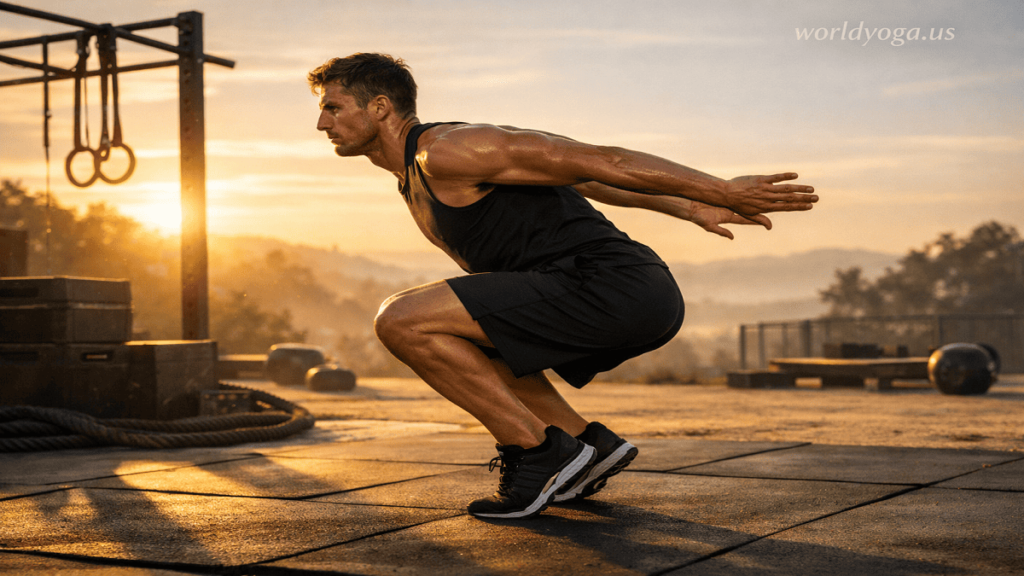
White Paper of Chair Squat: High Stance Heels Up—Arms in Front & Behind
Abstract
The Chair Squat with high stance, heel elevation, and alternating arm positions is a functional training variation designed to enhance lower-body strength, ankle stability, core control, and upper-body coordination. This white paper analyzes its biomechanical structure, neuromuscular demands, physiological benefits, risk factors, and applied use cases in fitness, rehabilitation, and athletic performance systems.
1. Introduction
The Chair Squat variation is a progression of the traditional squat that introduces instability through heel elevation and dynamic arm positioning. Unlike standard squats, this movement reduces the base of support and increases reliance on postural control systems. It is widely used in functional training and movement conditioning frameworks, including performance-based systems and rehabilitation protocols.
2. Biomechanical Analysis
2.1 Base of Support and Load Shift
Heel elevation shifts the center of gravity forward, increasing load on the forefoot. This reduces stability and requires continuous micro-adjustments through the ankle complex. The metatarsals bear increased pressure, activating intrinsic foot stabilizers.
2.2 Kinetic Chain Engagement
The movement follows a closed kinetic chain pattern from foot to hip. Key contributors include:
- Quadriceps: primary force production during knee extension
- Gluteus maximus: hip extension and stabilization
- Calves (gastrocnemius, soleus): continuous plantar flexion control
- Core musculature: spinal stabilization under shifting load
2.3 Upper Body Integration
Arm positioning modifies the center of mass:
- Arms forward: increases anterior counterbalance demand
- Arms behind: increases posterior chain and scapular activation
This alternating pattern introduces controlled perturbation to postural stability.
3. Neuromuscular Demand Profile
This variation requires simultaneous activation of multiple systems:
- Lower-limb stabilizers for balance and force production
- Deep core muscles (transverse abdominis, obliques) for anti-extension control
- Shoulder stabilizers (deltoids, trapezius, rhomboids) for arm coordination
- Proprioceptive system for continuous balance correction
The exercise functions as a neuromotor integration task rather than isolated strength work.
4. Physiological and Functional Benefits
4.1 Lower-Body Strength Development
Enhanced quadriceps activation improves knee extension strength and endurance.
4.2 Ankle and Foot Conditioning
Sustained forefoot loading strengthens calf musculature and improves ankle joint stability.
4.3 Core Stability Enhancement
Continuous postural adjustment improves anti-rotation and anti-flexion core strength.
4.4 Coordination and Balance
Alternating arm positions improve interlimb coordination and dynamic balance control.
4.5 Functional Movement Transfer
The movement pattern supports real-world activities requiring simultaneous balance, strength, and coordination, such as athletic cutting, lifting, and directional changes.
5. Risk Assessment
5.1 Mechanical Stress Considerations
Increased load on the Achilles tendon and forefoot may elevate risk of strain if progression is too rapid.
5.2 Common Movement Faults
- Heel drop during squat phase
- Knee valgus collapse
- Excessive forward trunk lean
- Loss of core engagement during arm transitions
5.3 Contraindications
Not recommended for individuals with acute ankle injuries, Achilles tendinopathy, or severe balance disorders without supervision.
6. Progression Framework
A structured progression is recommended:
- Standard bodyweight squat
- Heel raises in standing position
- Assisted heel-elevated squats
- Static heel squat holds
- Full Chair Squat with arm variations
7. Applied Use Cases
- Functional fitness training programs
- Athletic conditioning and injury prevention systems
- Physiotherapy balance and proprioception rehabilitation
- Corporate wellness and movement correction protocols
8. Conclusion
The Chair Squat (High Stance Heels Up—Arms in Front & Behind) is a high-demand functional exercise that integrates lower-body strength, ankle stability, core control, and upper-body coordination. Its primary value lies in training neuromuscular control under instability. When applied progressively, it enhances movement efficiency, balance resilience, and functional strength across multiple physical domains.
References
- ACE Fitness Exercise Library: https://www.acefitness.org/education-and-resources/lifestyle/exercise-library/
- NSCA Strength and Conditioning Resources: https://www.nsca.com/education/
- Human Kinetics Movement Science: https://us.humankinetics.com/
- Physiopedia Balance Training Concepts: https://www.physio-pedia.com/Balance_Training
#Chair Squat: High Stance Heels Up—Arms in Front & Behind in Banglore
Industry Application of Chair Squat: High Stance Heels Up—Arms in Front & Behind
1. Fitness and Strength Training Industry
In fitness programming, this variation is used as a functional lower-body conditioning drill rather than a traditional hypertrophy squat. It is commonly integrated into:
- Athletic conditioning circuits
- Functional training programs
- Bodyweight strength systems
The heel-elevated stance increases quadriceps activation while reducing reliance on posterior chain dominance. The alternating arm positions introduce a coordination challenge that improves whole-body integration. Trainers use it to enhance:
- Lower-body endurance
- Core stability under dynamic load
- Balance under fatigue conditions
This makes it particularly valuable in group fitness classes and high-repetition training environments.
2. Sports Performance and Athletic Training
In sports science, this movement is applied as a neuromuscular control and stability drill. Athletes in sports requiring rapid directional changes benefit from improved:
- Ankle stability under load
- Forefoot force control
- Core anti-rotation strength
- Upper-lower body coordination
It is especially relevant for sports such as basketball, football, tennis, and martial arts, where athletes frequently operate in unstable, semi-squatted positions while reacting to external forces.
The exercise helps simulate real-world athletic demands involving deceleration, balance recovery, and explosive reorientation.
3. Physiotherapy and Rehabilitation
In rehabilitation environments, modified versions of the exercise are used for progressive load reintroduction and proprioceptive retraining. Under supervision, it supports recovery from:
- Ankle sprains (late-stage rehab)
- Mild knee instability
- Postural control deficits
The heel-elevated position is carefully introduced to gradually recondition the Achilles tendon and calf complex. Arm variations are used to challenge coordination without increasing lower-limb load excessively.
Therapists value this exercise for its ability to combine strength rebuilding with balance retraining in a controlled environment.
4. Corporate Wellness and Ergonomics
In workplace wellness programs, simplified versions are used to counteract sedentary behavior. Benefits include:
- Activation of underused lower-limb muscles
- Improved circulation through dynamic movement
- Postural awareness enhancement
Short movement breaks incorporating squat variations help reduce stiffness from prolonged sitting and improve neuromuscular activation during the workday.
5. Military, Tactical, and Functional Readiness Training
In tactical training systems, this exercise is used to build:
- Load-bearing endurance
- Stability under unstable footing conditions
- Rapid postural adjustment ability
The heel-elevated squat mimics situations where soldiers or tactical personnel must maintain readiness in constrained or unstable environments while carrying gear.
6. Mind-Body and Movement Education Systems
Within movement education frameworks, this exercise is used to teach:
- Center of gravity control
- Kinesthetic awareness
- Breath-linked movement stability
It is also applied in advanced body awareness training to improve coordination between visual focus, limb movement, and postural alignment.
7. Conclusion
The Chair Squat (High Stance Heels Up—Arms in Front & Behind) is a versatile functional movement used across fitness, sports performance, rehabilitation, workplace wellness, tactical training, and movement education. Its value lies in its ability to integrate strength, balance, and coordination under instability, making it a practical tool for enhancing real-world physical performance and neuromuscular efficiency.
#Chair Squat: High Stance Heels Up—Arms in Front & Behind in Mumbai
Ask FAQs
What is the Chair Squat (High Stance Heels Up with Arm Variations)?
It is a functional squat variation where the heels are lifted off the ground throughout the movement, placing the body on the balls of the feet. The exercise includes arm positions in front and behind the body to increase balance demand and coordination challenge while performing controlled squats.
What is the main purpose of this exercise?
The primary purpose is to develop lower-body strength, ankle stability, core control, and full-body coordination. The heel-elevated position increases quadriceps and calf engagement, while alternating arm positions challenge postural stability and neuromuscular control.
Is this exercise suitable for beginners?
It is considered an intermediate to advanced variation. Beginners should first master standard bodyweight squats and basic heel raises before attempting this movement. Assistance from a wall or reduced depth can be used during early learning stages.
What muscles are mainly worked in this exercise?
The exercise primarily targets the quadriceps, glutes, and calves. It also strongly engages the core muscles for stability, along with the shoulders and upper back when performing arm movements. The intrinsic foot muscles are also activated due to forefoot balance demand.
What are the key safety precautions?
Maintaining heel elevation without collapsing is essential. The knees should always track in line with the toes to avoid joint strain. Individuals with ankle instability, Achilles tendon issues, or knee pain should modify or avoid this exercise. Controlled movement and proper posture are more important than depth or speed.
Table of Contents
Disclaimer: This content is for educational and informational purposes only and is not a substitute for professional medical, fitness, or physiotherapy advice. Perform exercises only within your comfort level and stop immediately if you experience pain or discomfort. Consult a qualified healthcare or fitness professional before attempting advanced movements, especially if you have existing injuries or medical conditions.