Upward Bow Pose
The Upward Bow Pose, commonly known as Wheel Pose and traditionally referred to in yoga as Chakrasana, is a deep backbending posture that combines spinal extension, shoulder flexibility, and full-body strength. It is widely practiced in advanced yoga systems, gymnastics conditioning, and mobility training due to its strong emphasis on posterior chain activation and thoracic spine opening.
Overview and Execution
The pose begins by lying on the back with knees bent and feet placed firmly on the ground, hip-width apart. The heels are positioned close enough to the body to allow optimal lift. The hands are placed beside the ears with fingers pointing toward the shoulders, elbows bent and aligned parallel.
On an inhale, the practitioner engages the core and glutes, pressing through both hands and feet simultaneously. The hips lift first, followed by the chest, Upward Bow Pose as the spine arches into a full backbend. The arms straighten gradually, creating a strong wheel-like shape from hands to feet.
The weight is distributed evenly between the hands and feet, with the chest actively opening and the shoulders externally rotating.
Muscles Engaged
This pose is a full-body strength and flexibility posture involving:
- Erector spinae: Primary spinal extensors supporting the deep backbend
- Gluteus maximus: Hip extension and pelvic lift
- Hamstrings: Assist in stabilizing lower-body alignment
- Quadriceps: Maintain knee extension and leg stability
- Deltoids and triceps: Support arm extension and shoulder stability
- Latissimus dorsi: Assists in shoulder extension and chest opening
- Abdominals (eccentric engagement): Lengthen under spinal extension
The posterior chain is heavily activated while the anterior body undergoes controlled stretching.
Benefits
1. Spinal Flexibility and Mobility
Improves extension of the entire spine, especially the thoracic region, counteracting prolonged sitting posture.
2. Strength Development
Builds significant strength in the arms, shoulders, glutes, and back muscles.
3. Chest and Lung Expansion
Opens the chest cavity, Upward Bow Pose improving respiratory capacity and posture.
4. Energy and Circulation Boost
In yoga traditions, deep backbends are associated with increased energy flow and nervous system activation.
5. Postural Correction
Helps reverse rounded shoulders and forward head posture caused by sedentary habits.
Precautions
- Avoid if you have wrist, shoulder, or spinal injuries
- Not recommended for individuals with severe lower back pain or herniated discs
- Beginners should practice under supervision due to high spinal load
- Always warm up with gentle backbends before attempting
Common risks include wrist strain, lower back compression, and shoulder impingement if alignment is incorrect.
Preparatory Poses
- Bridge Pose (Setu Bandhasana)
- Cobra Pose (Bhujangasana)
- Camel Pose (Ustrasana)
- Locust Pose (Salabhasana)
These help gradually build spinal extension strength and shoulder flexibility.
Conclusion
Upward Bow Pose (Chakrasana) is a powerful full-body backbend that develops strength, Upward Bow Pose, flexibility, and postural awareness. When practiced with proper alignment and progression, it enhances spinal mobility, strengthens the posterior chain, Upward Bow Pose and improves overall functional movement capacity.
References
- Yoga Journal Pose Library: https://www.yogajournal.com/poses
- Yoga International Backbend Guides: https://yogainternational.com/
- DoYogaWithMe Practice Library: https://www.doyogawithme.com/yoga-poses
#Upward Bow Pose in India
How is Upward Bow Pose performed correctly?
Step-by-Step Correct Execution
1. Starting Position
Lie flat on your back with knees bent and feet placed hip-width apart. The feet should be parallel, close enough that you can graze your heels with your fingertips. Keep arms bent and place palms beside your ears, fingers pointing toward the shoulders. Elbows should be shoulder-width apart and pointing upward, not flaring outward.
The spine should be neutral initially, with the core lightly engaged.
2. Foundation Setup
Before lifting, actively ground through both feet. Press evenly through the big toe, little toe, and heel points. At the same time, Upward Bow Pose engage the legs by slightly drawing the thighs inward to maintain hip alignment.
Hands should press firmly into the ground with fingers spread wide to distribute wrist pressure evenly.
3. Lift Phase (Initiation of Backbend)
On an inhale, Upward Bow Pose, engage the glutes and core. Press simultaneously through hands and feet to lift the hips off the ground.
- First, the pelvis lifts
- Then the lower back arches
- Finally, the chest opens upward
Avoid pushing the hips too fast; the movement should be smooth and controlled.
4. Full Expression of the Pose
Once the crown of the head is lifted off the floor, Upward Bow Pose, begin straightening the arms gradually. The chest should move through the shoulders rather than collapsing into them.
Key alignment points:
- Arms straight but not locked
- Shoulders externally rotated and stable
- Chest lifted and open
- Hips actively pushing upward
- Feet grounded and stable
The body forms a smooth arch from hands to feet.
5. Breathing and Stability
Breathing should remain steady and controlled. Avoid holding the breath, as this increases tension in the spine and shoulders. The breath supports expansion in the chest and stability in the posture.
Key Alignment Principles
- Feet hip-width and firmly grounded
- Knees tracking forward, not splaying outward
- Hands shoulder-width with fingers spread
- Elbows not collapsing sideways
- Spine evenly arched (no compression in one region)
- Weight distributed between hands and feet
Common Mistakes to Avoid
- Allowing knees to flare outward
- Collapsing into the lower back instead of distributing the arch
- Pushing only through arms without leg engagement
- Letting elbows splay wide
- Over-compressing the neck or lower spine
Safety and Control Tips
- Warm up with Bridge Pose or Cobra Pose first
- Do not attempt if wrists or shoulders are weak or injured
- Use a wall or yoga block support if learning
- Exit slowly by tucking chin and lowering spine segment by segment
Conclusion
Correct performance of Upward Bow Pose (Chakrasana) depends on balanced engagement of hands, feet, and core while distributing spinal extension evenly across the entire back. When aligned properly, it becomes a powerful posture for improving spinal mobility, full-body strength, and chest opening without unnecessary joint strain.
#Upward Bow Pose in Maharahstra
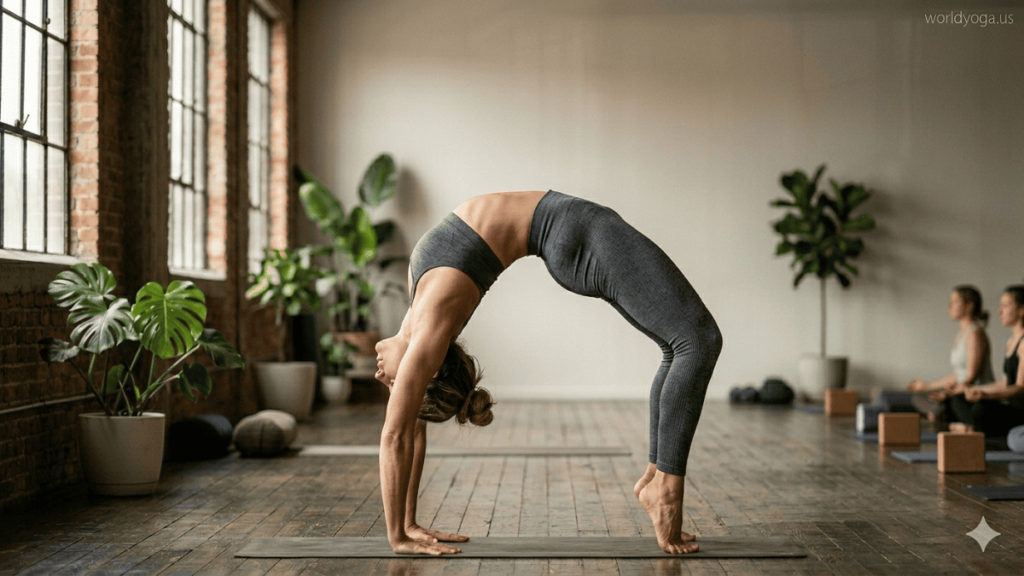
What is the proper alignment in this backbend?
1. Foot and Leg Alignment
The foundation starts with the feet. Both feet should be placed hip-width apart and remain parallel to each other. One of the most important alignment cues is to keep pressure evenly distributed across the big toe mound, little toe mound, and heel.
The knees should track in line with the second and third toes, preventing outward flaring. The thighs should stay active, with a subtle inward engagement to stabilize the pelvis. The glutes assist in lifting the hips but should not be overly clenched, as excessive tension can compress the lower back.
2. Pelvis and Lower Spine Alignment
The pelvis should lift evenly without tilting to one side. The goal is to create a smooth, continuous arch rather than a sharp bend in the lower back.
The lumbar spine naturally extends, but the movement should not be forced from this region. Instead, the lift should be shared between the hips, thoracic spine, and shoulders to avoid excessive lumbar compression.
3. Spinal Alignment
The spine should form a uniform arc from the hands to the feet. The thoracic spine (upper back) should actively participate in the backbend, not remain rigid. This helps distribute the curve evenly and protects the lower back.
The chest should open upward and forward, creating space between the ribs. The neck remains neutral or slightly extended, but never compressed.
4. Hand and Arm Alignment
Hands are placed beside the ears with fingers pointing toward the shoulders. The hands should be shoulder-width apart to ensure stability.
Elbows must remain parallel and not splay outward. During lift-off, the arms gradually straighten, but they should not lock aggressively. The shoulders externally rotate to create space and prevent impingement.
Weight should be shared evenly between hands and feet, not biased toward either end.
5. Shoulder Alignment
The shoulders are one of the most critical elements in this pose. They should be actively lifted away from the ears and externally rotated. This prevents collapse into the joints and supports safe spinal extension.
The shoulder blades should move slightly toward each other without pinching, allowing the chest to open fully.
6. Head and Neck Alignment
The head should be relaxed and either hanging naturally or gently extended depending on flexibility. The neck should remain free of compression. The gaze is typically toward the floor or slightly behind the body, but not forcing strain into the cervical spine.
Key Alignment Summary
- Feet parallel and hip-width apart
- Knees aligned over toes
- Even weight through feet and hands
- Pelvis lifting evenly without tilt
- Spine forming a smooth, distributed arch
- Shoulders externally rotated and stable
- Chest open without collapsing lower back
- Neck relaxed and free of compression
Conclusion
Proper alignment in Chakrasana is about even distribution of spinal extension and balanced engagement of both upper and lower body. When correctly aligned, the pose strengthens the posterior chain, improves spinal mobility, and opens the chest without placing excessive stress on any single joint or region.
#Upward Bow Pose in Delhi
Which muscles are engaged during the pose?
Primary Muscle Groups Engaged
1. Posterior Chain (Main Power Source)
- Erector spinae:
These deep spinal muscles are heavily engaged to extend and support the spine throughout the backbend. They maintain spinal integrity and prevent collapse. - Gluteus maximus:
Acts as a primary hip extensor, lifting the pelvis upward and supporting the arch of the lower back. - Hamstrings:
Assist in stabilizing the hips and maintaining alignment of the thighs during the lift. - Calves (gastrocnemius and soleus):
Help stabilize the ankles and maintain grounded foot positioning.
2. Upper Body Muscles
- Deltoids (especially anterior fibers):
Support shoulder flexion and stabilize the arms in the overhead pressing position. - Triceps brachii:
Assist in straightening and stabilizing the elbows once the arms are extended. - Latissimus dorsi:
Contributes to shoulder stability and supports controlled chest opening. - Trapezius and rhomboids:
Stabilize the shoulder blades, preventing collapse and supporting thoracic extension. - Forearm muscles:
Maintain grip and wrist stability under load.
3. Core Muscles (Stabilizing Role)
Although the spine is extending, the core does not relax. Instead, it provides controlled support:
- Rectus abdominis:
Lengthens under stretch but still helps regulate spinal extension. - Internal and external obliques:
Stabilize the torso and assist in maintaining balanced spinal alignment. - Transverse abdominis:
Acts as a deep stabilizer to control intra-abdominal pressure and protect the lumbar spine.
4. Hip and Pelvic Stabilizers
- Hip flexors (iliopsoas):
Lengthen during the backbend, allowing deeper spinal extension. - Adductor muscles:
Help stabilize thigh positioning and prevent outward collapse of the legs. - Gluteus medius:
Maintains pelvic alignment and prevents lateral shifting.
5. Supporting Muscle Synergy
The pose is not dominated by one muscle group but by coordinated activation:
- Posterior chain generates lift and extension
- Upper body provides structural support through shoulders and arms
- Core stabilizes spinal alignment under extension
- Lower body maintains grounding and balance
This integrated activation makes the pose a full-body strength and mobility expression.
Conclusion
Chakrasana engages nearly every major muscle group in the body, with primary emphasis on the spinal extensors, glutes, hamstrings, shoulders, and triceps. At the same time, the abdominal muscles and hip flexors work eccentrically to control and balance the deep backbend. The result is a coordinated system of strength, flexibility, and stabilization working simultaneously to support the posture safely and effectively.
#Upward Bow Pose in Kolkata
What preparatory poses are recommended?
1. Spinal Extension Preparations
These poses gradually build mobility in the spine, especially the thoracic region:
- Cobra Pose (Bhujangasana):
Introduces gentle spinal extension while strengthening the back muscles without weight-bearing on the hands and feet. - Sphinx Pose:
A softer version of Cobra that helps activate spinal extensors with minimal strain. - Locust Pose (Salabhasana):
Strengthens the posterior chain, including the erector spinae and glutes, preparing the body for deeper backbends.
2. Shoulder and Chest Openers
Wheel Pose requires strong shoulder mobility and chest expansion.
- Bridge Pose (Setu Bandhasana):
Builds foundational strength for spinal extension while opening the chest. - Camel Pose (Ustrasana):
Deepens front-body opening, particularly in the hip flexors, chest, and shoulders. - Supported Fish Pose (Matsyasana variation):
Helps expand the chest and improve thoracic flexibility.
3. Arm and Wrist Strengthening
Since the pose involves weight-bearing on the hands, wrist preparation is crucial:
- Tabletop Wrist Rocks:
Improves wrist mobility and prepares joints for extension load. - Downward Dog Holds (Adho Mukha Svanasana):
Builds shoulder stability and arm endurance under partial body weight. - Plank Pose:
Strengthens wrists, shoulders, and core simultaneously.
4. Lower Body Activation
Strong legs and hips are essential for lifting into the backbend:
- Chair Pose (Utkatasana):
Strengthens quadriceps and glutes for hip lift support. - Lunge Variations:
Open hip flexors, which are often tight and limit backbend depth. - Bridge Pose with Heel Walks:
Activates glutes and hamstrings while training controlled hip extension.
5. Core Stability Training
Core engagement helps protect the lower back during deep extension:
- Boat Pose (Navasana):
Builds abdominal strength and control. - Forearm Plank:
Enhances full-core stability and spinal support. - Dead Bug Exercise:
Improves coordination between limbs and core stability.
Progression Strategy
A safe progression typically follows this sequence:
- Gentle spinal extension (Cobra, Sphinx)
- Strength building (Locust, Plank, Bridge)
- Shoulder opening (Camel, Fish)
- Full integration (Wheel Pose practice)
Conclusion
Effective preparation for Chakrasana requires a balanced approach that develops spinal flexibility, shoulder mobility, wrist strength, core stability, and lower-body power. When these elements are trained progressively, the body is better equipped to enter the full backbend safely, with even distribution of effort and reduced risk of strain.
#Upward Bow Pose in Ahemadabad
What are the benefits and precautions of this pose?
Benefits of the Pose
1. Spinal Flexibility and Mobility
Chakrasana deeply extends the entire spine, especially the thoracic region, which is often stiff due to prolonged sitting. Regular practice improves spinal articulation and helps maintain a healthy range of motion in the back.
2. Strengthening of the Posterior Chain
The pose strongly engages the erector spinae, glutes, hamstrings, and shoulders. This builds functional strength across the back of the body, improving posture and overall structural support.
3. Chest and Lung Expansion
The deep opening of the chest increases rib cage mobility and can support better breathing capacity. It helps counteract rounded shoulders and forward head posture caused by sedentary habits.
4. Shoulder and Arm Strength
Weight-bearing through the hands strengthens the deltoids, triceps, and stabilizing muscles of the shoulder girdle. This improves upper-body endurance and joint stability.
5. Hip Flexor Release
The front body, especially the hip flexors and abdominal region, undergoes a strong stretch. This can reduce tightness caused by prolonged sitting and improve pelvic mobility.
6. Energetic and Mental Effects
Traditionally, deep backbends are associated with increased energy levels, improved mood, and reduced fatigue due to chest opening and increased oxygen flow.
Precautions and Safety Considerations
1. Wrist and Shoulder Stress
Since the pose requires significant weight-bearing on the hands, individuals with wrist pain, carpal tunnel syndrome, or shoulder injuries should avoid or modify the posture.
2. Lower Back Compression Risk
Improper execution can place excessive stress on the lumbar spine. Overarching only the lower back instead of distributing the curve can lead to discomfort or injury.
3. Neck Strain
If the head is improperly positioned or weight shifts toward the neck, cervical strain may occur. The neck should remain relaxed without compression.
4. Spinal Conditions
Individuals with herniated discs, severe scoliosis, or acute back pain should avoid this pose unless cleared by a medical professional.
5. Blood Pressure and Dizziness
Deep backbends may affect circulation and blood pressure. Those with hypertension, vertigo, or heart conditions should practice cautiously or avoid the pose.
6. Overexertion and Fatigue
Attempting the full pose without proper warm-up can lead to muscle strain, especially in the shoulders and lower back. Fatigue increases risk of misalignment and injury.
Modification Tips
- Use Bridge Pose as a safer alternative
- Practice with a yoga block under the hands for support
- Warm up thoroughly with gentle backbends
- Enter and exit slowly with controlled breathing
Conclusion
Chakrasana offers powerful benefits in spinal mobility, strength development, chest opening, and postural correction. However, it demands respect for its intensity and should be approached progressively. When practiced with correct alignment and preparation, it becomes a highly effective posture for improving full-body strength and flexibility while maintaining joint safety.
#Upward Bow Pose in Hyderabad
Case Study of Upward Bow Pose
Subject Profile
The subject is a 32-year-old recreational yoga practitioner with two years of consistent practice. The individual demonstrated good lower-body flexibility and moderate core strength but reported limitations in shoulder mobility and spinal extension depth. Mild wrist sensitivity was also noted during weight-bearing upper-body movements.
Initial Assessment
At baseline, the practitioner showed:
- Limited thoracic spine extension
- Moderate glute and hamstring strength
- Restricted shoulder flexion and external rotation
- Weak wrist load tolerance in extended positions
- Over-reliance on lumbar spine during backbending attempts
These factors indicated a need for progressive backbend conditioning and joint preparation.
Intervention Strategy
A six-week progressive program was implemented focusing on spinal mobility, posterior chain strengthening, shoulder opening, and wrist conditioning.
Phase 1: Foundation Mobility (Weeks 1–2)
- Sphinx Pose and Cobra Pose for gentle spinal extension
- Bridge Pose for controlled hip and chest opening
- Wrist mobility drills and forearm strengthening
Objective: Introduce safe spinal extension patterns and prepare weight-bearing joints.
Phase 2: Strength and Activation (Weeks 3–4)
- Locust Pose variations to strengthen posterior chain
- Plank Pose and Downward Dog for shoulder and wrist load adaptation
- Supported Bridge Pose with emphasis on glute engagement
Objective: Build strength in back extensors and shoulder stabilizers.
Phase 3: Integrated Backbend Progression (Weeks 5–6)
- Camel Pose for deep anterior chain opening
- Elevated Bridge Pose with controlled holds
- Assisted Wheel Pose using blocks for partial lift
Objective: Transition from partial to full spinal extension with support.
Observations and Outcomes
By the end of the intervention period, the subject demonstrated:
- Improved thoracic spine mobility and reduced lumbar overcompensation
- Increased shoulder opening and improved arm load tolerance
- Enhanced glute activation during hip extension phases
- Better control during controlled entry into Wheel Pose variations
The practitioner was able to perform a modified version of Chakrasana with improved alignment and reduced wrist discomfort.
Discussion
This case highlights that successful progression into Chakrasana depends on distributed spinal loading rather than isolated lumbar extension. The combination of posterior chain strengthening and anterior chain opening was essential in achieving safe backbend depth.
The gradual exposure model significantly reduced joint strain and improved neuromuscular control, particularly in the shoulders and wrists. This supports the importance of structured progression in deep backbending practices.
Conclusion
Upward Bow Pose (Chakrasana) requires coordinated development of spinal mobility, shoulder flexibility, posterior chain strength, and joint stability. This case demonstrates that progressive training significantly improves execution quality, reduces compensatory movement patterns, and enhances overall movement safety and efficiency.
References
- Yoga Journal Pose Library: https://www.yogajournal.com/poses
- Yoga International Backbend Progressions: https://yogainternational.com/
- DoYogaWithMe Practice Sequences: https://www.doyogawithme.com/yoga-poses
- Human Kinetics Movement Science: https://us.humankinetics.com/
#Upward Bow Pose in Pune
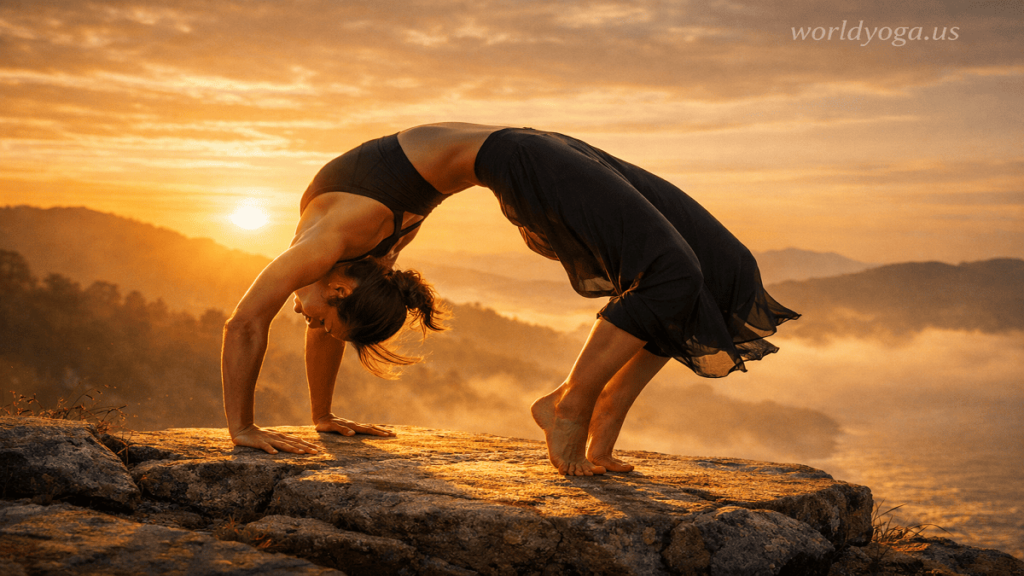
White Paper of Upward Bow Pose
Abstract
Upward Bow Pose, commonly known as Wheel Pose and referred to as Chakrasana, is a high-intensity spinal extension posture used in yoga, mobility training, and movement conditioning systems. This white paper analyzes its biomechanical structure, neuromuscular demands, physiological benefits, risk profile, and applied use cases. The posture is characterized by full-body engagement, requiring coordinated strength across the posterior chain and controlled lengthening of the anterior body.
1. Introduction
Chakrasana is a foundational advanced backbend in yoga systems that emphasizes spinal extension under load. Unlike isolated flexibility movements, it requires simultaneous activation of multiple kinetic chains, making it a model exercise for studying integrated strength and mobility. It is widely used in yoga, gymnastics conditioning, and modern functional training environments.
2. Biomechanical Analysis
2.1 Load Distribution
The body weight is distributed between the hands and feet in a closed kinetic chain. This creates a dual support system where both upper and lower limbs share compressive load. The center of gravity shifts toward the upper thoracic region during full expression.
2.2 Spinal Extension Mechanics
The spine forms a continuous arc with emphasis on:
- Thoracic extension (primary mobility requirement)
- Lumbar extension (high load-bearing region)
- Cervical extension (secondary, controlled involvement)
Balanced distribution of extension is critical to avoid localized lumbar compression.
2.3 Shoulder and Hip Mechanics
Shoulders move into deep flexion and external rotation under load, while hips extend into a lifted position driven by gluteal activation. The shoulder girdle functions as a primary load-bearing structure.
3. Neuromuscular Activation Profile
Chakrasana requires coordinated activation of multiple systems:
- Posterior chain: erector spinae, gluteus maximus, hamstrings
- Upper limb stabilizers: deltoids, triceps, trapezius, serratus anterior
- Core stabilizers: transverse abdominis, obliques, rectus abdominis (eccentric control)
- Lower limb stabilizers: quadriceps, calf muscles, intrinsic foot stabilizers
The neuromuscular system must continuously regulate tension between opposing muscle groups to maintain structural integrity.
4. Physiological and Functional Benefits
4.1 Spinal Mobility Enhancement
Improves extension capacity across the entire spine, particularly beneficial for counteracting flexion-dominant postures caused by sedentary lifestyles.
4.2 Strength Development
Develops functional strength in the posterior chain and shoulder complex under bodyweight load conditions.
4.3 Respiratory Expansion
Chest opening increases thoracic capacity and improves rib cage mobility, supporting more efficient breathing mechanics.
4.4 Postural Correction
Helps reduce forward head posture and rounded shoulders by strengthening spinal extensors and opening anterior structures.
4.5 Neuromuscular Coordination
Enhances intermuscular coordination between upper and lower body systems under load-bearing extension.
5. Risk Assessment
5.1 Mechanical Stress Factors
High compressive forces are placed on the lumbar spine and wrist joints. Improper alignment can lead to localized overload.
5.2 Common Fault Patterns
- Over-reliance on lumbar spine instead of thoracic extension
- Elbow splaying and shoulder instability
- Knee misalignment causing hip rotation imbalance
- Inadequate core engagement leading to spinal compression
5.3 Contraindications
Not recommended for individuals with wrist injuries, severe lower back conditions, shoulder impingement, or uncontrolled hypertension without medical clearance.
6. Progression Model
A structured progression is essential:
- Gentle spinal extension (Sphinx, Cobra)
- Strength development (Locust, Bridge)
- Shoulder and hip opening (Camel Pose)
- Assisted wheel variations (block-supported)
- Full Chakrasana execution
7. Applied Use Cases
- Yoga-based mobility systems
- Athletic conditioning and backbend training
- Rehabilitation for postural dysfunction (supervised)
- Gymnastics and bodyweight strength training
- Breath expansion and posture correction programs
8. Conclusion
Chakrasana is a complex integrative movement that combines strength, flexibility, and neuromuscular control under full-body load. When practiced progressively, it enhances spinal mobility, posterior chain strength, and postural alignment. However, due to its high mechanical demand, structured preparation and alignment awareness are essential for safe execution.
References
- Yoga Journal Pose Library: https://www.yogajournal.com/poses
- Yoga International Backbend Resources: https://yogainternational.com/
- Human Kinetics Movement Science: https://us.humankinetics.com/
- DoYogaWithMe Practice Library: https://www.doyogawithme.com/yoga-poses
#Upward Bow Pose in Banglore
Industry Application of Upward Bow Pose
1. Fitness and Strength Training Industry
In modern fitness systems, Chakrasana is used as a bodyweight strength and mobility integration exercise. It is often included in advanced training programs that emphasize functional movement rather than isolated muscle work.
Key applications include:
- Posterior chain strengthening (glutes, hamstrings, back extensors)
- Shoulder and triceps endurance under load
- Mobility training for thoracic spine and hip flexors
- Full-body coordination under closed kinetic chain stress
Fitness professionals use it as a benchmark movement for advanced mobility and body control, often included in calisthenics and functional training circuits.
2. Yoga and Mind-Body Wellness Industry
Within yoga systems, Chakrasana is considered a peak backbending posture. It is used in structured sequences to:
- Develop spinal extension capacity
- Improve chest opening and breathing mechanics
- Enhance energetic and emotional release practices
- Train mental focus under physical intensity
It also serves as a progression milestone in advanced yoga curricula, indicating readiness for deeper backbend practices.
3. Physiotherapy and Rehabilitation
In clinical rehabilitation settings, modified versions of Chakrasana are used under supervision for spinal mobility restoration and postural correction.
Applications include:
- Recovery from prolonged postural dysfunction (rounded shoulders, kyphosis patterns)
- Controlled reintroduction of spinal extension after injury (late-stage rehab)
- Shoulder and thoracic mobility retraining
Therapists typically use supported variations (blocks, bridges, or partial lifts) to reduce load while restoring movement capacity.
4. Sports Performance and Athletic Training
In sports science, Chakrasana is used as a mobility-strength hybrid drill for athletes requiring explosive extension and spinal control.
Relevant benefits for athletes:
- Improved posterior chain power for jumping and sprinting
- Enhanced shoulder stability under load
- Better spinal resilience in dynamic movement
- Increased hip extension efficiency
It is especially useful in gymnastics, martial arts, diving, and track-and-field conditioning programs.
5. Movement Education and Somatic Training
In movement education systems, Chakrasana is used to teach:
- Load distribution across multiple joints
- Awareness of spinal segmentation
- Coordination between breathing and extension
- Integration of upper and lower kinetic chains
It is often introduced as a progression exercise to develop body awareness and controlled mobility under stress.
6. Corporate Wellness and Ergonomic Health
In workplace wellness programs, simplified backbend variations inspired by Chakrasana are used to counteract sedentary lifestyle effects:
- Reduction of thoracic stiffness from prolonged sitting
- Improved posture and spinal alignment awareness
- Enhanced breathing capacity through chest opening
- Short mobility breaks for spinal decompression
These adaptations are typically low-intensity and supported.
7. Conclusion
Chakrasana is a highly versatile movement with applications across multiple industries due to its combination of strength, flexibility, and neuromuscular coordination demands. Whether used in fitness, rehabilitation, sports performance, or wellness systems, it serves as a powerful tool for improving spinal mobility, postural alignment, and integrated body control when applied with appropriate progression and safety protocols.
#Upward Bow Pose in Mumbai
Ask FAQs
What is Upward Bow Pose?
Upward Bow Pose, commonly known as Wheel Pose and referred to as Chakrasana, is an advanced backbending yoga posture where the body forms a full arch supported by the hands and feet. It develops spinal flexibility, shoulder strength, and full-body coordination.
Who can practice this pose?
This pose is suitable for intermediate to advanced practitioners who already have sufficient flexibility in the spine, shoulders, and hips, along with basic upper-body strength. Beginners should first build capacity through preparatory poses like Bridge Pose and Cobra Pose.
What are the main benefits of Chakrasana?
The main benefits include improved spinal mobility, stronger back and shoulder muscles, expanded chest capacity, better posture, and enhanced overall body strength. It also supports flexibility in the hip flexors and improves functional movement control.
What are common mistakes to avoid?
Common mistakes include overloading the lower back instead of distributing the arch evenly, allowing knees or elbows to collapse outward, placing uneven weight on hands and feet, and skipping warm-up preparation. Poor alignment can increase risk of wrist or spinal strain.
Who should avoid this pose?
Individuals with wrist injuries, severe lower back pain, shoulder impingement, or spinal conditions such as herniated discs should avoid this pose unless cleared by a healthcare professional. Pregnant individuals and those with uncontrolled hypertension should also avoid deep backbends.
Table of Contents
Disclaimer: This content is for educational purposes only and is not a substitute for professional medical, fitness, or physiotherapy advice. Practice Upward Bow Pose (Chakrasana) only under proper guidance and within your physical limits. Avoid this pose if you have injuries or medical conditions unless cleared by a qualified healthcare professional.