
Eka Pada Urdhva Dhanurasana
Eka Pada Urdhva Dhanurasana (One-Legged Upward Bow Pose) is an advanced backbend variation in modern yoga practice that builds upon the foundational posture of Urdhva Dhanurasana (Wheel Pose). The Sanskrit name translates as “eka pada” (one foot/leg), “urdhva” (upward), “dhanu” (bow), and “asana” (pose). This posture is commonly practiced in intermediate to advanced yoga systems, especially within Ashtanga, Eka Pada Urdhva Dhanurasana, Vinyasa, and contemporary mobility-focused disciplines.
Overview and Technique
In this pose, the practitioner first establishes stability in Urdhva Dhanurasana by pressing hands and feet firmly into the ground, Eka Pada Urdhva Dhanurasana, lifting the chest and hips into a full backbend. Once a stable wheel pose is achieved, one leg is slowly lifted upward while maintaining pelvic alignment and spinal extension. The grounded leg and both arms bear the majority of the body weight, Eka Pada Urdhva Dhanurasana, requiring significant strength in the shoulders, glutes, hamstrings, and spinal extensors.
Proper execution depends heavily on controlled breathing, Eka Pada Urdhva Dhanurasana, even weight distribution through the palms and feet, and active engagement of the core muscles to prevent compression in the lower back. The lifted leg should remain active, with toes pointed or flexed depending on stylistic approach, Eka Pada Urdhva Dhanurasana, while avoiding collapse of the supporting hip.
Benefits
Eka Pada Urdhva Dhanurasana offers a range of physical and energetic benefits:
- Deep spinal extension improves flexibility of the thoracic and lumbar spine
- Strengthens shoulders, arms, glutes, and hamstrings
- Enhances balance, coordination, and neuromuscular control
- Opens the hip flexors and chest, counteracting prolonged sitting posture
- Stimulates cardiovascular engagement due to its intensity
- Encourages focus and mental discipline through balance demand
Regular practice may also improve overall backbend capacity and prepare the body for deeper asymmetrical poses and transitions.
Precautions and Contraindications
Due to its intensity, this pose is not suitable for beginners. Individuals with the following conditions should avoid or modify it:
- Lower back injuries or disc issues
- Shoulder instability or rotator cuff injuries
- Wrist pain or carpal tunnel syndrome
- Uncontrolled high blood pressure
- Pregnancy (especially in later stages)
Proper warm-up is essential, Eka Pada Urdhva Dhanurasana, particularly poses like Bridge Pose, Camel Pose, and standard Wheel Pose before attempting this variation.
References and Further Reading
- Yoga Journal – Wheel Pose and Backbends Guide:
https://www.yogajournal.com/poses/wheel-pose/ - Verywell Fit – Urdhva Dhanurasana Overview:
https://www.verywellfit.com/upward-facing-bow-wheel-pose-3567128 - DoYogaWithMe – Backbend Safety Principles:
https://www.doyogawithme.com/yoga-poses/backbends
#Eka Pada Urdhva Dhanurasana in India
How is Eka Pada Urdhva Dhanurasana performed correctly?
Eka Pada Urdhva Dhanurasana is a demanding asymmetrical backbend that requires a strong foundation in Urdhva Dhanurasana (Wheel Pose). Proper execution depends on spinal mobility, Eka Pada Urdhva Dhanurasana, shoulder stability, and controlled core engagement. The pose should only be attempted after consistent practice of basic backbends and with adequate warm-up.
1. Preparation and Setup
Begin by lying on your back with knees bent and feet hip-width apart, Eka Pada Urdhva Dhanurasana, placed close to the sitting bones. Position your hands beside your head with fingers pointing toward the shoulders. Ensure elbows are shoulder-width apart and actively drawn inward to prevent flaring.
Before lifting, engage the core lightly and establish even pressure through both feet and palms. This foundation ensures stability when transitioning into the full backbend.
2. Entering Wheel Pose
Press firmly through the hands and feet simultaneously while lifting the hips and chest off the ground. Extend the arms gradually until they straighten, Eka Pada Urdhva Dhanurasana, opening the chest fully into Urdhva Dhanurasana.
At this stage, check alignment:
- Feet remain parallel and grounded
- Knees track forward without collapsing outward
- Shoulders are externally rotated and stable
- Spine forms a smooth, even arch without compression in the lower back
Hold the wheel pose steadily for several breaths before progressing.
3. Transition to Eka Pada Variation
Shift body weight evenly between both hands and one supporting foot. Choose one leg to lift while ensuring the pelvis remains level.
Slowly extend the chosen leg upward, keeping it active and aligned with the hip. Avoid letting the lifted hip drop or twist. The standing foot and both hands must intensify engagement to compensate for the imbalance.
The lifted leg can remain straight or slightly bent depending on flexibility, but the key principle is maintaining pelvic stability and spinal length rather than height.
4. Breathing and Stability
Breathing should remain steady and controlled. Avoid breath holding, as this increases tension in the lumbar spine. Each inhale can help expand the chest, while each exhale supports stabilization through the core and supporting limbs.
The pose demands strong proprioception—awareness of body position—to prevent collapsing into one side of the spine.
5. Exiting Safely
Slowly lower the lifted leg back to the ground, returning to symmetrical wheel pose. Gradually bend the elbows and lower the spine vertebra by vertebra until the back rests on the mat. Avoid dropping suddenly to prevent spinal compression.
Key Alignment Principles
- Maintain even weight distribution in hands and supporting foot
- Keep hips square to avoid rotation
- Engage glutes and core to protect the lower back
- Extend through the lifted leg without over-arching the spine
References
- Yoga Journal – Wheel Pose Fundamentals:
https://www.yogajournal.com/poses/wheel-pose/ - Verywell Fit – Backbend Alignment Guide:
https://www.verywellfit.com/upward-facing-bow-wheel-pose-3567128 - DoYogaWithMe – Safe Backbending Techniques:
https://www.doyogawithme.com/yoga-poses/backbends
#Eka Pada Urdhva Dhanurasana in Maharashtra
What is the proper alignment in this one-legged backbend?
Proper alignment in Eka Pada Urdhva Dhanurasana is essential to ensure spinal safety, shoulder stability, and balanced muscular engagement. Because the pose is an asymmetrical backbend, Eka Pada Urdhva Dhanurasana even small misalignments can create compression in the lumbar spine or instability in the shoulders and pelvis. The goal is not maximum height of the lifted leg, but controlled extension with structural integrity.
1. Base Alignment in Wheel Pose
Before introducing the one-legged variation, the foundation must be a correctly aligned Urdhva Dhanurasana. The feet should be parallel and hip-width apart, Eka Pada Urdhva Dhanurasana, with weight evenly distributed through the inner and outer edges of both feet. Knees track forward rather than flaring outward. Hands are placed shoulder-width apart with fingers pointing toward the shoulders, and elbows remain parallel rather than splaying outward.
The arms should straighten evenly, lifting the chest without collapsing into the shoulders. Shoulder blades actively draw down the back while externally rotating the upper arms. This creates space in the cervical and thoracic spine, Eka Pada Urdhva Dhanurasana, reducing compression in the lower back.
2. Pelvic Stability
Once in wheel pose, pelvic neutrality becomes the key focus. The pelvis should remain level, neither tilting nor rotating. In Eka Pada variation, Eka Pada Urdhva Dhanurasana, this is the most critical alignment challenge.
When one leg lifts, the opposite hip has a natural tendency to drop or twist. To counter this, the gluteal muscles of both sides remain engaged. The abdominal muscles, especially the transverse abdominis, stabilize the midsection and prevent excessive arching in the lumbar spine.
3. Leg Position and Extension
The standing leg remains firmly grounded with strong activation through the foot and hamstring chain. The lifted leg should extend directly upward from the hip joint, not outward or diagonally. Ideally, the hip points remain square to the front of the mat.
The lifted leg is active rather than passive—whether straight or slightly bent, it should maintain muscular engagement through the quadriceps and hamstrings. The toes may point or flex depending on stylistic preference, but alignment of the hip joint is more important than foot positioning.
4. Spinal Integrity
The spine should maintain an even, smooth arch without sharp compression points. Overarching typically occurs when mobility is forced into the lumbar spine instead of being distributed through the thoracic region and shoulders. A well-aligned pose emphasizes chest opening rather than collapsing weight into the lower back.
5. Shoulder and Arm Alignment
Hands press firmly into the mat with fingers spread for stability. Elbows stay shoulder-width apart, and forearms remain perpendicular to the ground. Shoulder joints are externally rotated to protect the rotator cuff and maintain lift through the upper back.
Key Alignment Summary
- Pelvis remains square and level
- Standing foot is grounded and active
- Lifted leg extends straight from the hip joint
- Spine arches evenly without lumbar compression
- Shoulders stay stable and externally rotated
- Core engagement supports overall structure
References
- Yoga Journal – Wheel Pose Alignment Guide:
https://www.yogajournal.com/poses/wheel-pose/ - Verywell Fit – Backbend Safety and Form:
https://www.verywellfit.com/upward-facing-bow-wheel-pose-3567128 - Yoga International – Safe Backbending Principles:
https://yogainternational.com/article/view/backbends-safe-practice/
#Eka Pada Urdhva Dhanurasana in Hyderabad
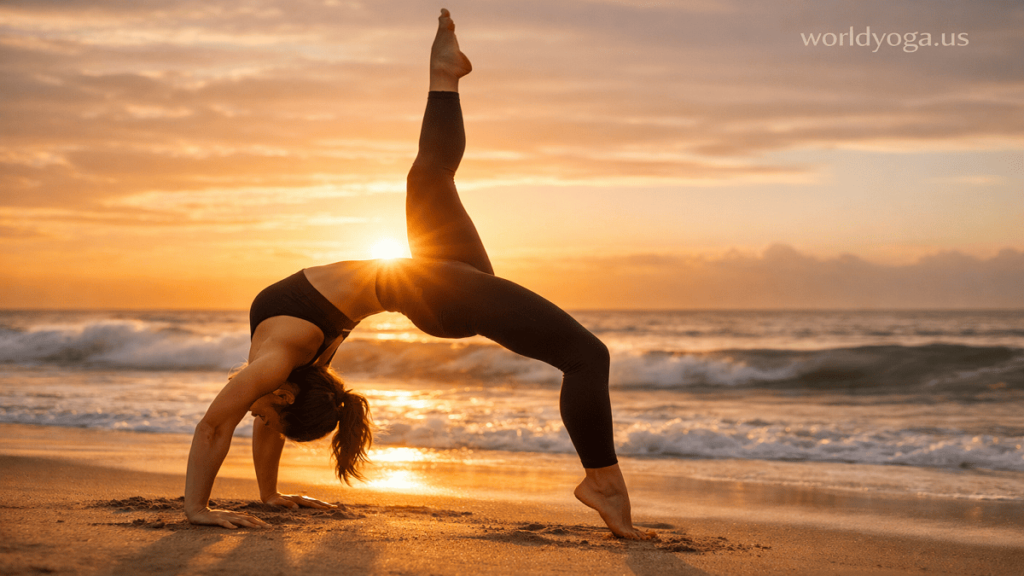
Which muscles are engaged during the pose?
Eka Pada Urdhva Dhanurasana is a full-body backbend that combines spinal extension, shoulder loading, and single-leg balance. Because it is performed from Wheel Pose with one leg lifted, it requires simultaneous activation of multiple muscle groups across the posterior chain, core, upper body, and hips. The asymmetry of the pose increases neuromuscular demand, particularly for stabilization.
1. Spinal Extensors
The primary muscles driving the backbend are the spinal extensors:
- Erector spinae (iliocostalis, longissimus, spinalis): Maintain spinal extension and control the arch of the back
- Multifidus: Provides segmental stability to individual vertebrae
- Semispinalis muscles: Assist in maintaining upright spinal alignment in extension
These muscles work continuously to support the thoracic and lumbar curve while preventing collapse into the lower back.
2. Shoulder and Upper Body Muscles
Because body weight is heavily supported through the arms, the upper body is highly engaged:
- Deltoids (especially anterior fibers): Stabilize shoulder flexion under load
- Triceps brachii: Maintain elbow extension and support body weight
- Latissimus dorsi: Assists in shoulder stability and controls excessive shoulder flexion
- Trapezius (upper, middle, lower fibers): Stabilizes and repositions the scapulae
- Serratus anterior: Keeps shoulder blades anchored and prevents winging
The rotator cuff muscles (supraspinatus, infraspinatus, teres minor, subscapularis) also play a crucial role in stabilizing the shoulder joint under compression.
3. Core Muscles
Core engagement is essential to prevent excessive lumbar compression and maintain pelvic control:
- Rectus abdominis: Controls overextension of the spine
- Transverse abdominis: Deep stabilizer that supports intra-abdominal pressure
- Internal and external obliques: Resist unwanted rotation, especially during the one-legged variation
These muscles are especially active when one leg is lifted, as asymmetry increases rotational forces on the pelvis.
4. Hip and Gluteal Muscles
Hip stabilizers are heavily challenged in this pose:
- Gluteus maximus: Supports hip extension and protects the lower back
- Gluteus medius and minimus: Maintain pelvic alignment and prevent dropping of the lifted hip
- Iliopsoas (hip flexor group): Active in controlling the lifted leg position
- Deep external rotators (piriformis, obturators): Stabilize hip joint alignment
In Eka Pada variation, the standing leg’s glute medius is particularly important for preventing pelvic tilt.
5. Leg and Lower Limb Muscles
Both legs are active but in different ways:
- Standing leg hamstrings and quadriceps: Stabilize weight-bearing support
- Calves (gastrocnemius and soleus): Assist in grounding the feet
- Lifted leg quadriceps and hamstrings: Maintain extension and control elevation
The foot of the grounded leg also engages intrinsic foot muscles to maintain balance and stability.
6. Neck Muscles
- Sternocleidomastoid and deep cervical flexors: Maintain neck alignment
- Suboccipital muscles: Stabilize head position during spinal extension
Summary of Key Muscle Actions
- Spinal extensors create and maintain the backbend
- Shoulders and arms support body weight under compression
- Core muscles prevent collapse and excessive lumbar arching
- Hip stabilizers maintain pelvic symmetry in asymmetrical loading
- Legs coordinate grounding and controlled lift
References
- Yoga Journal – Anatomy of Backbends:
https://www.yogajournal.com/poses/wheel-pose/ - Kenhub – Muscles of the Back and Spine:
https://www.kenhub.com/en/library/anatomy/muscles-of-the-back - Verywell Fit – Wheel Pose Muscular Engagement:
https://www.verywellfit.com/upward-facing-bow-wheel-pose-3567128
#Eka Pada Urdhva Dhanurasana in Ahemadabad
What preparatory poses are recommended?
Eka Pada Urdhva Dhanurasana is an advanced backbend that requires a combination of spinal mobility, shoulder flexibility, hip opening, and core stability. Proper preparation is essential to reduce strain on the lumbar spine and shoulders while building the strength needed for controlled asymmetry. Preparatory poses typically focus on opening the chest and hip flexors, strengthening the posterior chain, and safely introducing spinal extension.
1. Foundational Backbends
Before attempting any variation of Wheel Pose, the body should be comfortable in simpler backbends that progressively load the spine.
- Setu Bandhasana (Bridge Pose)
Builds initial spinal extension strength while keeping weight partially supported. It activates glutes, hamstrings, and spinal extensors without deep shoulder loading. - Urdhva Mukha Svanasana (Upward-Facing Dog)
Strengthens the arms, shoulders, and upper back while opening the chest. It also introduces weight-bearing through the wrists and shoulder girdle.
These poses help establish baseline spinal and shoulder readiness before progressing to full Wheel Pose.
2. Primary Wheel Preparation
- Urdhva Dhanurasana (Wheel Pose)
This is the essential prerequisite. Practicing Wheel Pose regularly builds full spinal extension capacity, shoulder flexion strength, and wrist endurance. The practitioner should be able to hold the pose steadily and breathe comfortably before adding asymmetry.
3. Shoulder Opening and Mobility
Strong shoulder flexibility is critical for safe backbending.
- Gomukhasana (Cow Face Pose – Arms)
Improves shoulder external rotation and opens tight upper back muscles. - Dolphin Pose (Ardha Pincha Mayurasana)
Strengthens shoulders and prepares them for weight-bearing inversion-like stress. - Anahatasana (Melting Heart Pose)
Gently opens the chest and thoracic spine, reducing stiffness in the upper back.
4. Hip Flexor and Quadriceps Opening
Since Eka Pada variation requires one leg to lift upward, hip flexibility is essential.
- Anjaneyasana (Low Lunge)
Deeply stretches hip flexors, especially iliopsoas and rectus femoris. - Virabhadrasana I (Warrior I)
Builds strength in the back leg while opening the front hip flexors. - Supta Virasana (Reclined Hero Pose)
Intensively lengthens quadriceps and improves knee-to-hip flexibility needed for safe leg extension.
5. Core and Stability Work
Asymmetrical backbends require strong anti-rotation control.
- Phalakasana (Plank Pose)
Strengthens the entire core and shoulder stabilizers. - Vasisthasana (Side Plank)
Develops lateral core strength, important for preventing pelvic rotation during one-legged variations.
6. Progressive Integration
Once mobility and strength are established, practitioners may integrate:
- Wheel Pose with alternating leg lifts (very small range)
- Supported backbends using blocks or wall assistance
- Short holds with emphasis on pelvic stability
Key Preparation Principles
- Prioritize shoulder opening before deep spinal extension
- Ensure hip flexors are flexible enough to allow leg lift without lumbar compression
- Build strong core engagement to resist twisting forces
- Progress gradually from supported to unsupported backbends
References
- Yoga Journal – Backbend Preparation Guide:
https://www.yogajournal.com/poses/wheel-pose/ - Verywell Fit – Safe Backbend Progressions:
https://www.verywellfit.com/upward-facing-bow-wheel-pose-3567128 - Yoga International – Preparing for Advanced Backbends:
https://yogainternational.com/article/view/how-to-safely-practice-backbends/
#Eka Pada Urdhva Dhanurasana in Delhi
What are the benefits and precautions of this advanced pose?
Benefits of the Pose
1. Spinal Strength and Mobility
This pose deeply engages the entire posterior chain, especially the spinal extensors such as the erector spinae and multifidus. Regular practice improves spinal flexibility, particularly in the thoracic region, while strengthening the lumbar support system. This can help counteract stiffness from prolonged sitting and improve overall posture.
2. Shoulder and Upper Body Strength
Because the body weight is supported through the hands, the pose strengthens the shoulders, triceps, and upper back muscles. It enhances scapular stability through activation of the serratus anterior and trapezius muscles, improving shoulder joint resilience.
3. Core Stability and Anti-Rotation Strength
The one-legged variation significantly increases the demand on core stabilizers. The rectus abdominis, transverse abdominis, and obliques must actively resist twisting forces created by the lifted leg. This improves functional core strength and balance in dynamic movement patterns.
4. Hip Flexor and Leg Strength
Lifting one leg while maintaining spinal extension strengthens hip flexors, glutes, and hamstrings in a coordinated manner. It also improves pelvic control and unilateral leg strength, which can benefit athletic performance and gait symmetry.
5. Nervous System and Mental Focus
Advanced backbends stimulate the nervous system, requiring concentration, breath control, and body awareness. Practitioners often experience increased focus, confidence, and mental resilience due to the pose’s intensity and balance challenge.
Precautions and Contraindications
1. Spinal and Back Issues
Individuals with herniated discs, chronic lower back pain, or spinal injuries should avoid this pose. The deep extension and asymmetrical load can aggravate existing conditions if not properly managed.
2. Shoulder and Wrist Vulnerability
Because significant weight is placed on the arms, people with rotator cuff injuries, shoulder instability, or wrist conditions (such as carpal tunnel syndrome) should approach with caution or avoid entirely.
3. Neck Compression Risk
Incorrect alignment can compress the cervical spine. It is important to avoid collapsing the head backward or overloading the neck.
4. Blood Pressure and Cardiovascular Concerns
Deep backbends increase cardiovascular demand. Individuals with uncontrolled high or low blood pressure should consult a medical professional before attempting this pose.
5. Pregnancy
This pose is not recommended during pregnancy due to strong abdominal engagement and intense spinal extension.
6. Lack of Preparation
Attempting Eka Pada variation without mastering Urdhva Dhanurasana can lead to instability, pelvic misalignment, and lower back strain. Adequate preparation through hip opening, shoulder mobility, and core strengthening is essential.
Key Safety Principles
- Always warm up with progressive backbends
- Maintain even shoulder and wrist alignment
- Keep pelvis square during leg lift
- Avoid forcing height of the lifted leg
- Exit the pose slowly and with control
- Practice under supervision if new to advanced backbends
References
- Yoga Journal – Wheel Pose and Backbend Safety:
https://www.yogajournal.com/poses/wheel-pose/ - Verywell Fit – Risks and Benefits of Backbends:
https://www.verywellfit.com/upward-facing-bow-wheel-pose-3567128 - Yoga International – Advanced Backbend Guidelines:
https://yogainternational.com/article/view/backbends-safe-practice/
#Eka Pada Urdhva Dhanurasana in Kolkata
Case Study of Eka Pada Urdhva Dhanurasana
1. Introduction
This case study examines the progression, execution, and outcomes of practicing Eka Pada Urdhva Dhanurasana in an experienced yoga practitioner. The focus is on biomechanical adaptation, mobility gains, strength development, and injury risk management. The subject is a 32-year-old recreational yoga practitioner with 5 years of consistent Vinyasa and backbend-focused training.
The objective was to assess readiness for asymmetrical backbending and document physical and neuromuscular responses during progression from standard Urdhva Dhanurasana (Wheel Pose) to its one-legged variation.
2. Initial Assessment
The practitioner demonstrated:
- Strong baseline in Urdhva Dhanurasana (30–40 second hold)
- Moderate shoulder flexibility with mild tightness in pectorals
- Limited hip flexor openness on the dominant side
- Good core endurance but mild asymmetry in glute activation
- No history of spinal injury
However, during early attempts at asymmetrical loading, a slight pelvic rotation and lumbar overextension were observed, indicating insufficient unilateral stability.
3. Preparation Phase (6 Weeks)
A structured program was implemented:
Mobility Focus
- Anjaneyasana (Low Lunge) for hip flexor release
- Gomukhasana arms for shoulder external rotation
- Supported Bridge Pose for spinal extension control
Strength Focus
- Plank variations for core anti-rotation control
- Locust Pose (Salabhasana) for posterior chain activation
- Dolphin Pose for shoulder endurance
Integration Work
- Wheel Pose with micro-weight shifts
- Assisted leg lifts using wall support
After 6 weeks, improvements included:
- Increased shoulder stability under load
- Reduced lumbar compression during backbends
- Improved pelvic control in asymmetrical positions
4. Execution Phase
The final progression into Eka Pada Urdhva Dhanurasana followed a controlled sequence:
- Establish stable Wheel Pose with even breath
- Engage core to neutralize pelvic tilt
- Shift weight evenly through both hands and supporting foot
- Lift one leg slowly without disturbing spinal alignment
- Maintain hold for 5–8 breaths before switching sides
Key observation: The practitioner achieved stable lift only when emphasis was placed on glute medius activation of the standing leg rather than height of the lifted leg.
5. Observed Outcomes
Positive Adaptations
- Improved unilateral hip stability
- Increased thoracic spine mobility
- Enhanced shoulder load tolerance
- Better neuromuscular coordination between core and lower limbs
- Greater awareness of pelvic alignment under asymmetrical load
Challenges Identified
- Early tendency toward lumbar compression when fatigued
- Slight shoulder dominance on right side
- Difficulty maintaining equal hip height during left-leg lift
No acute pain or injury was reported during the study period.
6. Biomechanical Analysis
The pose required coordinated activation of:
- Spinal extensors for global backbend support
- Serratus anterior and rotator cuff for shoulder stabilization
- Gluteus medius for pelvic leveling
- Transverse abdominis for anti-rotation control
- Hamstrings and quadriceps for leg extension control
The most critical limiting factor was pelvic stability under unilateral load, not spinal flexibility.
7. Conclusion
This case study demonstrates that successful execution of Eka Pada Urdhva Dhanurasana depends more on stability and control than extreme flexibility. Progressive preparation focusing on hip stability, shoulder endurance, and core anti-rotation strength significantly improved performance outcomes.
The pose proved effective in enhancing functional strength, spinal mobility, and neuromuscular coordination when introduced gradually with proper preparatory work.
References
- Yoga Journal – Wheel Pose Anatomy and Practice:
https://www.yogajournal.com/poses/wheel-pose/ - Yoga International – Safe Backbending Progressions:
https://yogainternational.com/article/view/backbends-safe-practice/ - Verywell Fit – Backbend Safety and Biomechanics:
https://www.verywellfit.com/upward-facing-bow-wheel-pose-3567128
#Eka Pada Urdhva Dhanurasana in Banglore
White Paper of Eka Pada Urdhva Dhanurasana
1. Executive Summary
Eka Pada Urdhva Dhanurasana is an advanced asymmetrical backbend derived from Urdhva Dhanurasana (Wheel Pose). It integrates spinal extension, shoulder-loaded support, and unilateral lower-limb elevation, creating a high-demand posture for strength, mobility, and neuromuscular coordination. This white paper examines its biomechanics, physiological impact, progression framework, safety considerations, and training applications in modern yoga practice and movement science.
2. Background and Context
Wheel Pose is a foundational deep backbend widely used in yoga systems to develop spinal extension capacity and upper-body strength. The one-legged variation introduces asymmetry, significantly increasing stabilization demands on the pelvis, core, and shoulder girdle.
Unlike symmetrical backbends, Eka Pada Urdhva Dhanurasana challenges anti-rotation control and unilateral weight distribution, making it relevant not only in yoga but also in rehabilitation, athletic conditioning, and functional movement training.
3. Biomechanical Overview
The pose involves three primary force systems:
3.1 Spinal Extension System
y=f(x)=spinal extension curve under loady = f(x) = \text{spinal extension curve under load}y=f(x)=spinal extension curve under load
The spine operates in a global extension pattern requiring coordinated action of erector spinae, multifidus, and deep stabilizers. Load distribution must remain even across cervical, thoracic, and lumbar regions to prevent localized compression.
3.2 Shoulder Load-Bearing System
The upper limbs function as closed-chain support structures. Force transmission travels through wrists → elbows → shoulders → scapula → thoracic spine. Scapular stability (serratus anterior and trapezius synergy) is critical to prevent collapse.
3.3 Unilateral Pelvic Control System
The lifted leg introduces rotational torque on the pelvis. The body must counteract this using obliques and gluteus medius to maintain alignment.
4. Musculoskeletal Engagement Summary
Primary muscle groups include:
- Spinal extensors: maintain global backbend
- Deltoids, triceps, serratus anterior: shoulder load support
- Gluteus maximus and medius: hip extension and pelvic stabilization
- Rectus abdominis and obliques: anti-extension and anti-rotation control
- Hamstrings and quadriceps: lower-limb stabilization and lift control
The pose is best understood as an integrated kinetic chain rather than isolated muscle activation.
5. Physiological and Functional Benefits
5.1 Structural Adaptations
- Increased thoracic spine mobility
- Enhanced shoulder flexion capacity
- Improved hip flexor length and elasticity
5.2 Strength Development
- Closed-chain upper-body strength
- Posterior chain reinforcement
- Unilateral hip and core stability
5.3 Neuromuscular Coordination
- Improved proprioception under asymmetrical load
- Enhanced motor control between limbs and trunk
- Increased balance and postural awareness
5.4 Functional Transfer
The pose has relevance to athletic movements requiring:
- Single-leg stability
- Overhead load control
- Spinal extension under resistance
6. Risks and Constraints
Key risk factors include:
- Lumbar hyperextension due to poor core engagement
- Shoulder impingement from inadequate scapular control
- Pelvic misalignment during unilateral loading
- Wrist strain under excessive compression
Contraindications:
- Herniated discs or chronic spinal conditions
- Shoulder instability or rotator cuff injuries
- Severe wrist pathology
- Uncontrolled hypertension
7. Progression Framework
A structured progression model is recommended:
- Setu Bandhasana (Bridge Pose) – foundational extension
- Urdhva Mukha Svanasana – shoulder conditioning
- Urdhva Dhanurasana – full symmetrical load adaptation
- Assisted leg lifts in Wheel Pose – controlled asymmetry introduction
- Full Eka Pada Urdhva Dhanurasana – independent execution
Progression should prioritize control over depth.
8. Safety and Alignment Principles
- Maintain square pelvis during leg lift
- Distribute load evenly across both hands
- Avoid lumbar compression by engaging core
- Lift leg without collapsing opposite hip
- Exit pose slowly to protect spine and shoulders
9. Applications in Modern Practice
Eka Pada Urdhva Dhanurasana is used in:
- Advanced yoga sequencing
- Movement therapy for spinal mobility (controlled environments)
- Athletic conditioning for posterior chain and unilateral strength
- Neuromotor training for balance and coordination
10. Conclusion
Eka Pada Urdhva Dhanurasana is a high-complexity movement that integrates spinal extension, shoulder loading, and unilateral pelvic control. Its value lies not in aesthetic depth but in the integration of strength, stability, and mobility under asymmetrical conditions. When introduced progressively, it serves as a powerful tool for advanced movement development and functional body awareness.
References
- Yoga Journal – Wheel Pose Anatomy and Practice:
https://www.yogajournal.com/poses/wheel-pose/ - Yoga International – Advanced Backbend Methodology:
https://yogainternational.com/article/view/backbends-safe-practice/ - Verywell Fit – Backbend Safety and Muscular Engagement:
https://www.verywellfit.com/upward-facing-bow-wheel-pose-3567128
#Eka Pada Urdhva Dhanurasana in Pune
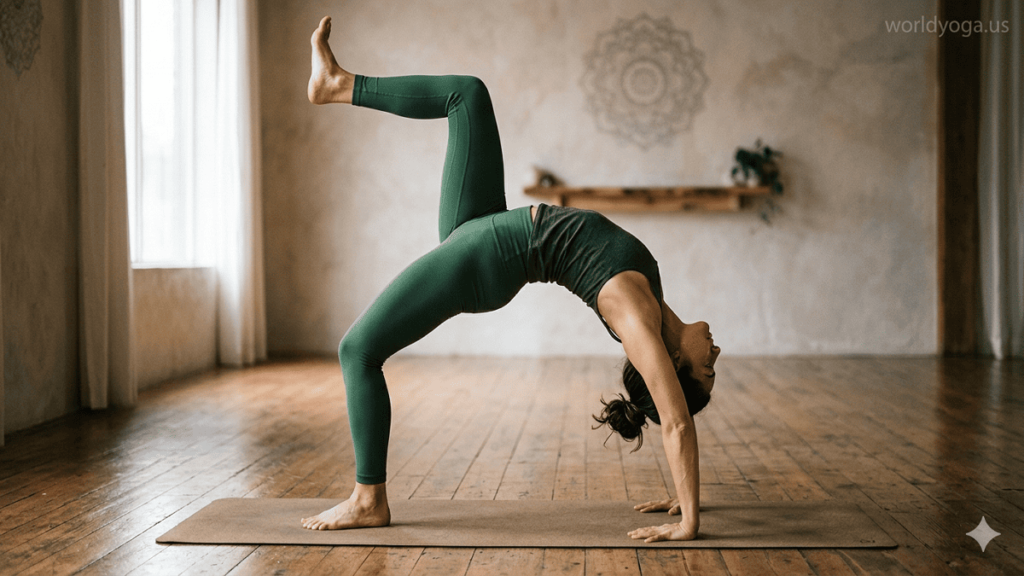
Industry Application of Eka Pada Urdhva Dhanurasana
1. Overview
Eka Pada Urdhva Dhanurasana is an advanced biomechanical movement derived from a deep spinal extension pattern combined with unilateral lower-limb elevation and closed-chain upper-body loading. While it originates in yoga practice, its underlying movement principles—spinal extension, shoulder load-bearing, and anti-rotation stability—make it relevant across multiple modern industries including sports science, physiotherapy, rehabilitation, performing arts, and human movement training systems.
This document outlines how the pose’s biomechanical structure translates into real-world applications beyond yoga practice.
2. Sports Performance and Athletic Training
In sports science, the pose is relevant for athletes requiring posterior chain strength, unilateral stability, and overhead control.
Applications:
- Track and field (sprinters, hurdlers): Enhances hip flexor mobility and glute activation balance
- Gymnastics and diving: Improves spinal extension strength and aerial body awareness
- Combat sports: Builds core anti-rotation strength for grappling and striking stability
- Running mechanics: Supports pelvic control during single-leg gait cycles
The unilateral nature of the pose closely mirrors athletic movements such as sprinting, jumping, and directional changes.
3. Physiotherapy and Rehabilitation
In controlled rehabilitation environments, modified versions of Wheel Pose and its asymmetrical progression are used for functional restoration of spinal and shoulder mobility.
Applications:
- Restoration of thoracic spine extension after prolonged postural dysfunction
- Shoulder girdle strengthening in closed-chain rehabilitation protocols
- Pelvic stabilization training after hip imbalances or asymmetrical gait issues
- Neuromuscular retraining for coordinated limb-trunk movement
However, full Eka Pada variation is typically not used in early rehab stages; instead, it appears in late-stage functional progression under supervision.
4. Movement Therapy and Functional Training
In contemporary movement systems (e.g., functional fitness, mobility training, somatic education), the pose supports:
- Anti-rotation core development
- Spinal articulation under load
- Integrated kinetic chain coordination
- Proprioceptive enhancement in asymmetrical positions
Functional Stability=Mobility+Strength+ControlAsymmetrical Load\text{Functional Stability} = \frac{\text{Mobility} + \text{Strength} + \text{Control}}{\text{Asymmetrical Load}}Functional Stability=Asymmetrical LoadMobility+Strength+Control
This model reflects how increasing asymmetry elevates the demand for neuromuscular control rather than raw flexibility.
5. Performing Arts and Dance
In dance, gymnastics, and performance arts, the movement pattern contributes to:
- Stage backbend variations and choreography aesthetics
- Improved spinal articulation for expressive movement
- Enhanced balance in inverted or semi-inverted transitions
- Greater control in single-leg balance poses during performance sequences
Contemporary dancers often use similar asymmetrical backbends to develop expressive range and dynamic control.
6. Strength and Conditioning Industry
In strength and conditioning systems, especially those integrating mobility training, the pose is used conceptually to train:
- Closed-chain shoulder endurance
- Posterior chain integration (glutes, hamstrings, spinal extensors)
- Unilateral pelvic stability under extension load
- Core stiffness under spinal extension stress
It complements training modalities like calisthenics, gymnastics strength, and functional mobility systems.
7. Ergonomics and Postural Health Applications
Indirectly, the movement principles inform ergonomic correction strategies:
- Counteracting forward-head and kyphotic posture
- Rebalancing anterior-posterior chain dominance caused by sedentary behavior
- Restoring thoracic extension capacity in desk-bound populations
Even simplified bridge-based variations are used in workplace wellness programs and corrective exercise routines.
8. Risk Management in Industry Use
Across all industries, strict limitations are necessary:
- Not suitable for untrained populations without progression
- Requires shoulder and spinal screening before application
- Should be introduced in stages to prevent lumbar compression
- Must be avoided in acute injury cases (spine, shoulder, wrist)
9. Conclusion
Eka Pada Urdhva Dhanurasana serves as a high-level integrative movement model rather than a standalone exercise in industry contexts. Its greatest value lies in its ability to unify spinal extension, unilateral stability, and closed-chain upper-body strength into a single coordinated pattern.
Across sports science, rehabilitation, performing arts, and functional training, the pose provides a framework for understanding how the human body manages asymmetrical load under extension stress. When appropriately modified, it becomes a powerful reference model for advanced movement efficiency and structural integration.
References
- Yoga Journal – Backbend Anatomy and Application:
https://www.yogajournal.com/poses/wheel-pose/ - Physiopedia – Shoulder and Spinal Rehabilitation Principles:
https://www.physio-pedia.com/Shoulder_Complex - Verywell Fit – Bridge and Wheel Pose Mechanics:
https://www.verywellfit.com/upward-facing-bow-wheel-pose-3567128
#Eka Pada Urdhva Dhanurasana in Mumbai
Ask FAQs
What level of practitioner can attempt Eka Pada Urdhva Dhanurasana?
This pose is strictly for advanced practitioners who already have a stable and comfortable Urdhva Dhanurasana (Wheel Pose). A practitioner should be able to hold Wheel Pose for at least 20–30 seconds with steady breathing, without wrist, shoulder, or lower back discomfort. Beginners and intermediate practitioners should focus on foundational backbends such as Bridge Pose and standard Wheel Pose before attempting this variation.
What is the most important alignment principle in this pose?
The most important alignment principle is pelvic stability. The hips must remain level and square even when one leg is lifted. Any rotation or dropping of one hip increases stress on the lumbar spine. Along with this, even weight distribution through both hands and the grounded foot is essential to maintain structural balance.
Which muscles are most engaged during the pose?
The pose activates multiple major muscle groups simultaneously:
Spinal extensors (erector spinae, multifidus) for backbend control
Shoulders and arms (deltoids, triceps, serratus anterior) for weight-bearing
Core muscles (rectus abdominis, obliques, transverse abdominis) for anti-rotation stability
Glutes and hamstrings for hip extension and pelvic control
Hip stabilizers (gluteus medius) for maintaining alignment during single-leg lift
What are the common mistakes in Eka Pada Urdhva Dhanurasana?
Common mistakes include:
Letting the pelvis rotate or drop to one side
Overarching the lower back instead of distributing extension through the spine
Locking or collapsing the shoulders instead of actively stabilizing them
Lifting the leg too high at the cost of spinal alignment
Holding the breath, which reduces core stability
These errors often lead to strain in the lower back or shoulders if not corrected.
What precautions should be taken before practicing this pose?
Key precautions include:
Avoid if you have spinal injuries, herniated discs, or severe lower back pain
Avoid if you have wrist or shoulder instability
Warm up thoroughly with hip openers, shoulder mobility drills, and basic backbends
Practice under supervision if attempting for the first time
Never force the lifted leg higher than your control allows
This pose should be approached progressively rather than attempted directly.
Table of Contents
Disclaimer:
Eka Pada Urdhva Dhanurasana is an advanced yoga posture that should only be practiced under proper guidance. It is not suitable for individuals with injuries to the spine, shoulders, wrists, or neck, or for those with cardiovascular or blood pressure conditions. Always warm up thoroughly and progress gradually from simpler backbends. The information provided is for educational purposes and is not a substitute for medical advice or professional instruction.