
Hindolasana in Eka Pada Prapadasana 2
Hindolasana and Eka Pada Prapadasana II are advanced yoga-based balancing and strength postures that require a combination of flexibility, core stability, hip control, and focused breath awareness. When practiced together or in sequence variations, they form a highly demanding progression that challenges proprioception and muscular integration, particularly in the lower body and deep core stabilizers.
Hindolasana, often referred to as the “swing pose,” is typically derived from seated or supported positions where the practitioner shifts weight and engages in controlled lateral or suspended movement. The primary objective is not only balance but also controlled mobility through the pelvis and spine. This posture emphasizes scapular stability, hip opening, and controlled activation of the abdominal muscles. It is commonly used as a preparatory or transition pose in advanced vinyasa and Iyengar-based sequences.
Eka Pada Prapadasana II is a one-legged balancing posture where the body is stabilized on the toes or forefoot of one leg while the other leg is lifted or extended depending on the variation. The second version (II) generally increases difficulty by requiring deeper ankle stability, stronger quadriceps engagement, and enhanced focus on pelvic alignment. The pose demands precise neuromuscular coordination to maintain vertical alignment while resisting rotational collapse at the hip and knee joints.
When Hindolasana is integrated into Eka Pada Prapadasana II sequencing, the transition requires seamless transfer of weight and controlled engagement of stabilizing muscle groups. This combination develops dynamic balance rather than static balance alone. Practitioners must coordinate breath with movement—typically inhaling during lengthening phases and exhaling during stabilization or weight transfer.
Biomechanically, the combination strengthens the intrinsic foot muscles, tibialis anterior, gluteus medius, and deep core musculature such as the transverse abdominis. It also enhances joint awareness in the ankles and knees, reducing the risk of instability in unilateral loading patterns. From a physiological standpoint, these poses improve neuromuscular efficiency and enhance postural control systems.
However, this sequence is not recommended for beginners due to its high demand on balance and joint integrity. Proper warm-up involving hip openers, ankle mobility drills, and core activation is essential. Use of a wall or support block is advised during initial practice phases.
For further reference on alignment and methodology, credible yoga resources include:
https://www.yogajournal.com/poses
https://www.iyengar.org/
https://www.yogapedia.com/
#Hindolasana in Eka Pada Prapadasana 2 in Singapore
How is Hindolasana in Eka Pada Prapadasana 2 performed correctly?
Performing Hindolasana in transition with Eka Pada Prapadasana II requires precise alignment, controlled balance, and progressive weight transfer. This combination is typically practiced in advanced yoga sequencing, where the goal is not only to hold postures but to move between them with stability and awareness.
Starting Position Preparation
Begin in a stable standing position such as Tadasana (Mountain Pose). Establish even weight distribution across both feet. Engage the quadriceps gently, lift the kneecaps, and activate the core by drawing the lower abdomen inward and upward. The pelvis should remain neutral, avoiding anterior or posterior tilt.
Entry into Eka Pada Prapadasana II
Shift weight onto one leg, usually the standing leg, and slowly come onto the ball of the foot. The heel may lift depending on the variation, increasing the demand on ankle stabilizers. The opposite leg is lifted or positioned according to the specific variation of Eka Pada Prapadasana II, Eka Pada Prapadasana often requiring a forward or slightly extended placement while maintaining hip alignment.
Key alignment points:
- Keep the pelvis level and square
- Avoid collapsing into the supporting hip
- Engage the gluteus medius of the standing leg for lateral stability
- Maintain a steady drishti (gaze point) to reduce postural sway
Transition into Hindolasana
From the stabilized Eka Pada Prapadasana II position, the transition into Hindolasana begins with a controlled shift of the torso and pelvis. The movement should feel like a “swing” rather than a drop or collapse.
Step-by-step execution:
- Inhale and lengthen the spine upward.
- Begin a controlled lateral or forward swing of the lifted leg or pelvis, depending on variation.
- Engage the core deeply to prevent overextension or loss of balance.
- Allow the arms (if used in variation) to counterbalance the movement.
- Exhale as you stabilize into the end position of Hindolasana, ensuring the motion is smooth and continuous.
The key principle is controlled momentum, not forceful swinging. The movement should originate from the hip joint and core, Eka Pada Prapadasana not from the lower back.
Return and Stabilization
After completing the swing phase, return slowly to Eka Pada Prapadasana II by re-centering the pelvis over the standing leg. Re-establish grounding through the foot and re-engage the quadriceps and core.
Common Mistakes
- Collapsing into the standing knee or hip
- Using excessive momentum instead of muscular control
- Holding breath during transitions
- Losing focus on alignment of pelvis and spine
Training Recommendations
This sequence should be practiced after preparatory poses such as Vrksasana (Tree Pose), Utthita Hasta Padangusthasana, Eka Pada Prapadasana and basic hip openers. Using a wall or support is recommended for beginners to reduce fall risk.
References
https://www.yogajournal.com/poses
https://www.iyengar.org/
https://www.yogaalliance.org/
#Hindolasana in Eka Pada Prapadasana 2 in India
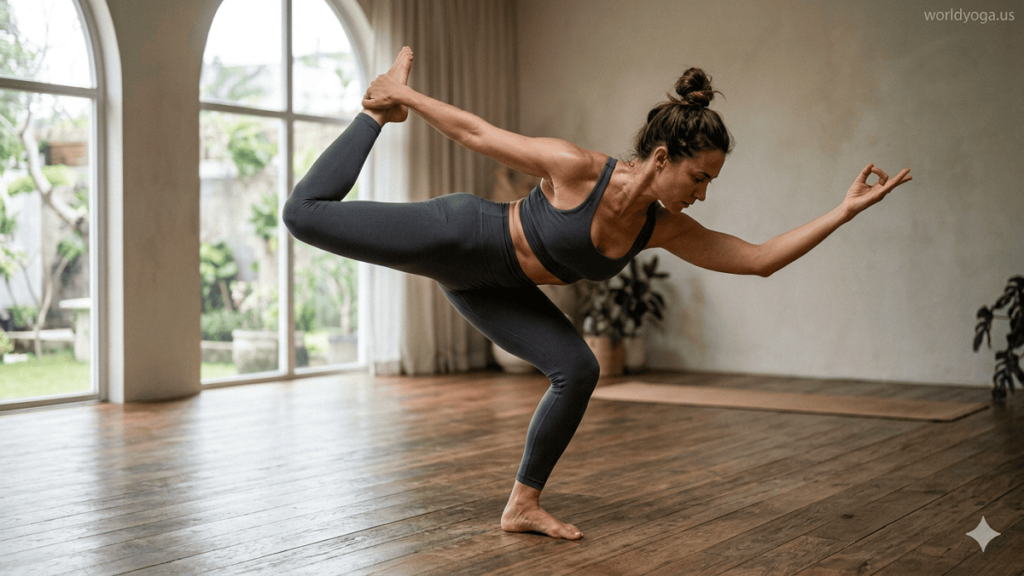
What is the proper alignment in this variation?
Proper alignment in the combined variation of Hindolasana within Eka Pada Prapadasana II is primarily about maintaining a stable kinetic chain from the foot through the spine while allowing controlled dynamic movement without collapsing structural integrity. Because this is an advanced balancing transition, alignment must be understood in terms of joint stacking, Eka Pada Prapadasana muscular engagement, and spatial orientation rather than simply “holding a shape.”
Foot and Ankle Alignment
The foundation begins at the standing foot. The weight should be distributed across the tripod of the foot: the base of the big toe, little toe, and center of the heel (or forefoot contact point depending on the variation of Prapadasana II). The arch of the foot should remain active, avoiding pronation or collapse inward. The ankle must remain stable, with the tibialis anterior and calf muscles engaged to prevent wobbling or inward rolling.
Knee and Hip Positioning
The standing knee should remain in line with the second and third toes, avoiding valgus collapse (inward drift). The quadriceps must stay engaged without hyperextending the knee joint. At the hip level, the pelvis should remain level and square to the front plane. One of the most common alignment errors is letting the lifted-side hip rise excessively or drop backward, which disrupts spinal neutrality and balance.
In Eka Pada Prapadasana II, the lifted leg should be controlled by the hip flexors and gluteal muscles rather than momentum. The femur should move within the hip socket without external rotation unless specifically required by a variation.
Pelvic and Core Alignment
The pelvis acts as the central stabilizing structure. It should remain neutral—neither excessively tilted forward nor tucked under. The transverse abdominis and deep core stabilizers must be engaged to prevent lumbar compression. In Hindolasana transitions, the pelvis should move as a single unit rather than twisting independently of the spine.
Spinal Alignment
The spine should remain elongated throughout the movement. The natural curves of the cervical, thoracic, and lumbar regions should be preserved without exaggeration. During the “swing” phase of Hindolasana, spinal movement should be minimal; the motion originates from the hip joint, Eka Pada Prapadasana not the lower back.
Shoulder and Upper Body Alignment
If the arms are involved for balance, the shoulders should remain relaxed and level. The scapulae should be gently drawn down and stabilized against the ribcage. The chest should remain open without flaring the ribs forward. The head stays aligned with the spine, with the gaze (drishti) fixed at a steady point to support vestibular balance.
Dynamic Alignment Principle
The most important concept is “controlled stillness within movement.” Even during the swing of Hindolasana, the body should maintain structural alignment while allowing only the intended joint movement.
References
https://www.yogajournal.com/poses
https://www.iyengar.org/
https://www.yogaanatomy.net/
#Hindolasana in Eka Pada Prapadasana 2 in Maharashtra
Which muscles are engaged during the pose?
In the combined practice of Hindolasana within Eka Pada Prapadasana II, muscle engagement is complex because the body must simultaneously maintain unilateral balance, control pelvic stability, and execute controlled dynamic transitions. The muscular activity is best understood in layers: primary stabilizers, secondary movers, and postural control systems.
Lower Limb Stabilizers
The most significant engagement occurs in the standing leg. The intrinsic foot muscles (flexor hallucis brevis, flexor digitorum brevis, and interossei) are constantly active to maintain arch integrity and prevent collapse. The calf complex—gastrocnemius and soleus—works isometrically to stabilize the ankle and control subtle shifts in weight.
At the knee joint, the quadriceps femoris group (rectus femoris, vastus medialis, vastus lateralis, and vastus intermedius) plays a major stabilizing role. The vastus medialis, in particular, is crucial for preventing medial knee collapse during single-leg loading in Eka Pada Prapadasana II.
The hamstrings assist in eccentric control of knee extension and contribute to pelvic stability by influencing posterior chain tension.
Hip and Pelvic Musculature
The gluteus medius is one of the most important muscles in this sequence, as it prevents contralateral pelvic drop during single-leg stance. The gluteus maximus contributes to hip extension control and stabilizes the pelvis during transitions in Hindolasana.
Deep external rotators of the hip (piriformis, obturator internus/externus, gemelli, and quadratus femoris) provide fine-tuned femoral positioning within the hip socket. The iliopsoas acts as both a stabilizer and controlled mobilizer, especially when lifting or swinging the non-supporting leg.
Core and Spinal Stabilizers
The core musculature is heavily engaged throughout. The transverse abdominis provides deep abdominal compression, creating intra-abdominal pressure that stabilizes the lumbar spine. The rectus abdominis assists in controlling anterior pelvic tilt, while the obliques (internal and external) prevent unwanted rotational collapse during the “swing” phase of Hindolasana.
The multifidus and erector spinae muscles maintain spinal alignment and prevent excessive flexion or extension, ensuring that movement originates from the hip joints rather than the lumbar spine.
Upper Body Engagement
If the arms are used for counterbalance, the deltoids and rotator cuff muscles (supraspinatus, infraspinatus, teres minor, subscapularis) stabilize the shoulder joint. The trapezius and serratus anterior assist in scapular positioning, ensuring the chest remains open without collapsing or overextending.
The neck muscles, particularly the sternocleidomastoid and deep cervical flexors, maintain head alignment with the spine, which is essential for vestibular balance during single-leg stance.
Dynamic Coordination in Hindolasana Transition
During the swing phase of Hindolasana, the nervous system coordinates rapid yet controlled activation of the hip flexors and extensors. This requires eccentric-concentric coupling across the gluteal and iliopsoas systems, while the core prevents rotational instability.
Summary
Overall, this combined variation recruits nearly the entire kinetic chain, with emphasis on:
- Foot and ankle stabilizers for grounding
- Quadriceps and gluteus medius for single-leg balance
- Deep core muscles for spinal protection
- Hip rotators and flexors for controlled movement transitions
References
https://www.yogajournal.com/poses
https://www.yogaanatomy.net/
https://www.kenhub.com/en/library/anatomy
#Hindolasana in Eka Pada Prapadasana 2 in Ahemadabad
What preparatory poses are recommended?
Preparation for the combined practice of Hindolasana within Eka Pada Prapadasana II should focus on three core capacities: single-leg stability, hip mobility, and controlled core activation. Because this variation demands both static balance and dynamic transition control, preparatory poses are chosen to progressively condition the ankle–knee–hip chain and refine neuromuscular coordination.
1. Foundational Balance Poses
Begin with basic unilateral standing postures to build proprioception and ankle strength.
- Vrksasana (Tree Pose) helps establish basic single-leg balance and teaches even weight distribution through the standing foot.
- Utthita Hasta Padangusthasana (Extended Hand-to-Big-Toe Pose) develops hamstring flexibility and improves pelvic control while balancing on one leg.
- Garudasana (Eagle Pose) enhances joint stability in the ankles and knees while training controlled compression and balance under instability.
These poses are essential for learning how to maintain equilibrium without excessive muscular tension.
2. Ankle and Foot Strengthening Poses
Since Eka Pada Prapadasana II often involves forefoot or toe loading, ankle conditioning is crucial.
- Tadasana (Mountain Pose) on toes strengthens intrinsic foot muscles and calf endurance.
- Utkatasana (Chair Pose) builds quadriceps strength and reinforces knee alignment over the toes.
- Ardha Chandrasana (Half Moon Pose) introduces lateral stability and strengthens the outer hip and ankle stabilizers.
These positions ensure the foot–ankle complex can handle sustained micro-adjustments without collapse.
3. Hip Opening and Pelvic Control Poses
Hip mobility is essential for smooth Hindolasana transitions, where controlled swinging originates from the pelvis and hip joint.
- Baddha Konasana (Bound Angle Pose) opens the adductors and improves pelvic mobility.
- Anjaneyasana (Low Lunge) stretches the hip flexors and prepares the iliopsoas for controlled lifting and extension.
- Eka Pada Rajakapotasana (Pigeon Pose) deeply targets external rotators and helps release restrictions that could disrupt alignment during single-leg balance.
4. Core Activation and Spinal Stability Poses
Core strength is critical for preventing lumbar collapse during dynamic movement.
- Phalakasana (Plank Pose) strengthens transverse abdominis and shoulder stability.
- Navasana (Boat Pose) builds deep abdominal endurance and improves balance between hip flexors and core.
- Vasisthasana (Side Plank) enhances oblique strength and prepares the body for resisting rotational forces.
5. Transitional Integration Poses
Before attempting the full combination, transitional drills help connect balance with movement.
- Slow step-through variations from Warrior III to High Lunge improve controlled weight transfer.
- Supported single-leg stands with wall assistance help refine alignment without instability risk.
Key Principle of Preparation
The main objective is not flexibility alone but controlled stability under asymmetrical load. Each preparatory pose should emphasize alignment over depth and breath control over speed.
References
https://www.yogajournal.com/poses
https://www.iyengar.org/
https://www.yogaanatomy.net/
#Hindolasana in Eka Pada Prapadasana 2 in Hyderabad
What are the benefits and precautions of this pose?
Benefits
1. Improved balance and proprioception
This sequence strongly develops proprioception—the body’s ability to sense position in space. Because the practitioner must stabilize on one leg while coordinating controlled movement, the nervous system becomes more efficient at micro-adjustments in the ankle, knee, and hip. Over time, this improves overall coordination and reduces instability in daily movement.
2. Strengthening of the lower kinetic chain
The standing leg undergoes sustained activation of the quadriceps, hamstrings, gluteus medius, and calf muscles. This builds functional strength in a closed-chain pattern, which is directly transferable to walking, running, and other unilateral activities.
3. Core stabilization and spinal control
Deep core muscles, particularly the transverse abdominis and obliques, are heavily engaged to prevent rotational collapse during the swing-like motion of Hindolasana. This improves spinal stability and helps develop better postural control under dynamic conditions.
4. Hip mobility and control
The movement pattern enhances both hip flexion and extension control while also improving rotational awareness. Tight hip flexors and external rotators are progressively released, leading to more efficient pelvic mechanics.
5. Neuromuscular coordination
The integration of static balance (Eka Pada Prapadasana II) with dynamic transition (Hindolasana) trains the brain to coordinate multiple muscle groups simultaneously. This improves reaction time, movement precision, and athletic control.
Precautions
1. Risk of ankle and knee strain
Because the pose involves significant single-leg loading, improper alignment can stress the ankle ligaments and knee joint. Valgus collapse (knee caving inward) is a common risk and should be strictly avoided.
2. Lower back vulnerability
If the core is not fully engaged, the lumbar spine may compensate during the swinging phase of Hindolasana, potentially leading to compression or strain. Movement should originate from the hip joint, not the spine.
3. Balance-related fall risk
This is a high-level balancing sequence. Loss of focus or fatigue can result in falls, making wall support or a spotter advisable during early practice.
4. Hip overextension or misalignment
Forcing range of motion in the lifted leg or twisting the pelvis can lead to hip joint irritation or muscular imbalance. The pelvis must remain controlled and level.
5. Contraindications
Individuals with recent ankle sprains, knee injuries, hip labral issues, or significant lower back pain should avoid this sequence until adequately rehabilitated.
Safe Practice Guidelines
- Warm up thoroughly with hip openers and balance drills
- Use a wall or chair for support initially
- Focus on slow transitions rather than depth or height
- Maintain steady breathing to stabilize the nervous system
- Prioritize alignment over duration of hold
References
https://www.yogajournal.com/poses
https://www.iyengar.org/
https://www.yogaanatomy.net/
#Hindolasana in Eka Pada Prapadasana 2 in Banglore

Case Study of Hindolasana in Eka Pada Prapadasana 2
Subject Profile
A 32-year-old intermediate-to-advanced yoga practitioner with 4+ years of consistent practice, including standing balance poses (e.g., Vrksasana, Warrior III) and basic dynamic vinyasa transitions. No current musculoskeletal injuries, but mild historical ankle instability on the right side.
Objective
To evaluate improvements in:
- Single-leg balance control
- Hip stability under dynamic load
- Core engagement during transitional movement
- Proprioceptive accuracy during shifting center of gravity
Methodology
The subject practiced a structured progression leading into the combined sequence:
- Static hold of Eka Pada Prapadasana II (supported initially)
- Controlled transition into Hindolasana swing phase
- Return to stabilized single-leg stance
- Repetition over 6-week progressive cycle
Each session included preparatory activation (ankle strengthening, hip openers, and core engagement drills).
Observations
1. Initial Phase (Weeks 1–2)
- Noticeable instability during weight transfer phase
- Over-reliance on visual focus (drishti fixation) for balance
- Mild pelvic tilt during Hindolasana transition
- Rapid fatigue in gluteus medius and calf muscles
Interpretation: The neuromuscular system had not yet adapted to dynamic unilateral load transfer.
2. Adaptation Phase (Weeks 3–4)
- Improved ankle control and reduced wobbling
- Smoother transition between static and dynamic phases
- Increased core engagement, reducing lumbar compensation
- Better pelvic alignment during swing motion
Interpretation: Early proprioceptive recalibration and improved kinetic chain coordination.
3. Integration Phase (Weeks 5–6)
- Stable single-leg hold maintained for longer durations
- Controlled Hindolasana movement without loss of balance
- Reduced dependence on visual fixation
- Noticeable symmetry improvement between left and right sides
Interpretation: Enhanced neuromuscular efficiency and improved intermuscular coordination.
Key Biomechanical Findings
- Primary stabilizers: gluteus medius, quadriceps, intrinsic foot muscles
- Core engagement became anticipatory rather than reactive
- Hip joint began functioning as the primary movement axis rather than the spine
- Improved eccentric control during transition phase reduced instability risk
Therapeutic and Functional Benefits Observed
- Improved ankle joint stability and injury resilience
- Enhanced pelvic control during unilateral loading
- Increased core endurance and postural awareness
- Better dynamic balance applicable to gait and athletic movement patterns
Risks and Limitations Identified
- Fatigue-related collapse in late-stage repetitions increased fall risk
- Overcorrection in pelvis positioning led to occasional hip strain sensation
- Asymmetry between dominant and non-dominant leg persisted
Conclusion
The combined practice of Hindolasana with Eka Pada Prapadasana II demonstrates strong potential for improving dynamic balance, hip stability, and neuromuscular coordination. However, adaptation requires progressive overload principles, careful alignment control, and adequate preparatory conditioning.
This movement pattern is most effective when treated not as a static pose but as a controlled locomotor skill, emphasizing transition quality over duration.
References
https://www.yogajournal.com/poses
https://www.yogaanatomy.net/
https://www.iyengar.org/
https://www.ncbi.nlm.nih.gov/pmc/ (yoga and neuromuscular studies)
#Hindolasana in Eka Pada Prapadasana 2 in Kolkata
White Paper of Hindolasana in Eka Pada Prapadasana 2
1. Executive Summary
This white paper examines the biomechanical, neuromuscular, and functional movement implications of integrating Hindolasana into Eka Pada Prapadasana II. The combined sequence represents an advanced unilateral balance-and-transition system that challenges postural control, joint stability, and dynamic coordination. It is primarily relevant to advanced yoga practitioners, movement therapists, and sports conditioning specialists interested in balance optimization and injury-resistant movement patterns.
2. Introduction
Eka Pada Prapadasana II is a single-leg balancing posture emphasizing forefoot or toe-based stabilization, requiring high levels of ankle, knee, and hip control. Hindolasana introduces a controlled oscillatory or “swing-like” movement pattern that adds dynamic load shifting and neuromuscular complexity. When integrated, the two create a hybrid model of static-dynamic balance training.
This combination is best understood as a functional movement system, rather than isolated asana execution.
3. Functional Objectives
The integrated sequence aims to develop:
- Unilateral balance under dynamic conditions
- Proprioceptive refinement in lower limb joints
- Pelvic stability during motion transfer
- Core-driven spinal stabilization
- Controlled eccentric-concentric coordination
4. Biomechanical Framework
4.1 Ground Reaction Force Management
Eka Pada Prapadasana II requires efficient dispersion of ground reaction forces through the forefoot and ankle complex. Hindolasana introduces shifting vectors, demanding rapid recalibration of force distribution.
4.2 Kinetic Chain Activation
Primary stabilizers include:
- Foot intrinsics for arch integrity
- Gastrocnemius–soleus complex for ankle control
- Quadriceps for knee alignment
- Gluteus medius for pelvic stabilization
- Deep core (transverse abdominis, multifidus) for spinal control
4.3 Hip as Primary Movement Hub
The hip joint functions as the central axis of motion during Hindolasana. Proper execution reduces compensatory lumbar movement, ensuring safe load transfer.
5. Neuromuscular Adaptation
Repeated practice induces:
- Improved sensorimotor integration
- Faster postural reflex response time
- Enhanced intermuscular coordination
- Reduced dependence on visual balance cues
- Increased bilateral symmetry in stability control
These adaptations align with principles observed in balance training and motor learning literature.
6. Functional and Therapeutic Applications
6.1 Sports Performance
- Enhances agility and single-leg stability in running, jumping, and directional changes
- Improves ankle resilience and reduces non-contact injury risk
6.2 Rehabilitation Context (Advanced Stage Only)
- Useful for restoring proprioception after lower limb injury
- Supports graded return-to-load protocols when appropriately modified
6.3 Movement Education
- Develops awareness of center-of-mass control
- Trains transition-based movement intelligence rather than static holding capacity
7. Risk Assessment
Key risks include:
- Ankle inversion/instability under fatigue
- Knee valgus collapse due to weak gluteal engagement
- Lumbar strain from core disengagement
- Loss of balance during transition phase
Mitigation requires progressive overload, wall support in early stages, and strict alignment discipline.
8. Safety and Implementation Guidelines
- Mandatory warm-up: ankle mobility, hip openers, core activation
- Progression from static balance → assisted transition → free dynamic flow
- Emphasis on slow, controlled movement rather than range or speed
- Avoid practice under fatigue or unstable surfaces
9. Conclusion
The integration of Hindolasana with Eka Pada Prapadasana II represents a high-level neuromotor training system that bridges static balance and dynamic control. It offers measurable benefits in proprioception, joint stability, and kinetic chain efficiency, but requires advanced preparatory conditioning and precise technical execution to minimize injury risk.
References
https://www.yogajournal.com/poses
https://www.yogaanatomy.net/
https://www.iyengar.org/
https://www.ncbi.nlm.nih.gov/pmc/ (search: balance training + proprioception studies)
#Hindolasana in Eka Pada Prapadasana 2 in Delhi
Industry Application of Hindolasana in Eka Pada Prapadasana 2
The combined application of Hindolasana with Eka Pada Prapadasana II is increasingly relevant across several industries where balance, proprioception, and controlled unilateral movement are critical. Although rooted in traditional yoga systems, this integrated movement pattern is now being interpreted through modern biomechanics, rehabilitation science, sports performance training, and movement-based wellness industries.
1. Sports Performance and Athletic Training
In elite sports conditioning, this sequence is valued as an advanced unilateral stability drill with dynamic transition loading.
Applications:
- Improves single-leg control for running, sprinting, and jumping sports
- Enhances ankle stiffness regulation, reducing risk of sprains in field sports
- Trains hip stabilizers (especially gluteus medius) for lateral movement efficiency
- Builds reactive balance useful in football, basketball, tennis, and martial arts
Functional Outcome:
Athletes develop better force absorption and redirection mechanics, which directly improves agility and reduces non-contact injury risk.
2. Physiotherapy and Rehabilitation (Advanced Phase)
In rehabilitation settings, the sequence is not used early-stage but becomes relevant in late-stage functional recovery.
Applications:
- Re-education of proprioception after ankle or knee injuries
- Restoration of unilateral loading capacity post immobilization
- Controlled reintroduction of dynamic balance after lower limb surgery
Clinical Value:
The transition element of Hindolasana helps retrain movement confidence under shifting load, which is often lost after injury.
Note: It is only suitable when the patient already demonstrates pain-free single-leg stability.
3. Movement Science and Biomechanics Research
Researchers studying human balance systems view this combination as a model for dynamic postural instability training.
Applications:
- Analysis of center-of-mass displacement under oscillatory movement
- EMG studies on gluteal and core activation during unilateral transitions
- Investigation of sensorimotor adaptation under controlled instability
Key Insight:
The sequence creates a measurable shift from reactive balance control → anticipatory neuromuscular control, which is a core marker in motor learning research.
4. Fitness and Functional Training Industry
In modern functional fitness systems, this hybrid movement is adapted for:
- Advanced balance circuits
- Core stabilization programs
- Mobility–stability integration training
- Injury prevention conditioning modules
It is often incorporated into yoga-fusion, calisthenics, and movement-based fitness programs.
5. Corporate Wellness and Cognitive Performance Programs
Emerging wellness frameworks use balance-intensive yoga patterns to improve:
- Focus and attentional control under physical stress
- Stress regulation via breath–movement synchronization
- Neuromuscular coordination linked with cognitive load management
This combination is especially useful in high-performance corporate environments where mental focus and physical stability training overlap.
6. Dance, Performing Arts, and Movement Education
In dance training and movement arts:
- Improves controlled weight shifting between limbs
- Enhances spatial awareness during transitions
- Supports injury-resistant lower limb mechanics in choreography
The “swing” element of Hindolasana is particularly useful for teaching flow-based transitional control.
7. Key Industry Value Proposition
Across sectors, the combined posture delivers:
- High-level balance training under dynamic load
- Improved joint resilience (ankle–knee–hip chain)
- Enhanced neuromuscular efficiency
- Transferable movement control for real-world tasks
8. Limitations in Industry Use
- Requires advanced baseline strength and balance
- Not suitable for general beginner fitness populations
- Needs professional supervision in rehabilitation contexts
- Risk of injury if used without progression protocols
Conclusion
The integration of Hindolasana with Eka Pada Prapadasana II functions as a multi-domain movement training system with applications in sports science, rehabilitation, biomechanics research, fitness programming, and performance arts. Its primary value lies in developing controlled instability tolerance and refining human balance under dynamic conditions.
References
https://www.yogajournal.com/poses
https://www.ncbi.nlm.nih.gov/pmc/ (balance training, proprioception studies)
https://www.acefitness.org/ (functional training research)
https://www.yogaanatomy.net/
#Hindolasana in Eka Pada Prapadasana 2 in Mumbai
Ask FAQs
What is the main purpose of practicing this combined variation?
The primary purpose is to develop advanced unilateral balance, dynamic stability, and neuromuscular coordination. The integration of Eka Pada Prapadasana II (static single-leg stability) with Hindolasana (controlled swinging transition) trains the body to maintain alignment while shifting the center of gravity. This improves proprioception, ankle control, hip stability, and core engagement simultaneously.
Who should avoid this pose?
This variation should be avoided by beginners and individuals with recent or chronic injuries to the ankles, knees, hips, or lower back. It is also not recommended for those with severe balance disorders or vestibular dysfunction. Because the pose requires strong unilateral loading and dynamic control, insufficient strength or stability can increase injury risk.
What are the most common mistakes in this pose?
Common errors include collapsing the standing knee inward, losing pelvic alignment, and using momentum instead of muscular control during the Hindolasana transition. Another frequent issue is over-arching the lower back instead of engaging the core, which shifts stress to the lumbar spine rather than the hip complex.
How can beginners safely work toward this pose?
Beginners should first build foundational strength and balance using poses such as Vrksasana (Tree Pose), Utthita Hasta Padangusthasana, and Chair Pose. Strengthening the ankles, glutes, and core is essential before attempting any dynamic transitions. Wall support or a chair can be used initially to reduce instability and build confidence gradually.
What are the key benefits of regular practice?
Regular practice improves single-leg balance, strengthens stabilizing muscles in the lower body, and enhances core control. It also increases hip mobility and trains the nervous system to manage dynamic shifts in posture efficiently. Over time, practitioners develop better coordination, reduced risk of falls, and improved functional movement in daily activities and sports.
Table of Contents
Disclaimer:
This advanced yoga variation involving Hindolasana and Eka Pada Prapadasana II is intended for experienced practitioners only. It should be performed under the guidance of a qualified instructor. Individuals with injuries to the ankles, knees, hips, or lower back, or those with balance disorders, should avoid this practice or seek medical advice before attempting it.