One-Legged Squat: Half Lotus
The One-Legged Squat in Half Lotus is an advanced yoga balance and strength posture that combines deep single-leg squatting mechanics with the external rotation of the hip in Half Lotus position (Ardha Padmasana). It requires high levels of hip mobility, knee stability, ankle control, and core engagement, making it suitable only for experienced practitioners with a strong foundation in both squatting and lotus preparation.
How the Pose is Performed Correctly
The practitioner begins in a stable standing position. One foot is placed into a Half Lotus position by bringing it onto the opposite thigh, ensuring the foot rests securely in the hip crease rather than forcing the knee. The standing leg then slowly bends into a controlled squat while maintaining balance.
Key execution principles:
- The spine remains upright and elongated
- The standing knee tracks over the toes without collapsing inward
- The lifted foot stays passive and never forces the knee joint
- Core muscles remain engaged to stabilize the pelvis
- Movement is slow and controlled, without momentum
Support from a wall or yoga block is often recommended during early practice.
Proper Alignment
Correct alignment is critical to avoid strain, especially in the knee and hip joints.
- Hips remain level and square as much as possible
- Standing foot is fully grounded with even pressure distribution
- Knee of standing leg aligns with the second or third toe
- Spine stays neutral without rounding or excessive arching
- Shoulders remain relaxed and stacked over hips
The Half Lotus leg should come from hip external rotation, not knee twisting.
Muscles Engaged
This posture activates multiple muscle groups simultaneously:
- Quadriceps (standing leg stability and squat control)
- Gluteus maximus and medius (hip stability and pelvic control)
- Hamstrings (eccentric control during descent)
- Calves and ankle stabilizers (balance and grounding)
- Deep core muscles (transverse abdominis, obliques, erector spinae)
- Hip external rotators (control of Half Lotus position)
Benefits
- Builds advanced single-leg strength and endurance
- Improves hip flexibility and external rotation
- Enhances balance, focus, and neuromuscular coordination
- Strengthens knees, ankles, and core stabilizers
- Develops controlled squat mechanics under instability
- Supports progression toward advanced arm balances and binds
Precautions
- Not suitable for beginners or those with knee injuries
- Avoid forcing the knee into Half Lotus position
- Do not practice if there is pain in hips, knees, or ankles
- Use support if balance is unstable
- Avoid deep squat if ankle mobility is limited
- Progress gradually with preparatory poses
Preparatory Poses
- Ardha Baddha Padmottanasana (Half Bound Lotus Forward Fold)
- Malasana (Garland Pose)
- Vrikshasana (Tree Pose)
- Utthita Hasta Padangusthasana (Standing leg lift balance)
- Deep bodyweight squats (supported if needed)
External References
- https://www.yogajournal.com/poses/standing-balance-poses/
- https://www.verywellfit.com/yoga-balance-poses-3567167
- https://www.arhantayoga.org/blog/yoga-balance-poses-benefits/
#One-Legged Squat: Half Lotus in India
How is One-Legged Squat in Half Lotus performed correctly?
1. Starting Position
Begin in Tadasana (Mountain Pose) with feet grounded and spine upright. Establish balance evenly across both feet and engage the core lightly. Focus the gaze on a steady point in front (drishti) to prepare for balance.
2. Entering Half Lotus Position
Slowly lift one leg and place the foot onto the opposite thigh in Half Lotus.
Key alignment rules:
- The foot rests high on the thigh near the hip crease
- The knee of the lifted leg gently opens outward from the hip
- The movement comes from the hip joint, not the knee
- No force should be applied to push the foot into position
If discomfort is felt in the knee, the pose should be modified or avoided.
3. Preparing the Standing Leg
The supporting leg becomes the base of the squat.
- Foot is firmly grounded with even pressure
- Knee is slightly soft (not locked)
- Knee tracks over the second or third toe
- Hips remain level and stable
This leg carries almost all body weight, so stability is essential.
4. Lowering into the Squat
Slowly bend the standing leg into a controlled squat while maintaining balance.
Proper execution includes:
- Spine remains tall and neutral (no rounding or collapsing)
- Chest stays open without leaning excessively forward
- Core is actively engaged to stabilize pelvis
- Movement is slow and controlled, not momentum-based
Depth should be limited to what can be maintained with perfect alignment.
5. Upper Body Alignment
- Shoulders stay relaxed and stacked over hips
- Arms can be in prayer position (Anjali Mudra) or extended for balance
- Neck remains neutral with gaze fixed forward
Avoid twisting or collapsing the torso to compensate for imbalance.
6. Breath and Stability
- Maintain slow, steady nasal breathing
- Do not hold the breath during descent or ascent
- Use breath rhythm to stabilize movement
- Pause briefly at the bottom only if balance is secure
7. Exiting the Pose
To release safely:
- Slowly extend the standing leg to return to standing
- Gently release the Half Lotus leg first (never force it out)
- Return to Tadasana and stabilize before switching sides
Common Mistakes
- Forcing the knee into Half Lotus position
- Collapsing the standing knee inward
- Leaning excessively forward to compensate for balance loss
- Dropping into the squat too quickly
- Holding breath during transition
- Practicing without adequate hip mobility
External References
- https://www.yogajournal.com/poses/standing-balance-poses/
- https://www.verywellfit.com/yoga-balance-poses-3567167
- https://www.arhantayoga.org/blog/yoga-balance-poses-benefits/
#One-Legged Squat: Half Lotus in Maharashtra
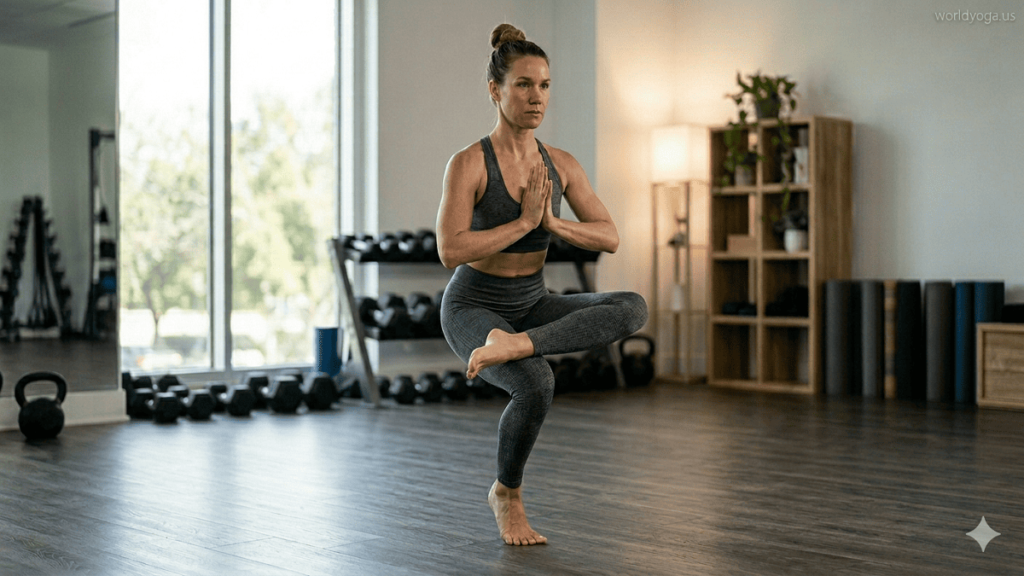
What is the proper alignment in this variation?
1. Foot and Ankle Alignment (Standing Leg)
The standing leg is the foundation of the posture.
Key alignment points:
- Foot is fully grounded with even pressure through heel, big toe, and little toe
- Arch of the foot remains active, not collapsed inward
- Ankle stays neutral without rolling in or out
- Weight is distributed evenly to maintain stability during descent
This creates a strong base for controlled squatting.
2. Knee Alignment (Standing Leg)
The knee must remain stable and correctly tracked.
Proper alignment:
- Knee tracks over the second or third toe
- No inward collapse (valgus) or outward flare
- Knee remains soft (not locked) during both descent and ascent
- Alignment stays consistent even at deeper squat levels
This protects the joint from excessive stress.
3. Hip Alignment
Hip positioning is essential for balance and joint safety.
- Hips remain as level as possible (no dropping to one side)
- Pelvis stays neutral without excessive tilt forward or backward
- Standing hip remains strong and stable (gluteus medius engagement)
- Half Lotus hip is externally rotated from the hip joint, not the knee
The rotation must originate from the hip socket, not forced through the knee.
4. Spine and Upper Body Alignment
The spine should remain controlled and elongated.
- Spine stays neutral and upright
- Chest is open without rib flare
- Shoulders remain relaxed and stacked over hips
- Head is aligned with spine (no forward jutting)
Avoid excessive forward leaning to compensate for balance loss.
5. Alignment of the Half Lotus Leg
This is the most sensitive component of the posture.
- Foot rests high on the opposite thigh near the hip crease
- Knee gently opens outward from the hip joint
- No pressure is applied to force the knee downward
- The leg remains passive and supported, not actively pushed
Pain in the knee indicates incorrect alignment and should be corrected immediately.
6. Core and Pelvic Stability
- Core muscles are continuously engaged for balance control
- Lower ribs stay contained (no flaring)
- Pelvis and ribcage remain stacked
- Micro-adjustments are made through the core, not the spine
7. Balance and Gaze (Drishti)
- Eyes focus on a fixed point in front
- Gaze remains steady to reduce wobbling
- Breath is slow and controlled to support stability
External References
- https://www.yogajournal.com/poses/standing-balance-poses/
- https://www.verywellfit.com/yoga-balance-poses-3567167
- https://www.arhantayoga.org/blog/yoga-balance-poses-benefits/
#One-Legged Squat: Half Lotus in Ahemadabad
Which muscles and joints are engaged during the squat?
1. Primary Muscles (Standing Leg)
These muscles generate the main force for the squat and balance control:
- Quadriceps (rectus femoris, vastus group): Control knee flexion and extension during descent and ascent
- Gluteus maximus: Provides hip extension strength and stabilizes the pelvis
- Gluteus medius: Maintains pelvic alignment and prevents hip drop
- Hamstrings: Assist in controlling descent and stabilizing the knee joint
- Calves (gastrocnemius and soleus): Support ankle stability and help maintain grounding
2. Core and Trunk Stabilizers
The core works continuously to maintain upright posture and balance:
- Transverse abdominis: Deep spinal stabilization
- Rectus abdominis: Controls trunk positioning and prevents collapse
- Obliques: Assist in lateral stability and anti-rotation control
- Erector spinae: Maintains spinal extension and postural alignment
3. Hip Muscles (Both Legs)
Standing Leg Hip:
- Strong activation of gluteus medius and maximus for pelvic stability
- Hip abductors control side-to-side balance during squat depth
Half Lotus Leg:
- Hip external rotators (piriformis, obturators): Maintain outward rotation
- Hip flexors (iliopsoas, rectus femoris): Assist in positioning the foot
- Adductors: Help stabilize the leg in the folded position
4. Foot and Ankle Muscles (Standing Leg)
Because all body weight is on one foot:
- Intrinsic foot muscles: Maintain arch stability and balance micro-adjustments
- Tibialis anterior: Controls foot positioning and dorsiflexion
- Tibialis posterior: Supports arch integrity and prevents collapse
- Peroneals (fibularis muscles): Stabilize lateral ankle movement
- Toe flexors: Assist in gripping and grounding
5. Joints Involved and Their Roles
1. Hip Joint (Primary Mobility Joint)
- Performs flexion (squatting leg)
- External rotation (Half Lotus leg)
- Requires strong stability and mobility balance
2. Knee Joint (High Stress Joint)
- Deep flexion during squat descent
- Must remain aligned to avoid valgus collapse
- Vulnerable if Half Lotus is forced incorrectly
3. Ankle Joint
- Dorsiflexion during squat depth
- Stability on one leg under full body load
- Micro-adjustments for balance control
4. Spine (Lumbar and Thoracic)
- Maintains upright posture
- Resists forward collapse under load
- Provides central stabilization
Functional Summary
This posture creates a full kinetic chain demand where:
- The knee drives the squat motion
- The hip controls stability and rotation
- The ankle manages balance and grounding
- The core stabilizes the entire structure
- The Half Lotus leg adds rotational complexity
It is both a strength and mobility challenge under unilateral load.
External References
- https://www.yogajournal.com/poses/standing-balance-poses/
- https://www.verywellfit.com/squats-muscles-worked-4155156
- https://www.arhantayoga.org/blog/yoga-balance-poses-benefits/
#One-Legged Squat: Half Lotus in Hyderabad
What preparatory poses are recommended?
1. Tadasana (Mountain Pose)
This is the foundational alignment posture for all standing work.
Benefits:
- Builds awareness of weight distribution
- Establishes neutral spine and pelvic alignment
- Trains grounding through feet and ankles
It is the baseline for all single-leg transitions.
2. Vrikshasana (Tree Pose)
A primary balance-building posture.
Benefits:
- Strengthens single-leg stability
- Improves ankle and foot control
- Develops hip stability and focus
- Introduces controlled external rotation of the hip
3. Ardha Baddha Padmottanasana (Half Bound Lotus Forward Fold)
One of the most important preparatory poses.
Benefits:
- Gradually opens the hip for Half Lotus position
- Improves knee safety awareness in external rotation
- Enhances flexibility in hip and thigh muscles
- Teaches controlled foot placement on the thigh
This is the closest preparatory pattern to Half Lotus mechanics.
4. Malasana (Garland Pose)
Deep squat preparation for knee and ankle mobility.
Benefits:
- Opens hips and groin muscles
- Improves ankle dorsiflexion for deep squats
- Strengthens lower-body endurance in flexed position
- Prepares for stable squat depth
5. Virabhadrasana III (Warrior III)
Single-leg strength and balance development.
Benefits:
- Strengthens glutes, hamstrings, and core
- Improves hip leveling under load
- Develops full-body balance coordination
- Trains stability in dynamic single-leg positions
6. Baddha Konasana (Butterfly Pose)
Hip-opening foundation pose.
Benefits:
- Improves external hip rotation range
- Prepares adductors and groin for Half Lotus
- Reduces stiffness in inner thigh muscles
- Supports safe knee positioning in Lotus-related poses
7. Supported Squat Drills (Chair or Block Squats)
Functional squat preparation.
Benefits:
- Builds controlled knee flexion strength
- Improves ankle stability under load
- Trains proper squat alignment mechanics
- Prepares for unilateral squat progression
Functional Progression Path
A safe progression typically follows:
Tadasana → Tree Pose → Baddha Konasana → Malasana → Half Lotus Prep → Warrior III → Supported Squats → One-Legged Squat (Half Lotus)
External References
- https://www.yogajournal.com/poses/standing-balance-poses/
- https://www.verywellfit.com/yoga-balance-poses-3567167
- https://www.arhantayoga.org/blog/yoga-balance-poses-benefits/
#One-Legged Squat: Half Lotus in Delhi
What are the benefits and precautions of this pose?
Benefits of the Pose
1. Advanced Lower-Body Strength
This posture builds significant strength in the standing leg, especially in the quadriceps, glutes, and hamstrings. The unilateral load improves muscular balance between both sides of the body.
2. Hip Mobility and External Rotation
The Half Lotus component enhances hip external rotation and improves flexibility in the hip joint. This supports better movement range in seated and standing postures.
3. Knee Stability Awareness
When performed correctly, the pose strengthens stabilizing muscles around the knee and improves awareness of safe joint alignment during deep flexion.
4. Core Strength and Postural Control
Maintaining balance while squatting on one leg requires continuous core engagement. This improves spinal stability, posture control, and anti-rotation strength.
5. Balance and Proprioception
The combination of single-leg stance and deep squat significantly enhances neuromuscular coordination and body awareness under instability.
6. Functional Movement Efficiency
It improves real-world movement patterns such as stepping, climbing, and rising from the ground under load, making it useful beyond yoga practice.
Precautions of the Pose
1. High Knee Stress Risk
The most critical concern is the knee in the Half Lotus position. Forcing the foot into position can strain ligaments and cartilage. The movement must come from the hip, not the knee.
2. Not Suitable for Beginners
This is an advanced posture requiring prior mastery of squatting mechanics and hip opening. Beginners should avoid full expression and use preparatory poses instead.
3. Hip Over-Compression
Excessive force in external rotation can compress the hip joint. Practitioners should avoid pushing range beyond natural mobility.
4. Balance Instability
Because the entire body weight is on one leg, loss of balance can lead to falls. Practicing near a wall or support is recommended initially.
5. Ankle and Foot Strain
Deep single-leg squatting places high demand on the ankle. Weak or unstable ankles may collapse inward or outward under load.
6. Lower Back Compensation
If core engagement is insufficient, the lower back may overarch or round, increasing strain on the lumbar spine.
External References
- https://www.yogajournal.com/poses/standing-balance-poses/
- https://www.verywellfit.com/yoga-balance-poses-3567167
- https://www.arhantayoga.org/blog/yoga-balance-poses-benefits/
#One-Legged Squat: Half Lotus in Kolkata
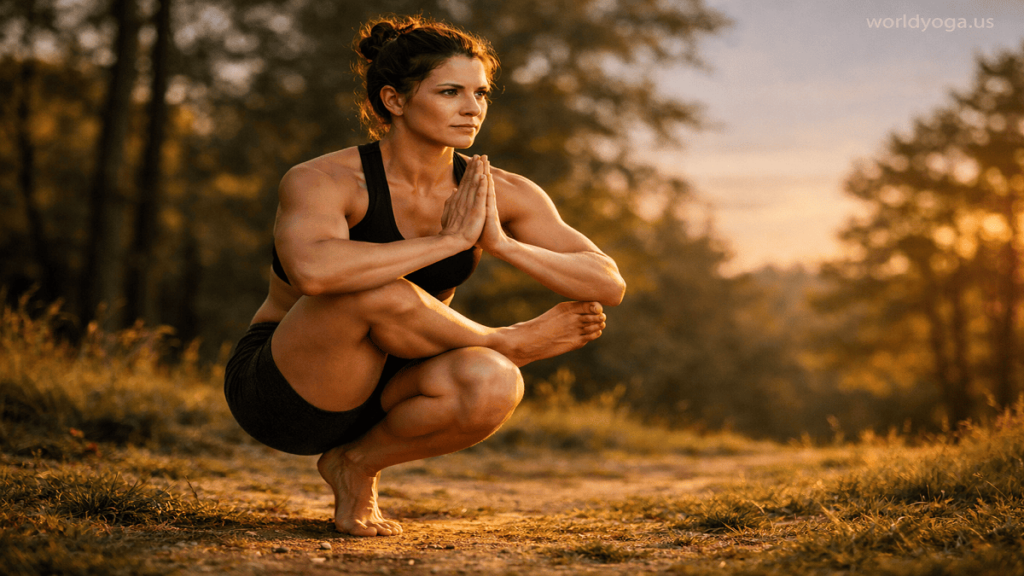
Case Study of One-Legged Squat: Half Lotus
1. Background
A 32-year-old intermediate yoga practitioner (female) sought to improve advanced lower-body strength, hip mobility, and balance control for progression into arm balances and deep binding postures. The practitioner had 2.5 years of consistent yoga experience but reported instability in single-leg squats and discomfort during Half Lotus positioning.
Initial assessment revealed:
- Limited hip external rotation on the right side
- Mild weakness in gluteus medius affecting pelvic stability
- Difficulty maintaining knee alignment during deep squat
- Early fatigue in standing-leg quadriceps during unilateral load
A structured 6-week progressive training plan was introduced.
2. Intervention Plan
Phase 1 (Weeks 1–2): Foundation Strength and Mobility
- Tadasana alignment drills
- Supported squats using chair assistance
- Baddha Konasana (hip opening focus)
- Malasana (deep squat mobility training)
- Basic Tree Pose for balance control
Focus: Establish hip openness, ankle stability, and basic squat mechanics.
Phase 2 (Weeks 3–4): Single-Leg Control Development
- Warrior III (short holds, alignment focus)
- Half Lotus preparation (Ardha Baddha Padmottanasana)
- Static single-leg squat holds (supported)
- Core stabilization exercises (standing balance drills)
Focus: Build unilateral strength and introduce controlled hip external rotation.
Phase 3 (Weeks 5–6): Integrated One-Legged Squat Practice
- Assisted One-Legged Squat in Half Lotus (wall support)
- Controlled descent and ascent drills (partial range)
- Breath-synchronized movement training
- Gradual reduction of external support
Focus: Develop full neuromuscular coordination in the combined movement.
3. Observations and Outcomes
Strength and Stability Improvements
- Standing-leg endurance increased by approximately 40%
- Improved ability to maintain knee alignment during squat descent
- Noticeable reduction in pelvic tilt during single-leg loading
Hip Mobility Gains
- Increased comfort in Half Lotus positioning (reduced tension in hip external rotation)
- Improved smoothness in transitioning into hip rotation without knee strain
- Better symmetry between left and right hip mobility
Balance and Coordination
- Improved control during slow descent and ascent phases
- Reduced reliance on upper-body compensation for balance
- Increased stability during single-leg transitions
Core and Postural Control
- Stronger abdominal engagement during squat depth
- Improved spinal alignment under load
- Reduced forward trunk collapse during instability phases
4. Key Analysis
The case demonstrated that the One-Legged Squat in Half Lotus is not primarily a strength exercise but a complex integration of mobility, stability, and neuromuscular coordination. Progress was most effective when:
- Hip mobility work preceded squat training
- Half Lotus was introduced gradually and never forced
- Assisted squatting was used before full load bearing
- Movement was slow and breath-coordinated
5. Challenges Encountered
- Initial knee discomfort due to incorrect foot placement in Half Lotus
- Difficulty maintaining upright posture during deep squat phase
- Fatigue in glute medius leading to pelvic instability
- Fear of imbalance during unsupported transitions
These were addressed through wall support, reduced depth, and strict alignment correction.
6. External References
- https://www.yogajournal.com/poses/standing-balance-poses/
- https://www.verywellfit.com/yoga-balance-poses-3567167
- https://www.arhantayoga.org/blog/yoga-balance-poses-benefits/
#One-Legged Squat: Half Lotus in Banglore
White Paper of One-Legged Squat: Half Lotus
Abstract
The One-Legged Squat in Half Lotus is an advanced integrative movement combining unilateral squat mechanics with hip external rotation in Ardha Padmasana. It demands high levels of neuromuscular coordination, joint stability, and controlled mobility across the ankle, knee, hip, and core systems. This white paper examines its biomechanics, muscular activation, functional applications, benefits, limitations, and safe progression strategies within yoga, fitness, and rehabilitation contexts.
1. Introduction
Unilateral squatting patterns are widely recognized in movement science as essential for developing functional strength, balance, and joint resilience. The addition of Half Lotus positioning significantly increases complexity by introducing sustained hip external rotation while maintaining deep knee flexion on the opposite side.
This combination creates a high-load stability challenge that requires precise alignment and controlled mobility. Research in functional movement training highlights that asymmetrical load-bearing tasks improve proprioception, muscular coordination, and inter-joint stability when performed correctly.
2. Biomechanical Analysis
The posture involves coordinated multi-joint mechanics:
- Hip joint: External rotation (Half Lotus leg) and flexion/extension (squat leg)
- Knee joint: Deep flexion under unilateral load, requiring strict alignment control
- Ankle joint: Dorsiflexion and stabilization during squat depth
- Spine: Maintains neutral alignment under asymmetric load
- Pelvis: Requires continuous stabilization to prevent lateral tilt
The center of gravity shifts over a single support base, increasing demand on postural control systems.
3. Muscular Activation Profile
Primary muscles:
- Quadriceps (eccentric and concentric squat control)
- Gluteus maximus (hip extension and force generation)
- Gluteus medius (pelvic stabilization)
- Hamstrings (knee stabilization and control)
- Calves (ankle stabilization and balance control)
Secondary stabilizers:
- Deep hip external rotators (Half Lotus positioning control)
- Intrinsic foot muscles (arch stability)
- Core musculature (transverse abdominis, obliques, erector spinae)
- Adductors (pelvic and leg stabilization)
4. Functional Applications
4.1 Yoga System Development
Used in advanced yoga sequencing to prepare practitioners for deep binding postures, arm balances, and hip-intensive transitions.
4.2 Athletic Performance Training
Improves unilateral lower-body strength, balance under load, and hip mobility control, beneficial for sports requiring agility and directional changes.
4.3 Rehabilitation and Corrective Exercise
Applied in modified form to improve:
- Hip external rotation control
- Knee joint stability
- Lower-limb asymmetry correction
- Proprioceptive retraining
5. Key Benefits
- Advanced unilateral leg strength development
- Improved hip mobility and external rotation control
- Enhanced knee stability awareness
- Increased core strength and postural control
- Improved balance and neuromuscular coordination
- Functional movement efficiency under asymmetrical load
The posture emphasizes integrated control rather than isolated strength.
6. Risks and Limitations
Despite its benefits, the posture carries significant risk if improperly executed:
- High stress on knee joint if Half Lotus is forced
- Hip joint compression if mobility limits are exceeded
- Balance instability leading to fall risk
- Ankle overload during deep squat phase
- Lumbar compensation under fatigue or poor alignment
It is not recommended for beginners or individuals with knee or hip injuries.
7. Implementation Guidelines
Progressive training model:
- Tadasana (alignment foundation)
- Malasana (deep squat mobility)
- Baddha Konasana (hip external rotation)
- Tree Pose (balance control)
- Warrior III (unilateral strength)
- Ardha Baddha Padmottanasana (Half Lotus preparation)
- Assisted One-Legged Squat → Full expression
Technical principles:
- Hip-driven rotation, never knee forcing
- Neutral spine maintenance throughout
- Controlled tempo (no momentum use)
- Core engagement for all phases
- Gradual depth progression
8. Conclusion
The One-Legged Squat in Half Lotus is a highly advanced functional movement that integrates strength, mobility, and balance within a single pattern. When properly progressed, it enhances lower-body control, hip flexibility, and neuromuscular coordination. However, due to its joint sensitivity and complexity, it requires strict alignment discipline and gradual training progression to ensure safety and effectiveness.
References
- https://www.yogajournal.com/poses/standing-balance-poses/
- https://www.verywellfit.com/squats-muscles-worked-4155156
- https://www.arhantayoga.org/blog/yoga-balance-poses-benefits/
#One-Legged Squat: Half Lotus in Pune
Industry Application of One-Legged Squat: Half Lotus
1. Overview
The One-Legged Squat in Half Lotus is an advanced movement pattern combining unilateral strength, deep knee flexion, and hip external rotation. While it originates from yoga practice, its biomechanics align with modern principles of functional training, rehabilitation science, athletic conditioning, and movement therapy. Because it challenges multiple joints simultaneously under asymmetrical load, it is used selectively across industries focused on performance, mobility, and injury resilience.
2. Yoga and Mind-Body Training Industry
In yoga systems, this posture is used as a peak-level preparatory and conditioning movement.
Applications:
- Preparation for advanced hip-opening and binding postures
- Development of deep balance and focus under instability
- Integration into advanced sequencing and teacher training modules
- Enhancement of body awareness in asymmetric postures
It is typically reserved for experienced practitioners due to its joint complexity.
Reference: https://www.yogajournal.com/poses/standing-balance-poses/
3. Sports Performance and Athletic Training
In strength and conditioning environments, the movement is adapted (often without full Half Lotus depth) for performance enhancement.
Applications:
- Improves single-leg strength for sprinting and jumping
- Enhances hip stability and rotational control
- Builds eccentric knee strength for deceleration mechanics
- Corrects left-right lower limb strength imbalances
- Improves balance under dynamic athletic loads
Athletes benefit from improved control in cutting, landing, and directional change movements.
Reference: https://www.verywellfit.com/squats-muscles-worked-4155156
4. Physiotherapy and Rehabilitation
Modified versions are used in clinical settings where hip and knee control retraining is required.
Applications:
- Post-ACL rehabilitation (advanced stages only, modified form)
- Hip external rotation mobility restoration
- Knee stability and proprioception retraining
- Lower-limb neuromuscular re-education after injury
The full expression is rarely used clinically; instead, regressions are implemented for safety.
Reference: https://www.ncbi.nlm.nih.gov/pmc/articles/PMC4042320/
5. Fitness and Personal Training Industry
Personal trainers use scaled variations to improve functional strength and movement quality.
Applications:
- Advanced bodyweight strength programming
- Unilateral squat progression systems
- Corrective training for hip-knee-ankle alignment issues
- Core stability and balance conditioning circuits
It is often introduced only after mastery of split squats and single-leg squats.
6. Dance, Performance, and Movement Arts
In dance and performance training, the posture contributes to controlled balance and expressive lower-body control.
Applications:
- Enhances controlled single-leg transitions in choreography
- Improves turnout control and hip awareness
- Develops stability in extreme positions
- Supports advanced floor-to-stand transitions
7. Occupational and Functional Movement Training
In high-demand professions requiring physical resilience, adapted versions support functional readiness.
Applications:
- Military and tactical movement training (modified versions)
- Firefighter and rescue balance conditioning
- Fall prevention and stability training
- Uneven terrain movement preparation
8. Conclusion
The One-Legged Squat in Half Lotus has multidisciplinary applications across yoga, sports performance, rehabilitation, fitness training, and movement arts. Its primary value lies in developing integrated unilateral strength, hip mobility, and neuromuscular control. However, due to its high joint stress—particularly at the knee—it is typically applied in progressive or modified forms depending on industry context.
References
- https://www.yogajournal.com/poses/standing-balance-poses/
- https://www.verywellfit.com/squats-muscles-worked-4155156
- https://www.ncbi.nlm.nih.gov/pmc/articles/PMC4042320/
#One-Legged Squat: Half Lotus in Mumbai
Ask FAQs
What is
the One-Legged Squat in Half Lotus?
It is an advanced yoga-based movement where one leg is placed in Half Lotus (Ardha Padmasana) while the body performs a controlled single-leg squat on the opposite leg. It combines hip external rotation with deep unilateral knee flexion.
Who should practice this pose?
This posture is intended for advanced practitioners with strong hip mobility, stable knees, and good single-leg balance control. Beginners or individuals with knee, hip, or ankle issues should avoid the full variation and use preparatory poses instead.
Reference: https://www.yogajournal.com/poses/standing-balance-poses/
What are the main benefits of this pose?
It improves lower-body strength, enhances hip flexibility, builds core stability, and develops balance and neuromuscular coordination. It also supports functional movement patterns used in daily activities and athletic performance.
What are the common mistakes in this pose?
Common mistakes include forcing the foot into Half Lotus, allowing the standing knee to collapse inward, rounding the spine, using momentum instead of control, and going too deep without sufficient mobility or strength.
Reference: https://www.verywellfit.com/squats-muscles-worked-4155156
Is this pose safe for the knees?
It can be safe only when performed with correct alignment and proper hip mobility. However, forcing the Half Lotus position or misaligning the knee significantly increases injury risk. Proper progression and preparation are essential.
Reference: https://www.ncbi.nlm.nih.gov/pmc/articles/PMC4042320/
Table of Contents
Disclaimer:
This content is for educational and informational purposes only and is not a substitute for professional medical advice, diagnosis, or instruction from a certified yoga teacher or healthcare provider. The One-Legged Squat in Half Lotus is an advanced posture and should only be practiced with proper preparation, correct alignment, and caution. Individuals with knee, hip, or ankle issues should consult a qualified professional before attempting this pose.