Ardha Padma Eka Pada Malasana
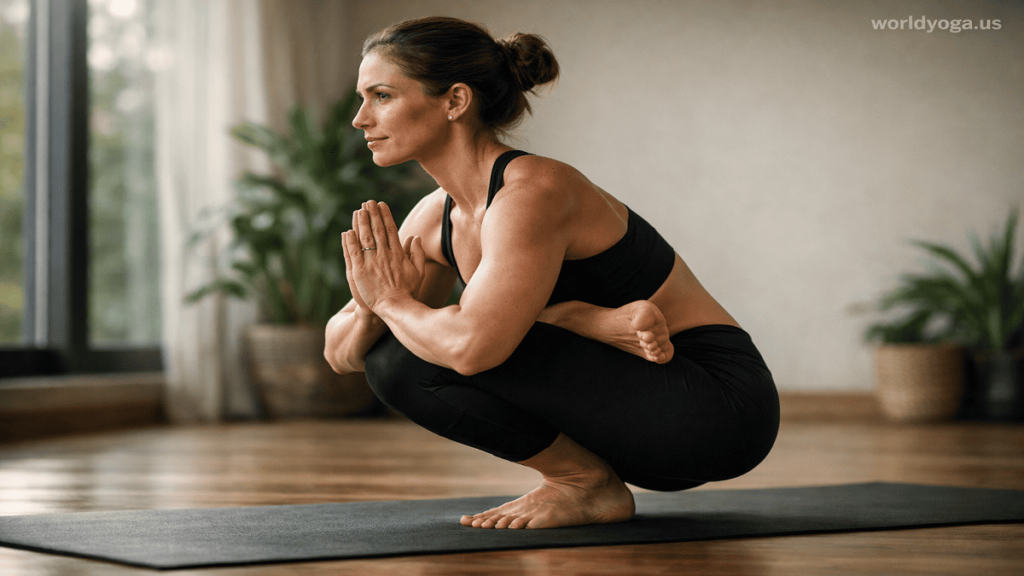
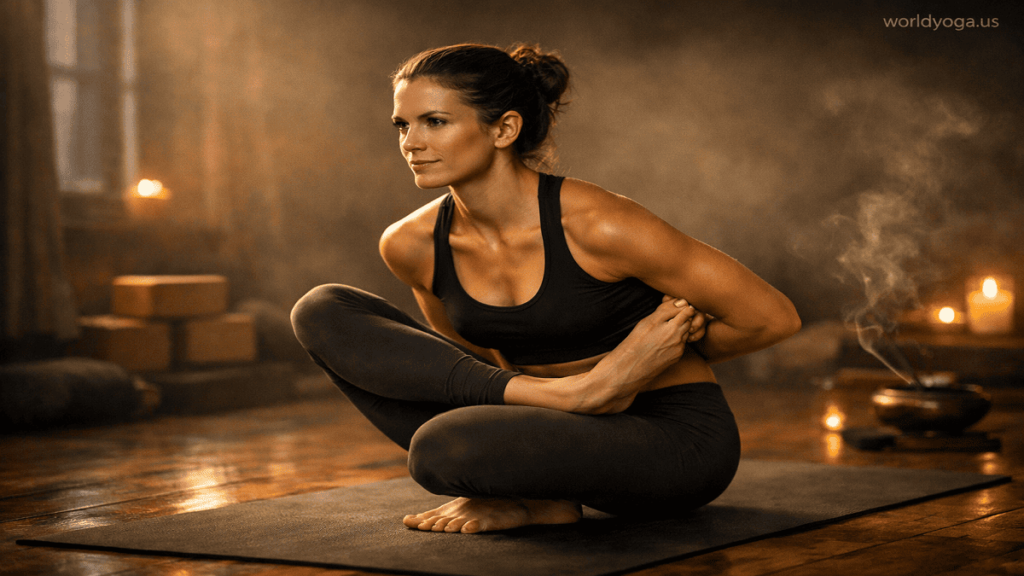
Ardha Padma Eka Pada Malasana is a deep hip-opening yoga posture combining elements of squatting, balance, and half-lotus positioning. It is a variation of Malasana (Garland Pose) with one leg folded into a half-lotus position, demanding flexibility in the hips, knees, and ankles while also requiring stability and mindful alignment.
Meaning and Structure
The name comes from Sanskrit:
- Ardha Padma = Half Lotus
- Eka Pada = One leg
- Malasana = Garland or squat pose
In this posture, one foot is placed in a half-lotus position on the opposite thigh while the other leg remains in a deep squat. The hands are often brought into prayer position at the chest or used for balance on the floor.
Benefits
This pose offers both physical and energetic benefits:
- Hip Flexibility and Mobility
It deeply opens the hip joints, groin, and inner thighs, helping reduce stiffness caused by prolonged sitting. - Strengthens Lower Body
The squat position strengthens quadriceps, calves, and gluteal muscles. - Improves Balance and Stability
The half-lotus component challenges coordination and enhances neuromuscular control. - Stimulates Digestion
Deep squatting compresses the abdominal region, supporting digestive function. - Enhances Mindfulness and Focus
The balancing requirement encourages concentration and breath awareness.
How to Perform (Basic Steps)
- Begin in a standing position and transition into a deep squat (Malasana).
- Shift weight onto one leg while carefully placing the opposite foot in half lotus on the standing thigh.
- Keep the spine elongated and chest lifted.
- Bring palms together in front of the chest or extend arms for balance.
- Hold the position while breathing steadily, then switch sides.
Precautions
- Avoid if you have knee, ankle, or hip injuries.
- Do not force the half-lotus position; it requires gradual preparation.
- Use support under the heel or sit on a block if balance is difficult.
- Warm up with hip-opening poses such as Butterfly Pose or Pigeon Pose before attempting.
Variations and Modifications
Beginners can practice a simple Malasana squat without the half-lotus leg position. Advanced practitioners may deepen the pose by extending arms overhead or incorporating a bind.
Conclusion
Ardha Padma Eka Pada Malasana is an advanced posture that blends flexibility, strength, and balance. It should be approached progressively, respecting the body’s limitations while focusing on controlled breathing and alignment.
External References
- Yoga Journal – Malasana Guide
- Yoga Basics – Squat Pose Benefits and Instructions
- Tummee Yoga – Pose Variations and Alignment Details
#Ardha Padma Eka Pada Malasana in India
How is Ardha Padma Eka Pada Malasana performed correctly?
Ardha Padma Eka Pada Malasana is an advanced yoga posture that combines a deep squat with a half-lotus leg position. Correct execution requires careful attention to alignment, controlled movement, and adequate preparation of the hips and knees. Because it places significant demand on joint mobility and balance, it should be practiced slowly and mindfully rather than forced.
Step-by-Step Correct Technique
Begin in a neutral standing position at the top of your mat. Feet should be slightly wider than hip-width apart, with toes gently turned outward. Lower your body into a deep squat, transitioning into Malasana (Garland Pose). Keep your heels grounded as much as possible; if they lift, place a folded blanket or block underneath for support.
Once stable in Malasana, shift your weight slightly onto one leg. Slowly lift the opposite foot and place it carefully onto the opposite thigh in a half-lotus position. The sole of the foot should face upward, and the heel should be close to the lower abdomen, without forcing the knee.
It is essential that this movement is gradual. The knee should never be forced downward or twisted. The supporting foot remains firmly grounded, with the knee tracking in line with the toes to avoid strain.
Once the leg is positioned, lengthen your spine upward. Engage your core muscles lightly to maintain balance. The chest should remain open rather than collapsing forward. Hands can be brought together in Anjali Mudra at the heart center or placed on the floor for additional stability.
Hold the posture while breathing steadily and evenly through the nose. Maintain a calm gaze at a fixed point (drishti) to improve balance. To exit, gently release the lifted foot back to the ground and return to Malasana before slowly rising to standing. Repeat on the opposite side.
Key Alignment Principles
Proper alignment is critical in this posture:
- The spine should remain elongated, not rounded.
- The knee of the half-lotus leg must stay pain-free and never be forced.
- Weight should be evenly distributed through the grounded foot.
- The pelvis should remain as level as possible, avoiding excessive tilting.
Common Mistakes to Avoid
- Forcing the half-lotus position without sufficient hip flexibility
- Collapsing the chest or rounding the back
- Allowing the supporting heel to lift excessively without modification
- Twisting the knee joint instead of opening the hip
Preparatory Practices
To safely approach this pose, practitioners should first build flexibility with hip-opening poses such as Butterfly Pose, Pigeon Pose, and regular Malasana squats. Warm-up is essential before attempting this posture.
Precautions
This pose is not recommended for individuals with knee, ankle, or hip injuries. Beginners should use props or practice simpler variations until adequate mobility and strength are developed.
External References
- Yoga Journal – Malasana Guide and Alignment
- Yoga Basics – Squat Pose Instructions
- Tummee Yoga – Ardha Padma Eka Pada Malasana Details
#Ardha Padma Eka Pada Malasana in Maharashtra
What is the proper alignment in this variation?
Ardha Padma Eka Pada Malasana is a hybrid of a deep squat (Malasana) and a half-lotus hip position, so correct alignment is essential to protect the knees, ankles, and lower back while allowing safe depth and balance. Because it combines asymmetrical loading with external hip rotation, alignment should prioritize joint safety over depth.
1. Base and Lower Body Alignment
The foundation begins in Malasana. The feet should be slightly wider than hip-width, with toes turned out moderately (not excessively). Heels ideally stay grounded; if they lift, a folded blanket or yoga block should support them to maintain stability and spinal alignment.
The supporting leg (the one not in half lotus) must track carefully: the knee should align in the same direction as the toes. It should not collapse inward, as this can strain the medial knee structures.
Weight distribution should be even across the whole foot—especially the heel and outer edge—to prevent instability. The pelvis should remain as level as possible rather than dropping heavily toward one side.
2. Half-Lotus Leg Alignment
The lifted leg is placed into a half-lotus position, which requires external rotation of the hip joint. The key principle is that the movement originates from the hip, not the knee.
The foot rests on the opposite thigh with the sole facing upward. The heel should gently move toward the lower abdomen, but never be forced. The knee of the lifted leg should naturally descend only as far as the hip allows.
A critical rule: the knee must not be manually pushed downward. Any pressure on the knee joint can lead to injury. If the hip is tight, the foot should be placed lower or the full lotus avoided.
3. Spinal and Upper Body Alignment
The spine should be long and upright, with the crown of the head reaching upward. Avoid rounding the back or collapsing the chest forward. The sternum should remain lifted to promote open breathing.
The core muscles are lightly engaged to stabilize the pelvis and prevent excessive sway.
Hands can be placed in Anjali Mudra (prayer position) at the chest or placed on the floor for additional balance support, depending on the practitioner’s stability level.
The neck remains neutral, with a soft forward gaze (drishti) to maintain focus and equilibrium.
4. Pelvic and Hip Position
The pelvis should aim for neutrality. One of the most common misalignments is twisting or dropping one side due to uneven hip flexibility. The goal is to keep both hip points as level as possible while allowing natural asymmetry.
If the pelvis tilts significantly, it is a sign that the half-lotus depth is too advanced for the current flexibility level.
5. Key Safety Principle
All rotation should come from the hip joint, not the knee. Pain in the knee is a sign to immediately reduce depth or modify the pose.
External References
- Yoga Journal – Malasana Alignment Guide
- Yoga Basics – Squat Pose Technique
- Tummee Yoga – Ardha Padma Eka Pada Malasana Details
#Ardha Padma Eka Pada Malasana in Pune
Which muscles are engaged during the pose?
1. Primary Lower Body Muscles
The most significant engagement occurs in the lower body, especially due to the deep squat (Malasana) component:
- Quadriceps (front thigh muscles):
These muscles work isometrically to control knee flexion and support the squat position. - Gluteus maximus and gluteus medius:
The gluteus maximus stabilizes hip extension control, while the gluteus medius plays a key role in pelvic stability, especially when weight shifts unevenly. - Hamstrings:
These assist in controlling hip and knee positioning during descent and stabilization in the squat. - Adductors (inner thigh muscles):
Strongly engaged due to the deep hip flexion and external rotation required in Malasana, helping stabilize the pelvis and thighs.
2. Hip Rotators and Half-Lotus Engagement
The half-lotus leg significantly activates the deep hip musculature:
- External rotators of the hip (piriformis, obturator internus/externus, gemelli muscles):
These muscles are responsible for turning the femur outward into external rotation. - Hip flexors (iliopsoas):
Assist in lifting and positioning the leg into half lotus. - Tensor fasciae latae (TFL):
Helps stabilize the hip joint and maintain balance in asymmetrical positioning.
This segment of the pose requires controlled hip mobility rather than knee force, making hip rotators especially important.
3. Core Muscles
Core engagement is essential for maintaining upright posture and balance:
- Rectus abdominis:
Helps maintain spinal alignment and prevents collapse forward. - Obliques (internal and external):
Assist in stabilizing the torso, especially when weight shifts unevenly between legs. - Transverse abdominis:
Provides deep core stabilization, supporting pelvic alignment and balance.
4. Spinal and Back Muscles
- Erector spinae:
These muscles run along the spine and keep the torso lifted and extended in the squat position. - Multifidus muscles:
Support fine spinal stability and posture control.
5. Lower Leg and Foot Muscles
- Calves (gastrocnemius and soleus):
Engage isometrically to support balance, especially if heels are lifted or unstable. - Tibialis anterior and intrinsic foot muscles:
Help stabilize the ankle and maintain foot positioning during deep flexion.
6. Stabilizing Synergy
One of the defining characteristics of this pose is the combination of symmetrical and asymmetrical loading. One leg is in deep flexion (Malasana), while the other is externally rotated and elevated (half lotus). This creates a demand for coordinated activation between both sides of the pelvis, requiring constant micro-adjustments from stabilizing muscles.
Conclusion
Ardha Padma Eka Pada Malasana is a full-body engagement posture that primarily targets the hips, thighs, and core while demanding significant neuromuscular control for balance and alignment. It is particularly effective for improving hip mobility, lower body strength, and postural stability when practiced correctly and progressively.
External References
- Yoga Journal – Garland Pose Benefits and Anatomy
- Yoga Basics – Malasana Muscle Engagement Overview
- Tummee Yoga – Ardha Padma Eka Pada Malasana Anatomy
#Ardha Padma Eka Pada Malasana in Ahemadabad
What preparatory poses are recommended?
Ardha Padma Eka Pada Malasana is an advanced posture that combines deep hip opening, ankle flexibility, and balance in a squat with a half-lotus leg position. Because it places significant demand on the hips, knees, and lower back, proper preparation is essential. The goal of preparatory poses is to gradually open the hips, improve external rotation, and build stability in deep flexion.
1. Hip-Opening Preparatory Poses
Since the half-lotus component requires strong external rotation of the hip joint, hip-opening poses are the most important foundation.
Baddha Konasana (Butterfly Pose)
This pose gently opens the inner thighs and groin while introducing external hip rotation. It is one of the safest and most effective preparations for lotus-related movements.
Eka Pada Rajakapotasana (Pigeon Pose)
Pigeon Pose deeply targets the hip rotators and glutes. It helps release tightness in the piriformis and surrounding muscles, which is essential for safe half-lotus positioning.
Anjaneyasana (Low Lunge)
This pose stretches the hip flexors, particularly the iliopsoas, which supports deeper squatting and pelvic mobility.
2. Squat Preparation Poses
To prepare for the Malasana (deep squat) foundation, the following poses are important:
Malasana (Garland Pose)
This is the direct preparatory pose. Practicing it regularly improves ankle mobility, hip flexion, and balance in a low squat position. It also strengthens the lower body and builds endurance in deep flexion.
Utkatasana (Chair Pose)
Chair Pose builds strength in the quadriceps, glutes, and core, which are necessary for maintaining stability in the squat portion of the final pose.
3. Hip Rotation and Mobility Preparations
Ardha Baddha Padmottanasana (Half Bound Lotus Forward Bend)
This pose introduces the half-lotus position in a standing variation, allowing the practitioner to safely explore external hip rotation without full squat pressure.
Supta Baddha Konasana (Reclining Bound Angle Pose)
A restorative position that passively opens the hips and groin, useful for increasing flexibility over time without strain.
4. Ankle and Foot Preparation
Vajrasana (Thunderbolt Pose)
Improves ankle flexibility and helps prepare the lower legs for deep squat positioning.
Heel lifts in squat practice
Simple dynamic movements in Malasana with lifted heels help strengthen foot muscles and improve balance control.
5. Core and Stability Preparations
Phalakasana (Plank Pose)
Strengthens the core muscles needed to stabilize the torso during the asymmetrical balance of Ardha Padma Eka Pada Malasana.
Navasana (Boat Pose)
Builds deep core strength and improves pelvic control, which is important for maintaining upright posture in the final pose.
Conclusion
A safe approach to Ardha Padma Eka Pada Malasana requires a balanced preparation of hip mobility, squat strength, and core stability. Practicing these preparatory poses consistently reduces strain on the knees and improves control in both the Malasana and half-lotus components. Progress should always be gradual, with attention to comfort in the hips rather than forcing depth.
External References
- Yoga Journal – Hip Opening Poses Guide
- Yoga Basics – Malasana Practice and Benefits
- Tummee Yoga – Ardha Padma Variations and Preparations
#Ardha Padma Eka Pada Malasana in Hyderabad
What are the benefits and precautions of this pose?
Benefits of the Pose
1. Deep Hip Opening and Mobility
This posture strongly targets the hip joints through two movement patterns: deep flexion (Malasana) and external rotation (half lotus). Regular practice can improve overall hip range of motion, reduce stiffness from prolonged sitting, and enhance functional mobility in daily life.
2. Strengthens Lower Body Muscles
The squat position engages the quadriceps, glutes, hamstrings, and calves. These muscles work isometrically to maintain stability, building endurance and strength in the lower body.
3. Improves Balance and Coordination
Because one leg is grounded while the other is externally rotated and elevated, the body must constantly adjust to maintain equilibrium. This improves proprioception, neuromuscular coordination, and single-leg stability.
4. Supports Digestive Function
Deep squatting gently compresses the abdominal region, which can stimulate digestive organs and support bowel movement efficiency. This is one reason traditional squatting postures are associated with improved gut function.
5. Enhances Postural Awareness and Focus
Maintaining an upright spine in an unstable position requires core engagement and concentration. This helps improve mindfulness, breath control, and mental focus during practice.
Precautions of the Pose
1. Knee Sensitivity and Injury Risk
The most important caution is related to the knee joint. The half-lotus position can strain the knee if forced. The rotation must come from the hip, not the knee. Pain in the knee is a warning sign to stop immediately or modify the pose.
2. Hip Flexibility Limitations
Tight hips can prevent safe external rotation. Forcing the leg into half lotus without adequate mobility may lead to joint strain. Practitioners should progress gradually using preparatory poses rather than pushing into depth.
3. Ankle and Balance Challenges
Limited ankle mobility may cause instability in the squat. If heels lift excessively, support should be used to avoid strain and maintain alignment.
4. Not Suitable for Certain Conditions
This pose is not recommended for individuals with:
- Knee injuries or ligament issues
- Hip impingement or severe tightness
- Ankle instability
- Recent lower limb surgery
5. Risk of Over-Compression
Excessive forward collapse or rounding of the spine can place unnecessary pressure on the lower back. Maintaining a lifted chest and engaged core is essential.
Safe Practice Guidelines
- Always warm up with hip-opening and squat-preparation poses first
- Avoid forcing the half-lotus position
- Use props (blocks or blankets) if balance is unstable
- Practice both sides evenly to prevent muscular imbalance
- Prioritize comfort over depth or aesthetics
Conclusion
Ardha Padma Eka Pada Malasana is a highly effective posture for developing hip mobility, lower body strength, and balance. However, its benefits can only be safely achieved when practiced with patience, proper alignment, and respect for individual anatomical limits. Progression should be gradual, with a strong focus on hip-driven movement rather than knee strain.
External References
- Yoga Journal – Garland Pose Benefits and Alignment
- Yoga Basics – Malasana Guide
- Tummee Yoga – Ardha Padma Eka Pada Malasana Overview
#Ardha Padma Eka Pada Malasana in Banglore
Case Study of Ardha Padma Eka Pada Malasana
1. Client Profile
The subject is a 34-year-old office professional with a predominantly sedentary lifestyle. Primary complaints included:
- Tight hips and groin stiffness
- Occasional lower back discomfort after prolonged sitting
- Limited ankle mobility and poor squat depth
- Reduced balance and lower body strength
There was no history of major knee or hip injury, but mild discomfort was reported during deep squatting movements.
2. Initial Assessment
Functional movement screening indicated:
- Restricted external rotation in both hips
- Limited ability to maintain heel contact in deep squat
- Weak core stabilization under asymmetrical load
- Difficulty maintaining upright posture in Malasana
Based on this, direct practice of Ardha Padma Eka Pada Malasana was not introduced immediately. A preparatory phase was prioritized.
3. Intervention Strategy
A progressive 6-week yoga therapy plan was implemented:
Phase 1: Mobility and Foundation (Weeks 1–2)
- Malasana (Garland Pose) for squat conditioning
- Baddha Konasana for groin opening
- Anjaneyasana for hip flexor release
Goal: Improve basic hip and ankle mobility while building squat tolerance.
Phase 2: Strength and Hip Rotation (Weeks 3–4)
- Eka Pada Rajakapotasana for deep hip rotator release
- Assisted Malasana holds with props
- Core stabilization drills (plank variations and controlled breathing)
Goal: Increase external hip rotation capacity and core stability.
Phase 3: Integration Phase (Weeks 5–6)
- Introduction of half-lotus positioning in supine and seated forms
- Supported transition into Ardha Padma Eka Pada Malasana using a wall for balance
- Gradual removal of support as stability improved
Goal: Safely integrate hip rotation with deep squat mechanics.
4. Observed Outcomes
After 6 weeks of consistent practice:
- Improved hip external rotation and reduced groin tightness
- Increased depth and comfort in squat position
- Noticeable improvement in balance and single-leg stability
- Reduction in lower back discomfort during prolonged sitting
- Better postural awareness and core engagement
However, half-lotus depth remained partial, indicating that full expression of the pose required longer-term mobility development.
5. Key Challenges Identified
- Initial tendency to collapse forward in squat due to weak core control
- Mild knee sensitivity when attempting forced half-lotus positioning
- Asymmetry between left and right hip flexibility
These were addressed through modifications, slower progression, and avoidance of forced joint rotation.
6. Clinical Insights
This case highlights that Ardha Padma Eka Pada Malasana is not an entry-level posture but a culmination of:
- Hip mobility training
- Squat conditioning
- Core stabilization
- Neuromuscular balance development
Progress was most effective when hip rotation was prioritized over depth, and when knee alignment was carefully protected.
7. Conclusion
The structured introduction of Ardha Padma Eka Pada Malasana demonstrates that safe access to advanced yoga postures depends on progressive preparation rather than immediate execution. The pose proved beneficial for improving functional mobility, posture, and lower body strength, but only when approached through staged conditioning and anatomical awareness.
External References
- Yoga Journal – Hip Opening Practice Overview
- Yoga Basics – Malasana and Squat Mechanics
- Tummee Yoga – Pose Progressions and Variation
#Ardha Padma Eka Pada Malasana in Kolkata
White Paper of Ardha Padma Eka Pada Malasana
Abstract
Ardha Padma Eka Pada Malasana is an advanced yoga posture combining deep squatting mechanics with unilateral half-lotus hip external rotation. This white paper examines its biomechanical structure, physiological impact, therapeutic relevance, contraindications, and progressive training methodology. The pose is positioned as a complex integrative movement requiring coordinated mobility, stability, and neuromuscular control across the lower kinetic chain.
1. Introduction
Ardha Padma Eka Pada Malasana is derived from traditional yogic squat (Malasana) combined with half-lotus positioning. It is classified as an advanced hip-opening and balance posture. Unlike standard squatting patterns, it introduces asymmetrical loading and rotational demands on the hip joint, making it both functionally beneficial and technically demanding.
The pose is increasingly used in modern yoga therapy and mobility training systems for its ability to address hip stiffness, postural dysfunction, and lower limb instability.
2. Biomechanical Analysis
The posture integrates two primary movement systems:
- Deep hip flexion (Malasana component)
- External hip rotation (half-lotus component)
Key biomechanical demands:
- Knee flexion under load in a deep squat
- Femoral external rotation from the hip joint
- Pelvic stabilization under asymmetrical positioning
- Spinal extension maintenance in a low center of gravity
The supporting limb bears most of the load, requiring coordinated activation of quadriceps, gluteus medius, and intrinsic foot stabilizers. The lifted leg demands controlled hip rotation without knee torque.
3. Musculoskeletal Engagement
Primary muscle groups include:
- Quadriceps and hamstrings (squat stabilization)
- Gluteus maximus and medius (hip stability)
- Deep external rotators (piriformis, obturator internus/externus)
- Adductor group (pelvic stabilization)
- Core musculature (transverse abdominis, obliques)
- Spinal erectors (postural support)
This makes the pose a full-chain kinetic engagement exercise rather than an isolated stretch.
4. Physiological and Functional Benefits
Evidence-based functional outcomes include:
- Improved hip joint range of motion
- Enhanced lower limb strength and endurance
- Increased proprioceptive control and balance
- Support for digestive motility through abdominal compression
- Improved postural awareness in seated populations
It is particularly relevant for individuals with sedentary lifestyles, where hip tightness and reduced squat ability are common.
5. Therapeutic Applications
In yoga therapy frameworks, the posture is used for:
- Hip mobility restoration programs
- Lower back tension reduction (indirect via pelvic release)
- Functional movement retraining
- Balance rehabilitation protocols
However, it is not used as a primary intervention without preparatory sequencing.
6. Contraindications and Risk Profile
This pose presents moderate to high risk for:
- Knee ligament stress (if half-lotus is forced)
- Hip impingement in limited mobility individuals
- Ankle instability in deep squat positioning
- Lower back compensation due to poor core control
The most critical risk factor is improper knee loading from misdirected hip rotation.
7. Progressive Training Model
Safe development requires staged progression:
- Hip opening foundation (Baddha Konasana, Pigeon Pose)
- Squat conditioning (Malasana, supported squat holds)
- Core stabilization (plank-based training)
- Assisted half-lotus integration
- Supported full posture execution
Progression should prioritize hip mobility before structural depth.
8. Discussion
Ardha Padma Eka Pada Malasana represents a convergence of flexibility, strength, and neuromotor control. Its complexity makes it unsuitable for unconditioned practitioners but highly effective in structured mobility development programs. The pose highlights the importance of joint-specific preparation, particularly in the hip-knee relationship.
9. Conclusion
This posture is best understood as a developmental milestone in lower-body mobility rather than a static end goal. When executed correctly, it enhances functional movement capacity, postural alignment, and joint awareness. However, it requires disciplined progression, anatomical understanding, and strict adherence to safety principles.
External References
- Yoga Journal – Garland Pose Overview
- Yoga Basics – Malasana Technique and Benefits
- Tummee Yoga – Ardha Padma Eka Pada Malasana Analysis
#Ardha Padma Eka Pada Malasana in Pune
Industry Application of Ardha Padma Eka Pada Malasana
1. Fitness and Strength & Conditioning Industry
In contemporary fitness programming, this pose is valued for its integration of mobility, stability, and functional strength.
- Functional Training Systems:
Trainers use elements of the pose to improve deep squat mechanics, hip mobility, and unilateral stability, which are essential for athletic performance. - Mobility Programs:
The half-lotus squat variation is incorporated into advanced hip-opening routines to address stiffness caused by prolonged sitting or repetitive movement patterns. - Injury Prevention Training:
Controlled practice helps improve joint awareness in the hips and knees, reducing risk of strain during dynamic sports activities.
The movement pattern is especially relevant in athletic populations requiring rotational control, such as runners, martial artists, and dancers.
2. Physiotherapy and Rehabilitation
In rehabilitation contexts, modified versions of Ardha Padma Eka Pada Malasana are used under supervision.
- Hip Mobility Rehabilitation:
Therapists may use supported squat variations to restore hip external rotation and flexion capacity. - Postural Re-education:
The pose helps retrain lower limb alignment and pelvic stability in individuals recovering from sedentary-related dysfunctions. - Balance and Proprioception Training:
The asymmetrical load improves neuromuscular control, particularly in post-injury recovery programs.
However, full expression of the pose is typically avoided in early rehabilitation due to knee sensitivity risks.
3. Workplace Wellness and Corporate Health
With increasing sedentary work environments, this pose influences ergonomic and wellness interventions.
- Desk-bound Population Mobility Programs:
Simplified squat variations inspired by Malasana are introduced to counteract hip tightness from prolonged sitting. - Stress Reduction and Mindfulness Integration:
The balance and breath control required in the posture are used in short movement-based mindfulness breaks. - Postural Correction Initiatives:
It indirectly supports spinal alignment and pelvic awareness, helping reduce lower back discomfort among office workers.
Organizations often integrate such movements into corporate yoga or wellness sessions.
4. Dance, Martial Arts, and Performance Arts
This pose has strong applications in movement-based disciplines.
- Dance Training:
Enhances turnout, hip flexibility, and low-level balance control essential for classical and contemporary dance forms. - Martial Arts Conditioning:
Deep squat strength and unilateral stability improve stance control, grounding, and transition speed. - Theatrical Movement Training:
Improves body awareness and expressive lower-body control in performance settings.
5. Sports Science and Athletic Development
Sports science professionals use the underlying biomechanics of the pose for:
- Enhancing hip mobility in sprinting mechanics
- Improving deep squat depth for weightlifting
- Supporting injury prevention in rotational sports
- Developing single-leg stability for agility performance
The pose is not used directly in competition training but as a corrective and preparatory movement pattern.
6. Wellness and Mental Health Industry
In holistic wellness programs, the posture contributes to mind-body integration practices.
- Improves breath awareness under physical challenge
- Encourages focus and present-moment attention
- Supports grounding techniques used in stress management programs
Its slow, controlled nature makes it suitable for mindful movement therapy.
Conclusion
Ardha Padma Eka Pada Malasana has evolved beyond traditional yoga into a multi-industry movement tool. Its applications span fitness, rehabilitation, workplace wellness, performance arts, and sports science. However, its complexity requires structured progression and anatomical awareness, making it most effective when adapted rather than directly imposed across populations.
External References
- Yoga Journal – Functional Hip Mobility Insights
- Yoga Basics – Malasana and Functional Movement Benefits
- Tummee Yoga – Pose Mechanics and Variations
#Ardha Padma Eka Pada Malasana in Mumbai
Ask FAQs
What is Ardha Padma Eka Pada Malasana?
Ardha Padma Eka Pada Malasana is an advanced yoga posture that combines a deep squat (Malasana) with a half-lotus leg position. One leg remains grounded in a squat while the other is externally rotated and placed on the opposite thigh. It is used to improve hip mobility, balance, and lower body strength.
Who can practice this pose safely?
This pose is suitable for intermediate to advanced yoga practitioners who already have good hip flexibility, stable knees, and comfortable squat depth. Beginners can work toward it through preparatory poses like Malasana and hip-opening stretches. Individuals with knee, hip, or ankle injuries should avoid or modify it under guidance.
What are the main benefits of this posture?
The pose improves hip flexibility, strengthens the legs, and enhances balance and coordination. It also supports core engagement, promotes better posture, and may help stimulate digestion due to the deep squat position. Over time, it increases overall lower-body mobility and body awareness.
What are the common mistakes in this pose?
A major mistake is forcing the half-lotus position from the knee instead of rotating from the hip joint, which can cause injury. Other errors include collapsing the spine, lifting the heels excessively without support, and uneven weight distribution in the squat. Proper alignment and gradual progression are essential.
What precautions should be taken while practicing it?
The most important precaution is to avoid any knee pain or pressure. The pose should never be forced. Practitioners should warm up with hip-opening and squat-preparatory poses before attempting it. Using props like blocks or blankets is recommended for balance and support. Controlled breathing and slow transitions help ensure safety.
Table of Contents
Disclaimer:
Ardha Padma Eka Pada Malasana is an advanced yoga posture that should be practiced with caution. The information provided is for educational purposes only and is not a substitute for professional medical or certified yoga instruction. Individuals with knee, hip, ankle, or back conditions should consult a qualified healthcare provider or yoga therapist before attempting this pose. Practice only within your comfort level and avoid forcing any movement.