One-Legged Squat: Leg Behind the Head
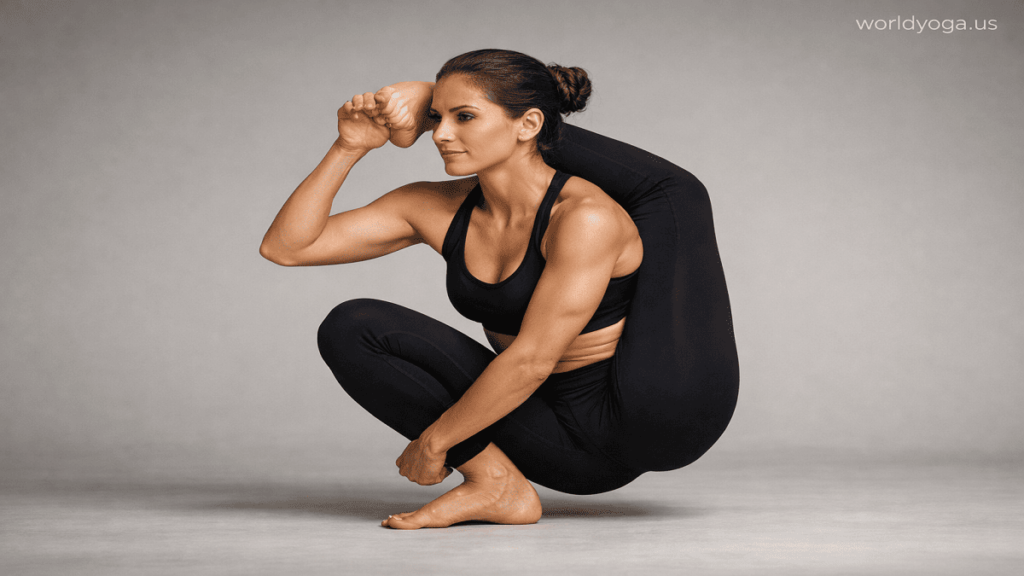
The One-Legged Squat: Leg Behind the Head is an advanced yoga and movement-based posture that combines deep unilateral squatting with extreme hip flexion and external rotation, where one leg is lifted and guided behind the head or neck. It is a highly demanding variation often associated with advanced yoga systems and mobility training disciplines that emphasize full-body integration, control, One-Legged Squat and joint awareness.
Movement Structure and Mechanics
This posture typically begins from a deep squat position similar to Malasana (Garland Pose), where one leg bears most of the body weight. The grounded leg remains in a stable squat with the knee tracking over the toes, One-Legged Squat while the lifted leg is gradually brought upward using deep hip flexion.
The raised leg requires extreme mobility in the hip flexors, adductors, and external rotators, One-Legged Squat while also demanding controlled spinal positioning to allow the leg to travel behind the head without compressing the cervical spine or lower back. The movement is not forced but progressively built through controlled hip opening.
A foundational squat reference for this movement pattern can be found here:
Yoga Journal – Garland Pose Overview
Key Muscles Involved
This posture engages a complex network of muscles:
- Lower body (supporting leg): quadriceps, gluteus maximus, hamstrings, calves
- Hip mobility (lifted leg): iliopsoas, rectus femoris, adductors, deep external rotators
- Core stabilizers: transverse abdominis, obliques, One-Legged Squat erector spinae
- Upper body stabilizers: latissimus dorsi and spinal extensors (for balance control)
The extreme leg elevation places significant demand on hip joint integrity and requires gradual conditioning rather than direct force.
Benefits
When safely developed over time, this posture may contribute to:
- Advanced hip flexibility and joint mobility
- Strong unilateral leg strength and balance control
- Deep core engagement and spinal stabilization
- Enhanced neuromuscular coordination and body awareness
- Improved control of extreme range-of-motion positions
Risks and Precautions
This posture carries a high risk profile if attempted without adequate preparation:
- Knee injury risk if hip mobility is insufficient and the joint compensates
- Hip impingement from forced external rotation or compression
- Lower back strain due to excessive spinal rounding or overextension
- Neck and cervical stress if the leg is forced behind the head improperly
Safe practice requires that all movement originates from the hip joint and not from pushing or pulling the knee or lower spine.
A general overview of hip mechanics in advanced lotus-based movements is available here:
Yoga Basics – Hip Opening and Lotus Safety Principles
Preparatory Requirements
Before attempting this posture, practitioners typically need:
- Deep mastery of Malasana (deep squat stability)
- Strong hip opening through poses like Baddha Konasana and Pigeon Pose
- Controlled half and full lotus mobility (without knee strain)
- Core strength for spinal stabilization
- Shoulder and upper back mobility for balance support
Conclusion
The One-Legged Squat: Leg Behind the Head is not a standard yoga pose but an extreme mobility expression requiring years of progressive training. Its value lies less in aesthetic achievement and more in demonstrating the limits of hip flexibility, balance control, One-Legged Squat and integrated body awareness. Safe practice depends entirely on gradual progression, proper alignment, and avoidance of forceful movement into end ranges.
#One-Legged Squat: Leg Behind the Head in India
How is One-Legged Squat with leg behind the head performed correctly?
1. Starting Position: Stable Deep Squat Base
The movement typically begins in a deep squat similar to Malasana (Garland Pose). Both feet are grounded initially, One-Legged Squat with heels either on the floor or slightly elevated depending on mobility.
When transitioning to one leg:
- The supporting foot stays fully rooted (tripod base: heel, big toe, little toe)
- The knee tracks in line with the second or third toe
- The pelvis remains level and not collapsed to one side
A correct squat foundation is essential before any leg lifting begins:
Yoga Journal – Garland Pose Alignment Guide
2. Weight Transfer and Balance Control
Shift weight slowly into the supporting leg while maintaining a tall spine. The torso should stay lifted rather than folding forward excessively.
Key alignment cues:
- Core engaged to prevent collapse
- Chest open, not compressed into the thigh
- Hips square and stable (no twisting collapse)
The balance phase should feel like controlled suspension rather than instability.
3. Lifting and Preparing the Working Leg
The lifted leg begins in a bent position and is drawn upward using hip flexion and external rotation, One-Legged Squat not knee force.
Correct mechanics require:
- Movement originating at the hip joint
- Knee staying protected and aligned (no twisting pressure)
- Gradual elevation of the thigh toward the torso
This is the most critical safety phase—forcing the leg is the primary injury risk.
4. Transitioning the Leg Behind the Head
From a high lifted position, One-Legged Squat the leg is carefully guided over the shoulder and behind the head only if sufficient hip mobility exists.
Correct execution principles:
- The neck remains neutral and elongated
- The spine does not collapse forward or excessively arch backward
- The shoulder acts as a passive contact point, not a lever
- The hip remains the primary driver of motion
If the leg cannot pass smoothly, the pose should be stopped or modified immediately.
5. Core, Spine, and Upper Body Alignment
Throughout the movement:
- The core (transverse abdominis and obliques) stabilizes the pelvis
- The erector spinae keeps the spine upright
- The shoulders remain relaxed, not forced upward or forward
Over-tension in the neck or lower back indicates misalignment.
6. Breathing and Control
Breath should remain slow and steady:
- Inhale to lengthen the spine before lifting the leg
- Exhale during transitions into deeper positioning
- Avoid breath-holding, which increases instability and joint stress
7. Key Markers of Correct Performance
The pose is considered correctly performed only if:
- No pain in knees, hips, or neck
- Hip drives all leg movement (no knee torque)
- Spine remains controlled and stable
- Balance is maintained without collapsing or straining
- Exit from the pose is smooth and controlled
8. Safety Note
This movement carries a high risk of knee and hip injury if forced. It should only be attempted after mastery of deep squat mechanics, hip opening work, One-Legged Squat and non-load-bearing leg-behind-head variations.
A foundational reference for squat alignment principles can be reviewed here:
Yoga Basics – Squat and Hip Mobility Foundations
Summary
Correct performance of the One-Legged Squat with Leg Behind the Head is not about achieving the final shape, but about controlled hip-driven motion, protected knee alignment, spinal stability, One-Legged Squat and absence of strain. If any part of the movement requires force, compensation, or pain, the posture is not being performed correctly and should be regressed to preparatory stages.
#One-Legged Squat: Leg Behind the Head in Maharashtra
What is the proper alignment in this advanced variation?
1. Supporting Leg Alignment (Foundation)
The standing leg in the squat is the primary load-bearing structure:
- Foot is grounded in a tripod base (heel, big toe, little toe evenly weighted)
- Knee tracks directly over the second or third toe (no inward collapse)
- Shin stays stable without excessive forward sway
- Hip of the supporting side remains level and not dropped
The squat foundation should resemble a controlled Malasana (Garland Pose) before any lifting begins:
Yoga Journal – Garland Pose Alignment Principles
2. Pelvic Alignment (Critical Control Point)
The pelvis must remain as neutral as possible despite asymmetry:
- Hips stay square and level (no major tilt or rotation)
- Core gently engages to prevent pelvic collapse
- Tailbone remains neutral (neither excessively tucked nor arched)
A tilted pelvis is one of the earliest indicators of unsafe compensation in this posture.
3. Lifting Leg Alignment (Hip-Driven Mechanics)
The lifted leg follows a strict hip-dominant pathway:
- Movement originates from the hip joint, not the knee
- Femur lifts with controlled flexion + external rotation
- Knee stays aligned with hip (no twisting torque)
- Foot remains relaxed, not forced into rigid positioning
If the knee is used as a lever, alignment is incorrect and potentially harmful.
4. Spinal Alignment (Stability Axis)
The spine acts as a stabilizing column:
- Spine stays long and decompressed
- Natural curves are maintained (no excessive rounding or arching)
- Chest remains open without rib flare
- Head is aligned over the spine (no forward craning to accommodate the leg)
The torso should feel “lifted inside the posture,” not compressed.
5. Neck and Head Position (Safety Zone)
Because the leg passes near or behind the head:
- Neck remains neutral and elongated
- No downward pressure from the leg onto the cervical spine
- Head does not push into the leg for leverage
- Eyes remain forward or slightly downward for balance control
Any compression in the neck is a clear misalignment.
6. Shoulder and Upper Body Alignment
If arms are involved for balance or support:
- Shoulders stay relaxed and down away from ears
- No excessive rounding forward of the upper back
- Scapulae remain stable, not winged or collapsed
7. Key Alignment Integrity Markers
The posture is considered properly aligned only when:
- Weight is evenly controlled through the supporting foot
- Knee is stable and tracking correctly
- Hip drives all movement of the lifted leg
- Spine remains long without collapse or overextension
- Neck is free of compression
- No joint pain is present anywhere in the chain
8. Summary
Proper alignment in this advanced variation is fundamentally about stacking and separation of roles:
- The foot and leg stabilize
- The hip mobilizes
- The core stabilizes
- The spine organizes
- The neck remains protected
If any of these roles overlap incorrectly (especially hip → knee substitution), alignment is compromised and the posture becomes unsafe.
#One-Legged Squat: Leg Behind the Head in Kolkata

Which muscles and joints are engaged during the pose?
1. Joints Involved
Hip Joint (Primary Mobility Driver)
The hip joint is the most heavily loaded and mobile structure in this posture. It performs:
- Deep flexion (lifting the leg upward)
- External rotation (guiding the leg behind the head)
- Stabilization under asymmetrical load in the supporting side
This joint must remain the primary source of movement, especially for the lifted leg.
Knee Joint (Supporting Stability Point)
The knee of the standing leg functions as a controlled hinge:
- Flexion under deep squat load
- Stabilization against inward collapse (valgus stress)
- Minimal rotational movement (should remain stable, not twisted)
Improper hip mobility often transfers stress to this joint, increasing injury risk.
Ankle Joint
The ankle of the supporting foot manages:
- Dorsiflexion in deep squat position
- Balance adjustments (micro-stability corrections)
- Load absorption through tripod foot support
Limited ankle mobility can force compensations in the knee or spine.
Spine (Cervical, Thoracic, Lumbar)
The spine functions as a dynamic stabilizer:
- Lumbar spine resists collapse under squat load
- Thoracic spine maintains upright posture and extension
- Cervical spine remains neutral as the leg approaches the head
2. Primary Muscle Groups Engaged
Lower Body (Supporting Leg)
- Quadriceps femoris: controls deep knee flexion in squat
- Gluteus maximus: hip extension and pelvic stabilization
- Hamstrings: assist in load control and descent stability
- Calves (gastrocnemius, soleus): ankle stabilization
- Adductors: medial knee and pelvic stability
Hip Mobility Muscles (Lifted Leg)
- Iliopsoas: primary hip flexor lifting the leg
- Rectus femoris: assists in hip flexion and knee positioning
- Deep external rotators (piriformis, obturator internus/externus, gemelli): guide safe rotation
- Adductor group: controls inward/outward leg positioning
These muscles must work in coordination to prevent knee strain.
Core Muscles (Stability System)
- Transverse abdominis: deep spinal stabilization
- Obliques: resist rotational collapse
- Rectus abdominis: controls pelvic tilt
- Erector spinae: maintains spinal extension
The core prevents the body from collapsing into the asymmetrical load.
Upper Body and Neck Stabilizers
- Latissimus dorsi: supports trunk control in advanced variations
- Rhomboids and trapezius: scapular stability
- Neck flexors/extensors: maintain cervical alignment as leg approaches head
3. Functional Muscle Chains
Instead of isolated muscles, this pose relies on integrated chains:
- Posterior chain: glutes, hamstrings, spinal erectors (stability foundation)
- Anterior hip chain: iliopsoas and quadriceps (leg lift mechanism)
- Deep core cylinder: diaphragm + abdominals (pressure regulation and balance)
- Lateral stabilizers: gluteus medius and obliques (anti-tilt control)
4. Key Biomechanical Insight
The most important principle is that:
- Hip muscles initiate movement
- Knee and spine only stabilize
- Core distributes load
If the knee or spine becomes a primary mover instead of the hip, the joint load becomes unsafe.
Summary
This advanced posture engages nearly every major system in the body, with dominant emphasis on:
- Hip joint mobility and control
- Lower-body strength under deep flexion
- Core stabilization against asymmetry
- Spinal alignment under compressive load
- Shoulder and neck control for final positioning
It is best understood as a whole-body kinetic chain integration challenge, One-Legged Squat not an isolated stretch or strength exercise.
#One-Legged Squat: Leg Behind the Head in Banglore
What preparatory poses are recommended before attempting it?
1. Deep Squat Foundation
Malasana (Garland Pose)
This is the primary prerequisite for squat mechanics. It develops ankle dorsiflexion, One-Legged Squat hip flexion, and core engagement in a stable deep squat.
- Builds tolerance for full knee flexion under load
- Trains upright spine in a low position
- Improves balance in grounded squat patterns
Reference alignment:
Yoga Journal – Garland Pose Guide
Assisted Squats (Heels Elevated or Supported)
Used to gradually increase depth without collapsing the spine or heels.
2. Hip Opening and External Rotation
Baddha Konasana (Bound Angle Pose)
Essential for developing safe external rotation in the hips.
- Opens inner thighs and groin
- Trains femur rotation without knee strain
- Builds awareness of hip-driven movement
Ananda Balasana (Happy Baby Pose)
Helps decompress the lower back and open hips in a supported position.
Lizard Pose (Utthan Pristhasana)
Targets hip flexors and prepares the front chain for deep flexion.
3. Leg Behind Head Preparation (Progressive Mobility)
Ardha Padmasana (Half Lotus Pose)
Introduces controlled external hip rotation in a seated position.
- Teaches hip vs knee separation
- Develops safe lotus mechanics
Reference:
Yoga Basics – Half Lotus Pose
Eka Pada Sirsasana Progressions (Foot-to-Shoulder Drills)
Step-by-step mobility drills that gradually introduce leg elevation toward the upper body without forcing placement behind the head.
4. Lower Body Strength and Balance
Utkatasana (Chair Pose)
Builds quadriceps endurance for sustained squat control.
Virabhadrasana III (Warrior III)
Develops single-leg stability and hip control under load.
Bakasana (Crow Pose)
Trains weight-bearing through arms and core coordination (useful for balance transitions).
5. Core and Spinal Stability
Plank Pose Variations
Strengthens deep core stabilizers essential for preventing collapse in asymmetrical loading.
Navasana (Boat Pose)
Builds anti-collapse abdominal strength for upright posture control.
Bhujangasana (Cobra Pose)
Prepares spinal extension and thoracic openness.
6. Shoulder and Binding Preparation
Gomukhasana (Cow Face Pose)
Develops shoulder internal rotation and binding capability.
Garudasana (Eagle Arms Variation)
Improves scapular stability and upper-back engagement.
7. Integrated Control Drills
Before attempting the full posture, the body should be able to:
- Hold a deep squat comfortably (Malasana)
- Maintain balance on one leg (Warrior III)
- Perform hip external rotation without knee strain (Half Lotus)
- Keep core stable under asymmetry (plank variations)
- Move shoulders into bind without pain (Gomukhasana)
Key Principle
Progression should always follow this sequence:
Mobility → Stability → Strength → Integration
If any step causes knee pain, hip pinching, or spinal strain, One-Legged Squat the practitioner should regress rather than progress.
Summary
The safest preparation for this extreme posture includes:
- Deep squat training (Malasana)
- Hip opening (Baddha Konasana, Happy Baby)
- Controlled lotus mechanics (Half Lotus variations)
- Core strengthening (Plank, Boat Pose)
- Balance development (Warrior III, Crow Pose)
- Shoulder mobility for eventual binding (Cow Face Pose)
This layered approach ensures that the final pose is approached through control and capacity-building rather than force or flexibility alone.
#One-Legged Squat: Leg Behind the Head in Pune
What are the benefits and precautions of this pose?
Benefits
1. Advanced Hip Mobility Development
This posture strongly challenges the hip joint in multiple directions—deep flexion, external rotation, and abduction. Over time (with proper progression), it may improve overall hip range of motion and control in end-range positions. The movement requires precise femur articulation within the hip socket, which enhances joint awareness and mobility.
A foundational reference for hip opening principles can be found here:
Yoga Basics – Half Lotus Pose Mechanics
2. Lower Body Strength and Stability
The supporting leg performs a deep single-leg squat, engaging:
- Quadriceps for knee flexion control
- Gluteus maximus for hip stabilization
- Hamstrings for eccentric control
- Calves and ankle stabilizers for balance
This builds strong unilateral leg strength and improves stability under uneven load.
3. Core Integration and Spinal Control
The asymmetry of the posture forces continuous core engagement:
- Transverse abdominis stabilizes internal pressure
- Obliques resist rotational collapse
- Erector spinae maintains upright posture
This improves spinal control in unstable positions and enhances body coordination.
4. Neuromuscular Coordination and Balance
Because the body must manage deep squat loading while controlling a highly mobile lifted limb, the nervous system develops improved:
- Proprioception (body awareness)
- Balance under asymmetry
- Motor control in extreme ranges
This is valuable in advanced movement training and athletic conditioning contexts.
Precautions
1. High Knee Injury Risk
The most significant risk is to the knee of the lifted leg. If hip mobility is insufficient, force is often transferred to the knee joint instead of the hip, potentially stressing ligaments such as the ACL or meniscus structures.
Correct principle: movement must originate from the hip, not the knee
2. Hip Impingement and Overcompression
Forcing the leg behind the head without adequate external rotation can cause femoroacetabular impingement or deep joint compression. Sharp groin or hip pain is a warning sign to stop immediately.
3. Lower Back Strain
Without core stability, the spine may compensate through excessive flexion or extension. This can lead to lumbar strain, especially under deep squat load combined with asymmetry.
4. Neck and Cervical Stress
Placing the leg behind the head can compress the cervical spine if alignment is incorrect. The neck must remain neutral, and the head should never be used as a support structure.
5. Ankle and Balance Overload
The supporting ankle bears full body weight in a deep flexed position, increasing strain if dorsiflexion is limited or if balance is unstable.
Safety Guidelines
- Never force the leg into position
- Use preparatory poses to build hip mobility gradually
- Maintain even weight distribution through the supporting foot
- Keep spine long and stable under load
- Stop immediately if knee, hip, or neck pain occurs
- Practice under supervision if attempting advanced variation
Summary
This pose offers benefits in hip mobility, unilateral strength, core stability, and neuromuscular coordination, but only when approached progressively. The primary risks involve knee injury, hip compression, and spinal strain, making strict attention to alignment and gradual progression essential. It is best viewed as an advanced training expression of human mobility rather than a standard yoga posture.
#One-Legged Squat: Leg Behind the Head in Ahemadabad
Case Study of One-Legged Squat: Leg Behind the Head
1. Background
This case study examines a 29-year-old experienced movement practitioner (yoga and functional mobility background of 5+ years) who attempted progressive training toward the One-Legged Squat with Leg Behind the Head. The goal was not immediate full expression, but structured progression toward extreme hip mobility, unilateral squat strength, and controlled leg-behind-head integration.
The practitioner had strong baseline fitness, including stable Malasana (Garland Pose) and intermediate balance control in single-leg movements, but limited end-range hip flexion and external rotation symmetry between left and right hips.
Reference for foundational squat mechanics used in baseline assessment:
Yoga Journal – Garland Pose Alignment
2. Initial Assessment Findings
Key limitations identified:
- Moderate restriction in hip external rotation (right side > left side)
- Difficulty maintaining upright spine in deep squat beyond 20–30 seconds
- Tight hip flexors limiting controlled leg elevation
- Early compensation patterns in lumbar spine during asymmetrical loading
- Limited comfort in seated lotus-based variations
No structural injuries were present, but movement screening showed high compensation risk at the knee and lumbar spine if progression was forced.
3. Training Protocol (8–10 Weeks)
The intervention was divided into three phases:
Phase 1: Mobility Expansion
Focus on unlocking hip range safely:
- Baddha Konasana (Bound Angle Pose) for external rotation control
- Happy Baby Pose for hip decompression
- Supported deep squats with heel elevation
Phase 2: Pattern Isolation
Introduction of controlled movement components:
- Ardha Padmasana (Half Lotus variations)
- Hip flexor strengthening drills (knee-to-chest control work)
- Static Malasana holds for squat endurance
Reference for hip mechanics foundation:
Yoga Basics – Half Lotus Pose Guide
Phase 3: Integration Phase
Combining elements gradually:
- Single-leg squat transitions (assisted)
- Partial leg elevation toward shoulder line
- Wall-supported balance drills
- Controlled exit strategies to prevent joint overload
4. Observations During Progression
By week 6:
- Improved squat depth and stability
- Increased hip range, especially in left hip
- Reduced spinal compensation in deep squat
- Better balance control in unilateral loading
By week 10:
- Leg could be elevated toward shoulder height in controlled conditions
- However, full behind-the-head placement was not safely achievable without compensation
- Right hip remained the limiting factor in external rotation range
5. Key Risk Events and Corrections
During early integration attempts, two key risk patterns were identified:
- Knee torque during leg lift attempts
- Corrected by reducing range and reinforcing hip-driven initiation
- Lumbar rounding under fatigue in squat hold
- Addressed with shorter holds and core engagement drills
No injuries occurred due to early regression protocols.
6. Outcome Summary
The practitioner achieved:
- Significant improvement in hip mobility and squat endurance
- Better neuromuscular coordination under asymmetry
- Increased awareness of hip vs knee movement separation
- Partial progression toward leg elevation control
However, full expression of the pose was not reached safely within the timeframe, reinforcing the need for long-term progression.
7. Key Insights
- Hip mobility must exceed knee demand threshold before progression
- Strength alone is insufficient without end-range joint control
- Asymmetry between hips is a major limiting factor
- Forced progression increases risk without improving performance
8. Conclusion
This case demonstrates that the One-Legged Squat with Leg Behind the Head is not a short-term goal posture but a long-term neuromuscular development system. Safe progression depends on layered training of mobility, stability, and control rather than attempting full expression prematurely.
#One-Legged Squat: Leg Behind the Head in Hyderabad
White Paper of One-Legged Squat: Leg Behind the Head
1. Abstract
The One-Legged Squat with Leg Behind the Head is an advanced human movement pattern combining deep unilateral squatting, extreme hip flexion, and external rotation with cervical-adjacent leg placement. This white paper outlines the biomechanical demands, joint loading characteristics, muscular recruitment, progression methodology, and safety considerations. The objective is to frame the movement as a high-risk, high-control mobility-strength integration model, rather than a conventional yoga posture.
2. Movement Classification
This pattern integrates three primary systems:
- Deep squat mechanics (Malasana-based structure)
- Extreme hip flexion and external rotation (leg-behind-head pathway)
- Unilateral load-bearing under instability (single-leg squat domain)
Reference squat foundation mechanics:
Yoga Journal – Garland Pose Overview
3. Biomechanical Demands
3.1 Hip Joint (Primary Driver)
The hip joint of the lifted leg undergoes:
- Maximal flexion
- External rotation
- Controlled abduction
The supporting hip simultaneously stabilizes pelvic alignment under deep flexion load.
3.2 Knee Joint (High-Risk Interface)
The knee of the supporting leg experiences:
- Deep flexion under full bodyweight
- High compressive load
- Risk of valgus collapse if hip stability is insufficient
Importantly, the knee must not substitute for hip rotation mechanics.
3.3 Ankle Complex
The ankle provides:
- Dorsiflexion capacity for squat depth
- Proprioceptive balance control
- Load dispersion through tripod foot structure
4. Muscular Activation Profile
Lower Body (Supporting Leg)
- Quadriceps femoris (eccentric control in squat)
- Gluteus maximus (hip stabilization)
- Hamstrings (joint control and load modulation)
- Calves and intrinsic foot muscles (balance and stability)
Hip Mobility Chain (Lifted Leg)
- Iliopsoas (primary hip flexor)
- Rectus femoris (assists elevation)
- Deep external rotators (piriformis, obturators, gemelli)
- Adductor group (fine positioning control)
Core Stabilization System
- Transverse abdominis (intra-abdominal pressure control)
- Obliques (anti-rotation stability)
- Erector spinae (postural extension control)
5. Physiological Adaptations
With long-term structured training, adaptations may include:
- Increased hip flexion and external rotation range
- Improved unilateral lower-limb strength
- Enhanced spinal stabilization under asymmetry
- Greater proprioceptive precision in extreme positions
- Improved neuromuscular coordination across kinetic chains
6. Progression Framework
A staged development model is required:
Phase 1: Mobility Acquisition
- Baddha Konasana (hip external rotation)
- Happy Baby Pose (hip decompression)
Phase 2: Squat Integration
- Malasana (deep squat endurance)
- Supported squat holds
Phase 3: Hip Isolation Training
- Seated leg-behind-head preparation drills
- Controlled hip flexion progressions
Phase 4: Load Integration
- Single-leg squat transitions
- Assisted balance work (wall/strap support)
Reference for hip rotation mechanics:
Yoga Basics – Hip Opening and Lotus Safety Principles
7. Risk Analysis
Primary Risks
- ACL and meniscus stress from improper hip-knee transfer
- Femoroacetabular impingement from forced hip flexion
- Lumbar spine overload due to compensation
- Cervical compression from incorrect leg placement
- Ankle instability under deep squat fatigue
Risk Amplifiers
- Insufficient hip external rotation
- Fatigue-induced spinal collapse
- Asymmetrical hip mobility
- Forced range progression
8. Safety Protocols
- Movement must originate exclusively from the hip joint
- Knee must remain a passive hinge, not a rotational driver
- No pain threshold should be crossed
- External support tools (blocks, straps, walls) are recommended in early stages
- Progressive overload must prioritize control over depth
9. Conclusion
The One-Legged Squat with Leg Behind the Head is best understood as an extreme-range neuromuscular integration model rather than a static posture. It represents the upper threshold of combined hip mobility, unilateral strength, and spinal control. Safe progression depends on structured mobility development, precise joint mechanics, and strict avoidance of forced end-range positioning. When approached correctly, it serves as a benchmark for advanced human movement capacity rather than a goal of aesthetic completion.
#One-Legged Squat: Leg Behind the Head in Delhi
Industry Application of One-Legged Squat: Leg Behind the Head
The One-Legged Squat with Leg Behind the Head is not a standardized exercise used in mainstream fitness or clinical settings. However, its underlying movement principles—extreme hip mobility, unilateral strength, deep squat control, and end-range neuromuscular coordination—have clear applications across several industries. In practice, it functions as a high-level diagnostic and training archetype, not a prescribed posture.
1. Fitness and Strength & Conditioning Industry
In elite fitness and mobility training systems, this movement is not taught as a goal position but used as a progressive capability model for:
- Assessing deep squat capacity under unilateral load
- Evaluating hip flexion and external rotation limits
- Training single-leg strength with rotational control
- Developing advanced bodyweight mobility integration
Coaches may break it into components (deep squat, hip lift, balance drills) rather than teaching the full expression. It aligns with functional training models used in athletic conditioning rather than aesthetic yoga systems.
A foundational squat mechanics reference used in these training contexts:
Yoga Journal – Garland Pose Alignment
2. Physiotherapy and Rehabilitation Science
In rehabilitation settings, the full posture is not used clinically, but its components are valuable for movement screening and recovery design.
Applications include:
- Identifying hip-knee dissociation problems (critical in ACL rehabilitation)
- Assessing compensatory lumbar movement under load
- Evaluating asymmetry in hip external rotation
- Testing progression readiness for advanced functional loading
Rehab professionals focus on safe regressions of the movement pattern, especially deep squat mechanics and hip flexion control.
3. Yoga Education and Advanced Teacher Training
Within advanced yoga education, the posture is used as a theoretical integration model, not a standard teaching pose.
Key uses include:
- Demonstrating risks of forcing hip external rotation into knee joints
- Teaching progression from Malasana → Half Lotus → advanced leg-behind-head work
- Training instructors in injury prevention and safe regression strategies
- Highlighting differences between mobility vs joint compression
Reference for hip safety principles in lotus-based movements:
Yoga Basics – Half Lotus Pose Safety Guide
4. Sports Performance and Athletic Training
In sports science and performance coaching, the movement is indirectly relevant as a composite performance capability marker.
Applications include:
- Enhancing hip mobility for kicking, grappling, and directional change sports
- Improving single-leg stability under rotational stress
- Increasing core control in asymmetrical athletic positions
- Supporting movement efficiency in disciplines like martial arts, dance, and gymnastics
Athletes rarely train this exact posture but develop its components separately for performance transfer.
5. Biomechanics and Human Movement Research
In academic and applied biomechanics, this posture is useful as a high-complexity movement model for studying:
- Load distribution across hip–knee–ankle chains
- Rotational torque transfer between joints
- Stability requirements under extreme range of motion
- Neuromuscular coordination in asymmetrical deep flexion
It serves as a “stress-test archetype” for understanding human movement limits rather than a practical exercise prescription.
6. Mind-Body and Cognitive Performance Systems
In mind-body disciplines and performance psychology, the movement is used as a high-focus motor control challenge:
- Enhances proprioceptive awareness under instability
- Improves breath control under physical stress
- Strengthens cognitive control during complex movement sequencing
- Trains emotional regulation in discomfort zones
Conclusion
The One-Legged Squat with Leg Behind the Head has no direct mainstream industrial application as a full posture, but its components are widely valuable across fitness, rehabilitation, sports performance, yoga education, and biomechanics research. Its true industry value lies in being a composite model of extreme human movement capacity, used to inform training systems, injury prevention strategies, and performance development frameworks rather than being practiced as a standalone goal shape.
#One-Legged Squat: Leg Behind the Head in Mumbai
Ask FAQs
Is the One-Legged Squat with Leg Behind the Head suitable for beginners?
No. This is an advanced movement that requires years of preparation in hip mobility, deep squatting, balance, and core control. Beginners should first master foundational patterns like Malasana (Garland Pose) and basic single-leg balance before attempting any leg-behind-head variations.
What is the biggest safety risk in this pose?
The primary risk is knee injury due to improper hip mechanics. If the hip does not have enough external rotation and flexion, the knee may absorb the rotational force, leading to strain or ligament stress. Secondary risks include hip impingement, lower back compression, and neck strain.
What benefits can be gained from training toward this movement?
When properly prepared and progressively trained, this movement pattern can improve:
Extreme hip mobility and control
Unilateral leg strength and stability
Core activation under asymmetrical load
Balance and proprioception
Neuromuscular coordination in end-range positions
However, benefits come primarily from the training progression, not forcing the final pose.
Why is hip mobility more important than flexibility in this pose?
Hip mobility refers to active control of movement within the joint, while flexibility is passive range. In this posture, the leg must be actively controlled behind the head, meaning the hip must generate and stabilize movement. Without mobility, flexibility alone can lead to instability and injury.
What modifications are recommended for safer practice?
Safer progressions include:
Practicing deep squats without lifting one leg
Using Half Lotus variations in seated positions instead of behind-the-head placement
Keeping the lifted leg in a supported knee-to-chest position
Using a wall or strap for balance support
Stopping before any pain or joint compression occurs
These modifications allow development of strength and mobility without risking joint overload.
Table of Contents
Disclaimer: This movement is highly advanced and should only be attempted after adequate preparation. It carries a risk of injury to the knees, hips, spine, and neck if performed incorrectly. Avoid forcing any range of motion, and discontinue immediately if pain or joint strain occurs. Professional guidance is strongly recommended.