Eka Pada Shirsha Prapadasana
The Eka Pada Shirsha Prapadasana is an advanced yoga-inspired movement pattern that combines deep single-leg squatting, extreme hip flexion, and controlled leg elevation toward or behind the head region. The name reflects its components: Eka Pada (one leg), Shirsha (head), and Prapadasana (a preparatory standing or balancing posture concept in advanced practice systems). In modern movement terminology, it is often associated with extreme mobility training and advanced balance conditioning rather than a standardized classical asana.
Movement Structure
The posture typically begins from a deep squat base similar to Malasana (Garland Pose), where one leg supports the full body weight. The practitioner gradually shifts into a one-legged squat while the opposite leg is lifted using controlled hip flexion. In advanced expression, Eka Pada Shirsha Prapadasana the lifted leg may travel toward the upper torso or behind the head region, depending on mobility capacity.
The movement demands precise sequencing:
- Deep squat foundation for stability
- Gradual unilateral weight transfer
- Hip-driven leg elevation (not knee-driven)
- Controlled spinal alignment throughout
A foundational reference for squat mechanics can be found here:
Yoga Journal – Garland Pose Overview
Key Biomechanical Focus
This movement integrates multiple joint systems simultaneously:
- Hip joint: primary driver of flexion and external rotation
- Knee joint: stabilizing hinge under deep flexion load
- Ankle joint: balance and load distribution in squat position
- Spine: maintains upright control under asymmetry
The most important principle is that movement must originate from the hip joint, Eka Pada Shirsha Prapadasana not from forcing the knee or spine into extreme positions.
Muscular Engagement
Supporting leg:
- Quadriceps (deep squat control)
- Gluteus maximus (pelvic stability)
- Hamstrings (eccentric control)
- Calves and foot stabilizers (balance control)
Lifted leg:
- Iliopsoas (primary hip flexor)
- Rectus femoris (assists elevation)
- Deep external rotators (control rotation)
- Adductor group (fine positioning)
Core system:
- Transverse abdominis (stability)
- Obliques (anti-rotation control)
- Erector spinae (postural support)
Benefits
When trained progressively and safely, this movement pattern may support:
- Advanced hip mobility and joint awareness
- Unilateral leg strength and endurance
- Core stabilization under asymmetrical load
- Improved balance and proprioception
- Enhanced neuromuscular coordination in extreme ranges
Precautions
Due to its intensity, the posture carries significant risk if forced:
- Knee strain from improper hip-to-knee force transfer
- Hip impingement from excessive compression
- Lower back stress from spinal compensation
- Cervical strain if leg placement is forced near the head
- Ankle overload in unsupported deep squat positions
Pain is a direct indicator of incorrect execution and should not be ignored.
Preparatory Requirements
Before attempting this movement, practitioners should demonstrate proficiency in:
- Malasana (deep squat stability)
- Baddha Konasana (hip external rotation)
- Controlled single-leg balance work
- Hip flexor mobility drills
- Core stabilization exercises
Reference hip mobility foundation:
Yoga Basics – Hip Opening Principles
Conclusion
Eka Pada Shirsha Prapadasana represents an extreme integration of mobility, Eka Pada Shirsha Prapadasana strength, and balance. It is not a beginner or intermediate posture, Eka Pada Shirsha Prapadasana but a complex movement system that highlights the limits of human hip flexibility and unilateral control. Safe progression depends on structured training, Eka Pada Shirsha Prapadasana joint awareness, and avoidance of forced range of motion.
#Eka Pada Shirsha Prapadasana in India
How is Eka Pada Shirsha Prapadasana performed correctly?
1. Start with a stable deep squat foundation
Begin in a deep squat similar to Malasana (Garland Pose):
- Feet grounded evenly with tripod support (heel, big toe, little toe)
- Knees tracking in line with toes (no inward collapse)
- Spine long, chest lifted, core lightly engaged
This phase establishes the structural base before any unilateral load is introduced. A proper squat foundation is essential for safety and control:
Yoga Journal – Garland Pose Alignment Guide
2. Shift into controlled single-leg loading
Slowly transfer weight onto one leg:
- Supporting foot remains fully grounded
- Knee stays stable and aligned (no twisting or collapse)
- Hips remain level as much as possible
- Torso stays upright rather than leaning excessively forward
The goal is to create stable asymmetry, not instability.
3. Lift the working leg using hip mechanics
The lifted leg is raised gradually:
- Movement originates from the hip joint, not the knee
- Hip flexion is combined with controlled external rotation
- Knee stays relaxed and aligned with the hip (no torque)
- Elevation is slow and progressive, not forced
If hip mobility is insufficient, the range should be reduced immediately.
4. Maintain spinal alignment throughout
The spine must remain stable under asymmetrical load:
- Neutral cervical spine (no neck strain or forward craning)
- Long thoracic spine (no rounding collapse)
- Controlled lumbar position (no excessive arching or tucking)
- Ribcage remains contained, not flared
The spine acts as a stabilizing column, not a compensating structure.
5. Controlled approach toward head-level positioning
In advanced expression, the lifted leg may approach or move toward the upper body:
- The leg moves toward the torso gradually
- No pressure is placed on the neck or head
- The head is never used as a support point
- Movement stops well before pain or compression occurs
Correct execution prioritizes space and control, not contact.
6. Core engagement and balance control
Throughout the posture:
- Transverse abdominis stabilizes internal pressure
- Obliques resist rotation and collapse
- Glutes stabilize the pelvis on the supporting side
- Breath remains steady to support balance
Without core control, the spine and knee compensate dangerously.
7. Exit the posture safely
A correct exit is as important as entry:
- Slowly lower the lifted leg back to squat position
- Re-establish even weight in both feet
- Rise gradually without collapsing forward
- Reset alignment before repeating or transitioning
8. Key indicators of correct performance
The posture is being performed correctly only if:
- No pain is present in knee, hip, spine, or neck
- Hip drives all movement (not knee or lumbar spine)
- Supporting leg remains stable and aligned
- Spine stays long and controlled
- Balance is maintained without collapsing or straining
Summary
Correct performance of Eka Pada Shirsha Prapadasana is defined by controlled progression, hip-led movement, spinal neutrality, and joint safety. The pose is not about achieving maximum leg height or behind-the-head placement, but about maintaining stable, pain-free, and mechanically sound movement under extreme mobility demand.
#Eka Pada Shirsha Prapadasana in Maharashtra
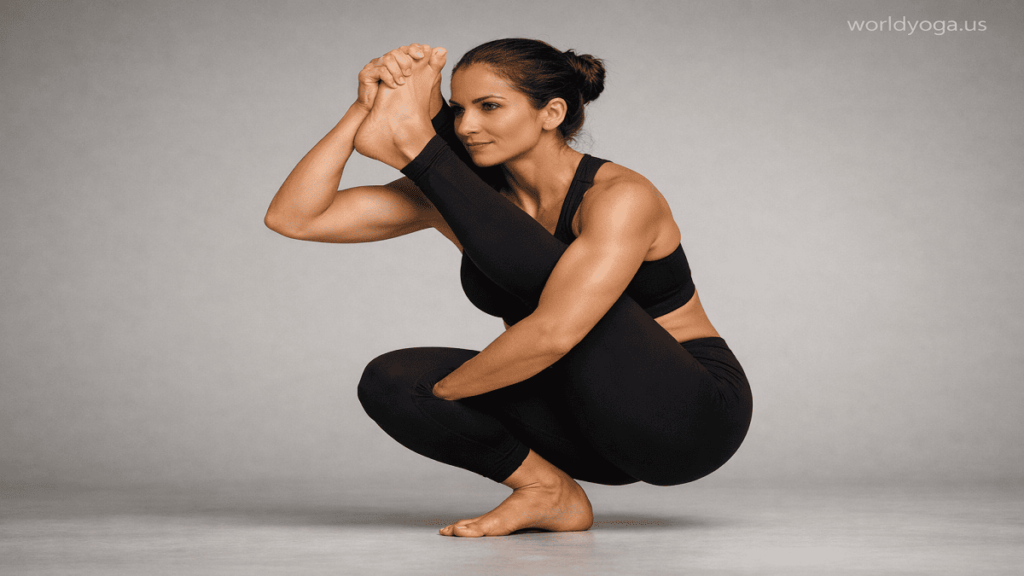
What is the proper alignment in this advanced balancing pose?
1. Supporting Leg Alignment (Foundation of Balance)
The standing leg is the entire base of the posture:
- Foot is grounded in a tripod structure (heel, base of big toe, base of little toe evenly loaded)
- Knee tracks directly over the second or third toe (no inward collapse or outward flare)
- Shin remains stable in deep flexion without wobbling
- Hip of the supporting side stays engaged and lifted, not dropped
This structure is essentially a controlled deep squat foundation similar to Malasana (Garland Pose):
Yoga Journal – Garland Pose Alignment Principles
2. Pelvic Alignment (Most Critical Control Point)
The pelvis must remain as neutral and controlled as possible:
- Hips are kept level and square to the front
- No excessive tilt toward the lifted leg side
- Core lightly engages to prevent pelvic collapse
- Tailbone stays neutral (not aggressively tucked or arched)
If the pelvis shifts significantly, it indicates loss of hip control and increases knee and lumbar stress.
3. Lifted Leg Alignment (Hip-Driven Pathway)
The raised leg follows strict hip mechanics:
- Movement originates from the hip joint only
- Femur moves into controlled flexion + external rotation
- Knee remains aligned with hip (no twisting torque)
- Foot stays relaxed, not forced into rigid positioning
The key rule: if the knee feels strain, alignment is incorrect.
4. Spine Alignment (Vertical Stability Axis)
The spine must function as a controlled column:
- Cervical spine remains neutral and elongated
- Thoracic spine stays lifted (no rounding collapse)
- Lumbar spine maintains natural curve without compression
- Chest stays open without rib flare
The torso should feel stable even as the limbs move asymmetrically.
5. Head and Neck Position (Protection Zone)
Because the leg moves toward the upper body:
- Neck remains free and neutral at all times
- No compression from the leg onto the cervical spine
- Head is not used as a support or leverage point
- Gaze remains steady for balance control
Any pressure in the neck indicates unsafe execution.
6. Shoulder and Upper Body Alignment
If arms assist balance:
- Shoulders stay relaxed and away from ears
- Scapulae remain stable (not winged or collapsed)
- Upper back remains engaged but not rigid
The upper body should support balance, not compensate for lower-body instability.
7. Key Alignment Integrity Markers
The posture is correctly aligned only if:
- Weight is evenly distributed through the supporting foot
- Knee remains stable and tracks correctly
- Pelvis stays level without collapse or rotation
- Hip controls all movement of the lifted leg
- Spine remains long and neutral
- No pain is present in joints or soft tissue
Summary
Proper alignment in Eka Pada Shirsha Prapadasana is defined by controlled asymmetry with structural stability:
- The foot anchors
- The knee stabilizes
- The hip mobilizes
- The core organizes
- The spine maintains integrity
- The neck remains protected
If any segment begins compensating for another (especially knee replacing hip function), the alignment is no longer safe or correct.
#Eka Pada Shirsha Prapadasana in Delhi
Which muscles are engaged during the posture?
1. Lower body (supporting leg – primary load system)
The supporting leg carries almost the entire body weight in a deep squat position, making it the main strength driver:
- Quadriceps femoris: controls deep knee flexion and maintains squat position
- Gluteus maximus: stabilizes hip extension and prevents pelvic collapse
- Hamstrings: assist in controlling descent and stabilizing knee alignment
- Adductors (inner thigh muscles): help stabilize pelvis and prevent lateral collapse
- Calves (gastrocnemius and soleus): support ankle stability and balance
- Intrinsic foot muscles: maintain tripod foot structure for grounding
This group works isometrically and eccentrically to maintain stability under load.
2. Hip mobility muscles (lifted leg – movement system)
The lifted leg requires extreme hip control and flexibility:
- Iliopsoas: primary hip flexor lifting the leg upward
- Rectus femoris: assists in hip flexion and knee positioning
- Deep external rotators (piriformis, obturator internus/externus, gemelli, quadratus femoris): control rotation and alignment
- Adductor group: fine-tunes positioning of the lifted leg
- Tensor fasciae latae (TFL): assists in hip stabilization and flexion
These muscles must coordinate precisely to avoid transferring stress to the knee joint.
3. Core stabilizers (central control system)
The core is responsible for maintaining balance under asymmetrical load:
- Transverse abdominis: deep internal stability and pressure control
- Obliques (internal and external): resist rotation and maintain pelvic alignment
- Rectus abdominis: supports controlled trunk flexion
- Erector spinae: maintains spinal extension and upright posture
Without strong core engagement, the spine compensates excessively, increasing injury risk.
4. Spinal and postural muscles
The spine works continuously to stabilize the posture:
- Erector spinae group: maintains vertical spinal alignment
- Multifidus: fine segmental spinal stability
- Latissimus dorsi: assists in trunk control during asymmetry
- Quadratus lumborum: stabilizes pelvis and lumbar spine
These muscles prevent collapse during deep squat and leg elevation.
5. Upper body and neck muscles
If arms assist balance or positioning:
- Deltoids: shoulder stabilization
- Trapezius (upper, middle, lower): scapular control
- Rhomboids: scapular retraction and posture control
- Neck flexors and extensors: maintain cervical alignment
The neck must remain relaxed to avoid compression as the leg approaches the upper body.
6. Functional muscle chains (integrated system view)
Rather than isolated muscles, the posture relies on coordinated chains:
- Posterior chain: glutes, hamstrings, spinal erectors (stability foundation)
- Anterior hip chain: iliopsoas and quadriceps (leg lift mechanism)
- Lateral stabilizers: obliques and gluteus medius (anti-tilt control)
- Deep core cylinder: diaphragm + abdominal wall (pressure and balance regulation)
Summary
Eka Pada Shirsha Prapadasana engages nearly the entire musculoskeletal system, with dominant emphasis on:
- Hip flexors and external rotators (movement control)
- Quadriceps and glutes (supporting leg strength)
- Deep core muscles (stability under asymmetry)
- Spinal stabilizers (postural integrity)
The key biomechanical principle is that mobility comes from the hip, stability from the core, and load-bearing from the supporting leg.
#Eka Pada Shirsha Prapadasana in Ahemadabad
What preparatory poses are recommended?
Eka Pada Shirsha Prapadasana demands extreme hip flexion, deep squat endurance, unilateral stability, and controlled spinal alignment. Preparation must therefore be systematic—building mobility first, then strength, then integration. Below are the most relevant preparatory poses grouped by function.
1. Deep Squat Foundation
Malasana (Garland Pose)
This is the most essential base for the posture. It develops deep knee flexion, ankle dorsiflexion, and hip mobility in a stable position.
- Builds tolerance for long-duration deep squats
- Trains upright spine under low-center-of-gravity load
- Prepares knee tracking and foot stability
Reference:
Yoga Journal – Garland Pose Guide
2. Hip Opening and External Rotation
Baddha Konasana (Bound Angle Pose)
Improves controlled external rotation of the hips and groin flexibility.
Upavistha Konasana (Wide-Angle Seated Forward Bend)
Develops adductor length and pelvic openness required for extreme leg elevation.
Ananda Balasana (Happy Baby Pose)
Helps decompress hips and lower back while safely exploring deep hip flexion.
These poses prepare the hip joint to move independently without stressing the knee.
3. Leg Behind Head Preparation Progressions
Ardha Padmasana (Half Lotus Pose)
Teaches controlled hip external rotation without knee torque.
Supta Kurmasana Preparations (Sleeping Tortoise variations)
Develops progressive shoulder-to-hip coordination for leg positioning.
Eka Pada Sirsasana Progressions (Foot-to-Shoulder drills)
Builds gradual ability to bring the leg toward the upper body safely.
Reference hip mechanics:
Yoga Basics – Half Lotus Pose
4. Single-Leg Strength and Balance
Virabhadrasana III (Warrior III)
Develops hip stability and balance on one leg.
Utkatasana (Chair Pose)
Builds quadriceps endurance for deep squat control.
Bakasana (Crow Pose)
Improves core engagement and forward weight control in squat-like positions.
5. Core Stability Training
Plank Pose (Phalakasana)
Strengthens deep core stabilizers required for asymmetry control.
Navasana (Boat Pose)
Develops abdominal strength for upright posture under load.
Side Plank (Vasisthasana)
Trains anti-rotation control, critical for uneven hip positions.
6. Spine and Shoulder Preparation
Bhujangasana (Cobra Pose)
Opens thoracic spine and builds controlled spinal extension.
Gomukhasana (Cow Face Pose)
Improves shoulder internal rotation for eventual binding patterns.
Garudasana Arms (Eagle Arms Variation)
Enhances scapular stability and upper-back control.
7. Integrated Control Drills
Before attempting the full posture, the practitioner should be able to:
- Hold a deep squat comfortably (Malasana)
- Maintain balance in single-leg stance (Warrior III)
- Lift the leg without knee strain (Half Lotus progressions)
- Keep core stable under asymmetry (plank variations)
- Maintain shoulder mobility without pain (Gomukhasana)
Key Principle
Preparation should follow a strict progression:
Mobility → Stability → Strength → Integration
Summary
Recommended preparatory poses include:
- Malasana (deep squat foundation)
- Baddha Konasana & Upavistha Konasana (hip opening)
- Half Lotus variations (hip rotation control)
- Warrior III & Chair Pose (single-leg strength)
- Plank & Boat Pose (core stability)
- Cow Face & Cobra Pose (shoulder and spine mobility)
Together, these build the structural capacity required for safe progression into Eka Pada Shirsha Prapadasana while minimizing knee, hip, and spinal risk.
#Eka Pada Shirsha Prapadasana in Hyderabad
What are the benefits and precautions of this pose?
Benefits
1. Extreme Hip Mobility and Joint Awareness
This posture develops advanced control over hip flexion, external rotation, and abduction. Over time, it improves how the femur moves within the hip socket, increasing joint awareness and reducing stiffness in deep ranges (when trained safely and progressively).
A reference for hip-opening mechanics:
Yoga Basics – Hip Opening Principles
2. Unilateral Lower Body Strength
The supporting leg works in a deep squat under full bodyweight, strengthening:
- Quadriceps (knee control in deep flexion)
- Gluteus maximus (hip stabilization)
- Hamstrings (eccentric control)
- Calves and foot stabilizers (balance support)
This improves single-leg strength and functional stability in asymmetrical movement patterns.
3. Core Stability Under Asymmetry
The posture forces continuous engagement of deep stabilizers:
- Transverse abdominis for internal pressure control
- Obliques for anti-rotation stability
- Erector spinae for spinal alignment
This improves the ability to maintain posture under unstable or uneven load conditions.
4. Neuromuscular Coordination and Balance
Because the body must manage deep squat loading while simultaneously controlling a highly mobile limb, the nervous system adapts by improving:
- Proprioception (body awareness in space)
- Motor control in extreme ranges
- Balance under asymmetrical stress
5. Functional Mobility Transfer
When properly trained, the movement supports better performance in:
- Athletic directional changes
- Martial arts kicking control
- Dance and acrobatic transitions
- Advanced bodyweight movement systems
Precautions
1. High Knee Injury Risk
The most significant risk is to the supporting and lifted knee. If hip mobility is insufficient, the knee may absorb rotational force instead of the hip, leading to ligament strain or long-term joint stress.
Key rule: rotation must originate from the hip, not the knee.
2. Hip Impingement and Compression
Forcing the leg into extreme flexion or behind-the-head positioning can cause femoroacetabular impingement or deep joint compression, especially if structural hip mobility is limited.
3. Lower Back Strain
Without strong core engagement, the spine may compensate through rounding or overextension, increasing lumbar stress in deep squat positions.
4. Neck and Cervical Stress
If the leg is forced near the head, pressure may transfer to the cervical spine. The neck must remain neutral and should never act as a support structure.
5. Ankle and Balance Overload
The supporting ankle is under continuous load in deep dorsiflexion. Limited ankle mobility can shift stress upward into the knee or hip.
Safety Guidelines
- Never force end-range leg positioning
- Progress gradually through hip-opening and squat training
- Maintain even weight distribution through the supporting foot
- Keep spine long and stable throughout
- Stop immediately if pain occurs in any joint
Summary
This posture offers benefits in hip mobility, unilateral strength, core stability, and neuromuscular coordination, but only when approached progressively. The primary risks involve knee stress, hip compression, spinal overload, and cervical strain, making careful preparation and controlled progression essential for safe practice.
#Eka Pada Shirsha Prapadasana in Kolkata
Case Study of Eka Pada Shirsha Prapadasana
1. Background
This case study examines a 34-year-old advanced movement practitioner with a background in yoga, calisthenics, and mobility training (7+ years of consistent practice). The primary objective was not immediate attainment of Eka Pada Shirsha Prapadasana, but structured progression toward extreme hip mobility, unilateral squat strength, and controlled leg-to-upper-body integration.
Initial screening showed strong foundational strength in deep squats and balance work, but moderate limitations in:
- End-range hip external rotation (right hip tighter than left)
- Sustained deep squat endurance
- Controlled leg elevation without lumbar compensation
2. Baseline Movement Assessment
Key observations included:
- Stable Malasana (deep squat hold ~45–60 seconds)
- Good single-leg balance (Warrior III variation maintained ~20 seconds)
- Limited ability to maintain neutral spine during deep asymmetrical loading
- Early hip-knee compensation patterns during leg lift attempts
Deep squat foundation reference:
Yoga Journal – Garland Pose Alignment
No pain was reported, but movement screening indicated high risk of knee and lumbar compensation under progression pressure.
3. Training Intervention (10–12 Weeks)
The intervention was divided into structured phases:
Phase 1: Mobility Expansion
Focus on unlocking hip range safely:
- Baddha Konasana (external rotation control)
- Happy Baby Pose (hip decompression)
- Assisted deep squat holds (support at wall)
Phase 2: Strength and Stability
Development of structural control:
- Chair Pose (Utkatasana) for quad endurance
- Plank variations for core stability
- Single-leg balance drills (slow transitions)
Phase 3: Hip Isolation and Control
Targeted end-range training:
- Half Lotus progressions
- Controlled knee-to-chest lifts
- Slow eccentric hip flexion drills
Hip mechanics reference:
Yoga Basics – Half Lotus Pose Guide
Phase 4: Integration Attempts
- Assisted one-leg squat transitions
- Partial leg elevation toward shoulder line
- Wall-supported balance in deep squat
- Strict range limitation (no forcing behind-head position)
4. Observations During Progression
By week 6:
- Improved squat depth stability and reduced ankle compensation
- Increased hip control in left side significantly
- Better core engagement during asymmetrical load
By week 12:
- Able to maintain stable one-leg squat for short durations
- Controlled leg elevation to mid-torso level achieved
- However, behind-the-head placement remained unsafe due to hip asymmetry and end-range restriction
5. Risk Events and Corrections
Two major risk patterns were identified and corrected:
- Knee torque during aggressive leg lift attempts
- Corrected through reduced range and hip-first cueing
- Lumbar rounding under fatigue in squat position
- Addressed with shorter holds and core bracing drills
No injuries occurred due to strict regression protocol enforcement.
6. Outcome Summary
The practitioner achieved:
- Significant improvement in hip mobility and squat control
- Enhanced neuromuscular coordination under asymmetry
- Stronger core stability in deep squat positions
- Partial but controlled leg elevation capacity
However, full expression of Eka Pada Shirsha Prapadasana was not achieved safely within the timeframe.
7. Key Insights
- Hip mobility asymmetry is the primary limiting factor
- Strength alone does not compensate for end-range joint restriction
- Knee safety depends entirely on hip control
- Progress must prioritize control over depth or expression
8. Conclusion
This case demonstrates that Eka Pada Shirsha Prapadasana is not a target pose but a long-term adaptive process. Safe development requires layered progression through mobility, stability, and integration phases. Attempting full expression without structural readiness significantly increases risk without improving functional outcome.
#Eka Pada Shirsha Prapadasana in Banglore

White Paper of Eka Pada Shirsha Prapadasana
1. Abstract
Eka Pada Shirsha Prapadasana is an advanced movement archetype combining deep unilateral squatting, extreme hip flexion, and controlled end-range lower-limb positioning near the upper torso or head region. This white paper examines its biomechanical structure, neuromuscular demands, progression model, risk profile, and functional applications. It is not a standardized therapeutic posture, but a high-complexity human movement system used primarily in advanced mobility training and performance conditioning contexts.
2. Movement Definition and Classification
This movement integrates three core domains:
- Deep squat mechanics (Malasana-based loading structure)
- Unilateral strength under full bodyweight
- Extreme hip flexion and external rotation control
The movement should be classified as a high-risk, high-control mobility-strength integration pattern, not a beginner or intermediate exercise.
Reference squat foundation mechanics:
Yoga Journal – Garland Pose Alignment
3. Biomechanical Structure
3.1 Hip Joint (Primary Driver)
The hip is responsible for:
- Deep flexion under load
- External rotation control
- Stabilization of femoral head within the acetabulum
This joint must remain the exclusive initiator of movement.
3.2 Knee Joint (Secondary Stabilizer)
The knee acts as a hinge under:
- Deep flexion load
- High compressive force
- Valgus risk under poor hip control
Incorrect hip mechanics result in knee overload.
3.3 Ankle Complex
The ankle provides:
- Dorsiflexion capacity for squat depth
- Micro-adjustments for balance
- Load distribution through foot tripod structure
4. Muscular Activation Framework
Supporting Leg System
- Quadriceps femoris (eccentric squat control)
- Gluteus maximus (hip stabilization)
- Hamstrings (load modulation)
- Calves and intrinsic foot muscles (balance support)
Lifted Leg System
- Iliopsoas (primary hip flexor)
- Rectus femoris (assistive flexion)
- Deep external rotators (piriformis, obturators, gemelli)
- Adductor group (fine control and stabilization)
Core and Spine System
- Transverse abdominis (pressure regulation)
- Obliques (anti-rotation stability)
- Erector spinae (postural integrity)
5. Neuromuscular Adaptations
Long-term structured training may result in:
- Increased hip flexion and external rotation capacity
- Enhanced unilateral strength endurance
- Improved proprioceptive accuracy under asymmetry
- Greater spinal stability in deep flexion positions
- Improved inter-joint coordination across kinetic chains
6. Progression Framework
A structured development model is required:
Phase 1: Mobility Acquisition
- Malasana (deep squat tolerance)
- Hip opening sequences
Phase 2: Isolation Control
- Half Lotus variations
- Controlled hip flexion drills
Phase 3: Strength Integration
- Single-leg squat progressions
- Core stabilization training
Phase 4: Controlled Expression
- Assisted leg elevation patterns
- Partial range integration (no forced end-range)
Reference hip mobility foundation:
Yoga Basics – Half Lotus Pose
7. Risk Analysis
Primary Risks
- Knee ligament stress due to hip-knee dissociation failure
- Femoroacetabular impingement from forced hip flexion
- Lumbar overload due to spinal compensation
- Cervical compression if leg is forced near head region
- Ankle instability under deep squat fatigue
Risk Amplifiers
- Asymmetrical hip mobility
- Fatigue-induced loss of core control
- Forced progression beyond structural capacity
8. Safety and Operational Guidelines
- Movement must originate from the hip joint only
- Knee must remain a passive load-bearing hinge
- Spine must remain neutral under asymmetrical load
- No pain threshold should be crossed at any stage
- External support (wall/blocks/straps) recommended in early phases
- Progression must prioritize control over range
9. Industry Interpretation
This movement is primarily relevant to:
- Advanced mobility training systems
- Athletic performance conditioning
- Movement science and biomechanics research
- Yoga education (as a conceptual limit case, not a standard pose)
- Rehabilitation screening for hip-knee dissociation issues
10. Conclusion
Eka Pada Shirsha Prapadasana represents an extreme expression of human mobility capacity rather than a conventional posture. Its value lies in its role as a benchmark movement model for integrated strength, flexibility, and control systems. Safe development depends entirely on progressive loading, hip-first mechanics, and strict avoidance of forced end-range positioning.
#Eka Pada Shirsha Prapadasana in Pune
Industry Application of Eka Pada Shirsha Prapadasana
1. Fitness and Strength Training Industry
In elite fitness and functional training, this movement is broken down into components rather than practiced as a full pose. Its applications include:
- Assessing deep squat capacity under unilateral load
- Evaluating hip flexion and external rotation limits
- Training single-leg strength and balance under instability
- Developing advanced mobility control systems for athletes
Coaches often use its progression model (squat → hip mobility → integration) to design safer training protocols rather than teaching the final expression.
A foundational squat reference used in such programming:
Yoga Journal – Garland Pose Alignment
2. Physiotherapy and Rehabilitation Science
In rehabilitation settings, this movement is not prescribed but used as a screening and diagnostic reference pattern.
Key applications:
- Identifying hip-knee dissociation failure (common in ACL rehab contexts)
- Detecting asymmetry in hip external rotation and flexion
- Assessing lumbar compensation under deep flexion load
- Evaluating readiness for advanced functional loading
Therapists focus on safe regressions of the movement pattern rather than full execution.
3. Sports Performance and Athletic Conditioning
In sports science, this movement informs training for disciplines requiring extreme mobility and control:
- Martial arts (kicking and grappling range control)
- Gymnastics and acrobatics (balance under asymmetry)
- Dance and performance arts (end-range control)
- Combat sports (hip-driven explosive movement efficiency)
Athletes do not perform the full posture but train its components for performance transfer.
4. Yoga Education and Teacher Training
Within advanced yoga systems, this posture is treated as a limit-case educational model rather than a standard asana.
Applications include:
- Teaching safe progression from Malasana → Half Lotus → advanced leg-behind-head patterns
- Demonstrating risks of forcing knee-based rotation instead of hip-driven motion
- Training instructors in injury prevention and regression design
- Clarifying the difference between flexibility and controlled mobility
Reference for hip safety principles:
Yoga Basics – Half Lotus Pose Safety
5. Biomechanics and Movement Research
In academic and applied biomechanics, this movement is used as a high-complexity model system for studying:
- Load distribution across hip–knee–ankle chains
- Torque transfer in asymmetrical deep flexion
- Stability requirements in extreme ranges of motion
- Neuromuscular coordination under combined mobility-strength demand
It is especially useful in modeling human movement limits and joint interaction behavior.
6. Human Performance and Mind-Body Systems
In performance psychology and somatic training systems, the movement supports:
- Proprioceptive refinement under instability
- Cognitive control during complex movement sequencing
- Breath regulation under physical stress
- Emotional control in end-range discomfort zones
Conclusion
The Eka Pada Shirsha Prapadasana has no direct mainstream application as a full posture, but its value is significant across industries as a composite model of extreme mobility, strength, and control. It informs training design, injury prevention strategies, athletic conditioning, and biomechanical research by representing the upper threshold of coordinated human movement capacity.
#Eka Pada Shirsha Prapadasana in Mumbai
Ask FAQs
Is Eka Pada Shirsha Prapadasana suitable for beginners?
No. This is an advanced movement pattern that requires significant preparation in deep squatting, hip mobility, balance, and core strength. Beginners should first master foundational poses like Malasana (Garland Pose) and basic hip-opening sequences before attempting any progression toward leg-behind-head variations.
What is the main purpose of this posture?
The primary purpose is not aesthetic performance but developing extreme hip mobility, unilateral strength, and neuromuscular control under asymmetrical load. It is often used as a progression benchmark in advanced mobility systems rather than a standard practice pose.
What is the biggest risk in performing this pose?
The highest risk is knee injury caused by improper hip mechanics. If the hip lacks sufficient mobility, the knee may compensate during rotation or leg lifting, leading to ligament strain. Additional risks include hip impingement, lower back stress, and cervical strain.
What are the key benefits of training toward this movement?
When trained progressively and safely, it can improve:
Deep hip mobility and control
Unilateral leg strength and stability
Core activation under asymmetry
Balance and proprioception
Coordination across multiple joint systems
However, these benefits come from progressive training, not forced final positioning.
How long does it take to safely progress toward this posture?
There is no fixed timeline. Progress depends on individual factors such as hip structure, mobility history, strength level, and training consistency. For most practitioners, safe progression typically requires months to years of structured mobility and strength work, with gradual exposure to end-range positions.
Table of Contents
Disclaimer: Eka Pada Shirsha Prapadasana is an advanced movement with a high risk of injury if attempted without proper preparation. It should only be practiced under qualified guidance after developing adequate strength, mobility, and control. Avoid forcing any position and discontinue immediately if pain or joint strain occurs.