
Ardha Navasana
Ardha Navasana is a foundational core-strengthening posture in yoga that emphasizes abdominal control, spinal stability, and balance. Derived from Sanskrit, “Ardha” means half, and “Navasana” means boat pose, symbolizing the body’s shape as a partially lifted boat floating on water. It is widely practiced in modern yoga systems such as Hatha Yoga and Ashtanga Yoga as a preparatory posture for full Boat Pose.
Understanding the Pose
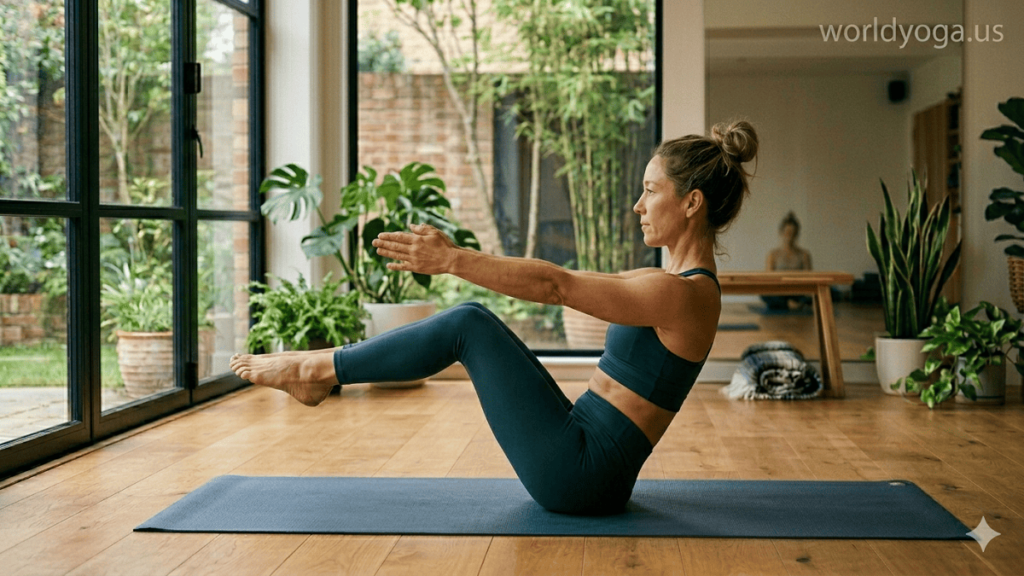
Ardha Navasana focuses primarily on activating the abdominal muscles while maintaining a stable spine. In this posture, the practitioner balances on the sit bones, with the torso slightly reclined and the legs lifted at an angle. The arms typically extend forward or rest alongside the legs depending on the variation and difficulty level.
Unlike full Boat Pose, Ardha Navasana keeps the body at a lower angle, making it more accessible for beginners while still delivering significant core engagement.
How to Perform Ardha Navasana
To practice safely, begin seated on a yoga mat with knees bent and feet flat on the ground. Engage your core muscles and slowly lean back while lifting your feet off the floor. Keep your spine long rather than rounded. Extend your arms forward parallel to the floor or hold the backs of your thighs for support if needed. Hold the position while maintaining steady breathing.
A key principle is controlled breathing and avoiding strain in the lower back or neck. Movements should be slow and deliberate to maintain stability.
Benefits of Ardha Navasana
Ardha Navasana provides multiple physical benefits, especially for core development and postural strength. It strengthens the rectus abdominis, hip flexors, and lower back muscles. Regular practice improves digestion by stimulating abdominal organs and enhances balance and coordination.
It is also beneficial for improving posture, particularly for individuals who sit for long hours, as it activates deep stabilizing muscles of the spine. Additionally, it prepares the body for advanced core poses by gradually building endurance.
Precautions and Common Mistakes
Practitioners with lower back pain, hernia, or recent abdominal surgery should avoid or modify this pose. Common mistakes include rounding the spine excessively, holding the breath, or lifting the legs too high too soon, which can strain the hip flexors.
Using props such as yoga straps or practicing near a wall for support can make the pose more accessible for beginners.
Conclusion
Ardha Navasana is a highly effective posture for developing core strength, stability, and body awareness. When practiced consistently and with proper alignment, it becomes a valuable foundation for more advanced yoga practices.
For further reading on yoga alignment and core strengthening practices, you can explore:
#Ardha Navasana in India
How is Ardha Navasana performed correctly?
Ardha Navasana is performed correctly when the practitioner maintains a balance between core engagement, spinal alignment, and controlled breathing. Although it looks simple, precision is essential to avoid strain on the lower back and hip flexors while maximizing abdominal activation.
Step-by-step correct performance
Begin by sitting on a yoga mat with your legs extended straight in front of you. Place your hands beside your hips, fingers pointing forward, and sit tall on your sit bones. This initial alignment is important because collapsing the spine at the start makes the rest of the pose unstable.
Next, bend your knees and place your feet flat on the floor. Engage your abdominal muscles by drawing the navel gently toward the spine. This activation protects the lower back as you transition into the posture.
Slowly lean your torso back while maintaining a long spine rather than rounding it. As you recline, lift your feet off the ground so that your shins become parallel to the floor. This is the key position of Ardha Navasana—half boat shape.
Extend your arms forward at shoulder height, palms facing each other. The arms should be active but not tense. Your chest remains open, and your shoulders should stay relaxed rather than hunched.
Hold the posture while breathing steadily through the nose. The breath should remain smooth and controlled, even though the abdominal muscles are working intensely. Ideally, maintain the position for 10–30 seconds depending on your strength, gradually increasing duration with practice.
Key alignment principles
Correct performance depends on three main alignment points:
First, the spine must stay long and neutral, not rounded. Second, the core must remain continuously engaged to support the lower back. Third, the legs should be lifted without excessive tension in the hip flexors.
Avoid lifting the legs too high or lowering the torso too far, as both can disrupt balance and strain the lower back.
Common mistakes to avoid
Many beginners round their back excessively or hold their breath, which reduces stability and increases risk of discomfort. Another common mistake is using momentum to lift the legs instead of controlled muscle engagement. The pose should always feel steady, not jerky.
If maintaining balance is difficult, hands can be placed behind the thighs for support until core strength improves.
Benefits of correct execution
When performed properly, Ardha Navasana strengthens the abdominal muscles, improves posture, enhances digestion, and builds endurance for advanced core-based yoga postures. It also improves body awareness and coordination.
Helpful resources
#Ardha Navasana in Maharashtra

What is the proper alignment in Half Boat Pose?
Proper alignment in Ardha Navasana is essential for building core strength safely while protecting the lower back and maintaining balance. Unlike more dynamic yoga poses, Half Boat Pose is highly dependent on precision—small adjustments in spine, legs, and shoulders significantly affect both effectiveness and safety.
Spinal alignment
The foundation of correct alignment begins with the spine. The practitioner should maintain a long, neutral spine rather than rounding the back or collapsing the chest. The torso is slightly reclined, but the chest remains open and lifted. The goal is to create a controlled “V” shape between the torso and thighs without compressing the lumbar region.
The lower back should feel supported by active abdominal engagement. If the spine begins to round excessively, it indicates that the core is not sufficiently engaged or the body has leaned back too far.
Pelvic positioning
Proper pelvic alignment is often overlooked but crucial. The pelvis should rest on the sit bones, not roll backward onto the sacrum. A slight anterior tilt helps maintain spinal length. This alignment ensures that the abdominal muscles—not the spine—bear the load of the posture.
Leg alignment
The legs are lifted with knees bent and shins parallel to the floor. Feet should remain relaxed but active, not pointed rigidly. The thighs should not collapse inward or drift outward; instead, they should stay aligned with the hips. Overextending the legs or straightening them too early can strain the hip flexors and disrupt balance.
Arm positioning
Arms are extended forward at shoulder height, parallel to the floor, with palms facing inward. The shoulders must stay relaxed and away from the ears. Excess tension in the neck or shoulders is a sign of improper alignment. The arms act as a counterbalance to the lifted legs and torso, helping stabilize the posture.
Core engagement
Core activation is central to correct alignment. The abdominal muscles should be gently drawn inward toward the spine throughout the pose. This engagement stabilizes the torso and prevents collapsing in the lower back. However, the engagement should be controlled—not forced or held with tension that restricts breathing.
Breath and stability
Proper alignment also depends on breath control. The breath should remain steady and even, without strain or breath-holding. If breathing becomes shallow, it usually indicates misalignment or excessive effort.
Common alignment mistakes
Common errors include rounding the spine, lifting the legs too high, locking the shoulders, or leaning too far back. These mistakes reduce core efficiency and increase the risk of discomfort in the lumbar region.
Conclusion
Correct alignment in Half Boat Pose is a balance between stability and ease. The posture should feel active yet controlled, with the spine elongated, core engaged, legs aligned, and shoulders relaxed.
For further study on yoga alignment principles and core-focused postures, refer to:
#Ardha Navasana in Ahemadabad
Which muscles are engaged during the pose?
In Ardha Navasana, multiple muscle groups work together to stabilize the body, maintain balance, and support controlled movement. Although the pose is often described as a core exercise, it actually involves coordinated activation of the abdomen, hip flexors, spine stabilizers, and supporting muscles of the legs and upper body.
Primary muscles engaged
The most active muscle group in Half Boat Pose is the abdominal region. The rectus abdominis, commonly known as the “six-pack” muscles, is strongly engaged to flex the torso and hold the body in a semi-reclined position. Alongside this, the transverse abdominis plays a crucial stabilizing role by drawing the abdominal wall inward and supporting spinal integrity. The internal and external obliques assist in maintaining balance and preventing unwanted side-to-side movement.
These core muscles work isometrically, meaning they contract without changing length, to hold the posture steady rather than producing dynamic movement.
Hip flexors
The hip flexors are another major muscle group involved in Ardha Navasana. The iliopsoas (psoas major and iliacus) is particularly active as it lifts and supports the legs in a bent position. The rectus femoris, part of the quadriceps group, also contributes to maintaining the lifted shin position. These muscles often feel intense engagement, especially for beginners, as they are not commonly strengthened in daily activities.
Spinal stabilizers
The erector spinae muscles along the spine are engaged to maintain an elongated, neutral back position. While the abdominal muscles create forward flexion, the spinal extensors provide counterbalance, ensuring the torso does not collapse. This balance between front and back body engagement is essential for safe execution of the pose.
Lower body muscles
Although the legs are not actively moving, the quadriceps remain engaged to keep the knees stable and shins lifted parallel to the floor. The adductors (inner thigh muscles) assist in maintaining alignment and preventing the legs from drifting outward. Even the calf muscles may activate slightly to support overall leg tension.
Upper body involvement
The deltoids in the shoulders and the muscles of the upper back, including the trapezius and serratus anterior, are engaged when the arms are extended forward. These muscles help stabilize the shoulder girdle and maintain arm position without collapsing the chest. Proper engagement ensures that the upper body contributes to balance rather than creating unnecessary strain.
Breathing muscles
The diaphragm and intercostal muscles also play an important role. Since the core is actively engaged, breathing becomes more controlled and requires deeper engagement of respiratory muscles. Maintaining steady breath helps prevent excessive tension in the abdominal region.
Functional benefit of muscle engagement
The coordinated activation of these muscle groups makes Ardha Navasana an effective posture for improving core endurance, posture, and functional strength. It trains the body to stabilize under load, which translates into better balance and spinal support in daily movement.
Conclusion
Half Boat Pose is not just an abdominal exercise; it is a full-body stabilization posture. The abdomen, hip flexors, spinal muscles, and supporting limb muscles all work together to create controlled balance and strength.
For further reference on yoga anatomy and muscle engagement in core poses, you can explore:
#Ardha Navasana in Hyderabad
What preparatory poses help build strength for Ardha Navasana?
Building strength for Ardha Navasana requires progressive conditioning of the core, hip flexors, and spinal stabilizers. Since Half Boat Pose demands sustained abdominal engagement and balance on the sit bones, preparatory poses focus on gradually developing endurance, alignment awareness, and controlled lifting of the legs and torso.
1. Supta Baddha Konasana (Reclined Bound Angle Pose)
This gentle supine posture helps activate deep core awareness while keeping the spine supported. Although it is primarily restorative, it introduces practitioners to abdominal engagement without strain. It also opens the hips, which is helpful for later hip flexor activation required in Ardha Navasana.
2. Apanasana (Knees-to-Chest Pose)
Apanasana is one of the most effective preparatory poses for core activation. By drawing the knees toward the chest, the abdominal muscles are gently compressed and strengthened. This helps develop awareness of engaging the transverse abdominis and rectus abdominis, which are essential for maintaining stability in Half Boat Pose.
3. Setu Bandhasana (Bridge Pose)
Setu Bandhasana strengthens the posterior chain, including the lower back, glutes, and hamstrings. While Ardha Navasana is front-body dominant, a strong back body is necessary for balance. Bridge Pose also improves pelvic control, which is critical for maintaining proper alignment on the sit bones.
4. Phalakasana (Plank Pose)
Phalakasana is one of the most direct strength-building poses for Ardha Navasana. It trains full-core engagement under static load, strengthening the rectus abdominis, transverse abdominis, shoulders, and spinal stabilizers. Plank also builds endurance, which is essential for holding Half Boat Pose without collapsing.
5. Ardha Navasana variations (supported versions)
Practicing modified versions of Ardha Navasana itself is a key preparatory step. Keeping hands behind the thighs or lightly touching the floor helps reduce load while still training core engagement. Gradually lifting one leg at a time can also build progressive strength and coordination.
6. Navasana (Boat Pose progression)
Navasana is the advanced progression of Ardha Navasana. Even brief holds in full Boat Pose significantly strengthen hip flexors and abdominal muscles. Practicing it in short intervals helps bridge the gap between beginner and intermediate core strength.
7. Viparita Karani (Legs-Up-the-Wall Pose)
Viparita Karani supports recovery while gently engaging core awareness. It helps reduce lower back tension and improves circulation in the legs, which is beneficial for maintaining endurance during core-focused sequences.
Conclusion
A well-structured preparation for Ardha Navasana combines gentle core activation, progressive strengthening, and spinal support work. Poses like Apanasana, Plank, and Bridge collectively build the stability required to hold Half Boat Pose safely and effectively.
For additional guidance on yoga sequencing and core preparation, you can explore:
#Ardha Navasana in Pune
What are the benefits and precautions of practicing this pose?
Practicing Ardha Navasana offers a combination of physical strengthening, postural improvement, and core stabilization benefits, but it also requires careful attention to alignment and safety due to the intensity of abdominal engagement and spinal load.
Benefits of Ardha Navasana
One of the primary benefits of Half Boat Pose is deep core strengthening. The rectus abdominis, transverse abdominis, and obliques are all actively engaged, helping build abdominal endurance and stability. This makes the pose especially useful for improving functional strength used in daily movements such as bending, lifting, and maintaining posture.
The pose also significantly strengthens the hip flexors, particularly the iliopsoas and rectus femoris. This improves lower-body control and supports better coordination between the torso and legs.
Another important benefit is spinal stability and posture improvement. By training the muscles that support the spine, Ardha Navasana helps reduce slouching and encourages a more upright posture, especially for individuals who spend long hours sitting.
The pose also contributes to better digestive stimulation. The compression of the abdominal region can gently stimulate internal organs, which may support improved digestion and metabolic activity over time.
Additionally, Ardha Navasana enhances balance and body awareness. Because it requires controlled engagement on the sit bones, practitioners develop a stronger sense of alignment and proprioception.
Finally, it serves as a preparatory posture for advanced core work, including full Boat Pose and arm balances, by gradually building endurance and control.
Precautions for Practicing Ardha Navasana
Despite its benefits, this pose should be practiced with caution, especially for beginners or individuals with certain health conditions.
People with lower back pain, slipped disc, or spinal injuries should avoid or modify the pose, as incorrect alignment can increase pressure on the lumbar spine.
Those with hernia or recent abdominal surgery should also avoid it, since the strong abdominal engagement may strain healing tissues.
A common risk is rounding the lower back excessively. This usually happens when core strength is insufficient or when the practitioner leans back too far. Proper engagement of the abdominal muscles and maintaining a long spine is essential to prevent strain.
Another precaution involves the neck and shoulders. Lifting the chest while tensing the shoulders or holding breath can create unnecessary tension. The upper body should remain relaxed while the core does the primary work.
Beginners should avoid overextending the legs too quickly. Keeping knees bent is safer and more effective for gradually building strength.
Breathing is also critical. Holding the breath during the posture reduces oxygen flow and increases muscular tension, making the pose harder and less stable. Steady nasal breathing is recommended throughout.
Conclusion
Ardha Navasana is a highly effective core-strengthening posture that improves stability, posture, and functional strength. However, it must be practiced with correct alignment, controlled breathing, and appropriate modifications when needed to avoid strain and ensure long-term benefits.
For further reading on yoga safety and core-strengthening practices, you can refer to:
#Ardha Navasana in Banglore
Case Study of Ardha Navasana
Ardha Navasana is widely used in yoga-based conditioning programs to develop core stability, spinal control, and hip flexor strength. This case study presents an observational analysis of how consistent practice of Half Boat Pose influenced core endurance and postural alignment in a beginner-level yoga practitioner over a structured training period.
Subject Profile and Initial Assessment
The subject was a 29-year-old office worker with a sedentary lifestyle and no prior structured core training. Initial assessment indicated weak abdominal endurance, frequent lower back fatigue during prolonged sitting, and limited hip flexor control. The subject was unable to hold Ardha Navasana for more than 5–7 seconds without loss of spinal alignment or breath control.
Intervention Protocol
A six-week progressive yoga intervention was designed, focusing on gradual adaptation to Half Boat Pose. The training schedule included:
- Preparatory poses such as Plank Pose and Apanasana for foundational core activation
- Modified Ardha Navasana holds with knees bent and hands supporting thighs
- Gradual progression toward full unsupported holds
- Breathing synchronization training (slow nasal breathing during static holds)
Practice frequency was set at 5 days per week, with each session lasting approximately 20 minutes.
Progression and Observations
During the first two weeks, the subject struggled with maintaining a neutral spine, often collapsing into the lower back. Supportive variations were essential to prevent strain and build confidence.
By week three, noticeable improvement in core engagement was observed. The subject could maintain a bent-knee version of Ardha Navasana for 15–20 seconds while maintaining controlled breathing. Hip flexor fatigue was still present but less intense.
By week five, the subject demonstrated improved spinal stability and was able to extend the arms forward without significant loss of balance. Duration increased to approximately 30 seconds per hold.
At the end of six weeks, the subject achieved a stable 40–45 second hold in Ardha Navasana with proper alignment, including a long spine, engaged abdomen, and controlled breathing.
Outcomes
The intervention produced several measurable and functional improvements:
- Increased abdominal endurance and reduced core fatigue during daily activities
- Improved posture, particularly reduced slouching during seated work
- Enhanced awareness of pelvic alignment and spinal positioning
- Reduced lower back discomfort during prolonged sitting
The subject also reported improved body control and confidence in performing other core-based yoga postures.
Discussion
This case highlights that Ardha Navasana is an effective progressive tool for developing functional core strength when introduced systematically. The pose’s effectiveness lies in its ability to train isometric abdominal endurance while integrating hip flexor and spinal stabilizer engagement.
However, the case also emphasizes the importance of modifications in early stages. Unsupported entry into the pose without adequate preparation can lead to poor alignment patterns and lower back strain.
Conclusion
The structured practice of Ardha Navasana demonstrates significant potential for improving core strength, posture, and functional stability in beginners when combined with preparatory poses and progressive overload principles.
For additional reference on yoga-based core training and posture development:
#Ardha Navasana in Delhi
White Paper of Ardha Navasana
Ardha Navasana is a foundational isometric yoga posture used in contemporary movement science and yoga therapy to develop core stability, hip flexor strength, and postural control. This white paper examines its biomechanical principles, physiological effects, applications in training systems, and safety considerations based on established yoga methodology and functional anatomy principles.
1. Introduction
Ardha Navasana, or Half Boat Pose, is a scaled variation of full Boat Pose designed to introduce controlled spinal flexion and abdominal engagement under static load. It is widely used in yoga sequences, rehabilitation-based movement programs, and athletic conditioning due to its accessibility and progressive scalability.
The posture primarily trains the anterior kinetic chain while requiring coordinated stabilization of the posterior chain, making it a balanced isometric conditioning tool.
2. Biomechanical Overview
Ardha Navasana involves a controlled reclined sitting position where the torso forms an approximate 30–45° angle from the floor while the knees remain bent and shins elevated.
Key biomechanical actions include:
- Isometric spinal flexion maintained by abdominal musculature
- Hip flexion stabilized by iliopsoas and rectus femoris
- Spinal extension resistance provided by erector spinae
- Shoulder flexion and stabilization through deltoids and scapular stabilizers
The posture creates a closed kinetic chain between the pelvis and thorax, requiring continuous neuromuscular coordination.
3. Muscle Activation Profile
Primary muscle engagement includes:
- Rectus abdominis: primary trunk flexor and stabilizer
- Transverse abdominis: deep core compression and lumbar stabilization
- Obliques: rotational and lateral stability control
- Iliopsoas: hip flexion and leg elevation support
- Quadriceps (rectus femoris): knee and leg stabilization
- Erector spinae: spinal alignment maintenance
This coordinated activation enhances core endurance rather than maximal strength output.
4. Physiological and Functional Benefits
Regular practice of Ardha Navasana contributes to:
- Improved trunk stability and postural alignment
- Enhanced neuromuscular coordination between upper and lower body
- Increased isometric endurance of abdominal musculature
- Improved hip joint control and flexor conditioning
- Support for functional movement patterns such as lifting and bending
In therapeutic settings, it is often used as a preparatory exercise for more advanced core stabilization protocols.
5. Applications in Training Systems
Ardha Navasana is utilized in:
- Yoga-based strength development sequences
- Pilates-inspired core conditioning programs
- Athletic off-season functional training
- Rehabilitation protocols for postural correction (under supervision)
Its scalability allows modification for beginners through supported variations and progression to full Boat Pose.
6. Safety and Risk Considerations
Despite its benefits, improper execution can lead to:
- Lumbar strain due to excessive spinal rounding
- Hip flexor overloading in weak practitioners
- Cervical tension from improper shoulder engagement
Contraindications include recent abdominal surgery, untreated hernia, and acute lower back injuries. Proper regression strategies are essential in early training phases.
7. Conclusion
Ardha Navasana represents a biomechanically efficient, scalable core stabilization exercise with broad applications in yoga therapy and functional fitness. When practiced with correct alignment and progressive loading principles, it enhances core endurance, postural control, and movement efficiency.
References
- Yoga Journal – Core Strength and Boat Pose Insights
- Yoga Basics – Navasana Anatomy and Practice Guide
- NCBI – Core Stability and Trunk Muscle Function Research
#Ardha Navasana in Kolkata
Industry Application of Ardha Navasana
Ardha Navasana, commonly known as Half Boat Pose, has moved beyond traditional yoga practice and is now widely applied across multiple industries focused on physical training, rehabilitation, wellness, and performance optimization. Its value lies in its ability to train core stability, postural control, and neuromuscular coordination using minimal equipment.
1. Fitness and Strength Training Industry
In modern fitness programming, Ardha Navasana is used as a foundational core conditioning exercise. Personal trainers incorporate it into functional training circuits to improve abdominal endurance and hip flexor strength. Unlike high-impact abdominal exercises, it provides controlled isometric loading, making it suitable for beginners and intermediate trainees.
It is often included in core circuits alongside planks and dynamic leg raises to improve trunk stability and movement efficiency. Many group fitness formats, including yoga-fusion and functional HIIT classes, use it as a low-equipment core builder.
2. Yoga and Wellness Industry
In yoga studios and wellness centers, Ardha Navasana serves as a preparatory posture for advanced asanas such as full Boat Pose and arm balances. It is frequently integrated into Hatha Yoga, Vinyasa Flow, and therapeutic yoga sequences.
Wellness instructors use it to improve posture, reduce sedentary lifestyle effects, and develop body awareness. Its scalability allows instructors to modify intensity based on practitioner experience, making it a versatile teaching tool.
3. Physiotherapy and Rehabilitation
In physiotherapy settings, Ardha Navasana is used under controlled supervision for core stabilization rehabilitation programs. It helps patients rebuild abdominal strength after injury or prolonged inactivity.
It is particularly relevant in:
- Lower back rehabilitation programs
- Postural correction therapy
- Gradual reconditioning after abdominal strain
Because it can be modified easily (such as using hand support behind thighs), it is considered a safe progressive strengthening tool when appropriately prescribed.
4. Sports Performance and Athletic Training
Athletic conditioning programs use Half Boat Pose to enhance core endurance, which is critical for force transfer between upper and lower body movements. Sports such as running, football, martial arts, and gymnastics benefit from improved trunk stability developed through this posture.
It supports:
- Improved balance and coordination
- Better injury resistance in the lumbar region
- Enhanced kinetic chain efficiency during explosive movements
Strength and conditioning coaches often integrate it into warm-up or accessory core training blocks.
5. Corporate Wellness and Ergonomics
With increasing sedentary work environments, corporate wellness programs include Ardha Navasana to counteract posture-related issues such as lower back stiffness and weak core musculature.
Short guided sessions help employees activate deep core muscles, improving seated posture and reducing fatigue associated with prolonged desk work.
6. Education and Movement Training Systems
In yoga teacher training and movement education curricula, Ardha Navasana is taught as a foundational anatomy-based posture. It helps students understand core engagement mechanics, breath control, and alignment principles before progressing to advanced poses.
Conclusion
Ardha Navasana has strong cross-industry relevance due to its adaptability, low equipment requirement, and strong biomechanical benefits. From rehabilitation clinics to elite sports training environments, it serves as an effective tool for improving core stability, posture, and functional movement efficiency.
References
- Yoga Journal – Core Strength and Functional Yoga Practices
- Yoga Basics – Boat Pose Guide and Variations
- NCBI – Core Stability and Functional Movement Research
#Ardha Navasana in Mumbai
Ask FAQs
What is Ardha Navasana?
Ardha Navasana, or Half Boat Pose, is a yoga posture where the body is balanced on the sit bones with the torso slightly reclined and the legs lifted with knees bent. It is a preparatory version of full Boat Pose and primarily targets core muscles, especially the abdominal region.
What are the main benefits of practicing Ardha Navasana?
This pose strengthens the abdominal muscles, hip flexors, and lower back stabilizers. It improves posture, enhances core endurance, and supports better balance and body awareness. Regular practice can also help reduce slouching caused by prolonged sitting and improve functional movement efficiency.
Who should avoid Ardha Navasana?
Individuals with recent abdominal surgery, hernia, or serious lower back injuries should avoid this pose or practice it only under professional supervision. People with weak core strength should begin with modified versions to prevent strain on the lumbar spine and hip flexors.
What are common mistakes in Ardha Navasana?
Common mistakes include rounding the lower back, holding the breath, lifting the legs too high too quickly, and tensing the shoulders. These errors reduce stability and can increase the risk of discomfort in the lower back or neck. Maintaining a long spine and steady breathing is essential.
How long should beginners hold Ardha Navasana?
Beginners should start with short holds of about 10–15 seconds and gradually increase duration as strength improves. It is more effective to maintain correct alignment for a shorter time than to hold the pose longer with poor form. Over time, practitioners can progress to 30–60 second holds.
Table of Contents
Disclaimer: This content is for general informational and educational purposes only and is not a substitute for professional medical advice, diagnosis, or treatment. Always consult a qualified healthcare provider or certified yoga instructor before starting or modifying any exercise or yoga practice, especially if you have any pre-existing medical conditions or injuries.