
One-Legged Supported Boat Pose
One-Legged Supported Boat Pose is a modified version of the traditional Boat Pose that introduces unilateral leg extension while maintaining external or partial support to assist balance. It is derived from Navasana and is commonly used as a preparatory progression toward more advanced core balance variations such as unsupported single-leg boat poses.
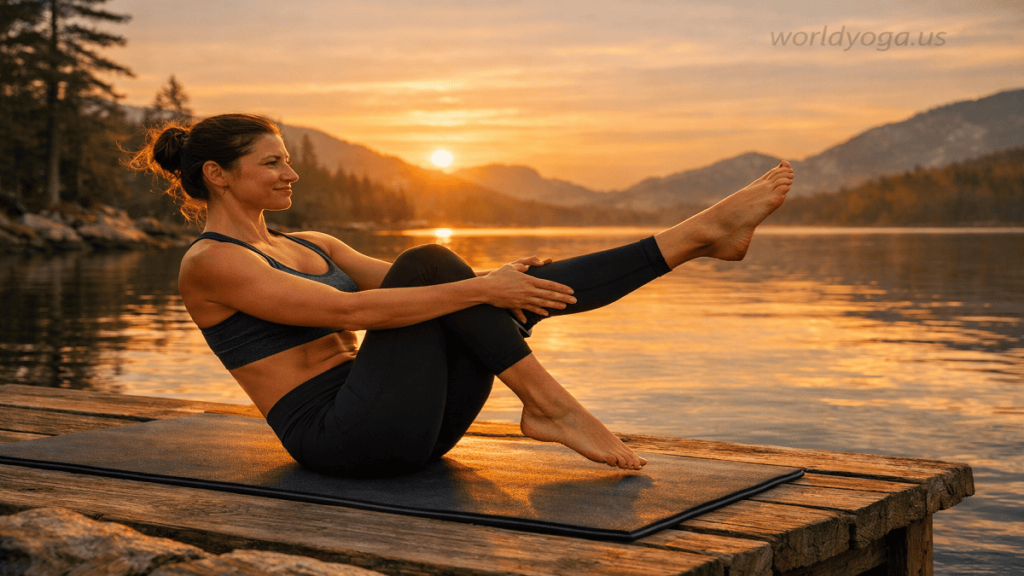
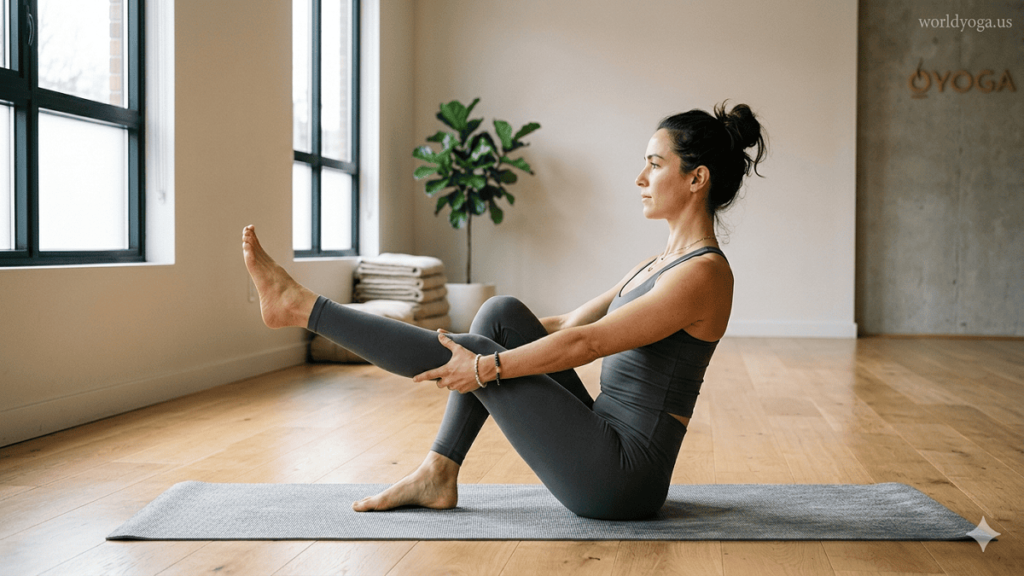
In this posture, the practitioner sits in a balanced position with the torso leaning back slightly while the core remains actively engaged. One leg is extended forward in a straight line, while the other may remain bent or lightly supported by the floor, hands, or a prop depending on the variation. This support reduces the intensity of the balance challenge while still training core activation and hip flexor engagement.
The primary focus of One-Legged Supported Boat Pose is controlled stability rather than maximal difficulty. It allows practitioners to safely develop unilateral core strength, improve pelvic alignment awareness, and gradually build endurance in the abdominal and lower back muscles. Because one leg is extended, the body must resist rotational imbalance, encouraging activation of the obliques and deep stabilizing muscles.
This pose is especially useful in foundational yoga sequencing and rehabilitation-based movement training. It helps bridge the gap between basic Boat Pose and advanced asymmetrical variations by introducing controlled instability in a safer, supported format. The support element also makes it suitable for beginners, individuals returning from injury (under supervision), One-Legged Supported Boat Pose or practitioners working on core reconditioning.
From a biomechanical perspective, the posture enhances coordination between the abdominal wall, hip flexors, and spinal stabilizers. It also improves proprioception, One-Legged Supported Boat Pose as the body learns to maintain alignment while distributing load unevenly across the pelvis.
#One-Legged Supported Boat Pose in India
How is One-Legged Supported Boat Pose performed correctly?
One-Legged Supported Boat Pose is performed by combining the foundation of Navasana with external support and a controlled single-leg extension. The goal is not to “force balance,” but to build stable core engagement while gradually introducing asymmetry in a safe and aligned way.
Step 1: Starting Position
Begin seated on the mat with the knees bent and feet flat on the floor. Sit tall on the sit bones and lengthen the spine upward. Engage the abdominal muscles gently before leaning back. This prepares the core to support the body without collapsing the lower back.
Step 2: Establish Supported Boat Base
Lean the torso slightly backward while keeping the chest open. Place the hands either on the floor beside the hips or lightly behind the thighs for support. This support is what distinguishes the posture from the fully unsupported variation.
At this stage, the spine should remain long, not rounded. The movement should come from the hips, not from collapsing the chest.
Step 3: Lift and Stabilize the Core
Engage the core muscles and begin lifting both feet slightly off the ground if possible, One-Legged Supported Boat Pose or keep one foot grounded for additional stability. The focus is on controlled engagement rather than height.
The pelvis should remain neutral, avoiding excessive backward tilting.
Step 4: Introduce Single-Leg Extension
Slowly extend one leg forward, keeping it straight and active. The opposite leg may remain bent or lightly supported depending on strength level. This is where unilateral core engagement becomes active.
The extended leg should not drop or wobble; it should stay firm with the thigh engaged and toes pointing upward.
Step 5: Upper Body and Arm Position
Maintain a long spine with the chest lifted. The arms can stay:
- Behind the thighs for support (easier variation)
- Beside the hips for moderate support
- Slightly extended forward for increased challenge
The shoulders should stay relaxed, not hunched toward the ears.
Step 6: Breath and Stability Control
Breathing should remain slow, steady, and nasal. The diaphragm works with the deep abdominal muscles to stabilize the core. If the breath becomes shallow or strained, reduce intensity or return one foot to the ground.
Key Alignment Principles
- Spine remains long and neutral
- Core stays engaged without gripping
- Hips stay level and stable
- Extended leg remains active and straight
- Shoulders stay relaxed and away from ears
Common Mistakes to Avoid
- Rounding the lower back
- Using momentum to lift or switch legs
- Over-relying on hands instead of core muscles
- Holding the breath during effort
- Collapsing the chest backward
When practiced correctly, One-Legged Supported Boat Pose builds a strong foundation for progressing toward more advanced variations of Navasana and asymmetrical core balance postures, while maintaining safety and control.
#One-Legged Supported Boat Pose in Maharashtra
What is the proper alignment in this supported asymmetrical Navasana variation?
Spine: Long, Neutral, and Actively Lifted
The spine should stay elongated from the tailbone to the crown of the head. A slight backward lean is natural, but the key is avoiding collapse in the lower back. The chest remains open and lifted rather than dropped or rounded. Think of creating length through the torso instead of compressing into a C-shape.
Pelvis: Stable and Unrotated
The pelvis is the foundation of alignment in this posture. Both sides of the hips should stay level, even when one leg extends. A common compensation is twisting or dropping one hip, which reduces core engagement and stresses the lumbar spine. The sit bones should feel evenly grounded through the initial setup, then lightly lifted in a controlled balance.
Core: Continuous Engagement, Not Gripping
The abdominal wall should stay gently activated throughout the hold. The transverse abdominis provides internal support, while the obliques prevent rotational collapse caused by the single-leg extension. The engagement should feel steady and responsive, not rigid or strained.
Legs: Active Extension and Control
The extended leg should be fully active, with the quadriceps engaged and the toes pointing upward or neutrally flexed. The bent or supported leg should remain close to the body without flaring outward. Both legs contribute to balance even when only one is extended.
Arms and Support: Functional, Not Passive
Hands placed behind the thighs or on the floor are for stability, but they should not carry the full body weight. The arms assist balance while the core remains the primary stabilizer. Shoulders stay relaxed and drawn away from the ears to prevent upper-body tension.
Chest and Shoulders: Open but Relaxed
The chest should stay lifted without over-arching the spine. Shoulder blades gently draw back and down, avoiding hunching or excessive tightening in the upper trapezius region.
Breath: Steady and Uninterrupted
Breathing should remain smooth and nasal. If the breath becomes shallow or uneven, it usually indicates loss of alignment or overuse of superficial muscles instead of deep core engagement.
Common Alignment Errors
- Collapsing the lumbar spine instead of lifting through the core
- Leaning too heavily on the hands and reducing abdominal activation
- Allowing one hip to drop during leg extension
- Tensing the neck and shoulders
- Holding the breath during effort
Summary
Correct alignment in this variation of Navasana means the spine stays long, the pelvis remains stable, the core controls the movement, and the support from the hands is minimal and functional. When these elements work together, the pose becomes a controlled strength-building posture rather than a balance struggle.
#One-Legged Supported Boat Pose in Ahemadabad
Which muscles are engaged during the pose?
Deep Core Stabilizers (Primary Control System)
The deepest layer of activation comes from the transverse abdominis, which acts like an internal corset to stabilize the spine and control abdominal pressure. The multifidus muscles along the spine support segmental alignment, helping prevent micro-instability in the lumbar region. The pelvic floor muscles also contribute by forming a stable base for intra-abdominal pressure regulation.
Global Abdominal Muscles (Trunk Control and Endurance)
The rectus abdominis maintains trunk flexion and prevents backward collapse of the torso. The internal and external obliques are especially important in this asymmetrical variation, as they resist rotational forces created when one leg extends forward. These muscles work continuously to keep the torso facing forward and the pelvis aligned.
Hip Flexors (Leg Support and Lift)
The iliopsoas and rectus femoris play a major role in holding the extended leg in position. They help lift and stabilize the leg against gravity. However, over-reliance on these muscles can reduce core engagement, so balance between hip flexors and abdominal activation is essential.
Spinal Stabilizers (Postural Support)
The erector spinae muscles provide controlled support to keep the spine elongated. In this posture, they work isometrically rather than dynamically, helping maintain posture without excessive arching or collapsing.
Shoulder and Upper Body Muscles (Support Function)
Since this is a supported variation, the deltoids, triceps, and latissimus dorsi assist by stabilizing the upper body through light contact with the floor or thighs. These muscles reduce load on the spine but should not dominate the movement.
Respiratory Muscle Integration
The diaphragm plays a key role by coordinating breath with core engagement. Proper breathing helps regulate intra-abdominal pressure, improving stability and reducing unnecessary muscular tension.
Integrated Functional Activation
What makes this posture effective is not isolated muscle use, but coordinated activation. The core prevents spinal collapse, the obliques control rotation, the hip flexors manage leg extension, and the spinal muscles maintain posture—all while the breath system stabilizes internal pressure.
In comparison to Navasana, this variation adds unilateral load, increasing oblique and pelvic stabilizer demand significantly due to asymmetry.
Summary
One-Legged Supported Boat Pose engages:
- Transverse abdominis (deep core stability)
- Rectus abdominis (trunk flexion control)
- Obliques (anti-rotation stability)
- Iliopsoas and rectus femoris (leg support)
- Erector spinae (spinal alignment)
- Shoulder stabilizers (support function)
- Diaphragm (breath-core coordination)
Together, these muscles create a controlled stability system that trains balance, core endurance, and neuromuscular coordination in a safe, supported environment.
#One-Legged Supported Boat Pose in Hyderabad
What preparatory poses are recommended before practicing it?
Foundational Core Strength Builders
The most important base posture is standard Boat Pose (Navasana). Holding it with steady breath trains the rectus abdominis and deep stabilizers to maintain a lifted spine without collapsing backward. Gradually increasing hold time improves endurance, which is essential before introducing any single-leg variation.
A key supporting preparation is Ardha Navasana. This variation targets the lower abdominal region more directly and helps correct the common weakness of “upper-abdominal dominance” seen in beginners.
Stability and Anti-Extension Training
Plank Pose is one of the most effective preparatory poses. It teaches full-core integration under load, especially the transverse abdominis and obliques, which are essential for preventing lumbar collapse in Boat Pose variations.
Side Plank variations are also valuable because they introduce anti-rotation strength. This is especially important for One-Legged Supported Boat Pose, where one side of the body is loaded differently due to the extended leg.
Hip Flexor Strength and Control
Since leg lifting depends heavily on hip flexors, preparatory poses that activate this region are essential. Low Lunge (Anjaneyasana) helps open and strengthen the iliopsoas while maintaining pelvic awareness. Supine leg raises or controlled seated leg extensions also build endurance in the hip flexors without stressing the spine.
Spinal Awareness and Mobility
Gentle spinal mobility drills such as Cat-Cow (Marjaryasana-Bitilasana) help develop awareness of neutral spine positioning. This is critical for avoiding excessive rounding or arching in supported Boat variations.
Seated balance drills—such as lifting one foot slightly off the floor while maintaining an upright spine—help train the nervous system to handle asymmetry gradually.
Breath and Core Coordination Training
Breath control is often overlooked but essential. Practicing slow nasal breathing during core holds teaches coordination between the diaphragm and abdominal muscles. This improves stability and reduces tension during effort, especially when transitioning into single-leg positions.
Progression Logic
A safe progression pathway typically looks like this:
- Navasana (baseline endurance)
- Ardha Navasana (lower abdominal activation)
- Plank Pose (full-core integration)
- Side plank and anti-rotation drills
- Controlled seated leg extensions
- One-Legged Supported Boat Pose
Conclusion
Preparation for One-Legged Supported Boat Pose is not about flexibility alone but about building layered stability. When foundational poses like Navasana and plank variations are practiced consistently, the body develops the strength, control, and awareness needed to safely support asymmetrical balance and controlled core engagement.
#One-Legged Supported Boat Pose in Delhi
What are the benefits and precautions of this variation?
Key Benefits
1. Builds Functional Core Strength
This pose strongly activates the deep abdominal system, especially the transverse abdominis and rectus abdominis. Because one leg is extended, the core must stabilize uneven load, making strength gains more functional and transferable to movement patterns like walking, running, and lifting.
2. Improves Pelvic Stability
The asymmetrical leg position trains the pelvis to remain level under imbalance. This helps improve control of the hip region and reduces tendencies toward pelvic tilt or rotational instability in daily movement.
3. Develops Oblique and Anti-Rotation Strength
The obliques work continuously to prevent twisting of the torso. This anti-rotation training is especially valuable for improving spinal control and protecting the lower back during dynamic activities.
4. Enhances Hip Flexor Endurance
The iliopsoas and rectus femoris are engaged to support the lifted or extended leg. Over time, this improves endurance in the hip flexors, which is important for posture, walking efficiency, and seated stability.
5. Safe Progression Toward Advanced Balance Poses
Because it includes support, this variation serves as a bridge toward more challenging postures like advanced Boat variations or unsupported core balances. It allows gradual neuromuscular adaptation without excessive strain.
Precautions
1. Risk of Lower Back Overload
If core engagement is weak, the lumbar spine may compensate by rounding or compressing. This can lead to discomfort, especially in practitioners with pre-existing lower back issues.
2. Overuse of Hip Flexors
A common mistake is relying too heavily on the hip flexors instead of engaging the abdominal muscles. This can lead to tightness in the front of the hips and reduced core efficiency.
3. Shoulder and Neck Tension
Using the arms excessively for support or lifting the chest too aggressively can create unnecessary tension in the shoulders and neck. Support should assist balance, not replace core engagement.
4. Loss of Alignment Due to Fatigue
As fatigue increases, practitioners may drop one hip, twist the torso, or collapse the chest. Short holds with correct form are more beneficial than longer holds with poor alignment.
5. Contraindications
This posture should be avoided or modified in cases of:
- Acute lower back pain or disc issues
- Recent abdominal surgery
- Severe hip injuries
- Pregnancy without professional guidance
Summary
The One-Legged Supported Boat Pose provides a safe and effective way to develop core strength, pelvic stability, and anti-rotation control while reducing the intensity of full balance demands. When practiced with awareness and progression from basic Navasana, it becomes a highly effective preparatory tool for advanced core balance training, provided alignment and breath control are maintained throughout.
#One-Legged Supported Boat Pose in Pune
Case Study of One-Legged Supported Boat Pose
1. Background and Objective
This case study explores the use of One-Legged Supported Boat Pose as a progressive core-conditioning tool derived from Navasana. The objective was to evaluate its effectiveness in improving core stability, pelvic control, and asymmetrical strength in intermediate yoga practitioners with inconsistent lumbar stability during dynamic movements.
The study focused on individuals transitioning from basic core training into asymmetrical balance work, with no prior exposure to advanced boat pose variations.
2. Methodology and Program Design
A structured 6-week progression model was implemented:
Phase 1: Foundational Stability (Weeks 1–2)
Participants practiced sustained Navasana holds with emphasis on neutral spine alignment and controlled breathing. Supportive cues focused on activating the transverse abdominis and avoiding lumbar rounding.
Phase 2: Controlled Support Introduction (Weeks 3–4)
The One-Legged Supported Boat Pose was introduced with hands placed behind the thighs or lightly on the floor. Participants alternated leg extensions while maintaining pelvic alignment.
Phase 3: Stability Under Asymmetry (Weeks 5–6)
Hold durations were increased gradually. The focus shifted to minimizing reliance on the hands while maintaining stable hip alignment and steady breathing under fatigue.
3. Observations and Outcomes
At the end of the 6-week cycle, consistent improvements were observed:
- Increased ability to maintain neutral spine during seated balance holds
- Improved pelvic symmetry control during unilateral leg extension
- Enhanced endurance in deep abdominal musculature
- Reduced compensatory reliance on hip flexors and lower back muscles
- Better breath regulation during core engagement tasks
A key finding was improved neuromuscular coordination between the core and hip flexors, particularly during transitions from supported to less-supported holds.
4. Challenges Identified
Despite improvements, several recurring challenges were noted:
- Early fatigue leading to hip drop on the extended-leg side
- Overuse of hand support reducing core activation efficiency
- Difficulty maintaining consistent breath rhythm during asymmetrical holds
- Occasional lumbar tension in participants with pre-existing weak core control
These issues were mitigated by shortening hold times and reinforcing regression back to symmetrical Navasana when alignment was lost.
5. Discussion
The results indicate that One-Legged Supported Boat Pose functions effectively as a bridging posture between basic core conditioning and advanced asymmetrical balance training. The supported nature of the pose reduces injury risk while still challenging anti-rotation and pelvic stabilization systems.
Findings align with general yoga conditioning principles outlined in sources such as https://www.yogajournal.com/poses/boat-pose/ and https://www.verywellfit.com/boat-pose-paripurna-navasana-3567176, which emphasize gradual progression, alignment integrity, and breath coordination.
6. Conclusion
This case study demonstrates that One-Legged Supported Boat Pose is an effective intermediate progression tool for developing core strength, pelvic control, and asymmetrical stability. When introduced after foundational mastery of Navasana, it provides a safe and structured pathway toward advanced core balance training while minimizing compensatory strain patterns.
#One-Legged Supported Boat Pose in Banglore
White Paper of One-Legged Supported Boat Pose
1. Executive Summary
One-Legged Supported Boat Pose is a structured, supported progression of Navasana designed to introduce unilateral loading while maintaining external stability assistance. It functions as an intermediate neuromuscular training tool for core stabilization, pelvic alignment control, and anti-rotation conditioning.
Unlike its advanced unsupported counterparts, this variation reduces balance complexity while preserving high activation of the abdominal and hip stabilizing systems.
2. Functional Classification
This posture falls under three primary movement domains:
- Core stabilization training (moderate intensity)
- Asymmetrical motor control development
- Supported balance conditioning
It is categorized as a transitional exercise between foundational core work and advanced instability-based yoga postures.
3. Biomechanical Overview
The posture introduces unilateral load through one extended lower limb while maintaining partial external support via the upper limbs. This creates:
- Controlled asymmetrical torque on the pelvis
- Increased demand on anti-rotation core mechanisms
- Reduced axial loading due to support contact points
- Stabilization requirement across lumbar and hip regions
The spine remains in a semi-flexed, lengthened position with emphasis on resisting lumbar collapse rather than generating movement.
4. Muscular Activation Profile
Primary muscular systems engaged include:
- Deep stabilizers: transverse abdominis, multifidus, pelvic floor
- Global stabilizers: rectus abdominis, internal and external obliques
- Hip flexors: iliopsoas, rectus femoris (unilateral emphasis)
- Spinal stabilizers: erector spinae (isometric control)
- Upper limb stabilizers: deltoids, triceps (support-dependent activation)
The supported nature of the posture reduces overall load but increases control specificity.
5. Functional Applications
This posture is widely applicable in:
- Early-stage functional core training programs
- Yoga sequencing systems as a preparatory pose for advanced balance work
- Rehabilitation environments (under supervision) for reactivating deep core stability
- Athletic conditioning for controlled unilateral trunk stability
It is particularly valuable where safe progression from bilateral to unilateral core control is required.
6. Progression Model
Recommended progression pathway:
- Navasana (bilateral stability foundation)
- Supported One-Legged Boat variation (current stage)
- Reduced hand support transition drills
- Unilateral seated balance holds without support
- Advanced asymmetrical core balance postures
This staged model ensures gradual adaptation of the neuromuscular system.
7. Risk Assessment and Safety Considerations
Key risks include:
- Lumbar strain due to insufficient core engagement
- Hip flexor overactivation leading to anterior pelvic tilt
- Shoulder compensation from excessive support reliance
- Loss of alignment during fatigue
Contraindications:
- Acute spinal injuries
- Post-surgical abdominal conditions
- Severe hip dysfunction
- Unmanaged chronic lower back pain
8. Comparative Analysis
Compared to unsupported core balance postures, this variation:
- Reduces fall risk due to external support
- Maintains moderate-to-high core activation
- Enhances motor learning efficiency for beginners and intermediates
- Provides safer exposure to asymmetry training stimuli
9. Conclusion
One-Legged Supported Boat Pose serves as a controlled transitional framework between foundational core strength and advanced instability-based yoga training. When integrated after mastery of Navasana, it enables safe development of unilateral control, anti-rotation stability, and functional core endurance while minimizing injury risk and compensatory movement patterns.
#One-Legged Supported Boat Pose in Kolkata
Industry Application of One-Legged Supported Boat Pose
Introduction
One-Legged Supported Boat Pose is a structured, supported progression of Navasana that introduces asymmetrical loading while maintaining external stability. This makes it highly adaptable across multiple industries where controlled core strength, balance training, and injury-safe progression are required.
Unlike advanced unsupported variations, its supported nature makes it suitable for both performance development and rehabilitation contexts.
1. Fitness and Functional Training Industry
In modern fitness systems, this posture is used as a progressive core conditioning tool. Trainers incorporate it into bodyweight circuits to develop:
- Core endurance under asymmetrical load
- Anti-rotation strength
- Controlled hip flexor engagement
- Beginner-to-intermediate stability progression
Because it requires no equipment and can be easily modified, it is widely used in group fitness classes, calisthenics training, and functional movement programs.
2. Yoga Instruction and Teacher Training
In yoga education systems, One-Legged Supported Boat Pose functions as a bridge posture between basic core work and advanced balance poses.
Its applications include:
- Sequencing preparation for advanced Navasana variations
- Teaching alignment awareness in asymmetrical postures
- Developing progressive core engagement skills in students
- Assessing readiness for unsupported balance work
It is often introduced after mastery of Navasana in structured yoga curricula.
3. Physiotherapy and Rehabilitation
In clinical movement therapy, this posture is used in controlled core reactivation protocols under supervision.
It supports:
- Post-injury deep core re-engagement
- Lumbo-pelvic stability retraining
- Gradual restoration of asymmetrical control
- Safe transition from supine exercises to seated balance work
The supported nature reduces spinal load, making it appropriate for late-stage rehabilitation phases.
4. Sports Performance and Athletic Conditioning
Athletic trainers use this posture to enhance:
- Unilateral trunk stability for dynamic sports
- Core control during directional changes
- Midline resistance under fatigue
- Hip-core coordination in movement transitions
It is especially relevant for sports such as martial arts, football, gymnastics, climbing, and running, where asymmetrical forces frequently challenge spinal stability.
5. Corporate Wellness and Ergonomic Health Programs
In workplace wellness settings, simplified adaptations are used to address:
- Poor postural endurance from prolonged sitting
- Weak core activation due to sedentary lifestyles
- Early-stage back discomfort prevention strategies
Short-duration seated core engagement inspired by this posture helps improve postural awareness and spinal support in office environments.
6. Movement Education and Coaching Systems
In movement coaching and yoga certification programs, this posture serves as a motor control assessment tool. It helps educators evaluate:
- Core sequencing and cueing skills
- Understanding of pelvic alignment in asymmetry
- Ability to teach progression safely
- Student readiness for advanced instability training
Conclusion
One-Legged Supported Boat Pose functions as a versatile training bridge across fitness, rehabilitation, sports performance, wellness, and education industries. Its supported asymmetrical design makes it a safe yet effective method for developing core stability and neuromuscular control when progressed appropriately from foundational postures like Navasana.
#One-Legged Supported Boat Pose in Mumbai
Ask FAQs
What is One-Legged Supported Boat Pose?
It is a supported variation of Navasana where one leg is extended while the other remains bent or supported, and the hands assist balance. It is used to build core strength with reduced balance difficulty.
Who can practice this pose?
This pose is suitable for beginners to intermediate practitioners who already understand basic core engagement. It is also commonly used in rehabilitation and foundational yoga training because of its supported nature.
What are the main benefits of this pose?
It improves core stability, strengthens abdominal muscles, enhances hip flexor endurance, and develops better pelvic control. It also helps train asymmetrical balance safely before moving into advanced variations.
What are common mistakes in this pose?
Common mistakes include collapsing the lower back, relying too much on the hands, lifting the chest excessively, or allowing the hips to twist. These errors reduce effectiveness and may increase strain on the spine.
Is this pose safe for people with back pain?
It depends on the condition. Mild, supervised practice may be beneficial for core activation, but individuals with acute or severe lower back pain should avoid it or consult a healthcare professional before attempting it.
Table of Contents
Disclaimer:
The information provided about One-Legged Supported Boat Pose is for educational and informational purposes only and is not a substitute for professional medical advice, diagnosis, or treatment. Practice should be done under the guidance of a qualified yoga instructor. Individuals with injuries, medical conditions, or physical limitations should consult a healthcare professional before attempting this or any advanced yoga posture.