Boat Pose: Twist, Scissor Legs
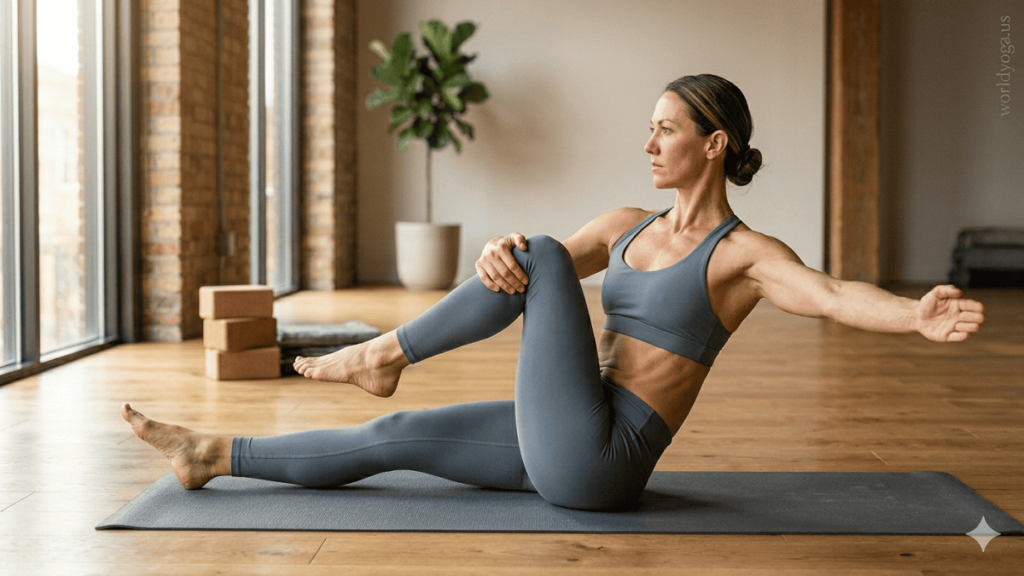
Boat Pose (Navasana) is a foundational yoga posture widely used to develop core strength, balance, and spinal stability. When combined with dynamic variations such as twists and scissor-leg movements, it becomes an advanced core-conditioning sequence that challenges endurance, coordination, and control. This variation is commonly used in modern yoga flows and functional training routines.
Overview of Boat Pose
In its classical form, Boat Pose involves balancing on the sitting bones while lifting the legs and torso to form a V-shape. The spine remains long, the chest open, and the abdominal muscles actively engaged. The arms may extend forward parallel to the floor, helping stabilize balance. According to Yoga Journal, the posture primarily strengthens the hip flexors, abdominal muscles, and lower back while improving focus and posture stability Yoga Journal – Boat Pose Guide.
Twist Variation: Enhancing Core Rotation
The twisting variation of Boat Pose introduces spinal rotation while maintaining balance. From the standard position, the torso rotates gently to one side, bringing the hands toward one side of the body before returning to center and repeating on the opposite side. This movement activates the obliques more deeply than the static pose.
Twisting Boat Pose supports improved spinal mobility and strengthens the rotational core muscles, which are essential for functional movement patterns such as walking, running, and lifting. It also enhances digestive stimulation due to mild abdominal compression and release during rotation. However, the movement must remain controlled to avoid collapsing the chest or straining the lower back.
Scissor Legs Variation: Dynamic Stability Challenge
The scissor-leg variation transforms Boat Pose into a dynamic endurance exercise. Instead of holding both legs still, one leg extends forward while the other bends toward the chest, alternating in a controlled “scissoring” motion. This variation significantly increases the demand on the lower abdominals and hip flexors.
Fitness references such as Verywell Fit highlight that dynamic Navasana variations improve both muscular endurance and coordination by forcing continuous stabilization under movement Verywell Fit – Boat Pose (Navasana) Benefits. The scissor motion also trains neuromuscular control, making it useful for athletes and individuals seeking improved core performance.
Key Benefits
When practiced consistently, Boat Pose variations offer several benefits:
- Strengthens deep core muscles including rectus abdominis and obliques
- Improves balance and body awareness
- Enhances spinal stability and posture control
- Builds endurance in hip flexors and lower abdominal region
- Supports functional athletic movement patterns
Safety and Alignment Considerations
Proper alignment is essential. The lower back should not collapse, and the chest should remain lifted throughout all variations. Beginners may modify the pose by keeping knees bent or placing hands behind the thighs for support. Breath control is equally important—steady breathing helps maintain stability during both static and dynamic phases.
Conclusion
The combination of Boat Pose with twist and scissor-leg variations transforms a traditional yoga posture into a powerful core-training sequence. It bridges the gap between yoga and functional fitness by integrating strength, mobility, and controlled movement. Practiced mindfully, it becomes an effective tool for developing both physical stability and mental focus.
#Boat Pose: Twist, Scissor Legs in India
How is Boat Pose with twist and scissor legs performed correctly?
Boat Pose (Navasana) with twist and scissor-leg variations is an advanced core sequence that requires precise alignment, controlled breathing, and steady engagement of the abdominal muscles. Performing it correctly is essential not only for effectiveness but also for preventing strain on the lower back and hip flexors. This variation is commonly used in yoga and functional fitness training to build dynamic core stability.
Step 1: Setting Up the Base Boat Pose
Begin seated on a yoga mat with knees bent and feet flat on the floor. Sit tall on the sit bones, lengthening the spine and gently engaging the core. Lean back slightly while lifting the feet off the ground, bringing the shins parallel to the floor. This is the foundational Boat Pose position.
From here, extend the arms forward at shoulder height, keeping the chest open and shoulders relaxed. The goal is to maintain a long spine rather than rounding the back. Beginners may keep knees bent, while advanced practitioners can straighten the legs into a full V-shape.
Yoga resources such as Yoga Journal emphasize that core engagement and spinal length are more important than leg height in maintaining correct alignment Yoga Journal – Boat Pose Guide.
Step 2: Adding the Twist Variation
Once stable in Boat Pose, initiate the twist by slowly rotating the torso to one side while keeping the hips as steady as possible. Bring both arms slightly toward that side without collapsing the chest. Return to center with control, then rotate to the opposite side.
The key to correct execution is movement from the ribs and obliques rather than forcing rotation from the arms or shoulders. The spine should remain tall, and the pelvis should stay balanced on the sit bones. Avoid leaning backward during the twist, as this reduces core activation and increases strain on the lower back.
Step 3: Scissor-Leg Movement
After stabilizing, transition into the scissor-leg variation. From the Boat Pose position, extend one leg forward while bending the other toward the chest. Alternate legs in a controlled rhythm, ensuring the core remains fully engaged throughout the movement.
The motion should be slow and deliberate rather than fast. Each switch should pass through a brief moment of control at the center position before changing sides. This prevents momentum from replacing muscular effort.
Fitness guidance from Verywell Fit highlights that controlled movement variations in Boat Pose improve endurance and neuromuscular coordination, especially in the deep abdominal muscles Verywell Fit – Boat Pose Benefits.
Step 4: Breathing and Alignment Control
Breathing should remain steady and controlled throughout. Exhale during effort (twisting or leg switching) and inhale while returning to center. The chest should stay lifted, and the shoulders should remain relaxed away from the ears.
Avoid common mistakes such as rounding the spine, dropping the chest, or holding the breath. These errors reduce core engagement and increase risk of discomfort in the lower back.
Step 5: Finishing the Pose
To exit, gently lower both feet to the mat and return to a seated position. Rest briefly before repeating if needed.
#Boat Pose: Twist, Scissor Legs in Maharashtra

What is the proper alignment in this dynamic Navasana variation?
Proper alignment in this dynamic version of Boat Pose (Navasana)—which includes twist and scissor-leg movement—is the foundation that determines whether the posture strengthens the core effectively or places unnecessary strain on the spine and hip flexors. Because this variation introduces rotation and alternating leg extension, maintaining structural integrity becomes more important than range of motion or speed.
Neutral Spine and Stable Pelvis
The most critical element of alignment in dynamic Boat Pose is a long, neutral spine. The practitioner should sit tall on the sit bones without collapsing into the lower back. The chest must stay lifted, with the sternum gently moving upward rather than sinking toward the thighs. The abdomen should remain engaged throughout, creating a supportive “corset” around the trunk.
The pelvis should stay as stable as possible, even during twisting and leg switching. A common mistake is rolling backward onto the tailbone, which reduces core activation and increases pressure on the lumbar spine. Instead, the weight should remain slightly forward on the sit bones to maintain balance and spinal extension.
Yoga alignment references consistently emphasize that spinal length is more important than how high the legs lift, especially in Navasana variations Yoga Journal – Boat Pose Guide.
Core Engagement and Rib Control
In this dynamic variation, core engagement must be deep and continuous. The transverse abdominis acts as the primary stabilizer, while the obliques assist during twisting movements. The ribs should remain drawn inward rather than flaring outward. If the ribs expand forward, the lower back tends to overarch, breaking alignment.
During the twist phase, rotation should originate from the thoracic spine (mid-back) rather than the shoulders or arms. The pelvis should remain square and steady. Over-rotation or collapsing into one side compromises both balance and spinal safety.
The arms, whether extended forward or used for balance, should remain level with the shoulders. They should not drop or swing, as this disrupts core stability.
Leg Positioning in Scissor Variation
In the scissor-leg movement, alignment depends on controlled opposition. One leg extends forward while the other bends toward the chest, but both legs must remain active. The extended leg should not drop too low, as this pulls the lower back into strain. Instead, it should hover at a height that allows the spine to stay long and stable.
The bent knee should move toward the torso without collapsing the chest forward. The switching motion must pass through a centered, balanced Boat Pose position rather than swinging from side to side. This ensures the core—not momentum—is driving the movement.
Fitness guidance on core mechanics in Navasana variations reinforces the importance of controlled movement and pelvic stability for injury prevention and strength development Verywell Fit – Boat Pose (Navasana) Benefits.
Breath and Head Alignment
Breathing supports alignment by preventing tension buildup. The inhale should expand the chest slightly without losing abdominal engagement, while the exhale should reinforce core contraction during twists or leg switches. Breath holding often leads to collapse or unnecessary tension.
The head should remain in line with the spine, neither dropping forward nor tilting back. The gaze can stay forward or slightly upward to encourage an open chest and elongated cervical spine.
Conclusion
Proper alignment in dynamic Boat Pose with twist and scissor legs is defined by stability over movement. A lifted spine, steady pelvis, controlled rib positioning, and intentional core engagement work together to create safe and effective execution. When alignment is maintained, this variation becomes a powerful tool for developing deep abdominal strength, rotational control, and full-core coordination.
#Boat Pose: Twist, Scissor Legs in Ahemadabad
Which muscles are engaged during the pose?
In Boat Pose (Navasana) and its dynamic variations such as twist and scissor-leg movements, multiple muscle groups work together to stabilize the body, control movement, and maintain balance. Unlike isolated strength exercises, this posture requires coordinated engagement across the core, hips, spine, and even the upper body. Understanding the muscular involvement helps in practicing the pose more effectively and safely.
Primary Core Muscles Engaged
The most active muscle group in Boat Pose is the core, particularly the rectus abdominis, which is responsible for spinal flexion and maintaining the V-shape position of the torso and legs. This is the “six-pack” muscle that visibly contracts as the body holds itself in balance.
Alongside it, the transverse abdominis plays a crucial stabilizing role. This deep core muscle acts like a natural corset, compressing the abdomen and supporting the spine during both static holds and dynamic movements like twisting and leg switching.
The internal and external obliques become especially active during the twisting variation. These muscles control rotational movement of the torso and help maintain balance while the upper body rotates side to side. They also assist in resisting unwanted rotation, which is essential for stability.
Hip Flexors and Lower Body Activation
The hip flexors, including the iliopsoas group, are heavily engaged as they lift and hold the legs off the ground. In the scissor-leg variation, these muscles work continuously as each leg alternates between extension and flexion.
The quadriceps also contribute significantly, especially when the legs are extended straight. They help stabilize the knees and maintain leg alignment. Meanwhile, the adductor muscles (inner thighs) assist in keeping the legs aligned and preventing outward collapse, particularly when the legs are held together or switching positions.
According to Yoga Journal, Boat Pose is one of the most effective yoga postures for strengthening both abdominal and hip flexor muscles simultaneously due to its sustained lifting action Yoga Journal – Boat Pose Guide.
Spinal and Back Muscles
Although Boat Pose is primarily known as a core exercise, the spinal extensors (erector spinae) play a supportive role by helping maintain an upright and elongated spine. These muscles prevent the back from rounding excessively and contribute to postural control throughout the pose.
The multifidus, a deep stabilizing muscle along the spine, also activates to maintain segmental spinal alignment, especially during twisting movements.
Upper Body Engagement
The upper body is not passive in Boat Pose. The shoulder stabilizers, including the deltoids and rotator cuff muscles, engage when the arms are extended forward. They help maintain shoulder alignment and prevent collapsing of the chest.
The latissimus dorsi may also assist in maintaining upper-body stability, particularly when the arms are actively reaching forward with engagement.
Dynamic Variation Demands
In dynamic versions with twisting and scissor-leg movements, muscular demand increases significantly. The obliques alternate between concentric and eccentric contraction, while the hip flexors continuously switch engagement between legs. This creates a high level of neuromuscular coordination and endurance demand.
Fitness resources such as Verywell Fit highlight that Navasana variations improve overall core endurance and stability due to the simultaneous activation of multiple muscle groups under load Verywell Fit – Boat Pose (Navasana) Benefits.
Conclusion
Boat Pose with twist and scissor-leg variations is a full-core and full-body stabilizing exercise. It primarily targets the abdominal muscles but also significantly engages the hip flexors, spinal stabilizers, thighs, and shoulder muscles. This integrated activation is what makes the pose highly effective for building functional strength, balance, and controlled movement efficiency.
#Boat Pose: Twist, Scissor Legs in Hyderabad
What preparatory poses are recommended before practicing it?
Before practicing the dynamic version of Boat Pose (Navasana) with twist and scissor-leg movements, it is important to prepare the body with foundational poses that build core strength, hip flexibility, spinal awareness, and balance control. These preparatory postures reduce strain on the lower back and help practitioners maintain proper alignment during more advanced variations.
1. Seated Forward Bend (Paschimottanasana)
A key preparatory pose is the seated forward bend, which gently stretches the hamstrings and lengthens the spine. Tight hamstrings often pull the pelvis backward, making Boat Pose alignment difficult. By improving posterior chain flexibility, this pose supports a more upright seated position and easier lifting of the legs.
According to Yoga Journal, forward bends also help calm the nervous system while improving spinal mobility, which is essential before core-intensive work Yoga Journal – Seated Forward Bend Guide.
2. Low Boat Pose (Ardha Navasana)
Low Boat Pose is a modified version where the torso and legs are closer to the ground. This variation builds foundational core endurance without requiring full balance in a V-shape. It is especially useful for developing awareness of abdominal engagement before adding twists or dynamic leg movements.
Practicing this variation helps train the transverse abdominis and rectus abdominis gradually, ensuring the core is activated correctly before progression.
3. Plank Pose (Phalakasana)
Plank Pose is one of the most effective preparatory postures for Boat Pose variations. It strengthens the entire core chain, including the abdominals, shoulders, and spinal stabilizers. Since both plank and Boat Pose require anti-gravity core engagement, transitioning between them helps develop stability and endurance.
Verywell Fit notes that plank variations significantly improve core strength and postural control, making them an ideal foundation for advanced abdominal work Verywell Fit – Plank Exercise Guide.
4. Cat-Cow Stretch (Marjaryasana-Bitilasana)
This gentle spinal movement prepares the back for both flexion and extension, which are essential in Boat Pose transitions. Cat-Cow improves spinal mobility, warms up the core muscles, and enhances breath coordination with movement.
It also helps practitioners develop awareness of neutral spine alignment, which is critical for avoiding rounding or collapsing in Navasana.
5. Supine Leg Raises
Lying on the back and lifting the legs builds hip flexor and lower abdominal strength without the challenge of balancing. This is especially useful for beginners who struggle to maintain lifted legs in Boat Pose. It also trains controlled movement, which is essential for the scissor-leg variation.
6. Bridge Pose (Setu Bandhasana)
Bridge Pose activates the posterior chain, including glutes and lower back muscles, which support spinal stability in seated balancing poses. It also opens the hip flexors and chest, helping counteract tightness caused by prolonged sitting.
7. Core Activation Breath Work
Before attempting dynamic Navasana, practicing diaphragmatic breathing or gentle core bracing exercises helps establish internal abdominal engagement. This ensures that the core remains active throughout twisting and leg-switching movements rather than relying on momentum.
Conclusion
Preparing for Boat Pose (Navasana) with a combination of core-strengthening, hip-opening, and spinal-mobility exercises ensures safer and more effective practice. Poses like plank, low boat, cat-cow, and leg raises progressively build the strength and control needed for advanced variations such as twist and scissor-leg movements. With proper preparation, practitioners can improve stability, reduce injury risk, and achieve better alignment and endurance in the final pose.
#Boat Pose: Twist, Scissor Legs in Banglore
What are the benefits and precautions of this advanced core variation?
The advanced core variation of Boat Pose (Navasana) that includes twisting and scissor-leg movements is a high-intensity yoga-based conditioning exercise. It combines isometric core holding with dynamic rotation and alternating leg work, making it both strengthening and demanding on neuromuscular control. Because of its complexity, it offers significant benefits but also requires careful attention to safety and alignment.
Key Benefits
One of the primary benefits is deep core strengthening. This variation activates not only the superficial abdominal muscles like the rectus abdominis but also the deeper stabilizers such as the transverse abdominis and obliques. The addition of twisting enhances rotational strength, which is essential for functional movement patterns like turning, lifting, and athletic performance.
The scissor-leg movement increases engagement of the hip flexors and quadriceps through continuous alternating activation. This builds muscular endurance and improves lower-body coordination. Over time, it helps develop better control over leg movement in both static and dynamic conditions.
Another major benefit is improved spinal stability and posture control. Maintaining a lifted spine while rotating and moving the legs trains the deep spinal stabilizers to work under load. This can translate into better posture during daily activities and reduced risk of slouching or lower back weakness.
This variation also enhances balance and proprioception. Because the body is constantly adjusting to small shifts in weight during twists and leg switches, the nervous system becomes more efficient at maintaining stability. This improves body awareness and coordination.
According to Yoga Journal, Boat Pose variations are highly effective for strengthening core and hip flexors while improving overall body control when practiced consistently Yoga Journal – Boat Pose Guide.
Additional Functional Benefits
- Builds endurance in abdominal and hip muscles
- Enhances rotational strength and control
- Supports athletic performance requiring core stability
- Improves concentration and breath-body coordination
- Strengthens shoulder stabilizers when arms are engaged
Precautions and Contraindications
Despite its benefits, this variation places significant stress on the lower back and hip flexors if performed incorrectly. Individuals with lower back pain, disc issues, or spinal injuries should avoid or modify the pose.
Another common risk is hip flexor strain, especially when the legs are extended too low or movements are performed too quickly. The scissor motion should always remain controlled rather than momentum-driven.
Practitioners should also avoid collapsing the chest or rounding the spine excessively, as this can compress the lumbar region and reduce core engagement. Maintaining a lifted chest and neutral spine is essential.
Breath holding is another precautionary concern. Holding the breath during effort increases internal pressure and reduces control. Instead, steady breathing should be maintained throughout movement transitions.
Verywell Fit emphasizes that controlled execution and proper alignment are critical in Navasana variations to prevent strain and ensure effective core activation Verywell Fit – Boat Pose (Navasana) Benefits.
Modifications for Safety
- Keep knees bent instead of fully extending legs
- Reduce range of motion in twists
- Perform slower scissor movements
- Place hands behind thighs for support if needed
- Practice near a wall for balance assistance
Conclusion
The advanced Boat Pose variation with twist and scissor legs is a powerful tool for building core strength, stability, and coordination. However, its effectiveness depends on controlled execution, proper alignment, and mindful progression. When practiced safely and consistently, it supports functional strength development while improving balance, posture, and overall core endurance.
#Boat Pose: Twist, Scissor Legs in Delhi
Case Study of Boat Pose: Twist, Scissor Legs
This case study examines the integration of an advanced core sequence based on Boat Pose, incorporating twisting and scissor-leg movements, into a structured yoga-based conditioning program. The focus is on assessing improvements in core strength, stability, movement control, and injury resilience over a six-week training period.
Participant Profile and Initial Assessment
The subject was a recreational fitness practitioner with moderate yoga experience but limited exposure to advanced core balancing poses. Initial assessments indicated weak deep core engagement, early fatigue during static holds, and reduced control during rotational movements. The participant also demonstrated difficulty maintaining spinal neutrality under load, particularly when transitioning between dynamic lower-body movements.
The goal of the intervention was to improve core endurance, enhance rotational stability, and develop controlled neuromuscular coordination using progressive Navasana variations.
Training Protocol
The program was structured over six weeks, with three sessions per week. Each session included progressive preparation (plank holds, low Boat Pose, and supine leg raises), followed by the main sequence:
- Static Boat Pose hold (30–60 seconds)
- Alternating scissor-leg movement in Boat Pose
- Controlled torso twists from center alignment
- Breath-coordinated transitions between each phase
Emphasis was placed on slow tempo execution, spinal length, and diaphragmatic breathing. Rest intervals were minimized to increase muscular endurance adaptation while maintaining form integrity.
Research on core training effectiveness highlights that progressive overload combined with controlled instability significantly improves trunk strength and neuromuscular coordination Verywell Fit – Plank Exercise Guide.
Observed Outcomes
By week three, the participant demonstrated improved ability to maintain a lifted chest and stable pelvis during static Boat Pose. Early fatigue in hip flexors reduced noticeably, indicating improved muscular endurance.
By week six, measurable improvements were observed in three key areas:
- Core Stability: The participant maintained longer holds without spinal collapse, showing increased transverse abdominis engagement.
- Rotational Control: Twisting movements became smoother and more controlled, with reduced upper-body compensation.
- Dynamic Coordination: Scissor-leg transitions were performed with consistent rhythm and minimal loss of balance.
Additionally, the participant reported improved posture during daily activities and reduced lower back discomfort during prolonged sitting.
Yoga-based research supports that structured core engagement in poses like Navasana enhances both abdominal strength and postural control when practiced consistently over time Yoga Journal – Boat Pose Guide.
Analysis and Discussion
The combination of isometric holds (static Boat Pose), rotational movement (twists), and alternating limb activation (scissor legs) created a comprehensive neuromuscular training environment. This forced continuous stabilization, requiring both anticipatory and reactive core engagement.
The progression strategy—starting with foundational poses and gradually introducing dynamic complexity—was critical in preventing injury and ensuring adaptation. The participant’s improvement suggests that multi-plane core training is more effective than isolated abdominal exercises for functional strength development.
Conclusion
This case study demonstrates that an integrated approach using Boat Pose with twist and scissor-leg variations can significantly enhance core strength, stability, and movement coordination within a relatively short training period. When applied progressively and with proper alignment principles, this sequence serves as an effective functional training tool for both yoga practitioners and general fitness populations.
#Boat Pose: Twist, Scissor Legs in Pune
White Paper of Boat Pose: Twist, Scissor Legs
Abstract
This white paper evaluates the biomechanical demands, neuromuscular activation patterns, and functional training value of an advanced Boat Pose (Navasana) variation incorporating rotational (twist) and alternating lower-limb (scissor-leg) movements. The objective is to understand how this integrated core exercise contributes to trunk stability, dynamic balance, and multi-planar control in yoga and functional fitness systems.
1. Introduction
Traditional Boat Pose is an isometric core posture used widely in yoga for strengthening the abdominal wall and hip flexors. When modified with twisting and scissor-leg dynamics, the pose transitions from static stabilization to a multi-planar movement pattern. This increases neuromuscular demand across the anterior core, obliques, hip flexors, and spinal stabilizers.
According to Yoga Journal, Navasana is a foundational posture for building abdominal strength and postural awareness due to its sustained anti-gravity hold Yoga Journal – Boat Pose Guide.
2. Biomechanical Framework
2.1 Static Load (Isometric Phase)
In the base Boat Pose, the body maintains a V-shaped lever system. The lumbar spine resists flexion while the abdominal wall provides anterior stabilization. Hip flexors generate torque to sustain leg elevation.
2.2 Rotational Load (Twist Phase)
The twist introduces transverse-plane motion, primarily engaging the internal and external obliques. This requires anti-rotation control from the deep core stabilizers, particularly the transverse abdominis and multifidus muscles.
2.3 Alternating Limb Load (Scissor Phase)
The scissor-leg variation creates alternating unilateral loading. Each leg switch produces a shift in the center of mass, requiring continuous core recalibration. This enhances dynamic stability and neuromuscular responsiveness.
3. Muscular Activation Profile
Primary muscle groups involved include:
- Rectus abdominis: trunk flexion and static hold support
- Transverse abdominis: deep core stabilization
- Internal/external obliques: rotational control
- Iliopsoas: hip flexion and leg elevation
- Rectus femoris and quadriceps: knee and leg stabilization
- Erector spinae: spinal alignment control
- Shoulder stabilizers: upper limb positioning support
Verywell Fit highlights that Navasana variations significantly increase core endurance and functional stability due to multi-muscle coordination under sustained load Verywell Fit – Boat Pose (Navasana) Benefits.
4. Functional Training Applications
This variation is applicable in:
- Athletic conditioning (rotation + core endurance)
- Rehabilitation (controlled trunk stabilization under supervision)
- Yoga progression systems (advanced sequencing)
- Functional fitness (multi-planar movement control)
The integration of static and dynamic loading improves both strength endurance and proprioceptive control.
5. Risk Assessment and Limitations
Despite its benefits, the exercise presents several biomechanical risks:
- Lumbar spine overload if core engagement is insufficient
- Hip flexor strain due to excessive leg lowering
- Loss of spinal neutrality during fatigue
- Momentum substitution reducing muscular control
Individuals with lower back pathology or reduced core stability should modify the movement (bent knees, reduced range, or supported variation).
6. Methodological Recommendations
For safe implementation:
- Prioritize static Boat Pose mastery before dynamic progression
- Maintain controlled tempo in scissor transitions
- Limit rotational amplitude in twist phase
- Use breath synchronization (exhale on exertion)
- Incorporate preparatory strengthening (plank, leg raises)
7. Conclusion
The Boat Pose twist and scissor-leg variation represents a high-level integrated core training model combining isometric endurance, rotational stability, and dynamic limb coordination. Its effectiveness lies in multi-planar neuromuscular engagement, making it valuable for advanced yoga practitioners and functional fitness programs.
#Boat Pose: Twist, Scissor Legs in Kolkata
Industry Application of Boat Pose: Twist, Scissor Legs
Overview
The advanced variation of Boat Pose incorporating twisting and scissor-leg movements has evolved beyond traditional yoga practice into a widely applicable functional training tool. Its multi-planar demand on the core makes it relevant across fitness, rehabilitation, sports performance, wellness programming, and digital health platforms. This posture is valued for its ability to simultaneously train strength, stability, coordination, and proprioception under controlled bodyweight resistance.
Yoga-based conditioning frameworks frequently reference Navasana as a core-strengthening foundation due to its sustained abdominal engagement and postural control demands Yoga Journal – Boat Pose Guide.
1. Fitness and Strength Training Industry
In commercial fitness environments such as gyms, group classes, and personal training programs, this variation is used as a bodyweight core conditioning drill. It is often integrated into:
- HIIT (High-Intensity Interval Training) circuits
- Functional core workouts
- Bodyweight strength programs
- Pilates-inspired conditioning sessions
The scissor-leg component increases muscular endurance demand, while the twist introduces rotational strength training, making it a comprehensive core exercise without equipment dependency.
Verywell Fit notes that dynamic Navasana variations significantly enhance abdominal endurance and functional core stability due to continuous muscular engagement Verywell Fit – Boat Pose (Navasana) Benefits.
2. Yoga and Mind-Body Training Industry
Within modern yoga systems, this variation is used in advanced vinyasa flows and core-focused sequences. It supports progression from static asanas to dynamic transitions, improving practitioner control and awareness.
Key applications include:
- Advanced yoga sequencing modules
- Core-strength-focused workshops
- Teacher training programs (RYT certifications)
- Therapeutic yoga (modified versions for rehabilitation contexts)
It is particularly valued for integrating breath control with movement coordination, reinforcing the mind-body connection central to yoga practice.
3. Sports Performance and Athletic Conditioning
Athletes in sports requiring rotational power and core stability—such as tennis, martial arts, running, and football—benefit from this exercise due to its emphasis on:
- Anti-rotation strength
- Dynamic trunk stabilization
- Hip flexor endurance
- Controlled lower-limb coordination
The twisting motion simulates sport-specific rotational patterns, while scissor-leg action enhances lower-body coordination under core load.
4. Rehabilitation and Physiotherapy (Controlled Use)
In clinical and rehab environments, modified versions of this pose are used under supervision to restore:
- Core stability after lower back injury
- Postural control deficits
- Hip flexor weakness
- Motor control and proprioception
However, full dynamic execution is typically avoided in early rehabilitation phases. Instead, therapists may use supported or reduced-range variations.
5. Corporate Wellness and Preventive Health
Organizations increasingly include yoga-based core training in workplace wellness programs. This variation is used in short movement breaks or guided sessions to:
- Reduce sedentary posture strain
- Improve spinal alignment awareness
- Enhance core endurance for desk workers
- Decrease lower back discomfort risk
Because it requires no equipment and minimal space, it is highly adaptable for office environments.
6. Digital Fitness and App-Based Platforms
Fitness apps and online platforms integrate this variation into structured programs due to its scalability and instructional clarity. It is commonly featured in:
- Core progression challenges
- Guided yoga flows
- AI-based posture correction systems
- Virtual personal training modules
Its measurable difficulty progression makes it suitable for algorithm-driven training plans.
Conclusion
The twist and scissor-leg variation of Boat Pose has broad cross-industry relevance due to its ability to combine static strength, rotational stability, and dynamic coordination in a single movement pattern. Its adaptability allows it to be used in fitness training, yoga education, sports conditioning, rehabilitation, wellness programs, and digital health platforms. As demand grows for efficient, equipment-free functional training methods, this posture continues to serve as a versatile and scalable core conditioning solution.
#Boat Pose: Twist, Scissor Legs in Mumbai
Ask FAQs
What is Boat Pose with twist and scissor-leg variation used for?
Boat Pose with twist and scissor-leg movements is primarily used to build core strength, improve spinal stability, and enhance balance. The twist targets rotational strength in the obliques, while the scissor-leg action develops hip flexor endurance and coordination. Together, they create a full-core conditioning exercise commonly used in yoga and functional fitness training.
Who should practice this advanced variation?
This variation is best suited for intermediate to advanced practitioners who already have a stable foundation in basic Boat Pose. Individuals with strong core control and good spinal awareness can safely progress into dynamic movements. Beginners should first master modified versions with bent knees or shorter holds before attempting twists and scissor-leg transitions.
What are the main benefits of this pose?
The key benefits include improved abdominal strength, better posture, enhanced rotational control, and increased lower-body endurance. It also strengthens deep stabilizing muscles of the spine and improves neuromuscular coordination. According to Yoga Journal, Navasana is highly effective for building core strength and improving body awareness when practiced consistently Yoga Journal – Boat Pose Guide
What are common mistakes to avoid?
Common mistakes include rounding the lower back, dropping the chest, and relying on momentum during scissor-leg movements. Another frequent error is rotating from the shoulders instead of the core during the twist. Overextending the legs too low can also strain the lower back and reduce core engagement. Maintaining a lifted spine and controlled movement is essential.
Are there any precautions for this pose?
Yes, individuals with lower back pain, hip flexor injuries, or spinal disc issues should approach this variation carefully or avoid it altogether. It is important to keep movements slow and controlled, maintain steady breathing, and avoid holding tension in the neck or shoulders. Verywell Fit emphasizes that proper alignment and controlled execution are key to preventing strain in Navasana variations Verywell Fit – Boat Pose (Navasana) Benefits.
Table of Contents
Disclaimer: This content is for educational and informational purposes only and is not a substitute for professional medical, fitness, or physiotherapy advice. Practice Boat Pose (Navasana) and its variations under proper guidance. Discontinue if you experience pain or discomfort and consult a qualified healthcare professional before attempting advanced movements, especially if you have existing injuries or medical conditions.