
Sukha Navasana
Introduction
Sukha Navasana, often referred to as the “Easy Boat Pose,” is a simplified variation of the traditional Navasana. In Sanskrit, “Sukha” means comfort, ease, or relaxation, while “Navasana” translates to boat pose. Together, Sukha Navasana represents a gentler approach to core engagement, making it suitable for beginners or individuals working on foundational strength and balance in yoga practice.
This posture is widely used in yoga sequences to build abdominal strength while minimizing strain on the lower back and hip flexors.
What is Sukha Navasana?
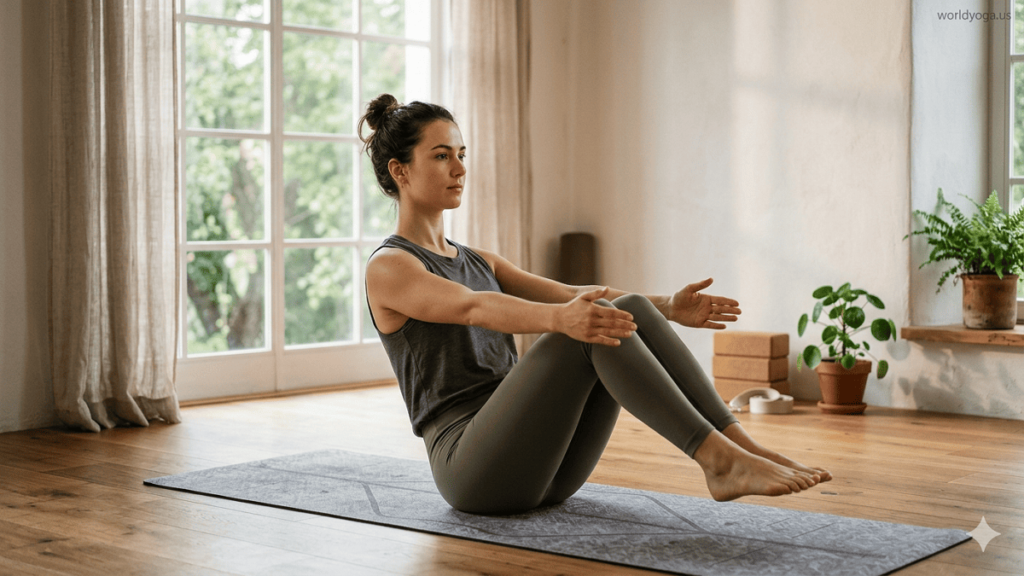
Sukha Navasana is a modified version of the traditional boat pose where the intensity is reduced. Instead of fully extending the legs at a high angle, the practitioner keeps the knees bent or the legs closer to the ground while still maintaining a V-shaped balance.
The pose primarily focuses on controlled engagement of the core muscles, mindful breathing, and spinal stability.
How to Perform Sukha Navasana
Step-by-step Instructions:
- Sit on the floor with your legs extended forward.
- Place your hands slightly behind your hips for support.
- Lean back gently while keeping your spine straight.
- Lift your feet slightly off the ground, keeping knees bent for the easy variation.
- Engage your abdominal muscles to maintain balance.
- Hold the position while breathing steadily.
- Slowly release by lowering your feet and relaxing your core.
Key Benefits of Sukha Navasana
1. Strengthens Core Muscles
Sukha Navasana targets the abdominal muscles, helping build foundational core strength without excessive strain.
2. Improves Balance and Stability
Regular practice enhances body awareness and improves overall balance control.
3. Supports Lower Back Health
Since it is a gentler variation, it reduces pressure on the lumbar spine while still activating supporting muscles.
4. Enhances Posture
Strengthening the core contributes to better spinal alignment and improved posture over time.
5. Prepares for Advanced Yoga Poses
It serves as a preparatory step toward full Navasana and other advanced core-based yoga postures.
Common Mistakes to Avoid
- Rounding the spine excessively instead of keeping it long
- Holding the breath instead of maintaining steady breathing
- Overstraining the legs instead of keeping a comfortable bend
- Losing core engagement and relying on lower back support
Who Should Practice Sukha Navasana?
This pose is ideal for:
- Beginners in yoga
- Individuals with weak core strength
- People recovering from mild lower back stiffness (with guidance)
- Those preparing for advanced core yoga poses
However, individuals with severe back injuries or medical conditions should consult a qualified yoga instructor or healthcare professional before practicing.
Conclusion
Sukha Navasana is a foundational yoga posture that bridges the gap between relaxation and strength training. By offering a comfortable variation of the traditional boat pose, it allows practitioners to build core stability safely and progressively. With consistent practice, it enhances balance, posture, and overall physical awareness, making it a valuable addition to any yoga routine.
#Sukha Navasana in Delhi
How is Sukha Navasana performed correctly?
Step-by-Step Execution of Sukha Navasana
1. Starting Position
Sit on a yoga mat with your legs extended forward. Keep your spine upright, shoulders relaxed, and hands placed beside or slightly behind your hips for initial support.
2. Engage the Core
Before lifting, gently activate your abdominal muscles. This engagement is essential to protect the lower back and maintain stability throughout the posture.
3. Lean Back with Control
Slowly tilt your upper body backward while keeping your spine long and chest open. Avoid collapsing the shoulders or rounding the back.
4. Lift the Legs in Modified Position
Lift your feet slightly off the ground while keeping your knees bent. In Sukha Navasana, the legs do not need to be fully extended; the focus is on comfort and stability.
5. Balance the Body
Your body should form a mild “V” shape. The weight should be balanced between your sitting bones and core muscles, not your lower back.
6. Maintain Steady Breathing
Breathe evenly through the nose. Avoid holding the breath, as steady respiration helps maintain core activation and balance.
7. Hold and Release
Hold the position for a few seconds to a comfortable duration. To release, slowly lower your legs, return your torso upright, and relax.
Key Alignment Tips for Correct Practice
- Keep the spine straight, not rounded
- Shoulders should stay relaxed, not hunched
- Core muscles must remain gently engaged throughout
- Knees can remain bent for comfort and control
- Avoid straining the neck by keeping it neutral
Common Errors to Avoid
- Relying on the lower back instead of the abdominal muscles
- Lifting the legs too high too soon
- Holding the breath during the pose
- Losing balance due to lack of core engagement
- Forcing a straight-leg position before readiness
Summary
Correct performance of Sukha Navasana focuses on stability, alignment, and controlled core activation rather than intensity. When practiced mindfully, it builds foundational strength and prepares the body for the full expression of Navasana while minimizing strain and improving overall body awareness.
#Sukha Navasana in India
What is the proper alignment in this gentle Boat Pose variation?
Sukha Navasana is designed to develop core strength while maintaining a supportive and accessible body position. Proper alignment is essential not only for effectiveness but also for preventing strain, especially in the lower back and hip flexors.
1. Spine: Long and Neutral
The spine should remain elongated rather than rounded or collapsed. Imagine lifting through the crown of the head while keeping the lower back supported by active abdominal engagement. The goal is a natural, neutral curve—not excessive arching or rounding.
2. Pelvis: Balanced on Sitting Bones
Sit evenly on both sitting bones. Avoid tipping backward onto the sacrum or tailbone. A stable pelvic base ensures that the core muscles, rather than the lower back, are doing the work.
3. Core: Gently but Firmly Engaged
The abdominal muscles should remain active throughout the pose. This engagement stabilizes the torso and supports the lifted position of the legs. The activation should feel controlled, not strained.
4. Legs: Bent and Controlled
In this variation, the knees are bent, and the feet are lifted slightly off the ground. The shins may be parallel to the floor or at a lower angle depending on strength level. The key is controlled lifting rather than height.
5. Chest and Shoulders: Open and Relaxed
The chest should stay open without collapsing inward. Shoulders remain relaxed and away from the ears. Avoid hunching forward, as this restricts breathing and reduces postural integrity.
6. Arms: Supportive but Not Overloaded
Hands may rest lightly on the floor beside the hips or hover forward for balance. The arms should assist stability without bearing excessive body weight.
7. Neck and Head: Neutral Position
The neck should be aligned with the spine. The gaze can be forward or slightly upward, but the head must not drop back or strain forward.
8. Breathing: Steady and Controlled
Breathing should remain smooth and continuous. A stable breath pattern supports balance and helps maintain muscular control throughout the pose.
Relation to Full Boat Pose
Proper alignment in Sukha Navasana builds the foundation for progressing into the full Navasana, where the legs are fully extended and core demand increases significantly.
Summary
Correct alignment in Sukha Navasana centers on a long spine, stable pelvis, engaged core, and relaxed upper body. When these elements are combined, the posture becomes both safe and effective, allowing practitioners to strengthen the core progressively while maintaining comfort and control.
#Sukha Navasana in Maharashtra

Which muscles are engaged during the pose?
Sukha Navasana is a controlled core-strengthening posture that activates multiple muscle groups across the abdomen, hips, and supporting stabilizers. Although it is a simplified variation of the traditional Navasana, it still demands coordinated muscular engagement to maintain balance and spinal alignment.
Primary Muscles Engaged
1. Rectus Abdominis
This is the main “six-pack” muscle responsible for spinal flexion. In Sukha Navasana, it helps lift and stabilize the torso while preventing the body from collapsing backward.
2. Transverse Abdominis
The deepest layer of abdominal muscles plays a critical stabilizing role. It acts like a natural corset, drawing the abdomen inward and supporting core control throughout the pose.
3. Obliques (Internal and External)
The oblique muscles assist with balance and lateral stability. They help prevent the body from tipping to either side and maintain symmetry in the lifted position.
Hip and Thigh Muscles
4. Iliopsoas (Hip Flexors)
The iliopsoas is heavily engaged as it lifts and holds the legs in a raised position. It is one of the key muscle groups responsible for maintaining the “boat-like” shape.
5. Rectus Femoris
Part of the quadriceps group, this muscle assists in hip flexion and supports knee positioning, especially when the knees are bent in this variation.
6. Quadriceps
The quadriceps help stabilize the thighs and maintain controlled knee alignment, reducing unnecessary strain on the hip flexors.
Supporting Stabilizer Muscles
7. Erector Spinae
These muscles along the spine provide postural support and help maintain an elongated, neutral spine without excessive rounding.
8. Gluteal Muscles
The glutes offer subtle stabilization to the pelvis, helping maintain balance and alignment while reducing load on the lower back.
9. Pelvic Floor Muscles
These deep stabilizers assist in core integration, working in coordination with the abdominal muscles to support balance and control.
Secondary Muscles
- Shoulder stabilizers (for arm support and balance)
- Deep spinal stabilizers (multifidus muscles)
- Intercostal muscles (assist in breathing control during posture holding)
Summary
Sukha Navasana is primarily a core-focused posture, but it involves a coordinated effort from the abdominal muscles, hip flexors, thighs, and spinal stabilizers. While less intense than the full Navasana, it still provides a comprehensive strengthening effect that improves core stability, posture, and overall body control when practiced consistently.
#Sukha Navasana in Ahemadabad
What preparatory poses are recommended before practicing it?
Sukha Navasana requires core stability, hip flexibility, and spinal control. Preparing the body with the right foundational poses helps improve balance, reduce strain, and make the posture more effective. Since it is a modified version of the traditional Navasana, preparatory work should focus on strengthening the abdomen and activating the hip flexors gradually.
1. Dandasana (Staff Pose)
This seated posture builds awareness of spinal alignment and engages the core in a neutral position. It teaches proper upright posture, which is essential before attempting any variation of Boat Pose.
2. Setu Bandhasana (Bridge Pose)
Bridge Pose strengthens the glutes, lower back, and hamstrings while opening the hip flexors. This balance of strength and openness supports better control during Sukha Navasana.
3. Adho Mukha Svanasana (Downward-Facing Dog)
This pose activates the entire posterior chain, including the core, shoulders, and hamstrings. It builds overall stability and prepares the body for weight distribution and endurance.
4. Bhujangasana (Cobra Pose)
Cobra Pose helps strengthen the spinal extensors and improves chest opening. This is important for maintaining an elongated spine during Sukha Navasana.
5. Ardha Navasana (Half Boat Pose)
This is one of the most direct preparatory poses. It closely resembles Sukha Navasana but increases core engagement slightly. It builds the endurance needed for balancing without full leg extension.
6. Tadasana (Mountain Pose)
Though simple, Mountain Pose develops full-body alignment awareness. It trains posture, balance, and muscle engagement from the ground up.
7. Marjaryasana-Bitilasana (Cat-Cow Stretch)
This dynamic movement warms up the spine, improves flexibility, and activates the core gently. It is especially helpful for preparing the lower back and abdominal coordination.
8. Paschimottanasana (Seated Forward Bend)
This pose stretches the hamstrings and calms the nervous system. Flexible hamstrings make it easier to maintain a lifted and controlled leg position in Sukha Navasana.
Summary
A combination of spinal awareness, core strengthening, and hip flexibility work prepares the body effectively for Sukha Navasana. Practicing foundational postures such as Ardha Navasana, Dandasana, and Setu Bandhasana ensures safer alignment, better endurance, and smoother progression into the full expression of Navasana.
#Sukha Navasana in Hyderabad
What are the benefits and precautions of Sukha Navasana?
Sukha Navasana is a foundational core-strengthening posture that offers many physical and postural benefits while remaining accessible to beginners. As a modified version of the traditional Navasana, it reduces strain on the body while still effectively engaging key muscle groups. However, like all yoga postures, it must be practiced with awareness to avoid injury and maximize benefits.
Benefits of Sukha Navasana
1. Strengthens Core Muscles
Sukha Navasana primarily targets the abdominal region, including the rectus abdominis, transverse abdominis, and obliques. Regular practice helps build foundational core strength, which supports nearly every movement of the body.
2. Improves Posture and Spinal Alignment
By encouraging an upright, elongated spine, the pose helps correct slouching and postural imbalances. A stronger core directly contributes to better spinal support in daily life.
3. Enhances Balance and Stability
The controlled lifting of the legs and torso improves neuromuscular coordination. Over time, this leads to better balance not only in yoga but also in functional movements such as walking, running, and bending.
4. Strengthens Hip Flexors
The iliopsoas and surrounding hip muscles are actively engaged, improving hip mobility and endurance. This is especially beneficial for individuals with sedentary lifestyles.
5. Supports Lower Back Health
Unlike the full expression of Boat Pose, this variation reduces excessive strain on the lumbar spine. When performed correctly, it strengthens supporting muscles around the lower back, contributing to better spinal resilience.
6. Prepares the Body for Advanced Yoga Poses
Sukha Navasana builds the foundational strength required for more advanced core postures, including the full Navasana. It acts as a safe progression step in yoga practice.
7. Improves Body Awareness and Breathing Control
Holding the posture with steady breathing enhances mindfulness, concentration, and breath-body coordination, which are essential elements of yoga practice.
Precautions for Sukha Navasana
1. Avoid If You Have Severe Lower Back Injuries
Individuals with acute or chronic lower back conditions should avoid this posture unless guided by a qualified instructor, as improper engagement may increase discomfort.
2. Do Not Overstrain the Core
The pose should be performed with controlled effort, not excessive force. Over-engaging the abdominal muscles can lead to fatigue or improper alignment.
3. Maintain a Neutral Spine
Rounding or collapsing the spine reduces effectiveness and increases risk of strain. Proper alignment is essential for safety.
4. Avoid Holding the Breath
Breath retention can create unnecessary tension. Continuous, steady breathing supports balance and muscle control.
5. Do Not Lift the Legs Too High Too Soon
Beginners should keep the knees bent and feet closer to the floor. Progression should be gradual to avoid hip flexor strain.
6. Pregnancy and Medical Conditions
Pregnant individuals or those with hernia, recent abdominal surgery, or severe spinal issues should consult a healthcare professional before attempting this posture.
Conclusion
Sukha Navasana is a safe and effective introduction to core strengthening when practiced correctly. It offers multiple benefits, including improved posture, stronger abdominal muscles, and better balance, while minimizing strain compared to the full Navasana. However, mindful alignment, controlled movement, and awareness of physical limitations are essential to ensure a safe and beneficial practice.
#Sukha Navasana in Pune
Case Study of Sukha Navasana
Sukha Navasana is frequently used in therapeutic and beginner-level yoga programs to develop core stability with minimal strain. This case study outlines how the posture was incorporated into a structured 6-week yoga intervention aimed at improving core strength, posture, and functional stability in individuals with sedentary lifestyles.
1. Background of the Case
A group of adult participants (ages 25–40) with predominantly desk-based occupations reported common issues such as:
- Weak abdominal muscles
- Mild lower back discomfort
- Poor postural alignment (forward head and rounded shoulders)
- Low core endurance
The goal of the intervention was to introduce safe core-strengthening practices using modified yoga postures, with Sukha Navasana as a central element. The posture was selected due to its reduced intensity compared to the traditional Navasana.
2. Intervention Design
The program was conducted over 6 weeks, with sessions held 4 times per week.
Key Components:
- Warm-up: spinal mobility and breathing exercises
- Core activation drills (gentle abdominal engagement)
- Progressive practice of Sukha Navasana
- Complementary yoga postures for flexibility and balance
- Relaxation and recovery phase
3. Method of Practice
Participants practiced Sukha Navasana in a staged progression:
Week 1–2: Foundation Building
- Knees bent, feet lightly lifted
- Hands placed behind hips for support
- Short hold duration (5–10 seconds)
Week 3–4: Stability Development
- Reduced hand support
- Increased hold duration (10–20 seconds)
- Improved spinal alignment awareness
Week 5–6: Controlled Endurance
- Hands lifted forward for balance
- Stronger core engagement without strain
- Improved breath control during holds
4. Observations and Outcomes
After six weeks, the following improvements were recorded:
1. Core Strength Improvement
Participants demonstrated noticeable improvement in abdominal endurance and control during static holds.
2. Postural Correction
Reduced forward slouching and improved spinal alignment were observed in most participants during standing and sitting positions.
3. Reduction in Lower Back Discomfort
Several participants reported decreased mild lumbar discomfort due to improved core support and spinal stabilization.
4. Enhanced Balance and Body Awareness
Participants showed better coordination and control during transitional movements.
5. Increased Confidence in Yoga Practice
Sukha Navasana served as a gateway posture, helping participants progress toward the full Navasana with greater confidence.
5. Challenges Noted
- Initial difficulty maintaining balance without hand support
- Core fatigue during early sessions
- Tendency to round the spine under strain
- Overactivation of hip flexors in beginners
These challenges were addressed through modifications, shorter holds, and emphasis on breath control.
6. Conclusion
The case study demonstrates that Sukha Navasana is an effective introductory posture for improving core strength, posture, and stability in individuals with low to moderate fitness levels. Its gradual progression model makes it particularly suitable for beginners and therapeutic yoga programs.
#Sukha Navasana in Kolkata
White Paper of Sukha Navasana
Abstract
Sukha Navasana is a modified core-stability posture derived from the traditional Navasana. This white paper examines its biomechanical principles, physiological impact, therapeutic relevance, and application in beginner and rehabilitation-focused yoga programs. The objective is to present a structured understanding of its role in developing foundational core strength while minimizing musculoskeletal strain.
1. Introduction
Core stability is a fundamental requirement for postural control, functional movement, and injury prevention. Traditional Boat Pose is effective but often inaccessible to beginners due to its intensity. Sukha Navasana addresses this limitation by offering a reduced-load variation that emphasizes controlled engagement, breath coordination, and spinal alignment.
2. Definition and Conceptual Framework
Sukha Navasana is defined as a supported variation of Boat Pose in which the practitioner maintains a semi-reclined seated position with bent knees and partial leg lift. The term “Sukha” signifies ease, indicating reduced mechanical demand while preserving the core activation principles of the original posture.
This modification shifts the emphasis from maximal effort to sustainable neuromuscular engagement.
3. Biomechanical Analysis
3.1 Spinal Alignment
The spine remains in a neutral-to-slightly extended position. This reduces compressive loading on the lumbar vertebrae while maintaining postural integrity.
3.2 Load Distribution
Body weight is partially supported by the pelvis and isometrically stabilized by abdominal musculature, reducing stress on hip flexors compared to full Navasana.
3.3 Center of Gravity
The center of gravity shifts posteriorly, requiring controlled engagement of stabilizing muscles to prevent backward collapse.
4. Muscular Activation Profile
Sukha Navasana engages multiple muscle groups in a coordinated manner:
Primary Muscles
- Rectus abdominis (trunk stabilization and flexion control)
- Transverse abdominis (deep core stabilization)
- Internal and external obliques (lateral stability and balance control)
Secondary Muscles
- Iliopsoas and rectus femoris (hip flexion support)
- Erector spinae (spinal stabilization)
- Gluteal muscles (pelvic stabilization)
This distributed activation pattern makes the posture suitable for progressive conditioning programs.
5. Physiological and Functional Benefits
5.1 Core Strength Development
The posture enhances isometric endurance of abdominal muscles, contributing to improved trunk stability.
5.2 Postural Optimization
Regular practice supports correction of postural deviations such as anterior pelvic tilt and thoracic kyphosis.
5.3 Neuromuscular Coordination
Sustained balance requirements improve proprioception and motor control efficiency.
5.4 Respiratory Integration
Controlled breathing during hold phases enhances diaphragm engagement and core synergy.
6. Therapeutic Applications
Sukha Navasana is commonly utilized in:
- Beginner yoga protocols
- Low-intensity rehabilitation programs
- Postural correction interventions
- Sedentary lifestyle conditioning modules
Its reduced load profile makes it suitable for gradual progression toward full Navasana.
7. Contraindications and Safety Considerations
While generally safe, the posture should be modified or avoided in cases of:
- Acute lumbar disc pathology
- Post-abdominal surgical recovery
- Severe hip flexor strain
- Uncontrolled balance disorders
Proper alignment and breath control are essential to prevent compensatory strain patterns.
8. Limitations
- Limited hypertrophic stimulus compared to advanced core training
- Requires progression for long-term strength adaptation
- May be challenging for individuals with poor baseline postural awareness
9. Conclusion
Sukha Navasana serves as a foundational biomechanical bridge between basic seated postures and advanced core-strengthening asanas. By reducing load while maintaining neuromuscular engagement, it provides an accessible and effective pathway for improving core stability, posture, and functional movement efficiency. Its structured application supports both general fitness and therapeutic yoga frameworks, making it a valuable component in progressive training systems.
#Sukha Navasana in Banglore
Industry Application of Sukha Navasana
Sukha Navasana has gained relevance beyond traditional yoga practice and is increasingly integrated into multiple professional and wellness-related industries. As a scalable, low-impact core stabilization posture derived from the traditional Navasana, it offers practical value in fitness, healthcare, corporate wellness, sports conditioning, and rehabilitation sectors.
1. Fitness and Yoga Industry
In modern fitness and yoga studios, Sukha Navasana is widely used as a foundational core exercise.
Key Applications:
- Beginner yoga sequencing for core development
- Progressive training toward advanced balancing poses
- Group fitness classes focusing on functional strength
- Warm-up or activation drill before intense workouts
Industry Value:
It provides a safe entry point for clients with limited core strength, improving accessibility and retention in yoga programs.
2. Physiotherapy and Rehabilitation
Sukha Navasana is frequently incorporated into therapeutic exercise plans due to its controlled load and adaptability.
Key Applications:
- Postural correction programs
- Mild lower back pain rehabilitation (under supervision)
- Core reconditioning after inactivity or injury
- Motor control retraining for spinal stability
Industry Value:
It allows clinicians to introduce core activation without excessive spinal compression or strain, making it suitable for early-stage rehabilitation protocols.
3. Corporate Wellness Programs
With increasing sedentary work environments, Sukha Navasana is used in workplace wellness initiatives.
Key Applications:
- Desk-based mobility and core activation breaks
- Stress reduction through breath-centered movement
- Posture improvement programs for office workers
- Short guided movement sessions during work hours
Industry Value:
It helps reduce musculoskeletal complaints associated with prolonged sitting and improves employee productivity and comfort.
4. Sports and Athletic Conditioning
Athletes and trainers use Sukha Navasana as a foundational stability drill.
Key Applications:
- Core activation warm-ups
- Balance and proprioception training
- Injury prevention routines
- Early-stage rehabilitation after core or hip injuries
Industry Value:
It supports controlled strengthening without fatigue overload, making it suitable during recovery phases and off-season training.
5. Healthcare and Preventive Medicine
Preventive healthcare programs integrate Sukha Navasana as part of lifestyle modification strategies.
Key Applications:
- Obesity management programs
- Elderly mobility and stability training
- Chronic pain prevention strategies
- Lifestyle disease management (sedentary behavior correction)
Industry Value:
It promotes safe movement habits and improves functional independence across age groups.
6. Digital Fitness and Wellness Platforms
With the rise of online fitness, Sukha Navasana is commonly featured in guided virtual sessions.
Key Applications:
- Beginner yoga mobile applications
- AI-guided posture correction programs
- Online physiotherapy modules
- Short-form wellness content for home practice
Industry Value:
Its simplicity makes it highly adaptable for remote instruction and digital coaching formats.
7. Education and Academic Training
Yoga schools and physical education curricula include Sukha Navasana as a teaching tool.
Key Applications:
- Introduction to core anatomy and biomechanics
- Beginner-level yoga certification training
- Movement science education modules
- Demonstration of progressive posture scaling
Industry Value:
It provides a safe pedagogical model for teaching core engagement principles.
Conclusion
Sukha Navasana serves as a versatile and scalable posture with applications across multiple industries, including fitness, rehabilitation, corporate wellness, sports science, and digital health. Its reduced intensity compared to the full Navasana makes it particularly valuable for beginner populations and therapeutic settings. As demand for accessible, low-impact core training continues to grow, Sukha Navasana is positioned as a practical and widely applicable movement solution in modern wellness ecosystems.
#Sukha Navasana in Mumbai
Ask FAQs
What is Sukha Navasana?
Sukha Navasana is a simplified version of the traditional Navasana. It involves balancing the body in a semi-reclined position with bent knees, focusing on gentle core engagement rather than full leg extension.
Who can practice Sukha Navasana?
It is suitable for beginners, individuals with low core strength, office workers with posture-related issues, and those recovering from mild inactivity. It is often used as a preparatory step before progressing to advanced core poses.
What are the main benefits of Sukha Navasana?
This posture helps strengthen abdominal muscles, improve posture, enhance balance, support lower back stability, and develop overall core endurance in a safe and controlled manner.
How long should Sukha Navasana be held?
Beginners can start by holding the pose for 5–10 seconds and gradually increase to 20–30 seconds as strength improves. The focus should remain on control and proper alignment rather than duration.
Are there any precautions while practicing Sukha Navasana?
Yes. Individuals with severe lower back pain, recent abdominal surgery, or significant hip issues should avoid or modify the pose. It is also important to maintain a neutral spine, avoid breath holding, and progress gradually to prevent strain.
Table of Contents
Disclaimer
The information provided about Sukha Navasana is for educational and informational purposes only and should not be considered medical advice. Individuals with existing health conditions, injuries, or concerns should consult a qualified healthcare professional or certified yoga instructor before practicing. Practice should always be done within personal comfort limits and with proper guidance to avoid injury.