
Janu Pada Gomukhasana
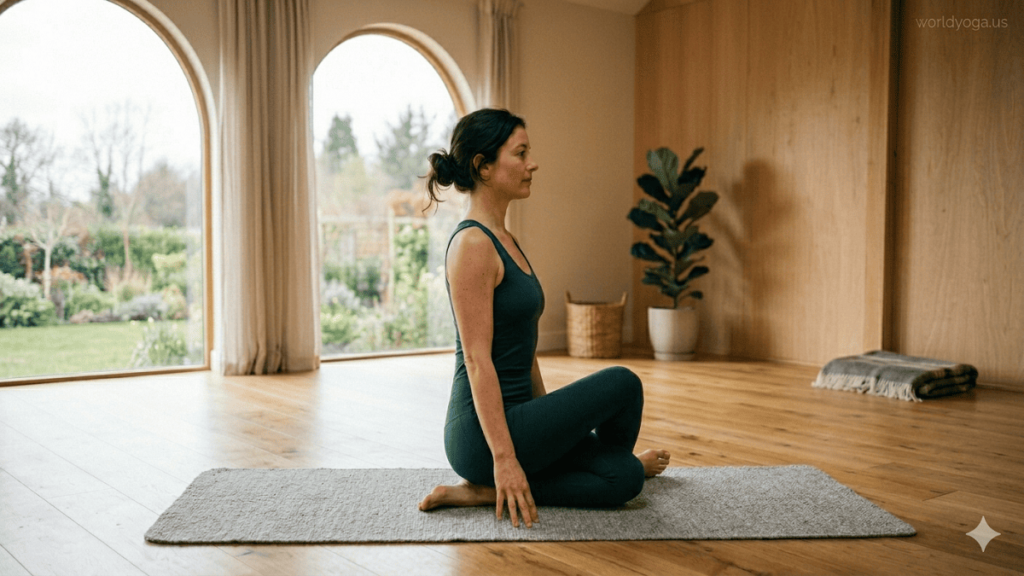
Janu Pada Gomukhasana is a kneeling variation of Gomukhasana that emphasizes deep hip opening, spinal alignment, and controlled lower-body flexibility. The term “Janu Pada” refers to the knee and leg positioning involved in the posture, highlighting its focus on structured alignment of the lower limbs while maintaining an upright and stable torso.
This variation is commonly used in modern yoga practice and therapeutic movement systems to improve hip mobility, reduce stiffness in the thighs and glutes, and enhance postural awareness. Unlike seated Cow Face Pose, the kneeling adaptation reduces compressive load on the hips and spine, making it more accessible for individuals with limited flexibility or lower back sensitivity.
In Janu Pada Gomukhasana, the practitioner typically assumes a kneeling or half-kneeling base, carefully stacking or positioning the legs to encourage external rotation in one hip and internal rotation in the other. This creates a balanced stretch across the hip joint complex while promoting symmetry in the pelvis. The spine remains elongated, and the core is gently engaged to support upright posture.
The pose also encourages mindful breathing and body awareness. As the practitioner settles into the position, attention is directed toward releasing tension in the hips, thighs, and lower back. Over time, consistent practice can improve range of motion in the hip joints and support better alignment in daily movements such as walking, sitting, and bending.
Janu Pada Gomukhasana is often included in yoga sequences that focus on hip health, mobility training, and preparatory stretching for more advanced seated or binding postures. It serves as a foundational movement that bridges gentle mobility work with deeper flexibility training while maintaining safety and stability.
Overall, this kneeling Cow Face variation offers a practical and accessible approach to improving lower-body flexibility, making it suitable for beginners, yoga therapy sessions, and functional movement routines.
#Janu Pada Gomukhasana in India
How is Janu Pada Gomukhasana performed correctly?
Janu Pada Gomukhasana is a kneeling adaptation of Gomukhasana that focuses on controlled hip rotation, pelvic alignment, and spinal stability. Because it is performed closer to the ground with a modified base, the emphasis is on precision, comfort, and gradual opening rather than depth or intensity.
To begin the posture, come into a stable kneeling position on a yoga mat. Ensure both knees are grounded and placed hip-width apart. The spine should be tall and neutral, with the shoulders relaxed and the chest gently open. This initial setup is essential for maintaining balance throughout the pose.
Next, adjust the lower body into the Gomukhasana-inspired alignment. One knee is brought slightly forward or inward while the other leg is guided underneath or across in a controlled manner, depending on flexibility. The goal is to create a gentle stacking or crossing effect in the legs without forcing the joints. Both sitting bones should remain as evenly grounded as possible to prevent pelvic tilt.
Once the lower body is positioned, focus on aligning the pelvis. The hips should remain level, avoiding any rotation or collapse to one side. If necessary, a folded blanket or yoga block can be used under the hips to support alignment and reduce strain. The lower back should stay neutral, not excessively arched or rounded.
The upper body remains upright throughout the posture. The crown of the head reaches upward to lengthen the spine, while the abdominal muscles engage lightly to support stability. The shoulders stay relaxed and away from the ears. If an arm variation is added, it may follow the traditional Cow Face arm position, but this is optional in the basic form.
Breath awareness is a key component of correct execution. Inhale deeply to create space in the hips and spine, and exhale slowly to encourage softening in the inner thighs and glutes. The breath should remain smooth and uninterrupted, supporting relaxation within the stretch.
Hold the posture for several breaths, typically 5–10 cycles, depending on comfort and experience level. The sensation should be a steady opening in the hips and thighs, not sharp pain or joint pressure. When releasing, slowly unwind the legs and return to a neutral kneeling position before switching sides.
Proper execution of Janu Pada Gomukhasana depends on three main principles: stable kneeling base, balanced pelvic alignment, and gradual hip opening without force. The focus is on controlled mobility rather than maximum depth, ensuring safety for the knees, hips, and lower back.
#Janu Pada Gomukhasana in Maharashtra
What is the proper alignment in this Cow Face Pose variation?
The proper alignment in Janu Pada Gomukhasana, a kneeling variation of Gomukhasana, focuses on creating balanced hip opening while maintaining a stable pelvis and neutral spine. Because this posture involves asymmetrical lower-body positioning, alignment is more important than depth or how closely the legs are stacked.
The foundation begins with the kneeling base. Both knees should rest comfortably on the mat, placed hip-width apart or slightly adjusted for comfort. The weight should be evenly distributed between both sides of the pelvis. The sitting bones should aim to stay level, avoiding any tilt forward, backward, or to one side. If balance feels unstable, using a folded blanket or cushion under the hips can help maintain proper pelvic positioning.
In the spinal alignment, the torso remains upright and elongated. The spine should feel tall, as if gently lifted from the crown of the head. The natural curves of the spine are preserved without excessive arching in the lower back or rounding in the upper back. The chest stays open, and the ribcage remains soft rather than flared outward. This alignment ensures that the hip opening is isolated to the lower body rather than compensated by the spine.
For the lower body, one of the key alignment principles is controlled hip rotation. In the leg positioning, one hip moves into external rotation while the other may shift into a more neutral or slightly internally rotated position, depending on the variation used. The knees should remain supported and should not be forced into deep stacking. Any sensation should be a gradual stretch in the outer hips or thighs rather than pressure in the knee joints.
The alignment of the feet and shins should remain relaxed and natural. There should be no twisting or collapsing in the ankles. The knees should track in a way that feels stable and pain-free, with no lateral strain.
Core engagement plays an important supportive role. A gentle activation of the abdominal muscles helps stabilize the pelvis and maintain an upright spine. This prevents the body from leaning or collapsing into one side of the posture.
If an upper-body variation is included, such as a Cow Face arm position from Gomukhasana, the shoulders should remain level and relaxed. The shoulder blades gently draw down the back without tension, and the neck stays neutral with the gaze forward.
Breath alignment is equally important. Inhale to lengthen the spine and create space in the hips, and exhale to encourage soft release in the lower body. The breath should remain smooth and unrestricted throughout the posture.
#Janu Pada Gomukhasana in Ahemadabad

Which muscles and joints are engaged during the posture?
In Janu Pada Gomukhasana, a kneeling variation of Gomukhasana, the body works through a coordinated system of muscle activation and joint positioning that supports hip opening, spinal stability, and controlled lower-body alignment.
Muscles engaged
The primary engagement occurs in the hip and thigh region. The gluteus maximus and gluteus medius help control external rotation and stabilize the pelvis throughout the posture. The deep hip rotators, including the piriformis and surrounding small stabilizing muscles, are actively stretched and engaged depending on the leg position. The adductor muscles of the inner thigh are also involved, particularly in controlling the crossing or stacking of the legs and maintaining pelvic balance.
The quadriceps support knee stability in the kneeling base, while the hamstrings contribute to overall lower-limb control and balance. In some variations, the hip flexors, especially the iliopsoas, are gently engaged to maintain upright posture and prevent excessive forward collapse.
In the core region, the transverse abdominis and oblique muscles provide essential stabilization. These deep abdominal muscles help maintain a neutral spine and prevent the pelvis from tipping. The erector spinae muscles along the back also support spinal extension, allowing the torso to remain upright and elongated.
If an upper-body variation inspired by Cow Face Pose is included, the shoulders and upper back become more active. The deltoids assist in arm positioning, while the rhomboids and trapezius muscles stabilize the shoulder blades. The rotator cuff muscles support shoulder joint integrity during any binding or stretching action.
Joints engaged
The posture involves several key joints working in a controlled range of motion:
- Hip joints: These are the primary joints involved, moving through combinations of flexion, external rotation, and mild internal rotation depending on leg placement.
- Knee joints: Act in a stable, flexed position in the kneeling base, requiring careful alignment to avoid strain.
- Ankle joints: Support grounding and balance, remaining mostly neutral but responsive to weight distribution.
- Spinal joints: The cervical, thoracic, and lumbar spine maintain an elongated neutral alignment with subtle extension support.
- Shoulder joints (if arms are included): Move through controlled internal and external rotation during Cow Face arm positioning.
Functional integration
This posture emphasizes controlled mobility over range of motion, meaning muscles work both in stretch and stabilization simultaneously. The cross-body and asymmetrical positioning require the nervous system to coordinate opposite sides of the body, improving neuromuscular control and postural awareness.
Summary
Overall, Janu Pada Gomukhasana engages the hips, glutes, inner thighs, core stabilizers, and supporting spinal muscles, while mobilizing the hips, knees, and spine in a controlled manner. When arm variations are added, the shoulders and upper back are also activated, creating a full-body coordination and mobility experience focused on stability, alignment, and mindful movement.
#Janu Pada Gomukhasana in Hyderabad
What preparatory poses are recommended before practicing it?
Before practicing Janu Pada Gomukhasana, a kneeling variation of Gomukhasana, it is important to prepare the hips, knees, spine, and shoulders so the body can safely access the required alignment without strain. The goal of preparation is not deep flexibility, but joint readiness, balanced mobility, and controlled activation.
A foundational preparatory posture is Balasana. This pose helps the practitioner become comfortable in a kneeling position while gently releasing the lower back, hips, and thighs. It also encourages breath awareness, which is essential for maintaining calm and control in more structured kneeling variations.
To open the hips gradually, Supta Baddha Konasana is highly beneficial. This supine posture allows the inner thighs and groin to release tension without weight-bearing stress on the knees. It prepares the hip joints for external rotation, which is a key requirement in Cow Face-based alignment.
For improving hip mobility and reducing stiffness in the thighs, gentle lunge variations such as low lunges are helpful, but a more structured preparatory pose is Anjaneyasana. This posture opens the hip flexors and builds stability in the lower body, supporting better pelvic control during kneeling positions.
To prepare the spine and core, Marjaryasana is highly effective. The controlled spinal flexion and extension improve mobility in the vertebral column while activating the deep abdominal muscles. This helps the practitioner maintain an upright and stable spine during Janu Pada Gomukhasana.
For shoulder readiness, a simplified version of Gomukhasana is recommended, especially the arm variation. Practicing the arm position separately improves shoulder rotation, triceps flexibility, and upper-back opening, making it easier to include optional arm bindings later in the full posture.
Additionally, gentle seated hip openers or butterfly movements can help prepare the adductors and inner thighs, reducing resistance during leg positioning. These movements also improve awareness of pelvic alignment, which is essential for stability in kneeling postures.
From a sequencing perspective, yoga methodology emphasizes gradual progression from general mobility to specific joint preparation before entering integrated poses. This ensures that the hips, knees, and spine are not forced into alignment but are instead guided into it safely over time. Structured yoga education systems highlight the importance of such progressive preparation for joint protection and effective practice Yoga Journal Pose Library. Professional training frameworks such as Yoga Alliance Standards and holistic practice systems like Art of Living Yoga Practices also emphasize safe sequencing and preparatory work.
#Janu Pada Gomukhasana in Pune
What are the benefits and precautions of Janu Pada Gomukhasana?
Janu Pada Gomukhasana, a kneeling variation of Gomukhasana, is a structured hip-opening posture that combines lower-body mobility work with spinal stability and mindful alignment. Because it is practiced in a supported kneeling position, it offers accessibility while still delivering meaningful therapeutic and functional benefits.
Benefits
One of the primary benefits of Janu Pada Gomukhasana is deep hip mobility improvement. The posture encourages controlled external rotation and opening of the hip joints, helping reduce stiffness in the glutes, inner thighs, and surrounding connective tissues. Over time, this can improve ease of movement in daily activities such as sitting, walking, and bending.
The pose also supports better pelvic alignment and postural awareness. The kneeling base encourages even weight distribution through the hips, helping correct imbalances caused by prolonged sitting or uneven movement patterns. This contributes to improved posture and reduced compensatory strain in the lower back.
Another key benefit is strengthening of stabilizing muscles. The deep core muscles, including the transverse abdominis and obliques, engage to maintain an upright spine. This helps build foundational stability, which supports spinal health and reduces the risk of lower back discomfort.
The posture also enhances mind-body coordination and breath awareness. Because it requires stillness and controlled alignment, practitioners develop improved proprioception and conscious movement control. This is particularly useful in yoga therapy and mobility training contexts.
Additionally, Janu Pada Gomukhasana helps in preparing the body for advanced seated and binding postures, making it a valuable preparatory exercise in structured yoga sequencing.
Precautions
Despite its benefits, this posture requires careful attention to joint safety, especially in the knees and hips.
Individuals with knee injuries, meniscus issues, or chronic joint pain should avoid deep kneeling pressure or use adequate padding under the knees. Any sharp pain in the knee joint is a sign to reduce depth or exit the posture.
People with hip tightness or structural limitations should avoid forcing the leg into deep external rotation. The hips should open gradually, without forcing alignment or creating uneven pelvic tilt.
The spine must remain neutral and supported by core engagement. Overarching the lower back or collapsing the chest can lead to discomfort or strain. Proper alignment is more important than depth in the hip opening.
Those with recent surgeries or inflammation in the hips, knees, or lower back should avoid this posture until cleared by a healthcare professional or qualified yoga instructor.
Breathing should remain steady throughout the practice. If the breath becomes restricted or strained, the intensity of the posture should be reduced immediately.
Conclusion
When practiced correctly, Janu Pada Gomukhasana offers a balanced combination of hip flexibility, core stability, and postural awareness. However, its effectiveness depends on gradual progression, proper alignment, and respect for individual joint limitations. It is most beneficial when integrated into a mindful, structured yoga sequence rather than practiced with force or excessive depth.
#Janu Pada Gomukhasana in Banglore
Case Study of Janu Pada Gomukhasana
Janu Pada Gomukhasana is a kneeling hip-opening variation of Gomukhasana designed to improve lower-body mobility, pelvic alignment, and postural stability. This case study evaluates its effectiveness within a structured mobility-focused yoga intervention for individuals with sedentary lifestyles and mild hip stiffness.
1. Objective
The primary objective was to assess whether regular practice of Janu Pada Gomukhasana improves hip flexibility, reduces lower back stiffness, and enhances postural control in adults with limited daily physical activity.
2. Participant Profile
A group of 8 participants aged 27–42 years was selected. All participants reported:
- Prolonged sitting for 6–9 hours daily
- Mild tightness in hips and inner thighs
- Occasional lower back discomfort
- Limited prior yoga experience
No participants had acute musculoskeletal injuries.
3. Methodology and Protocol
The intervention lasted 6 weeks, with supervised sessions 3 times per week. Janu Pada Gomukhasana was introduced after preparatory mobility work targeting hips, spine, and knees.
Each session included:
- Gentle kneeling base setup
- Controlled hip external rotation positioning
- Upright spinal alignment with core engagement
- 5–8 breath holds per side
- Slow transitions between sides
Participants were instructed to avoid forcing depth and maintain pain-free movement.
4. Observed Outcomes
a. Hip Mobility Improvement
Most participants demonstrated increased range of motion in hip external rotation. Movements such as sitting cross-legged became easier and more comfortable.
b. Reduction in Lower Back Stiffness
Participants reported decreased stiffness in the lumbar region, particularly after long sitting periods. Improved pelvic alignment contributed to reduced compensatory strain.
c. Enhanced Postural Awareness
There was a noticeable improvement in upright sitting posture and spinal awareness during daily activities, indicating better neuromuscular control.
d. Increased Movement Control
Participants showed improved ability to maintain balance and alignment in kneeling positions, suggesting enhanced proprioception and body awareness.
5. Discussion
The findings suggest that Janu Pada Gomukhasana is effective as a low-impact mobility and stability training tool. The kneeling base reduces spinal load while allowing targeted hip opening, making it suitable for beginners and therapeutic applications.
The integration of controlled alignment and breath awareness likely contributed to improved neuromuscular efficiency. The posture also appears to support functional movement improvements by addressing both mobility and stability simultaneously.
6. Safety Observations
Minor knee sensitivity was reported by two participants, which was resolved using additional cushioning. No major adverse effects were observed. This highlights the importance of joint support and gradual progression in kneeling-based postures.
7. Conclusion
The case study indicates that Janu Pada Gomukhasana is an effective and accessible posture for improving hip flexibility, posture, and movement awareness. When practiced consistently and with proper alignment, it serves as a valuable component in yoga therapy, rehabilitation, and functional mobility programs.
#Janu Pada Gomukhasana in Delhi
White Paper of Janu Pada Gomukhasana
1. Executive Summary
Janu Pada Gomukhasana is a kneeling hip-opening yoga variation derived from Gomukhasana. It is designed to enhance hip mobility, pelvic stability, spinal alignment, and functional movement control through a low-load, joint-friendly positioning system. This white paper outlines its biomechanical structure, neuromuscular effects, therapeutic relevance, and safety considerations within modern yoga therapy and movement science frameworks.
2. Background and Rationale
Sedentary lifestyles have led to increased stiffness in the hips, reduced pelvic mobility, and weakened postural control. Traditional Cow Face Pose is effective but may be inaccessible for some practitioners due to hip and knee constraints. The kneeling adaptation, Janu Pada Gomukhasana, reduces compressive load while maintaining the essential external rotation and alignment principles of the original posture.
This modification supports accessibility in yoga therapy, rehabilitation, and functional mobility training contexts.
3. Biomechanical Structure
The posture is built on three core biomechanical principles:
- Kneeling base stability: Provides a grounded, low-impact foundation with reduced spinal load
- Hip external rotation and controlled adduction: Facilitates deep but safe hip opening
- Neutral spinal alignment: Maintains axial extension with minimal compressive stress
The posture distributes weight evenly across the knees and hips while minimizing compensatory spinal movement.
4. Musculoskeletal Engagement
Janu Pada Gomukhasana activates multiple muscle groups:
- Hip musculature: Gluteus maximus, gluteus medius, and deep external rotators support controlled opening
- Inner thigh muscles: Adductors regulate leg positioning and pelvic balance
- Core stabilizers: Transverse abdominis and obliques maintain upright posture
- Spinal extensors: Erector spinae support vertical alignment
- Knee stabilizers: Quadriceps assist in maintaining joint integrity in the kneeling base
Joint involvement includes the hips (primary mobility focus), knees (support and stabilization), and spine (alignment control).
5. Neuromuscular and Functional Effects
The posture enhances neuromuscular coordination by training the body to maintain stability under asymmetrical lower-body loading. This improves proprioception, balance awareness, and pelvic control.
Regular practice supports:
- Improved movement symmetry
- Better coordination between pelvis and spine
- Enhanced functional mobility for daily activities
The controlled nature of the pose strengthens motor control without excessive strain.
6. Therapeutic Applications
Janu Pada Gomukhasana is widely applicable in:
- Yoga therapy for hip stiffness and postural correction
- Rehabilitation programs for sedentary individuals
- Mobility training in fitness systems
- Preventive care for lower back discomfort
Its kneeling structure makes it particularly suitable for populations requiring low-impact joint work.
7. Safety Considerations and Limitations
While generally safe, the posture requires mindful adaptation:
- Avoid excessive pressure on knees; use padding if needed
- Do not force hip rotation or depth
- Maintain neutral spine to prevent lumbar strain
- Modify or avoid in cases of acute hip or knee injury
Progressive sequencing is essential for safe adaptation.
8. Educational and Industry Standards Alignment
Yoga sequencing principles emphasize gradual progression, joint awareness, and individualized adaptation. These principles are supported by established educational frameworks such as Yoga Journal Pose Library, professional training standards from Yoga Alliance Standards, and holistic movement methodologies documented by Art of Living Yoga Practices.
9. Conclusion
Janu Pada Gomukhasana is a functional and accessible adaptation of Cow Face Pose that prioritizes hip mobility, spinal alignment, and neuromuscular control. Its kneeling structure reduces physical barriers while preserving therapeutic benefits, making it valuable for yoga therapy, rehabilitation, and modern mobility training systems when practiced with proper alignment and progression.
#Janu Pada Gomukhasana in Kolkata
Industry Application of Janu Pada Gomukhasana
Janu Pada Gomukhasana, a kneeling hip-opening variation of Gomukhasana, has strong relevance across multiple modern wellness and movement-based industries due to its low-impact structure, accessibility, and functional mobility benefits. Its design supports hip opening, pelvic alignment, and postural stability without requiring advanced flexibility, making it adaptable for both clinical and non-clinical environments.
1. Physiotherapy and Rehabilitation Industry
In physiotherapy settings, this posture is used as a gentle hip mobility and joint re-education tool. The kneeling base reduces spinal load while allowing controlled external rotation of the hip joint, making it suitable for early-stage rehabilitation programs.
It is often included in protocols addressing:
- Hip stiffness from sedentary behavior
- Mild lower back discomfort linked to pelvic imbalance
- Postural dysfunction caused by prolonged sitting
Therapists value its ability to restore movement patterns without aggressive stretching or high-impact loading.
2. Yoga Therapy and Clinical Wellness
In yoga therapy, Janu Pada Gomukhasana is used to improve pelvic awareness and restore functional alignment. Its controlled structure allows practitioners to safely explore hip opening while maintaining spinal neutrality.
It is commonly integrated into:
- Hip opening therapeutic sequences
- Postural correction programs
- Stress reduction and body awareness practices
The posture also supports breath-based mindfulness due to its stable and grounded kneeling position.
3. Fitness and Functional Training Industry
In fitness environments, this posture is used as a mobility activation exercise rather than a strength-building movement. Trainers incorporate it into warm-ups or recovery sessions to improve joint readiness before training.
Key applications include:
- Hip mobility preparation for squats and lunges
- Injury prevention through improved joint range of motion
- Core activation and pelvic stability training
Its simplicity makes it suitable for beginners and advanced athletes alike.
4. Corporate Wellness Programs
Corporate wellness initiatives use this posture to counteract the effects of prolonged sitting. The kneeling structure requires minimal space and can be performed in short breaks.
Benefits in workplace settings include:
- Reduced hip and lower back stiffness
- Improved posture awareness
- Enhanced focus through breath and movement integration
It is often included in guided micro-session wellness routines.
5. Sports Performance and Athletic Conditioning
Athletes use Janu Pada Gomukhasana to maintain hip mobility and prevent movement restrictions caused by repetitive training. It supports balanced muscular development and improves joint resilience.
Applications include:
- Recovery and mobility sessions
- Injury prevention programs
- Movement efficiency enhancement
The posture helps maintain optimal hip function, which is essential for running, jumping, and rotational sports.
6. Education and Movement Training Industry
In yoga teacher training and movement education programs, this posture is used to teach principles of joint alignment, controlled mobility, and safe progression in kneeling postures.
It helps students understand:
- Hip mechanics and external rotation
- Spinal alignment under load
- Gradual progression from basic to intermediate poses
Conclusion
Janu Pada Gomukhasana is a versatile mobility-focused posture with wide applicability across rehabilitation, fitness, corporate wellness, sports training, and yoga education. Its accessibility and low-impact nature make it a practical tool for improving hip mobility, posture, and functional movement across diverse populations.
#Janu Pada Gomukhasana in Mumbai
Ask FAQs
What is Janu Pada Gomukhasana?
Janu Pada Gomukhasana is a kneeling variation of Gomukhasana that focuses on hip opening, pelvic alignment, and spinal stability. It is designed to provide a more accessible version of the traditional Cow Face Pose while still improving lower-body flexibility and posture.
Who can practice this posture?
This pose is generally suitable for beginners, yoga practitioners with moderate flexibility, and individuals with sedentary lifestyles. It is also used in yoga therapy and mobility training. However, people with knee injuries, severe hip issues, or acute lower back pain should modify or avoid it.
What are the main benefits of Janu Pada Gomukhasana?
It improves hip mobility, enhances pelvic alignment, and supports better posture. The pose also strengthens core stabilizing muscles, reduces stiffness from prolonged sitting, and increases awareness of body alignment and controlled movement.
What precautions should be taken?
Avoid forcing the knees or hips into deep positions. Use padding under the knees if needed. Keep the spine neutral and avoid slouching or over-arching the lower back. If any sharp pain occurs in the hips or knees, the pose should be released immediately.
How long should the pose be held?
It is typically held for 5–10 slow breaths on each side. Beginners may start with shorter durations and gradually increase hold time as flexibility and comfort improve. The focus should always remain on alignment, breath control, and comfort rather than depth.
Table of Contents
Disclaimer: This content is for educational purposes only and is not intended as medical advice. Please consult a qualified healthcare professional or certified yoga instructor before practicing Janu Pada Gomukhasana, especially if you have any injuries, pain, or medical conditions.