Intense Side Stretch Pose
Parsvottanasana, commonly known as Intense Side Stretch Pose, is a classical standing forward-bending yoga posture that focuses on deep hamstring stretching, spinal alignment, and balance. The Sanskrit name comes from “Parsva” meaning side, “Uttana” meaning intense stretch, and “Asana” meaning pose. It is widely practiced in Hatha and Vinyasa yoga sequences as a foundational posture for improving flexibility and mental focus.
This pose is typically performed from a standing position, where one foot steps forward and the other remains slightly turned outward. The body is aligned facing forward, and the hips are squared toward the front leg. As the practitioner inhales, the spine lengthens, and as they exhale, the torso folds forward over the front leg while maintaining extension through the back. The hands may be placed on the floor, shin, or held behind the back in a reverse prayer position, depending on flexibility and experience level.
One of the primary benefits of Parsvottanasana is deep hamstring and calf stretching. The forward fold places controlled tension on the posterior chain, improving lower-body flexibility over time. It also strengthens the quadriceps and stabilizing muscles of the hips, which support better posture and movement efficiency in daily life.
From a spinal health perspective, the pose encourages elongation of the vertebral column. When performed correctly, it helps reduce compression in the lower back and promotes better alignment. However, the emphasis is not on touching the ground but on maintaining a long, straight spine throughout the movement.
The posture also enhances balance and concentration. Because the feet are in a staggered stance and the torso is folded forward, the practitioner must engage core muscles and maintain mental focus to stay stable. This improves proprioception and body awareness, which are essential for functional movement and injury prevention.
According to Yoga Journal, standing forward bends like Parsvottanasana are effective for improving hamstring flexibility and calming the nervous system when practiced with controlled breathing Yoga Journal Parsvottanasana Guide. Additionally, Harvard Health Publishing notes that consistent yoga practice supports flexibility, balance, and musculoskeletal health, especially in individuals with sedentary lifestyles Harvard Health Yoga Benefits.
Despite its benefits, precautions are important. Individuals with hamstring injuries, lower back issues, or balance difficulties should practice with modifications, such as bending the front knee slightly or using props for support. Overstretching should be avoided, as forcing the torso down can strain the spine or hamstrings.
In summary, Intense Side Stretch Pose (Parsvottanasana) is a powerful yoga posture that develops flexibility, strength, balance, and focus. When practiced with proper alignment and mindful breathing, it becomes an effective tool for improving overall physical stability and promoting a calm, centered mind.
#Intense Side Stretch Pose in India
How is Intense Side Stretch Pose performed correctly?
Parsvottanasana (Intense Side Stretch Pose) is a standing forward-bending yoga posture that requires precise alignment, controlled movement, and steady balance. When performed correctly, it deeply stretches the hamstrings and calves while maintaining spinal length and stability through the core.
To begin, stand in a neutral position at the top of your mat. Step one foot forward and the other foot back, creating a long stance of about 3–4 feet depending on your height and flexibility. The front foot should point straight ahead, while the back foot is turned slightly outward at an angle of about 45–60 degrees. Both legs remain active and engaged.
Next, focus on aligning the hips. Square the pelvis toward the front leg as much as possible. This is one of the most important alignment principles in Parsvottanasana, as it ensures the stretch is directed evenly through both sides of the body rather than collapsing into one hip. Engage the quadriceps of both legs to stabilize the stance.
As you inhale, lift the chest and lengthen the spine upward. The shoulders should roll back and down, away from the ears, creating space in the upper body. This spinal extension is crucial before entering the forward fold.
On an exhalation, begin to hinge forward from the hips rather than rounding the spine. The torso moves over the front leg in a controlled manner, maintaining length through the back. The head follows the natural line of the spine, avoiding tension in the neck. The focus should remain on extending forward rather than simply reaching downward.
The hands can be placed in different positions depending on flexibility and comfort. Beginners often place the hands on the floor, yoga blocks, or the shin for support. More advanced practitioners may bring the hands behind the back in a reverse prayer position, which intensifies the chest opening and shoulder flexibility requirements.
Throughout the pose, the front leg remains active with a slight micro-bend to protect the knee joint. The back leg is firmly grounded, with the heel pressing into the mat to maintain stability and balance. Both legs work together to create a strong foundation.
Breathing plays a key role in maintaining correct form. Inhale to lengthen the spine, and exhale to deepen the fold without losing alignment. The goal is not to touch the floor but to maintain structural integrity while gradually increasing flexibility.
According to Yoga Journal, proper execution of standing forward bends like Parsvottanasana depends on hip alignment and spinal extension rather than depth of the fold Yoga Journal Parsvottanasana Guide. Additionally, guidance from Harvard Health Publishing highlights that yoga postures are most beneficial when performed with controlled alignment and gradual progression to reduce injury risk Harvard Health Yoga Benefits.
In summary, Intense Side Stretch Pose is performed correctly by maintaining a wide, stable stance, squaring the hips, lengthening the spine, and folding forward from the hips with controlled breath. Proper alignment ensures both safety and effectiveness, making the posture a powerful tool for flexibility and balance.
#Intense Side Stretch Pose in Maharashtra
What is the proper alignment in Parsvottanasana?
Parsvottanasana (Intense Side Stretch Pose) is an alignment-focused standing forward bend where precision matters more than depth. Proper alignment ensures the pose safely stretches the hamstrings and hips while maintaining spinal integrity and balance.
The foundation of alignment begins with the feet. They should be placed in a long stance, typically 3–4 feet apart depending on height and flexibility. The front foot points straight forward, while the back foot is turned slightly outward (about 45–60 degrees). Both feet must be firmly grounded, with equal pressure distributed across the heel and ball of each foot to create stability.
The next key element is hip alignment. The hips should be squared toward the front of the mat as much as possible. This means the pelvis is not allowed to open outward toward the side. Instead, both hip points face forward evenly. This alignment is essential because it determines whether the stretch is evenly distributed through the hamstrings and lower back or unevenly concentrated on one side.
The legs remain fully engaged throughout the posture. The front leg is strong and active, with the quadriceps lifting the kneecap and a slight micro-bend to protect the joint from hyperextension. The back leg is straight and firm, with the heel pressing into the ground to maintain stability and support proper pelvic positioning.
Spinal alignment is another critical component. Before folding, the spine should be lengthened upward, not compressed. The chest lifts, shoulders roll back and down, and the crown of the head reaches upward. This creates a long neutral spine that is maintained as the body moves into the forward fold.
When transitioning into the pose, the movement should originate from the hips, not the lower back. The torso hinges forward while maintaining spinal length. The goal is to keep the back flat rather than rounding it excessively. This ensures the stretch is focused on the hamstrings rather than placing strain on the lumbar spine.
The head and neck remain in a neutral position, aligned with the spine. The gaze is typically directed toward the shin, foot, or floor, depending on flexibility and comfort. The shoulders stay relaxed and away from the ears to prevent tension in the upper body.
Arm placement varies but should always support alignment rather than compromise it. Hands may rest on the floor, on blocks, on the shin, or in a reverse prayer position behind the back. Regardless of variation, the chest should remain open and not collapse inward.
According to Yoga Journal, proper alignment in Parsvottanasana emphasizes hip squaring and spinal extension over depth of the fold, making structural integrity the priority Yoga Journal Parsvottanasana Guide. Similarly, Harvard Health Publishing highlights that correct alignment in yoga postures reduces injury risk while improving flexibility and functional strength Harvard Health Yoga Benefits.
In summary, proper alignment in Parsvottanasana involves a stable staggered stance, squared hips, engaged legs, a long neutral spine, and a controlled hip-driven forward fold. When these elements are maintained, the pose becomes safe, effective, and deeply beneficial for flexibility and balance.
#Intense Side Stretch Pose in Ahemadabad
Which muscles are engaged during this standing forward bend?
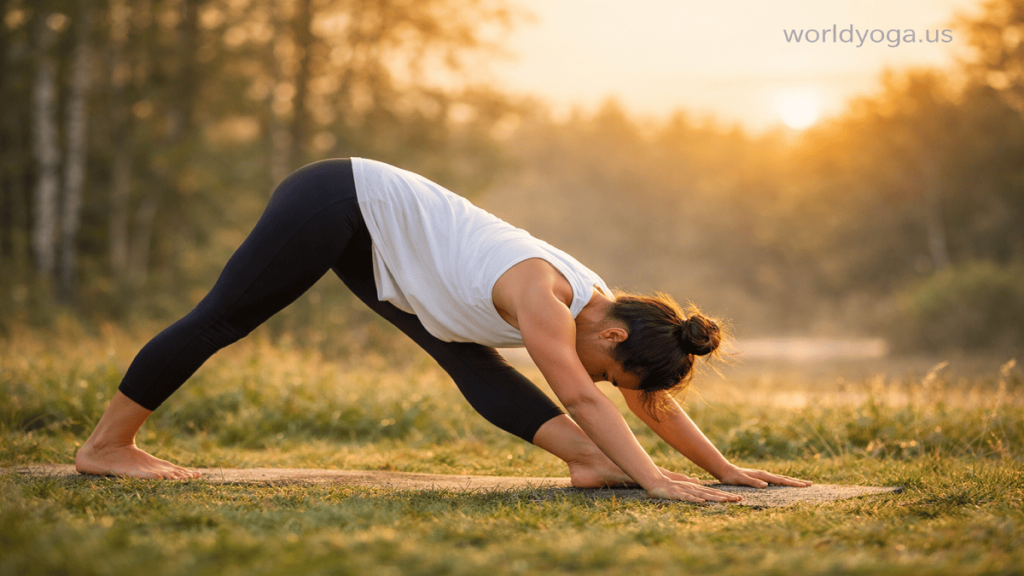
Parsvottanasana (Intense Side Stretch Pose) is a standing forward bend that creates a strong combination of muscular engagement and passive stretching. It works primarily along the posterior chain while simultaneously activating stabilizing muscles in the legs, hips, core, and back to maintain balance and alignment.
One of the primary muscle groups engaged is the hamstrings, located at the back of the thighs. These muscles experience a deep stretch in the front leg as the torso folds forward, helping improve flexibility and reduce tightness caused by prolonged sitting or repetitive activity. The calf muscles, particularly the gastrocnemius and soleus, are also stretched and engaged to stabilize the ankle and support grounding of the feet.
In the quadriceps, especially in both the front and back legs, there is active engagement to stabilize the knee joints. The front leg’s quadriceps help control the forward hinge and prevent hyperextension, while the back leg’s quadriceps maintain a strong, straight stance. This dual engagement contributes to overall lower-body strength and joint stability.
The gluteal muscles play a key stabilizing role, particularly in maintaining hip alignment. The gluteus medius and gluteus maximus help square the hips toward the front of the mat, preventing rotation and ensuring balanced stretching on both sides of the pelvis. This engagement is essential for protecting the lower back and maintaining pelvic control.
The core muscles, including the rectus abdominis, obliques, and transverse abdominis, are actively engaged throughout the pose. They stabilize the spine during the forward fold and help control the descent of the torso. A strong core ensures that movement originates from the hips rather than collapsing through the lumbar spine, reducing the risk of strain.
The spinal muscles, particularly the erector spinae, are also involved in maintaining spinal length. Even though the body is folding forward, these muscles work isometrically to keep the back extended rather than rounded, supporting safe alignment and posture control.
In the upper body, the shoulder stabilizers, including the trapezius, rhomboids, and deltoids, are lightly engaged depending on arm position. If the hands are placed behind the back in a reverse prayer position, the chest muscles (pectorals) and shoulder flexors are actively stretched, increasing upper-body mobility. When the hands are placed on the floor or shin, the arms assist in balance and support.
According to Yoga Journal, standing forward bends like Parsvottanasana engage both stretching and stabilizing muscle groups, particularly in the hamstrings, hips, and spinal extensors, making them effective for improving flexibility and postural strength Yoga Journal Parsvottanasana Guide. Harvard Health Publishing also notes that yoga-based movements improve muscular strength, balance, and flexibility across multiple muscle groups when practiced consistently Harvard Health Yoga Benefits.
In summary, Parsvottanasana engages the hamstrings, calves, quadriceps, glutes, core stabilizers, spinal muscles, and shoulder stabilizers. This integrated muscle activation makes it a powerful posture for developing full-body strength, flexibility, and alignment awareness.
#Intense Side Stretch Pose in Hyderabad
What preparatory poses help achieve this posture safely?
Parsvottanasana (Intense Side Stretch Pose) requires a combination of hamstring flexibility, hip stability, spinal control, and balance. Because of this, several preparatory yoga poses are commonly practiced to build the necessary strength and mobility before attempting the full posture safely and effectively.
One of the most important preparatory categories is standing hamstring stretches. Poses such as Standing Forward Bend (Uttanasana) help lengthen the entire posterior chain, including the hamstrings, calves, and lower back. This directly prepares the body for the deep forward fold required in Parsvottanasana. Practicing with bent knees initially helps maintain spinal alignment while gradually increasing flexibility.
Another key preparatory pose is Pyramid Pose (a simplified variation of Parsvottanasana itself). It introduces the staggered stance and hip-squaring action in a less intense form. This allows practitioners to become familiar with foot placement, pelvic alignment, and controlled forward hinging without forcing depth.
Low Lunge (Anjaneyasana) is also highly beneficial for opening the hips and strengthening the legs. It helps build stability in the front thigh while gently stretching the hip flexors of the back leg. This is essential because tight hip flexors can restrict proper pelvic alignment in Parsvottanasana.
Cat-Cow Stretch is another foundational preparatory movement. It improves spinal mobility and teaches awareness of spinal extension versus flexion. This is important for ensuring that the forward fold in Parsvottanasana originates from the hips rather than rounding the lower back.
Downward-Facing Dog also plays a supportive role in preparation. It strengthens the shoulders and lengthens the hamstrings simultaneously, building endurance in both upper and lower body muscle chains. This makes it easier to maintain balance and control during the standing forward fold.
Bridge Pose is useful for strengthening the posterior chain, including the glutes, hamstrings, and lower back muscles. This strength supports better hip control and spinal stability in the final posture. It also helps balance the flexibility gained from forward bends with necessary muscular support.
Chair Pose (Utkatasana) is another effective preparatory posture. It builds quadriceps strength and teaches proper knee alignment, both of which are essential for maintaining a stable stance in Parsvottanasana.
According to Yoga Journal, combining hamstring stretches like Uttanasana with alignment-focused poses such as Pyramid Pose is one of the safest ways to prepare for standing forward bends Yoga Journal Parsvottanasana Guide. Harvard Health Publishing also emphasizes that gradual progression through foundational yoga poses improves flexibility, balance, and reduces the risk of injury in advanced postures Harvard Health Yoga Benefits.
In summary, effective preparation for Parsvottanasana includes Uttanasana, Pyramid Pose, Low Lunge, Cat-Cow, Downward-Facing Dog, Bridge Pose, and Chair Pose. Together, these poses develop the flexibility, strength, and alignment awareness needed for a safe and stable Intense Side Stretch Pose.
#Intense Side Stretch Pose in Delhi
What are the benefits and precautions of practicing Intense Side Stretch Pose?
Parsvottanasana (Intense Side Stretch Pose) is a powerful standing forward bend that offers deep benefits for flexibility, strength, and postural alignment. However, like many alignment-intensive yoga postures, it must be practiced with awareness and proper technique to avoid strain or injury.
Benefits of Parsvottanasana
One of the primary benefits of this pose is improved hamstring and calf flexibility. The forward folding action creates a deep stretch along the entire posterior chain, helping reduce stiffness caused by prolonged sitting or limited movement. Over time, this can improve overall lower-body mobility and ease of movement in daily activities.
The pose also strengthens key stabilizing muscles, particularly in the legs and hips. The quadriceps work isometrically to support the knees, while the gluteal muscles help maintain pelvic alignment. This combination enhances lower-body stability and supports better posture.
From a spinal health perspective, Parsvottanasana encourages controlled elongation of the vertebral column. When performed correctly, it reduces compression in the lower back and promotes awareness of spinal alignment. This can be beneficial for individuals with mild postural imbalances due to sedentary habits.
Balance and concentration are also significantly improved. The staggered stance requires focus and neuromuscular coordination, which enhances proprioception (body awareness). This makes the pose useful not only physically but also mentally, as it encourages mindfulness and steady breathing.
According to Yoga Journal, standing forward bends like Parsvottanasana are effective for improving flexibility and calming the nervous system when practiced with proper alignment and breath control Yoga Journal Parsvottanasana Guide.
Precautions and Safety Guidelines
Despite its benefits, Parsvottanasana must be approached with caution. One of the most common risks is overstretching the hamstrings, especially if the practitioner forces the torso too close to the front leg. This can lead to strain or micro-injuries in the muscle tissue. Instead, a gradual approach with slight knee bending is recommended.
Individuals with lower back issues should avoid rounding the spine excessively. The forward fold should originate from the hips, not the lumbar region, to prevent spinal compression. Maintaining a long spine is essential for safety.
Balance-related concerns are also important. Since the pose involves a staggered stance, individuals with ankle instability or balance difficulties should use a wall or yoga blocks for support.
People with hamstring injuries, sciatica, or severe hip tightness should modify the pose or avoid deep forward folding. Overextension in these conditions can worsen discomfort.
According to Harvard Health Publishing, yoga is most beneficial when practiced with proper alignment and gradual progression, as improper form can increase the risk of musculoskeletal strain Harvard Health Yoga Benefits.
Conclusion
Parsvottanasana offers a balanced combination of flexibility, strength, and focus benefits, but it requires mindful execution. When practiced with correct alignment and appropriate modifications, it becomes a safe and effective posture for improving lower-body flexibility, spinal awareness, and overall physical stability.
#Intense Side Stretch Pose in Pune
Case Study of Intense Side Stretch Pose
Background
This case study examines the effects of incorporating Parsvottanasana into a structured yoga routine over a 6-week period. The participant is a 32-year-old software professional with a sedentary lifestyle, reporting tight hamstrings, mild lower back stiffness, and reduced flexibility in the hips due to prolonged sitting (8–10 hours daily).
The intervention involved practicing Parsvottanasana 4 times per week as part of a 25-minute yoga sequence, along with preparatory poses such as Uttanasana (Standing Forward Bend), Low Lunge, and Cat-Cow for mobility and alignment support.
Initial Assessment
At the beginning of the study, the participant demonstrated:
- Limited hamstring flexibility (difficulty maintaining straight legs in forward bends)
- Mild anterior pelvic tilt due to prolonged sitting
- Reduced balance stability in staggered stance positions
- Occasional discomfort in the lower back during forward folding movements
Spinal alignment was compromised during forward bends, with a tendency to round the lower back instead of hinging from the hips.
Intervention Protocol
The practice protocol emphasized:
- Proper foot alignment and hip squaring in Parsvottanasana
- Controlled hip hinge movement instead of spinal rounding
- Use of yoga blocks for support under the hands
- Breath coordination (inhale to lengthen spine, exhale to deepen fold)
- Gradual increase in hold duration from 15 seconds to 45 seconds
The goal was not depth of the fold, but improvement in alignment, stability, and muscular engagement.
Observed Outcomes (After 6 Weeks)
1. Improved Hamstring Flexibility
The participant showed noticeable improvement in posterior chain flexibility, with reduced tightness in hamstrings and calves during forward bends.
2. Better Postural Alignment
There was improved awareness of hip squaring and spinal extension. The participant began initiating movement from the hips rather than the lower back.
3. Increased Core Stability
Core engagement improved significantly, leading to better balance in staggered stance positions and reduced sway during the pose.
4. Reduced Lower Back Discomfort
Mild lower back stiffness reported at baseline decreased, likely due to improved spinal decompression and better movement mechanics.
5. Enhanced Body Awareness
The participant developed stronger proprioception, particularly in maintaining even weight distribution between both legs.
Discussion
The improvements observed align with the biomechanical effects of Parsvottanasana, which integrates hamstring stretching with hip stabilization and spinal alignment training. According to Yoga Journal, standing forward bends are most effective when practiced with emphasis on alignment rather than depth Yoga Journal Parsvottanasana Guide. Similarly, Harvard Health Publishing highlights that consistent yoga practice can improve flexibility, balance, and musculoskeletal function in sedentary individuals Harvard Health Yoga Benefits.
Conclusion
This case study demonstrates that consistent, alignment-focused practice of Parsvottanasana can significantly improve hamstring flexibility, postural alignment, core stability, and lower back comfort. The findings emphasize that gradual progression and correct technique are essential for safe and effective outcomes in standing forward bend postures.
#Intense Side Stretch Pose in Banglore
White Paper of Intense Side Stretch Pose
Abstract
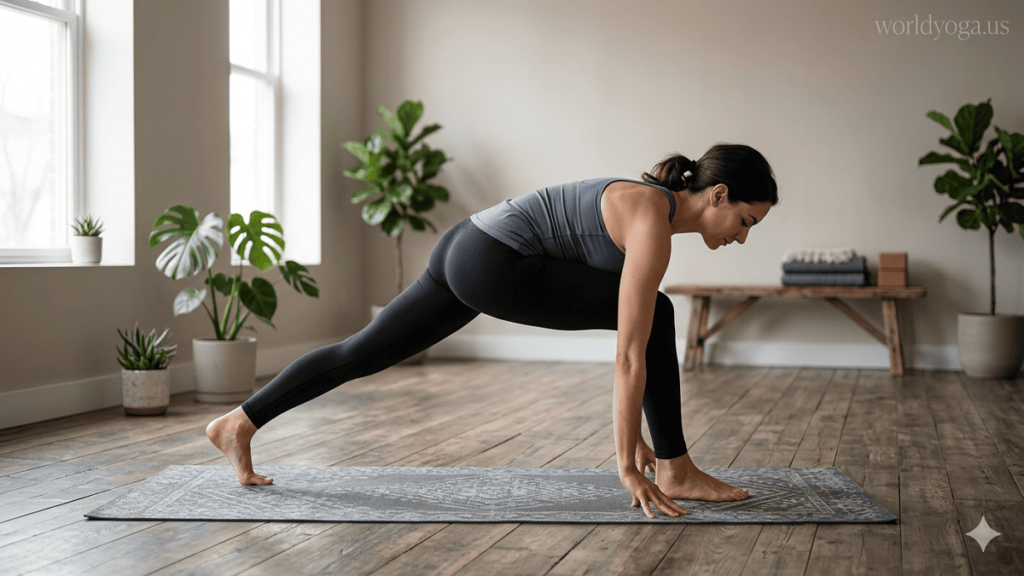
Parsvottanasana is a classical standing forward bend used in traditional and modern yoga systems to improve posterior-chain flexibility, hip stability, and spinal alignment. This white paper presents a structured analysis of its biomechanics, physiological effects, functional applications, and safety considerations. The objective is to provide an evidence-informed overview of its role in movement training, rehabilitation support, and preventive musculoskeletal health.
1. Introduction
Parsvottanasana, derived from Sanskrit meaning “intense side stretch posture,” is a unilateral standing forward bend performed in a staggered stance. It is widely used in Hatha and Vinyasa yoga sequences to develop hamstring flexibility, improve postural awareness, and enhance balance. The posture is particularly relevant in modern sedentary populations due to its corrective effects on tight posterior-chain musculature and reduced hip mobility.
2. Biomechanical Analysis
The posture creates a closed kinetic chain in the lower body, combining stability and flexibility demands. Key biomechanical actions include:
- Hip flexion driven from a controlled hinge rather than spinal collapse
- Isometric contraction of quadriceps to stabilize knee joints
- Eccentric stretching of hamstrings and gastrocnemius
- Engagement of gluteal muscles to maintain pelvic alignment
- Spinal extensors working isometrically to preserve neutral spine
This integrated muscle activation improves neuromuscular coordination and enhances movement efficiency across functional tasks.
3. Physiological and Functional Benefits
The primary physiological effect is posterior-chain lengthening combined with core stabilization. This helps reduce muscular imbalances caused by prolonged sitting.
Key benefits include:
- Improved hamstring and calf flexibility
- Enhanced hip stability and pelvic control
- Better spinal decompression and postural alignment
- Increased balance, proprioception, and body awareness
- Support for functional movement patterns such as walking and bending
According to Yoga Journal, standing forward bends like Parsvottanasana are most effective when alignment and spinal extension are prioritized over depth of stretch Yoga Journal Parsvottanasana Guide.
Harvard Health Publishing also notes that consistent yoga practice contributes to improved flexibility, strength, and balance, particularly in sedentary populations Harvard Health Yoga Benefits.
4. Applications Across Domains
4.1 Fitness and Yoga Training
Used in yoga sequencing to develop hamstring flexibility and improve alignment awareness.
4.2 Physiotherapy and Rehabilitation
Applied as a controlled mobility exercise for mild lower back stiffness and postural correction.
4.3 Workplace Wellness Programs
Integrated into short mobility breaks to counteract prolonged sitting and reduce musculoskeletal fatigue.
4.4 Sports Conditioning
Supports lower-body flexibility, balance, and injury prevention in running, cycling, and field sports.
5. Safety Considerations
Despite its benefits, Parsvottanasana requires careful execution:
- Avoid excessive rounding of the lower back
- Do not force chest toward the knee
- Modify stance width for balance issues
- Use blocks or support for reduced flexibility
- Avoid overstretching hamstrings in injury-prone individuals
Proper progression and alignment-focused practice are essential to prevent strain.
6. Conclusion
Parsvottanasana is a highly effective posture for improving flexibility, postural alignment, and neuromuscular control. Its biomechanical efficiency and adaptability make it valuable across fitness, rehabilitation, and wellness domains. When practiced with correct alignment principles and gradual progression, it serves as a safe and functional tool for enhancing overall movement quality and musculoskeletal health.
#Intense Side Stretch Pose in Kolkata
Industry Application of Intense Side Stretch Pose
Parsvottanasana is increasingly used beyond traditional yoga practice, with applications spanning fitness training, physiotherapy, corporate wellness, sports conditioning, and digital health platforms. Its combination of hamstring flexibility, hip stability, and spinal alignment makes it a versatile movement pattern suitable for multiple professional domains focused on physical performance and preventive health.
1. Fitness and Yoga Training Industry
In fitness studios and yoga schools, Parsvottanasana is commonly included in standing sequence flows such as Hatha and Vinyasa yoga. It is used to develop posterior-chain flexibility while reinforcing alignment principles such as hip squaring and spinal extension. Fitness instructors also integrate it into mobility circuits and functional training programs to improve lower-body range of motion and balance. Its scalability allows modifications for beginners using blocks, while advanced practitioners can deepen the posture with arm variations like reverse prayer.
2. Physiotherapy and Rehabilitation
In rehabilitation settings, Parsvottanasana is applied as a controlled stretching exercise for patients with mild hamstring tightness, lower back stiffness, and postural imbalances. Physiotherapists often use it to retrain hip-hinge mechanics, which are essential for safe bending and lifting in daily life. When appropriately modified, it supports recovery from sedentary-related musculoskeletal issues by improving neuromuscular control and spinal awareness. According to Harvard Health Publishing, yoga-based interventions can support flexibility and functional recovery when performed consistently and with proper alignment Harvard Health Yoga Benefits.
3. Corporate Wellness Programs
Corporate wellness initiatives increasingly incorporate standing forward bends like Parsvottanasana to counteract the effects of prolonged sitting. Employees in desk-based jobs benefit from improved hamstring flexibility, reduced lower back stiffness, and enhanced circulation. Short guided sessions during breaks help improve focus and reduce physical fatigue. The posture is particularly effective in workplace yoga routines because it requires minimal space and no equipment.
4. Sports Performance and Athletic Conditioning
In sports training, Parsvottanasana is used to improve flexibility in the hamstrings, calves, and hips—key muscle groups involved in running, cycling, and field sports. It also enhances balance and proprioception, which are critical for injury prevention and performance efficiency. Athletes use it during warm-up and cooldown phases to maintain muscular elasticity and reduce post-exercise stiffness.
5. Digital Health and Fitness Technology
With the rise of mobile fitness apps and AI-driven coaching platforms, Parsvottanasana is frequently used as a benchmark posture for alignment analysis. Motion-tracking systems evaluate hip symmetry, spinal extension, and weight distribution to provide real-time feedback. This enables users to correct form remotely and safely. Yoga Journal emphasizes that correct alignment, rather than depth, is the key factor in the effectiveness of standing forward bends Yoga Journal Parsvottanasana Guide.
Conclusion
Parsvottanasana has strong multi-industry relevance due to its adaptability, low equipment requirement, and wide-ranging physical benefits. Its application in fitness, rehabilitation, workplace wellness, sports training, and digital health highlights its value as a functional movement tool for improving flexibility, posture, and overall musculoskeletal health.
#Intense Side Stretch Pose in Mumbai
Ask FAQs
What is Parsvottanasana used for?
Parsvottanasana is used to improve hamstring flexibility, strengthen the legs, and enhance spinal alignment. It also helps develop balance, posture awareness, and controlled movement through a deep standing forward bend.
Is Intense Side Stretch Pose suitable for beginners?
Yes, beginners can practice it with modifications such as using yoga blocks or slightly bending the front knee. The focus should be on maintaining a long spine and proper hip alignment rather than achieving a deep forward fold.
What are the main benefits of Parsvottanasana?
Regular practice improves flexibility in the hamstrings and calves, strengthens the quadriceps and hips, and supports better posture. It also enhances balance, concentration, and body awareness when practiced with steady breathing.
What precautions should be taken while performing this pose?
Avoid rounding the lower back or forcing the torso too close to the front leg. Individuals with hamstring injuries, lower back pain, or balance issues should use support and practice under guidance. Proper alignment is essential to prevent strain.
How long should I hold Parsvottanasana?
Beginners typically hold the pose for 15–30 seconds on each side, while advanced practitioners may hold it longer depending on comfort and stability. The key is maintaining correct alignment and steady breathing throughout the hold.
Table of Contents
Disclaimer:
The information provided about Parsvottanasana is for educational purposes only and is not a substitute for professional medical advice. Individuals with injuries, medical conditions, or physical limitations should consult a qualified healthcare provider or certified yoga instructor before practicing.