Vishama Pada Prapada Parshvottanasana
Vishama Pada Prapada Parshvottanasana is an advanced standing yoga posture that combines balance, flexibility, concentration, and muscular control. Derived from Sanskrit terminology, “Vishama” means uneven or asymmetrical, “Pada” refers to the foot, “Prapada” relates to the ball of the foot or raised heel position, and “Parshvottanasana” translates to Intense Side Stretch Pose. This variation introduces an uneven foot placement that increases the challenge of balance and stability while deepening the stretch through the lower body.
The posture is commonly practiced in advanced Hatha and Vinyasa yoga sequences where precision, alignment, and controlled breathing are emphasized. Unlike the traditional Parshvottanasana, this variation requires greater engagement of the stabilizing muscles in the ankles, legs, hips, and core due to the altered weight distribution and elevated heel positioning. As a result, the pose enhances coordination, body awareness, and neuromuscular control.
Vishama Pada Prapada Parshvottanasana primarily stretches the hamstrings, calves, hips, and spine while simultaneously strengthening the legs and core muscles. The asymmetrical stance also challenges pelvic alignment and postural stability, making the posture beneficial for improving balance and mobility. Additionally, the forward-folding movement encourages spinal elongation and promotes flexibility throughout the posterior chain of the body.
The pose is often included in advanced yoga practices to help practitioners develop focus and mental discipline. Maintaining stability while holding the posture requires mindful breathing and concentration, which can contribute to greater mental clarity and relaxation. From a physical perspective, regular practice may support improved posture, increased flexibility, and better functional movement patterns.
Because Vishama Pada Prapada Parshvottanasana is an advanced variation, adequate preparation is important before attempting the full posture. Foundational poses such as Parsvottanasana, Downward-Facing Dog, Warrior I, and standing forward bends are commonly practiced beforehand to warm up the hamstrings, hips, and shoulders. Practitioners should focus on proper alignment rather than depth to avoid strain in the lower back, knees, or hamstrings.
Individuals with balance limitations, acute injuries, or severe muscular tightness should approach the posture cautiously and may benefit from practicing with yoga props or under professional guidance. Gradual progression and controlled breathing are essential for safe and effective practice.
Today, Vishama Pada Prapada Parshvottanasana is recognized not only as a flexibility-focused posture but also as a valuable practice for enhancing stability, posture, concentration, and overall body awareness within advanced yoga training.
For additional yoga posture references and alignment guidance, visit Yoga Journal and Tummee Yoga Guide.
#Vishama Pada Prapada Parshvottanasana in India
How is Vishama Pada Prapada Parshvottanasana performed correctly?
Vishama Pada Prapada Parshvottanasana is an advanced variation of Intense Side Stretch Pose that emphasizes asymmetrical balance, flexibility, and lower-body stability. The posture requires careful alignment, controlled breathing, and mindful muscular engagement to ensure safe and effective practice. Because of the uneven foot positioning and forward-folding movement, proper technique is essential to avoid unnecessary strain on the hamstrings, lower back, knees, and ankles.
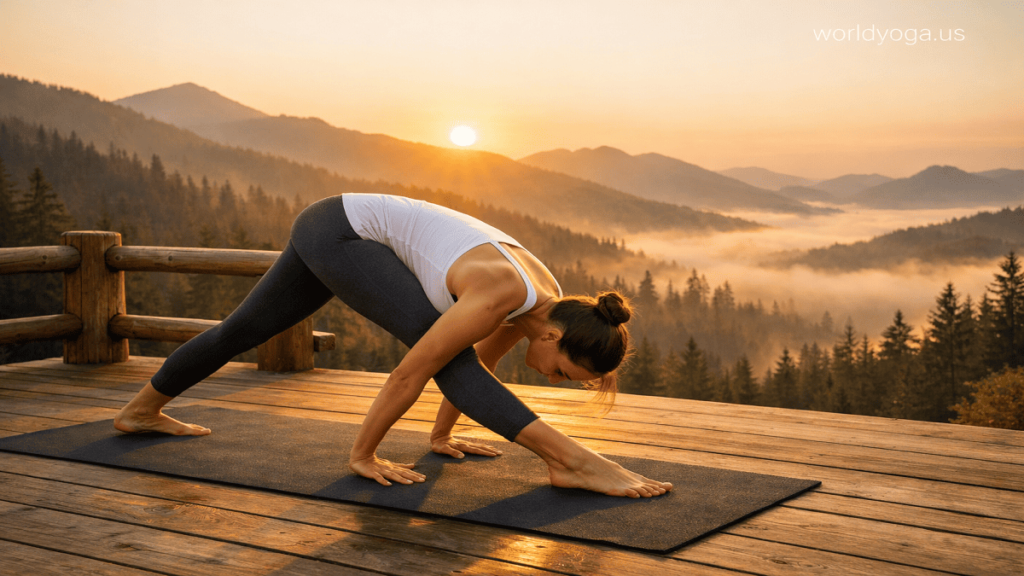
To begin the posture, stand upright in Tadasana (Mountain Pose) with the spine elongated and the body balanced evenly on both feet. Step one foot backward approximately three to four feet while keeping the front foot facing directly forward. In this variation, the back heel is lifted so that the practitioner balances on the ball of the back foot, creating an uneven or asymmetrical stance. This elevated heel position significantly increases the challenge of balance and muscular stabilization.
Both hips should face forward toward the front leg. Squaring the pelvis is important for maintaining proper alignment and achieving an effective stretch through the hamstrings and hips. Engage the thigh muscles and activate the core to support stability throughout the posture.
Place the hands on the hips, in prayer position, or behind the back depending on flexibility and experience level. Inhale deeply and lengthen the spine upward through the crown of the head. As you exhale, hinge forward slowly from the hips while maintaining a straight spine. Avoid collapsing the chest or rounding the back during the fold.
The torso gradually extends over the front leg while the back leg remains active and lifted through the heel. The front knee should remain straight but not locked. A slight micro-bend may help protect the joint while maintaining muscular engagement. The practitioner should focus on distributing body weight evenly and maintaining balance despite the asymmetrical foot position.
Breathing should remain smooth and controlled throughout the pose. Each inhalation helps create length in the spine, while each exhalation allows the body to deepen naturally into the stretch without force. The neck should remain relaxed and aligned with the spine rather than strained upward or downward.
To exit the posture safely, engage the core muscles and slowly lift the torso back to an upright position while inhaling. Step the back foot forward and return to Tadasana before repeating the pose on the opposite side.
Proper preparation is important before attempting Vishama Pada Prapada Parshvottanasana. Preparatory poses such as Downward-Facing Dog, Pyramid Pose, Warrior I, and standing hamstring stretches help warm up the muscles and improve mobility.
Practitioners should avoid forcing flexibility or sacrificing alignment for depth. Beginners and individuals with balance limitations may practice near a wall or use yoga blocks for additional support. Consistent and mindful practice improves flexibility, posture, coordination, and concentration over time.
For detailed yoga posture guidance and alignment references, visit Yoga Journal and Tummee Yoga Guide.
#Vishama Pada Prapada Parshvottanasana in Maharashtra
What is the proper alignment in this asymmetrical Intense Side Stretch variation?
Proper alignment in Vishama Pada Prapada Parshvottanasana is essential for maintaining balance, protecting the joints, and achieving the full benefits of this advanced asymmetrical Intense Side Stretch variation. Because the pose combines a forward fold with uneven foot positioning and a lifted back heel, alignment plays a critical role in stability, flexibility, and muscular engagement.
The posture begins with establishing a strong and balanced foundation. The front foot should point directly forward while remaining firmly grounded through the heel, ball of the foot, and toes. The back foot is positioned several feet behind with the heel lifted, balancing on the ball of the foot. This asymmetrical stance increases the demand on the stabilizing muscles of the ankles, calves, and legs. The back leg should remain active and extended throughout the pose.
Hip alignment is one of the most important aspects of Vishama Pada Prapada Parshvottanasana. Both hips should square toward the front leg rather than opening to the side. Drawing the front hip slightly backward and the back hip forward helps maintain pelvic stability and creates a deeper stretch through the hamstrings and hips. Proper hip positioning also reduces strain on the lower back.
The spine should remain elongated during the forward fold. Instead of rounding the upper back or collapsing the chest, practitioners should hinge forward from the hips while extending the torso over the front leg. Maintaining spinal length protects the lumbar region and improves posture. The chest should remain broad and lifted even while folding forward.
Core engagement is essential for balance and stability. Activating the abdominal muscles helps support the spine and prevents excessive pressure on the lower back. A strong core also assists in maintaining control over the asymmetrical stance and prevents wobbling or instability.
The front leg should remain straight but not hyperextended. Locking the knee can place unnecessary stress on the joint and reduce muscular activation. A slight micro-bend may help maintain safe alignment while keeping the thigh muscles engaged. The back leg should remain strong and energized with the heel actively reaching backward.
Shoulder alignment depends on the arm variation being practiced. If the hands are placed on the hips or in prayer position, the shoulders should stay relaxed and away from the ears. In more advanced variations involving a bind, the chest should remain open while avoiding tension in the neck and shoulders.
The neck should stay neutral and aligned with the spine. Practitioners should avoid straining to look upward or forcing the head toward the shin. The gaze can remain softly downward to help maintain balance and relaxation.
Breathing supports proper alignment throughout the pose. Inhalations lengthen the spine and create space in the torso, while exhalations deepen the forward fold gradually and safely. Controlled breathing also improves concentration and body awareness.
Consistent focus on alignment in Vishama Pada Prapada Parshvottanasana helps improve flexibility, posture, balance, and muscular coordination while minimizing the risk of injury.
For additional alignment guidance and yoga posture references, visit Yoga Journal and Tummee Yoga Guide.
#Vishama Pada Prapada Parshvottanasana in Ahemadabad
Which muscles are engaged during the posture?
Vishama Pada Prapada Parshvottanasana is an advanced asymmetrical variation of Intense Side Stretch Pose that requires balance, flexibility, stability, and muscular coordination. Due to the uneven foot positioning and lifted back heel, the posture activates multiple muscle groups simultaneously while also creating deep stretches throughout the body. Understanding which muscles are engaged during the pose helps practitioners improve alignment, body awareness, and safe execution.
One of the primary muscle groups involved is the hamstrings. The hamstrings of the front leg experience an intense stretch while also working eccentrically to stabilize the body during the forward fold. This muscular engagement improves flexibility and supports proper hip movement throughout the posture.
The quadriceps are strongly activated to support the legs and protect the knee joints. The front thigh muscles help maintain leg extension without hyperextending the knee, while the back quadriceps stabilize the lifted heel position and support balance. Engaging the quadriceps also assists in creating length through the hamstrings.
The calf muscles, particularly the gastrocnemius and soleus, are heavily engaged because the back heel remains elevated. Balancing on the ball of the back foot requires continuous muscular activation in the calves and ankles, improving lower-leg strength and stability.
The gluteal muscles and hip stabilizers play an essential role in maintaining pelvic alignment. The gluteus maximus, gluteus medius, and smaller stabilizing muscles around the hips work together to square the pelvis and prevent rotational imbalance. These muscles also help maintain balance in the asymmetrical stance.
Core muscles are significantly engaged throughout Vishama Pada Prapada Parshvottanasana. The abdominal muscles, including the transverse abdominis, obliques, and rectus abdominis, stabilize the torso and support spinal alignment during the forward fold. Strong core engagement helps prevent collapsing into the lower back and improves overall control in the posture.
The spinal muscles, especially the erector spinae, remain active to keep the spine elongated rather than rounded. These muscles support posture and help maintain proper extension through the torso as the body folds over the front leg.
Depending on the arm variation, the shoulders and upper back muscles may also be engaged. If the hands are bound behind the back or held in prayer position, muscles such as the deltoids, trapezius, rhomboids, and rotator cuff muscles contribute to shoulder stabilization and chest opening.
The muscles of the feet and ankles continuously activate to maintain balance and distribute body weight evenly. Since the pose challenges asymmetrical stability, these smaller stabilizing muscles work constantly to prevent loss of balance.
Overall, Vishama Pada Prapada Parshvottanasana develops a combination of strength, flexibility, balance, and coordination. The integrated muscular engagement improves functional movement patterns and postural awareness while enhancing lower-body endurance and spinal stability.
For additional yoga anatomy and posture guidance, visit Yoga Anatomy and Tummee Yoga Guide.
#Vishama Pada Prapada Parshvottanasana in Hyderabad
What preparatory poses are recommended before practicing it?
Vishama Pada Prapada Parshvottanasana is an advanced asymmetrical standing yoga posture that requires balance, hamstring flexibility, hip stability, spinal elongation, and strong muscular control. Because the pose involves a forward fold combined with uneven foot positioning and a lifted back heel, proper preparation is essential for safe and effective practice. Performing suitable preparatory poses helps warm up the muscles, improve mobility, and enhance body awareness before attempting the full posture.
One of the most important preparatory poses is Adho Mukha Svanasana (Downward-Facing Dog). This posture stretches the hamstrings, calves, shoulders, and spine while strengthening the arms and legs. It also improves overall body alignment and prepares the practitioner for forward-folding movements.
Parsvottanasana (Pyramid Pose) is considered the primary foundation for Vishama Pada Prapada Parshvottanasana. Practicing the traditional version helps develop hamstring flexibility, hip alignment, and spinal extension without the added challenge of asymmetrical balance. It also teaches proper forward-folding mechanics and lower-body engagement.
Uttanasana (Standing Forward Fold) is highly effective for warming up the hamstrings and lower back. The posture encourages hip hinging and spinal lengthening, both of which are essential in advanced standing forward bends. Practicing Uttanasana regularly can improve flexibility and reduce stiffness in the posterior chain.
Virabhadrasana I (Warrior I) helps strengthen the legs, improve balance, and open the hip flexors. Since Vishama Pada Prapada Parshvottanasana requires pelvic stability and lower-body endurance, Warrior I serves as an excellent preparation pose for building strength and alignment awareness.
Anjaneyasana (Low Lunge) is beneficial for opening the hips, quadriceps, and hip flexors. Tight hip flexors can restrict movement and affect pelvic alignment during asymmetrical standing poses. This posture also supports balance and spinal extension.
Prasarita Padottanasana (Wide-Legged Forward Fold) stretches the hamstrings, inner thighs, and spine while improving lower-body flexibility. It also helps practitioners become more comfortable with weight distribution during standing forward bends.
Ardha Hanumanasana (Half Splits Pose) specifically targets hamstring flexibility and calf mobility. Since Vishama Pada Prapada Parshvottanasana creates an intense stretch in the front leg, practicing Half Splits helps prepare the muscles gradually and safely.
Balancing poses such as Vrksasana (Tree Pose) can also be helpful. Because Vishama Pada Prapada Parshvottanasana challenges asymmetrical stability, balance-focused postures improve ankle strength, concentration, and neuromuscular coordination.
In addition to physical preparation, breath awareness is important before attempting advanced yoga postures. Slow and controlled breathing during warm-up sequences helps improve concentration, circulation, and muscular relaxation.
Practitioners should avoid rushing into the full expression of the posture. Gradual progression through preparatory poses allows the body to adapt safely while improving flexibility, stability, and alignment over time.
For additional yoga sequencing and posture guidance, visit Yoga Journal and Tummee Yoga Guide.
#Vishama Pada Prapada Parshvottanasana in Banglore
What are the benefits and precautions of Vishama Pada Prapada Parshvottanasana?
Vishama Pada Prapada Parshvottanasana is an advanced asymmetrical variation of Intense Side Stretch Pose that combines balance, flexibility, muscular strength, and focused concentration. The posture challenges the body through uneven foot positioning and a deep forward fold, making it highly effective for improving stability, coordination, and postural control. When practiced correctly, the pose offers numerous physical and mental benefits, but it also requires careful attention to alignment and safety precautions.
One of the primary benefits of Vishama Pada Prapada Parshvottanasana is the deep stretch it provides to the hamstrings, calves, hips, and spine. The forward-folding movement lengthens the posterior muscles of the body and improves overall flexibility. Regular practice can help reduce muscular stiffness caused by prolonged sitting, limited mobility, or repetitive physical activity.
The posture also strengthens the legs, ankles, and core muscles. Because the back heel remains lifted, the stabilizing muscles of the calves and ankles work continuously to maintain balance. The thighs and abdominal muscles remain actively engaged throughout the pose, improving lower-body endurance and core stability.
Another significant benefit is improved balance and coordination. The asymmetrical stance challenges proprioception, which enhances body awareness and neuromuscular control. This makes the posture beneficial for developing functional balance and postural efficiency.
Vishama Pada Prapada Parshvottanasana also promotes spinal elongation and postural correction. Maintaining a long spine during the forward fold strengthens the supporting spinal muscles and encourages proper alignment. This can help counteract poor posture associated with sedentary lifestyles and extended desk work.
From a mental perspective, the posture encourages concentration, mindfulness, and breath awareness. Holding balance while maintaining controlled breathing requires focus and calmness, which may help reduce mental stress and improve clarity during yoga practice.
Despite its benefits, the posture requires several important precautions. One of the main risks involves overstretching the hamstrings or straining the lower back. Practitioners should avoid forcing the forward fold and instead prioritize spinal length and controlled movement. Rounding the back or collapsing into the posture may increase the risk of muscular strain.
Individuals with ankle instability or balance disorders should practice cautiously because the lifted back heel creates additional instability. Practicing near a wall or using yoga blocks for support may help improve safety during the learning process.
People with hamstring injuries, severe lower back pain, sciatica, knee problems, or recent hip injuries should avoid the pose or modify it under professional supervision. Those with high blood pressure or dizziness should also practice carefully, as forward bends may affect balance and circulation.
Beginners should not rush into the full expression of Vishama Pada Prapada Parshvottanasana. Proper preparation through foundational poses and gradual progression is essential for safe practice. Controlled breathing, mindful alignment, and muscular engagement are key to receiving the benefits of the posture while minimizing injury risk.
With consistent and careful practice, Vishama Pada Prapada Parshvottanasana can improve flexibility, balance, stability, posture, and overall body awareness.
For additional yoga safety and alignment guidance, visit Yoga Journal and Yoga Anatomy.
#Vishama Pada Prapada Parshvottanasana in Delhi
Case Study of Vishama Pada Prapada Parshvottanasana
Vishama Pada Prapada Parshvottanasana is an advanced asymmetrical standing yoga posture designed to improve balance, flexibility, postural stability, and muscular coordination. This case study examines the effects of consistent practice of the posture on flexibility, balance, and postural awareness in an intermediate-level yoga practitioner over an eight-week training period.
The study focuses on how the pose contributed to physical mobility, lower-body stability, and improved body awareness while also identifying challenges encountered during the progression process.
Background of the Practitioner
The subject was a 33-year-old office professional with moderate yoga experience and a sedentary work lifestyle. The practitioner reported:
- Tight hamstrings and calves
- Mild lower back stiffness
- Reduced ankle stability
- Difficulty maintaining balance in asymmetrical standing poses
Although the individual practiced yoga regularly for approximately one year, advanced balancing forward bends remained challenging due to limited flexibility and lower-body instability.
The primary objective of introducing Vishama Pada Prapada Parshvottanasana into the yoga routine was to improve:
- Hamstring flexibility
- Balance and coordination
- Core strength
- Hip alignment
- Postural awareness
Practice Methodology
The practitioner followed a guided yoga program five days per week for eight weeks. Each session included preparatory poses such as:
- Downward-Facing Dog
- Pyramid Pose
- Warrior I
- Standing Forward Fold
- Tree Pose
- Low Lunge
During the initial phase, the practitioner used modifications including:
- Shortening the stance
- Using yoga blocks for support
- Practicing near a wall for balance assistance
- Maintaining a partial forward fold rather than maximum depth
The posture was held for 20 to 30 seconds on each side with emphasis on controlled breathing, spinal elongation, and hip alignment.
Observed Results
By the fourth week, the practitioner demonstrated noticeable improvements in lower-body flexibility and postural stability. Hamstring tightness decreased significantly, and ankle control improved during balancing movements.
At the conclusion of the eight-week program, the following improvements were recorded:
- Increased hamstring and calf flexibility
- Improved ankle strength and balance
- Better pelvic alignment during standing poses
- Reduced lower back stiffness
- Enhanced core activation and postural awareness
- Improved concentration and breath control during practice
The practitioner also reported increased confidence in performing advanced standing yoga postures.
Challenges Encountered
The most common challenge during the early stages was maintaining stability with the lifted back heel. Muscle fatigue in the calves and ankles occurred frequently during the first two weeks.
The practitioner also struggled to maintain spinal length while folding forward. This issue was corrected through slower transitions, increased core engagement, and reduced range of motion.
Minor hamstring soreness was experienced during the adaptation phase, emphasizing the importance of gradual progression and proper warm-up.
Conclusion
This case study demonstrates that regular and mindful practice of Vishama Pada Prapada Parshvottanasana can improve flexibility, balance, muscular coordination, and postural control. The asymmetrical nature of the posture proved particularly effective for developing lower-body stability and body awareness.
#Vishama Pada Prapada Parshvottanasana in Pune
White Paper of Vishama Pada Prapada Parshvottanasana
Introduction
Vishama Pada Prapada Parshvottanasana is an advanced asymmetrical variation of Parshvottanasana (Intense Side Stretch Pose) practiced within traditional Hatha and contemporary Vinyasa yoga systems. The posture combines forward flexion, asymmetrical balance, lower-body stabilization, and spinal elongation, making it a complex and highly integrative movement pattern.
The Sanskrit terminology reflects the structural nature of the posture: “Vishama” refers to unevenness or asymmetry, “Pada” means foot, “Prapada” indicates the ball of the foot or lifted heel positioning, and “Parshvottanasana” translates to Intense Side Stretch Pose. This variation differs from the classical form by elevating the back heel, thereby increasing balance demands, muscular activation, and proprioceptive engagement.
This white paper explores the biomechanical, physiological, therapeutic, and functional applications of Vishama Pada Prapada Parshvottanasana within modern yoga, movement science, and wellness practices.
Anatomical and Biomechanical Analysis
Vishama Pada Prapada Parshvottanasana primarily targets the posterior kinetic chain while simultaneously challenging lower-body stabilization systems. The posture involves:
- Hip flexion
- Ankle plantar flexion
- Spinal extension and elongation
- Core stabilization
- Dynamic balance control
Major muscles engaged include:
- Hamstrings
- Quadriceps
- Gastrocnemius and soleus
- Gluteal muscles
- Hip stabilizers
- Core musculature
- Erector spinae
The elevated back heel shifts body weight onto the forefoot, increasing activation in the calf muscles, ankle stabilizers, and intrinsic foot muscles. This asymmetrical loading pattern enhances neuromuscular coordination and proprioceptive awareness.
Proper pelvic alignment is biomechanically critical. Anterior pelvic rotation combined with spinal elongation allows safe forward folding while minimizing lumbar compression and hamstring overstretching.
Physiological Benefits
Consistent practice of Vishama Pada Prapada Parshvottanasana may contribute to several physiological improvements, including:
- Increased hamstring and calf flexibility
- Enhanced lower-body stability
- Improved balance and coordination
- Greater spinal mobility
- Core strengthening
- Postural correction
The balance component stimulates proprioceptive pathways and neuromuscular control systems, which may improve movement efficiency and injury prevention capabilities.
Controlled breathing during the posture also promotes parasympathetic nervous system activation, supporting mental focus, relaxation, and breath regulation.
Functional and Therapeutic Applications
Vishama Pada Prapada Parshvottanasana has applications across yoga therapy, athletic conditioning, mobility training, and functional movement education.
Potential therapeutic uses include:
- Improving postural awareness
- Addressing muscular stiffness from sedentary lifestyles
- Enhancing lower-limb coordination
- Supporting balance rehabilitation
- Increasing movement efficiency
Athletes and movement practitioners may use the posture to improve flexibility, ankle stability, and muscular endurance required in dynamic physical activities.
In therapeutic environments, modifications and progressive sequencing are essential to ensure safety and accessibility.
Risks and Contraindications
Despite its benefits, the posture presents several biomechanical risks when performed without adequate preparation or alignment awareness.
Potential risks include:
- Hamstring strain
- Ankle instability
- Lower back compression
- Knee hyperextension
- Loss of balance
Individuals with severe hamstring injuries, ankle instability, sciatica, acute spinal conditions, or balance disorders should avoid or modify the posture under professional supervision.
Proper warm-up, gradual progression, and alignment-focused instruction are strongly recommended.
Conclusion
Vishama Pada Prapada Parshvottanasana represents a sophisticated integration of flexibility, balance, muscular activation, and neuromuscular coordination. Its asymmetrical structure makes it particularly effective for improving stability, proprioception, and postural control within advanced yoga practice.
#Vishama Pada Prapada Parshvottanasana in Kolkata
Industry Application of Vishama Pada Prapada Parshvottanasana
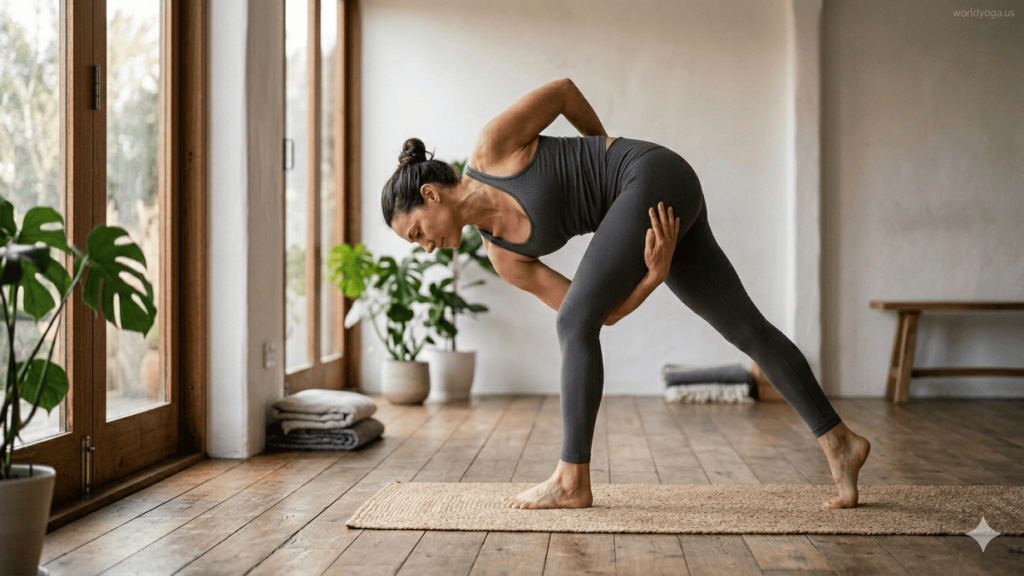
Vishama Pada Prapada Parshvottanasana is an advanced asymmetrical standing yoga posture that combines flexibility, balance, muscular control, and postural alignment. While traditionally practiced within Hatha and Vinyasa yoga systems, the posture has gained broader relevance across industries focused on wellness, rehabilitation, fitness, athletic conditioning, and workplace health. As organizations increasingly prioritize mobility training, injury prevention, and holistic wellness, advanced yoga postures such as Vishama Pada Prapada Parshvottanasana are becoming integrated into modern movement and health programs.
Application in the Fitness Industry
The global fitness industry increasingly incorporates yoga-based movement patterns into strength, mobility, and recovery training programs. Vishama Pada Prapada Parshvottanasana is particularly valued for its ability to improve lower-body flexibility, balance, and core stability.
Fitness professionals use the posture to:
- Improve hamstring and calf flexibility
- Develop ankle and hip stability
- Enhance functional movement patterns
- Increase core engagement and balance
- Support mobility-focused strength training
The asymmetrical stance and lifted heel positioning create a dynamic challenge that improves neuromuscular coordination and muscular endurance. Advanced yoga studios and functional training centers often include this posture in mobility and balance-focused classes.
Corporate Wellness Programs
Sedentary work environments contribute to postural dysfunction, reduced flexibility, and lower-body stiffness. Corporate wellness initiatives increasingly integrate yoga practices to address workplace-related musculoskeletal issues and improve employee well-being.
Vishama Pada Prapada Parshvottanasana can support corporate wellness programs by:
- Improving posture and spinal alignment
- Reducing stiffness caused by prolonged sitting
- Enhancing concentration and body awareness
- Strengthening stabilizing muscles
- Supporting stress reduction through breath-focused movement
Organizations implementing workplace wellness strategies often include guided yoga sessions to improve employee productivity, mobility, and mental focus.
Sports Performance and Athletic Conditioning
Athletes and sports performance specialists use advanced yoga postures to enhance flexibility, balance, and recovery. Vishama Pada Prapada Parshvottanasana is especially beneficial for sports requiring lower-body coordination, ankle stability, and hamstring mobility.
Applications in sports training include:
- Flexibility enhancement for runners and cyclists
- Balance development for martial artists and dancers
- Injury prevention through mobility training
- Core strengthening for dynamic movement control
- Ankle stabilization for athletic performance
The posture is commonly incorporated into recovery sessions and cross-training programs designed to improve movement efficiency and reduce muscular imbalance.
Rehabilitation and Physical Therapy
Modified variations of Vishama Pada Prapada Parshvottanasana may be used in rehabilitation and therapeutic movement programs under professional supervision. Physical therapists and yoga therapists utilize controlled asymmetrical movements to improve coordination, flexibility, and lower-limb stability.
Potential rehabilitation applications include:
- Balance retraining
- Mobility restoration
- Postural correction
- Functional movement rehabilitation
- Controlled hamstring flexibility development
Therapeutic application requires careful progression and individualized assessment to avoid overstretching or instability.
Wellness Tourism and Yoga Retreats
The wellness tourism industry continues to expand globally, with yoga retreats and holistic wellness centers offering advanced yoga training experiences. Vishama Pada Prapada Parshvottanasana is frequently included in advanced flexibility and balance workshops at wellness retreats.
Countries such as India, Thailand, and Indonesia remain major destinations for yoga tourism and advanced yoga education programs.
Conclusion
Vishama Pada Prapada Parshvottanasana has evolved beyond traditional yoga practice into a valuable movement tool across multiple industries. Its applications in fitness, corporate wellness, sports conditioning, rehabilitation, and wellness tourism demonstrate the increasing role of yoga in modern health and performance systems.
#Vishama Pada Prapada Parshvottanasana in Mumbai
Ask FAQs
What is Vishama Pada Prapada Parshvottanasana?
Vishama Pada Prapada Parshvottanasana is an advanced asymmetrical variation of Intense Side Stretch Pose. It combines a forward fold with uneven foot positioning and a lifted back heel to improve balance, flexibility, posture, and muscular stability.
Which muscles are primarily engaged in this posture?
The posture mainly engages the hamstrings, quadriceps, calves, gluteal muscles, core muscles, spinal stabilizers, and ankle-supporting muscles. It also stretches the hips, spine, and posterior chain of the body.
Is Vishama Pada Prapada Parshvottanasana suitable for beginners?
This posture is generally recommended for intermediate and advanced practitioners because it requires balance, flexibility, and lower-body strength. Beginners should first master foundational poses such as Parsvottanasana and practice under professional guidance if attempting modifications.
What are the main benefits of Vishama Pada Prapada Parshvottanasana?
The pose improves flexibility, balance, coordination, posture, ankle stability, and core strength. It also enhances body awareness and concentration while supporting lower-body mobility and spinal alignment.
What precautions should be taken while practicing this posture?
Practitioners with hamstring injuries, ankle instability, lower back pain, knee issues, or balance disorders should practice cautiously or avoid the pose without professional supervision. Proper warm-up, controlled breathing, and alignment-focused practice are essential for safety.
Table of Contents
Disclaimer: This content is intended for educational and informational purposes only and should not be considered medical or professional health advice. Practice advanced yoga postures under the guidance of a qualified instructor and consult a healthcare professional if you have any injuries or medical conditions.