Downward Dog: One-Armed—One-Legged
Downward-Facing Dog Pose is an advanced variation of the traditional Downward-Facing Dog posture that combines upper-body strength, balance, flexibility, and core stability into a single dynamic movement. This variation challenges practitioners by shifting body weight onto one arm while simultaneously lifting the opposite leg, creating a powerful asymmetrical engagement throughout the body.
Rooted in classical yoga movement principles, the pose builds upon the foundation of Adho Mukha Svanasana, a posture widely recognized for lengthening the spine, strengthening the shoulders, and stretching the hamstrings and calves. The one-armed, one-legged variation intensifies these benefits by introducing unilateral loading, which requires greater muscular control and coordination.
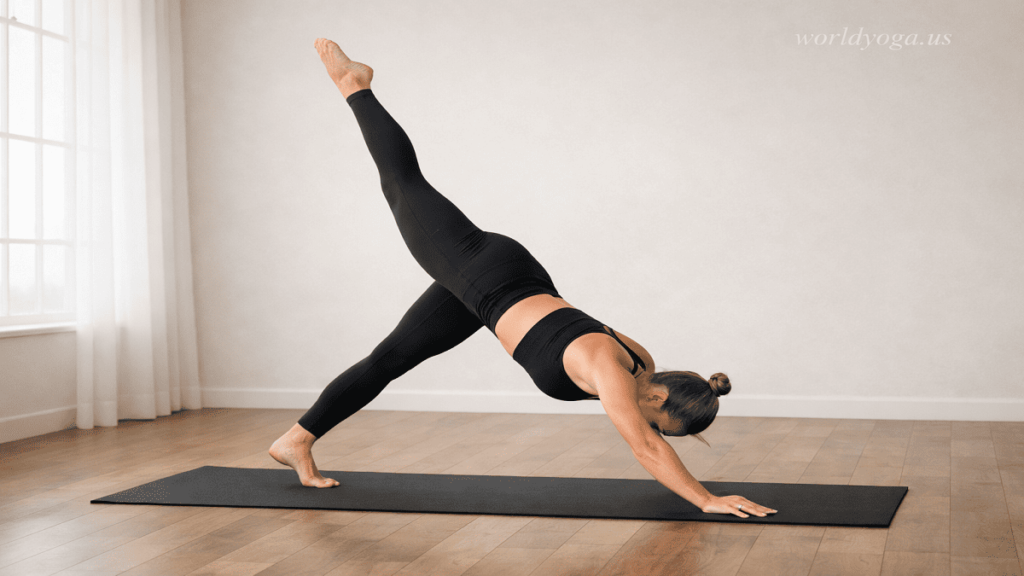
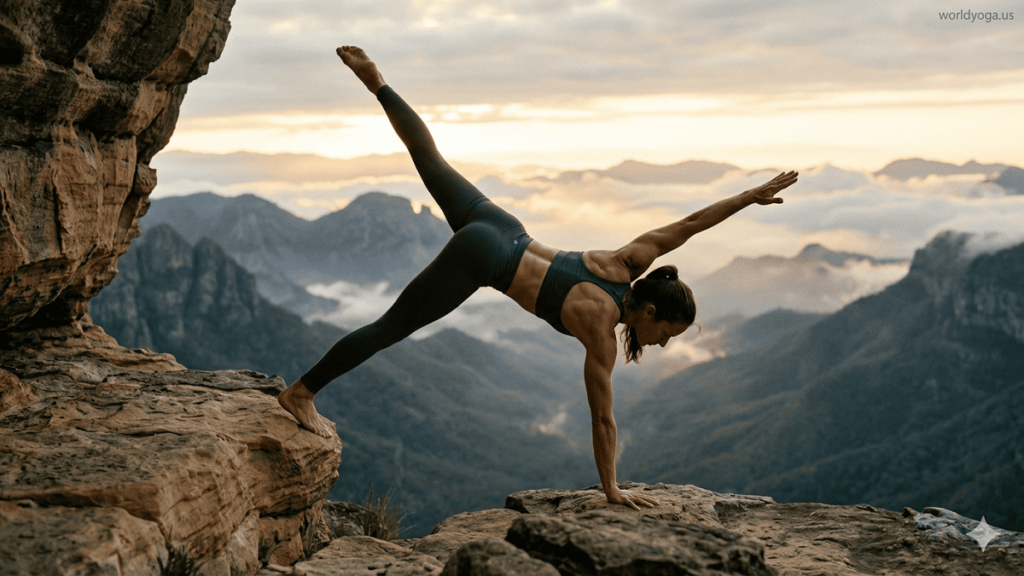
In this posture, the practitioner begins in a standard Downward-Facing Dog position with hands shoulder-width apart and hips lifted upward. One hand is either extended forward or lifted off the floor while the opposite leg rises into the air, forming a diagonal line through the body. The movement demands stability from the supporting shoulder, activation of the core muscles, and strong engagement of the glutes and legs to maintain balance.
One of the primary benefits of this variation is improved functional strength. The supporting arm and shoulder girdle work intensely to stabilize body weight, while the abdominal muscles engage to prevent rotation or collapse. The lifted leg activates the gluteal muscles and hamstrings, promoting lower-body strength and hip mobility. Because the posture requires cross-body coordination, it also enhances proprioception and neuromuscular awareness.
From a mobility perspective, the pose stretches the calves, hamstrings, shoulders, and spine while encouraging length through the posterior chain. The asymmetrical positioning additionally challenges balance and concentration, making it both physically and mentally demanding.
However, due to its complexity, this variation is generally recommended for intermediate to advanced practitioners. Individuals with wrist injuries, shoulder instability, or lower back issues should approach the pose cautiously and may require modifications or professional guidance. Proper warm-up and foundational strength are essential before attempting the posture safely.
The pose is commonly used in advanced Vinyasa and power yoga sequences, often as a transition movement that develops dynamic control and body awareness. It is particularly valuable for practitioners looking to improve unilateral stability and integrated movement patterns.
For additional guidance and alignment references, visit:
Yoga Journal – Downward Dog Variations
Verywell Fit – Downward Facing Dog Benefits and Technique
Overall, Downward Dog: One-Armed—One-Legged is a powerful progression that transforms a traditional yoga posture into an advanced balance and strength challenge, supporting both functional fitness and mindful movement development.
#Downward Dog: One-Armed—One-Legged in India
How is One-Armed, One-Legged Downward Dog performed correctly?
Downward-Facing Dog Pose is an advanced asymmetrical variation of the traditional Downward-Facing Dog that requires precise alignment, strong core engagement, and controlled breathing. Performing it correctly is less about how high you lift the limbs and more about maintaining stability, avoiding rotation, and preserving spinal length while balancing on one arm and one leg.
To begin, set up in a standard Adho Mukha Svanasana position. Place your hands shoulder-width apart, fingers spread wide, and press firmly through the base of the index finger and thumb. Feet are hip-width apart, heels gently reaching toward the floor, and hips lifted to form an inverted “V” shape. The spine should be long and neutral, not rounded.
Once stable, shift your weight gradually into one supporting hand and the opposite foot. This is the most critical phase, as it establishes balance and prevents collapse into the shoulder joint. The supporting arm must remain strong and externally rotated, with the shoulder blade stabilized and drawn away from the ear. The core engages deeply to prevent the torso from twisting.
Next, slowly extend the opposite leg upward and backward. The lift should originate from the hip rather than the lower back. The leg does not need to rise extremely high; the priority is maintaining pelvic alignment and avoiding rotation. Keep the hips as square as possible to the mat while resisting the tendency to open the lifted side excessively.
Simultaneously, you may either extend the free arm forward or keep it grounded depending on the variation being practiced. In most beginner-to-intermediate progressions, the second hand remains on the mat while the opposite leg lifts, creating a diagonal stability line through the body. In more advanced variations, the lifted arm extends forward, increasing the balance challenge significantly.
Breathing should remain steady and controlled. Inhale to lengthen the spine and stabilize the lift, and exhale to refine balance. Avoid holding the breath, as it increases tension and reduces coordination.
Common mistakes include collapsing into the supporting shoulder, rotating the hips open too far, or lifting the leg by arching the lower back. Another frequent issue is shifting weight too far forward, which destabilizes the pose and places excess pressure on the wrist.
To exit the pose safely, lower the lifted leg slowly back to the floor, return the hand if lifted, and reestablish even weight distribution in Downward-Facing Dog before resting in Child’s Pose if needed.
Practitioners are encouraged to develop strength and awareness through preparatory poses such as plank variations and shoulder stability drills before attempting this posture.
For additional technique references:
Yoga Journal – Downward Dog Alignment Guide
Verywell Fit – Proper Form in Downward Dog
When performed with control and awareness, this variation becomes a powerful exercise in unilateral strength, balance, and full-body coordination.
#Downward Dog: One-Armed—One-Legged in Maharashtra
What is the proper alignment in this advanced Downward Dog variation?
Proper alignment in Downward-Facing Dog Pose is essential because this asymmetrical variation significantly increases load on the shoulders, wrists, and core. The goal is not height or aesthetics, but controlled stability while maintaining a long spine and balanced pelvis.
The foundation begins in a strong Adho Mukha Svanasana. The hands are placed shoulder-width apart with fingers spread evenly, pressing through the index finger and thumb to protect the wrists. The arms remain straight but not locked, with the elbows gently soft and rotated outward to engage the upper back. The shoulders should be stable, drawn away from the ears, and actively lifting the torso upward and backward.
The spine is the central reference point for alignment. Even in the asymmetrical variation, the spine should remain long and neutral without excessive rounding or arching. The ribcage stays controlled, avoiding flaring on one side when weight shifts onto a single support arm. Core engagement—especially the transverse abdominis and obliques—prevents unwanted rotation and maintains midline stability.
In the lower body, both legs begin in a neutral Downward Dog position with feet hip-width apart. When transitioning into the variation, one leg lifts while the pelvis stays as level as possible. A key alignment principle is “hip squaring,” meaning both hip points should face the floor rather than opening toward the side. The lifted leg should rise from the hip joint, not the lower back, to avoid lumbar compression.
The supporting leg remains active, pressing the heel toward the floor and engaging the quadriceps and gluteal muscles for stability. This grounding effect helps counterbalance the lift and prevents excessive forward tipping.
Weight distribution is critical in the upper body. Most of the load remains in the supporting hand, which must be firmly rooted into the mat. The wrist stays neutral, avoiding collapse toward the inner or outer edge. The shoulder of the supporting arm must be stable and externally rotated to protect the joint and maintain space between the shoulder and ear.
If the variation includes lifting the opposite arm, it should extend forward in line with the spine rather than drifting upward or downward. This creates a clean diagonal energy line from fingertips through the lifted heel. However, the chest should remain controlled and not open excessively, as over-rotation compromises balance.
Breathing supports alignment by maintaining steady engagement. Each inhale lengthens the spine, while each exhale refines balance and stabilizes the core. Any loss of breath control often indicates misalignment or excessive strain.
For reference on foundational positioning and alignment cues:
Yoga Journal – Downward Dog Alignment Guide
Verywell Fit – Downward Dog Technique and Form
In summary, correct alignment in this advanced variation depends on three pillars: a stable supporting shoulder, a neutral and lengthened spine, and a controlled, level pelvis. Maintaining these principles ensures safety while maximizing strength, balance, and full-body integration.
#Downward Dog: One-Armed—One-Legged in Ahemadabad
Which muscles are engaged during the posture?
Downward-Facing Dog Pose is a high-intensity, full-body stabilization posture that significantly increases muscular demand compared to the traditional form due to its unilateral loading pattern. The combination of one supporting arm and one lifted leg creates asymmetrical tension across the entire kinetic chain, requiring coordinated activation of stabilizers, prime movers, and deep postural muscles.
In the upper body, the primary load is carried by the supporting arm, which heavily engages the deltoids (especially anterior and medial fibers) and the triceps to maintain elbow extension. The rotator cuff muscles stabilize the shoulder joint, while the serratus anterior and trapezius work together to keep the scapula elevated and stable, preventing collapse into the shoulder socket. The pectoralis minor also assists in maintaining shoulder girdle control under load.
The core is one of the most critically engaged regions in this posture. The transverse abdominis acts as a deep stabilizer, maintaining intra-abdominal pressure and preventing spinal collapse. The obliques—both internal and external—are highly active due to the anti-rotation demand created by lifting one arm or leg. The rectus abdominis contributes to maintaining spinal alignment, while the multifidus muscles stabilize individual vertebral segments. This coordinated engagement prevents excessive twisting of the torso.
The spinal extensors, including the erector spinae group, play a key role in maintaining spinal length and resisting gravitational collapse. These muscles work isometrically to support the elongated inverted “V” shape of the posture without allowing rounding or compression.
In the lower body, the supporting leg activates the quadriceps to stabilize the knee joint and maintain extension. The gluteus maximus and gluteus medius provide hip stability and prevent pelvic drop or rotation. The calf muscles, especially the gastrocnemius and soleus, assist in grounding the foot and maintaining balance.
The lifted leg engages the gluteus maximus strongly to drive hip extension, while the hamstrings assist in maintaining controlled elevation. The hip flexors of the lifted side are stretched while simultaneously stabilizing the movement path. This creates both strength and flexibility demands within the same muscle groups.
Foot and ankle stabilizers, including the tibialis anterior and intrinsic foot muscles, contribute to balance and proprioception, especially in the supporting leg where micro-adjustments are constantly required to maintain equilibrium.
Overall, this variation transforms a traditional posterior-chain stretch into a dynamic stability challenge involving nearly every major muscle group in the body. The emphasis shifts from passive flexibility to active control, particularly in the shoulders, core, and hips.
For additional anatomical and movement references:
Yoga Journal – Downward Dog Anatomy Guide
Verywell Fit – Muscles Used in Downward Dog
NCBI – Yoga and Muscle Activation Studies
In summary, the One-Armed, One-Legged Downward Dog engages the shoulders, core stabilizers, spinal extensors, glutes, hamstrings, and lower-leg muscles in a coordinated system of strength, balance, and anti-rotation control.
#Downward Dog: One-Armed—One-Legged in Hyderabad
What preparatory poses are recommended before attempting it?
Before attempting Downward-Facing Dog Pose, it is important to prepare the body for its high demands on shoulder stability, core anti-rotation strength, hamstring flexibility, and hip control. Because this posture is an advanced unilateral balance, the most effective preparation focuses on building foundational strength in alignment-based poses and gradually introducing instability.
A primary preparatory posture is the standard Adho Mukha Svanasana. This foundational pose conditions the shoulders, lengthens the spine, and opens the posterior chain, especially the hamstrings and calves. Practicing it with attention to even weight distribution in both hands is essential before progressing to one-arm loading.
To build shoulder stability and core strength, Plank Pose and its variations are essential. Although not always held as a final yoga posture in all traditions, plank mechanics train the serratus anterior, transverse abdominis, and shoulder stabilizers to resist collapse under body weight. This directly transfers to the supporting arm control needed in the advanced variation.
For hamstring and hip mobility, preparatory poses like Ardha Hanumanasana are highly effective. This posture lengthens the hamstrings while reinforcing a hip hinge pattern, which is crucial for lifting the leg without straining the lower back in the final pose.
To develop unilateral balance and anti-rotation strength, standing balancing postures such as Vasisthasana are extremely important. Side Plank directly trains lateral core engagement, shoulder stacking, and wrist stability, which are all critical for supporting one-sided body weight in the advanced variation.
For hip opening and controlled extension, preparatory back-line activation can be supported with poses like Locust Pose variations, which strengthen the posterior chain. While not directly part of the traditional yoga sequence list, they help activate the glutes and spinal extensors needed for controlled leg lift without collapsing the lumbar spine.
Additionally, gentle inversion familiarity through standard Downward Dog holds helps condition the vestibular system and wrist loading tolerance. Practicing transitions between Plank and Downward Dog builds dynamic shoulder control and prepares the body for shifting weight from two points of support to one.
Breath training is also a key preparatory component. Maintaining steady nasal breathing during all preparatory poses improves neuromuscular coordination and reduces unnecessary muscular tension when balance becomes unstable.
For reference on foundational sequencing and preparation:
Yoga Journal – Downward Dog Practice Guide
Verywell Fit – Yoga Strength and Alignment Training
Yoga International – Building Core Strength for Arm Balances
In summary, preparing for this advanced variation requires a structured progression from standard Downward Dog to core stabilization, unilateral balance training, and hamstring mobility work. When these elements are developed consistently, the transition into the One-Armed, One-Legged Downward Dog becomes safer, more stable, and biomechanically efficient.
#Downward Dog: One-Armed—One-Legged in Delhi
What are the benefits and precautions of this balancing variation?
Downward-Facing Dog Pose is an advanced balancing progression that significantly intensifies the traditional Downward-Facing Dog by adding unilateral load and anti-rotation demands. Because of this, it offers powerful functional benefits but also requires careful attention to safety, alignment, and readiness.
Benefits of the One-Armed, One-Legged Variation
One of the main benefits is enhanced full-body strength, especially in the shoulders, core, and posterior chain. The supporting arm must stabilize the entire body weight, which strengthens the deltoids, triceps, and rotator cuff muscles. At the same time, the core—particularly the transverse abdominis and obliques—works intensely to prevent twisting and maintain spinal alignment.
The lifted leg activates the glutes and hamstrings while improving hip mobility and control. This combination of strength and stretch supports better functional movement patterns, especially in activities that require single-leg stability such as running, climbing, or athletic directional changes.
Another major benefit is improved balance and proprioception. Because the posture reduces the base of support to one arm and one leg, the nervous system must make rapid micro-adjustments to maintain stability. This enhances coordination and neuromuscular control over time.
The pose also promotes spinal elongation and decompression. Similar to Adho Mukha Svanasana, it lengthens the posterior chain, but with increased engagement from stabilizing muscles, which improves postural awareness and reduces stiffness in the back and shoulders.
Additionally, this variation develops mental focus and concentration. Maintaining balance in an asymmetrical position requires sustained attention, controlled breathing, and calm awareness under physical challenge.
Precautions and Safety Considerations
Despite its benefits, this posture places significant stress on the wrists, shoulders, and core. Individuals with wrist injuries, carpal tunnel syndrome, or shoulder instability should avoid or modify the pose, as the supporting arm bears high compressive load.
A common risk is over-rotation of the pelvis and torso when lifting the leg. This can lead to strain in the lower back. To prevent injury, the hips should remain as square as possible to the floor, and the lift should originate from the hip joint rather than the lumbar spine.
Another precaution involves shoulder collapse. If the supporting shoulder sinks toward the ear or loses stability, it can strain the rotator cuff and reduce joint integrity. Proper engagement of the serratus anterior and upper back muscles is essential.
Practitioners should also avoid holding their breath during balance attempts, as breath-holding increases muscular tension and reduces coordination. Smooth, steady breathing improves stability and control.
Beginners should not rush into this variation. It is important to build foundational strength first through standard Downward Dog, plank-based holds, and side plank variations before progressing.
Modifications such as keeping one or both hands grounded, or using a wall for support, can significantly reduce load while maintaining training benefits.
For further safety and alignment references:
Yoga Journal – Downward Dog Safety and Alignment
Verywell Fit – Downward Dog Modifications and Benefits
Yoga International – Safe Progressions in Arm Balances
Summary
This advanced variation of Downward Dog builds exceptional strength, balance, and body awareness, but it must be approached progressively. When practiced with proper alignment and preparation, it becomes a powerful tool for developing integrated whole-body control and functional stability.
#Downward Dog: One-Armed—One-Legged in Pune
Case Study of Downward Dog: One-Armed—One-Legged
Downward-Facing Dog Pose is an advanced unilateral yoga variation used in modern movement training to develop shoulder stability, core anti-rotation strength, and lower-limb control. This case study explores its application in improving functional balance and neuromuscular coordination in an intermediate yoga practitioner transitioning into advanced arm-balance work.
Background and Initial Assessment
The subject was a 32-year-old recreational fitness practitioner with a 2-year yoga practice history. Primary limitations included shoulder instability during weight-bearing positions, reduced core endurance under asymmetrical load, and mild imbalance between left and right hip strength. Standard poses such as Plank and Downward Dog were stable, but dynamic transitions caused loss of control and pelvic rotation.
Baseline assessment highlighted weak anti-rotation control in the core and limited scapular stabilization during single-arm loading tasks. Flexibility in the hamstrings and calves was adequate, but integration under load was inconsistent.
Intervention Protocol
A 6-week progressive training plan was designed with gradual exposure to unilateral loading patterns.
The foundation phase focused on strengthening alignment in Adho Mukha Svanasana. Emphasis was placed on equal weight distribution between both arms, scapular engagement, and controlled breath mechanics.
The second phase introduced plank variations and shoulder stability drills to improve serratus anterior activation and core bracing. This stage aimed to build resistance against spinal rotation and shoulder collapse.
The third phase incorporated preparatory poses such as Side Plank (Vasisthasana) and hip extension drills to condition the obliques and gluteal muscles for unilateral load transfer. These movements helped develop foundational strength required for asymmetrical balance.
In the final phase, the subject began controlled practice of the One-Armed, One-Legged Downward Dog variation. Initially, the lifted leg remained low to reduce lumbar strain, and the opposite arm stayed grounded. Duration was limited to 10–15 second holds with full rest between repetitions.
Observed Outcomes
After six weeks, notable improvements were recorded in shoulder stability and core control. The subject demonstrated reduced scapular collapse under load and improved ability to maintain a square pelvis during leg lifts. Balance duration increased from an initial 5–8 seconds to 20–25 seconds per side.
Functional improvements were observed in daily movement patterns, particularly in single-leg balance tasks and transitional movements such as stepping from floor to standing positions. Core endurance improved significantly, with reduced compensatory lumbar movement during asymmetrical exercises.
Subjectively, the practitioner reported greater body awareness and improved confidence in advanced yoga transitions, particularly arm balances and inverted poses.
Analysis
The effectiveness of this progression highlights the importance of structured load adaptation. Rather than introducing the full variation immediately, incremental exposure to anti-rotation demands allowed the neuromuscular system to adapt safely.
The One-Armed, One-Legged Downward Dog functions as a closed-chain kinetic stability drill, integrating upper and lower body control through the core. It simultaneously challenges multiple systems—shoulder girdle stability, pelvic alignment, and proprioceptive feedback—making it a valuable bridge between foundational yoga and advanced arm balances.
Research in functional movement training supports the use of unilateral loading patterns to improve injury resilience and coordination efficiency, particularly in recreational athletes.
References for further study:
Yoga Journal – Downward Dog Practice and Variations
Verywell Fit – Downward Dog Mechanics and Benefits
NCBI – Neuromuscular Adaptation in Balance Training
Conclusion
This case study demonstrates that progressive training into One-Armed, One-Legged Downward Dog can significantly enhance functional stability, core control, and shoulder integrity when introduced through structured phases. It serves as an effective transitional tool between foundational yoga postures and advanced balancing practices.
#Downward Dog: One-Armed—One-Legged in Banglore
White Paper of Downward Dog: One-Armed—One-Legged
Downward-Facing Dog Pose is an advanced asymmetrical progression of the traditional Downward-Facing Dog used in modern yoga biomechanics, functional movement systems, and neuromuscular training frameworks. This white paper evaluates its structural mechanics, physiological demands, applied benefits, and safety considerations in advanced movement practice.
Abstract
The One-Armed, One-Legged Downward Dog is a closed-chain, inverted, multi-planar stabilization posture that combines unilateral upper-body loading with contralateral lower-limb elevation. It significantly increases demands on the shoulder girdle, core anti-rotation system, and posterior kinetic chain. The pose is increasingly utilized in advanced yoga sequencing and movement conditioning to develop integrated strength, balance, and proprioception.
Biomechanical Structure
The posture is derived from Adho Mukha Svanasana, which establishes the foundational inverted “V” structure. In its advanced variation, weight shifts predominantly onto a single upper limb and a contralateral lower limb, creating a diagonal force pathway through the body.
The supporting shoulder experiences high compressive and stabilizing forces, requiring coordinated activation of the deltoid complex, rotator cuff, trapezius, and serratus anterior. The scapula must remain stable in upward rotation to prevent joint collapse.
The core operates in an anti-rotation capacity. The transverse abdominis, obliques, and multifidus muscles resist torsional forces generated by unilateral limb elevation. This stabilizes the lumbar spine and prevents excessive spinal rotation or hyperextension.
The lifted leg engages hip extensors, primarily the gluteus maximus and hamstrings, while simultaneously requiring pelvic stabilization from the gluteus medius. The kinetic chain demands precise neuromuscular coordination between opposite sides of the body.
Physiological and Functional Effects
This posture enhances neuromuscular efficiency by training cross-body coordination patterns. It improves intermuscular synchronization between upper and lower extremities, which is critical for dynamic athletic movements such as sprinting, climbing, and directional changes.
Key adaptations include increased shoulder stability, improved core endurance, and enhanced proprioceptive awareness. The unilateral load forces the nervous system to develop refined balance responses and postural corrections in real time.
The posterior chain is simultaneously lengthened and activated, supporting improved hamstring flexibility and spinal decompression. Compared to bilateral Downward Dog, this variation introduces higher stabilization demand and reduced passive stretching emphasis.
Applied Use Across Disciplines
In yoga therapy, the posture is used as an advanced progression tool for practitioners transitioning toward arm balances and inversions. In functional fitness, it serves as a dynamic stability drill for core and shoulder conditioning. In athletic training, it is applied for improving unilateral control and injury resilience.
It is typically integrated after mastery of foundational stability patterns such as plank variations and standard Downward-Facing Dog holds.
Safety and Risk Considerations
Due to high load asymmetry, the posture places significant stress on the wrists, shoulders, and lumbar spine. Improper execution may lead to shoulder impingement, wrist strain, or lumbar rotation stress.
Key contraindications include acute shoulder injuries, wrist pathologies, and uncontrolled spinal instability conditions. Proper scapular engagement and core bracing are mandatory for safe execution.
Modifications such as reducing limb lift height or maintaining both hands on the floor can reduce load while preserving training benefits.
For foundational reference and alignment context:
Yoga Journal – Downward Dog Alignment and Practice
VeryWell Fit – Downward Dog Mechanics
NCBI – Balance Training and Neuromuscular Adaptation
Conclusion
The One-Armed, One-Legged Downward Dog represents a high-level integrative movement pattern that bridges yoga practice and functional strength training. When applied with progressive loading principles, it enhances shoulder stability, core anti-rotation strength, and whole-body coordination, making it a valuable tool in advanced movement systems.
#Downward Dog: One-Armed—One-Legged in Kolkata
Industry Application of Downward Dog: One-Armed—One-Legged
Downward-Facing Dog Pose is an advanced functional yoga variation that has moved beyond traditional practice into multiple professional sectors. Because it combines unilateral loading, anti-rotation core engagement, shoulder stability, and posterior chain activation, it is increasingly used as a training and assessment tool in fitness, rehabilitation, sports performance, and wellness industries.
1. Fitness and Strength Training Industry
In modern fitness programming, this variation is used as a high-level bodyweight stability drill. Trainers incorporate it into advanced mobility circuits to develop shoulder endurance, core control, and unilateral balance. It is especially useful in calisthenics-based training systems where athletes must control bodyweight under unstable conditions.
The movement is often programmed after mastery of foundational patterns such as Adho Mukha Svanasana and plank progressions. It serves as a bridge between basic static holds and dynamic bodyweight skills such as handstands and arm balances.
2. Physiotherapy and Rehabilitation
In rehabilitation settings, this posture is applied in modified forms to retrain neuromuscular coordination and restore shoulder stability. Therapists may use partial-load variations where one limb remains grounded while the opposite limb performs controlled lifts.
It is particularly relevant in post-injury rehabilitation for shoulder stabilization and core re-education. The anti-rotation demand helps rebuild deep core engagement patterns essential for spinal protection and functional movement recovery.
3. Sports Performance and Athletic Conditioning
In athletic training, the One-Armed, One-Legged Downward Dog is used to enhance cross-body coordination and unilateral strength. Sports such as tennis, cricket, football, and track athletics benefit from improved balance, agility, and rotational control.
Coaches use this variation to simulate real-world athletic demands where the body frequently operates under asymmetrical loading. It improves force transfer between upper and lower limbs, contributing to better sprint mechanics, directional changes, and injury resilience.
4. Yoga Therapy and Mind-Body Training
In yoga therapy, the posture is introduced in advanced sequencing programs to develop proprioception and controlled breath under instability. It is often used as a preparatory step toward more complex arm balances and inversions.
Its integration into therapeutic yoga supports improved body awareness, stress regulation, and neuromuscular re-education. Practitioners learn to maintain calm breathing while managing physical imbalance, which supports both physical and mental resilience.
5. Corporate Wellness and Preventive Health
In corporate wellness programs, simplified versions of this pose are used to address postural fatigue and sedentary-related dysfunction. While the full variation is not typically practiced in office settings, its principles are applied through simplified stability drills.
These adaptations help improve shoulder mobility, spinal alignment, and core activation, counteracting prolonged sitting and reducing musculoskeletal discomfort in employees.
Key Industry Value
Across all sectors, the primary value of this posture lies in its ability to train integrated movement: stability under load, control during imbalance, and coordination across multiple muscle chains. It is increasingly viewed as a functional assessment tool for identifying asymmetries in strength and control.
Reference Resources
Yoga Journal – Downward Dog Practice Overview
Verywell Fit – Downward Dog Benefits and Technique
NCBI – Neuromuscular Control and Balance Training
Conclusion
The One-Armed, One-Legged Downward Dog has evolved into a multi-industry functional movement tool. Its applications in fitness, rehabilitation, sports performance, and wellness highlight its value as a comprehensive exercise for developing strength, stability, and coordinated body control under asymmetrical load conditions.
#Downward Dog: One-Armed—One-Legged in Mumbai
Ask FAQs
What is the main purpose of this advanced variation?
The main purpose of this posture is to develop unilateral strength, core anti-rotation control, and shoulder stability. Unlike the standard Adho Mukha Svanasana, this variation challenges the body to maintain balance with reduced support, improving coordination and functional strength.
Is this pose suitable for beginners?
No, this is generally not suitable for beginners. It is considered an advanced variation that requires strong foundational strength in Downward Dog, plank holds, and shoulder stability. Beginners should first master symmetrical poses before attempting asymmetrical balance work.
What are the most common mistakes in this pose?
Common mistakes include collapsing into the supporting shoulder, rotating the hips excessively, and lifting the leg using the lower back instead of the hip. Another frequent issue is shifting too much body weight forward, which can strain the wrists and reduce stability.
Which muscles are most engaged during the pose?
This posture engages almost the entire body. The shoulders (deltoids, rotator cuff, trapezius), core muscles (obliques, transverse abdominis), and spinal stabilizers work intensely. The glutes and hamstrings activate during leg lift, while the wrists and forearms support body weight in the grounded hand.
How can I prepare safely for this pose?
Preparation should focus on building strength and stability through progressive exercises. Standard Downward Dog, plank variations, and side plank training are essential. Mobility work for hamstrings and shoulders also helps. Practicing these consistently reduces injury risk and improves control in the final variation.
Table of Contents
Disclaimer: The information provided about Downward-Facing Dog Pose is for educational and informational purposes only and is not a substitute for professional medical advice. Practice only under proper guidance if you are new, injured, or have any medical conditions. Stop immediately if you experience pain, dizziness, or discomfort, and consult a qualified healthcare professional before continuing.