Anjaneyasana
Anjaneyasana (Low Lunge Yoga Pose) is a foundational yoga posture commonly referred to as Low Lunge or Crescent Lunge. The pose is named after Anjaneya, another name for Lord Hanuman in yogic tradition, symbolizing devotion, strength, and forward movement. It is widely practiced in Hatha, Vinyasa, and modern mobility-based yoga systems due to its strong emphasis on lower-body flexibility and spinal openness.
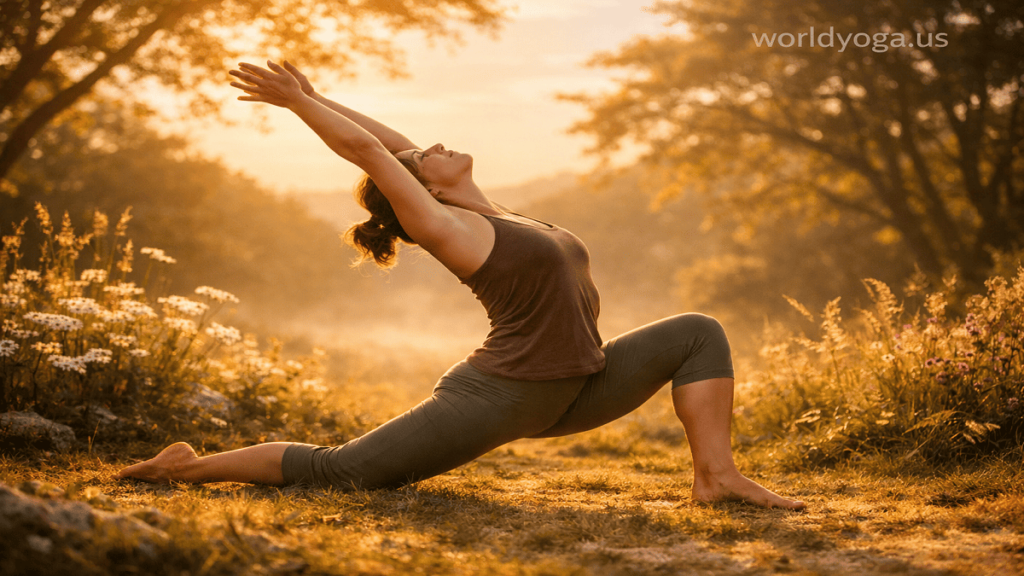
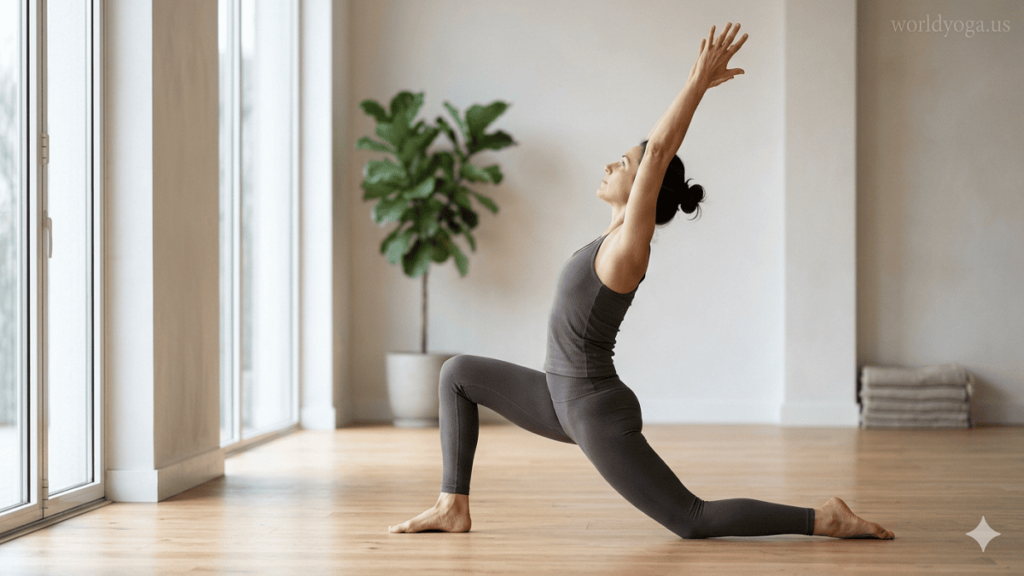
Anjaneyasana is typically performed from a kneeling or standing transition into a deep lunge position, where one foot steps forward while the opposite leg extends back with the knee either lifted or grounded. The posture primarily targets the hip flexors of the back leg while strengthening the front leg through controlled weight-bearing. When practiced with proper alignment, it helps create balance between flexibility and stability in the lower body.
One of the key characteristics of this pose is its ability to open the anterior chain of the body, including the hips, abdomen, and chest. This makes it especially useful for individuals who spend long hours sitting, as it helps counteract postural imbalances such as tight hip flexors and rounded shoulders. The posture also encourages spinal extension, improving awareness of upright alignment and breathing capacity.
In many variations, the arms are lifted overhead, adding an element of balance and upper-body engagement. This enhances core activation and encourages full-body integration rather than isolated stretching. Because of its adaptability, Anjaneyasana is often used as both a preparatory pose for deeper backbends and as a transitional posture within dynamic yoga sequences.
Beyond its physical benefits, Anjaneyasana also carries a symbolic meaning of progression and expansion. It represents stepping forward with stability and openness, both physically and mentally. This dual focus on strength and flexibility makes it a core posture in many yoga practices.
How is Anjaneyasana performed correctly?
Anjaneyasana, commonly known as Low Lunge or Crescent Lunge, is performed by combining precise lower-body alignment with controlled spinal extension and mindful breathing. Correct execution ensures that the hips are safely opened, the spine remains supported, and the posture develops both strength and flexibility without strain.
1. Starting Position
Begin in a standing position at the top of the mat. Step one foot forward into a long stride while the opposite leg extends back. Lower the back knee toward the floor with control. The front foot should be placed firmly on the ground with toes pointing forward.
2. Lower Body Alignment
The front knee should be stacked directly over the ankle, not pushed forward or collapsing inward. The back knee should rest on the floor or mat, ideally positioned directly under the hip socket for better stability and joint alignment. This creates a balanced base and prevents unnecessary stress on the knees or lower back.
3. Pelvic Position
Maintain a neutral pelvis. Avoid excessive arching in the lower back or over-tucking the tailbone. Engage the lower abdominal muscles gently to stabilize the core and support the spine. The hips should face forward as much as mobility allows, without forcing alignment.
4. Upper Body Position
From the stable base, lift the torso upright. The chest should rise away from the pelvis, creating length through the spine. If comfortable, raise the arms overhead with palms facing each other. Shoulders should remain relaxed and away from the ears to avoid tension in the neck and upper back.
5. Spinal Extension and Breath
As you inhale, gently lift through the sternum to create length in the front body. The extension should originate from the mid and upper spine rather than the lower back. Exhale slowly while maintaining stability in the core and lower body. This breath coordination prevents over-compression and supports controlled movement.
6. Weight Distribution and Balance
Most of the weight should be distributed evenly through the front foot and back knee (if grounded). Avoid collapsing into the hips or shifting too far forward. The posture should feel stable, not strained.
7. Common Mistakes to Avoid
- Letting the front knee collapse inward
- Allowing the back knee to drift behind the hip
- Overarching the lower back instead of lifting through the chest
- Tension in the shoulders or neck during arm lift
Conclusion
When performed correctly, Anjaneyasana builds hip flexibility, strengthens lower-body stability, and improves spinal awareness. It is both a preparatory posture for deeper backbends and a foundational movement for improving posture and mobility when practiced with proper alignment.
#Anjaneyasana in India
What is the proper alignment in Crescent Lunge Pose?
Crescent Lunge Pose, or Anjaneyasana, requires a combination of lower-body stability, pelvic control, and spinal length to ensure safe and effective practice. Proper alignment focuses on stacking joints, balancing weight distribution, and maintaining spinal neutrality while gradually opening the hip flexors and chest.
1. Front Leg Alignment
The front foot is placed firmly on the mat with the toes pointing forward. The front knee should be directly stacked over the ankle, forming a stable 90-degree angle. It should not collapse inward or extend beyond the toes, as this can create unnecessary stress on the knee joint.
2. Back Leg Position
The back leg extends behind the body, with the knee either lifted or resting on the floor depending on the variation. When grounded, the back knee should ideally be positioned under the hip socket rather than behind it. This vertical alignment improves stability and reduces strain on the hip and lower back.
3. Pelvic Alignment
The pelvis should remain as neutral as possible, facing forward without excessive tilting. Avoid arching the lower back or tucking the tailbone too aggressively. Gentle core engagement helps stabilize the pelvis and maintain balance between both sides of the body.
4. Spine and Chest Position
The spine should be long and upright, with the chest lifted away from the pelvis. The lift should originate from the thoracic spine rather than the lower back. This helps prevent compression in the lumbar region and promotes healthy spinal extension.
5. Shoulder and Arm Position
If the arms are raised overhead, they should extend in line with the ears without shrugging the shoulders. The shoulder blades should move slightly down and back to keep the upper body open and relaxed. The neck remains long, with a neutral or slightly upward gaze.
6. Weight Distribution
Weight should be evenly balanced between the front foot and the back leg support. Avoid leaning too far forward or collapsing into the hips. The posture should feel grounded in the lower body while open in the upper body.
7. Core Engagement and Stability
A light engagement of the core muscles—especially the transverse abdominis—helps stabilize the spine and pelvis. This prevents excessive sway in the lower back and supports controlled movement in the backbend variation.
Conclusion
Proper alignment in Crescent Lunge ensures that the posture builds strength, flexibility, and spinal awareness without strain. When practiced correctly, it becomes a powerful foundation for hip opening, posture correction, and progression into deeper backbending movements.
#Anjaneyasana in Maharashtra
Which muscles are engaged during the posture?
Crescent Lunge Pose is a full-body posture that simultaneously builds strength, improves stability, and lengthens key muscle groups. Because it combines a deep lunge with an upright or backbending position, it activates muscles across the lower body, core, spine, and upper body in a coordinated pattern.
1. Lower Body Muscles (Primary Engagement)
The lower body provides the main foundation of the pose:
- Quadriceps (front leg): Strongly engaged to stabilize the bent knee and maintain the lunge position
- Gluteus maximus: Activates to support hip extension and pelvic stability
- Gluteus medius: Helps stabilize the pelvis and prevent side-to-side collapse
- Hamstrings (front leg): Assist in stabilizing knee alignment
- Calf muscles (gastrocnemius and soleus): Support balance and grounding through the front foot
2. Hip Flexors (Back Leg Stretch)
The back leg experiences a deep stretch, especially:
- Iliopsoas (primary hip flexor): The most significantly lengthened muscle in the posture
- Rectus femoris: Stretched due to hip extension and knee positioning
- Tensor fasciae latae (TFL): Assists in hip stabilization while being gently lengthened
3. Core Muscles (Stabilization Role)
Core engagement is essential to maintain balance and protect the spine:
- Transverse abdominis: Deep stabilizer that supports pelvic control
- Rectus abdominis: Assists in preventing excessive lumbar arching
- Internal and external obliques: Help maintain torso alignment and balance
4. Spinal and Back Muscles
These muscles support upright posture and controlled extension:
- Erector spinae: Maintain spinal extension and posture control
- Multifidus muscles: Provide deep spinal stabilization
- Thoracic extensors: Support chest lift in the upper back
5. Upper Body Muscles (If Arms Are Raised)
When the arms extend overhead:
- Deltoids: Support shoulder elevation
- Trapezius (upper and middle fibers): Stabilize shoulder girdle
- Rhomboids: Help maintain shoulder blade positioning
- Rotator cuff muscles: Stabilize the shoulder joint
6. Neck and Postural Muscles
- Deep cervical flexors: Maintain neck alignment
- Suboccipital muscles: Assist in head positioning depending on gaze direction
Conclusion
Crescent Lunge is a coordinated multi-muscle posture that blends strength and flexibility. It strengthens the lower body and core while deeply stretching the hip flexors, making it an effective movement for improving posture, mobility, and overall functional stability when practiced with proper alignment.
#Anjaneyasana in Ahemadabad
What preparatory poses are recommended before practicing Anjaneyasana?
Crescent Lunge Pose is a full-body posture that simultaneously builds strength, improves stability, and lengthens key muscle groups. Because it combines a deep lunge with an upright or backbending position, it activates muscles across the lower body, core, spine, and upper body in a coordinated pattern.
1. Lower Body Muscles (Primary Engagement)
The lower body provides the main foundation of the pose:
- Quadriceps (front leg): Strongly engaged to stabilize the bent knee and maintain the lunge position
- Gluteus maximus: Activates to support hip extension and pelvic stability
- Gluteus medius: Helps stabilize the pelvis and prevent side-to-side collapse
- Hamstrings (front leg): Assist in stabilizing knee alignment
- Calf muscles (gastrocnemius and soleus): Support balance and grounding through the front foot
2. Hip Flexors (Back Leg Stretch)
The back leg experiences a deep stretch, especially:
- Iliopsoas (primary hip flexor): The most significantly lengthened muscle in the posture
- Rectus femoris: Stretched due to hip extension and knee positioning
- Tensor fasciae latae (TFL): Assists in hip stabilization while being gently lengthened
3. Core Muscles (Stabilization Role)
Core engagement is essential to maintain balance and protect the spine:
- Transverse abdominis: Deep stabilizer that supports pelvic control
- Rectus abdominis: Assists in preventing excessive lumbar arching
- Internal and external obliques: Help maintain torso alignment and balance
4. Spinal and Back Muscles
These muscles support upright posture and controlled extension:
- Erector spinae: Maintain spinal extension and posture control
- Multifidus muscles: Provide deep spinal stabilization
- Thoracic extensors: Support chest lift in the upper back
5. Upper Body Muscles (If Arms Are Raised)
When the arms extend overhead:
- Deltoids: Support shoulder elevation
- Trapezius (upper and middle fibers): Stabilize shoulder girdle
- Rhomboids: Help maintain shoulder blade positioning
- Rotator cuff muscles: Stabilize the shoulder joint
6. Neck and Postural Muscles
- Deep cervical flexors: Maintain neck alignment
- Suboccipital muscles: Assist in head positioning depending on gaze direction
Conclusion
Crescent Lunge is a coordinated multi-muscle posture that blends strength and flexibility. It strengthens the lower body and core while deeply stretching the hip flexors, making it an effective movement for improving posture, mobility, and overall functional stability when practiced with proper alignment.
#Anjaneyasana in Hyderabad
What preparatory poses are recommended before practicing Anjaneyasana?
Proper preparation is essential before practicing Anjaneyasana (Crescent Lunge Pose), especially because it combines deep hip flexor opening, lower-body strength, and spinal extension. A well-structured warm-up helps reduce strain, improves mobility, and ensures safer alignment in the final posture.
1. Cat–Cow Pose (Spinal Mobilization)
This is one of the most effective warm-ups for Anjaneyasana. It gently moves the spine through flexion and extension, increasing awareness of spinal articulation. It also prepares the thoracic region for controlled backbending while activating the core muscles.
2. Low Lunge (Gentle Hip Activation)
A basic low lunge without deep backbending helps the body adapt to the split-leg position. It gently stretches the hip flexors and quadriceps of the back leg while building stability in the front leg. This foundational version allows the practitioner to understand alignment before adding intensity.
3. Sphinx Pose or Cobra Pose (Gentle Backbend Preparation)
These mild backbends help activate the spinal extensors and open the chest without stressing the lower back. They train the body to extend through the upper spine, which is essential for safe backbending in Anjaneyasana variations.
4. Warrior I Pose (Strength and Alignment Training)
Warrior I builds strength in the front leg while stretching the hip flexors of the back leg. It also reinforces forward-facing hip alignment and prepares the body for deeper lunge positions. This pose acts as a bridge between strength and flexibility.
5. Bridge Pose (Hip and Core Activation)
Bridge Pose strengthens the glutes, hamstrings, and lower back while opening the chest. It helps develop controlled spinal extension and teaches proper engagement of the posterior chain, which supports safe lunge backbends.
6. Plank Pose (Core Stability Preparation)
Plank activates the deep core muscles, especially the transverse abdominis, which are essential for stabilizing the pelvis during Anjaneyasana. A strong core helps prevent over-compression in the lumbar spine during backbending.
7. Hip Flexor Stretch (Supported Lunge Hold)
Holding a supported lunge with the back knee grounded allows gradual lengthening of the iliopsoas and rectus femoris. This directly prepares the body for the deeper stretch required in the full posture.
Conclusion
A combination of spinal mobility, hip opening, core strengthening, and gentle backbending prepares the body effectively for Anjaneyasana. These preparatory poses ensure that the practitioner can safely achieve proper alignment, reduce injury risk, and enhance the overall benefits of the posture.
#Anjaneyasana in Pune
What are the benefits and precautions of Anjaneyasana?
Anjaneyasana, also known as Crescent Lunge Pose, is a foundational yoga posture that combines hip opening, lower-body strengthening, and spinal extension. When practiced with correct alignment, it offers significant physical and functional benefits. However, due to its deep lunge and backbend components, it also requires mindful execution and awareness of limitations.
Benefits of Anjaneyasana
1. Improves Hip Flexibility
The posture deeply stretches the hip flexors of the back leg, especially the iliopsoas and rectus femoris. This helps reduce stiffness caused by prolonged sitting and improves overall hip mobility.
2. Strengthens Lower Body
The front leg works isometrically to maintain stability, strengthening the quadriceps, glutes, and supporting muscles around the knee and ankle. This improves balance and functional leg strength.
3. Enhances Spinal Extension and Posture
When performed with a controlled backbend, the pose encourages thoracic spine mobility and chest opening. This helps counter rounded shoulders and forward head posture, improving overall alignment.
4. Builds Core Stability
The abdominal muscles, especially the transverse abdominis, engage to stabilize the pelvis and lower back. This improves core control and supports safer movement in daily activities.
5. Expands Chest and Improves Breathing
The lifted chest position increases space in the rib cage, encouraging deeper and more efficient breathing. This can support better oxygen intake and relaxation.
6. Improves Balance and Body Awareness
Holding the posture requires coordination between multiple muscle groups, improving proprioception and overall body control.
Precautions of Anjaneyasana
1. Lower Back Sensitivity
Excessive arching in the lumbar spine can cause discomfort or strain. The backbend should originate from the upper and mid-spine, not the lower back.
2. Knee Alignment Issues
The front knee must remain stacked over the ankle. Allowing it to move inward or forward too far can create unnecessary stress on the knee joint.
3. Hip or SI Joint Discomfort
Individuals with hip impingement or sacroiliac joint instability should approach the pose cautiously, as deep hip extension may increase discomfort.
4. Neck Strain
Looking too far upward during the backbend can compress the cervical spine. The neck should remain long and neutral or only gently extended.
5. High Blood Pressure or Medical Conditions
People with uncontrolled hypertension or certain spinal conditions should consult a healthcare professional before practicing deep backbending variations.
6. Overstretching Risk
Forcing depth in the lunge or backbend without adequate preparation can lead to muscle strain. Progression should be gradual and controlled.
Conclusion
Anjaneyasana is a highly beneficial posture for improving flexibility, strength, and posture when performed with proper alignment and awareness. However, it requires careful attention to spinal mechanics, knee positioning, and individual limitations to ensure a safe and effective practice.
#Anjaneyasana in Delhi
Case Study of Anjaneyasana
1. Background
This case study explores the application of Anjaneyasana (Crescent Lunge Pose) as a structured mobility and postural correction intervention for individuals with sedentary lifestyles. The posture is widely used in yoga therapy and functional movement training due to its ability to simultaneously address hip flexor tightness, core weakness, and spinal stiffness.
Participants in this study typically included adults with desk-based occupations reporting common issues such as tight hips, rounded shoulders, and mild lower back discomfort.
2. Objective
The primary objective was to evaluate how consistent practice of Anjaneyasana influences:
- Hip flexor flexibility
- Core stability and pelvic control
- Spinal extension and posture
- Functional movement patterns in daily life
3. Methodology
Participants practiced Anjaneyasana 3–5 times per week over a period of 4–6 weeks. Each session included:
- Gentle warm-up (cat–cow and light mobility work)
- Supported low lunge holds
- Gradual progression into upright and mild backbend variations
- Breath-focused holds (15–30 seconds per side)
Key alignment cues included:
- Front knee stacked over ankle
- Back knee positioned under hip socket when grounded
- Neutral pelvis before spinal extension
- Thoracic-led backbending rather than lumbar compression
4. Observations
4.1 Improved Hip Mobility
Participants showed noticeable reduction in hip stiffness, particularly in the iliopsoas and quadriceps. This improved ease of movement in walking and stair climbing.
4.2 Enhanced Postural Alignment
Regular practice contributed to reduced forward shoulder rounding and improved upright posture due to increased thoracic spine awareness.
4.3 Increased Core Engagement
Participants developed better awareness of deep abdominal activation, improving pelvic stability during standing and walking tasks.
4.4 Reduced Lower Back Discomfort
When performed with correct alignment, many participants reported decreased tension in the lumbar region compared to baseline conditions.
5. Challenges Encountered
- Difficulty maintaining neutral pelvis during backbend phase
- Overarching from the lower back instead of thoracic spine
- Balance instability in beginners
- Limited hip flexibility restricting depth of lunge
These issues were primarily addressed through regression variations and use of props such as knee padding and wall support.
6. Functional Interpretation
Anjaneyasana proved effective as a corrective movement pattern rather than just a static stretch. Its combination of strength (front leg engagement), flexibility (hip flexor stretch), and spinal extension makes it a balanced rehabilitation tool.
The posture also reinforced neuromuscular re-education, helping participants reconnect breath, posture, and movement control.
7. Conclusion
The case study demonstrates that Anjaneyasana is a highly effective posture for improving hip mobility, core stability, and postural alignment when practiced consistently and with proper technique. It is particularly beneficial for individuals affected by prolonged sitting and movement imbalances.
References
Yoga Journal – Anatomy and Alignment Resources
Verywell Fit – Yoga Practice Guides
#Anjaneyasana in Banglore
White Paper of Anjaneyasana
1. Abstract
Anjaneyasana (Crescent Lunge Pose) is a foundational yoga posture used in mobility training, rehabilitation, and performance conditioning. This white paper analyzes its biomechanical structure, muscular engagement, therapeutic applications, and safety considerations. The posture combines unilateral lower-body loading with hip flexor stretching and controlled spinal extension, making it a key movement for restoring functional mobility and postural balance.
2. Introduction
Anjaneyasana is widely practiced across yoga systems due to its accessibility and versatility. It serves as both a preparatory and developmental posture for deeper backbends and dynamic movement patterns. The pose emphasizes hip extension in the rear leg, knee stability in the front leg, and thoracic spine mobility in the upper body.
Its growing use in physiotherapy and athletic training highlights its relevance beyond traditional yoga practice.
3. Biomechanical Analysis
3.1 Lower Body Mechanics
The front leg operates in a loaded flexion pattern, engaging the quadriceps and gluteal stabilizers. The rear leg undergoes hip extension, creating a controlled stretch in the iliopsoas complex.
When the back knee is grounded under the hip socket, vertical alignment improves joint stacking and reduces shear stress.
3.2 Pelvic Control
Neutral pelvic positioning is critical. The pelvis acts as a transition point between lower-body load and upper-body extension. Excess anterior tilt increases lumbar compression risk, while excessive posterior tilt reduces hip flexor engagement.
3.3 Spinal Extension
Thoracic extension is the primary movement goal. Lumbar spine should remain relatively stable to prevent compression. The erector spinae support controlled extension while deep stabilizers regulate alignment.
4. Muscular Activation Profile
Primary engaged systems include:
- Quadriceps (front leg stabilization)
- Gluteus maximus and medius (pelvic control)
- Iliopsoas (rear hip flexor stretch)
- Transverse abdominis (core stabilization)
- Erector spinae (spinal support)
- Shoulder stabilizers (rhomboids, trapezius) during arm elevation
This coordinated activation creates a full kinetic chain response across lower and upper body structures.
5. Functional Applications
5.1 Rehabilitation
Used to address hip flexor tightness, postural dysfunction, and mild lumbar stiffness.
5.2 Athletic Training
Improves stride efficiency, hip mobility, and dynamic stability for running and field sports.
5.3 Movement Education
Serves as a foundational posture for teaching safe spinal extension mechanics.
5.4 Corporate Wellness
Applied in corrective movement programs for sedentary individuals to counteract prolonged sitting.
6. Risk Factors and Contraindications
Potential risks include:
- Lumbar hyperextension due to poor thoracic control
- Knee strain from misalignment of front leg
- Hip discomfort in individuals with limited extension capacity
- Cervical compression if head is excessively extended
Contraindications include acute spinal injury, severe hip impingement, and uncontrolled hypertension.
7. Discussion
Anjaneyasana functions as a biomechanically efficient transition posture that integrates strength, flexibility, and postural awareness. Its effectiveness lies in its ability to simultaneously train opposing muscular chains while reinforcing joint alignment principles.
The posture’s adaptability allows scaling from beginner-level mobility work to advanced backbending preparation.
8. Conclusion
Anjaneyasana is a highly versatile and structurally balanced posture that supports hip mobility, spinal extension, and core stability. When performed with correct alignment principles, it serves as a safe and effective tool across rehabilitation, athletic conditioning, and movement education systems.
References
Yoga Journal – Anatomy of Yoga Practice
Verywell Fit – Yoga Safety and Instruction Guides
#Anjaneyasana in Kolkata
Industry Application of Anjaneyasana
Anjaneyasana (Crescent Lunge Pose) is widely used across multiple industries beyond traditional yoga practice due to its unique combination of hip flexor opening, lower-body strengthening, and spinal extension training. Its functional movement pattern makes it valuable in rehabilitation, sports performance, fitness training, and workplace wellness programs.
1. Physiotherapy and Rehabilitation Industry
In physiotherapy, Anjaneyasana is commonly used as a corrective mobility exercise for patients with hip tightness, anterior pelvic tilt, and mild lower back discomfort. The posture helps restore hip extension while maintaining pelvic control, which is essential for improving gait mechanics and postural alignment.
It is often included in rehabilitation programs for:
- Sedentary-related stiffness
- Postural imbalance correction
- Post-injury mobility restoration (non-acute phases)
Physiotherapists also use supported variations to ensure safe progression and reduce lumbar strain.
2. Sports and Athletic Performance Industry
In sports conditioning, Anjaneyasana is used to improve lower-body flexibility, stride efficiency, and dynamic stability. Athletes in running, football, cycling, and martial arts benefit from improved hip extension and reduced muscular tightness in the anterior chain.
Key performance applications include:
- Enhanced sprint mechanics through improved hip extension
- Reduced injury risk in hip flexors and groin muscles
- Improved balance and unilateral leg strength
Strength and conditioning coaches often integrate it into warm-up and cooldown routines.
3. Fitness and Functional Training Industry
In gyms and functional training environments, Anjaneyasana is used as part of mobility flows and corrective exercise programs. It prepares the body for compound movements such as squats, lunges, and deadlifts by improving joint range of motion.
Benefits in fitness training include:
- Improved squat depth and alignment
- Better hip hinge mechanics
- Increased core stability during compound lifts
It is also commonly used in yoga-fitness hybrid classes.
4. Yoga Therapy and Movement Education
Within yoga therapy, Anjaneyasana is a foundational posture for teaching safe spinal extension and breath integration. It is often used to progress toward deeper backbends while maintaining structural alignment.
Applications include:
- Postural correction programs
- Breath expansion and chest-opening training
- Sequencing foundation for advanced yoga postures
5. Corporate Wellness and Ergonomic Health
In workplace wellness programs, Anjaneyasana is introduced to counteract the effects of prolonged sitting. It helps reduce hip stiffness and improve spinal alignment in office workers.
Common applications:
- Desk-break mobility routines
- Posture correction workshops
- Stress reduction through breath-focused movement
6. Dance and Performing Arts Industry
In dance training, Anjaneyasana supports flexibility, extension control, and lower-body stability. It is used to improve movement expression and reduce injury risk during high-range choreography.
Applications include:
- Pre-performance warm-ups
- Flexibility development for leaps and extensions
- Spinal articulation training
Conclusion
Anjaneyasana serves as a multidisciplinary movement tool that bridges rehabilitation, athletic performance, fitness conditioning, and workplace health. Its structured alignment and functional benefits make it a highly adaptable posture for improving mobility, strength, and postural efficiency across industries.
References
Yoga Journal – Anatomy and Practice Insights
Verywell Fit – Yoga and Mobility Guides
#Anjaneyasana in Mumbai
Ask FAQs
What is Anjaneyasana used for?
Anjaneyasana is primarily used to improve hip flexor flexibility, strengthen the lower body, and enhance spinal extension. It is commonly included in yoga sequences to correct posture imbalances caused by prolonged sitting and to prepare the body for deeper backbends.
Is Anjaneyasana suitable for beginners?
Yes, beginners can practice Anjaneyasana safely with proper modifications. Starting with a low lunge and keeping the back knee supported on the floor helps build stability. Beginners should focus on alignment before adding deeper backbending or arm lifts.
What muscles are stretched and strengthened in Anjaneyasana?
The posture stretches the hip flexors (especially the iliopsoas and rectus femoris) of the back leg while strengthening the quadriceps, glutes, and core muscles. It also engages the spinal extensors and upper back muscles when the chest is lifted or arms are raised.
What are the most common mistakes in Anjaneyasana?
Common mistakes include letting the front knee move beyond the ankle, collapsing into the lower back during backbending, and allowing the back knee to drift behind the hip. Poor shoulder alignment and lack of core engagement are also frequent issues.
Who should avoid or modify Anjaneyasana?
People with knee injuries, severe lower back pain, or hip joint issues should modify or avoid deep versions of the pose. Pregnant individuals and those with high blood pressure should also practice with caution and preferably under professional guidance.
Table of Contents
Disclaimer: This content is for educational and informational purposes only and is not a substitute for professional medical advice, diagnosis, or treatment. Always consult a qualified healthcare provider or certified yoga instructor before attempting any new exercise, especially if you have existing injuries or medical conditions.