
Lunge: Front Leg Straight-Backbend
The lunge with a straight front leg combined with a controlled backbend is a hybrid mobility and strength exercise that blends elements of lower-body conditioning with spinal extension work. It is commonly used in functional fitness, yoga-inspired training, and athletic mobility routines to improve flexibility, balance, and postural control. When performed correctly, this movement enhances hip flexibility, strengthens stabilizing muscles, and promotes thoracic spine mobility.
Understanding the Movement
This variation begins in a standard lunge position, where one foot is placed forward and the other extended backward. Unlike a traditional lunge, the front leg remains straight instead of bent at the knee. Once balance is established, the upper body gently transitions into a backbend, engaging the spinal extensors and opening the chest.
The exercise requires coordination between the lower and upper body. The front leg supports weight while remaining extended, demanding hamstring engagement and balance control. Simultaneously, the backbend activates the erector spinae muscles, glutes, and hip flexors of the rear leg.
Key Benefits
One of the primary benefits of this exercise is improved hip flexor mobility. Prolonged sitting often shortens hip flexors, contributing to posture issues and lower back discomfort. This movement helps counteract that stiffness by lengthening the anterior chain.
Additionally, the backbend component enhances thoracic spine extension, which is essential for maintaining upright posture and reducing rounded shoulders. According to research on spinal mobility and functional movement, thoracic extension plays a critical role in reducing mechanical stress on the lower back during daily activities and sports.
The straight-leg lunge also increases hamstring activation, improving flexibility over time while strengthening the muscles responsible for knee stability. This makes the exercise valuable for athletes and individuals recovering from lower-body stiffness or imbalance.
Proper Form and Technique
To perform the movement safely:
- Step one foot forward and keep it fully extended.
- Place the back foot behind you with toes grounded for stability.
- Engage your core to maintain balance.
- Slowly lift your chest and initiate a gentle backbend from the upper spine, avoiding compression in the lower back.
- Keep movements controlled and avoid forcing the range of motion.
Breathing should remain steady, with inhalation during the lift and exhalation during the return phase.
Common Mistakes and Safety Tips
A frequent mistake is over-arching the lower back instead of distributing the bend across the thoracic spine. Another is locking the front knee too aggressively, which may strain the joint if flexibility is limited. Beginners should reduce the depth of the lunge and limit the backbend range until mobility improves.
Individuals with lower back issues should consult a professional before attempting this exercise. Proper progression and warm-up are essential to prevent strain.
Conclusion
The lunge with a straight front leg and backbend is a powerful mobility exercise that integrates strength, flexibility, and spinal awareness. When practiced consistently and with proper form, it can significantly enhance posture, movement efficiency, and overall functional fitness.
For further reading on lunge mechanics and spinal mobility, refer to:
- https://www.physio-pedia.com/Lunge_Exercise
- https://www.health.harvard.edu/pain/exercises-for-back-pain-relief
- https://www.nsca.com/education/articles/kinetic-select/lower-body-training-and-mobility/
#Lunge: Front Leg Straight-Backbend in India
How is Lunge with front leg straight and backbend performed correctly?
The lunge with a straight front leg and a controlled backbend is a mobility-focused variation of a traditional lunge that combines lower-body stretching with spinal extension. When performed correctly, it improves hip flexibility, strengthens stabilizing muscles, and enhances posture. However, because it involves balance and spinal movement, precise technique is essential to avoid strain.
Step-by-Step Execution
Begin in a standing position with your feet hip-width apart. Step one foot forward into a long stance, ensuring that your back foot is positioned behind you with the heel lifted and toes grounded. Unlike a standard lunge, the front leg remains straight rather than bending at the knee. The front foot should be fully planted, and the weight should be distributed evenly between both legs.
Once stable, engage your core muscles to support the spine. This engagement is crucial for preventing excessive pressure on the lower back during the backbend phase. Keep your hips squared and avoid letting them rotate outward.
Next, slowly initiate a backbend by lifting your chest upward and gently extending through the upper spine. The movement should originate primarily from the thoracic region (upper and mid-back), not from the lower back. The head may follow the natural arc of the spine, but it should not be forced backward.
At the peak of the movement, pause briefly while maintaining control and steady breathing. Inhale as you lift into the backbend and exhale as you return to the neutral position.
Key Form Principles
Correct alignment is the foundation of this exercise. The front leg must remain straight but not hyperextended. The knee should not lock aggressively, as this can create unnecessary strain on the joint. The back leg provides support and balance, helping stabilize the pelvis.
The backbend should always feel smooth and controlled. A common error is over-arching the lower back instead of distributing the extension through the upper spine. Keeping the core engaged helps prevent this mistake.
Shoulders should remain relaxed and drawn slightly back to open the chest without tension. The movement should feel like a lengthening through the front of the body rather than compression in the lumbar spine.
Common Mistakes to Avoid
Many practitioners lose balance by taking too short or too long a stance. The distance between the feet should allow stability without forcing the stretch. Another common issue is rushing the backbend, which reduces control and increases injury risk.
It is also important to avoid holding the breath. Smooth breathing supports spinal mobility and helps maintain stability throughout the movement.
Safety and Progression Tips
Beginners should start with a shallow lunge stance and minimal backbend range. As flexibility improves, the depth and extension can be gradually increased. A proper warm-up, especially focusing on hip flexors and hamstrings, is essential before performing this exercise.
Individuals with lower back sensitivity should perform a modified version or seek guidance from a qualified fitness professional.
Conclusion
The lunge with a straight front leg and backbend is most effective when performed with controlled movement, proper alignment, and mindful breathing. It is not about depth or intensity but about coordination and safe spinal extension. Practiced consistently, it can significantly improve mobility, posture, and overall movement quality.
For additional technical guidance, you can refer to:
- https://www.physio-pedia.com/Lunge_Exercise
- https://www.spine-health.com/wellness/exercise/back-exercises-strengthen-your-spine
- https://www.nsca.com/education/articles/kinetic-select/fundamentals-of-lower-body-mobility-training/
#Lunge: Front Leg Straight-Backbend in Maharashtra
What is the proper alignment in this deep backbending lunge variation?
A deep backbending lunge with a straight front leg is a demanding mobility exercise that requires precise alignment to protect the spine and joints while maximizing flexibility gains. The movement combines a long lunge stance, hamstring engagement in the front leg, and controlled spinal extension. Proper alignment ensures that the stretch is distributed safely across the hips, hamstrings, and thoracic spine rather than overloading the lower back or knees.
Lower Body Alignment
The foundation of this variation begins with the stance. Step one foot forward into a long stride, ensuring the distance is wide enough to maintain balance without forcing the stretch. The front leg remains straight but not hyperextended. The knee should be soft rather than locked, allowing muscular engagement in the quadriceps and hamstrings.
The front foot must stay fully grounded, with weight distributed evenly across the heel and forefoot. Avoid shifting too much weight forward, as this can compress the knee joint. The back leg extends behind with the heel lifted and toes firmly planted for stability. The back knee remains off the ground, contributing to balance and hip flexor engagement.
The pelvis should remain as square as possible toward the front. Rotational collapse of the hips is a common error that reduces the effectiveness of the stretch and increases strain on the lumbar spine.
Core and Spinal Alignment
Core engagement is essential throughout the movement. The abdominal muscles should remain lightly activated to stabilize the pelvis and prevent excessive lumbar compression during the backbend phase.
The spine should follow a controlled, even arc. The extension must originate primarily from the thoracic spine (upper and mid-back), not from the lower back. This distinction is critical because overextension in the lumbar region increases the risk of strain or discomfort.
As the chest lifts, the sternum leads the movement upward and slightly backward. The head follows naturally without forcing the neck into extreme extension. The gaze can remain forward or slightly upward depending on comfort and mobility.
Upper Body Alignment
The shoulders should remain open and relaxed, moving slightly back and down to support chest expansion. Avoid shrugging or tensing the neck. The arms can either rest on the hips or extend backward slightly, depending on progression level, but they should not disrupt spinal alignment.
The ribcage should stay controlled and not flare excessively. Overarching the ribs is a common mistake that shifts pressure into the lower back instead of distributing it across the upper spine.
Common Alignment Errors
One of the most frequent issues is collapsing into the lower back instead of maintaining thoracic extension. Another is locking the front knee too aggressively, which reduces muscular support and increases joint stress. Poor hip alignment, especially letting the pelvis rotate outward, can also destabilize the movement.
Safety and Control Principles
Alignment should always prioritize stability over depth. A shallower lunge with correct positioning is far more effective than a deep stretch with compromised form. Movement should be slow, controlled, and coordinated with steady breathing.
Warm-up is essential, especially targeting hip flexors, hamstrings, and thoracic mobility. Individuals with lower back sensitivity should limit range of motion and progress gradually.
Conclusion
Proper alignment in this deep backbending lunge variation depends on a stable lower body base, neutral pelvic control, thoracic-driven spinal extension, and relaxed upper-body positioning. When these elements are maintained, the exercise becomes a powerful tool for improving flexibility, posture, and full-body coordination without unnecessary strain.
For further reference on alignment principles and spinal safety:
- https://www.physio-pedia.com/Lunge_Exercise
- https://www.health.harvard.edu/pain/exercises-for-back-pain-relief
- https://www.spine-health.com/wellness/exercise/back-exercises-strengthen-your-spine
#Lunge: Front Leg Straight-Backbend in Ahemadabad
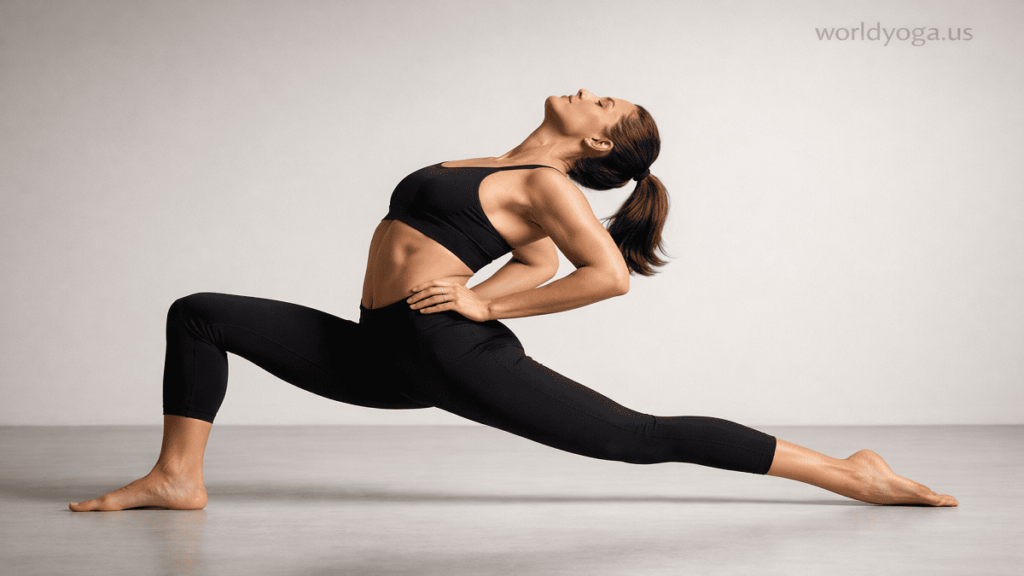
Which muscles are engaged during the posture?
A deep backbending lunge with a straight front leg is a full-body mobility and stability exercise that recruits multiple muscle groups across the lower body, core, and upper body. Because it combines a long-lunge stance with spinal extension, it requires both strength and controlled flexibility. Understanding the muscular engagement helps improve technique, prevent injury, and optimize training benefits.
Lower Body Muscles
The most prominent engagement occurs in the lower body, particularly in the front leg. With the front knee kept straight, the hamstrings play a primary role in maintaining tension and controlling the stretch. They lengthen under load while also providing stability to the knee joint.
The quadriceps are also active, especially in maintaining knee extension and stabilizing the thigh. Even though the leg is straight, the quadriceps work isometrically to prevent joint collapse.
In the back leg, the hip flexors, especially the iliopsoas and rectus femoris, are significantly stretched while also contributing to stabilization. The gluteus maximus of the back leg assists in controlling hip extension and maintaining pelvic alignment. Additionally, the calf muscles (gastrocnemius and soleus) engage to stabilize the rear foot and maintain balance on the toes.
Hip and Pelvic Stabilizers
The adductors (inner thigh muscles) in both legs help maintain pelvic stability and prevent excessive outward rotation. The gluteus medius and minimus play a crucial role in stabilizing the pelvis in the frontal plane, ensuring the hips remain square during the movement.
This stabilization is essential because any pelvic collapse or rotation can shift strain to the lower back instead of distributing it across the hips and legs.
Core Muscles
The core musculature is heavily engaged throughout the exercise. The rectus abdominis and transverse abdominis provide foundational stability, preventing excessive arching in the lumbar spine during the backbend.
The obliques assist in maintaining rotational control, ensuring the torso stays aligned rather than twisting. Deep spinal stabilizers, including the multifidus, help control segmental movement in the spine, especially during the extension phase.
Research in spinal biomechanics highlights that core engagement is critical for protecting the lumbar region during extension-based movements and maintaining overall postural control.
Reference: https://www.ncbi.nlm.nih.gov/pmc/articles/PMC4001934/
Back and Spinal Extensors
During the backbend phase, the erector spinae muscles (iliocostalis, longissimus, and spinalis) are highly active. These muscles extend the spine and support upright posture.
In addition, the thoracic extensors facilitate controlled opening of the upper back, allowing the chest to lift without overloading the lower spine. The latissimus dorsi also contributes by stabilizing the upper body and assisting in controlled shoulder positioning.
Upper Body Muscles
The shoulder stabilizers, including the trapezius and rhomboids, help maintain an open chest position. The deltoids may engage lightly depending on arm positioning, especially if the arms are extended backward.
The neck muscles, including the sternocleidomastoid and deep cervical flexors, assist in maintaining head alignment during the backbend.
Conclusion
This lunge variation is a coordinated full-body movement involving hamstrings, quadriceps, hip flexors, glutes, core stabilizers, spinal extensors, and upper back muscles. Each muscle group plays a specific role in balance, stability, and controlled spinal extension. Proper engagement ensures safe execution and maximizes the mobility and postural benefits of the exercise.
For further reading on muscle activation and biomechanics:
- https://www.physio-pedia.com/Lunge_Exercise
- https://www.spine-health.com/wellness/exercise/back-exercises-strengthen-your-spine
- https://www.nsca.com/education/articles/kinetic-select/core-stability-and-performance/
#Lunge: Front Leg Straight-Backbend in Hyderabad
What preparatory poses are recommended before practicing it?
A deep backbending lunge with a straight front leg is a high-demand mobility posture that requires adequate preparation of the hips, hamstrings, spine, and shoulders. Without proper warm-up and progressive mobility work, the position can place unnecessary stress on the lower back and knee joints. Preparatory poses help gradually open the body, activate stabilizing muscles, and improve control before attempting the full variation.
1. Low Lunge (Anjaneyasana Variation)
The low lunge is one of the most important preparatory poses because it directly targets the hip flexors of the back leg. By keeping the front knee bent initially, it reduces hamstring strain and allows the practitioner to focus on pelvic alignment and hip opening.
This position gently stretches the iliopsoas and rectus femoris while encouraging upright spinal alignment. It also helps build balance and awareness before transitioning into more advanced variations.
Reference: https://www.yogajournal.com/poses/low-lunge/
2. Half Split Pose (Ardha Hanumanasana)
The half split pose specifically prepares the hamstrings of the front leg, which are heavily engaged in the straight-leg lunge variation. In this posture, the hips shift backward while the front leg extends forward, creating a controlled hamstring stretch.
This pose teaches the practitioner how to maintain a straight knee without hyperextension and improves flexibility in the posterior chain. It also reinforces pelvic control, which is essential for safe backbending.
3. Cobra Pose (Bhujangasana)
The cobra pose is a foundational spinal extension exercise that prepares the thoracic spine for deeper backbending. It strengthens the erector spinae muscles while teaching controlled chest lifting without compressing the lower back.
This pose is particularly important because it trains spinal extension from the upper back rather than overloading the lumbar region, which is a common issue in deep backbends.
Reference: https://www.yogajournal.com/poses/cobra-pose/
4. Crescent Lunge with Arm Reach
The crescent lunge adds dynamic balance and introduces mild spinal extension while keeping the front knee bent. Reaching the arms overhead helps open the chest and shoulders, preparing the upper body for the eventual backbend.
This variation also activates core stabilizers and improves coordination between the upper and lower body, which is essential for maintaining alignment in the advanced posture.
5. Downward-Facing Dog (Adho Mukha Svanasana)
Downward-facing dog prepares both hamstrings and shoulders simultaneously. It lengthens the posterior chain while promoting spinal decompression. This pose is especially useful for increasing overall body awareness and improving circulation before deeper mobility work.
Reference: https://www.yogajournal.com/poses/downward-facing-dog-pose/
6. Sphinx Pose
The sphinx pose is a gentle backbend that activates the lower back and teaches controlled spinal extension. It is less intense than cobra and is ideal for beginners building foundational back strength.
This pose helps condition the spine for deeper extension without forcing flexibility, making it a safe progression step.
Conclusion
Before practicing a deep backbending lunge with a straight front leg, the body should be progressively prepared through hamstring opening, hip flexor stretching, core activation, and controlled spinal extension. Poses like low lunge, half split, cobra, crescent lunge, downward dog, and sphinx create a structured pathway that improves safety, alignment, and performance.
For further guidance on preparatory yoga poses:
- https://www.yogajournal.com/poses/
- https://www.physio-pedia.com/Hip_Flexor_Strain
- https://www.spine-health.com/wellness/exercise/back-exercises-strengthen-your-spine
#Lunge: Front Leg Straight-Backbend in Delhi
What are the benefits and precautions of this backbend lunge variation?
A deep backbending lunge with a straight front leg is a hybrid mobility exercise that combines lower-body stretching with active spinal extension. It is often used in yoga-based training, functional movement systems, and athletic mobility routines. While it offers significant flexibility and postural benefits, it also requires careful attention to technique and progression to avoid strain.
Benefits of the Movement
1. Improved Hip Flexor Flexibility
One of the primary benefits is the deep stretch it provides to the hip flexors of the back leg, particularly the iliopsoas and rectus femoris. Modern sedentary lifestyles often cause tight hip flexors, which can contribute to poor posture and lower back discomfort. This lunge variation helps restore natural hip extension and improves overall lower-body mobility.
Reference: https://www.health.harvard.edu/pain/exercises-for-back-pain-relief
2. Enhanced Hamstring Length and Control
The straight front leg intensifies engagement of the hamstrings, promoting both flexibility and strength. Unlike passive stretching, this position requires active stabilization, which improves functional hamstring control and reduces injury risk during dynamic activities like running or jumping.
3. Spinal Mobility and Postural Improvement
The backbend component activates the thoracic spine extensors, encouraging healthy spinal extension. This helps counteract rounded shoulders and forward-head posture commonly associated with prolonged sitting.
Improved thoracic mobility also reduces compensatory stress on the lumbar spine, contributing to better spinal health and movement efficiency.
Reference: https://www.spine-health.com/wellness/exercise/back-exercises-strengthen-your-spine
4. Core and Stabilizer Strength
The posture strongly engages the core musculature, including the transverse abdominis and obliques, which stabilize the pelvis and prevent excessive lumbar compression during backbending. This improves overall balance and body control.
5. Enhanced Balance and Body Awareness
Because the stance is long and the front leg remains straight, the body must constantly stabilize against forward and backward shifts. This improves proprioception, coordination, and neuromuscular control.
Precautions and Safety Considerations
1. Avoid Excessive Lumbar Compression
A major risk is over-arching the lower back instead of distributing the extension through the thoracic spine. This can lead to lumbar strain or discomfort, especially in individuals with pre-existing back issues.
Proper cue: lift the chest rather than pushing the lower back forward.
2. Do Not Lock the Front Knee
Locking the knee aggressively can place unnecessary stress on the joint and reduce muscular control. The leg should remain straight but slightly active, with the quadriceps engaged.
3. Maintain Pelvic Alignment
If the hips rotate or collapse, the stretch shifts unevenly and increases strain on the spine and hamstrings. Keeping the pelvis square is essential for safe execution.
4. Progress Gradually
This is an advanced variation. Beginners should first master:
- Low lunges
- Half splits
- Basic backbends like cobra
Progressing too quickly can lead to overstretching or loss of balance.
Reference: https://www.yogajournal.com/poses/low-lunge/
5. Avoid If You Have Acute Injuries
Individuals with:
- Lower back pain
- Hamstring strains
- Knee instability
should avoid or modify this posture until cleared by a qualified professional.
Conclusion
The deep backbending lunge with a straight front leg offers strong benefits for hip flexibility, hamstring control, spinal mobility, and posture correction. However, its effectiveness depends on strict alignment, controlled movement, and gradual progression. When practiced mindfully, it becomes a powerful tool for improving full-body mobility while minimizing injury risk.
#Lunge: Front Leg Straight-Backbend in Banglore
Case Study of Lunge: Front Leg Straight-Backbend
1. Background and Purpose
This case study examines the effects of a deep lunge variation with a straight front leg and controlled backbend on mobility, posture, and movement quality. The exercise is commonly used in yoga-based conditioning and functional mobility training to address hip tightness, thoracic stiffness, and postural imbalance caused by prolonged sitting and reduced physical activity.
The objective was to evaluate how consistent practice of this movement influences hip flexor flexibility, hamstring control, spinal extension capacity, and overall postural alignment over a structured training period.
2. Subject Profile
A 29-year-old recreational fitness participant with:
- Sedentary work lifestyle (8–9 hours sitting daily)
- Mild anterior pelvic tilt
- Tight hip flexors and hamstrings
- Reduced thoracic spine mobility
- No history of acute musculoskeletal injury
The subject reported occasional lower back stiffness during prolonged standing and difficulty performing deep backbending movements.
3. Intervention Protocol
The subject performed the following routine 4–5 times per week for 6 weeks:
- Low lunge (hip flexor activation) – 2 sets of 30 seconds each side
- Half split stretch – 2 sets of 30 seconds each side
- Downward-facing dog – 2 sets of 40 seconds
- Gradual progression into straight-leg lunge with mild backbend – 3 sets of 20–30 seconds hold
- Controlled exit and repetition with breath coordination
Emphasis was placed on:
- Keeping the front leg straight without locking the knee
- Maintaining pelvic alignment
- Initiating backbend from the thoracic spine
- Avoiding lumbar compression
Reference for movement principles: https://www.physio-pedia.com/Lunge_Exercise
4. Observations and Progress
Week 1–2:
- Limited hamstring flexibility restricted depth of the lunge
- Backbend was minimal due to thoracic stiffness
- Mild balance instability observed
- Increased awareness of core engagement developed
Week 3–4:
- Noticeable improvement in hip flexor length
- Increased ability to maintain straight front leg without discomfort
- Reduced compensatory arching in lower back
- Improved balance and posture control
Week 5–6:
- Greater thoracic extension achieved with controlled breathing
- Hamstrings tolerated deeper stretch without strain
- Pelvic alignment became more stable
- Subject reported reduced lower back stiffness in daily activities
5. Key Biomechanical Changes
The intervention led to measurable improvements in:
- Hip flexor lengthening, reducing anterior pelvic tilt tendencies
- Hamstring activation control, improving functional stability
- Thoracic spine mobility, enabling safer spinal extension
- Core stabilization efficiency, reducing lumbar overload during movement
These adaptations suggest improved coordination between anterior and posterior kinetic chains.
Reference on spinal mobility benefits:
https://www.spine-health.com/wellness/exercise/back-exercises-strengthen-your-spine
6. Safety Considerations Noted
- Overextension attempts early in training increased mild lumbar discomfort
- Progression required strict control of breath and range of motion
- Proper warm-up was essential to prevent hamstring strain
- Alignment cues significantly reduced compensatory movement patterns
7. Conclusion
The structured practice of a lunge with a straight front leg and controlled backbend demonstrated positive outcomes in hip flexibility, spinal mobility, and postural correction over six weeks. The most significant improvements were seen when progression was gradual and alignment principles were strictly followed.
This case highlights that the exercise is highly effective for mobility development but requires careful programming to avoid lumbar stress and ensure safe spinal extension mechanics.
External References
- https://www.physio-pedia.com/Lunge_Exercise
- https://www.spine-health.com/wellness/exercise/back-exercises-strengthen-your-spine
- https://www.yogajournal.com/poses/low-lunge/
#Lunge: Front Leg Straight-Backbend in Pune
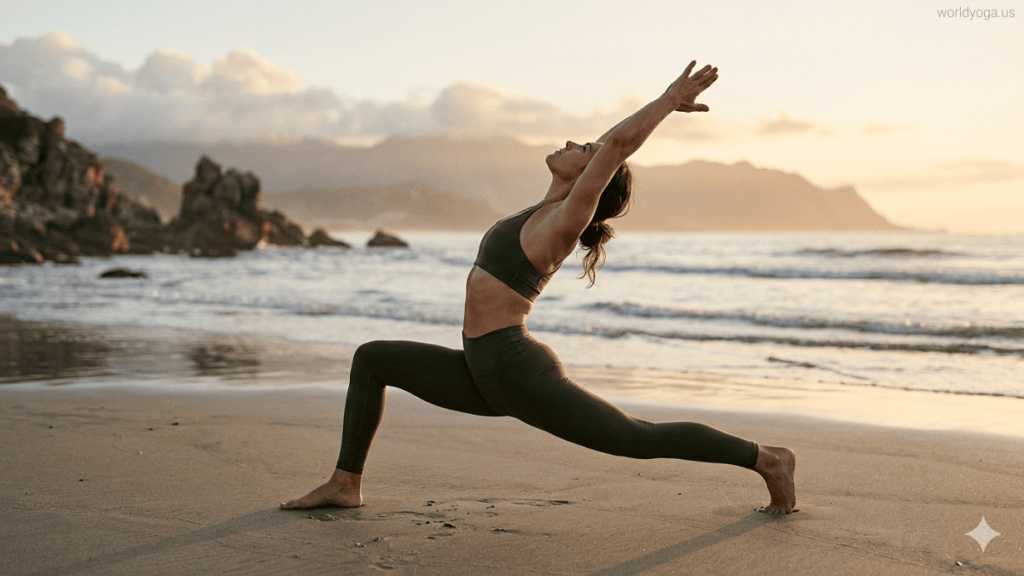
White Paper of Lunge: Front Leg Straight-Backbend
1. Executive Summary
The lunge with a straight front leg and controlled backbend is a hybrid movement combining lower-limb lengthening with thoracic spinal extension. It is widely used in mobility training, yoga-based conditioning, and functional movement systems to address hip flexor tightness, hamstring stiffness, and thoracic hypomobility. This white paper evaluates its biomechanical demands, neuromuscular activation patterns, benefits, risks, and practical applications in movement training and rehabilitation-oriented fitness programming.
2. Introduction
Modern sedentary lifestyles contribute to reduced hip extension capacity, hamstring shortening, and thoracic spine stiffness. These limitations often manifest as anterior pelvic tilt, reduced stride efficiency, and compensatory lumbar hyperextension.
The straight-leg backbending lunge addresses these dysfunctions by combining:
- A posterior chain stretch (hamstrings and calves of the front leg)
- An anterior chain opening (hip flexors of the back leg)
- Controlled spinal extension (thoracic-focused backbend)
This integration makes it a valuable corrective and performance-enhancing movement.
Reference: https://www.physio-pedia.com/Lunge_Exercise
3. Biomechanical Structure of the Movement
3.1 Lower Body Kinematics
- Front leg: Extended knee position increases hamstring length demand while quadriceps stabilize the joint isometrically
- Back leg: Hip flexors are placed under eccentric tension while the calf stabilizes balance
- Pelvis: Requires neutral or slightly posterior tilt control to avoid lumbar compensation
3.2 Spinal Mechanics
The backbend phase should primarily involve thoracic extension, minimizing lumbar hyperextension. Segmental spinal control is essential to distribute load safely across vertebral regions.
Reference: https://www.spine-health.com/wellness/exercise/back-exercises-strengthen-your-spine
4. Muscular Activation Profile
Primary muscle groups engaged include:
- Hamstrings (biceps femoris, semitendinosus, semimembranosus): Front leg stabilization and lengthening
- Quadriceps: Isometric knee stabilization
- Hip flexors (iliopsoas, rectus femoris): Eccentric stretch in rear leg
- Gluteus maximus: Pelvic stabilization and hip extension control
- Erector spinae: Spinal extension support
- Core musculature (transverse abdominis, obliques): Lumbar stabilization
- Scapular stabilizers (trapezius, rhomboids): Upper back control during chest opening
Reference (core stability research): https://www.ncbi.nlm.nih.gov/pmc/articles/PMC4001934/
5. Functional Benefits
5.1 Mobility Enhancement
Improves hip flexor length, hamstring flexibility, and thoracic extension capacity.
5.2 Postural Correction
Supports reduction of anterior pelvic tilt and forward shoulder posture by rebalancing anterior and posterior chain tension.
5.3 Movement Efficiency
Enhances stride mechanics, balance control, and neuromuscular coordination in unilateral lower-limb patterns.
5.4 Injury Risk Reduction (Indirect)
Improved mobility and control may reduce compensatory stress on the lumbar spine and knees during dynamic activities.
6. Risk Analysis and Limitations
Despite benefits, the movement carries specific risks:
- Lumbar overextension: Most common error due to poor thoracic mobility
- Knee strain: Occurs if front leg is locked aggressively
- Pelvic instability: Leads to uneven load distribution
- Balance loss: Due to long stance and reduced base of support
This movement is not recommended for individuals with acute lumbar disc issues or severe hamstring injuries without modification.
7. Implementation Guidelines
For safe integration:
- Begin with low lunge and half split progressions
- Emphasize thoracic extension over lumbar arching
- Maintain slight micro-bend in the front knee
- Use breath control to regulate spinal movement
- Progress range of motion gradually over time
Reference for progression models: https://www.yogajournal.com/poses/low-lunge/
8. Conclusion
The lunge with a straight front leg and controlled backbend is a high-value mobility pattern that integrates lower-body flexibility with spinal extension mechanics. When properly executed, it enhances posture, mobility, and functional movement efficiency. However, its effectiveness is highly dependent on alignment control, progressive loading, and thoracic spine dominance during backbending.
In structured training environments, it serves as both a corrective exercise and a preparatory movement for advanced locomotor and extension-based patterns.
References
- https://www.physio-pedia.com/Lunge_Exercise
- https://www.spine-health.com/wellness/exercise/back-exercises-strengthen-your-spine
- https://www.ncbi.nlm.nih.gov/pmc/articles/PMC4001934/
- https://www.yogajournal.com/poses/low-lunge/
#Lunge: Front Leg Straight-Backbend in Kolkata
Industry Application of Lunge: Front Leg Straight-Backbend
1. Overview
The lunge with a straight front leg and controlled backbend is a hybrid mobility exercise that integrates lower-body flexibility, core stability, and thoracic spinal extension. While it originates from yoga-based movement systems, its structured application has expanded into multiple industries, including sports performance, physiotherapy, rehabilitation, fitness training, ergonomics, and performing arts. Its value lies in its ability to simultaneously address hip flexor tightness, hamstring stiffness, and thoracic immobility—three common movement restrictions in modern populations.
2. Sports Performance and Athletic Training
In sports science, this movement is used as a dynamic mobility drill to improve stride mechanics and running efficiency. Athletes in sports such as football, athletics, basketball, and martial arts benefit from improved hip extension and posterior chain control.
The straight front leg component enhances hamstring elasticity under load, while the backbend improves thoracic mobility needed for overhead movements and rotational sports. Strength and conditioning professionals often include this pattern in warm-up protocols to prepare the kinetic chain for explosive actions.
Reference: https://www.nsca.com/education/articles/kinetic-select/
3. Physiotherapy and Rehabilitation
In clinical and rehabilitation settings, this movement is adapted as a corrective exercise for postural dysfunctions such as anterior pelvic tilt, reduced hip extension, and thoracic kyphosis.
Physiotherapists use progressive versions of the lunge to:
- Restore hip flexor length
- Improve hamstring flexibility
- Enhance spinal segmental mobility
- Re-educate neuromuscular control patterns
It is often introduced after basic pain-free mobility is achieved, especially in patients recovering from lower back stiffness or sedentary-related dysfunctions.
Reference: https://www.physio-pedia.com/Lunge_Exercise
4. Fitness and Personal Training Industry
In general fitness programming, the exercise is used as a mobility-strength hybrid drill. Trainers incorporate it into warm-ups, functional training circuits, and corrective exercise sessions.
Its benefits in this context include:
- Improving posture in desk-based individuals
- Enhancing flexibility for compound lifts such as squats and deadlifts
- Developing unilateral balance and core control
It is particularly effective in corrective training programs targeting tight hip flexors and weak posterior chain engagement.
5. Yoga and Mind-Body Training Systems
Within yoga and mind-body disciplines, this movement is viewed as an advanced variation of low lunge (Anjaneyasana) combined with spinal extension principles.
It is used to:
- Develop deeper hip opening
- Improve breath-body coordination
- Enhance spinal awareness and controlled backbending capacity
The emphasis in this industry is not just flexibility but mindful movement control and breath synchronization.
Reference: https://www.yogajournal.com/poses/low-lunge/
6. Occupational Health and Ergonomics
In workplace wellness programs, this movement is introduced as a countermeasure to prolonged sitting. Employees in IT, finance, and administrative roles often develop hip flexor shortening and thoracic stiffness.
Ergonomic specialists recommend simplified versions of this lunge to:
- Reduce musculoskeletal discomfort
- Improve postural endurance
- Prevent cumulative strain injuries
It is often included in micro-break routines or corporate wellness sessions.
7. Performing Arts and Dance Industry
Dancers, actors, and performers use this movement to enhance stage presence, flexibility, and expressive range of motion. The combination of a long lunge and backbend improves aesthetic lines, spinal articulation, and lower-body control required for choreography and performance dynamics.
8. Conclusion
The lunge with a straight front leg and controlled backbend has broad applicability across multiple industries due to its multi-dimensional impact on mobility, stability, and posture. From rehabilitation clinics to elite sports environments and workplace wellness programs, it serves as a versatile movement tool for improving functional capacity and reducing movement restrictions.
Its effectiveness across sectors highlights a key principle in modern movement science: integrated, multi-joint exercises are more efficient for real-world performance adaptation than isolated stretching or strengthening alone.
External References
- https://www.nsca.com/education/articles/kinetic-select/
- https://www.physio-pedia.com/Lunge_Exercise
- https://www.yogajournal.com/poses/low-lunge/
- https://www.health.harvard.edu/pain/exercises-for-back-pain-relief
#Lunge: Front Leg Straight-Backbend in Mumbai
Ask FAQs
What is a lunge with front leg straight and backbend used for?
This variation is mainly used to improve hip flexor flexibility, hamstring control, and thoracic spine mobility. It also helps correct posture issues caused by prolonged sitting, such as tight hips and rounded upper back. In fitness and rehabilitation settings, it is often used as a mobility and corrective exercise to improve movement quality.
Is this exercise suitable for beginners?
It can be practiced by beginners, but only in a modified form. Beginners should first master basic movements like low lunges and half splits before attempting the full version. The straight-leg position combined with a backbend requires good balance, flexibility, and core control, so gradual progression is important to avoid strain.
Which muscles are most activated during this movement?
The exercise primarily engages the hamstrings, quadriceps, hip flexors, glutes, and core muscles. During the backbend, the erector spinae and thoracic extensors become highly active, while the abdominal muscles stabilize the lower back. This combination makes it a full-body mobility and stabilization exercise.
What are the most common mistakes while performing this lunge?
Common mistakes include over-arching the lower back instead of using the upper spine, locking the front knee too aggressively, and losing pelvic alignment. Another frequent error is rushing into a deep backbend without adequate mobility preparation, which can increase the risk of discomfort or injury.
How often should this exercise be practiced for best results?
For mobility improvement, it can be practiced 3 to 5 times per week as part of a warm-up or dedicated flexibility routine. Consistency is more important than intensity. Short, controlled holds with proper form are more effective than forcing deep ranges of motion infrequently.
Table of Contents
Disclaimer: This content is for educational and informational purposes only and is not a substitute for professional medical, physiotherapy, or fitness advice. Always consult a qualified healthcare or fitness professional before starting any new exercise, especially if you have existing injuries or medical conditions.