
Vishvamitrasana
Vishvamitrasana is one of the most challenging and expressive postures in modern yoga practice. Named after the sage Vishvamitra from Indian mythology, this pose symbolizes transformation, discipline, and the integration of strength with flexibility. It is commonly practiced in advanced yoga sequences and requires a combination of balance, hamstring flexibility, hip opening, and core stability.
Meaning and Origin
The name Vishvamitrasana comes from Sanskrit: “Vishvamitra,” a revered sage known for his intense austerity and spiritual evolution, and “asana,” meaning posture. The pose reflects the sage’s journey from a king to a realized sage, representing inner transformation through dedicated practice. In traditional yoga philosophy, such postures are not merely physical exercises but tools for cultivating mental focus and self-awareness.
Technique and Execution
Vishvamitrasana is typically entered from a standing position or a side plank variation. The practitioner places one hand on the ground while extending the corresponding leg outward, often supported by the upper arm or shoulder. The opposite leg remains grounded or is lifted depending on the variation. The torso rotates and opens, creating a deep side-body stretch while maintaining balance on one arm.
Because of its complexity, preparatory poses such as Extended Side Angle Pose, Half Splits, and Crow Pose are often recommended. These help develop the necessary strength and flexibility before attempting the full expression of the pose.
Benefits of Vishvamitrasana
Regular practice of Vishvamitrasana offers several physical and mental benefits. It strengthens the arms, shoulders, wrists, and core muscles while deeply stretching the hamstrings, groin, and side body. The pose also enhances balance and coordination, improving overall body awareness.
On a mental level, holding such a demanding posture encourages focus, patience, and resilience. It can help practitioners develop concentration and calmness under physical pressure, which often translates into improved emotional regulation off the mat.
Precautions and Contraindications
Due to its advanced nature, Vishvamitrasana should not be attempted without adequate preparation. Individuals with wrist, shoulder, or hamstring injuries should avoid or modify the pose. Beginners are encouraged to work under the guidance of an experienced yoga instructor to prevent strain or injury.
Conclusion
Vishvamitrasana stands as a powerful representation of yoga’s deeper philosophy—balancing strength and surrender. With consistent practice and mindful progression, this pose can become a transformative milestone in an advanced practitioner’s journey.
For further reading on this pose and its variations, you can explore:
- https://www.yogajournal.com/poses/vishvamitrasana/
- https://www.yogapedia.com/definition/7007/vishvamitrasana
- https://en.wikipedia.org/wiki/Vishvamitrasana
#Vishvamitrasana in India
How is Vishvamitrasana performed correctly?
Vishvamitrasana is an advanced yoga posture that combines deep hamstring flexibility, hip opening, spinal rotation, and arm balance. Performing it correctly requires not only physical preparation but also precise alignment and controlled breathing. Because it is complex, practitioners are advised to approach it gradually with strong foundational strength in arm balances and forward folds.
Step-by-Step Execution
A common entry into Vishvamitrasana begins from a standing position:
Start in a wide stance and shift into a deep side lunge. The front foot points forward while the back leg extends long and active. Place the opposite hand of the front leg on the ground, slightly outside the foot. This hand becomes your primary base of support.
Begin to shift your weight onto the grounded hand while engaging the core muscles strongly. The front leg gradually straightens as the torso rotates open. At the same time, the back leg begins to lift and extend outward, often resting against the upper arm or shoulder for support.
The top arm extends upward initially to help create space in the chest and maintain balance. Over time, the practitioner may bind the lifted leg with the top arm, deepening the expression of the pose. The gaze should remain steady, either forward or slightly upward, depending on stability.
Alignment Principles
Correct alignment is essential to avoid strain and maintain stability. The supporting wrist should be directly under the shoulder to reduce pressure. The chest should remain open rather than collapsing toward the ground. The extended leg should stay active with engaged quadriceps, preventing it from hanging passively.
Core engagement is crucial throughout the pose. Without it, the body tends to collapse into the supporting shoulder, increasing the risk of injury. The lifted leg should be extended with intention, not just lifted, creating a long line of energy through the body.
Preparation and Progression
Before attempting Vishvamitrasana, it is important to build strength and flexibility through preparatory poses such as Side Angle Pose, Half Splits, and Crow Pose. These help develop the required hamstring openness, hip mobility, and arm strength.
Using props like yoga blocks under the supporting hand can also help beginners maintain proper alignment while gradually building confidence.
Common Mistakes to Avoid
One of the most common mistakes is collapsing into the supporting shoulder, which can lead to strain. Another is forcing the leg extension without adequate flexibility, resulting in overstretching of the hamstrings. Practitioners should avoid rushing into the full expression of the pose.
Conclusion
Performing Vishvamitrasana correctly is less about achieving a perfect shape and more about maintaining intelligent alignment, breath control, and gradual progression. With consistent practice, it becomes a powerful demonstration of strength, flexibility, and focus.
For further technical guidance, you can refer to:
- https://www.yogajournal.com/poses/vishvamitrasana/
- https://www.yogapedia.com/definition/7007/vishvamitrasana
- https://www.ekhartyoga.com/blog/vishvamitrasana-step-by-step-guide
#Vishvamitrasana in Maharashtra
What is the proper alignment in this advanced arm balance and side stretch?
Vishvamitrasana demands precise alignment because it combines multiple movement patterns at once: arm balance, spinal rotation, hamstring extension, and hip opening. Without correct alignment, the pose can quickly collapse into the supporting shoulder or overstretch the hamstrings. The goal is to create a stable base, an engaged core, and a long, open side body while maintaining controlled balance.
Hand and Shoulder Alignment
The foundation of the pose is the supporting hand. It should be placed firmly on the mat with the wrist directly under the shoulder. This vertical stacking is essential to avoid excessive strain on the wrist joint and to maintain structural stability. The fingers should be spread wide, actively pressing into the ground to distribute weight evenly.
The supporting shoulder must stay strong and lifted, not sinking toward the floor. A common mistake is collapsing into the shoulder joint, which reduces stability and increases injury risk. Instead, the shoulder should remain engaged, as if gently pushing the floor away.
Core and Torso Position
Core engagement is central to maintaining balance. The abdominal muscles should be actively drawn inward to stabilize the spine and prevent over-rotation. The torso should rotate open toward the lifted side while maintaining length through both sides of the waist.
Rather than compressing the chest downward, the sternum should remain broad and lifted. This helps create space for deeper breathing and prevents rounding in the upper back.
Leg Alignment and Extension
The front leg is typically straightened gradually, with the quadriceps engaged to protect the hamstring. It should not lock aggressively but remain active and controlled. The back leg extends outward with equal intention, creating a long line of energy through the heel.
Both legs should feel engaged rather than passive. The lifted leg should not simply hang but extend strongly, often supported lightly by the upper arm or shoulder depending on the variation. Proper engagement helps maintain balance and reduces strain on the hips.
Hip and Pelvic Position
The hips should stay as open and level as possible without collapsing to one side. Many practitioners unintentionally drop the pelvis, which disrupts alignment and increases pressure on the supporting arm. Instead, the pelvis should be lifted and stabilized through core activation and leg engagement.
Gaze and Breath Control
The gaze (drishti) should remain steady, usually forward or slightly upward, depending on balance stability. The breath must remain smooth and controlled. Holding the breath often leads to tension and loss of alignment.
Conclusion
Proper alignment in Vishvamitrasana is about integration rather than isolation. Each part of the body—hands, shoulders, core, hips, and legs—must work together to create a balanced structure. When aligned correctly, the pose becomes not just an arm balance, but a coordinated expression of strength, flexibility, and control.
For deeper technical reference:
- https://www.yogajournal.com/poses/vishvamitrasana/
- https://www.ekhartyoga.com/blog/vishvamitrasana-step-by-step-guide
- https://www.yogapedia.com/definition/7007/vishvamitrasana
#Vishvamitrasana in Ahemadabad
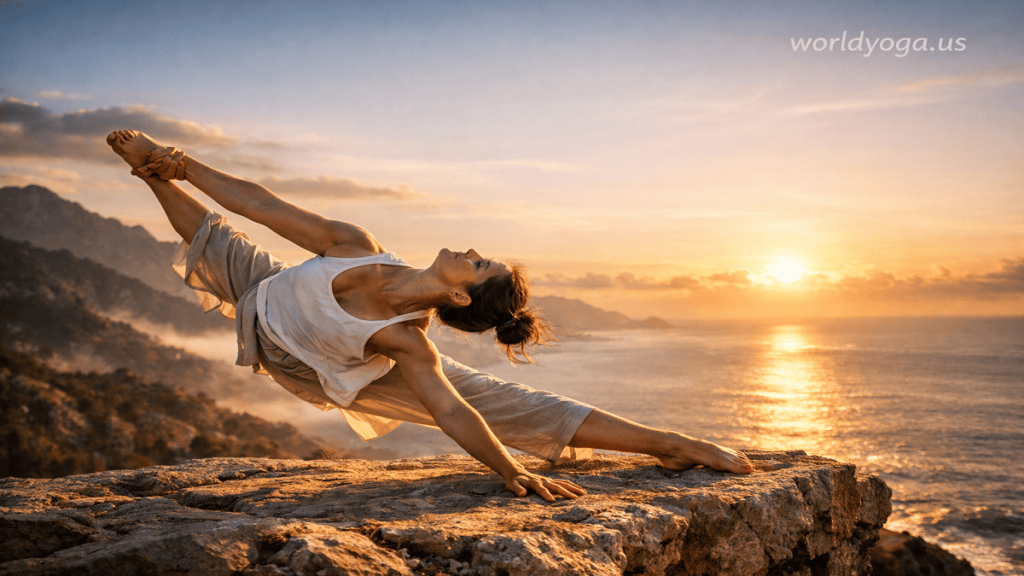
Which muscles and joints are engaged during the posture?
Vishvamitrasana is a full-body integration posture that demands simultaneous activation of strength, flexibility, and joint stability. Unlike simpler yoga poses that isolate specific regions, this posture recruits multiple muscle chains and load-bearing joints at once, making it both physically demanding and highly effective for advanced conditioning.
Upper Body Engagement
The most significant load in Vishvamitrasana is carried through the upper limbs, particularly the wrist, elbow, and shoulder joints of the supporting arm. The wrist is in strong extension, bearing body weight while stabilizing micro-adjustments for balance. The elbow joint remains extended but not locked, engaging the triceps brachii for structural support.
The shoulder joint (glenohumeral joint) plays a critical role in stabilization. The deltoids, rotator cuff muscles, and serratus anterior work together to maintain shoulder elevation and prevent collapse. The scapula must remain active, protracted, and slightly upwardly rotated to create a stable base.
Core and Spinal Musculature
The core is heavily engaged throughout the pose. The rectus abdominis provides anterior stability, while the obliques are deeply activated due to the rotational nature of the posture. The transverse abdominis acts as a stabilizing corset, controlling intra-abdominal pressure and supporting spinal integrity.
The spinal erectors along the thoracic and lumbar regions maintain extension and prevent rounding. Because the torso is both rotated and extended, the multifidus muscles also play a key role in segmental spinal stability.
Hip and Lower Body Activation
The hip joints are among the most dynamically engaged areas in Vishvamitrasana. The front hip performs a combination of flexion and external rotation, while the back hip is in extension and abduction depending on the variation.
Key muscles include the iliopsoas (hip flexor), gluteus maximus (hip extension), and gluteus medius (pelvic stabilization). The hamstrings of the extended leg are deeply stretched while still actively engaged to control length and prevent overstretching. The adductor group stabilizes the inner thighs and assists in maintaining pelvic alignment.
Lower Limb and Supporting Structures
The knees remain extended but not hyperextended, requiring balanced engagement of quadriceps and hamstrings. The ankle joints contribute to overall stability, especially in grounding the base foot. The foot intrinsic muscles assist in maintaining balance and distributing weight effectively.
Joint Integration and Load Distribution
The posture requires coordinated load sharing across the wrist, shoulder, spine, hip, and knee joints. No single joint functions independently; instead, each contributes to a kinetic chain that maintains equilibrium. Improper alignment in any one joint often results in compensatory strain elsewhere, particularly in the shoulders or lower back.
Conclusion
Vishvamitrasana is best understood as a complex biomechanical system rather than a static pose. It integrates upper-body strength, core stability, hip mobility, and joint coordination into a single expression of control and flexibility. Practicing with anatomical awareness significantly reduces injury risk and improves long-term progression.
For further anatomical and practice insights:
- https://www.yogajournal.com/poses/vishvamitrasana/
- https://www.ekhartyoga.com/blog/vishvamitrasana-step-by-step-guide
- https://www.yogapedia.com/definition/7007/vishvamitrasana
#Vishvamitrasana in Hyderabad
What preparatory poses are recommended before attempting Vishvamitrasana?
Vishvamitrasana is a highly advanced posture that requires a combination of hamstring flexibility, hip opening, shoulder stability, and core strength. Because it integrates multiple movement demands simultaneously, proper preparation through foundational yoga poses is essential. These preparatory asanas gradually condition the body, reduce injury risk, and build the specific mobility and strength patterns needed for safe progression.
1. Side Angle Pose (Utthita Parsvakonasana)
Side Angle Pose is one of the most important preparatory postures. It develops lateral body length, hip opening, and foundational stability in a standing lunge position. It also begins to train the coordination between the lower body and torso rotation, which is essential for Vishvamitrasana.
2. Half Splits (Ardha Hanumanasana)
Half Splits deeply stretches the hamstrings while maintaining hip alignment. Since Vishvamitrasana requires significant hamstring flexibility in an extended leg position, this pose helps prepare the posterior chain and teaches controlled lengthening without overstretching.
3. Lizard Pose (Utthan Pristhasana)
Lizard Pose targets the hip flexors and groin while also introducing weight-bearing through the arms. This combination closely mirrors the demands of Vishvamitrasana, making it a crucial mobility and strength builder for the hips and shoulders.
4. Crow Pose (Bakasana)
Crow Pose builds essential wrist strength, shoulder engagement, and core stability. Since Vishvamitrasana is an arm balance, developing confidence in weight-bearing through the hands is necessary before attempting more complex variations.
5. Compass Pose (Parivrtta Surya Yantrasana)
Compass Pose trains extreme hamstring flexibility and shoulder opening while requiring balance and control. It closely resembles the leg extension mechanics used in Vishvamitrasana and helps prepare the body for asymmetrical leg positioning.
6. Side Plank Variation (Vasisthasana)
Side Plank strengthens the obliques, wrists, and shoulder stabilizers. It is particularly useful for developing the lateral chain engagement required to support the body while one leg extends outward in Vishvamitrasana.
7. Eka Pada Koundinyasana I
This advanced arm balance builds coordination between hip rotation, core engagement, and arm support. It is one of the closest preparatory arm balances to Vishvamitrasana in terms of biomechanical demand.
Conclusion
Preparing for Vishvamitrasana is not about mastering a single prerequisite pose but about building a system of strength, flexibility, and control across multiple movement patterns. A consistent practice of the above postures gradually conditions the body for the complexity of the final pose, ensuring safer progression and improved stability.
For further guidance on these preparatory poses:
- https://www.yogajournal.com/poses/side-angle-pose/
- https://www.yogajournal.com/poses/bakasana/
- https://www.ekhartyoga.com/blog/compass-pose-step-by-step
- https://www.yogajournal.com/poses/vishvamitrasana/
#Vishvamitrasana in Pune
What are the benefits and precautions of practicing Vishvamitrasana?
Vishvamitrasana is an advanced-level yoga posture that blends deep flexibility, upper-body strength, and core stability into a single integrated movement. While it offers significant physical and mental benefits, it also carries a higher risk of strain if attempted without proper preparation. Understanding both its advantages and precautions is essential for safe and effective practice.
Benefits of Vishvamitrasana
One of the primary benefits of Vishvamitrasana is the development of full-body strength. The pose places significant demand on the shoulders, arms, wrists, and core muscles, helping to build upper-body endurance and stability. The triceps, deltoids, and forearm muscles are particularly engaged due to sustained weight-bearing.
It also enhances flexibility, especially in the hamstrings, hip flexors, groin, and side body. The extended leg position requires deep posterior chain opening, while the torso rotation and lateral stretch improve spinal mobility and rib cage expansion.
Another important benefit is improved balance and coordination. Since the posture involves supporting the body on one arm while managing leg extension and rotation, it refines neuromuscular control and proprioception. This translates into better body awareness in both yoga practice and daily movement.
From a physiological perspective, the pose stimulates core activation, particularly the obliques and transverse abdominis, which support spinal stability and posture. It also encourages better posture alignment over time by strengthening the muscles responsible for maintaining upright spinal positioning.
On a mental level, Vishvamitrasana promotes focus, patience, and resilience. Holding such a demanding posture requires concentration and controlled breathing, which can help reduce mental distractions and improve stress management. It also builds confidence through progressive achievement.
Precautions and Contraindications
Despite its benefits, Vishvamitrasana should be approached with caution. It is not recommended for beginners or individuals without a strong foundation in arm balances and hip flexibility.
People with wrist, shoulder, elbow, or lower back injuries should avoid this pose, as it places significant load on these areas. Overextension or collapse in the supporting arm can lead to strain or injury if alignment is not maintained.
Those with tight hamstrings or limited hip mobility should avoid forcing the leg extension, as this may result in muscle strain. Proper warm-up and preparatory poses are essential before attempting the full posture.
Pregnant practitioners should avoid Vishvamitrasana due to abdominal compression and balance demands. Additionally, individuals with uncontrolled hypertension or vertigo should practice caution with advanced balance poses.
It is strongly recommended to practice under the supervision of a qualified yoga instructor, especially during initial attempts. Using props such as yoga blocks can help reduce strain and improve alignment.
Conclusion
Vishvamitrasana is a powerful expression of strength, flexibility, and mental discipline. While it offers extensive physical and psychological benefits, it must be approached gradually and mindfully. With proper preparation and awareness, it can become a transformative milestone in an advanced yoga journey.
For further reference:
- https://www.yogajournal.com/poses/vishvamitrasana/
- https://www.ekhartyoga.com/blog/vishvamitrasana-step-by-step-guide
- https://www.yogapedia.com/definition/7007/vishvamitrasana
#Vishvamitrasana in Banglore
Case Study of Vishvamitrasana
Vishvamitrasana is often regarded as a benchmark posture in advanced yoga practice due to its combined demand for strength, flexibility, and neuromuscular control. This case study presents a structured example of how a dedicated practitioner progressed toward the pose over a 12-week training cycle, highlighting key adaptations, challenges, and outcomes.
Practitioner Profile
The subject, a 32-year-old recreational yoga practitioner with three years of consistent Vinyasa practice, aimed to achieve Vishvamitrasana as part of advancing toward arm balance proficiency. Initial assessment revealed strong foundational stamina but limited hamstring flexibility and moderate shoulder stability deficits during single-arm load-bearing.
Phase 1: Foundational Conditioning (Weeks 1–4)
The first phase focused on mobility and strength preparation. The practitioner emphasized preparatory poses such as Side Angle Pose, Lizard Pose, and Half Splits to improve hip opening and posterior chain flexibility. Wrist conditioning drills and Side Plank variations were incorporated to enhance shoulder stability.
During this phase, the primary challenge was restricted hamstring length, which limited safe leg extension. Modifications using yoga blocks were introduced to reduce load on the supporting arm and maintain alignment integrity.
Phase 2: Integration and Arm Balance Training (Weeks 5–8)
The second phase introduced controlled arm balance exposure through Crow Pose and Eka Pada Koundinyasana I. These poses helped develop proprioception, core engagement, and confidence in weight distribution through the hands.
At this stage, the practitioner began partial expressions of Vishvamitrasana, focusing on maintaining shoulder elevation and avoiding collapse into the supporting joint. Breath regulation became a key focus, particularly during transitions into balance.
A noticeable improvement was observed in scapular control and oblique activation, leading to increased stability during lateral extension.
Phase 3: Refinement and Full Expression (Weeks 9–12)
The final phase emphasized refinement of alignment and gradual progression into the full posture. Compass Pose was used to deepen hamstring flexibility, while dynamic transitions from Side Angle Pose helped simulate entry pathways.
By week 11, the practitioner successfully held a modified version of Vishvamitrasana for short durations, maintaining stable wrist alignment and controlled hip rotation. Full expression was achieved in brief holds with continued use of mindful breath control.
The primary limitation remained hamstring tightness, but improved neuromuscular coordination allowed for safer engagement despite this restriction.
Outcomes and Observations
By the end of the 12-week period, the practitioner demonstrated significant improvements in shoulder endurance, core stability, and lateral body flexibility. The most critical success factor was structured progression rather than forceful attainment of the final posture.
This case reinforces that Vishvamitrasana is not solely a flexibility goal but a coordinated strength-mobility system requiring phased development.
Conclusion
The progression toward Vishvamitrasana highlights the importance of systematic training, injury prevention strategies, and incremental loading. When approached correctly, the pose serves as a comprehensive indicator of advanced functional yoga capacity.
For further study and technical breakdown:
- https://www.yogajournal.com/poses/vishvamitrasana/
- https://www.ekhartyoga.com/blog/vishvamitrasana-step-by-step-guide
- https://www.yogapedia.com/definition/7007/vishvamitrasana
#Vishvamitrasana in Delhi
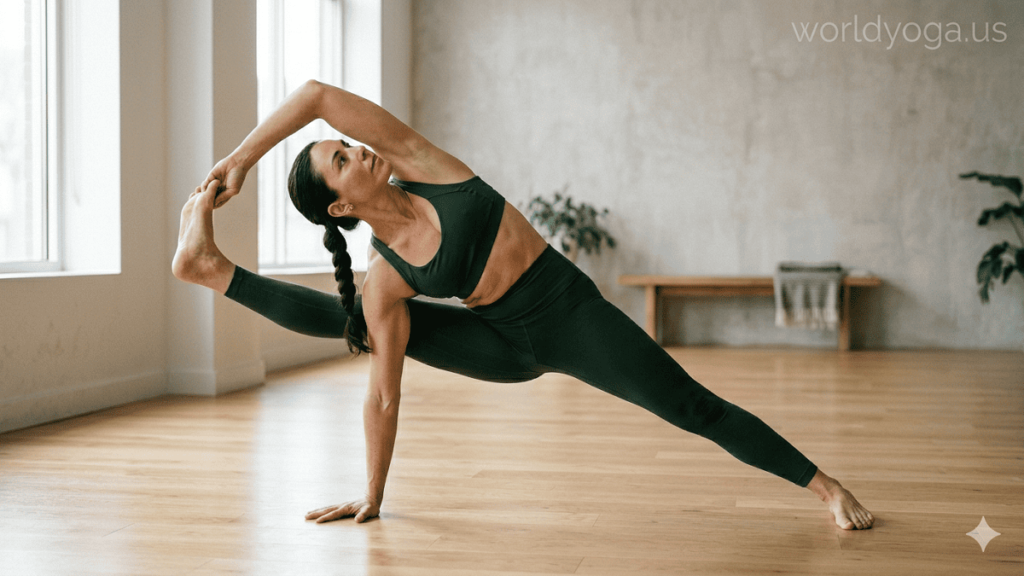
White Paper of Vishvamitrasana
Abstract
Vishvamitrasana is an advanced multi-planar yoga posture that integrates unilateral upper-limb load-bearing, deep hip flexion and abduction, hamstring extensibility, and spinal rotation. This white paper analyzes the pose from a biomechanical and training science perspective, outlining key joint mechanics, muscular demands, progression methodology, and risk mitigation strategies. The objective is to present a structured framework for safe skill acquisition in advanced yoga practitioners.
1. Introduction
Vishvamitrasana is classified as a complex asymmetrical arm balance combining strength, flexibility, and neuromuscular coordination. Unlike linear postures, it requires simultaneous control across multiple kinetic chains. Its successful execution depends on the integration of shoulder stability, pelvic mobility, and core anti-rotational strength.
2. Biomechanical Analysis
2.1 Kinetic Chain Overview
The posture operates through a closed kinetic chain in the supporting arm while the lower body functions in an open kinetic chain. Load transfer occurs through the wrist → elbow → shoulder → scapula complex, requiring coordinated stabilization.
2.2 Joint Actions
- Wrist joint: Extension under compressive load with radial-ulnar micro-adjustments
- Elbow joint: Isometric extension via triceps engagement
- Shoulder joint: Flexion, external rotation, and scapular protraction
- Spine: Rotational and lateral flexion with axial elongation
- Hip joints: Asymmetrical configuration—one hip in flexion/external rotation, the other in extension/abduction
- Knee joints: Extended under controlled hamstring tension
2.3 Muscular Engagement
Primary stabilizers include the deltoids, rotator cuff group, serratus anterior, and triceps brachii. Core stabilization is driven by the transverse abdominis, obliques, and spinal erectors. Lower-body control is maintained through the gluteus medius, gluteus maximus, iliopsoas, and hamstring complex.
3. Physiological Demands
The posture requires high levels of isometric strength endurance and fascial elasticity. Neuromuscular coordination is critical, as small deviations in shoulder or pelvic alignment significantly affect balance integrity. Oxygen efficiency is challenged due to sustained bracing and controlled breathing under load.
4. Training Methodology
4.1 Foundational Requirements
Prerequisites include proficiency in Side Plank, Compass Pose, Crow Pose, and extended hamstring mobility work.
4.2 Progressive Loading Model
A phased approach is recommended:
- Mobility development (hips, hamstrings, thoracic spine)
- Strength conditioning (shoulders, core, wrists)
- Integrated arm balance exposure
- Assisted Vishvamitrasana variations using props
- Full expression with controlled hold durations
4.3 Motor Learning Strategy
Repetition under low fatigue conditions enhances proprioceptive mapping. Static holds should precede dynamic entry attempts to reduce compensatory movement patterns.
5. Risk Assessment and Contraindications
Primary risk zones include the wrist flexors, anterior shoulder capsule, and hamstring insertions. Overloading without adequate preparation may result in strain injuries. Contraindications include recent wrist/shoulder injury, severe hamstring tightness, and uncontrolled balance disorders.
6. Conclusion
Vishvamitrasana represents a high-complexity movement system rather than a single static posture. Its mastery depends on progressive conditioning across mobility, strength, and coordination domains. A structured, evidence-informed approach significantly reduces injury risk while enhancing long-term performance capacity.
External References
- https://www.yogajournal.com/poses/vishvamitrasana/
- https://www.ekhartyoga.com/blog/vishvamitrasana-step-by-step-guide
- https://www.yogapedia.com/definition/7007/vishvamitrasana
#Vishvamitrasana in Kolkata
Industry Application of Vishvamitrasana
Vishvamitrasana is traditionally known as an advanced yoga posture, but in modern applied settings it extends far beyond the yoga studio. It is increasingly referenced across fitness training, physiotherapy, sports performance conditioning, and wellness education due to its unique combination of strength, mobility, and neuromuscular control requirements. Its complexity makes it a valuable functional movement model for assessing and developing full-body integration.
1. Application in Fitness and Strength Training
In the fitness industry, Vishvamitrasana is often used as a benchmark movement for advanced bodyweight control. Trainers incorporate its preparatory elements—such as single-arm support, lateral core engagement, and hamstring-loaded extensions—into calisthenics and functional training programs.
The posture’s demand on shoulder stabilizers, particularly the serratus anterior and rotator cuff, aligns closely with injury-prevention strategies used in strength conditioning. It is also used to improve unilateral strength and anti-rotation core control, which are essential for athletic performance in sports involving throwing, sprinting, and directional change.
2. Physiotherapy and Rehabilitation Contexts
In physiotherapy, modified elements of Vishvamitrasana are applied to restore functional mobility in the hips, shoulders, and spine. While the full pose is not typically used in early rehabilitation, its segmented movements are valuable for progressive loading protocols.
For example, supported side planks and assisted hamstring extensions derived from the posture help rebuild joint stability after injury. The pose’s emphasis on scapular control is particularly relevant in shoulder rehabilitation programs where restoring proper movement mechanics is a priority.
3. Sports Performance and Athletic Conditioning
Sports science professionals view Vishvamitrasana as a high-level integration drill for kinetic chain coordination. The posture replicates multi-planar demands seen in sports such as gymnastics, martial arts, climbing, and racket sports.
Its unilateral loading pattern improves proprioception and balance under instability, while its hamstring and hip extension components contribute to sprint efficiency and lower-body power mechanics. Coaches often adapt elements of the pose into mobility circuits and dynamic warm-up routines.
4. Mind-Body and Wellness Industry
In the wellness sector, Vishvamitrasana is used as a symbolic and practical expression of advanced mind-body integration. It represents discipline, patience, and focus, making it a staple in advanced yoga workshops and teacher training programs.
The controlled breathing and concentration required during the pose align with stress regulation practices used in corporate wellness programs. It is often used to cultivate mental resilience under physical challenge, reinforcing the connection between cognitive focus and physical control.
5. Education and Yoga Teacher Training
In yoga education systems, Vishvamitrasana is introduced as a capstone posture that synthesizes multiple foundational skills. It is used to evaluate a practitioner’s readiness for advanced sequencing, emphasizing progression, alignment awareness, and injury prevention principles.
Conclusion
Vishvamitrasana functions as more than an advanced yoga posture; it is a multidisciplinary movement model with applications across fitness, rehabilitation, sports performance, and wellness education. Its value lies in its ability to integrate mobility, strength, and coordination into a single controlled expression, making it a useful reference point for modern movement science.
References
- https://www.yogajournal.com/poses/vishvamitrasana/
- https://www.ekhartyoga.com/blog/vishvamitrasana-step-by-step-guide
- https://www.acefitness.org/education-and-resources/professional/exercise-library/
- https://www.ncbi.nlm.nih.gov/pmc/articles/PMC3193654/
#Vishvamitrasana in Mumbai
Ask FAQs
Is Vishvamitrasana suitable for beginners?
No, Vishvamitrasana is not suitable for beginners. It requires a strong foundation in arm balances, hamstring flexibility, and shoulder stability. Beginners should first master poses like Side Plank, Crow Pose, and basic hip-opening postures before attempting it.
What is the most important requirement for this pose?
The most important requirement is a balance between upper-body strength and lower-body flexibility. Without sufficient shoulder stability and hamstring openness, the pose becomes difficult to maintain safely. Core engagement is also essential to prevent collapse into the supporting arm.
Can Vishvamitrasana cause injuries?
Yes, if practiced incorrectly or without preparation, it can lead to strain in the wrists, shoulders, or hamstrings. Most injuries occur due to poor alignment or forcing the leg extension. Proper warm-up and gradual progression significantly reduce risk.
How long does it take to master Vishvamitrasana?
The time required varies depending on individual flexibility, strength, and consistency. For most practitioners, it can take several months to years of structured practice. Progress depends more on preparation quality than speed of achievement.
What modifications can help in learning the pose?
Common modifications include using yoga blocks under the supporting hand, practicing with bent knees instead of full leg extension, and using wall support for balance. These adjustments help reduce load and allow gradual development of strength and alignment awareness.
Table of Contents
Disclaimer: The information provided about Vishvamitrasana is for educational and informational purposes only. It is not a substitute for professional medical advice, diagnosis, or guidance from a certified yoga instructor. Practice this pose only under proper supervision and avoid it if you have any injuries or health conditions that may be affected.