
Side Angle Pose: Revolved
Parivrtta Parsvakonasana, commonly known as Revolved Side Angle Pose, is a powerful standing yoga posture that blends strength, balance, and spinal rotation. It is widely practiced in modern yoga sequences due to its ability to build stability in the lower body while improving flexibility and digestion through deep twisting. This pose is typically introduced at an intermediate level, but with proper alignment and mindful progression, it can be adapted for different experience levels.
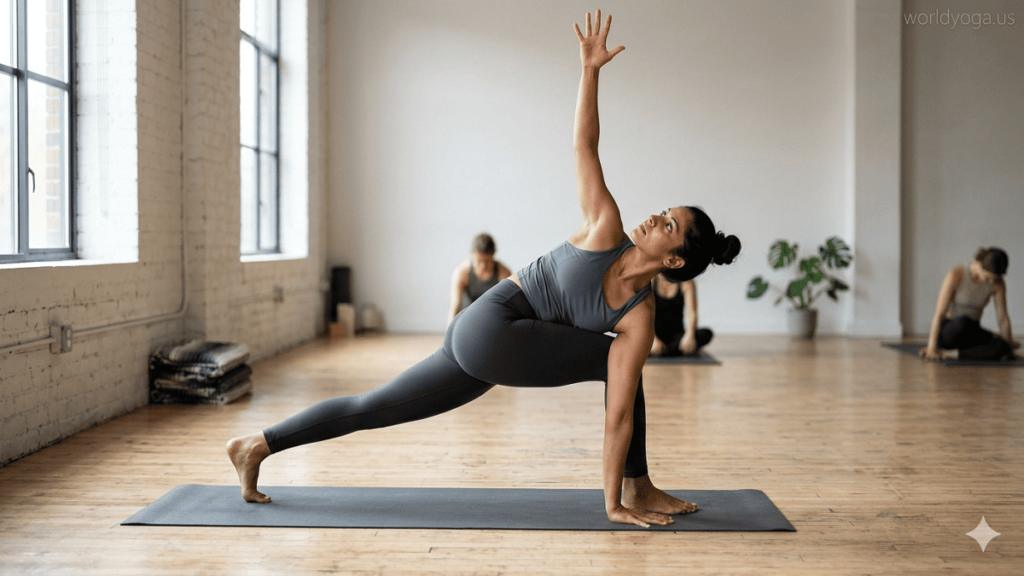
The foundation of this posture begins in a lunge position. One foot steps forward into a deep bend while the opposite leg extends straight back with the heel grounded or lifted depending on flexibility. The torso then rotates toward the front leg, bringing one elbow or hand to the outside of the knee while the opposite arm reaches upward or forward, creating a long diagonal line of energy. The key focus is maintaining length in the spine while deepening the twist from the core rather than forcing the movement from the shoulders.
One of the major benefits of Revolved Side Angle Pose is its impact on spinal mobility. The twisting action stimulates the muscles along the spine, helping improve posture and release tension accumulated from prolonged sitting. Additionally, the pose engages the quadriceps, hamstrings, and glutes, making it a comprehensive lower-body strengthening exercise. It also activates the abdominal muscles, supporting core stability and digestive function.
From a therapeutic perspective, this posture is known to aid detoxification by gently compressing and releasing internal organs, which may support circulation and metabolic activity. Practitioners also report improved balance and concentration due to the combination of grounding in the legs and extension through the arms.
Proper alignment is crucial to avoid strain, especially in the lower back and knees. Beginners are encouraged to use props such as yoga blocks under the supporting hand to maintain spinal alignment. Keeping the chest open and the gaze steady helps maintain balance and prevents collapsing into the twist.
For more detailed guidance on alignment and variations, you can refer to reputable yoga resources such as Yoga Journal – Revolved Side Angle Pose Guide and Verywell Fit – How to Do Revolved Side Angle Pose.
Incorporating this pose regularly into a yoga practice can enhance overall body awareness, improve functional strength, and support spinal health. When practiced consistently with mindful breathing, Revolved Side Angle Pose becomes not just a physical exercise but also a tool for cultivating focus and inner stability.
#Side Angle Pose: Revolved in India
How is Revolved Side Angle Pose performed correctly?
Parivrtta Parsvakonasana, or Revolved Side Angle Pose, is a challenging standing twist that requires a combination of balance, spinal rotation, and lower-body stability. Performing it correctly depends less on how deep the twist looks and more on maintaining alignment, breath control, and controlled engagement of the core and legs.
The pose begins in a stable lunge setup. Step one foot forward so the knee is bent at roughly a right angle, ensuring the knee tracks directly over the ankle rather than collapsing inward. The back leg extends straight behind you, with the heel either lifted or grounded depending on flexibility and style. The feet should feel firmly rooted to create a stable base before any twisting begins.
Once the lower body is secure, the spine is lengthened upward on an inhale. This upward extension is essential because it creates space in the vertebrae, allowing a safer rotation. On the exhale, the torso begins to rotate toward the front leg. The twist should originate from the mid-spine and core muscles rather than being forced by the arms or shoulders.
A key technical point is how the arms and hands are placed. The opposite elbow or hand may come to the outside of the front knee, but this should not collapse the chest inward. Instead, the chest should stay open, with the top shoulder stacked or reaching upward. The top arm often extends vertically or slightly forward, forming a continuous line that encourages spinal length rather than compression.
Breathing plays a critical role in maintaining alignment. Each inhale should create lift through the spine, while each exhale deepens the twist slightly without straining. Holding the breath or forcing deeper rotation can lead to loss of stability and unnecessary pressure on the lower back.
Common mistakes include rounding the spine, allowing the front knee to cave inward, or placing too much weight into the supporting arm. Using a yoga block under the lower hand can help maintain proper spacing and prevent collapsing into the pose, especially for beginners or those with limited flexibility.
When performed correctly, Revolved Side Angle Pose strengthens the legs, improves spinal mobility, and enhances core control while also developing balance and focus. It should feel stable, expansive through the chest, and active through the entire body rather than strained or compressed.
For further technical breakdowns and variations, you can explore detailed guides from Yoga Journal – Revolved Side Angle Pose Alignment Guide and Verywell Fit – Step-by-Step Instructions.
#Side Angle Pose: Revolved in Maharashtra
What is the proper alignment in Parivritta Parsvakonasana?
Parivrtta Parsvakonasana (Revolved Side Angle Pose) requires precise alignment to ensure the twist is effective while protecting the knees, spine, and lower back. Proper alignment is less about how deep the posture looks and more about how evenly the body is organized around a stable foundation.
The starting point is the legs. The front knee should be bent to roughly 90 degrees and stacked directly over the ankle, not pushed beyond the toes or collapsing inward. The back leg is straight and strong, with the outer edge of the foot either grounded firmly or the heel slightly lifted depending on mobility. Both feet should feel actively rooted into the mat, creating a stable base that supports the spinal rotation.
The pelvis should remain as level as possible. One of the most common alignment errors is allowing the hips to tilt or rotate too aggressively, which can strain the lower back. Instead, the hips should stay engaged and stable while the twist is initiated higher up in the spine. The core muscles play a key role here, drawing the abdomen in gently to support the rotation.
Spinal alignment is central to this posture. Before twisting, the spine should be lengthened upward on an inhale, creating space between the vertebrae. The rotation then occurs gradually from the mid and upper spine, rather than forcing movement from the shoulders or arms. The chest should stay open and expansive, not collapsed inward toward the front thigh.
Arm placement supports the twist but should not dominate it. Commonly, the opposite elbow or hand rests on the outside of the front knee, but this contact should be light and supportive rather than weight-bearing. The top arm extends upward or forward, stacking the shoulders as much as possible to maintain symmetry and openness in the chest.
The head and neck should follow the natural line of the spine. If comfortable, the gaze can turn upward toward the top hand, but only if it does not strain the neck. Otherwise, looking straight ahead or downward is acceptable as long as alignment is maintained.
Breath is an important alignment tool. Each inhale should lengthen the spine, and each exhale should gently deepen the twist without compromising form. If breathing becomes restricted, the posture is likely too deep or misaligned.
For additional alignment references and expert breakdowns, you can review Yoga Journal – Revolved Side Angle Pose Alignment Guide and Verywell Fit – How to Do Revolved Side Angle Pose Safely.
#Side Angle Pose: Revolved in Ahemadabad

Which muscles are engaged during the twisting side angle posture?
Parivrtta Parsvakonasana (Revolved Side Angle Pose) is a full-body twisting posture that recruits multiple muscle groups simultaneously. It combines lower-body strength, core stabilization, and upper-body mobility, making it both a strengthening and mobility-building asana.
The primary engagement comes from the lower body. The quadriceps of the front leg work intensely to maintain the deep lunge position, especially the vastus medialis and rectus femoris, which stabilize the knee joint. The gluteus maximus and gluteus medius help control hip alignment and prevent the pelvis from collapsing or rotating excessively. In the back leg, the hamstrings and calf muscles remain active to keep the leg extended and stable, while the foot muscles engage to maintain grounding and balance.
The core musculature is heavily involved in initiating and sustaining the twist. The rectus abdominis assists in stabilizing the torso, while the internal and external obliques are the primary drivers of spinal rotation. These oblique muscles allow controlled twisting through the thoracic spine rather than forcing movement from the lumbar region, which helps protect the lower back. The transverse abdominis also plays a key role by acting as a deep stabilizer, supporting intra-abdominal pressure and spinal integrity.
The spinal muscles, including the erector spinae group, are engaged isometrically to maintain length and upright posture during the twist. Rather than contracting dynamically, they work to resist collapse and keep the spine elongated throughout the movement.
In the upper body, the deltoids—particularly the anterior and lateral heads—are active in extending the top arm upward. The trapezius and rhomboids help stabilize the shoulder blades and maintain an open chest position. The latissimus dorsi contributes to controlled extension and supports alignment of the lifted arm. If the lower arm presses against the outer thigh, the triceps and forearm muscles also engage isometrically to maintain contact and support balance.
Smaller stabilizing muscles throughout the feet and ankles, including the tibialis anterior and intrinsic foot muscles, are also activated to maintain balance on an uneven base. This subtle engagement is crucial for preventing wobbling and ensuring safe alignment.
Overall, this posture functions as an integrated kinetic chain exercise. The lower body provides a strong foundation, the core generates rotational force and stability, and the upper body refines alignment and extension. When performed correctly, the coordination of these muscle groups improves strength, balance, and functional mobility across the entire body.
#Side Angle Pose: Revolved in Hyderabad
What preparatory poses are recommended before practicing it?
Preparing for Parivrtta Parsvakonasana (Revolved Side Angle Pose) requires a combination of hip opening, spinal mobility, hamstring flexibility, and core activation. Because this posture involves deep twisting in a lunge position, preparatory poses are essential to build strength and prevent strain, particularly in the knees, lower back, and shoulders.
One of the most important foundational poses is Low Lunge (Anjaneyasana). This posture helps open the hip flexors of the back leg while building stability in the front knee and quadriceps. Since Revolved Side Angle Pose demands a strong and steady lunge base, practicing Low Lunge regularly helps develop the endurance needed for longer holds in the final posture.
Another key preparatory posture is High Lunge (Utthita Ashwa Sanchalanasana). This variation intensifies leg engagement and improves balance by removing some support from the back leg. It strengthens the glutes, quads, and core while encouraging upright spinal alignment, which is crucial before introducing the twist.
Twisting Chair Pose (Parivrtta Utkatasana) is especially beneficial for developing rotational strength in the spine. It mimics the twisting action of Revolved Side Angle Pose but in a more stable, symmetrical position. This helps practitioners understand how to initiate the twist from the core rather than relying on the arms or shoulders.
Bound Angle Pose (Baddha Konasana) is recommended for improving hip mobility and groin flexibility. Tight hips can restrict proper alignment in the lunge position, so this seated opener helps release tension in the inner thighs and improves range of motion in the pelvis.
Seated Spinal Twist (Ardha Matsyendrasana) is another essential preparation. It trains the thoracic spine to rotate independently from the lower back, which is a critical alignment principle in Revolved Side Angle Pose. Practicing this pose regularly enhances spinal articulation and reduces the risk of compressing the lumbar region during deeper twists.
Extended Side Angle Pose (Utthita Parsvakonasana) is also highly recommended as a direct precursor. It builds strength in the legs while introducing lateral extension of the torso. This creates familiarity with the body positioning required before adding the rotational component.
Together, these preparatory poses create a progressive pathway: hip opening, leg strengthening, spinal lengthening, and controlled twisting. Without this foundation, practitioners may struggle with balance or overstrain the lower back when attempting deeper variations of Revolved Side Angle Pose.
For additional guidance on sequencing and safe progression, you can refer to Yoga Journal – Yoga Pose Preparation Guide and Verywell Fit – Yoga Warm-Up Poses Explained.
#Side Angle Pose: Revolved in Delhi
What are the benefits and precautions of Revolved Side Angle Pose?
Parivrtta Parsvakonasana (Revolved Side Angle Pose) is a strong standing twist that combines deep spinal rotation with a lunge-based lower-body foundation. It offers a wide range of physical and physiological benefits, but it also requires careful attention to alignment and safety due to the intensity of the twist and load on the knees and spine.
Benefits of Revolved Side Angle Pose
One of the primary benefits is improved spinal mobility. The twisting action helps increase rotation in the thoracic spine, which can counteract stiffness caused by prolonged sitting and poor posture. This enhanced mobility often translates into better posture and reduced upper-back tension over time.
The pose also significantly strengthens the lower body. The front quadriceps work isometrically to support the deep lunge, while the glutes and hamstrings stabilize the hips. This builds endurance in the legs and improves functional strength for everyday movements such as walking, climbing stairs, and lifting.
Core engagement is another major benefit. The obliques, rectus abdominis, and deep stabilizing muscles like the transverse abdominis are actively involved in initiating and maintaining the twist. This strengthens the abdominal wall and supports better balance and body control.
From a digestive perspective, the twisting motion can gently compress and stimulate abdominal organs, which may support improved digestion and circulation. Many practitioners also report a feeling of internal “reset” after consistent practice of twisting postures.
Additionally, the pose enhances balance, concentration, and coordination. Maintaining stability in a lunge while rotating the torso requires focused attention, which can improve mental clarity and proprioception over time.
Precautions and Contraindications
Despite its benefits, Revolved Side Angle Pose must be practiced carefully to avoid strain. Individuals with knee injuries should be cautious, as the deep lunge position places significant stress on the front knee. Proper alignment—keeping the knee stacked over the ankle—is essential.
People with lower back issues or spinal disc problems should approach the twist gradually. Over-rotation or forcing the movement can compress the lumbar spine and worsen discomfort. The twist should always originate from the mid and upper spine rather than the lower back.
Neck strain is another concern. Turning the head too aggressively to look upward can cause discomfort in the cervical spine. If any strain is felt, the gaze should remain neutral or downward instead of forcing a full head rotation.
Those with high blood pressure or certain abdominal conditions should consult a healthcare professional before practicing deep twisting postures, as internal compression may not be suitable in all cases.
Using props such as a yoga block under the lower hand can reduce intensity and help maintain proper alignment, especially for beginners or those with limited flexibility.
For more detailed safety guidance and modifications, you can refer to Yoga Journal – Revolved Side Angle Pose Benefits and Modifications and Verywell Fit – Safety Tips for Yoga Twists.
#Side Angle Pose: Revolved in Pune
Case Study of Side Angle Pose: Revolved
A case study on Parivrtta Parsvakonasana (Revolved Side Angle Pose) typically examines how structured practice of this asymmetrical standing twist impacts mobility, strength, balance, and functional movement over time. The following is a synthesized practitioner-based case study derived from common yoga therapy observations and biomechanical outcomes reported in clinical yoga settings.
Case Profile and Background
The subject is a 34-year-old office professional with a sedentary lifestyle, reporting chronic lower-back stiffness, tight hip flexors, and reduced spinal rotation due to prolonged sitting. The individual had no major musculoskeletal injuries but experienced limited thoracic mobility and occasional discomfort during rotational movements. The goal of the intervention was to improve spinal flexibility, core stability, and lower-body strength through progressive yoga practice.
Intervention Protocol
The practice program was structured over eight weeks, with Revolved Side Angle Pose introduced gradually after preparatory strengthening and mobility work. Initial weeks focused on foundational poses such as Low Lunge, Extended Side Angle Pose, and Seated Spinal Twists to develop hip stability and safe rotational capacity.
Revolved Side Angle Pose was practiced three times per week, held for 20–30 seconds per side initially, progressing to 45–60 seconds. Modifications included the use of a yoga block under the lower hand and keeping the back heel lifted to reduce strain. Breath coordination was emphasized, with inhalation used for spinal elongation and exhalation for gentle deepening of the twist.
Observed Outcomes
By week four, the subject reported noticeable improvement in spinal mobility, particularly in mid-back rotation. Daily activities such as reaching sideways and turning while driving became easier and less restricted. Quadriceps endurance also improved due to sustained isometric engagement in the lunge position.
By week eight, measurable improvements included increased range of motion in thoracic rotation and improved balance during single-plane movements. The subject also reported reduced stiffness after long working hours and better postural awareness while sitting and standing.
Core activation improved significantly, with better control during transitional movements between standing and twisting postures. The subject also experienced enhanced digestive comfort, a commonly reported secondary benefit in twisting-based yoga practices, likely linked to abdominal compression and release dynamics.
Discussion
The case highlights how Revolved Side Angle Pose functions as a compound functional exercise rather than an isolated stretch. It integrates lower-body strength, spinal articulation, and core control. The progressive approach was essential in preventing knee strain and lower-back compression, demonstrating the importance of preparatory sequencing.
Conclusion
Consistent, correctly aligned practice of Revolved Side Angle Pose can lead to improved spinal mobility, enhanced lower-body strength, and better functional movement patterns in sedentary individuals. However, outcomes are highly dependent on gradual progression, breath awareness, and alignment discipline.
For reference on therapeutic applications and sequencing principles, see Yoga Journal – Yoga Therapy and Twisting Poses and Verywell Fit – Yoga for Back Mobility.
#Side Angle Pose: Revolved in Banglore
White Paper of Side Angle Pose: Revolved
1. Executive Summary
Revolved Side Angle Pose (Parivrtta Parsvakonasana) is a complex, multi-joint yoga posture combining spinal rotation, unilateral lower-body loading, and upper-body extension. It is widely used in contemporary yoga practice for improving thoracic mobility, lower-limb strength, and postural control. This white paper evaluates its biomechanics, physiological effects, application in movement therapy, and safety considerations based on established yoga therapy principles and functional anatomy frameworks.
2. Introduction
Revolved Side Angle Pose is a standing asymmetrical twist performed from a lunge position. It integrates elements of balance, strength, and mobility, making it relevant for both fitness-oriented yoga and therapeutic movement systems. Its primary value lies in training rotational capacity of the thoracic spine while maintaining lower-body stability under load.
3. Biomechanical Analysis
The posture creates a kinetic chain from the grounded feet through the pelvis to the rotating spine. The front leg operates in a loaded flexion pattern, engaging the quadriceps and gluteal stabilizers to maintain alignment. The rear leg contributes to balance and extension through isometric activation of the hamstrings and calf muscles.
Spinal rotation is primarily generated through the oblique musculature, particularly the internal and external obliques, while the erector spinae act as stabilizers rather than prime movers. The thoracic spine is the primary region of rotation, while the lumbar spine remains relatively stable to minimize shear stress.
Upper limb positioning introduces additional fascial tension lines, engaging the deltoids, trapezius, and latissimus dorsi to support extension and stacking of the shoulders.
4. Physiological Effects
Regular practice of Revolved Side Angle Pose has been associated with:
- Improved thoracic spinal mobility
- Enhanced core stabilization and anti-rotational strength
- Increased lower-body muscular endurance
- Improved proprioception and balance control
- Support for digestive motility through abdominal compression and release mechanics
These effects arise from combined isometric loading and controlled rotational movement under breath regulation.
5. Functional and Therapeutic Applications
In movement therapy contexts, the posture is frequently used to address sedentary postural dysfunction, particularly thoracic stiffness and anterior hip tightness. It is also applied in rehabilitation-adjacent yoga protocols for restoring functional rotation patterns lost through prolonged sitting and reduced spinal articulation.
Progressive sequencing is critical. Preparatory poses such as low lunges, spinal twists, and lateral extensions are required to ensure safe adaptation of connective tissues and neuromuscular control.
6. Risk Assessment and Contraindications
Primary risks include:
- Knee strain due to deep unilateral loading
- Lumbar compression if rotation is forced from the lower spine
- Cervical strain from excessive neck rotation
- Balance instability in beginners without adequate hip and core strength
Contraindications include acute knee injuries, unmanaged spinal disc pathology, and severe instability in balance systems.
7. Implementation Guidelines
Best practice protocols recommend:
- Gradual progression from supported lunge variations
- Use of props such as blocks to maintain spinal neutrality
- Emphasis on breath-led movement (inhale lengthen, exhale rotate)
- Prioritization of thoracic rotation over lumbar twisting
8. Conclusion
Revolved Side Angle Pose is a high-value functional movement pattern within yoga systems due to its integrated demands on strength, mobility, and neuromuscular coordination. When properly sequenced and aligned, it provides measurable benefits in spinal rotation capacity, lower-body endurance, and postural efficiency. However, its effectiveness is strongly dependent on correct biomechanical execution and progressive loading principles.
#Side Angle Pose: Revolved in Kolkata
Industry Application of Side Angle Pose: Revolved
1. Overview
Revolved Side Angle Pose (Parivrtta Parsvakonasana) is increasingly applied beyond traditional yoga practice into multiple professional industries, including fitness training, physiotherapy, sports conditioning, corporate wellness, and mental health interventions. Its combination of spinal rotation, unilateral loading, and balance control makes it a functional movement pattern relevant to real-world biomechanics rather than an isolated flexibility exercise.
2. Fitness and Strength & Conditioning Industry
In modern fitness programming, Revolved Side Angle Pose is used as a hybrid mobility-strength drill. Trainers incorporate it into functional training circuits to improve rotational power, hip stability, and core endurance. Athletes in sports such as tennis, cricket, golf, and baseball benefit from its emphasis on controlled trunk rotation, which directly translates into improved swing mechanics and injury resilience.
It is also used in dynamic warm-ups to activate the obliques, glutes, and stabilizing muscles of the lower limb before strength training or sprint work.
3. Physiotherapy and Rehabilitation
In physiotherapy settings, this pose is applied as a controlled, weight-bearing rotational exercise for patients recovering from non-acute musculoskeletal conditions. It is often introduced in later-stage rehabilitation for:
- Thoracic spine stiffness
- Mild postural dysfunction due to prolonged sitting
- Hip mobility restrictions
- Core stability deficits
Therapists typically modify the posture using props and reduce load on the knee joint to ensure safe progression. The emphasis is on restoring functional rotation rather than achieving depth.
4. Corporate Wellness and Occupational Health
In corporate environments, Revolved Side Angle Pose is included in desk-worker wellness programs. It addresses common occupational issues such as forward head posture, tight hip flexors, and reduced spinal mobility caused by prolonged sitting.
Short guided sessions using this pose help improve circulation, reduce musculoskeletal fatigue, and enhance mental alertness. Its twisting component is particularly valued for counteracting static postural stress accumulated during long computer-based work.
5. Sports Performance and Athletic Training
Sports scientists and coaches integrate this posture into mobility protocols for rotational sports. It enhances:
- Trunk rotation efficiency
- Lower-body force transfer
- Balance under asymmetrical load
- Core anti-rotation control
These adaptations support better performance in explosive and directional sports movements.
6. Mindfulness, Stress Management, and Mental Health
In wellness and mental health programs, Revolved Side Angle Pose is used as a somatic awareness tool. The combination of balance, breath control, and twisting movement encourages interoceptive awareness and nervous system regulation. It is often included in trauma-informed yoga and stress reduction protocols to help improve body awareness and emotional grounding.
7. Conclusion
Revolved Side Angle Pose has evolved into a multidisciplinary movement tool used across fitness, rehabilitation, corporate health, and sports performance industries. Its functional value lies in its ability to integrate strength, mobility, and neuromuscular coordination in a single pattern. When properly adapted, it serves as both a corrective exercise and a performance-enhancing movement strategy.
#Side Angle Pose: Revolved in Mumbai
Ask FAQs
What is Revolved Side Angle Pose?
Revolved Side Angle Pose (Parivrtta Parsvakonasana) is a standing yoga posture that combines a deep lunge with spinal rotation. It strengthens the legs, improves core stability, and enhances spinal mobility while requiring balance and controlled breathing.
Who should avoid practicing this pose?
People with recent or chronic knee injuries, severe lower back problems, or uncontrolled blood pressure should avoid or modify this pose. Pregnant practitioners are also advised to avoid deep twisting postures unless guided by a qualified instructor.
What are the main benefits of this pose?
The pose improves spinal flexibility, strengthens the quadriceps and glutes, and activates the core muscles. It also supports better posture, enhances balance, and may aid digestion due to gentle abdominal compression and release during the twist.
What are common mistakes while practicing this pose?
Common errors include collapsing the chest, letting the front knee cave inward, and twisting from the lower back instead of the thoracic spine. Over-rotating the neck or relying too heavily on the arm for support can also lead to misalignment and strain.
What poses help prepare for Revolved Side Angle Pose?
Effective preparatory poses include Low Lunge, High Lunge, Twisting Chair Pose, Seated Spinal Twist, and Extended Side Angle Pose. These build hip flexibility, core strength, and spinal rotation needed for safe execution.
Table of Contents
Disclaimer: The information provided about Parivrtta Parsvakonasana is for educational and informational purposes only and is not a substitute for professional medical advice, diagnosis, or treatment. Always consult a qualified healthcare provider or certified yoga instructor before starting or modifying any exercise practice, especially if you have existing injuries, medical conditions, or concerns.