Horse Pose: Spine Straight
Horse Pose with a straight spine is a foundational posture often associated with strength-building, postural awareness, and lower-body stability in traditional movement systems such as Yoga. Although the term “Horse Pose” can vary across styles, it generally refers to a wide-stance squatting position that emphasizes grounded legs and an upright, aligned spine.
In this variation, the primary focus is maintaining a vertical spinal alignment while the lower body remains deeply engaged. The practitioner stands with feet placed wider than shoulder-width apart, toes slightly turned outward, and knees bent into a controlled squat. Unlike deeper collapsing squats, the spine remains elongated and neutral, with the crown of the head reaching upward. This alignment trains postural control and reinforces the connection between the pelvis and the spinal column.
The straight spine component is essential because it ensures that the load is distributed evenly across the hips and legs rather than compressing the lower back. The core muscles—particularly the transverse abdominis and obliques—activate to stabilize the torso. At the same time, the gluteus maximus, quadriceps, and adductor muscles work isometrically to maintain the squat position.
Breath awareness plays a central role in this posture. Slow, controlled breathing helps maintain spinal extension and prevents the tendency to lean forward or collapse through the chest. The chest remains open, shoulders relaxed, and gaze forward, supporting both balance and concentration.
From a functional perspective, Horse Pose with a straight spine improves lower-body endurance, enhances hip stability, and builds foundational strength for more advanced standing or balancing postures. It is often used as a preparatory stance for deeper squats, martial arts conditioning, and dynamic movement training. The posture also supports better postural habits in daily life by reinforcing spinal neutrality under load.
Alignment awareness is critical. Common mistakes include rounding the lower back, allowing the knees to collapse inward, or shifting weight unevenly into one leg. These errors reduce effectiveness and may place unnecessary strain on the joints.
In summary, Horse Pose with a straight spine is a simple yet powerful posture that develops structural strength, spinal awareness, and muscular endurance. When practiced consistently, it becomes a key foundation for more advanced movement patterns and stability-based exercises.
#Horse Pose: Spine Straight in India
How is Horse Pose with a straight spine performed correctly?
Horse Pose with a straight spine is a foundational alignment-based posture within Yoga that focuses on building lower-body strength while maintaining an upright, neutral spinal position. Correct execution depends on coordinated engagement of the legs, core, and postural muscles rather than depth of the squat.
Step 1: Establish a Stable Base
Begin by standing tall with feet placed wider than shoulder-width apart. Turn the toes slightly outward to allow natural hip opening. The weight should be evenly distributed across both feet, grounded through the heels and the balls of the feet. Avoid rolling the feet inward or outward excessively, as this destabilizes the knees.
Step 2: Controlled Descent into Squat
Slowly bend the knees and lower the body into a wide squat. The descent should be controlled rather than dropped. The hips move downward between the knees while maintaining alignment over the ankles. The knees track in the same direction as the toes, preventing inward collapse or outward strain.
Step 3: Maintain a Straight Spine
The defining feature of this posture is spinal neutrality. The spine remains elongated, with the crown of the head lifting upward. The chest stays open and lifted without overarching the lower back. The pelvis remains in a neutral position, avoiding excessive anterior or posterior tilt. This alignment ensures that the load is supported by the legs rather than the lumbar spine.
Step 4: Engage Core and Lower Body
Core engagement is essential for spinal stability. The transverse abdominis activates to support the lower back, while the obliques assist in maintaining balance. In the lower body, the quadriceps control knee flexion, the gluteus maximus supports hip stability, and the adductor muscles help maintain leg alignment. The inner thighs remain active to prevent outward collapse.
Step 5: Shoulder and Upper Body Alignment
The shoulders remain relaxed and down, away from the ears. The arms can be placed in front for balance or extended forward to increase engagement. The neck stays neutral, with the gaze directed forward to maintain balance and prevent cervical strain.
Step 6: Breath Control
Steady breathing is essential for maintaining posture integrity. Inhalation supports spinal lengthening, while exhalation helps deepen the squat without collapsing the torso. Breath should remain smooth and controlled throughout the hold.
Common Mistakes to Avoid
- Rounding the lower back instead of maintaining spinal extension
- Allowing knees to cave inward
- Shifting weight unevenly into one leg
- Collapsing the chest or leaning too far forward
- Holding breath during the posture
Safety and Alignment Note
Maintaining correct knee tracking and spinal neutrality is more important than achieving a deep squat. Individuals with knee or hip issues should reduce depth and focus on controlled alignment.
For additional movement safety principles and foundational posture guidance, refer to general yoga alignment resources such as Yoga Journal Pose Library and anatomical movement references like Verywell Fit Yoga Guides.
Summary
Horse Pose with a straight spine is correctly performed through a controlled wide squat, precise knee alignment, engaged core, and an upright neutral spine. Its effectiveness comes from stability and alignment rather than depth or intensity.
#Horse Pose: Spine Straight in Maharashtra
What is the proper alignment in this upright Horse Pose variation?
The upright Horse Pose variation, commonly practiced as a wide-stance squat with a neutral spine, is a foundational alignment posture within Yoga. Its effectiveness depends on precise structural positioning rather than depth or muscular effort alone. Proper alignment ensures joint safety while maximizing strength, stability, and postural control.
Foot and Base Alignment
Begin with the feet placed wider than shoulder-width apart. The toes are turned slightly outward, typically at a 15–30 degree angle, allowing natural hip external rotation. The weight must be evenly distributed across the tripod of the foot: the heel, the base of the big toe, and the base of the little toe. Avoid collapsing into the inner arches or rolling onto the outer edges of the feet, as this disrupts knee tracking and pelvic stability.
Knee Alignment
The knees bend in the direction of the toes and must never collapse inward. Proper alignment requires the kneecaps to track over the second or third toe. This protects the medial knee structures and ensures that the load is distributed through the quadriceps and surrounding stabilizers rather than the joint ligaments. The depth of the squat should always be adjusted based on knee comfort and control.
Hip and Pelvis Position
The hips lower vertically between the legs while remaining level and square. A neutral pelvis is essential—neither excessively tilted forward (anterior tilt) nor tucked under (posterior tilt). The hip joints remain active and engaged, supported by the gluteus maximus and deep stabilizing muscles. This alignment allows the lower body to bear weight efficiently without transferring stress to the lumbar spine.
Spinal Alignment
A key feature of this posture is an upright, elongated spine. The lumbar, thoracic, and cervical regions remain naturally aligned without excessive curvature. The crown of the head reaches upward, creating axial extension. The chest stays open but not flared, and the ribs remain gently contained to avoid compression in the lower back. This neutral spinal alignment ensures structural integrity throughout the pose.
Core Engagement
The core acts as a stabilizing system. The transverse abdominis engages to support the lumbar spine, while the obliques assist in maintaining balance and preventing lateral collapse. Gentle abdominal activation helps maintain posture without restricting breath.
Shoulder and Upper Body Alignment
Shoulders remain relaxed, drawn slightly down and away from the ears. The arms may extend forward for counterbalance or remain in a prayer position at the chest. The shoulder blades stay gently retracted without over-squeezing, allowing the chest to remain open and stable.
Head and Neck Position
The neck remains neutral in line with the spine. The gaze is forward at eye level or slightly above, avoiding downward tilting or excessive upward extension. This supports balance and prevents cervical strain.
Breath and Stability
Breathing remains steady and controlled. Inhalation lengthens the spine, while exhalation supports grounding and stability in the squat. Breath should not be held, as this reduces postural control and increases muscular tension.
Common Misalignments
- Knees collapsing inward under load
- Excessive forward lean of the torso
- Rounding or over-arching of the lower back
- Uneven weight distribution between feet
- Collapsed chest or raised shoulders
Summary
Proper alignment in upright Horse Pose is defined by grounded feet, controlled knee tracking, neutral pelvis, elongated spine, and active core engagement. Stability and structural integrity are prioritized over depth, making it a safe and effective foundational posture for strength and mobility development.
#Horse Pose: Spine Straight in Ahemadabad
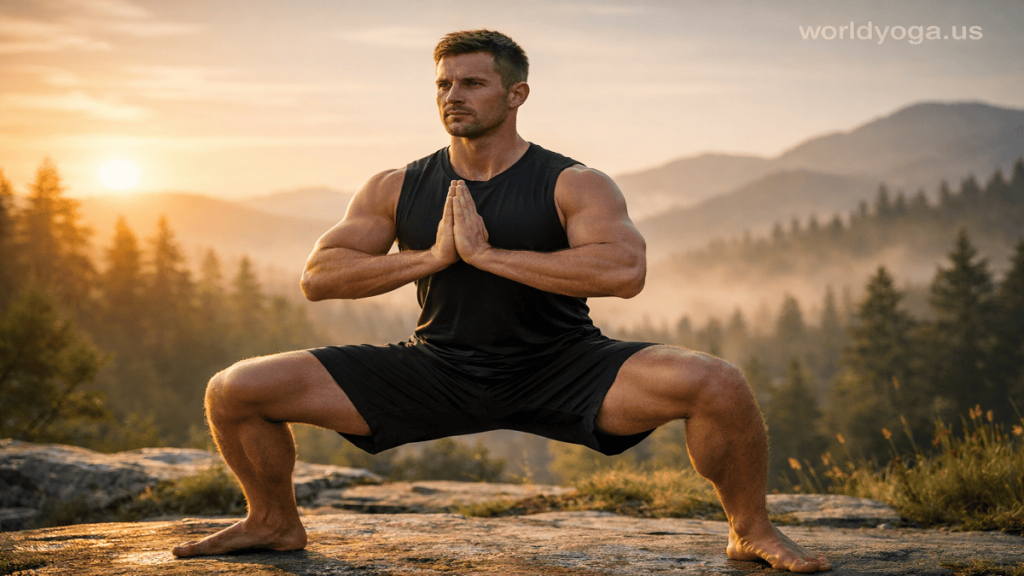
Which muscles are engaged during the posture?
The upright Horse Pose variation, practiced as a wide-stance squat with a neutral spine, is a full lower-body isometric strength posture within Yoga. It recruits multiple muscle groups simultaneously to maintain stability, alignment, and endurance under load.
Primary Lower-Body Muscles
The quadriceps femoris group is the main driver of knee flexion control in this posture. The rectus femoris, vastus medialis, vastus lateralis, and vastus intermedius work isometrically to stabilize the knees and maintain the squat position.
The gluteus maximus plays a major role in hip stabilization and external rotation control. It helps support the pelvis in a neutral position and prevents excessive forward tilt during the squat.
The adductor muscle group (adductor longus, brevis, magnus, gracilis, and pectineus) is heavily engaged due to the wide stance. These muscles work isometrically to control leg positioning and prevent outward collapse while maintaining stability between the thighs.
The hamstrings assist in stabilizing the hips and knees, working in coordination with the glutes to support controlled lowering and holding of the posture.
Hip Stabilizers
The gluteus medius and minimus are essential stabilizers in this posture. They prevent lateral pelvic drop and maintain hip alignment over the feet. The deep external rotators of the hip also contribute to rotational control, ensuring knee safety and alignment.
Core Musculature
The transverse abdominis is a key stabilizer, providing deep core engagement to protect the lumbar spine. The rectus abdominis helps maintain upright posture by controlling pelvic tilt, while the obliques assist in preventing lateral instability. Together, these muscles ensure that the spine remains neutral under load.
Spinal and Back Muscles
The erector spinae group (iliocostalis, longissimus, and spinalis) is actively engaged to maintain an upright and elongated spine. These muscles resist forward collapse and support postural endurance throughout the hold.
Calf and Ankle Muscles
The gastrocnemius and soleus muscles stabilize the ankle joint and help maintain balance through controlled foot grounding. The tibialis anterior also contributes to ankle stability, especially in maintaining even weight distribution across the foot.
Upper Body Muscles
Although primarily a lower-body posture, the upper body plays a stabilizing role. The trapezius (especially middle and lower fibers) helps maintain shoulder alignment. The deltoids assist in arm positioning if the arms are extended forward. The latissimus dorsi contributes to postural control by supporting the rib cage and spine connection.
Functional Integration
Rather than isolating one muscle group, this posture emphasizes isometric co-activation, meaning multiple muscles contract simultaneously to stabilize joints without movement. This creates a strong neuromuscular pattern that improves endurance, balance, and postural control.
Summary
Upright Horse Pose primarily engages the quadriceps, gluteal muscles, adductors, hamstrings, and deep core stabilizers, while also activating spinal erectors and lower-leg muscles for balance. The posture functions as a full-body stabilization exercise, training coordinated muscular engagement rather than isolated strength.
#Horse Pose: Spine Straight in Hyderabad
What preparatory poses are recommended before practicing it?
Upright Horse Pose, performed as a wide-stance squat with a neutral spine, requires a combination of hip mobility, lower-body strength, and core stability. Within structured Yoga practice, preparation is essential to ensure safe alignment and to avoid excessive strain on the knees, hips, and lower back.
1. Hip Opening Preparations
Since the posture involves a wide stance and external rotation of the hips, hip-opening poses are fundamental.
- Baddha Konasana (Bound Angle Pose): Helps open the inner thighs and groin, preparing the adductor muscles for the wide squat position.
- Upavistha Konasana (Wide-Angle Seated Forward Fold): Improves flexibility in the hamstrings and inner legs while encouraging pelvic awareness.
- Anjaneyasana (Low Lunge): Opens the hip flexors and improves range of motion in the hip joint for controlled squat depth.
These poses gradually prepare the hip joint for external rotation and abduction without strain.
2. Strength-Building Preparations
Strength in the quadriceps and glutes is essential for maintaining the squat position with an upright spine.
- Utkatasana (Chair Pose): Builds foundational quadriceps and glute strength while reinforcing spinal alignment.
- Warrior II (Virabhadrasana II): Develops lower-body endurance and trains knee tracking over the toes.
- Wall Sit Holds: Strengthen isometric endurance in the quadriceps and improve squat stability.
These strengthen the muscles required to hold the posture without collapsing.
3. Spinal Alignment and Core Stability
A neutral spine is a key requirement of Horse Pose, making core activation essential.
- Plank Pose (Phalakasana): Activates the transverse abdominis and builds full-core stability.
- Dead Bug Variation: Improves deep core control and coordination between pelvis and spine.
- Tadasana (Mountain Pose): Reinforces upright spinal alignment and postural awareness.
These ensure that the spine remains elongated under load.
4. Ankle and Balance Preparations
Stable grounding through the feet is critical in wide-stance squats.
- Tadasana Heel Lifts: Strengthen ankle stabilizers and improve balance control.
- Malasana (Garland Pose) – Supported: Prepares the ankles and hips for deeper squatting mechanics.
- Standing Balance Drills: Improve proprioception and even weight distribution across both feet.
5. Integrated Movement Preparations
Before attempting the full posture, dynamic sequences help connect strength and mobility.
- Sun Salutation Variations: Warm up the entire kinetic chain.
- Dynamic Squat Transitions: Improve fluid control in and out of squat depth.
Summary
Effective preparation for Upright Horse Pose focuses on opening the hips, strengthening the quadriceps and glutes, stabilizing the core, and improving ankle control. A balanced combination of mobility and strength work ensures safe spinal alignment and reduces the risk of knee or lower-back strain.
#Horse Pose: Spine Straight in Delhi
What are the benefits and precautions of this Horse Pose variation?
Upright Horse Pose, a wide-stance squat with an elongated neutral spine, is a foundational strength and stability posture within Yoga. It is widely used to develop lower-body endurance, postural control, and joint awareness. Like any loaded squat variation, it offers significant benefits when performed correctly but requires careful attention to alignment to avoid strain.
Benefits of Upright Horse Pose
1. Builds Lower-Body Strength and Endurance
This posture strongly engages the quadriceps, gluteus maximus, hamstrings, and adductor muscles. Because the position is held isometrically, it improves muscular endurance rather than just dynamic strength, making it highly effective for conditioning the legs and hips.
2. Improves Hip Stability and Mobility
The wide stance encourages controlled external rotation and abduction of the hips. Over time, this helps improve joint stability and functional mobility, particularly in movements that require lateral control or deep squatting patterns.
3. Strengthens Core and Spinal Support
Maintaining a straight spine activates the transverse abdominis, obliques, and erector spinae. This improves postural control and helps protect the lumbar spine during load-bearing activities.
4. Enhances Postural Alignment
By training an upright spine under lower-body load, the posture reinforces neutral alignment habits that translate into daily activities such as standing, lifting, and walking.
5. Improves Balance and Proprioception
The stance requires even weight distribution and joint coordination across both legs, enhancing neuromuscular awareness and balance control.
Precautions for Upright Horse Pose
1. Knee Joint Stress
Improper alignment, especially knees collapsing inward, can place strain on ligaments and cartilage. Knees must always track in line with the toes to maintain safety.
2. Lower Back Strain
Rounding or over-arching the spine shifts load into the lumbar region. The spine should remain neutral with core engagement to prevent compression or discomfort.
3. Hip Overload in Tight Practitioners
Individuals with limited hip mobility may feel strain in the groin or outer hips. Depth should be reduced to avoid forcing the joint range.
4. Ankle Instability
Insufficient grounding through the feet can lead to imbalance or ankle stress. Weight must be evenly distributed across the foot’s contact points.
5. Overexertion in Beginners
Holding the posture for too long without adequate strength preparation can cause muscular fatigue in the thighs and lower back.
Safety Guidelines
- Prioritize alignment over depth
- Keep knees tracking over toes at all times
- Engage the core before lowering into the squat
- Use wall support if balance is unstable
- Reduce hold time if fatigue compromises form
For general anatomical guidance and safe yoga alignment principles, resources such as Yoga Journal Pose Library and Verywell Fit Yoga Guides provide useful references.
Summary
Upright Horse Pose is highly beneficial for building leg strength, improving hip mobility, and reinforcing spinal alignment. However, its effectiveness depends on correct knee tracking, neutral spine control, and appropriate depth. When practiced with proper alignment and progression, it becomes a powerful foundational posture for strength and stability training.
#Horse Pose: Spine Straight in Pune
Case Study of Horse Pose: Spine Straight
1. Introduction
This case study examines the application and outcomes of the upright Horse Pose with a straight spine, a foundational posture in Yoga used to develop lower-body strength, postural alignment, and neuromuscular control. The posture is characterized by a wide stance squat with a neutral spine, emphasizing structural integrity over depth or flexibility.
2. Subject Profile
- Age: 29 years
- Training background: Intermediate yoga practitioner with 2 years of consistent practice
- Primary goals: Improve posture, strengthen lower body, reduce lower back stiffness
- Limitations: Mild knee tightness and reduced hip mobility due to sedentary lifestyle
3. Initial Assessment
Before introducing Horse Pose:
- Limited squat depth due to hip stiffness
- Occasional lumbar discomfort during prolonged sitting
- Weak gluteal activation during lower-body exercises
- Poor postural endurance in standing positions
Baseline movement screening indicated imbalance between quadriceps dominance and underactive posterior chain muscles.
4. Intervention Protocol
A 6-week structured progression was implemented:
Phase 1: Mobility Foundation (Weeks 1–2)
- Tadasana (Mountain Pose) for spinal awareness
- Anjaneyasana (Low Lunge) for hip flexor opening
- Supported Malasana for squat preparation
Phase 2: Strength Activation (Weeks 3–4)
- Utkatasana (Chair Pose) for quadriceps engagement
- Wall-supported Horse Pose holds (short duration)
- Glute activation drills
Phase 3: Integration Phase (Weeks 5–6)
- Full Horse Pose with neutral spine
- Extended hold duration with breath control
- Alignment correction focusing on knee tracking and pelvic neutrality
5. Observations During Practice
- Initial difficulty maintaining spinal neutrality under fatigue
- Tendency for knees to collapse inward during longer holds
- Gradual improvement in glute engagement and core activation
- Improved balance and reduced forward trunk lean over time
Breath control significantly improved posture stability, particularly during longer holds.
6. Outcomes After 6 Weeks
- Increased lower-body endurance and squat stability
- Improved spinal alignment awareness in standing and walking
- Reduction in reported lower back stiffness
- Enhanced hip mobility and controlled squat depth
- Better neuromuscular coordination between core and lower limbs
Participants also reported improved posture during daily activities, especially prolonged sitting and standing.
7. Risks and Limitations Identified
- Early fatigue in quadriceps during sustained holds
- Knee discomfort when alignment was not carefully maintained
- Limited hip mobility restricting deeper squat expression
- Overreliance on forward trunk compensation in initial stages
These issues were corrected through regression to supported variations and alignment-focused cues.
8. Discussion
The case demonstrates that Horse Pose (Spine Straight) functions primarily as a postural re-education tool rather than a flexibility-intensive posture. Its greatest impact lies in strengthening the kinetic chain responsible for upright posture and functional movement stability.
Consistent practice improved not only muscular endurance but also proprioceptive awareness, particularly in maintaining knee tracking and spinal neutrality under load.
9. Conclusion
Upright Horse Pose is an effective foundational training posture for improving lower-body strength, spinal alignment, and postural endurance. When introduced progressively with proper alignment cues, it supports functional movement improvements and reduces musculoskeletal imbalances associated with sedentary lifestyles.
References
- Yoga Journal Pose Library: https://www.yogajournal.com/poses/
- Verywell Fit Yoga Anatomy Guides: https://www.verywellfit.com/yoga-4157140
#Horse Pose: Spine Straight in Banglore
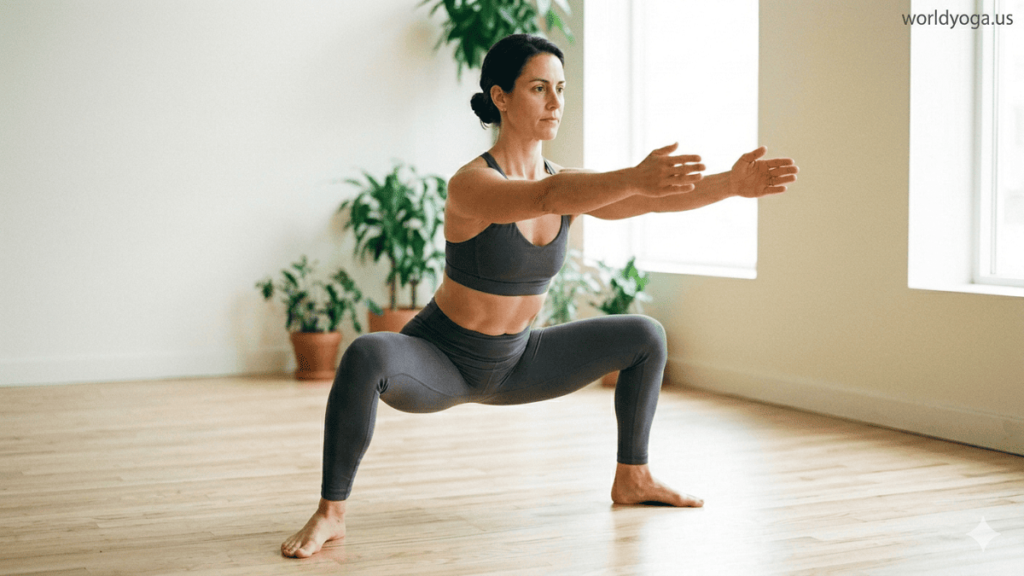
White Paper of Horse Pose: Spine Straight
Abstract
Horse Pose with a straight spine is a foundational wide-stance squat posture within Yoga used for developing lower-body strength, postural alignment, and neuromuscular stability. This white paper analyzes its biomechanical structure, functional objectives, muscle recruitment patterns, progression methodology, risk profile, and practical applications in fitness, rehabilitation, and movement training systems.
1. Introduction
Horse Pose (Spine Straight variation) is a controlled isometric squat performed with a neutral spine and wide lower-limb stance. Unlike dynamic squat variations, it emphasizes static endurance, alignment integrity, and joint coordination. It is commonly used as a preparatory posture for advanced squatting, balance training, and functional mobility systems.
2. Biomechanical Structure
The posture is defined by three primary structural components:
2.1 Lower-Limb Base
A wide stance with external foot rotation creates a stable base. The hips move into flexion while the knees bend in alignment with toes, distributing load across the lower kinetic chain.
2.2 Spinal Neutrality
The spine remains elongated in neutral alignment. Cervical, thoracic, and lumbar curves are maintained without excessive flexion or extension. Axial extension is preserved throughout the hold.
2.3 Pelvic Stability
The pelvis remains neutral without anterior or posterior tilt. This ensures balanced force distribution between anterior and posterior muscle chains.
3. Muscular Activation Profile
Primary muscle groups involved include:
- Quadriceps femoris: primary knee stabilizers
- Gluteus maximus: hip extension control and pelvic stabilization
- Adductors: medial thigh stabilization and control of leg spacing
- Hamstrings: posterior chain support and knee stabilization
- Erector spinae: spinal extension and postural endurance
- Transverse abdominis: deep core stabilization
- Calf muscles (gastrocnemius/soleus): ankle stabilization
This creates a full-chain isometric engagement pattern supporting posture maintenance.
4. Functional Objectives
The posture is designed to:
- Enhance lower-body muscular endurance
- Improve hip stability and controlled mobility
- Strengthen postural alignment under load
- Develop core-spine coordination
- Train neuromuscular control in static positions
- Support foundational movement patterns for squats and lunges
5. Progression Framework
A structured progression model is recommended:
Phase 1: Mobility Preparation
- Hip openers (Malasana, Baddha Konasana)
- Ankle mobility drills
Phase 2: Strength Conditioning
- Chair Pose (Utkatasana)
- Wall-supported squats
- Static lunges
Phase 3: Integration
- Partial Horse Pose holds
- Breath-controlled squat endurance training
- Full upright Horse Pose with alignment focus
6. Risk Assessment
Key risks include:
- Knee valgus collapse: improper knee tracking leading to ligament stress
- Lumbar strain: loss of spinal neutrality under fatigue
- Hip overload: excessive depth in limited mobility practitioners
- Ankle instability: poor weight distribution across the foot
Risk increases significantly when alignment is compromised or progression is rushed.
7. Mitigation Strategies
- Maintain knee-toe alignment at all times
- Prioritize spinal neutrality over squat depth
- Use wall support for beginners
- Limit hold duration based on muscular fatigue
- Emphasize breath control to maintain core engagement
- Integrate regression options when instability appears
8. Applications Across Domains
8.1 Fitness Training
Used for lower-body strength conditioning and postural endurance training.
8.2 Rehabilitation
Applied in modified form for neuromuscular re-education and controlled squat retraining.
8.3 Sports Performance
Supports athletic movement efficiency, especially in running, martial arts, and jumping mechanics.
8.4 Workplace Wellness
Reduces effects of sedentary posture by strengthening postural stabilizers.
9. Discussion
Horse Pose (Spine Straight variation) functions primarily as a foundational stabilization pattern rather than a mobility extreme. Its effectiveness lies in isometric co-activation of multiple muscle groups, reinforcing structural alignment under controlled load conditions.
10. Conclusion
This posture is a scalable and adaptable training tool for developing foundational strength, alignment, and postural endurance. When properly integrated into progressive movement systems, it supports long-term musculoskeletal efficiency and functional stability.
References
- Yoga Journal Pose Library: https://www.yogajournal.com/poses/
- Verywell Fit Yoga Anatomy: https://www.verywellfit.com/yoga-4157140
#Horse Pose: Spine Straight in Kolkata
Industry Application of Horse Pose: Spine Straight
Horse Pose with a straight spine is a foundational wide-stance squat used to develop lower-body strength, postural alignment, and neuromuscular stability within structured Yoga systems. Beyond traditional practice, its biomechanical structure has practical value across multiple modern industries, particularly those focused on movement efficiency, rehabilitation, performance, and occupational health.
1. Fitness and Strength Training Industry
In the fitness sector, this posture is widely used as a bodyweight conditioning tool for building foundational lower-body strength and endurance. Trainers incorporate it into functional training programs to improve:
- Quadriceps and glute endurance
- Isometric squat strength
- Hip stability under load
- Core engagement during static holds
It is often used as a regression or preparatory exercise before weighted squats, kettlebell training, or plyometric work. Because it requires no equipment, it is also common in group fitness and home training programs.
2. Physiotherapy and Rehabilitation
In rehabilitation environments, modified versions of Horse Pose are applied for controlled movement retraining. Clinicians use the posture to improve:
- Knee alignment awareness during weight-bearing
- Hip control in functional movement patterns
- Postural re-education for sedentary patients
- Core stabilization after lower-back strain
However, depth and duration are carefully adjusted based on patient capability. The focus is not on intensity but on restoring safe movement mechanics.
For foundational anatomical guidance, reference resources such as Verywell Fit Yoga Guides are commonly used in therapeutic education contexts.
3. Sports Performance and Athletic Conditioning
In sports science and athletic training, Horse Pose is used as a static strength and stability drill. It supports performance in activities requiring:
- Lateral movement control
- Explosive lower-body strength
- Postural endurance during competition
- Injury prevention through alignment training
Athletes in sports such as football, martial arts, and running benefit from improved hip-knee-ankle coordination and enhanced squat mechanics derived from this posture.
4. Corporate Wellness and Ergonomics
Within workplace wellness programs, this posture is adapted into short mobility routines to counteract prolonged sitting. It is used to:
- Activate lower-body musculature after sedentary work
- Improve circulation in the hips and legs
- Reinforce upright spinal alignment habits
- Reduce stiffness caused by desk posture
Simple squat holds based on Horse Pose are often included in desk-break movement protocols.
5. Dance, Movement, and Performing Arts
In dance and performance training, the posture is used to develop:
- Lower-body endurance for stage work
- Controlled plié-like strength in grounded positions
- Spinal alignment awareness during choreography
- Balance in wide-stance movements
It serves as a conditioning base for more expressive and dynamic movement sequences.
6. Military and Functional Training Systems
In tactical and functional training environments, Horse Pose is used for:
- Static endurance under load
- Lower-body resilience training
- Stability under fatigue conditions
- Basic combat stance conditioning
Its simplicity and effectiveness make it suitable for foundational physical readiness programs.
7. Limitations in Industry Application
Despite its versatility, certain limitations exist:
- Not suitable for high-load progression without adaptation
- Requires alignment supervision in clinical settings
- May be too demanding for individuals with knee or hip issues if improperly scaled
- Limited direct transfer to explosive athletic movement without dynamic progression
Conclusion
Horse Pose (Spine Straight variation) functions as a versatile foundational movement across industries, bridging fitness, rehabilitation, sports performance, wellness, and performing arts. Its primary value lies in developing alignment integrity, isometric strength, and postural control. When properly adapted, it serves as a scalable tool for improving functional movement efficiency across diverse professional domains.
#Horse Pose: Spine Straight in Mumbai
Ask FAQs
What is Horse Pose with a straight spine?
Horse Pose with a straight spine is a wide-stance squat posture within Yoga where the knees are bent and the spine is kept upright and neutral. It is used to build lower-body strength, improve posture, and develop stability in the hips and core.
What are the main benefits of this posture?
This posture strengthens the quadriceps, glutes, and adductors while improving hip stability and core control. It also enhances spinal alignment, builds endurance in the lower body, and improves overall posture and balance.
Who should avoid practicing Horse Pose?
Individuals with knee injuries, hip joint issues, or lower back problems should avoid deep variations of this pose or practice only modified versions. Beginners should focus on shallow squats and proper alignment before increasing depth.
What is the most important alignment cue in this pose?
The most important alignment cue is keeping the spine straight while ensuring the knees track over the toes. The chest should remain open, the core engaged, and the pelvis neutral to avoid strain on the lower back and knees.
How long should you hold Horse Pose?
Beginners can hold the posture for 15–30 seconds, gradually increasing to 1–2 minutes as strength improves. The duration should always depend on maintaining correct alignment rather than pushing through fatigue or discomfort.
Table of Contents
Disclaimer: This content is for educational purposes only and is not a substitute for professional medical advice or guidance from a qualified yoga instructor. Practice Horse Pose variations mindfully and within your physical limits. Individuals with injuries or medical conditions should consult a healthcare professional before attempting this posture.