
Lunge: Back Knee Off the Floor
The lunge with the back knee off the floor is a foundational dynamic movement used in fitness training, yoga, athletic conditioning, and rehabilitation programs. It is an advanced variation of the traditional lunge that increases intensity by requiring continuous engagement of the lower body, core stability, and balance control. This variation is widely used to develop functional strength and improve movement efficiency in daily activities and sports performance.
Understanding the Position
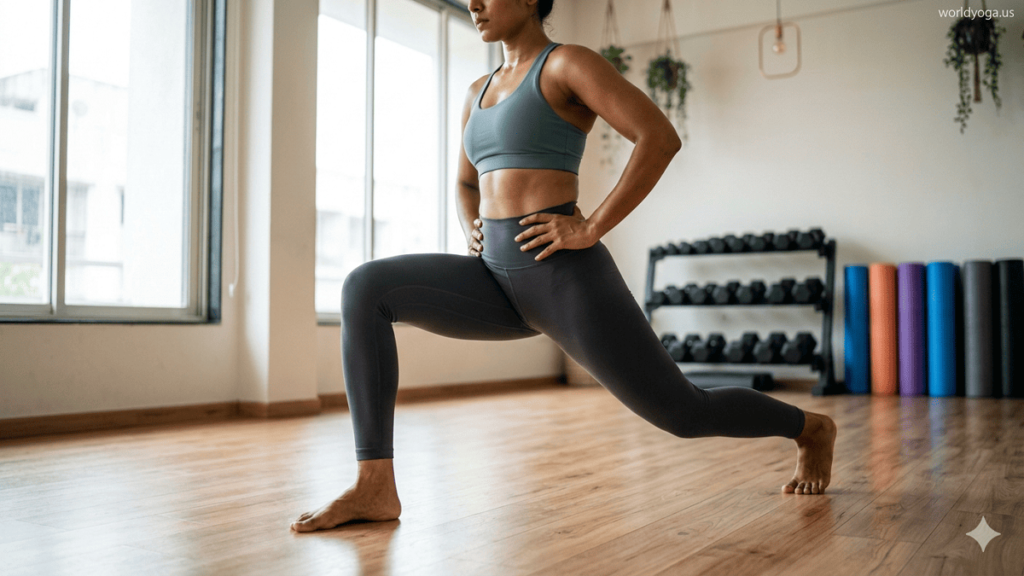
In this lunge variation, the practitioner steps one foot forward while extending the opposite leg backward without allowing the knee to touch the ground. The body remains elevated throughout the movement, creating constant muscular engagement in both legs. The torso stays upright, and the core is actively engaged to maintain balance and alignment.
This position eliminates external support from the back knee, increasing the demand on stabilizing muscles and improving overall coordination.
Proper Alignment Principles
Correct alignment is essential to maximize benefits and reduce injury risk:
- Front knee should align directly above the ankle
- Back leg remains extended and active without touching the floor
- Hips stay squared and facing forward
- Spine remains upright and neutral
- Core muscles are lightly engaged for stability
- Weight is distributed primarily through the front heel and back foot ball
According to Mayo Clinic, maintaining proper joint alignment during lower-body exercises is essential for preventing strain and improving movement efficiency.
Muscles Engaged
This lunge variation activates multiple muscle groups simultaneously:
Lower Body Muscles
- Quadriceps (front thigh)
- Hamstrings (back thigh)
- Gluteus maximus and medius
- Calves for stability and balance
Core Muscles
- Abdominals
- Obliques
- Lower back stabilizers
Supporting Muscles
- Hip flexors
- Stabilizing muscles around knees and ankles
According to Healthline, lunge variations are highly effective for strengthening multiple muscle groups and improving functional lower-body strength.
Key Benefits
1. Builds Lower-Body Strength
This movement significantly strengthens the thighs, glutes, and calves due to continuous load-bearing engagement.
2. Improves Balance and Coordination
Without the back knee as support, the body must stabilize dynamically, enhancing neuromuscular control.
3. Enhances Core Stability
Core muscles work continuously to maintain posture and prevent excessive forward or backward leaning.
4. Supports Athletic Performance
This lunge variation improves explosive power, stride strength, and agility, making it valuable for sports training.
5. Improves Functional Movement Patterns
It mimics natural human movement such as walking, running, and climbing, improving real-world mobility.
Precautions
- Avoid letting the front knee collapse inward
- Do not overarch the lower back
- Maintain controlled movement to avoid instability
- Beginners should practice near support if balance is limited
- Stop if knee or hip pain occurs
Experts from Cleveland Clinic emphasize that proper form and gradual progression are essential in preventing injury during dynamic lower-body exercises.
Conclusion
The lunge with the back knee off the floor is a powerful functional movement that builds strength, balance, core stability, and coordination. When performed with proper alignment and control, it becomes an effective exercise for improving lower-body performance and enhancing overall physical fitness across training, rehabilitation, and athletic programs.
#Lunge: Back Knee Off the Floor in Maharashtra
How is Lunge with the back knee off the floor performed correctly?
The lunge with the back knee off the floor is a dynamic strength and stability exercise that requires precise alignment, controlled movement, and continuous muscle engagement. Because the back leg remains elevated, the posture places greater demand on balance, core control, and lower-body strength compared to a traditional lunge.
Step-by-Step Correct Technique
1. Start in a Standing Position
Begin by standing tall with feet hip-width apart. Keep the spine upright, shoulders relaxed, and core gently engaged to prepare for movement.
2. Step Into a Long Lunge Stance
Step one foot forward and extend the opposite leg backward. The stance should be long enough to create stability but not so wide that balance is lost.
3. Lift the Back Knee Off the Floor
Unlike a traditional lunge, the back knee remains elevated throughout the movement. The back leg should be active, with the heel lifted and the toes grounded for support.
4. Align the Front Knee Properly
The front knee should track directly over the ankle and not collapse inward. This alignment helps protect the knee joint and ensures proper load distribution.
According to Mayo Clinic, maintaining correct joint alignment during lower-body exercises is essential for reducing injury risk and improving movement efficiency.
5. Keep the Torso Upright
The chest should remain lifted and the spine neutral. Avoid leaning too far forward or backward, as this can reduce balance and place unnecessary strain on the lower back.
6. Engage the Core Muscles
The abdominal muscles should remain lightly activated throughout the movement. Core engagement helps stabilize the pelvis and maintain balance between both legs.
7. Maintain Active Back Leg Engagement
The back leg is not passive. The quadriceps and glutes should remain active to support stability and prevent collapse.
8. Use Controlled Movement
Lower and rise slowly in a controlled manner if performing repetitions. Avoid bouncing or rushing the movement, as stability is more important than speed.
According to Healthline, controlled lunging movements improve strength, balance, and coordination while reducing strain on joints.
Key Alignment Tips
- Front knee stays aligned over the ankle
- Back leg remains lifted and active
- Hips stay square and facing forward
- Spine remains neutral and upright
- Weight is distributed evenly between both legs
Common Mistakes to Avoid
- Letting the front knee collapse inward
- Dropping the chest forward excessively
- Relaxing the back leg completely
- Overstriding and losing balance
- Holding breath during movement
Safety Considerations
- Beginners should practice near a wall or stable support
- Avoid the movement if experiencing knee or hip pain
- Warm up properly before performing dynamic lunges
- Progress gradually to build endurance and stability
Experts from Cleveland Clinic emphasize the importance of gradual progression and proper form in preventing injuries during balance-based lower-body exercises.
Conclusion
The lunge with the back knee off the floor is performed correctly when the practitioner maintains a stable stance, upright spine, active back leg, and properly aligned front knee. With controlled movement and consistent core engagement, this exercise becomes highly effective for building strength, balance, and functional lower-body stability.
#Lunge: Back Knee Off the Floor in Ahemadabad

What is the proper alignment in this high lunge variation?
The high lunge variation with the back knee lifted is a dynamic standing posture that demands strong alignment, core stability, and lower-body control. Proper positioning ensures that the joints are protected while maximizing strength and balance benefits.
1. Foot Position and Base of Support
A stable foundation is essential for this posture.
- Front foot is placed firmly on the ground with toes pointing forward
- Back foot is extended behind with heel lifted and weight on the ball of the foot
- Feet are hip-width apart side-to-side for balance (not on a tight line)
Both feet should feel active and grounded to maintain stability.
2. Knee Alignment
Correct knee tracking is crucial for joint safety:
- Front knee stays directly above or slightly behind the ankle
- Knee should track in line with the second and third toes
- Avoid inward collapse (valgus position)
According to Mayo Clinic, maintaining proper knee alignment during lower-body exercises helps reduce joint stress and prevent injury.
3. Hip Positioning
Hip alignment is key for stability and balance:
- Hips remain squared forward (both hip points facing the front)
- Avoid opening the back hip outward excessively
- Pelvis stays neutral without over-tilting forward or backward
This alignment ensures balanced muscle engagement between both legs.
4. Spinal Alignment
The spine should remain long and controlled:
- Chest lifted and open
- Spine in a neutral, elongated position
- Avoid rounding the upper back or over-arching the lower back
A stable spine supports efficient movement and reduces strain on the lower back.
5. Core Engagement
The core provides essential stabilization:
- Abdominal muscles are lightly engaged
- Ribcage stays stacked over the pelvis
- Core activation prevents excessive sway in the torso
According to Healthline, core engagement in lunge variations improves balance, posture control, and functional strength.
6. Shoulder and Arm Position
Upper-body alignment supports posture:
- Shoulders remain relaxed and away from ears
- Arms may be extended overhead or placed at the sides depending on variation
- Shoulder blades stay gently drawn down and back
7. Head and Neck Alignment
- Head remains in line with the spine
- Gaze is forward or slightly upward without straining the neck
- Avoid tilting the head forward
8. Weight Distribution
- Weight is shared between front leg and back foot
- Front heel and back ball of foot remain active
- Avoid collapsing too much into the front leg
Safety and Stability Tips
- Keep movements slow and controlled
- Avoid locking the knees
- Maintain steady breathing throughout
- Use a wall or support if balance is challenging
- Stop if sharp pain occurs
Experts from Cleveland Clinic highlight that proper alignment and gradual progression are essential for preventing injury in dynamic standing exercises.
Conclusion
Proper alignment in the high lunge variation requires a stable base, squared hips, aligned front knee, neutral spine, and active core engagement. When these elements are maintained together, the posture becomes safe, stable, and highly effective for building strength, balance, and functional mobility.
#Lunge: Back Knee Off the Floor in Hyderabad
Which muscles are engaged during the posture?
The high lunge variation is a powerful full-body standing posture that primarily targets the lower body while requiring strong core stabilization and postural control. Because the back knee remains lifted, the muscles must work continuously to maintain balance, alignment, and controlled movement.
1. Primary Lower Body Muscles
Quadriceps (Front Thigh)
The quadriceps are highly active in the front leg, responsible for stabilizing the knee and supporting body weight during the lunge position.
Gluteus Maximus and Medius
The gluteal muscles support hip extension and stabilization. They help maintain pelvic alignment and control movement during both holding and transitioning phases.
Hamstrings
The hamstrings assist in stabilizing the knee and supporting controlled hip positioning, especially in the back leg.
Calf Muscles (Gastrocnemius and Soleus)
The calves in both legs remain active to support balance, ankle stability, and grounding through the feet.
According to Healthline, lunging movements are highly effective for strengthening major lower-body muscle groups and improving functional movement patterns.
2. Core Muscles (Stabilization System)
The core plays a crucial role in maintaining upright posture and balance:
- Rectus abdominis (front abdominal muscles)
- Obliques (side rotational stabilizers)
- Transverse abdominis (deep core stabilizer)
- Erector spinae (lower back support muscles)
These muscles work together to prevent excessive forward leaning and maintain spinal alignment.
3. Hip Muscles
The hip region is heavily engaged for stability and control:
- Hip flexors (especially in the back leg)
- Gluteal stabilizers
- Deep hip rotators
The hips help maintain square alignment and prevent collapse or over-rotation.
4. Back and Postural Muscles
Erector Spinae
These muscles support the spine and help maintain an upright torso.
Upper Back Muscles (Trapezius and Rhomboids)
These muscles stabilize the shoulders and prevent rounding of the upper back.
5. Ankle and Foot Muscles
- Tibialis anterior helps stabilize the front ankle
- Intrinsic foot muscles maintain balance and grounding
- Back foot stabilizers control the lifted heel position
Functional Muscle Interaction
High lunge is a coordinated movement where:
- Lower body muscles generate strength and stability
- Core muscles maintain balance and posture
- Back muscles support spinal alignment
- Ankle and foot muscles fine-tune stability
This integrated activation improves neuromuscular control and functional movement efficiency.
Safety Insight
Over-reliance on the front leg or collapsing into the hips can reduce muscle balance and increase joint strain. Proper alignment ensures even distribution of muscular effort.
Experts from Cleveland Clinic emphasize that balanced muscle engagement and correct form are essential for reducing injury risk in lower-body strengthening exercises.
Conclusion
High lunge engages a wide range of muscles including the quadriceps, glutes, hamstrings, calves, core stabilizers, hip flexors, and postural back muscles. This coordinated activation makes it an effective exercise for building strength, improving balance, and enhancing full-body functional stability when performed with proper alignment and control.
#Lunge: Back Knee Off the Floor in Delhi
What preparatory poses are recommended before practicing it?
High Lunge with the back knee lifted is a strength-based balance posture that requires flexible hips, strong legs, stable ankles, and active core engagement. Proper preparation reduces strain and improves alignment, especially for beginners or those with tight hip flexors and hamstrings.
Below are the most effective preparatory poses to safely build readiness.
1. Mountain Pose
Mountain Pose is the foundational alignment posture used to develop awareness of posture, weight distribution, and core engagement. It helps establish stability before moving into dynamic standing positions like High Lunge.
According to Yoga Journal, Mountain Pose is essential for building structural alignment and body awareness for all standing yoga postures.
2. Low Lunge
Low Lunge is one of the most important preparatory poses. It gently opens the hip flexors, quadriceps, and groin while introducing the lunge position in a supported form with the back knee on the floor.
Benefits include:
- Hip flexor flexibility
- Knee joint preparation
- Improved balance foundation
- Gradual leg strengthening
3. Crescent Lunge Preparation
Crescent Lunge closely mirrors the final posture but often starts with support or reduced depth. It helps condition the body for maintaining the back knee lifted while developing core stability.
4. Warrior I Pose
Warrior I builds lower-body strength and teaches proper hip alignment in a forward-facing stance. It strengthens quadriceps and glutes while improving balance and focus.
5. Chair Pose
Chair Pose activates the quadriceps, glutes, and core muscles. It is highly effective for building endurance in the legs, which is essential for holding High Lunge positions.
6. Downward Dog
Downward Dog stretches the hamstrings, calves, and shoulders while building upper-body strength. It helps release tightness that can limit lunge depth and stability.
According to Healthline, stretching and mobility preparation significantly improves performance and reduces injury risk in lower-body strength exercises.
7. Hip Flexor Stretches
Simple hip-opening drills such as kneeling lunges or dynamic hip circles prepare the pelvis for forward alignment and reduce tension in the front of the hips.
8. Core Activation Exercises
Basic core engagement drills like pelvic tilts or plank holds help activate stabilizing muscles required to maintain upright posture in High Lunge.
Key Preparation Principles
Before practicing High Lunge:
- Warm up hips and quadriceps thoroughly
- Activate core muscles before entering stance
- Ensure ankle and knee mobility
- Practice gradual progression from low to high lunge
- Focus on alignment over depth
Experts from Cleveland Clinic recommend progressive warm-ups and mobility work to reduce injury risk and improve joint stability in dynamic standing exercises.
Conclusion
Preparatory poses such as Low Lunge, Warrior I, Chair Pose, and Downward Dog help build the strength, flexibility, and stability required for High Lunge. With proper preparation, the body can safely support the posture, improving balance, alignment, and overall functional movement control.
#Lunge: Back Knee Off the Floor in Banglore
What are the benefits and precautions of this dynamic lunge variation?
High Lunge with the back knee lifted is a dynamic standing posture that builds strength, balance, and stability through continuous engagement of the lower body and core. Because it is more demanding than a traditional lunge, it delivers significant functional benefits but also requires careful attention to alignment and control.
Benefits of the Dynamic Lunge Variation
1. Builds Lower-Body Strength
This variation strongly activates the quadriceps, hamstrings, glutes, and calves. Since the back knee does not rest on the floor, both legs remain continuously engaged, increasing muscular endurance and strength development.
2. Improves Balance and Stability
The absence of knee support makes the posture more unstable, requiring constant neuromuscular control. This improves balance, coordination, and ankle stability.
According to Healthline, lunge variations are highly effective for developing functional lower-body strength and improving balance in daily movement patterns.
3. Strengthens Core Muscles
The abdominal muscles and lower back stabilizers work continuously to keep the torso upright and aligned. This improves postural control and reduces reliance on external support.
4. Enhances Hip Flexor Mobility
The extended back leg position helps stretch and strengthen the hip flexors, which are often tight due to prolonged sitting.
5. Supports Functional Movement Patterns
This movement closely mimics walking, running, climbing, and athletic stepping patterns, making it highly relevant for real-life movement efficiency and sports performance.
Precautions for Safe Practice
1. Maintain Proper Knee Alignment
The front knee should always stay aligned over the ankle and should not collapse inward. Poor alignment can increase stress on the knee joint.
According to Mayo Clinic, correct joint alignment is essential to prevent strain and reduce injury risk during lower-body exercises.
2. Avoid Overarching or Leaning Forward
Excessive arching of the lower back or leaning of the torso can place strain on the spine and reduce balance efficiency. The spine should remain neutral and upright.
3. Do Not Lock the Knees
Both knees should remain slightly soft. Locking joints reduces shock absorption and increases injury risk.
4. Use Support if Needed
Beginners or individuals with balance challenges should practice near a wall or use yoga blocks for stability until strength improves.
5. Avoid if Experiencing Pain or Injury
Individuals with knee, hip, or lower-back injuries should avoid or modify this posture. Pain is a signal to stop and reassess alignment or intensity.
Experts from Cleveland Clinic emphasize gradual progression and proper form as key factors in preventing injuries during dynamic strength exercises.
Additional Safety Tips
- Warm up before practice to prepare muscles and joints
- Move slowly and with control rather than speed
- Engage the core throughout the posture
- Keep breathing steady and controlled
- Progress gradually in duration and depth
Conclusion
The high lunge variation is a powerful exercise for building lower-body strength, improving balance, enhancing core stability, and supporting functional movement. However, its effectiveness depends on proper alignment, controlled movement, and mindful progression. When practiced safely, it becomes a highly efficient posture for overall physical conditioning and stability.
#Lunge: Back Knee Off the Floor in Pune
Case Study of Lunge: Back Knee Off the Floor
Introduction
The lunge with the back knee off the floor is a dynamic strength and stability exercise widely used in fitness training, yoga conditioning, rehabilitation, and athletic performance programs. This variation increases muscular demand by requiring continuous engagement of both lower limbs and the core without external support from the back knee.
This case study evaluates its impact on strength, balance, mobility, and functional movement in a structured training setting.
Participant Profile
A 32-year-old office professional participated in a 6-week movement improvement program. The participant reported:
- Weak lower-body strength
- Poor balance during single-leg movements
- Tight hip flexors due to prolonged sitting
- Occasional knee discomfort during exercise
- Reduced core stability
The goal was to improve functional strength, posture, and movement control.
Training Program Overview
The program included:
- Dynamic high lunge practice (back knee lifted)
- Mobility drills for hips and ankles
- Core strengthening exercises
- Progressive resistance bodyweight training
Sessions were conducted 4 days per week for 30 minutes.
Initial Observations
During the first two weeks, the participant experienced:
- Difficulty maintaining balance in lunge stance
- Forward leaning of the torso
- Fatigue in quadriceps and calves
- Limited hip flexor flexibility
- Mild instability in the front knee
According to Cleveland Clinic, weak stabilizing muscles and poor movement mechanics are common in individuals with sedentary lifestyles.
Intervention and Adjustments
To improve performance and safety, the following modifications were introduced:
- Reduced stance length for better control
- Wall support during early sessions
- Focus on slow, controlled movement
- Emphasis on core engagement before each repetition
- Gradual increase in hold duration
Preparatory exercises included:
- Low Lunge
- Chair Pose
- Hip flexor mobility drills
- Ankle stability exercises
Mid-Program Progress (Weeks 3–4)
Improvements observed:
- Better balance and reduced wobbling
- Improved upright posture during lunge
- Increased hip flexibility
- Reduced knee discomfort
- Stronger core engagement
According to Healthline, lunge-based exercises improve functional strength, coordination, and lower-body stability when performed consistently.
Final Outcomes (Weeks 5–6)
By the end of the program, the participant demonstrated:
1. Improved Lower-Body Strength
Significant increase in quadriceps and glute endurance during sustained lunges.
2. Enhanced Balance and Coordination
Better control during dynamic transitions and reduced reliance on external support.
3. Increased Core Stability
Improved posture control and reduced forward trunk collapse.
4. Improved Hip Mobility
Reduced tightness in hip flexors and smoother stride mechanics.
5. Better Functional Movement Efficiency
Improvements carried over into daily activities such as walking, climbing stairs, and prolonged standing.
Discussion
The results indicate that the lunge with the back knee off the floor is highly effective for improving functional strength and stability. However, progression must be gradual, especially for individuals with limited baseline mobility or balance control.
Key success factors included:
- Controlled movement execution
- Core activation before each repetition
- Progressive overload approach
- Consistent mobility work
Conclusion
This case study demonstrates that the dynamic lunge variation significantly improves lower-body strength, balance, core stability, and movement efficiency when practiced correctly. With proper progression and alignment, it serves as a valuable exercise for both fitness development and functional rehabilitation programs.
#Lunge: Back Knee Off the Floor in Delhi
White Paper of Lunge: Back Knee Off the Floor
Introduction
The lunge with the back knee off the floor is a dynamic, closed-chain lower-body exercise widely used in strength training, yoga conditioning, rehabilitation, and athletic performance programs. Unlike a traditional lunge, this variation eliminates knee support on the rear leg, increasing muscular demand on the lower body, core stabilizers, and postural control systems.
This white paper analyzes the biomechanics, muscular engagement, benefits, risks, and applications of this movement within fitness, clinical, and performance contexts.
Movement Overview
The exercise involves:
- A forward stepping stance
- Elevated back leg (heel lifted, knee off the floor)
- Upright torso alignment
- Continuous engagement of stabilizing muscles
The posture creates constant tension in both legs while requiring active core stabilization to maintain balance and alignment.
Biomechanical Analysis
Lower-Body Mechanics
The movement is primarily driven by:
- Hip flexion and extension
- Knee flexion and extension (front leg)
- Ankle stabilization and proprioception
The front leg bears most of the load, while the back leg remains active to support balance and alignment.
Joint Involvement
- Hip joints: stability and movement control
- Knee joints: primary load-bearing on front leg
- Ankle joints: balance and shock absorption
- Spine: postural stabilization
According to Mayo Clinic, maintaining proper joint alignment during lower-body exercises is essential for reducing strain and preventing injury.
Muscular Engagement
Primary Muscle Groups
- Quadriceps (front leg stabilizer and extensor)
- Gluteus maximus and medius (hip stability and extension)
- Hamstrings (posterior chain support)
- Calves (balance and ankle stability)
Core Stabilizers
- Rectus abdominis
- Obliques
- Transverse abdominis
- Erector spinae
These muscles maintain upright posture and prevent excessive trunk movement.
Supporting Muscles
- Hip flexors (back leg control)
- Adductors (inner thigh stabilization)
- Foot intrinsic muscles (balance and grounding)
According to Healthline, lunge variations are highly effective for activating multiple muscle groups and improving functional strength.
Physiological Benefits
1. Strength Development
Enhances lower-body strength through sustained load-bearing without external support.
2. Balance and Neuromuscular Control
Improves proprioception and coordination by challenging stability systems.
3. Core Stability Enhancement
Strengthens deep stabilizing muscles responsible for posture control and movement efficiency.
4. Functional Movement Transfer
Improves real-world movement patterns such as walking, running, and stair climbing.
5. Joint Stability Improvement
Supports hip, knee, and ankle strength through controlled alignment under load.
Risks and Limitations
Improper execution may lead to:
- Knee joint stress due to poor alignment
- Lower-back strain from excessive leaning
- Hip flexor tightness or imbalance
- Loss of balance and fall risk
Safety Guidelines
- Maintain front knee alignment over the ankle
- Avoid locking joints
- Keep spine neutral and upright
- Engage core throughout movement
- Use support for beginners if needed
- Progress gradually in intensity and duration
Experts from Cleveland Clinic emphasize the importance of proper form, controlled progression, and balanced muscle engagement to prevent injury during dynamic lower-body exercises.
Applications Across Industries
1. Fitness and Strength Training
Used for building lower-body strength, endurance, and athletic performance.
2. Physiotherapy and Rehabilitation
Applied for controlled strengthening and functional movement retraining.
3. Sports Performance
Enhances agility, stride power, and unilateral leg strength.
4. Corporate Wellness
Reduces effects of prolonged sitting by improving hip mobility and posture.
5. Functional Training Programs
Supports everyday movement efficiency and injury prevention.
Conclusion
The lunge with the back knee off the floor is a highly effective functional exercise that enhances strength, stability, balance, and coordination. When performed with proper alignment and progression, it serves as a valuable tool across fitness, rehabilitation, and performance training systems, supporting both athletic development and everyday movement quality.
#Lunge: Back Knee Off the Floor in Kolkata
Industry Application of Lunge: Back Knee Off the Floor
Introduction
The lunge with the back knee off the floor is a dynamic strength and stability exercise widely used across fitness, rehabilitation, sports science, and workplace wellness programs. Its value lies in its ability to develop functional lower-body strength, improve balance, and enhance core stability under continuous load. Because it closely replicates real-life movement patterns such as walking, running, and climbing, it has strong applicability in multiple professional industries focused on human performance and health.
1. Fitness and Strength Training Industry
In the fitness sector, this lunge variation is a foundational movement used in:
- Functional training programs
- Bodyweight strength routines
- HIIT (High-Intensity Interval Training)
- Athletic conditioning circuits
It is commonly used to build:
- Quadriceps and glute strength
- Lower-body endurance
- Core stability
- Unilateral strength balance
According to Healthline, lunge variations are highly effective for developing functional strength because they engage multiple muscle groups simultaneously while improving coordination and stability.
2. Sports Performance and Athletic Conditioning
Athletes use the back-knee-off lunge to improve:
- Explosive leg power
- Stride efficiency
- Acceleration and deceleration control
- Injury resistance in lower limbs
It is especially beneficial in sports such as:
- Football
- Cricket
- Basketball
- Tennis
- Running and track events
Strength and conditioning coaches incorporate this movement to enhance unilateral strength and improve sport-specific movement mechanics.
3. Physiotherapy and Rehabilitation
In rehabilitation settings, this exercise is used (often in modified form) to support:
- Post-injury lower-body strengthening
- Knee and hip stability recovery
- Gait correction
- Functional movement retraining
Patients recovering from sedentary lifestyles or mild musculoskeletal issues benefit from controlled progression into this lunge variation.
According to Cleveland Clinic, controlled strengthening exercises are essential in rehabilitation programs to restore mobility and prevent reinjury.
4. Corporate Wellness Programs
With rising concerns around sedentary office work, corporate wellness programs integrate this lunge variation into movement breaks and fitness sessions.
Benefits for employees include:
- Reduced hip and lower-back stiffness
- Improved posture and mobility
- Increased energy levels
- Better circulation from active movement
Short guided mobility sessions often include lunges to counteract prolonged sitting and improve physical well-being.
5. Personal Training and Functional Coaching
Personal trainers use this movement to:
- Assess lower-body strength imbalances
- Improve client stability and coordination
- Build foundational movement patterns
- Progress clients toward advanced exercises
It is often introduced before weighted lunges or plyometric training.
6. Rehabilitation and Elder Fitness Adaptations
In senior fitness programs and rehabilitation environments, simplified versions are used to:
- Improve balance and fall prevention
- Strengthen leg muscles safely
- Enhance walking stability
- Support joint mobility
Support tools like chairs or walls are often used for safety and control.
7. Digital Fitness and Online Training Platforms
The exercise is widely featured in:
- Online fitness classes
- Mobile workout applications
- Virtual physiotherapy programs
- AI-based movement coaching systems
Its simplicity and scalability make it ideal for remote fitness instruction and structured progression programs.
Future Industry Potential
As demand for functional fitness and preventive healthcare grows, this lunge variation is expected to expand in:
- Workplace wellness technology
- Sports performance analytics
- Digital rehabilitation platforms
- AI posture and movement correction tools
Experts from Mayo Clinic highlight the importance of lower-body strength and balance training in reducing injury risk and improving long-term mobility.
Conclusion
The lunge with the back knee off the floor is a versatile, high-impact functional movement used across fitness, rehabilitation, sports performance, and corporate wellness industries. Its ability to develop strength, balance, and coordination makes it a core exercise in modern movement training systems focused on performance enhancement and injury prevention.
#Lunge: Back Knee Off the Floor in Mumbai
Ask FAQs
What is the lunge with the back knee off the floor?
It is a dynamic lower-body exercise where one leg steps forward into a lunge while the back leg remains lifted without touching the ground. This increases intensity by requiring continuous engagement of the legs, core, and stabilizing muscles.
Is this lunge variation suitable for beginners?
It can be challenging for beginners due to balance and strength demands. Beginners should first master basic stationary lunges and low lunges before progressing to this variation. Using wall support is recommended in early stages.
What muscles are worked in this exercise?
This movement targets the quadriceps, glutes, hamstrings, calves, hip flexors, and core muscles. It also activates stabilizing muscles in the ankles, knees, and lower back to maintain balance and posture.
What are the main benefits of this lunge variation?
Key benefits include improved lower-body strength, better balance, enhanced core stability, increased hip flexibility, and improved functional movement patterns used in daily activities and sports.
What precautions should be taken while performing it?
Maintain proper knee alignment, avoid leaning forward excessively, keep the core engaged, and do not lock the joints. Stop immediately if you feel knee, hip, or lower-back pain. Support can be used if balance is limited.
Table of Contents
Disclaimer: This content is for educational and informational purposes only and should not be considered medical or professional fitness advice. Always consult a qualified healthcare provider or certified fitness professional before starting any new exercise, especially if you have existing injuries or medical conditions.