Adho Mukha Shirsha Makarasana
Adho Mukha Shirsha Makarasana is a supported yoga posture that combines elements of prone positioning with gentle inversion and upper-body grounding. The pose typically involves the practitioner lying in a prone or semi-inverted position while maintaining controlled head and upper spine alignment, often with forearm or shoulder support depending on the variation being practiced. It is used in yoga therapy and restorative movement systems to encourage spinal decompression, relaxation of the nervous system, and improved breath awareness.
This posture emphasizes mindful alignment of the cervical spine, shoulders, and upper back while reducing load on the lower back and wrists. It is often incorporated into preparatory or recovery sequences where the goal is to gently open the chest, release tension in the neck region, and promote parasympathetic activation. The controlled positioning of the head and shoulders helps improve postural awareness and supports safe mobility in individuals with stiffness or fatigue.
Adho Mukha Shirsha Makarasana is also valued for its calming effects, as the supported nature of the pose encourages deep diaphragmatic breathing and mental relaxation. It is commonly used in therapeutic yoga, stress management programs, and beginner-friendly mobility routines. Proper guidance is recommended to ensure correct alignment and avoid unnecessary pressure on the neck or cervical spine.
#Adho Mukha Shirsha Makarasana in India
How is Adho Mukha Shirsha Makarasana performed correctly?
Adho Mukha Shirsha Makarasana is a supported prone yoga variation that focuses on gentle spinal decompression, chest opening, and controlled cervical alignment. The posture is performed slowly and mindfully to ensure that the neck, shoulders, and spine remain relaxed while still maintaining structural awareness.
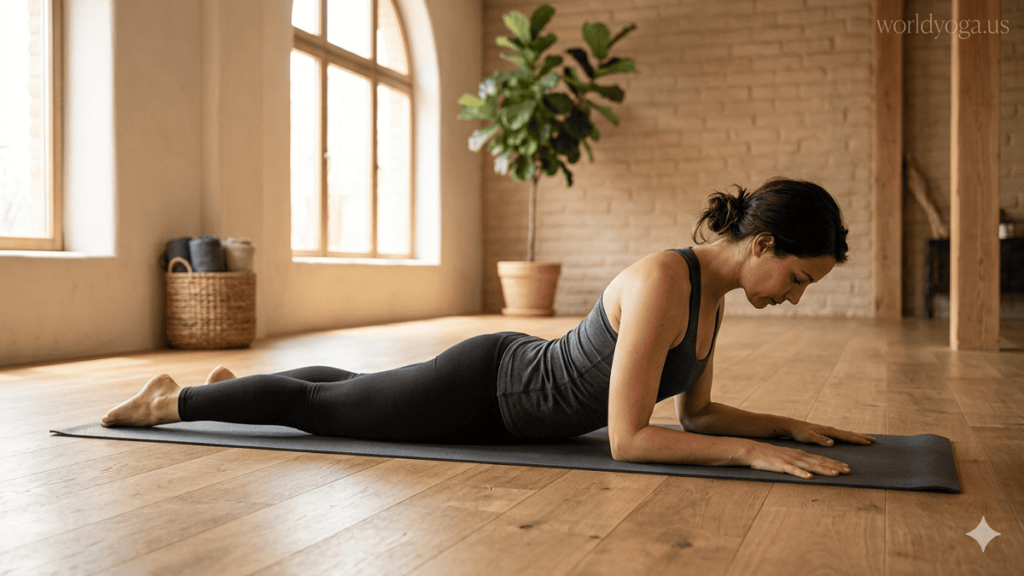
To begin, the practitioner lies face down on a yoga mat in a prone position with the body fully extended. The legs are kept relaxed and slightly apart, allowing the lower body to remain passive and grounded. The forehead or chin initially rests on the mat to establish a neutral starting point for the neck.
Next, the forearms are brought forward and placed on the mat for support, depending on the variation being practiced. The elbows are positioned comfortably under or slightly ahead of the shoulders, creating a stable base for the upper body. The palms may rest flat or gently cupped, depending on flexibility and comfort. The shoulders are drawn away from the ears to avoid compression in the neck region.
As the posture develops, the chest is gently lifted away from the floor using light engagement of the upper back muscles. This lift is not forceful; instead, it is controlled and supported by the forearms and shoulder girdle. The spine begins to lengthen as the practitioner creates space between the chest and the mat while keeping the lower body relaxed.
The head and neck play a crucial role in alignment. In the correct position, the cervical spine remains neutral without excessive flexion or extension. The chin is slightly tucked or the forehead remains lightly grounded, depending on the variation. There should be no strain or compression in the neck, and the head should never bear excessive weight.
Breathing remains slow, deep, and steady throughout the posture. The diaphragm should expand comfortably against the floor, promoting relaxation and nervous system regulation. This breath awareness is a key component of the pose’s restorative benefits.
Proper alignment requires that the shoulders stay broad and stable while the chest gently opens forward. The lower back remains relaxed, and there is no excessive arching. The engagement should be subtle, focusing more on length and release rather than muscular effort.
Common mistakes include lifting the chest too aggressively, collapsing into the neck, or placing too much pressure on the cervical spine. These errors usually occur when the movement is forced rather than gradually supported by the forearms and breath.
According to established yoga references such as Yoga Journal Restorative Yoga Guide and Verywell Fit Yoga Back Extension Poses, safe execution depends on gentle activation, proper support under the chest and shoulders, and avoidance of cervical strain.
In summary, Adho Mukha Shirsha Makarasana is performed by lying prone, supporting the upper body with the forearms, gently lifting the chest, and maintaining a neutral neck while focusing on relaxed breathing and spinal length.
#Adho Mukha Shirsha Makarasana in Maharahstra
What is the proper alignment in this forearm and head-supported pose?
Proper alignment in Adho Mukha Shirsha Makarasana focuses on creating a balanced relationship between the cervical spine, shoulders, thoracic spine, and forearms while keeping the body relaxed and supported. The posture is not about depth or effort, but about controlled positioning that allows decompression and gentle opening without strain.
The foundation begins with the forearms placed firmly on the mat. The elbows should be positioned either directly under the shoulders or slightly in front, depending on individual comfort and mobility. They should remain shoulder-width apart to ensure even weight distribution. The forearms press gently into the floor, creating a stable base that supports the upper body without collapsing into the joints.
The shoulders must remain broad and relaxed. They should actively move away from the ears to avoid compression in the cervical region. At the same time, the shoulder blades gently draw down and slightly outward, allowing the upper back to stay open and supported. This prevents the upper trapezius from over-engaging and protects the neck from unnecessary tension.
The spine is maintained in a long, neutral alignment. The thoracic spine gently lifts away from the floor, creating subtle extension in the upper back, while the lumbar region remains relaxed and not over-arched. The goal is elongation rather than deep backbending, ensuring even distribution of spinal load.
The neck and head require special attention in this posture. The cervical spine should remain neutral, neither forced into extension nor excessive flexion. The head may lightly rest on the mat or hover just above it, but it should never bear significant weight. The chin is slightly tucked to maintain cervical length and prevent compression at the back of the neck.
The chest remains gently open, supported by the engagement of the upper back muscles. There should be a soft lifting sensation rather than a forced elevation. This helps encourage natural expansion of the rib cage and supports deeper breathing without restriction.
The lower body stays relaxed and grounded. The legs are extended comfortably behind the body with minimal muscular engagement. The pelvis remains neutral, avoiding excessive tilt or tension in the lower back.
Core engagement is subtle but important. The abdominal muscles lightly activate to stabilize the spine and prevent collapse into the mat. This ensures that the posture remains supported rather than passive.
Weight distribution is evenly shared between the forearms, chest support points, and lower body contact with the mat. No single area—especially the neck—should carry excessive load.
According to established yoga alignment principles referenced in sources such as Yoga Journal Restorative Back Care and Verywell Fit Cervical Spine Safety in Yoga, correct alignment prioritizes spinal length, shoulder relaxation, and cervical neutrality over depth or intensity.
In summary, proper alignment in this forearm and head-supported pose is achieved through grounded forearms, relaxed but stable shoulders, a lengthened spine, a neutral neck, and minimal lower-body tension, ensuring a safe and restorative practice.
#Adho Mukha Shirsha Makarasana in Ahemadabad

Which muscles are engaged during the posture?
Adho Mukha Shirsha Makarasana is primarily a gentle, supported posture, but it still involves coordinated engagement of multiple muscle groups to maintain spinal alignment, shoulder stability, and controlled chest lift. The activation is mostly low-intensity and isometric, meaning the muscles work without large movements to support structure rather than generate force.
Upper Back and Shoulder Muscles
The upper back plays a key stabilizing role. The trapezius (especially the middle and lower fibers) helps maintain shoulder positioning and prevents the shoulders from collapsing toward the ears. The rhomboids assist in gently drawing the shoulder blades toward the spine, supporting an open chest. The serratus anterior is also engaged to stabilize the scapulae and maintain smooth shoulder girdle alignment against the floor or forearm support.
The rotator cuff muscles (supraspinatus, infraspinatus, teres minor, and subscapularis) provide fine stabilization of the shoulder joint, ensuring that the forearms and shoulders remain stable under light load.
Spinal Muscles
The erector spinae group is lightly engaged to support a gentle lift and elongation of the thoracic spine. This engagement is not forceful but helps maintain spinal extension and prevents collapse into the mat. The multifidus muscles contribute to segmental spinal stability, especially in maintaining alignment through the upper and mid-back.
Core Muscles
The core plays a subtle but important stabilizing role. The transverse abdominis activates to support internal abdominal pressure and maintain spinal integrity. The obliques assist in stabilizing the torso and preventing unwanted rotation. The rectus abdominis remains lightly engaged to balance spinal extension and prevent excessive arching.
Neck and Cervical Stabilizers
The deep cervical flexors are gently activated to maintain a neutral neck position and prevent compression in the cervical spine. The suboccipital muscles remain relaxed to avoid tension at the base of the skull. This balance ensures the head remains supported without strain.
Chest and Breathing Muscles
The intercostal muscles between the ribs assist in controlled breathing and rib cage expansion. The diaphragm is actively engaged during breathing cycles, especially in deep, slow inhalations that are common in restorative yoga practice. The pectoralis muscles remain lightly stretched rather than strongly engaged, allowing chest opening.
Lower Body Muscles
The lower body remains mostly passive, but not completely inactive. The gluteus maximus may engage lightly to support pelvic alignment. The hamstrings remain in a relaxed lengthened state. The quadriceps help maintain gentle extension of the legs without locking the knees. The calves remain relaxed unless subtle activation is needed for foot positioning.
Summary
Overall, Adho Mukha Shirsha Makarasana involves coordinated low-level engagement across the shoulders, upper back, core, and neck stabilizers, while the lower body remains largely passive. The muscular activity is focused on support and alignment rather than strength or intensity, making it a restorative and decompressive posture.
#Adho Mukha Shirsha Makarasana in Hyderabad
What preparatory poses are recommended before practicing it?
Adho Mukha Shirsha Makarasana is a gentle, supported prone posture that requires openness in the chest, stability in the shoulders, and ease in the cervical spine. Preparing the body with targeted poses helps reduce neck strain, improve spinal mobility, and create a safe foundation for relaxation and controlled extension.
1. Balasana (Child’s Pose)
Child’s Pose is one of the most important preparatory positions because it helps release tension in the spine, shoulders, and neck. It encourages gentle spinal flexion, which balances the mild extension used in Adho Mukha Shirsha Makarasana. It also promotes relaxation of the nervous system, making it easier to enter a restorative state.
2. Bhujangasana (Cobra Pose)
Cobra Pose gently strengthens the spinal extensors and opens the chest. It prepares the thoracic spine for controlled lifting in the posture. Unlike deeper backbends, Cobra keeps the pelvis grounded, making it ideal for building upper-back engagement without stressing the lower back.
3. Salamba Bhujangasana (Sphinx Pose)
Sphinx Pose is a key preparatory posture because it closely mimics the forearm support used in Adho Mukha Shirsha Makarasana. It helps activate the serratus anterior, trapezius, and rhomboids while teaching safe spinal extension with forearm grounding.
4. Thread the Needle Pose (Parsva Balasana variation)
This pose releases tension in the upper back, shoulders, and neck. It improves rotational mobility in the thoracic spine and helps reduce stiffness that can interfere with comfortable head and shoulder positioning.
5. Cat-Cow Stretch (Marjaryasana–Bitilasana)
Cat-Cow improves spinal articulation and awareness of segmental movement. It helps the practitioner understand the difference between spinal flexion and extension, which is essential for maintaining a neutral and supported alignment in the target posture.
6. Puppy Pose (Uttana Shishosana)
Puppy Pose is highly effective for opening the chest and shoulders while keeping the hips elevated. It prepares the upper body for gentle extension and improves flexibility in the latissimus dorsi and shoulder joints, both of which are important for forearm-supported postures.
Summary
A balanced preparation sequence includes Child’s Pose for relaxation, Sphinx and Cobra for spinal activation, Thread the Needle for shoulder release, Cat-Cow for mobility, and Puppy Pose for upper-body opening. Together, these poses create the flexibility, strength, and awareness needed for safe practice of Adho Mukha Shirsha Makarasana.
#Adho Mukha Shirsha Makarasana in Pune
What are the benefits and precautions of Adho Mukha Shirsha Makarasana?
Adho Mukha Shirsha Makarasana is a supported prone yoga posture that emphasizes gentle spinal extension, shoulder opening, and nervous system relaxation. Because it is a low-intensity, restorative variation, it is often used in therapeutic and beginner-friendly yoga sequences. However, like all spinal and cervical-oriented postures, it requires mindful alignment to ensure safety and effectiveness.
Benefits
1. Gentle Spinal Decompression
This posture helps create length along the spine by encouraging mild thoracic extension and relaxation of the lower back. The supported nature of the pose allows the vertebrae to decompress without aggressive loading, which can help reduce general back stiffness caused by prolonged sitting.
2. Improved Chest and Shoulder Opening
The gentle lift of the chest and positioning of the shoulders helps open the pectoral muscles and upper back. This can counteract rounded shoulder posture commonly seen in desk-based lifestyles, improving overall postural alignment over time.
3. Cervical Spine Relaxation
Because the head is supported or lightly grounded, the neck is encouraged to release tension without bearing significant load. This can help reduce tightness in the cervical region when performed correctly with neutral alignment.
4. Enhanced Breathing Capacity
The posture allows for expansion of the rib cage and diaphragm engagement. This supports deeper, slower breathing patterns, which can improve oxygen intake and promote relaxation of the nervous system.
5. Stress Reduction and Nervous System Calming
As a restorative posture, it activates the parasympathetic nervous system. The combination of supported positioning and controlled breathing can help reduce stress, mental fatigue, and anxiety levels.
Precautions
1. Avoid Excess Neck Pressure
The most important precaution is to ensure that the neck does not bear weight. The head should remain relaxed, and any sensation of compression in the cervical spine indicates incorrect alignment.
2. Limit Excessive Back Extension
Although the posture involves mild spinal extension, forcing the chest too high can strain the lower back. The lift should remain subtle and supported rather than deep or forceful.
3. Shoulder Overloading
If the shoulders collapse or over-engage without proper support, it may lead to discomfort in the upper trapezius or rotator cuff. Proper scapular positioning is essential to prevent strain.
4. Not Suitable During Acute Neck or Spinal Injury
Individuals with acute cervical issues, herniated discs, or severe spinal conditions should avoid or modify the posture under professional guidance.
5. Breathing Restriction Warning
If breathing feels restricted or shallow due to chest compression or misalignment, the posture should be adjusted immediately to allow full diaphragmatic movement.
Summary
Adho Mukha Shirsha Makarasana offers significant benefits in spinal decompression, chest opening, breathing enhancement, and nervous system relaxation. However, its effectiveness depends on maintaining a neutral neck, avoiding forced spinal extension, and ensuring proper shoulder support. When practiced correctly, it serves as a safe and restorative posture for both beginners and therapeutic applications.
#Adho Mukha Shirsha Makarasana in Delhi
Case Study of Adho Mukha Shirsha Makarasana
1. Introduction
Adho Mukha Shirsha Makarasana is a supported prone yoga posture used in restorative and therapeutic yoga systems to promote spinal decompression, gentle chest opening, and cervical relaxation. Unlike active backbends, this posture emphasizes passive support through the floor and controlled engagement of the upper back and shoulders. This case study evaluates its effects on a practitioner with postural discomfort and mild cervical tension.
2. Subject Profile
The subject is a 38-year-old administrative professional with a predominantly sedentary work routine. Reported concerns include upper back stiffness, forward head posture, and mild neck tension. There is no history of acute spinal injury, but chronic muscular tightness is present due to prolonged desk work.
3. Methodology
The subject practiced Adho Mukha Shirsha Makarasana over a 5-week period, 4 times per week. Each session included:
- Preparatory poses (Sphinx Pose, Child’s Pose, Cat-Cow)
- Slow entry into prone positioning with forearm support
- Gentle chest lift with controlled spinal extension
- Head resting or hovering near the floor without weight-bearing
- Duration: 30–60 seconds per hold, repeated 3–4 times per session
Progress was monitored based on neck comfort, shoulder mobility, breathing quality, and spinal ease.
4. Biomechanical Observations
In early sessions, the subject demonstrated excessive tension in the upper trapezius and difficulty maintaining shoulder relaxation. The head tended to drop heavily toward the floor, indicating poor cervical awareness. Limited thoracic mobility restricted smooth chest lifting.
By the third week, improved engagement of the rhomboids and lower trapezius was observed. The chest lift became more controlled, and scapular positioning stabilized. The cervical spine began maintaining a more neutral alignment with reduced muscular strain.
By week five, the subject achieved consistent forearm support with minimal shoulder compression. The thoracic spine showed improved extension capacity, and breathing became deeper and more rhythmic.
5. Outcomes
Key improvements included:
- Reduced neck stiffness and improved cervical comfort
- Increased thoracic spine mobility
- Enhanced shoulder relaxation and postural awareness
- Improved breathing depth and diaphragm engagement
- Decreased upper back fatigue during daily sitting tasks
Subjectively, the posture transitioned from effortful and unstable to calming and restorative.
6. Challenges and Adjustments
Initial challenges included:
- Neck tension due to improper head placement
- Shoulder fatigue from weak stabilizer muscles
- Limited chest opening due to tight pectoral muscles
Adjustments made:
- Emphasis on forearm grounding instead of neck support
- Use of Sphinx Pose to build foundational strength
- Reduction in chest lift height to avoid lumbar strain
- Increased focus on slow nasal breathing
7. Discussion
The case demonstrates that Adho Mukha Shirsha Makarasana is primarily a neuromuscular re-education posture rather than a strength-based exercise. Its effectiveness depends on coordination between gentle spinal extension, scapular stability, and cervical neutrality. The progression highlights the importance of gradual adaptation rather than deepening the posture prematurely.
8. Conclusion
Adho Mukha Shirsha Makarasana is an effective restorative posture for improving spinal alignment, reducing cervical tension, and enhancing upper-body mobility when practiced consistently. Its therapeutic value lies in controlled support, mindful breathing, and progressive neuromuscular adaptation rather than intensity.
#Adho Mukha Shirsha Makarasana in Banglore
White Paper of Adho Mukha Shirsha Makarasana
1. Executive Summary
Adho Mukha Shirsha Makarasana is a supported prone yoga posture designed to facilitate gentle spinal extension, cervical relaxation, and thoracic mobility while minimizing compressive load on the neck and lower back. It is widely used in restorative yoga, yoga therapy, and corrective movement systems as a low-intensity intervention for postural dysfunction, stress reduction, and upper-body mobility enhancement. This white paper outlines its biomechanical structure, muscular involvement, clinical applications, safety considerations, and implementation principles.
2. Background and Functional Context
Modern sedentary lifestyles frequently contribute to forward head posture, thoracic stiffness, and restricted breathing patterns. Traditional active backbends may be unsuitable for individuals with low tolerance to spinal loading. Adho Mukha Shirsha Makarasana addresses this gap by providing a supported extension pattern that emphasizes decompression rather than forceful mobility. Its design aligns with restorative movement principles focused on nervous system regulation and gentle tissue release.
3. Biomechanical Framework
This posture is characterized by a prone base with forearm-supported upper-body elevation. The elbows are typically positioned under or slightly ahead of the shoulders, creating a stable support system for the thoracic lift. The spine functions in a low-load extension pattern, where the chest gently lifts away from the floor while maintaining cervical neutrality.
The head remains passive, either lightly contacting the surface or hovering without weight-bearing. The pelvis remains grounded, ensuring that lumbar extension does not dominate the movement. Load distribution is primarily shared between the forearms, shoulder girdle, and passive lower body contact.
4. Muscular Activation Profile
Key muscle groups include:
- Upper back stabilizers: Rhomboids, trapezius (middle and lower fibers), serratus anterior
- Spinal extensors: Erector spinae and multifidus (low-level activation)
- Shoulder stabilizers: Rotator cuff complex for joint integrity
- Core musculature: Transverse abdominis and obliques for spinal support
- Respiratory muscles: Diaphragm and intercostals for expanded breathing mechanics
- Neck stabilizers: Deep cervical flexors for neutral alignment maintenance
Muscular engagement is primarily isometric and supportive rather than force-generating.
5. Joint Mechanics
- Cervical spine: Neutral alignment with no axial compression
- Thoracic spine: Controlled extension with decompressive emphasis
- Lumbar spine: Passive support with minimal extension load
- Shoulder joint: Stabilized in mild flexion with scapular control
- Elbows: Fixed flexion under vertical support load
- Hip joint: Neutral extension with relaxed positioning
Proper joint stacking ensures load is distributed safely across the kinetic chain.
6. Clinical and Functional Applications
This posture is widely applied in:
- Yoga therapy for cervical and thoracic stiffness
- Rehabilitation programs for postural correction
- Stress reduction and parasympathetic activation protocols
- Breathing retraining and diaphragmatic expansion exercises
- Beginner-friendly spinal mobility development
Authoritative movement references such as Yoga Journal Restorative Back Care Guide and Verywell Fit Neck and Spine Yoga Safety highlight the importance of controlled extension and cervical safety in such practices.
7. Risk Factors and Safety Considerations
Potential risks include:
- Cervical strain from improper head loading or misalignment
- Lumbar discomfort from excessive spinal extension
- Shoulder fatigue due to insufficient scapular support
- Breathing restriction from chest compression or collapse
- Overextension in individuals with hypermobility or spinal instability
Risk mitigation strategies include gradual progression, use of props, reduced range of motion, and emphasis on breath-led movement.
8. Implementation Guidelines
- Begin with preparatory poses such as Sphinx and Child’s Pose
- Maintain elbows under shoulders for structural stability
- Avoid weight-bearing through the head or neck
- Prioritize spinal length over depth of extension
- Use gentle breath cycles to guide movement quality
- Limit duration in early stages and progress gradually
9. Conclusion
Adho Mukha Shirsha Makarasana is a therapeutically valuable posture that integrates spinal decompression, shoulder stability, and cervical relaxation within a low-load framework. Its effectiveness depends on precise alignment, controlled muscular engagement, and avoidance of excessive extension. When applied correctly, it serves as a scalable tool for rehabilitation, stress reduction, and functional mobility enhancement.
#Adho Mukha Shirsha Makarasana in Kolkata
Industry Application of Adho Mukha Shirsha Makarasana
1. Overview
Adho Mukha Shirsha Makarasana is a supported prone yoga posture widely used across yoga therapy, physiotherapy, rehabilitation science, corporate wellness, sports recovery, and corrective movement training. Its key value lies in providing a low-load spinal extension pattern that improves thoracic mobility, reduces cervical tension, and enhances breathing mechanics without placing excessive stress on the wrists or lower back. This makes it highly adaptable across health, fitness, and workplace wellness industries.
2. Application in Physiotherapy and Rehabilitation
In physiotherapy, this posture is used as a gentle spinal extension and postural re-education tool. It is particularly relevant for individuals with forward head posture, cervical stiffness, or thoracic hypomobility.
Clinicians use it to:
- Improve thoracic spine extension mobility
- Reduce chronic neck and upper back tension
- Retrain scapular stability and shoulder positioning
- Support recovery from postural strain syndromes
Because it is low-load and supported, it is often included in early-stage rehabilitation programs where active backbends are not yet appropriate.
3. Application in Yoga Therapy
In yoga therapy, Adho Mukha Shirsha Makarasana is used as a restorative posture to regulate the nervous system and promote breath awareness. It supports parasympathetic activation, making it suitable for stress-related conditions.
It is commonly applied for:
- Anxiety and stress management protocols
- Breathing retraining and diaphragmatic expansion
- Gentle spinal release for fatigue and tension
- Preparatory work for deeper backbends
Its supported nature allows practitioners to remain in the pose longer without muscular fatigue.
4. Application in Fitness and Corrective Exercise
In fitness and functional training environments, this posture is used as a corrective mobility drill to counteract sedentary postural patterns. Trainers incorporate it into warm-ups and recovery sessions.
Key uses include:
- Correcting rounded shoulder posture
- Improving thoracic extension for lifting mechanics
- Enhancing shoulder mobility and stability
- Supporting recovery after upper-body workouts
It is especially useful for clients who struggle with traditional backbends due to stiffness or weakness.
5. Application in Occupational Health and Corporate Wellness
In corporate wellness programs, this posture is used as a micro-intervention to reduce musculoskeletal strain caused by prolonged sitting and screen exposure.
Benefits in workplace settings include:
- Relief from neck and shoulder fatigue
- Improved posture awareness during desk work
- Reduction in cumulative spinal stiffness
- Enhanced breathing and focus during breaks
Its simplicity makes it suitable for guided group sessions in office environments.
6. Application in Sports Recovery and Athletic Training
In sports science and athletic recovery programs, this posture is used as a low-intensity recovery tool to restore spinal alignment and reduce upper-body fatigue.
Athletic applications include:
- Recovery from overhead and contact sports strain
- Shoulder and upper-back decompression
- Breathing optimization for endurance athletes
- Mobility maintenance during training cycles
It is particularly useful during deload or recovery phases.
7. Risk Management Across Industries
Across all applications, safety principles remain consistent:
- Avoid cervical compression or head loading
- Prevent excessive lumbar extension
- Maintain controlled scapular support
- Use props for beginners or tight individuals
- Progress gradually in duration and range
8. Conclusion
Adho Mukha Shirsha Makarasana is a versatile, low-risk, high-adaptability posture with strong cross-industry relevance. Its ability to combine spinal decompression, shoulder stability, and nervous system relaxation makes it valuable in rehabilitation, fitness training, yoga therapy, workplace wellness, and sports recovery systems.
#Adho Mukha Shirsha Makarasana in Mumbai
Ask FAQs
What is Adho Mukha Shirsha Makarasana?
Adho Mukha Shirsha Makarasana is a supported prone yoga posture that gently lifts the chest while keeping the forearms grounded and the neck relaxed. It is mainly used for spinal decompression, shoulder opening, and relaxation rather than intense stretching or strength work.
Is this pose suitable for beginners?
Yes, it is generally suitable for beginners because it is a low-intensity, supported posture. However, beginners should focus on correct alignment, especially keeping the neck neutral and avoiding excessive chest lifting to prevent strain.
What should I feel while practicing this posture?
You should feel a gentle opening in the chest and upper back, mild activation in the shoulders, and a sense of length through the spine. There should be no pain or pressure in the neck or lower back.
Can this pose help with neck and back pain?
Yes, when practiced correctly, it may help reduce mild neck and upper back tension by promoting better posture and spinal alignment. However, it should not be used as a treatment for serious spinal conditions without professional guidance.
What are the most common mistakes to avoid?
Common mistakes include placing weight on the neck, lifting the chest too aggressively, collapsing the shoulders toward the ears, and over-arching the lower back. The focus should always remain on gentle support, alignment, and relaxed breathing.
Table of Contents
Disclaimer: This content is for educational and informational purposes only and is not intended as medical advice or a substitute for professional healthcare or certified yoga instruction. Practice mindfully and stop immediately if you experience pain or discomfort. Consult a qualified healthcare professional before attempting this or any new exercise, especially if you have existing neck, spine, or joint conditions.